Learn
Definition, methods, and best practices for product concept testing
At Harvard Business School, Clayton Christensen estimated that 30,000 new customer products reach shelves each year. Of those launches, roughly 85% fail. CB Insights’ 2026 study on why startups fail revealed that, most often (43% of the time), the reason was “poor product-market fit.” Put another way, the team was operating on unvalidated assumptions. They believed customers wanted something, and they were wrong.
Those kinds of failures aren’t inevitable. This is where product concept testing can change the trajectory of your product and, as a result, your organization.

What is product concept testing?
Product concept testing is how you find out if an idea is worth building before you build it.
Product concept testing is the practice of presenting a new product idea, feature, or marketing concept to a sample of your target audience before investing in development. Concept testing before design or engineering begins is one of the highest-leverage moves a product team can make. It allows you to measure appeal, identify confusion, and surface the feedback needed to refine or kill the idea early. This is the test that comes before deciding on execution details, whether the UX flows well, or whether the price is right.
What is a “concept” in product concept testing?
A concept is an idea communicated in enough detail that someone can react to it. That can be a written description, a value proposition statement, a rough mockup, or a visual rendering. Sometimes called the “stimulus,” it’s the earliest artifact you can put in front of a customer and get a meaningful signal back.
The stimulus itself determines what you learn. A vague concept description produces vague reactions. A specific one produces actionable data.
Why Product Concept Testing is Essential in New Product Development?
When concept testing sits between ideation and development, it catches what your team might miss before committing to a design direction. It’s how you make a go/no-go decision with data rather than just your team’s instincts. That increases your chances of success in the market, so your product doesn’t end up among the 85% of failures after launch.
There are three distinct decisions a concept test helps you make:
Decision Type | What You’re Testing For |
|---|---|
Go / No-Go | Is this idea worth pursuing at all? |
Prioritize / Deprioritize | Which of several concepts should we invest in? |
Refine / Redirect | The idea has potential, but something is off. What needs to change? |
Concept Testing vs Usability Testing
Product concept testing and usability testing are frequently confused, but they serve two distinct purposes.
Concept testing asks whether an idea is worth pursuing. Usability testing asks whether a specific implementation of that idea is working. Usability testing should follow concept testing.
When to do a product concept test versus a usability test?
First, run a concept test to validate the idea. Then, run a usability test with the prototype to validate that the execution works.
Skipping concept testing and going straight ot usability testing is a common mistake. By the time you’re testing usability, the core value proposition is already locked in. If it’s wrong, your team will spend valuable time and resources polishing something that you shouldn’t be building in the first place.
Concept Testing Methods
Creative testing methods
Creative testing methods fall into two main categories: qualitative approaches that explore why audiences react the way they do, and quantitative approaches that measure those reactions at scale. Most effective testing programs draw from both, matching the method to the stage of creative development and the decision at hand.
Qualitative methods
Method | How it works |
|---|---|
Moderated interviews | A trained human researcher works one-on-one with a participant to probe reactions to creative stimuli in real time. A skilled moderator can pursue unexpected responses, adapt the discussion guide mid-conversation, and capture the kind of reasoning that structured surveys cannot reach. The limitation is logistics: recruiting, scheduling, moderating, and transcribing a meaningful sample typically takes two to four weeks and can cost tens of thousands of dollars. Moderated interviews are most worth the investment for high-stakes creative decisions where the depth of a live session justifies the timeline. |
AI-moderated interviews | Conversational AI runs the interview protocol at scale, without a human moderator in the room. Respondents interact with an AI that asks structured questions, listens to their answers, and probes further based on what they say. A team can recruit 50 or 100 respondents, run concurrent sessions overnight, and receive synthesized themes by morning. The method also removes moderator-introduced variation: every respondent has the same experience, rather than a slightly different one depending on who was running the session that day. The primary limitation is that it does not translate well to tactile or sensory stimuli requiring physical interaction. For most creative testing applications, that constraint does not apply. |
Concept walkthroughs | A researcher or AI moderator guides participants through a creative asset step by step, asking them to narrate their experience as they go. Rather than reacting to a finished piece as a whole, respondents describe what they notice first, where their attention goes, what confuses them, and what sticks. The format is particularly useful for video creative and longer-form assets where order and pacing matter, and for identifying the specific moment where comprehension breaks down or attention drops. |
Focus groups | Between 6 and 10 participants are brought together to react to stimuli and discuss responses with each other. Group dynamics can surface tensions or associations that would not emerge in one-on-one settings. For creative testing specifically, focus groups carry a real risk: dominant voices shape group responses, and social desirability effects mean people often moderate their feedback in public. They are best suited for early exploratory research when the team does not yet know which questions to ask, not for evaluating specific finished assets where you need uncontaminated individual reactions. |
Quantitative methods
Method | How it works |
|---|---|
Surveys and rating tasks | Participants evaluate one or more creative assets against structured dimensions: clarity, relevance, emotional appeal, purchase intent, brand fit. Rating tasks can be run at scale across large panels and multiple markets simultaneously, making them a practical method for teams that need to compare several assets quickly or benchmark against category norms. The limitation is that ratings explain what respondents felt, not why. Survey-based testing is most useful when paired with open-ended qualitative questions, even in a lightweight form. |
Preference tests | Respondents are shown two or more creative options and asked which they prefer and why. Preference testing is fast to field and easy to communicate to stakeholders. It produces a clear winner but limited diagnostic depth. A preference test works well as a final tiebreaker between assets that have already been evaluated more thoroughly, or as a quick directional check earlier in the process when the team needs to narrow down before investing in detailed research. |
Copy testing | Copy testing focuses specifically on the written elements of an asset: headlines, taglines, body copy, calls to action, or value proposition statements. Respondents evaluate copy variations for clarity, persuasiveness, tone, and relevance. Because copy changes can be tested cheaply and quickly compared to producing multiple full visual executions, copy testing is a high-value method for teams that want to optimize messaging before committing to design. It is especially common in direct response and email marketing, where the headline or subject line drives most of the performance variance. |
Brand lift studies | Also called controlled exposure testing, brand lift studies measure changes in awareness, consideration, favorability, or purchase intent by comparing respondents who saw the creative against a control group that did not. The approach isolates the ad’s contribution to perception shifts rather than measuring clicks or conversions after the fact. Brand lift studies are typically run as post-campaign validation for awareness-focused creative, or pre-launch when teams want to forecast how a campaign will move brand metrics before deploying significant media spend. |
In-market A/B and multivariate testing | This is a post-launch method, not a pre-launch one. Once creative goes live, platforms like Meta, Google, and TikTok offer native testing tools that measure behavioral outcomes under real conditions: click-through rates, conversions, cost per acquisition. Multivariate testing extends this by running combinations of elements simultaneously to identify which mix performs best. In-market testing is most useful as a complement to pre-launch research, not a replacement. It confirms what earlier testing predicted and surfaces performance differences that only emerge at scale with real users making real decisions. |
Attention and neuromarketing testing | A category of specialized methods that measure how audiences process creative at a subconscious level: where attention goes, what triggers emotional response, and what gets encoded in memory. Tools like eye-tracking map visual attention across an image or video frame. Facial coding software reads emotional response in real time. AI-powered attention prediction models, like those offered by Neurons, can forecast where viewers will look within seconds of seeing an asset, without requiring a live panel. These methods are most valuable for teams optimizing visual hierarchy and composition in display and video creative, and are often used alongside survey-based testing to add a behavioral layer to self-reported reactions. |
Hybrid message and creative testing
Advanced teams often combine message-level testing with creative-level testing in a single study. The logic is straightforward: before evaluating whether an execution of a message works, it helps to know whether the message itself is the right one. Hybrid testing runs both questions together, typically presenting copy or messaging frames first to identify which value proposition resonates, then evaluating creative executions of the winning message to assess whether the execution delivers it effectively.
This approach is particularly valuable for teams in competitive categories where multiple plausible messages exist, or for campaigns entering new markets where audience assumptions need validation. B2B creative agencies and brand consultancies have built hybrid testing frameworks into their standard workflow for brand and product launches precisely because the two questions are deeply interdependent. The best execution of the wrong message still underperforms.
Qual-at-scale: How AI is transforming concept testing
As mentioned in some of the method descriptions above, additional concept testing has always involved a tradeoff between speed, depth, and cost. To get real qualitative depth, you need a human moderator, scheduled sessions, and hours of analysis. To get statistical confidence, you need a large sample and a structured survey. Doing both well on the same study means high cost and a long timeline.
AI is changing how product research teams consider those tradeoffs. AI research platforms have made it possible to run studies that once required weeks of scheduling and analysis in just a few hours.
AI-moderated interviews
This is a more recently developed method for concept testing. These interviews run structured qualitative conversations at scale using an AI moderator that asks dynamic follow-up questions based on each participant’s response. They combine the depth of individual interviews with the scale of surveys. A study that would take three weeks with human moderators can run in just a few hours.
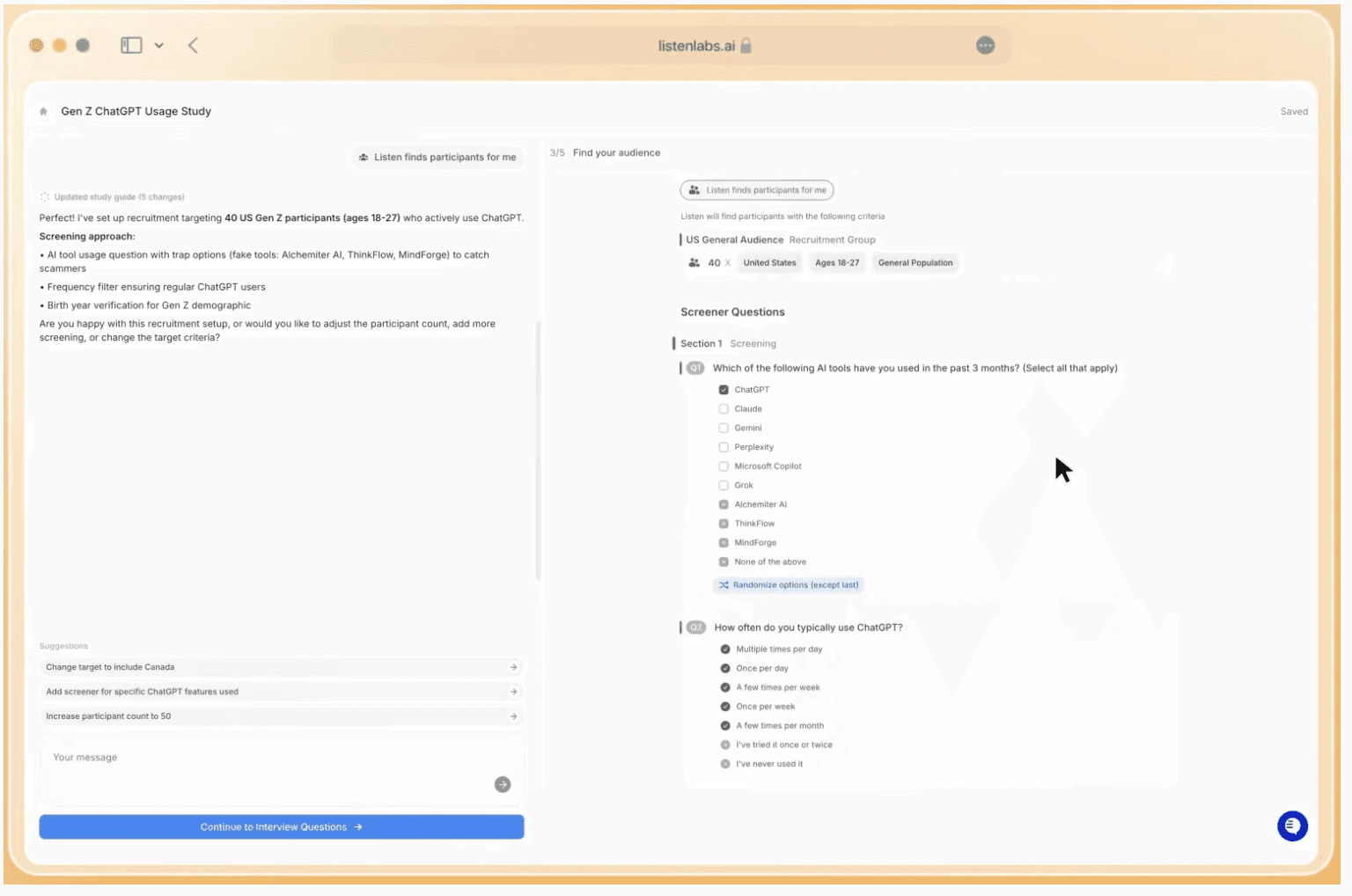
AI-moderated interview platforms can run 50 to 200 simultaneous conversations, each with dynamic follow-up questioning that adapts to what the participant says. If a participant says they find the concept confusing, the AI probes to find out which part it is. If they express strong enthusiasm, they ask why. The result is qualitative depth at a scale that would require 10-15 human moderators working in parallel to replicate.
For platforms like Listen Labs, there’s even more capability. Our interface allows you to combine quantitative scoring questions with dynamic follow-up questions that probe why.
On the synthesis side, AI analysis can turn 100 interview transcripts into a structured findings report in hours, not days. Themes are identified across responses, verbatim quotes are surfaced as evidence, and conflicting reactions are flagged rather than averaged away. Researchers still make the judgment calls, but they’re working from an organized synthesis rather than a raw pile of transcripts.
Limitations of AI-Moderated Interviews
AI-moderated interviews work best when the concept can be explained through text, images, or video. Tactile products, such as physical packaging, materials, and sensory experiences, are harder to evaluate without an in-person component. And AI synthesis is only as good as the questions asked; a poorly designed discussion guide produces well-organized answers to the wrong questions.
Still, for teams that need fast concept testing, AI-moderated methods have become the practical default.
AI as a trusted research collaborator: Listen Labs
At Listen Labs, we’ve built a research collaborator that helps companies across sectors run game-changing concept tests. They’re fast and meaningful, while keeping humans in the loop to ensure the best results.
At Simple Modern, an Oklahoma-based drinkware company selling stylish tumblers, Listen helped validate ideas for new product features. “We went from ‘Should we even have this product?’ to ‘How should we launch it?’” said Chris Hoyle, Chief Marketing Officer of the brand. In 2.5 hours, they collected feedback from 120 people across the country, yielding reliable results more quickly from a larger geographic pool than they’d previously had access to with focus groups.
In healthcare and research, KJT used Listen to overcome the challenges that stand between patients and the answers they seek. In pharma research, a Target Product Profile (TPP) is a strategic planning document that outlines the intended indication, target population, and desired clinical and product attributes, such as efficacy targets, safety and tolerability, dosing and administration, and potential differentiation. In healthcare, TPPs are the concepts that need testing. They’re used for aligning development, evidence generation, and future launch strategy.
Traditionally, the evaluation process for TPPs can take 6-8 weeks. But with Listen, Dan Wasserman, the COO and Head of AI Solutions, said that it’s been cut to 3 weeks. He said Listen is giving them the technology “ to break down barriers and enable us to do what we do best as researchers.”
Best Practices for Concept Testing
How to choose the right concept testing tool
The right tool for your team depends on four things:
How fast do you need results?
How much qualitative depth do you need?
Do you have access to your target audience?
What is your budget?
If you need fast results with qualitative depth, the best option will be an AI-moderated interview platform like Listen. The built-in synthesis allows for even faster completion of the study.
If you need statistical confidence at scale, using the quantitative survey methods will serve you well, but understanding the why will require a follow-up qualitative study.
If you’re in the early stages and your budget is constrained, doing 5-10 user interviews via video call could be an alternative that serves your needs. You’ll be able to get a directional read at a low cost, but the trade-off will be the time spent and the separate synthesis work required.
How to execute a study that gets the best results
Present the right stimulus
Write your concept statement in such a way that a fifth grader could understand it. If participants can’t understand what you’re testing, the data is useless. A stimulus should give your participants a clear understanding of what the product does, who it’s for, and why it matters. For a written stimulus, this shouldn’t be longer than three to five sentences and should avoid jargon.
For a mockup, test early before you have something polished to present. A prettier display will get a higher rating than a rough description of the same concept, but it might also hide more problems with the core idea you’re testing. Use the minimum stimulus needed to communicate the idea.
Design the study
Your team should test two or three concepts rather than just one. Absolute ratings are hard to interpret without context. Testing a single concept that scores 6.5 out of 10 on appeal doesn’t necessarily make it good or bad without any other ideas to compare it to. Sometimes it also helps to reveal the strong elements in the weaker idea that are worth borrowing.
You should also balance open- and closed-ended questions. Scores and ratings are fast to analyze and tell you what people think. But follow-up questions that probe for the why behind those ratings are just as valuable. A mix of both will help ensure the study produces actionable insights rather than just vague data.
Recruit participants
Don’t recruit a random sample of the total population; recruit your target user. General audience panels produce generic results. If your product is for first-time homebuyers, recruit first-time homebuyers. Recruiting too broadly can hide the real objections from the people who matter most to your product’s success.
Run iterative rounds
One concept test is a snapshot. Run two or three tests across iterations of the same concept, refining between rounds, is how you build confidence and avoid putting all of your eggs in one basket. Fast AI-moderated tools make this practical even for teams with limited research bandwidth.
FAQs
What is concept testing in new product development?
Concept testing in new product development is the process of evaluating a product idea with target customers before committing to development. It typically happens in the early stages of the development process, after initial ideation but before design or engineering work begins. The goal is to make a go/no-go decision based on customer evidence rather than internal product team assumptions.
What is the difference between concept testing and usability testing?
Concept testing asks, “Should we build this?” Usability testing asks, “Can people use what we’ve built?” Product concept testing happens before development and evaluates the idea. Usability testing happens after development and evaluates whether a working prototype or product is intuitive and functional. Because they answer different questions, they shouldn’t be treated as interchangeable.
What is concept validation testing?
Concept validation testing is a later-stage format of concept testing, typically done after an initial concept has been refined. Where early concept tests screen and compare ideas, concept validation tests a single developed concept against defined success criteria such as benchmarks for appeal, uniqueness, and purchase intent. It’s the last research check before committing to development.
How does AI improve concept testing?
AI improves concept testing primarily by breaking the speed/depth tradeoff. AI-moderated interview platforms can run 50-200 qualitative conversations, each with dynamic follow-up questioning. Platforms that integrate AI synthesis can turn 100 transcripts into a structured findings report in hours. The result is research that integrates the best of qualitative and quantitative methods in a fraction of the time and for a fraction of the cost.
How long does product concept testing take?
It depends on the methodology selected. A traditional qualitative study that includes recruiting, moderating interviews, and synthesizing data can take three to six weeks. A traditional quantitative study that gets binary feedback from a panel on one idea could take one to two weeks. AI-assisted research tools such as Listen can get a qual-at-scale study completed in a few hours to a few days.
What makes a good concept testing stimulus?
The best stimulus will communicate the concept clearly enough to participants so that they have something to react to. It doesn’t need to be so polished that it hides real objections. It should describe the product, its key benefit, and who it’s for in plain language. It can include a name, a visual, or a short video, but whatever stimulus is provided should aim for comprehension rather than persuasion. One way to ensure your stimulus is ready before launching your product concept study is to test it with someone outside the research team to see whether they understand the idea and what they have to say.
How many concepts should you test at once?
Two to three is the practical range for most concept tests. Testing two concepts gives you a relative comparison without overwhelming participants. Three is still manageable for sequential monadic designs. Testing more than three at once can lead to fatigue and diminish data quality. If your team is starting with more than three concepts, consider a first-round rapid comparative screening to pin down the most promising two or three concepts for deeper evaluation.
See how Listen helps teams run fast, AI-moderated concept studies and turn customer reactions into clear launch decisions. Book a demo.
Use Case
© 2026 Listen Labs • All rights reserved