Written by: Anish Rao, Head of Growth, Listen Labs
Key Takeaways from 2026 Traveler Interviews
Travelers in 2026 prioritize emotional motivations and experiences over traditional destination selection, reshaping how hotels, OTAs, and airlines should approach product and messaging strategy.
Listen Labs’ 300+ AI-moderated interviews reveal dominant emotions of anticipation and frustration that secondary market reports cannot capture at the individual decision level.
Purpose-driven travel, bleisure, wellness, and moment-driven bookings are accelerating, with distinct emotional profiles that vary by traveler segment and trip type.
Price sensitivity is highest in the mid-market, where hidden fees and dynamic pricing trigger elevated frustration scores, while luxury travelers show greater price tolerance when expectations are met.
Listen Labs delivers 300+ AI-moderated interviews with emotion scoring and verbatim insights in under 24 hours, helping teams replace weeks of traditional research lag. Book a demo to see this workflow in action.
2026 Travel Industry Snapshot
Secondary data from industry sources provide helpful context, but Listen Labs primary data points are drawn from 300+ AI-moderated traveler interviews conducted across the US, Europe, and APAC in 2026. Emotion scores are generated by Listen Labs’ Emotional Intelligence engine, which analyzes tone of voice, word choice, and facial micro-expressions using Ekman’s universal emotions framework.
Teams can now run a full travel consumer study in under 24 hours.Book a demo with Listen Labs and replace weeks of agency lag with the rapid research cycle described in this report.
Global Travel Industry Context and Emotional Undercurrent
These headline figures do not capture the emotional texture driving individual booking decisions. In Listen Labs’ 2026 interview corpus, travelers describing their trip-planning process consistently surface two dominant emotional states: anticipation (high joy scores when discussing experiential goals) and frustration (elevated anger and disgust scores when discussing pricing opacity and booking friction). The following verbatim quotes from three different traveler segments show how these emotions shape real booking choices.
“I know I want to travel, I’ve been saving for it, but every time I go to actually book, the fees that appear at checkout make me feel like I’m being tricked.” — US traveler, 34, mid-market segment. Emotion score: frustration (anger 72/100, disgust 61/100).
“We decided on the destination because of a concert. The trip was built around that one night. Everything else followed.” — UK traveler, 28, bleisure segment. Emotion score: anticipation (joy 84/100, trust 71/100).
“Price is almost irrelevant for this trip. We’ve been planning it for two years. It’s our anniversary and it has to be perfect.” — US traveler, 52, luxury segment. Emotion score: high joy (88/100), low fear (18/100).
These qualitative signals, invisible in secondary market sizing reports, give strategy leaders the detail they need to calibrate product, pricing, and messaging decisions for 2026.
Purpose, Bleisure, Wellness, and Moments: 2026 Travel Trends
Bleisure continues its structural expansion. 76% of surveyed business travelers across Asia-Pacific plan to combine business trips with personal leisure. In Listen Labs interviews, bleisure travelers score highest on trust (confidence in their employer’s flexibility) and anticipation. They also surface fear signals around reimbursement ambiguity and work-life boundary erosion, which shape their choice of property and length of stay.
Beyond the workplace-leisure blend, another purpose-driven category is reshaping the industry: wellness travel is no longer a niche. Health and well-being trips rank among the preferred tourism types globally. 56% of respondents in Hilton’s 2026 report cite rest and recharge as a top leisure travel motivation, giving rise to “hushpitality,” or demand for low-stimulation, low-tech quiet experiences.
Moment-driven planning, where travelers book trips around concerts, sports events, and festivals, is reshaping demand forecasting. Travelers are willing to pay premium prices for high-energy, emotionally connected experiences. Listen Labs’ emotion data confirms this pattern: joy and anticipation scores spike when interviewees describe event-anchored trips, and those same travelers show high price tolerance in that specific context.
Listen Labs’ Emotional Intelligence data surfaces a clear pattern across the 300+ interview corpus.
Budget and mid-market travelers show elevated frustration scores (anger 68/100, disgust 59/100 on average) when discussing dynamic pricing, hidden fees, and perceived value gaps. Verbatim: “I feel like the price I see is never the price I pay. It’s exhausting.”
Luxury travelers show markedly lower frustration and higher trust and joy scores when discussing premium experiences, but shift to fear and anger when service quality fails to match price expectations. Verbatim: “At this price point, I expect everything to be handled before I even ask.”
Industry outlooks note rising financial caution in parts of the higher-income traveler segment, which results in more conservative trip planning even among affluent travelers. This creates a nuanced picture: luxury spending remains resilient in aggregate, while individual luxury travelers apply more scrutiny to value-for-money than in prior years.
For hotels and OTAs, the actionable implication is clear. Transparent pricing and proactive value communication reduce frustration scores and increase conversion intent. Listen Labs’ interview data pinpoints where in the booking journey frustration peaks, intelligence that secondary reports cannot provide.
Teams that want to map customers’ emotional journey through the booking funnel can do this at scale.Book a demo to see how Listen Labs’ Emotional Intelligence engine delivers timestamp-level emotion data across hundreds of traveler interviews.
OTA, Direct, and AI: How Booking Channels Are Chosen
Travelers in the 2026 corpus describe a trust-mediated channel decision. OTAs win on price comparison and convenience, while direct booking wins on loyalty benefits, flexibility, and perceived authenticity. Channel preference does not remain fixed, it shifts by trip type, traveler segment, and the perceived stakes of the booking.
In Listen Labs interviews, travelers describing AI-assisted booking show a distinctive emotional profile. They report high anticipation around time savings and personalization, but persistent fear around accuracy and financial risk. 43% of Americans would be comfortable allowing an AI assistant to book travel if it requested final approval before payment, while only 8% of travelers are comfortable letting AI handle bookings without approval. Verbatim from Listen Labs corpus: “I’d let the AI find the options, but I want to be the one who actually confirms. It’s my money and my trip.”
For OTAs and direct booking teams, the strategic implication is that AI-readiness now functions as a distribution imperative, not a future consideration. Offerings must be machine-readable, continuously updated, and structured for AI agent decision sets.
United States: The US dominated the North America online travel market in 2025 with approximately $205-207 billion in revenue. Listen Labs’ US traveler interviews show the highest concentration of price-frustration signals in the mid-market segment, alongside strong joy and anticipation scores among luxury and bleisure travelers. Gen Z’s share of US holiday travelers has grown, and Listen Labs’ Gen Z interview subset shows the highest social-media influence on destination discovery and the lowest brand loyalty scores of any segment.
How Listen Labs Collected and Scored These Interviews
How Listen Labs Produced This Data
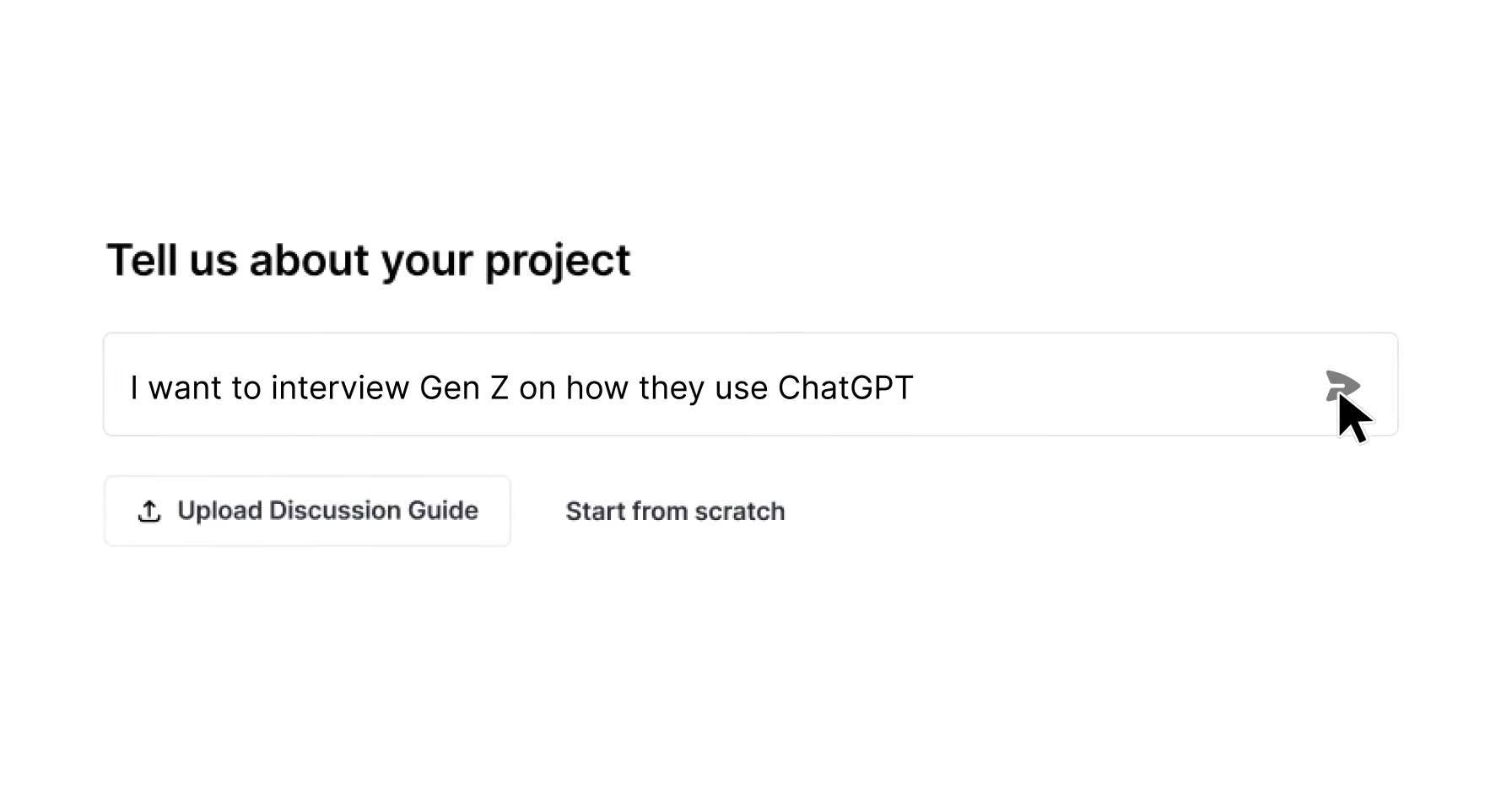
Our AI helps you go from idea to implemented discussion guide in seconds.
The consumer insights cited throughout this report are drawn from 300+ AI-moderated video interviews conducted by Listen Labs in 2026 across the US, Europe, and APAC. Participants were sourced from Listen Labs’ global network of 30M+ verified respondents spanning 45+ countries and 100+ languages. Every participant passed through Quality Guard, Listen Labs’ real-time fraud detection system that monitors video, voice, content, and device signals and limits each participant to three studies per month, which removes professional survey-takers and incentive-driven responses.
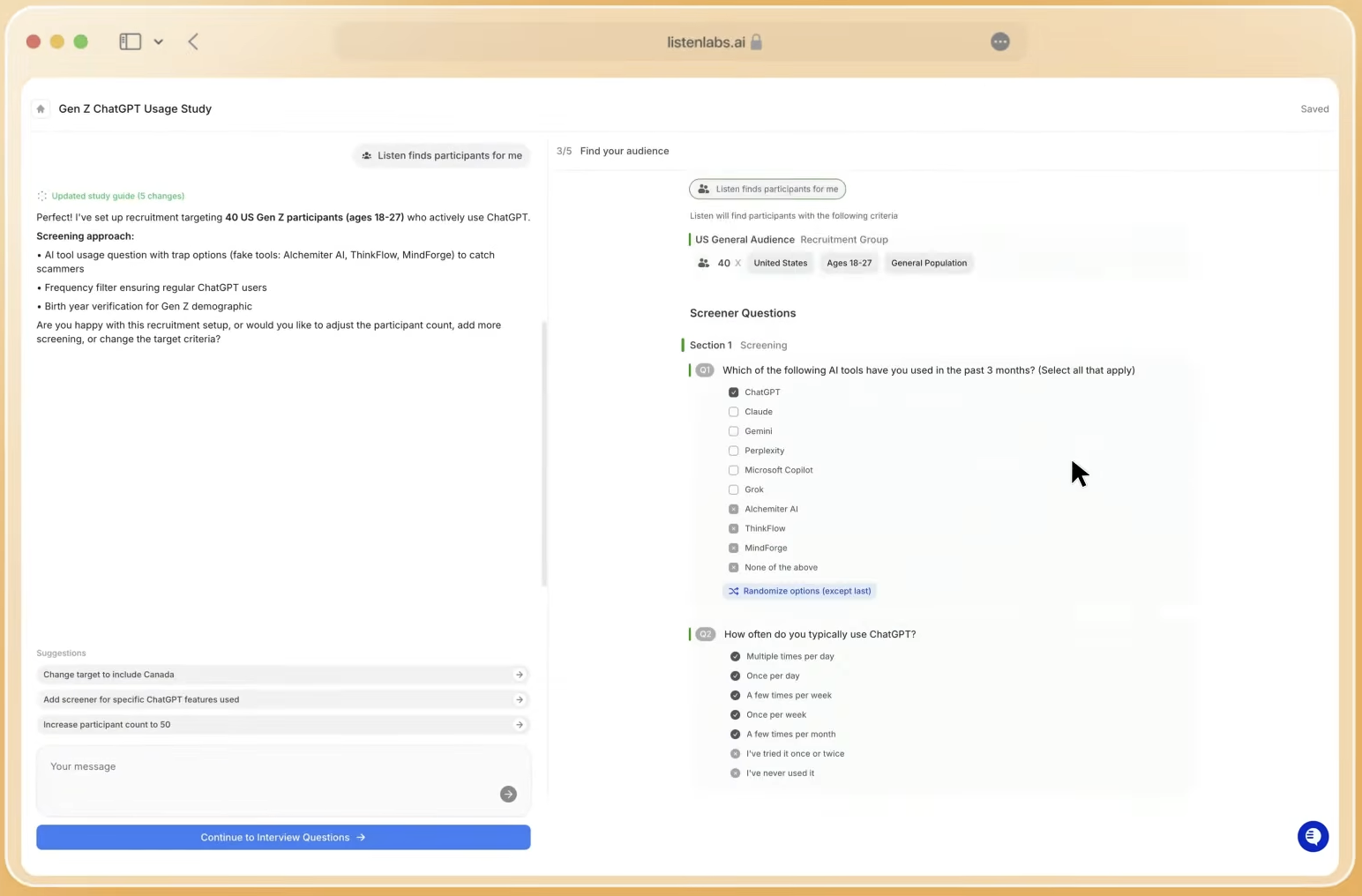
Listen Labs finds participants and helps build screener questions
Interviews were conducted by Listen Labs’ AI moderator, which applies dynamic follow-up questions in the same way a trained human researcher would. Emotional Intelligence analysis, built on Ekman’s universal emotions framework, quantified emotion scores per question and per participant, traceable to exact timestamps and verbatim quotes. The full research cycle, from study design to delivered insights, was completed in under 24 hours.
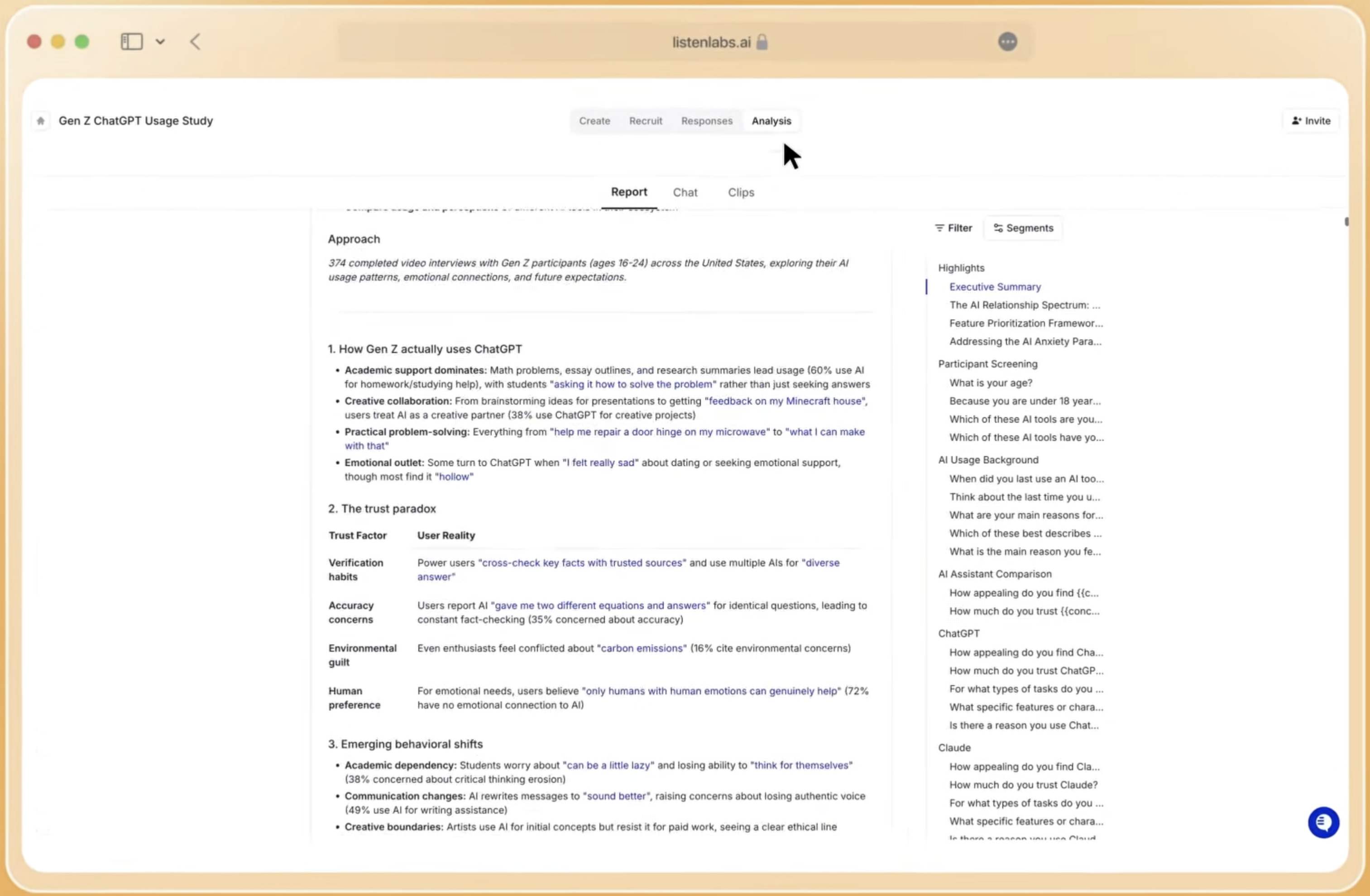
Listen Labs auto-generates research reports in under a minute
Listen Labs holds SOC 2 Type II, ISO 27001, ISO 27701, ISO 42001, and GDPR certifications. Customer data is never used for AI model training.
Next Steps for Travel Brands in 2026
Traditional travel market research, built on slow secondary reports, small qualitative samples, and 4–6 week agency timelines, cannot keep pace with the speed at which traveler behavior is shifting in 2026. The bifurcation of price sensitivity, the rise of moment-driven and purpose-led travel, the acceleration of AI-assisted booking, and the regional divergence in emotional drivers all require decision-grade consumer intelligence that is current, deep, and scalable.
Listen Labs provides that level of intelligence by combining hundreds of AI-moderated traveler interviews with quantified emotion scores, verbatim quotes, and consultant-grade reports, all delivered in under 24 hours. Whether a team needs to understand booking channel trust, test a new pricing communication, or map the emotional journey of a specific traveler segment, Listen Labs collapses the depth-versus-scale trade-off that has constrained travel consumer research for decades.
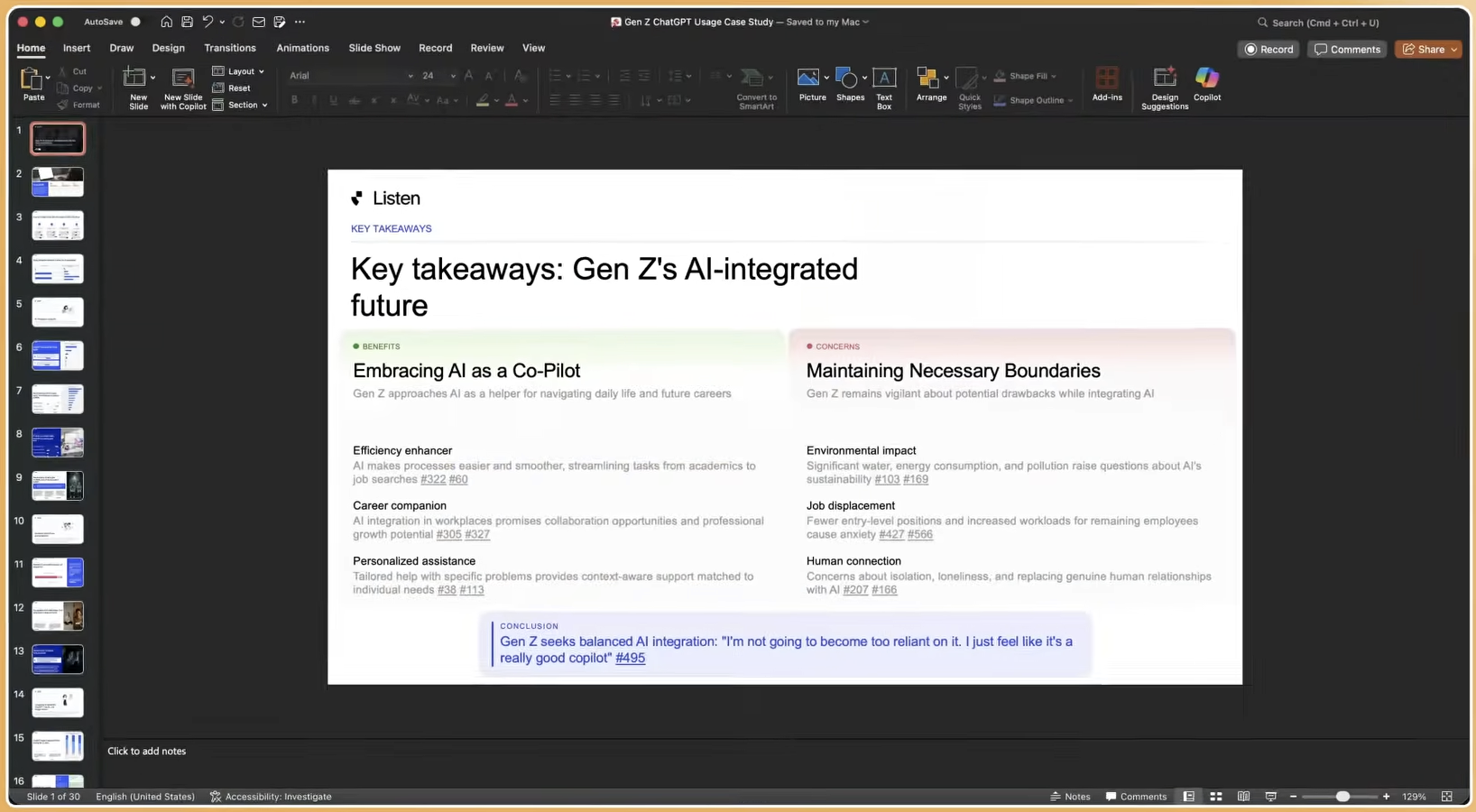
Listen Labs' Research Agent quickly generates consultant-quality PowerPoint slide decks
Teams can run their own travel consumer study or access the full 2026 interview dataset.Book a demo with Listen Labs today and get decision-grade traveler insights before the next planning cycle closes.
Frequently Asked Questions
What makes Listen Labs’ travel consumer data different from secondary market research reports?
Secondary reports from firms like Statista, Grand View Research, and WTTC aggregate existing data and publish findings on a quarterly or annual cycle. By the time those reports reach a strategy team, the underlying consumer behavior may have shifted. Listen Labs conducts primary qualitative research through AI-moderated video interviews with real travelers and delivers results in under 24 hours. Every insight is traceable to a specific verbatim quote, an emotion score, and a timestamp. That level of granularity and recency does not exist in secondary market sizing reports. For travel leaders making pricing, product, or channel decisions in 2026, a six-month-old secondary report functions as a hypothesis, while a 24-hour primary interview study supports a decision.
How does Listen Labs ensure the traveler interviews are high quality and representative?
Listen Labs applies three layers of quality control. First, participants are sourced exclusively from high-quality, non-commodity panels within the 30M+ verified respondent network, which removes professional survey-takers. Second, Quality Guard monitors every interview in real time across video, voice, content, and device signals to detect fraud, low-effort responses, AI-generated scripts, and mismatched profiles. Third, each participant is limited to three studies per month, which prevents panel fatigue and incentive-driven behavior. For travel studies specifically, Listen Labs can recruit by traveler segment, booking behavior, destination type, income band, and travel frequency, ensuring the sample reflects the exact audience a hotel, OTA, airline, or destination needs to understand.
Can Listen Labs capture emotional data from traveler interviews, and why does that matter for travel brands?
Listen Labs’ Emotional Intelligence engine captures emotional data from every traveler interview. The system analyzes three layers of signal from every interview, including tone of voice, word choice, and facial micro-expressions. Built on Ekman’s universal emotions framework, the same standard used in clinical psychology, it quantifies emotions including joy, fear, anger, disgust, trust, anticipation, sadness, and surprise at the question level and the concept level. For travel brands, this matters because what travelers say and what they feel often diverge. A traveler may describe a booking experience as “fine” while their facial expressions and vocal tone register frustration. Emotion scores allow hotels, OTAs, and airlines to identify exactly where in the customer journey friction peaks, where delight is generated, and which messaging or pricing approaches trigger trust versus anxiety, intelligence that surveys and secondary reports cannot surface.
How quickly can a travel brand run a study on Listen Labs, and what deliverables are produced?
The full research cycle, from study design to final deliverables, is completed in under 24 hours. A travel brand can describe its research objective in natural language, and Listen Labs’ AI co-designs the study guide, recruits participants from the verified global network, conducts AI-moderated video interviews, analyzes all responses, and generates deliverables automatically. Deliverables include a consultant-quality slide deck, a memo-style report, video highlight reels of the most emotionally significant moments, quantified theme analysis, verbatim quote libraries, and segmentation breakdowns by traveler type, region, or any custom variable. The Research Agent also supports natural-language queries, so a VP of Consumer Insights can ask “Which traveler segment shows the highest frustration with our checkout flow?” and receive a chart, supporting quotes, and emotion scores in seconds.
What types of travel consumer studies does Listen Labs support?
Listen Labs supports the full range of consumer insight needs relevant to travel brands, including booking experience and friction mapping, pricing communication testing, brand perception and competitive positioning studies, concept testing for new products or loyalty programs, creative and campaign testing, multi-market segmentation studies, traveler journey mapping, and ongoing consumer sentiment tracking. Studies can be run as one-off projects or as continuous research programs. Listen Labs also supports mixed-method designs that combine qualitative interview depth with quantitative formats such as Likert scales, NPS, and MaxDiff, all within a single interview session. For travel brands operating across multiple regions, all interviews are conducted in the participant’s native language across 100+ supported languages, with automatic translation and transcription included.