Written by: Anish Rao, Head of Growth, Listen Labs | Last updated: June 23, 2026
Key Takeaways
-
Traditional market research cycles of 4–6 weeks, and up to six months in enterprises, often arrive too late to influence decisions made on gut instinct.
-
A repeatable 10-step framework covers everything from defining precise objectives and profiling audiences to recruiting, interviewing, analyzing, and applying insights.
-
Each step emphasizes clarity, including precise objectives, behavioral screeners, mixed qualitative-quantitative methods, and emotional-signal capture, to produce actionable outputs.
-
AI-powered platforms compress the entire process into under 24 hours by automating guide creation, parallel recruitment, asynchronous interviews, and instant deliverables while maintaining quality guardrails.
-
Listen Labs delivers this speed and scale with the same 10-step rigor, so teams can act on data instead of instinct.
How to Conduct Market Research Step by Step
Step 1: Define Precise Objectives
State the business decision the research must inform. Vague objectives like “understand customers better” produce vague findings because they do not specify what choice the research should enable. In contrast, a precise objective such as “determine which of three packaging concepts drives highest purchase intent among millennial grocery shoppers” produces actionable outputs by tying the work to a clear decision. Once you have that precise objective, document the decision owner, the deadline, and the minimum confidence threshold required to act so the study stays anchored to a real business need.
Template: “This study will determine [specific decision] for [audience] by [date], so that [team] can [action].”
Step 2: Profile the Target Audience
Describe the audience using both demographics and psychographics. Demographics include age, geography, income, and job title. Psychographics cover values, purchase behavior, and category involvement. For a CPG study on premium snacks, the target might be adults 25–45 in urban markets who purchase premium grocery items at least twice per month. For a B2B tech study, it might be IT directors at companies with 500+ employees who influence software procurement.
Step 3: Conduct Secondary Research
Review existing data before you field primary research. Use internal sales reports, CRM data, prior studies, category reports, and publicly available sources such as the U.S. Small Business Administration’s market research guidance. Secondary research surfaces what is already known and prevents re-researching settled questions. It also informs screener design and discussion guide framing by clarifying gaps and hypotheses.
Step 4: Choose Primary Research Methods
Select methods that match the objective. In-depth interviews (IDIs) surface motivations, emotional reactions, and unexpected findings. Surveys measure prevalence and statistical significance. Qual-at-scale approaches use AI to conduct hundreds of adaptive qualitative interviews simultaneously, which collapses the traditional depth-versus-scale trade-off. For most product, brand, and UX decisions, a mixed-method design that combines qualitative IDIs with embedded quantitative measures such as Likert scales or MaxDiff delivers the most complete picture.
Step 5: Design the Discussion Guide and Stimuli
Structure the guide in three sections: warm-up questions to establish context, core questions tied directly to the research objective, and closing questions to capture unprompted reactions. Keep the guide to 45–60 minutes of content so participants stay engaged. Introduce stimuli such as images, video, prototypes, or live URLs only after you capture baseline attitudes to avoid priming. For a retail study testing two store layout concepts, show each concept in randomized order using monadic sequencing to reduce bias.
The following template shows how to structure these three sections with time allocation and question types that keep the conversation focused and efficient.
Discussion guide template:
Warm-up (5 min): “Walk me through the last time you [category behavior].”
Core (35 min): “What is your first reaction to [stimulus]? What would make this more appealing? What concerns, if any, does this raise?”
Close (5 min): “Is there anything about [topic] we have not covered that you think is important?”
Step 6: Recruit and Screen Participants with Quality Guardrails
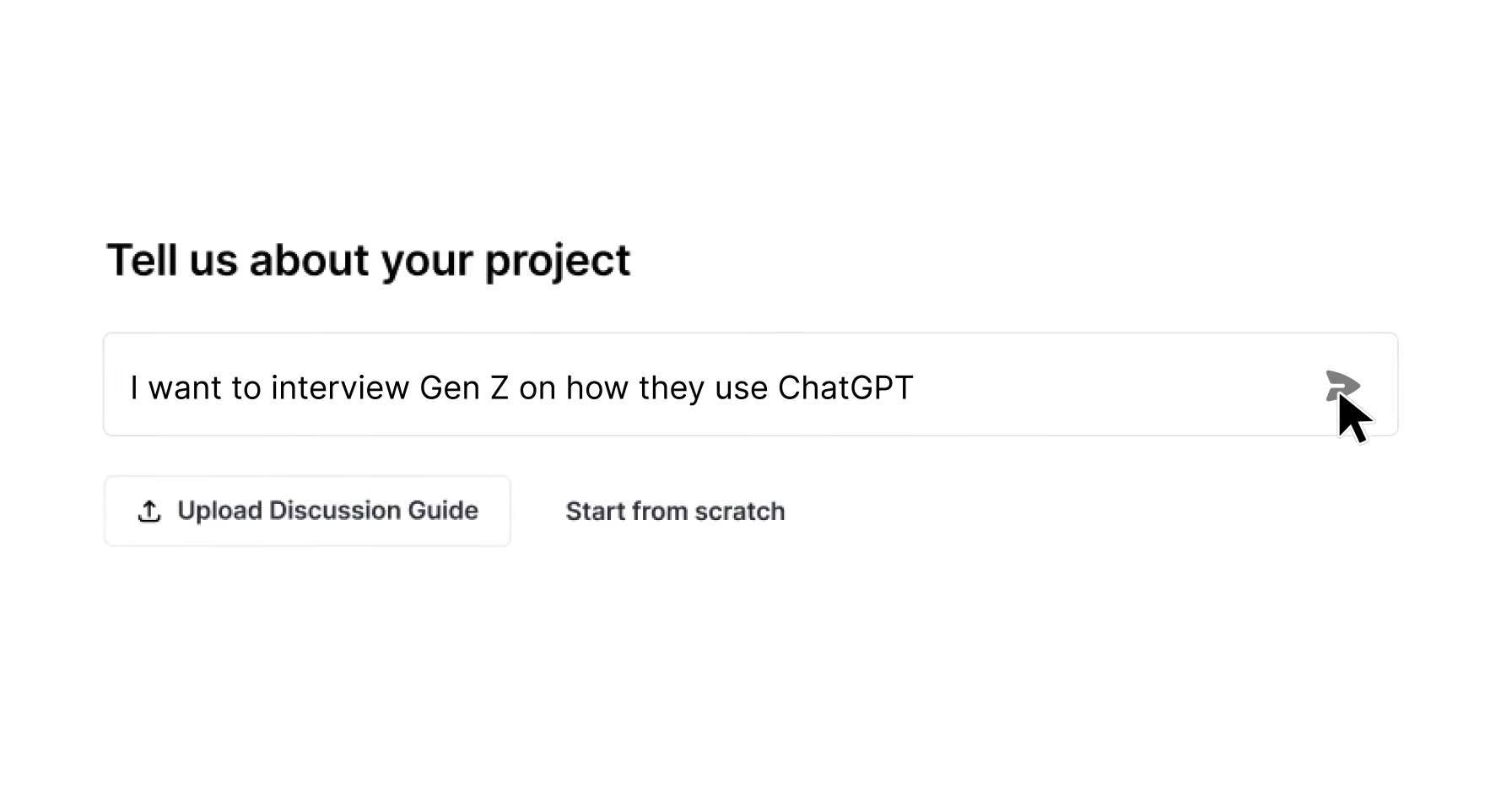
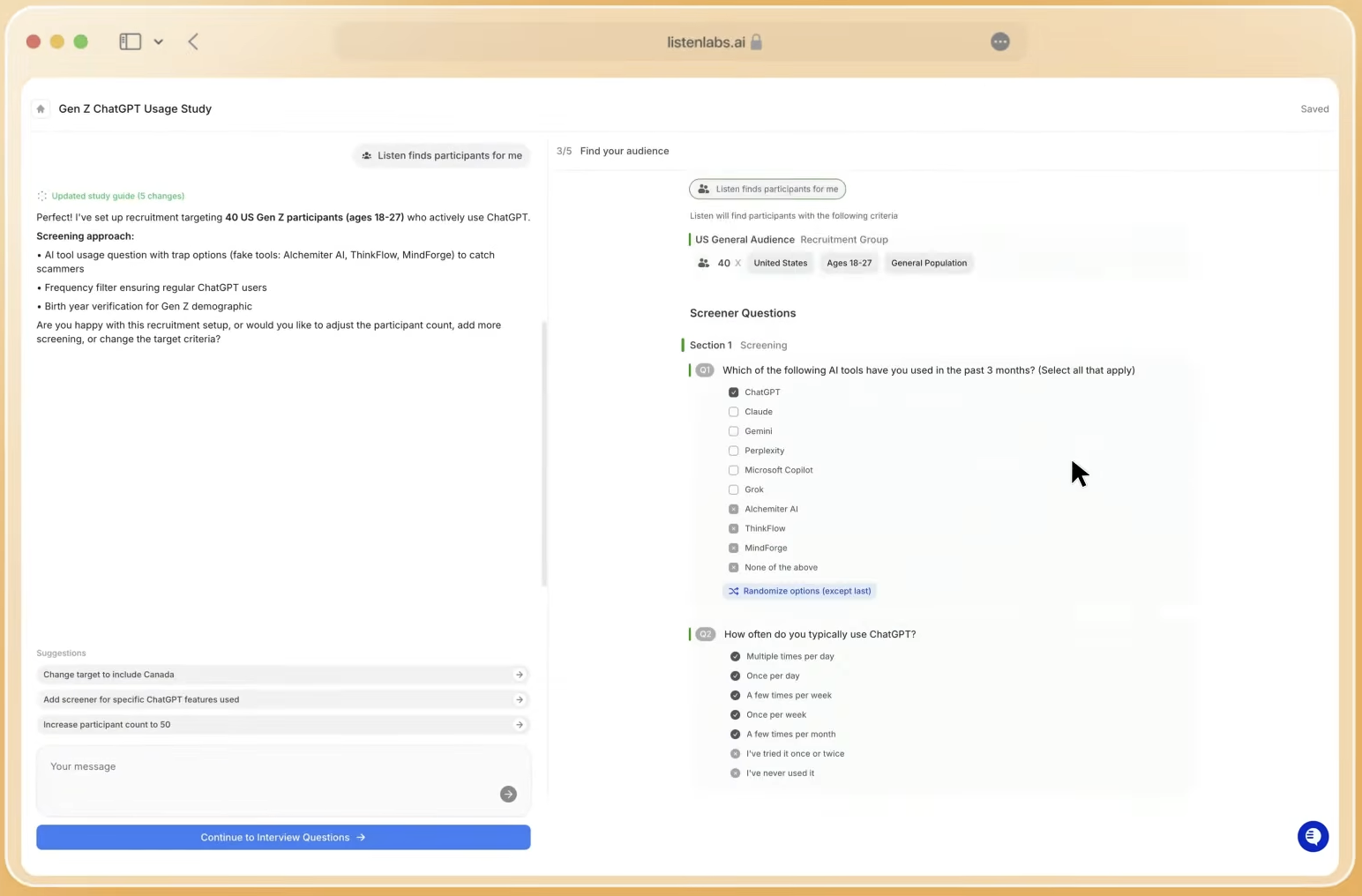
Write a screener that mirrors the audience profile from Step 2. Include behavioral qualification questions such as “How often do you purchase [category]?” rather than relying solely on self-reported demographics, because behavior is harder to fake than demographic claims. Even with behavioral questions, some respondents will rush, so build in red-herring answer options to identify inattentive participants. Finally, cap participation frequency, since professional survey-takers who complete dozens of studies per month produce incentive-driven, low-quality responses that undermine the entire research investment.
Screener template: “In the past 30 days, which of the following have you purchased? [list including target category and decoys]” and qualify only respondents who select the target category.
Step 7: Conduct Interviews While Capturing Emotional Signals
Treat what participants say and what they feel as separate data streams. Transcripts capture stated responses, yet they miss the frown during a product demo, the hesitation before answering a pricing question, or the widened pupils at a new concept reveal. Listen Labs’ Emotional Intelligence analyzes tone of voice, word choice, and subconscious micro expressions to surface emotions that transcripts alone miss, built on Ekman’s universal emotions framework, the same standard used in clinical psychology and UX research. Research comparing AI and human moderation found that 92% of participants reported top comfort levels in both formats, with AI preferred for sensitive topics including personal finances and political views.
Step 8: Analyze and Synthesize Findings
Code transcripts against the research objectives, not against the discussion guide structure. Group responses by theme rather than by question so patterns emerge across the conversation. Identify themes that appear across multiple participants, and flag outlier responses that may signal emerging needs. Separate signal from noise by weighting themes against both frequency and intensity of participant expression. Cross-tabulate findings by audience segment to see whether reactions differ by demographics, geography, or behavioral cohort.
Step 9: Generate Deliverables and Cross-Study Queries
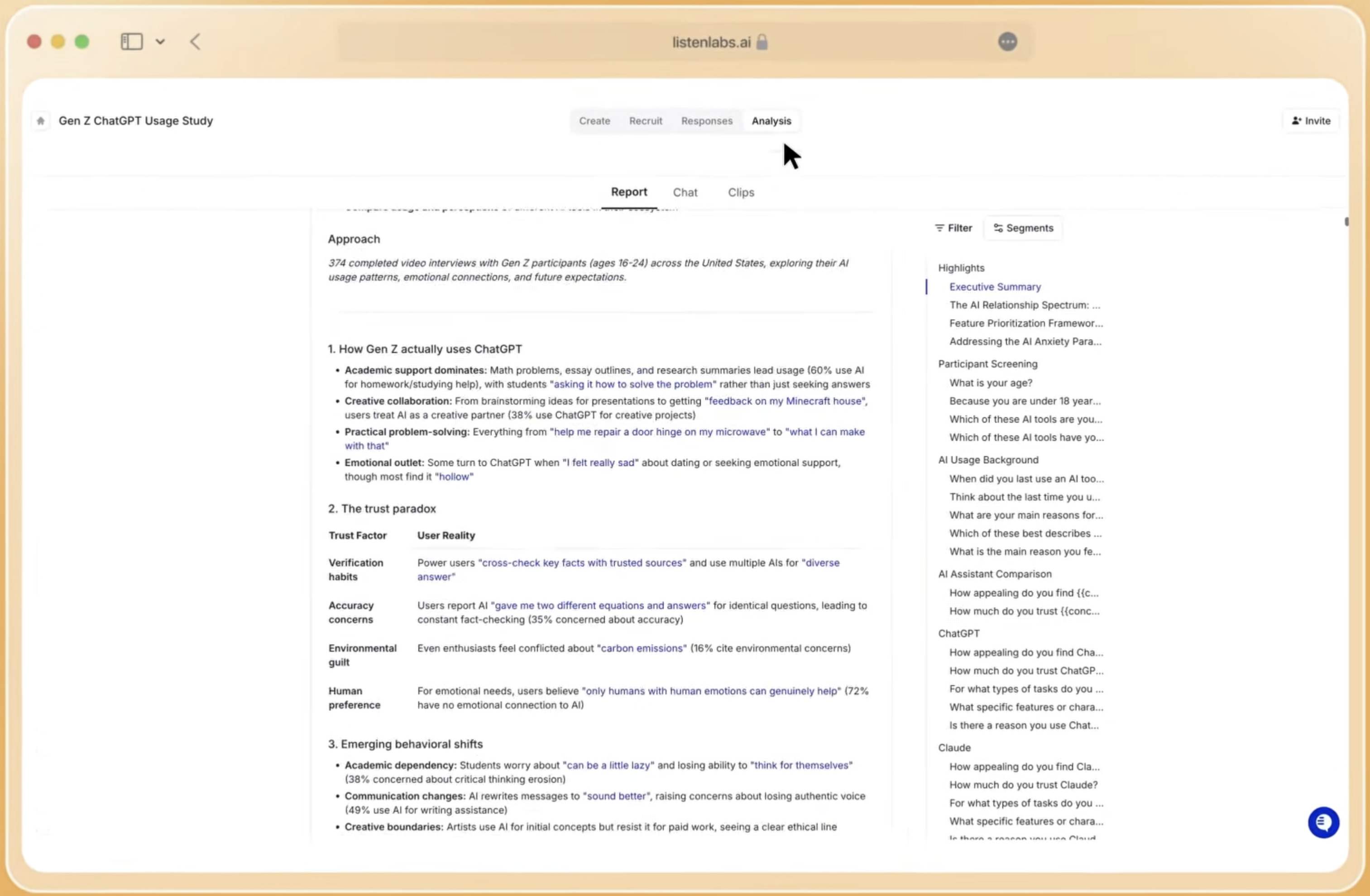
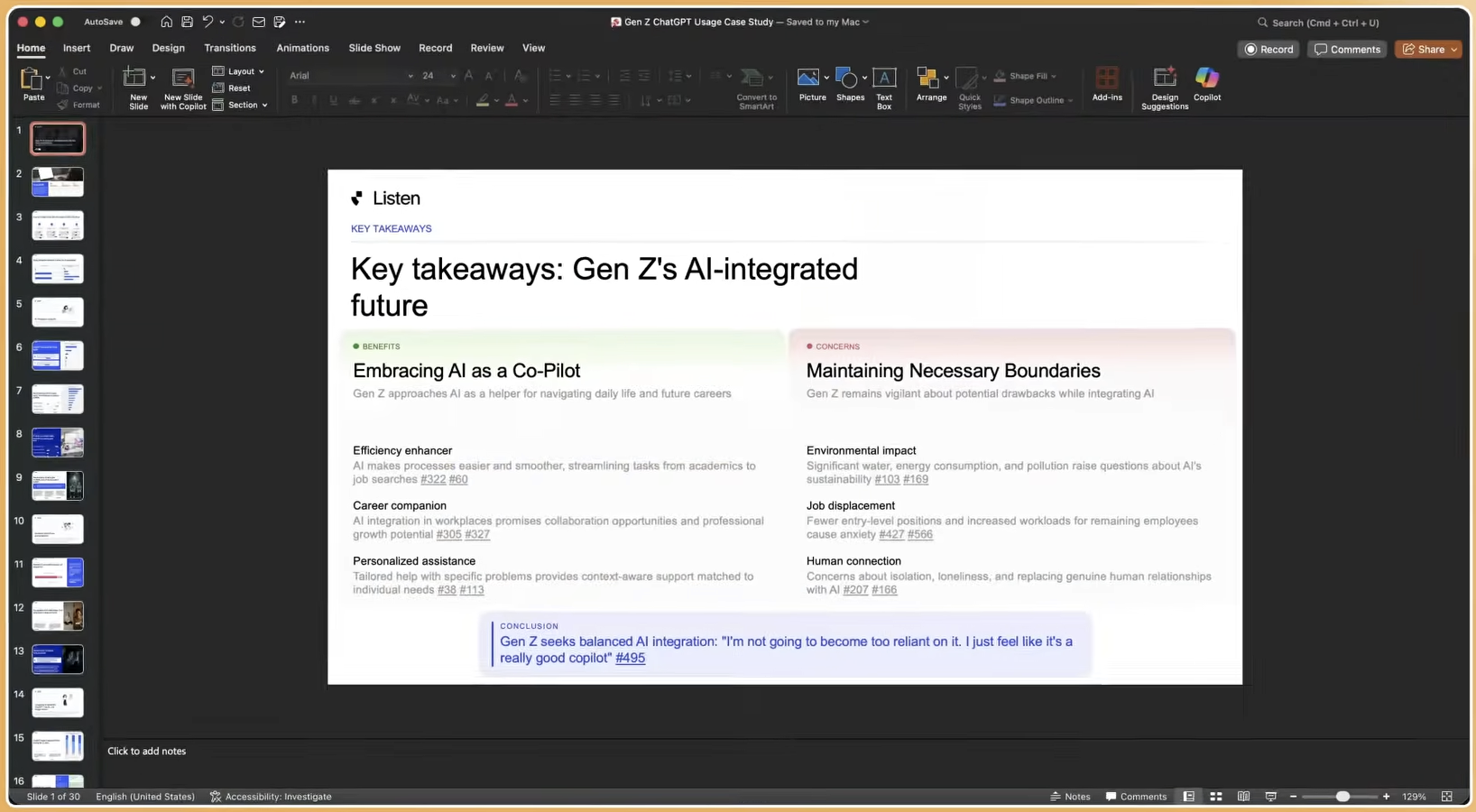
The Research Agent handles the full analysis workflow from raw data to final output, with every insight linking directly to the underlying response data. Match deliverables to the decision-maker’s preferred format, such as a slide deck for executive review, a memo for product teams, or video highlight reels for stakeholders who will not read a report. Use cross-study queries, which ask what past research says about a current question, to prevent re-researching settled questions and to build institutional knowledge over time.
Step 10: Apply Insights and Measure Impact
Assign each finding to a specific decision or action with an owner and deadline. Track whether the recommended action was taken and measure downstream business impact such as conversion rate, NPS change, or feature adoption to close the loop between research investment and outcome. Document the study in a central repository so future teams can query it rather than repeat it.
The 10-step framework above represents the methodological standard for rigorous market research. Teams often know these steps already, yet struggle to execute them fast enough to shape decisions before leaders act on instinct.
Modern AI-Powered Path: The Same 10 Steps in Under 24 Hours
The 10-step framework above is methodologically sound regardless of the tools used. The difference with an AI-powered platform lies in execution speed and scale. Traditional focus groups take 3–5 weeks and significant per-session costs, while Listen Labs compresses the entire research cycle to less than 24 hours at roughly a third of the typical spend.
Steps 1–3, which cover objective definition, audience profiling, and secondary research, move faster with AI-assisted study co-design. You describe the research goal in plain language and the platform drafts structured objectives, screener criteria, and a discussion guide in seconds, drawing on proprietary data from tens of thousands of completed studies. Steps 4–6, which include method selection, guide design, and recruitment, then execute simultaneously. Listen Atlas, the platform’s AI orchestration layer, matches and sources participants from a global network of 30M verified respondents across 45+ countries and 100+ languages, while Quality Guard runs real-time fraud detection across video, voice, content, and device signals. Participants are capped at three studies per month, which eliminates professional survey-takers.
Step 7, which focuses on interviews with emotional signal capture, runs asynchronously so hundreds of AI-moderated video interviews conduct in parallel. Each interview uses dynamic follow-up questions that probe short or interesting answers the way a trained human moderator would. Emotional Intelligence quantifies emotions per question and concept, with every label traceable to the exact timestamp, verbatim quote, and reasoning behind it, and this capability works across 50+ languages. Steps 8–10, which cover analysis, deliverables, and application, are handled by the Research Agent. One researcher ran a full buying intent analysis across three user segments in under a minute. Slide decks, memos, highlight reels, and statistical charts generate on demand. Mission Control stores every study as a queryable knowledge base, so cross-study questions return answers in seconds instead of triggering a new research cycle.
With qual-at-scale, the old trade-off between depth and scale no longer blocks decision-making, and enterprises like Microsoft, P&G, and Anthropic now run studies that previously took weeks in a single business day.
Market Research Templates for Common Study Types
The following templates turn the 10-step framework into ready-to-use formats for frequent research scenarios. Each one shows how to structure objective statements, screeners, and discussion guides so teams can move from idea to field-ready study quickly.
Objective statement: “This study will determine [specific decision] for [audience segment] by [date], so that [team] can [action].”
Screener (retail example): “In the past 60 days, have you purchased apparel online? [Yes / No, qualify Yes only] / Which of the following retailers have you purchased from? [list including target and decoys] / How would you describe your typical apparel spend per month? [Under $50 / $50–$150 / $150–$300 / Over $300, qualify $150+ for premium segment].”
Discussion guide (tech concept test): Warm-up: “Describe how you currently manage [workflow].” Core: “Here is a new product concept, what is your immediate reaction? What problem does this solve for you, if any? What would make you hesitant to try it? How does this compare to what you use today?” Close: “What would need to be true for this to become your default solution?”
CPG claim evaluation guide: Warm-up: “Walk me through your last purchase of [category].” Core: “Read this product claim aloud. What does it mean to you? Does it feel credible? What evidence would make it more believable? How does it compare to claims you have seen from other brands?” Close: “What single word would you use to describe this product based on what you have seen?”
Frequently Asked Questions
How long does market research take?
As noted earlier, traditional qualitative research cycles range from 4–6 weeks to six months in large enterprises. AI-powered platforms like Listen Labs compress the full cycle, including study design, recruitment, interviews, analysis, and deliverables, to under 24 hours. The reduction comes from parallel execution, where AI designs the guide, recruits participants simultaneously, conducts hundreds of interviews asynchronously, and generates deliverables automatically instead of working step by step.
How much does market research cost?
Costs vary significantly by method and scale. Traditional qualitative research that involves recruitment agencies, moderators, transcription services, and report writers can reach hundreds of thousands of dollars for a large study. AI-powered end-to-end platforms replace multiple vendors with a single subscription, which allows enterprises to run more studies at a fraction of traditional costs. Listen Labs operates on a subscription model with per-participant credits that vary based on audience difficulty, so general population studies cost fewer credits than niche or hard-to-reach segments.
How do you ensure participant quality in market research?
Participant quality represents the most underestimated risk in market research. Commodity panels contain professional survey-takers who optimize for incentives rather than honest responses, which produces data that looks complete but is fundamentally unreliable. Effective quality control requires three layers. First, source from non-commodity panels with behavioral matching rather than self-reported demographics. Second, run real-time fraud detection during the interview itself, monitoring video, voice, content, and device signals. Third, enforce frequency limits that prevent any single participant from completing too many studies per month. Listen Labs’ Quality Guard applies all three layers, and a dedicated recruitment operations team adds human review for hard-to-reach segments including enterprise decision-makers, healthcare workers, and audiences below 1% incidence rate.
When should market research be repeated?
Repeat research when you need to track change rather than answer a single point-in-time question. Studies should run again when a significant product, pricing, or brand decision is pending, when competitive dynamics shift, or when a prior study’s findings are more than 12 months old in a fast-moving category. Continuous research programs, where studies run regularly and findings accumulate in a queryable knowledge base, allow teams to track sentiment trends, monitor the impact of product changes, and answer new questions by querying past data instead of launching new studies from scratch.
Can market research reach niche or international audiences?
Market research can reach niche and international audiences with the right infrastructure. Reaching specialized groups such as enterprise IT decision-makers, healthcare professionals, or consumers with specific behavioral profiles requires purpose-built recruitment operations, not general consumer panels. International studies add language, cultural, and localization requirements that many platforms handle poorly. Listen Labs covers 45+ countries across the Americas, Europe, APAC, and MEA, supports 100+ languages for interview moderation with automatic translation and transcription, and maintains a dedicated recruitment operations team that sources audiences below 1% incidence rate through niche communities, micro-creators, and specialized networks.
How does AI market research handle data privacy and security?
Enterprise-grade research platforms maintain compliance with major data protection frameworks. Listen Labs holds SOC 2 Type II, GDPR, ISO 27001, ISO 27701, and ISO 42001 certifications, uses 256-bit encryption, and does not use customer data for AI model training. For global studies, teams should confirm localization of consent flows and data residency requirements with the platform before fielding in regulated markets such as the EU or healthcare contexts.
Conclusion
Effective market research follows a consistent 10-step process regardless of the tools used. Teams define precise objectives, profile the target audience, conduct secondary research, select methods, design the guide and stimuli, recruit with quality guardrails, capture both stated and emotional responses, analyze systematically, generate actionable deliverables, and close the loop on business impact. The difference between a four-week cycle and a sub-24-hour cycle is operational rather than methodological. AI handles logistics, parallelizes execution, and automates analysis, which frees research teams to focus on the strategic decisions the data should inform. Platforms like Listen Labs layer on auto-recruiting, transcription, sentiment tagging, and insight summarization so teams move from question to findings in hours, not weeks.