
Written by: Anish Rao, Head of Growth, Listen Labs
Key Takeaways for Startup Research in 2026
-
Early-stage founders need fast, affordable, and deep customer insights, yet traditional agencies and surveys often miss on speed, cost, or qualitative depth.
-
AI interview platforms like Listen Labs combine adaptive qualitative interviews with scalable recruitment and automated analysis to deliver consultant-grade insights in hours instead of weeks.
-
Listen Labs stands out with a large verified respondent network, real-time AI moderation, emotional intelligence signals, and fraud detection that commodity panels cannot match.
-
Founders can generate shareable slide decks, reports, and video clips in under a minute, so they can brief co-founders or investors without extra formatting work.
-
See the 24-hour research cycle in action with Listen Labs while staying within a $500 monthly budget.
Why Founders Compare Agencies, Surveys, and AI Interview Platforms
Founders reach for the fastest available research tool when they need to understand churn, concept fit, or competitor perception. That choice usually narrows to a survey, an agency brief, or an emerging AI platform. Each option promises insight, yet each delivers a different mix of speed, cost, and depth.
Bootstrapped teams tend to evaluate tools on a consistent set of criteria. They look for total cost under $500 per month, turnaround measured in hours not weeks, and qualitative depth instead of surface-level responses. They also care about reaching niche or early-adopter audiences, language and geographic flexibility, analysis effort for a solo operator, and deliverables that are ready to share without extra work.
No single legacy category satisfies all of these needs at once. AI interview platforms exist to close that gap for founders who cannot afford slow or shallow research.
See the 24-hour research cycle in action with a Listen Labs demo.
Study Setup and Design for Non-Researchers
Study design often becomes the first failure point for solo founders who lack a research background. Many stall at the “what should I even ask” stage and never translate business questions into sound research plans.
Traditional agencies rely on a formal briefing process that slows momentum. Scope documents, kickoff calls, and iterative guide reviews can consume one to two weeks before a single interview happens. Survey platforms offer templates, yet the structure stays rigid. Questions must be pre-set, branching logic is limited, and the format blocks follow-up based on what a respondent actually says.
Listen Labs approaches study design as a guided conversation instead of a blank form. Founders describe their research goals in plain language, and the AI drafts structured objectives, interview questions, and probing context in seconds. Studies support images, video, PDFs, and live URLs, along with branching logic, skip logic, quotas, and monadic or sequential randomization.

An auto-QA layer flags issues before launch, which reduces rookie mistakes. Past studies can be cloned and adapted, which helps teams running iterative PMF validation across multiple sprints.
Participant Sourcing and Recruitment for Niche Audiences
Recruitment quality shapes every insight that follows, so weak panels quietly sabotage research before analysis begins. Agency panels are curated yet narrow, often tuned for mainstream consumer demographics instead of the niche early adopters that pre-seed founders need.
Commodity survey panels, especially those attached to self-serve tools, carry well-documented fraud and professional-respondent risks. These issues distort data long before a founder opens a spreadsheet.
Qual-at-scale platforms are ideal when research requires large sample sizes or broad geographic reach, with AI tools engaging hundreds or thousands of participants remotely and asynchronously. Listen Labs operationalizes this through Listen Atlas, a verified respondent network spanning 45+ countries and 100+ languages. An AI orchestration layer matches participants on behavioral and intent signals instead of only self-reported demographics.
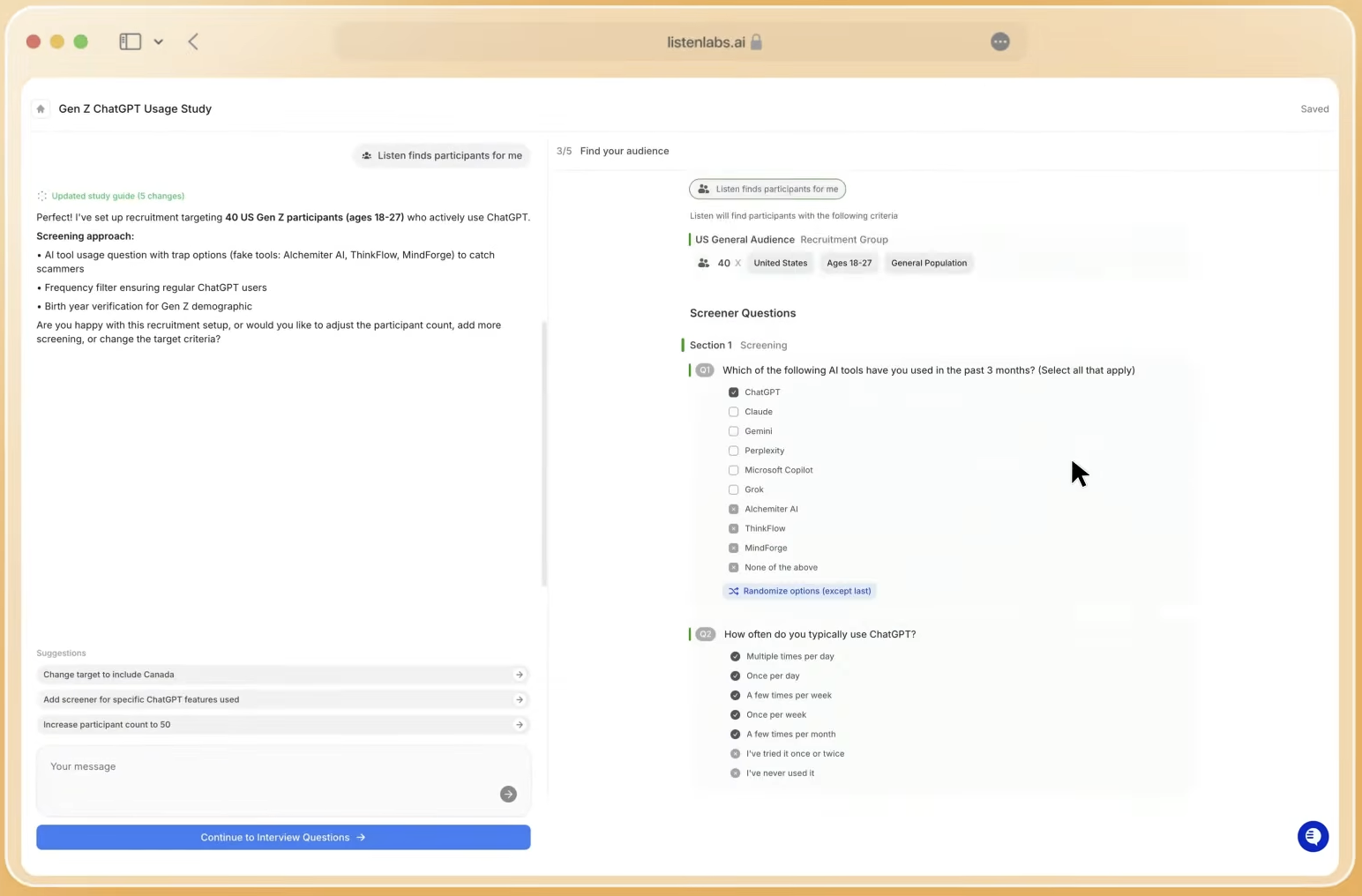
A dedicated recruitment ops team handles sub-1% incidence audiences such as enterprise decision-makers, healthcare workers, and engineers that commodity panels rarely reach reliably. Founders with an existing user base can self-recruit at reduced cost by integrating their own participants directly into the platform.
Moderation, Emotional Signals, and Data Quality Controls
Moderation quality determines how much depth each interview produces. Human moderators bring expertise, yet they introduce variability because tone, phrasing, and probing depth differ across sessions and interviewers. Survey platforms remove that variability by removing the conversation entirely, so every respondent answers the same pre-set questions with no adaptive follow-up.
Listen Labs runs AI-moderated video interviews that adapt in real time. When a participant gives a short or unexpected answer, the AI probes deeper in the same way a trained researcher would. Platforms like Listen Labs layer on auto-recruiting, transcription, sentiment tagging, and insight summarization so teams jump from question to findings in hours, not weeks.
Quality Guard monitors every session across video, voice, content, and device signals to detect fraud, low-effort responses, and mismatched profiles. Participants are capped at three studies per month, which removes the professional-survey-taker problem that plagues commodity panels.
Emotional intelligence signals add another layer of decision-making value. Listen Labs captures tone of voice, word choice, and subconscious micro-expressions, built on Ekman’s universal emotions framework. This view surfaces what participants feel, not just what they say, which matters when teams decide between competing concepts or messages.
Depth, Scale, and Analysis Workflow for Founders
Agencies deliver rich insights, yet the analysis cycle moves slowly. The typical deliverable timeline runs four to six weeks from study launch. Traditional focus groups alone cost $4,000–$12,000 per 90-minute session and take three to five weeks to complete. Survey platforms scale to thousands of respondents but capture only what pre-set questions allow, so they miss unexpected findings, emotional nuance, and unplanned lines of inquiry.
With qual-at-scale, the old trade-off between depth and scale is no longer a barrier. Listen Labs conducts hundreds of adaptive qualitative interviews at once, then routes all responses through an AI analysis engine that identifies themes, patterns, and outliers without human confirmation bias.
The Research Agent supports natural-language querying. Founders can ask “what did participants say about pricing friction?” and receive a structured answer with supporting verbatim quotes and timestamps. Mission Control aggregates findings across studies so institutional knowledge compounds instead of disappearing into a forgotten slide deck.
Deliverables Built for Investor and Team Readouts
Deliverable format often decides whether research actually influences decisions. Agency reports are thorough yet manual, and they typically require additional weeks after fieldwork closes. Survey exports arrive as raw data files that demand a separate analysis layer before anyone can share them.
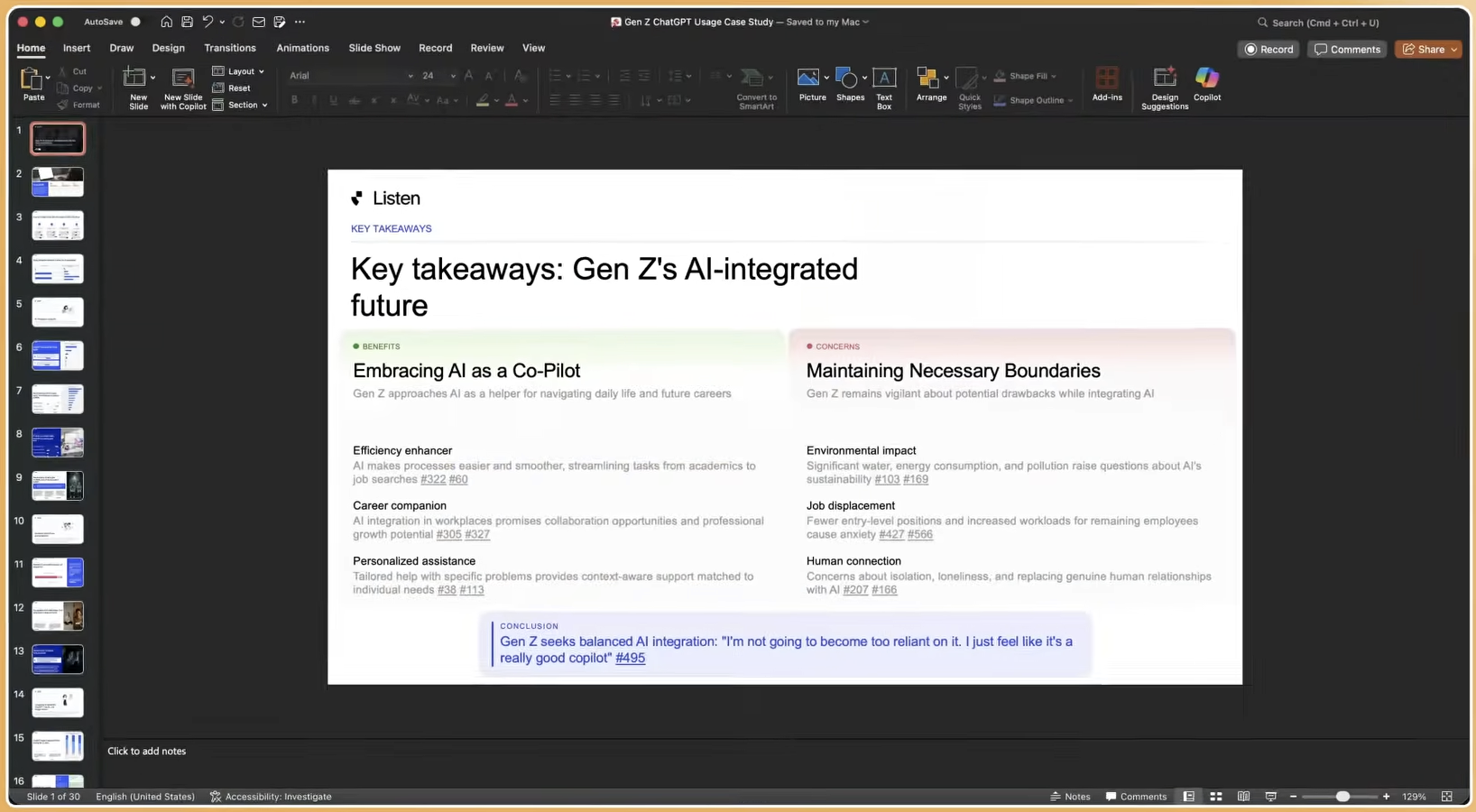
Neither format suits a solo founder who needs to brief a co-founder or present to investors on short notice. Listen Labs’ Research Agent generates consultant-quality slide decks, memo-style reports, video highlight reels, and statistical charts in under a minute.
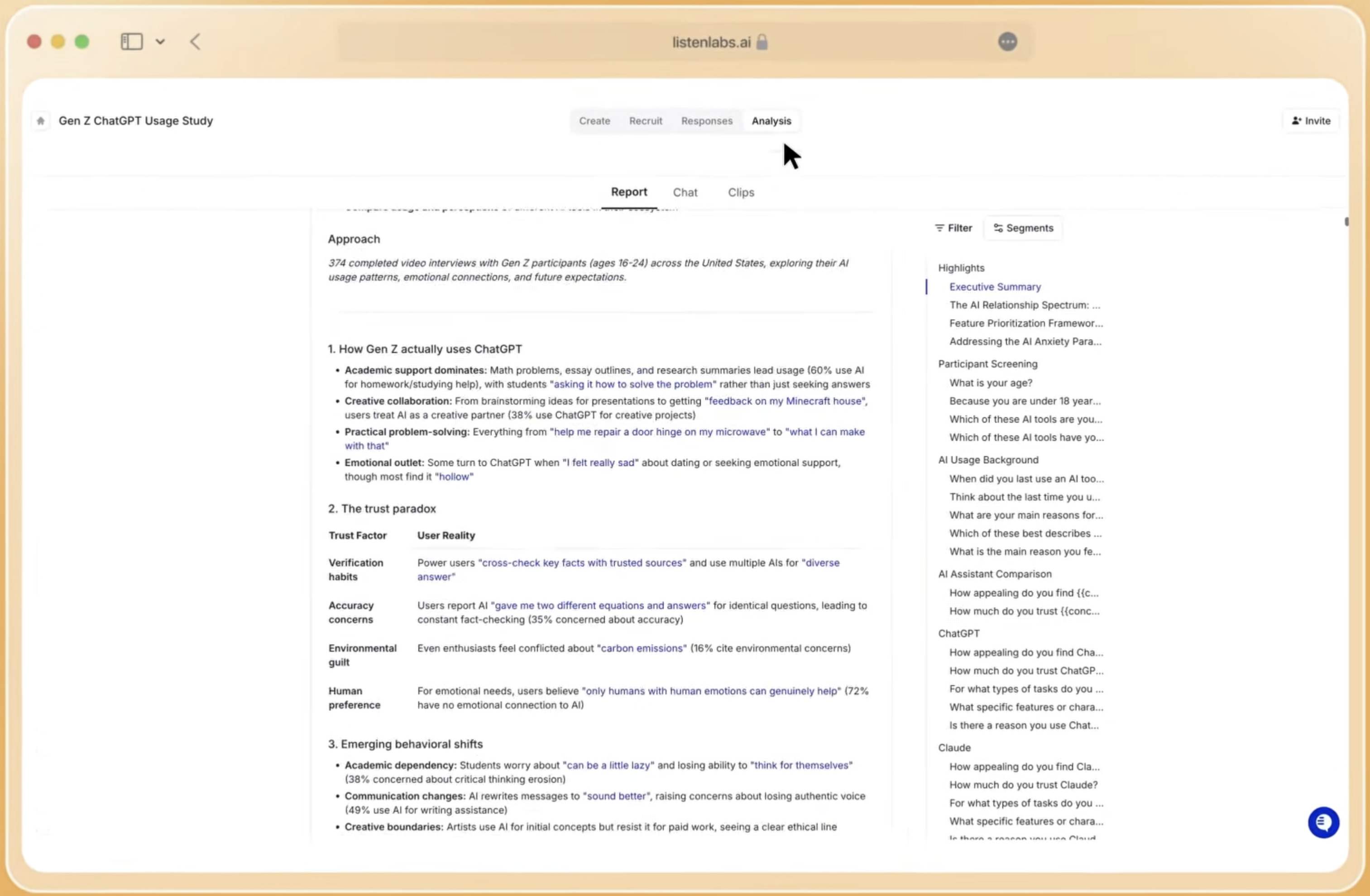
Video clips are automatically timestamped and linked to verbatim quotes, which makes it easy to share specific participant moments without manual editing. Switching to Listen Labs AI-moderated interviews let Chubbies capture hundreds of candid, one-to-one conversations overnight, with deliverables ready for immediate team review.
Best-Fit Use Cases for Different Founder Scenarios
AI interview platforms suit pre-seed validation when founders need to confirm that a problem is real and identify who feels it most acutely. Surveys tend to confirm what founders already suspect, while interviews surface what they did not know to ask.
For post-launch iteration, teams need rapid diagnosis of churn drivers or feature gaps. The combination of large sample sizes and adaptive questioning in Listen Labs delivers both statistical confidence and the “why” behind the numbers. Anthropic used Listen Labs to surface churn drivers from 300+ user interviews in 48 hours, mapping where former Claude users migrate and producing a prioritized list of must-fix items.
B2B niche recruitment benefits from the dedicated ops team and behavioral matching infrastructure, which outperform anything a solo founder could assemble alone. For multi-market testing, support for 100+ languages and coverage across 45+ countries removes much of the localization overhead that makes agency-led international research expensive.
Explore which research configuration fits your stage and schedule a walkthrough with Listen Labs.
Operational Considerations for Solo and Small Teams
Listen Labs is designed so non-researchers can run credible studies without methodology training. The AI-assisted study co-design handles question structure, and the Research Agent handles analysis. The founder defines the objective and reviews the output.
This simplicity matters because most early-stage teams cannot hire a dedicated researcher, yet compliance requirements still apply. For teams with compliance needs, Listen Labs holds SOC 2 Type II, GDPR, ISO 27001, ISO 27701, and ISO 42001 certifications, uses 256-bit encryption, and never uses customer data for AI model training.
Studies are repeatable and clonable, which supports ongoing research programs instead of one-off projects. Self-recruited participants integrate directly into the platform and reduce cost for teams with existing user bases.
Risks and Limitations Founders Should Weigh
Several recurring failure modes appear across startup research, regardless of tool choice. Rigid survey instruments produce shallow data by design because they cannot follow unexpected threads or probe ambiguous answers. Manual research workflows introduce delays at every handoff, including briefing, recruitment, moderation, transcription, analysis, and report writing.
Recruitment complexity often gets underestimated, especially for niche audiences, and commodity panels rarely solve that gap. Fraud in low-quality panels is not a theoretical risk, since incentive-driven pools attract repeat respondents who degrade data quality.
Speed introduces another risk when teams assume that faster tools automatically yield better research. Speed only creates value when the underlying data is reliable and the analysis is rigorous enough to support real decisions.
Decision Framework: Matching Research Options to Your Goals
Agency partnerships still help when founders have generous time and budget and need highly specialized methodological design for a specific study. Survey platforms work well for quantitative benchmarks at scale when teams already hold strong qualitative context.
Founders who need to understand customer motivation, validate concepts, diagnose churn, or test messaging, and who need results in hours rather than weeks, align naturally with an AI interview platform. Listen Labs raised $69 million in a Series B round led by Ribbit Capital, with participation from Sequoia Capital, Conviction, and Pear VC, at a valuation over $500 million, which signals that end-to-end AI interview platforms have moved beyond early-adopter status.
One investor summarized the shift: “Companies use it for all kinds of large decisions. This AI interviewer means that you can have hundreds of one-on-one interviews run at scale.” For bootstrapped founders, that capability, once reserved for enterprise research teams, now fits within a startup budget.
Frequently Asked Questions
Can general-purpose AI replace dedicated customer research tools?
General-purpose AI tools like ChatGPT or Claude can help draft interview guides or summarize transcripts, yet they lack the infrastructure that makes end-to-end research reliable. They cannot recruit verified participants, moderate live video interviews, apply real-time fraud detection, or generate statistically grounded analysis across hundreds of sessions.
Listen Labs is built on tens of thousands of completed studies, which gives the platform pattern recognition for which question types produce better analysis, which methodologies suit which objectives, and how to separate signal from noise. General-purpose AI supports one step, while Listen Labs supports the entire lifecycle.
How do you reach hard-to-find early adopters without weeks of recruiting?
Listen Labs combines three sourcing layers to reach early adopters quickly. The Listen Atlas network covers mainstream and mid-tier audiences across 45+ countries. An AI orchestration layer matches participants on behavioral and intent signals instead of only self-reported demographics, which improves targeting precision for early-adopter profiles.
For audiences below 1% incidence, such as niche professionals, specialized consumer segments, and enterprise decision-makers, a dedicated recruitment ops team partners with specialized networks and micro-communities. These layers source participants that commodity panels rarely reach. As a result, audiences that once required weeks of manual outreach through traditional channels are typically sourced within the platform’s standard turnaround window.
What emotional or behavioral signals matter beyond stated answers in interviews?
Non-verbal signals often reveal gaps between what participants say and what they actually feel. Participants may rate concepts positively while showing confusion, hesitation, or flat affect, and these cues only appear in the emotional layer of a conversation.
Listen Labs’ Emotional Intelligence feature analyzes tone of voice, word choice, and subconscious micro-expressions at the same time. Built on Ekman’s universal emotions framework, the same standard used in clinical psychology, it quantifies emotions such as joy, trust, surprise, fear, disgust, anticipation, sadness, and anger at the question and concept level.
Every emotional label links to a specific timestamp, verbatim quote, and the reasoning behind the classification. This level of traceability matters most in creative testing, concept comparison, usability testing, and brand research, where the gap between stated preference and genuine emotional response drives high-stakes decisions.
How does Listen Labs pricing work for teams under $500 per month?
Listen Labs uses a subscription model where platform access includes a set number of studies and credits, with credit cost varying by audience difficulty. General population studies consume fewer credits than niche or hard-to-reach segments, which keeps common use cases affordable.
Smaller teams and early-stage companies can access the self-serve platform directly. A single traditional focus group session often consumes a startup’s entire quarterly research allocation, as noted earlier, while Listen Labs replaces that spend with a platform that supports multiple studies per month, automated analysis, and shareable deliverables at a fraction of the per-study cost.
Self-recruiting from an existing user base reduces credit consumption further, which makes ongoing research programs realistic at startup scale.
Conclusion: Choosing the Right Research Approach for Your Stage
The core trade-off across agencies, surveys, and AI interview platforms centers on where each category forces compromise. Agencies trade speed and cost for depth. Surveys trade depth for scale. Well-designed AI interview platforms remove much of that trade-off.
Listen Labs delivers qualitative interview depth at the speed and scale that bootstrapped teams require, without a fragmented vendor stack or a six-figure agency retainer. It is trusted by Microsoft, Anthropic, P&G, and Skims, and it applies the same rigor to a solo product team running its first PMF validation study.
Run your first AI-moderated study in under 24 hours with a Listen Labs demo.