
Written by: Anish Rao, Head of Growth, Listen Labs | Last updated: April 15, 2026
Key Takeaways
- AI automation compresses traditional 4-6 week market research cycles to under 24 hours using global panels and automated analysis.
- Teams move faster when they define narrow, high-impact objectives with AI-assisted scoping that replaces days of meetings with minutes of study design.
- Automated recruitment from a global pool of 30M verified respondents, paired with AI-moderated interviews, delivers qualitative depth at quantitative volume.
- Emotional Intelligence surfaces real customer emotions and supports instant deliverables like slide decks generated in under a minute.
- Mission Control builds institutional knowledge over time; book a demo with Listen Labs to eliminate your research backlog today.
Who This Framework Serves and Core Concepts
This framework targets insights VPs at Fortune 500 companies, UX research leads at tech companies, product managers without dedicated research teams, and agencies conducting client research. To apply this framework effectively, you need to understand three core concepts that power modern AI research: qual-at-scale (conducting hundreds of qualitative interviews simultaneously), AI-moderated interviews (dynamic conversations with follow-up questions), and Emotional Intelligence (analyzing tone, word choice, and micro-expressions beyond transcripts).
The 2026 shift centers on AI eliminating the traditional trade-off between research depth and scale. With qual-at-scale, the old trade-off between depth and scale is no longer a barrier, enabling enterprise teams to maintain qualitative rigor while achieving quantitative sample sizes.
7 Proven Steps to Speed Up Market Research
To capitalize on this shift, enterprise research teams need a systematic approach that uses AI at every stage. These seven steps compress traditional 4-6 week cycles into under 24 hours while preserving research rigor.
Step 1: Define Narrow, High-Impact Objectives
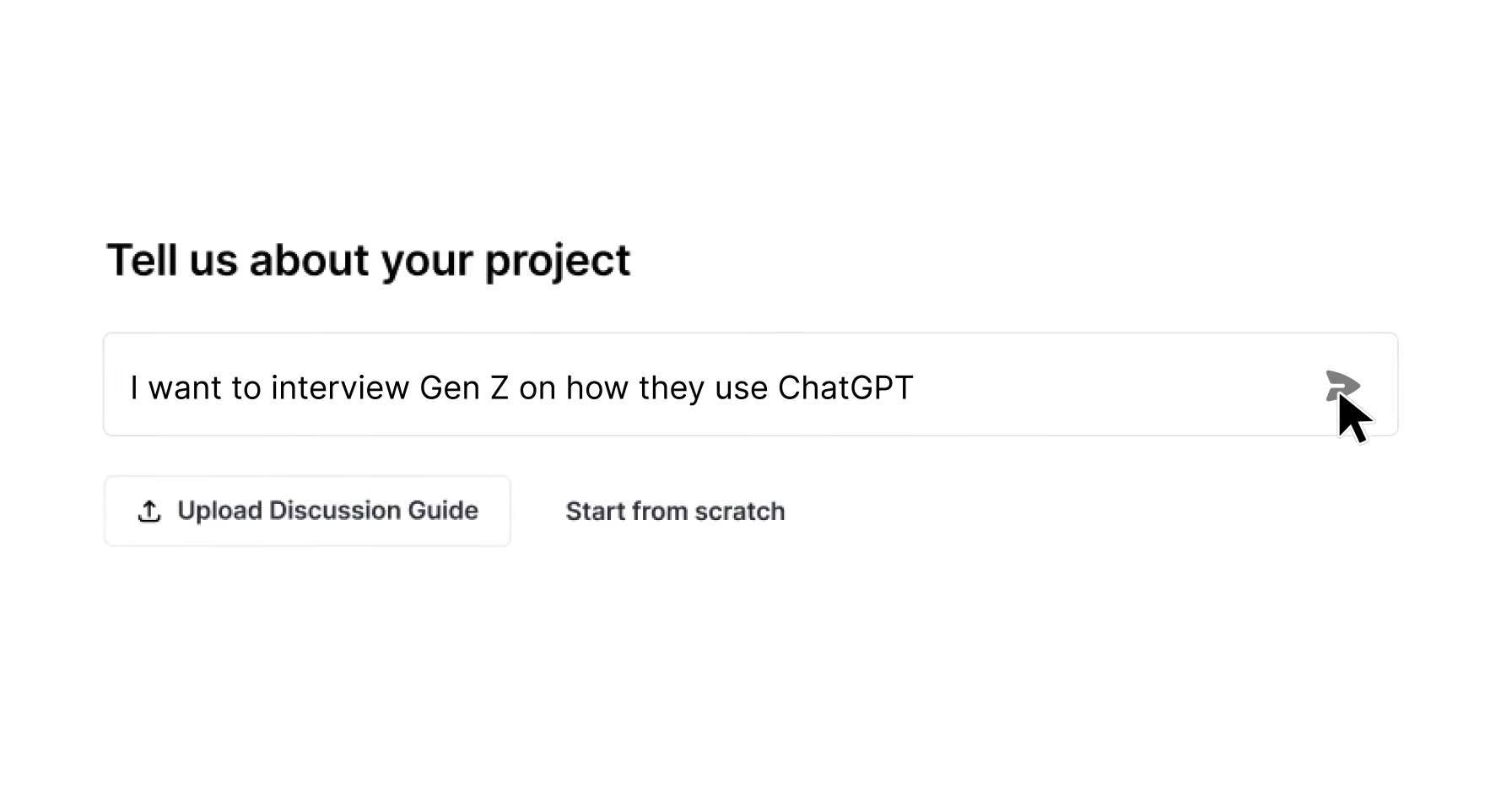
Clear, specific questions produce focused, actionable insights. Instead of “understand customer satisfaction,” specify “identify the top 3 friction points in our checkout process for mobile users aged 25-40.” Listen Labs’ AI study co-design translates natural language objectives into structured research frameworks within minutes, automatically suggesting question types, sample sizes, and methodologies based on tens of thousands of completed studies.
Traditional approach: 2-3 days of stakeholder alignment meetings. Listen Labs approach: 10 minutes of AI-assisted scoping with immediate study guide generation.
Step 2: Use Existing Insights with Secondary Data and Mission Control
Teams should mine existing research once objectives are clear, before commissioning new studies. OpenAI’s ChatGPT offers deep research mode to produce full research reports from basic prompts, while tools like Perplexity AI and Google Gemini speed up secondary research synthesis.
Listen Labs’ Mission Control serves as your organization’s research memory, turning scattered reports into a single searchable source of truth. Teams can run cross-study queries like “What have we learned about pricing sensitivity in the past year?” and receive synthesized answers in seconds instead of spending hours hunting through decks and PDFs.
Step 3: Automate Recruitment with Global Precision
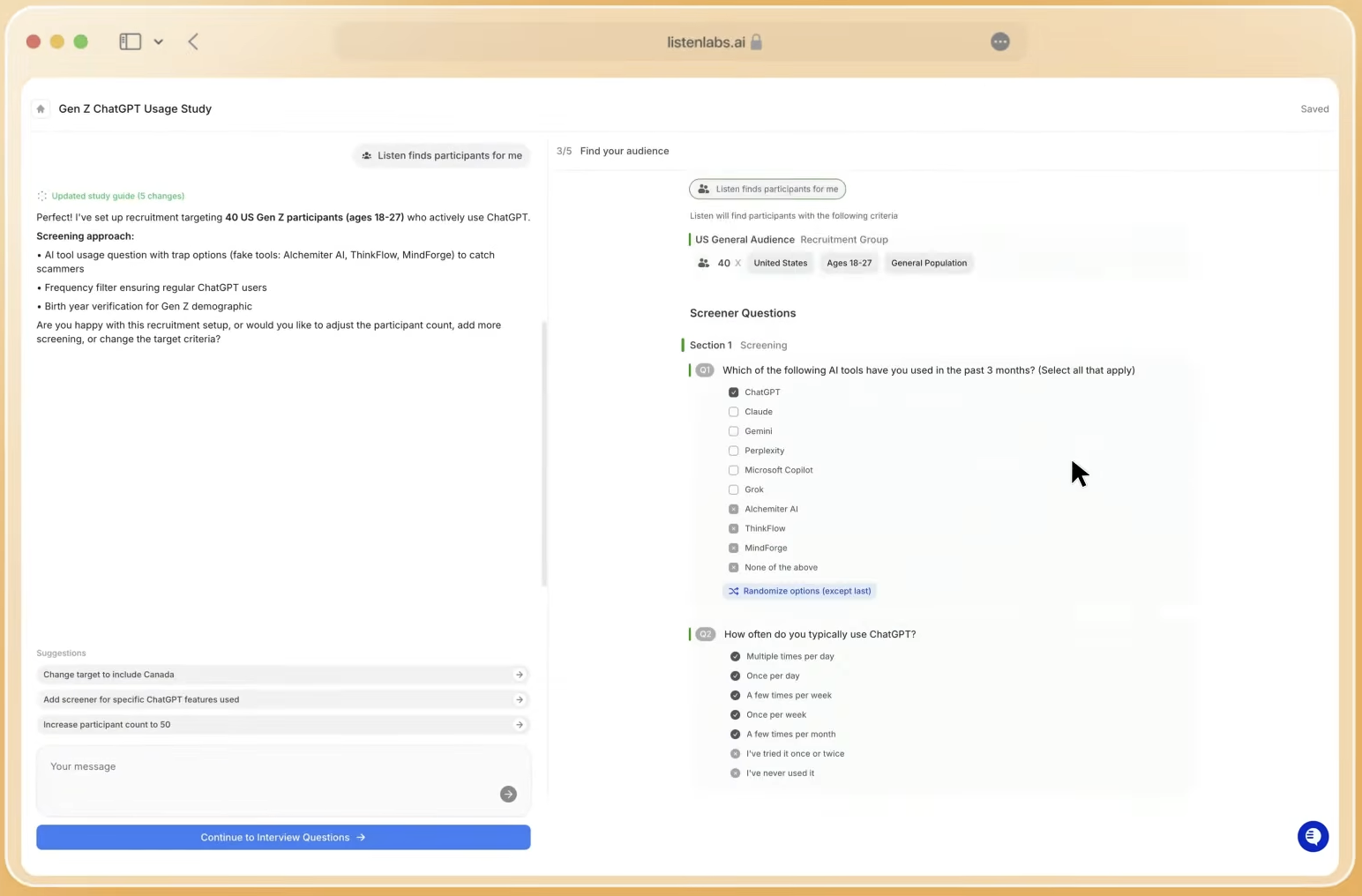
Participant recruitment traditionally consumes 40-60% of research timelines and often stalls projects. Listen Atlas, Listen Labs’ AI orchestration layer, automatically matches and recruits from a verified network of 30M respondents across 45+ countries. To ensure data quality at this scale, Quality Guard eliminates fraud through real-time behavioral monitoring, while dedicated recruitment ops teams handle niche audiences below 1% incidence rates that fall outside standard panels.
Traditional approach: 1-2 weeks of manual outreach and scheduling. Listen Labs approach: automated recruitment completed within hours, with safeguards that prevent panel fatigue and protect data quality.
Step 4: Run AI-Moderated Interviews at Global Scale
AI-moderated interviews deliver the depth of human conversations with the reach of large surveys. Platforms like Listen Labs layer on auto-recruiting, transcription, sentiment tagging, and insight summarization so teams jump from question to findings in hours, not weeks. Each interview adapts in real time with dynamic follow-up questions and supports 100+ languages with automatic translation.
Microsoft used this approach to run customer interviews for Microsoft, showing that AI-moderated qual can meet enterprise standards for scale, security, and quality.
Step 5: Reveal Hidden Emotions and Themes with Emotional Intelligence
Traditional transcripts capture what people say, not what they feel beneath the words. Listen Labs’ Emotional Intelligence analyzes tone of voice, word choice, and micro-expressions to surface emotions like hesitation, confusion, or genuine delight. Built on Ekman’s universal emotions framework, every emotion is quantified per question with traceable timestamps and clear reasoning.
This capability proves crucial for product claim evaluations. For example, a CPG brand testing three packaging claims can run 300 AI-moderated interviews in 24 hours, with Emotional Intelligence quantifying which claim sparks genuine excitement versus polite agreement. Timestamped verbatim clips and quantified themes then guide final claim selection and product positioning before launch.
Step 6: Turn Raw Data into Instant Deliverables
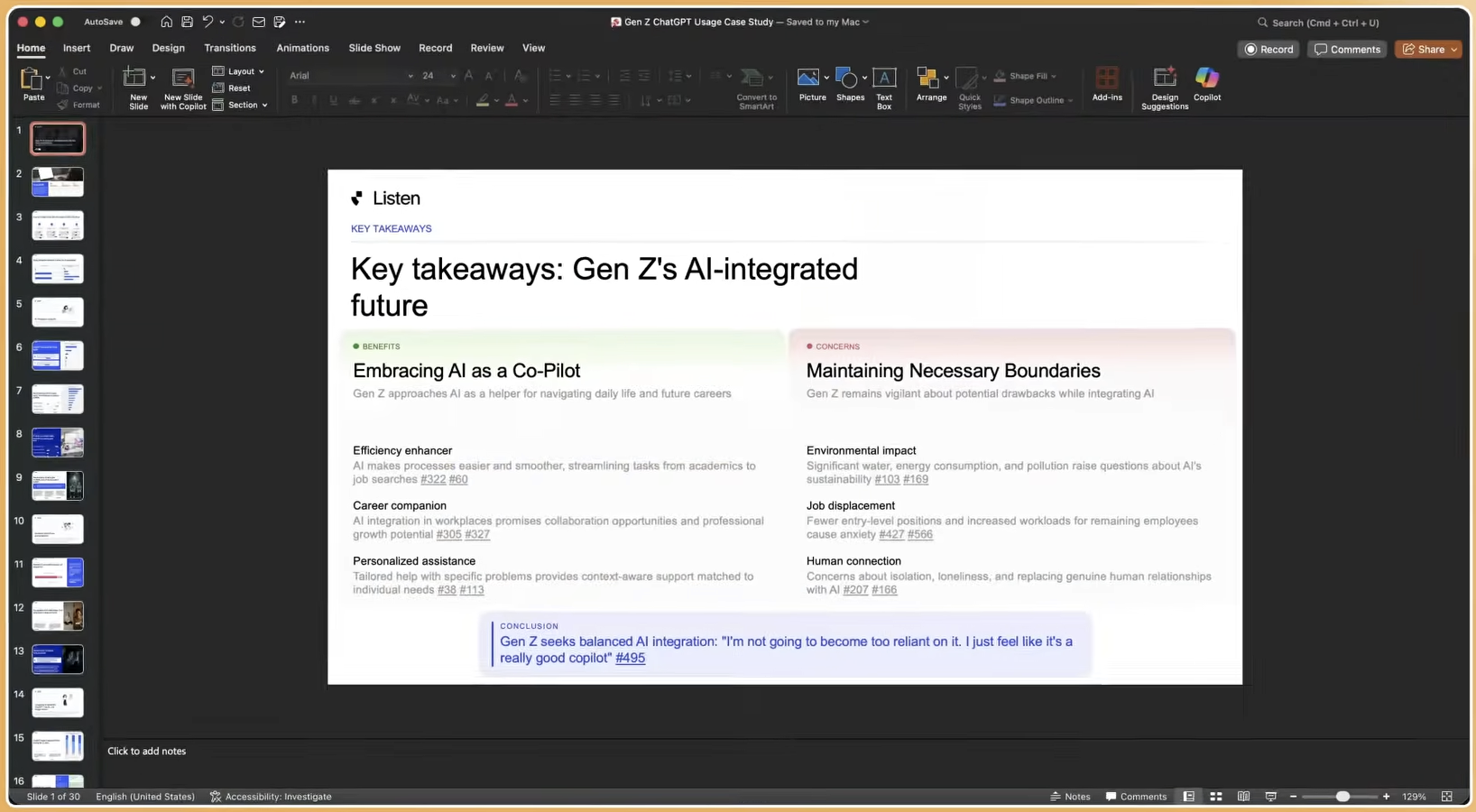
Analysis traditionally requires days or weeks of manual coding, theme identification, and report writing. Research Agent handles the full analysis workflow: from raw data to final output, generating slide decks, statistical tests, highlight reels, and custom reports in under a minute. Every insight links back to underlying response data so stakeholders can verify findings quickly.
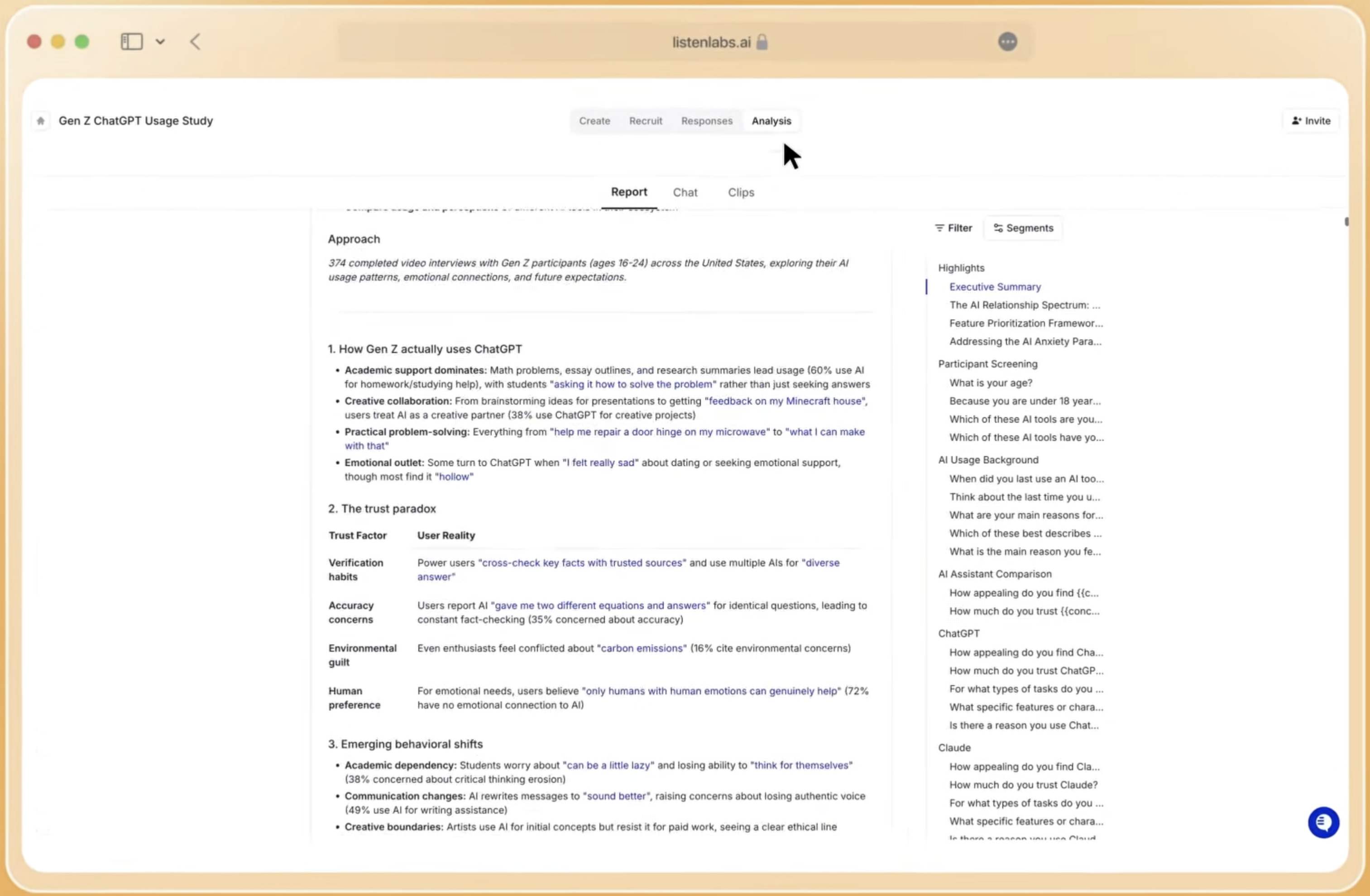
This capability enables teams to understand user churn at scale. For instance, a subscription app can conduct 200 exit interviews in 48 hours, then use Research Agent to identify patterns like migrations to specific competitors and rank retention features by frequency and emotional intensity.
Step 7: Build a Compounding Research Memory
Research insights often disappear into scattered reports and individual memories, which forces teams to repeat work. Mission Control creates a searchable knowledge base where each study adds to organizational learning instead of sitting in a folder. Teams can query across all past research, track trends over time, and avoid re-researching questions that already have strong evidence.
As mentioned earlier, the complete Listen Labs cycle, from study design through recruitment, interviews, analysis, and knowledge storage, compresses to under 24 hours. This unified workflow replaces fragmented tools and slow handoffs with a single continuous process.
Ready to transform your research velocity? See these steps in action with a personalized demo.
Applied Research Frameworks with Real-World Scenarios
Effective research acceleration relies on structured frameworks that guide decisions from exploration to validation. For example, a SaaS company investigating feature adoption can use a research funnel that starts with 500 exploratory interviews to uncover adoption barriers. The team then validates the top three barriers with 1,000 targeted interviews and finally tests solution concepts with 300 additional interviews, all within one week.
This mixed-methods approach combines qualitative depth, such as understanding why users struggle, with quantitative scale that measures how many users face each barrier. Listen Labs supports similar large-scale qualitative studies for product claim evaluations, churn analysis, and pricing research, delivering both statistical confidence and nuanced insights that inform product roadmaps.
Common Challenges and How Listen Labs Solves Them
Typical pitfalls include vague research briefs that produce unfocused insights, which Listen Labs addresses through AI-assisted study design that forces clarity upfront. Participant fraud undermines data quality, and Quality Guard solves this through real-time behavioral monitoring backed by a zero-fraud guarantee. Analysis bias confirms existing assumptions instead of surfacing new patterns, while unbiased AI analysis treats all data equally and highlights unexpected themes.
Siloed findings fail to inform future decisions, a problem Mission Control solves by building institutional knowledge that compounds over time. When teams ask whether ChatGPT alone can handle their research needs, they receive only a partial solution. General LLMs lack recruitment infrastructure, quality controls, and specialized research methodology, which end-to-end platforms like Listen Labs provide.
Measuring Success and Demonstrating ROI
Teams can track success through cycle time reduction to under 24 hours, high participant completion rates, and measurable business impact such as improved conversion or retention. These metrics feed into ROI calculations that compare AI-powered research costs to traditional approaches while accounting for the higher volume of studies completed. As organizations run more frequent, smaller studies, they shift from periodic projects to continuous customer intelligence that informs every major decision.
FAQ
How long should market research take in 2026?
Modern AI-powered research should deliver results in under 24 hours for most studies. Listen Labs demonstrates this timeline consistently, from study design through participant recruitment, AI-moderated interviews, automated analysis, and deliverable generation. Traditional 4-6 week cycles reflect outdated manual processes, not inherent research requirements. Continuous research programs enable always-on customer intelligence rather than periodic project-based insights.
Can ChatGPT do market research effectively?
ChatGPT and similar LLMs excel at study design assistance and secondary research synthesis but lack the infrastructure for complete market research. They cannot recruit verified participants, conduct scaled interviews, ensure data quality, or provide enterprise-grade security. Listen Labs combines LLM capabilities with proprietary recruitment networks, quality controls, and specialized research methodology to deliver end-to-end execution.
What are the best market research automation tools?
Listen Labs leads the end-to-end AI research category with its verified global panel, AI-moderated interviews, Emotional Intelligence analysis, and Mission Control knowledge building. Alternative tools serve specific functions: Qualtrics for surveys, UserTesting for human-moderated sessions, Prolific for recruitment, and Dovetail for analysis. However, fragmented toolchains introduce delays and quality risks that integrated platforms help eliminate.
How much does automated market research cost compared to traditional methods?
AI-powered research typically costs one-third of traditional approaches while enabling 10x more studies. Traditional focus groups require several weeks and cost thousands of dollars per session, while Listen Labs conducts hundreds of individual interviews for comparable costs. The economic advantage compounds as teams shift from periodic large studies to continuous smaller investigations.
Can AI research reach niche or hard-to-find audiences?
AI research can reach niche audiences when paired with specialized recruitment operations and global panel networks. Listen Labs’ recruitment ops team sources audiences below 1% incidence rates, including enterprise decision-makers, healthcare workers, and specialized consumer segments, demonstrating access to executive-level participants that traditionally required weeks of networking.
Conclusion
These seven steps turn market research from a weeks-long bottleneck into an hours-long competitive advantage. AI-powered automation removes the old trade-off between research depth and speed, enabling continuous customer intelligence that keeps pace with modern business velocity. Listen Labs serves as the comprehensive platform that supports this transformation through integrated recruitment, moderation, analysis, and knowledge management.
Start your research acceleration journey today. Pilot Listen Labs’ 24-hour research cycles and experience the future of customer insights.