
Written by: Anish Rao, Head of Growth, Listen Labs | Last updated: July 8, 2026
Key Takeaways
- Enterprise research backlogs stem from slow 4–6 week cycles, limited scale, participant quality issues, and lost institutional knowledge.
- End-to-end AI research platforms address all four dimensions by compressing studies to under 24 hours and enabling self-service deflection of routine requests.
- Key solutions include AI-moderated interviews, automated analysis, centralized insight repositories, global participant recruitment, and real-time fraud detection.
- Companies like Microsoft, P&G, Anthropic, and Skims have eliminated backlogs and delivered insights 5x faster using Listen Labs.
- Listen Labs is the end-to-end AI research platform trusted by leading enterprises, and Book a demo shows how your team can move from weeks to hours.
The Problem: Why Enterprise Research Backlogs Persist
Central research teams in Global 2000 companies typically run a limited number of studies per year, while unmet demand from product managers, marketing leads, and other internal stakeholders is often significantly higher. Four structural dimensions explain why the gap persists.
Speed. Traditional qualitative research requires sequential handoffs across study design, recruitment, scheduling, moderation, transcription, and analysis. Traditional focus groups alone take 3–5 weeks and cost $4,000–$12,000 per 90-minute session. Each handoff introduces delay, and the cumulative effect is a cycle measured in weeks rather than days.
Scale. Qualitative data methods lack in speed and sample size, though they make up for it tenfold in their ability to uncover nuance and complexity in human decision-making. Research teams cannot run hundreds of in-depth interviews without proportional increases in headcount or agency spend. As a result, they ration studies and defer requests.
Participant quality. Commodity panels carry fraud risk, repeat respondents, and incentive-driven answers. Quality assurance consumes researcher time that could otherwise be spent on analysis and delivery.
Knowledge loss. Findings from completed studies live in scattered slide decks and individual researchers’ memories. Teams repeatedly re-research the same questions because institutional knowledge is inaccessible, adding unnecessary volume to an already overloaded queue.
AI Research Platforms as a New Infrastructure Layer
These four structural dimensions, speed, scale, participant quality, and knowledge loss, require a fundamentally different approach to research infrastructure. Traditional consumer research follows a linear path of designing studies, collecting responses, cleaning data, manual analysis, and reporting findings weeks later. AI systems use machine learning, natural language processing, and predictive analytics to process thousands of data points simultaneously and surface patterns at scale.
End-to-end AI research platforms replace that fragmented linear process with a single system. Listen Labs handles the complete research lifecycle: AI-assisted study design, global participant recruitment via its 30M+ verified respondent network across 45+ countries, AI-moderated video interviews with dynamic follow-up questions, automated analysis, and delivery of slide decks, memos, and video highlight reels, all within 24 hours. Listen Labs has run over 1 million AI-powered customer interviews for companies including Microsoft, Perplexity, and Sweetgreen.
With qual-at-scale, the old trade-off between depth and scale no longer blocks progress. The platform enables research teams to multiply their output without adding headcount. Self-service capabilities also reduce the volume of requests that require researcher involvement at all.
8 Proven Solutions to Eliminate Research Backlogs
-
Deploy AI-moderated interviews to run studies in parallel. Traditional moderation is sequential, with one researcher and one participant at a time. AI moderation removes that constraint entirely. Listen Labs conducts hundreds of personalized, adaptive video interviews simultaneously, with dynamic follow-up questions that probe short or unexpected answers in the same way a trained human interviewer would.
- Replace scheduled moderation sessions with asynchronous AI-led interviews that participants complete on their own time.
- Configure smart follow-ups to probe deeper on responses that warrant it, without researcher involvement.
- Collect video, audio, text, and screen recordings in a single session.
Anthropic used this approach to complete 300+ user interviews in 48 hours, surfacing churn drivers 5x faster than their previous process.
Compress the analysis phase with automated insight generation. Researchers spend the bulk of their time in analysis: finding patterns, quantifying insights, testing significance, adding macro context, and formatting results for stakeholders who each need something different. Listen Labs’ Research Agent automates that entire workflow.
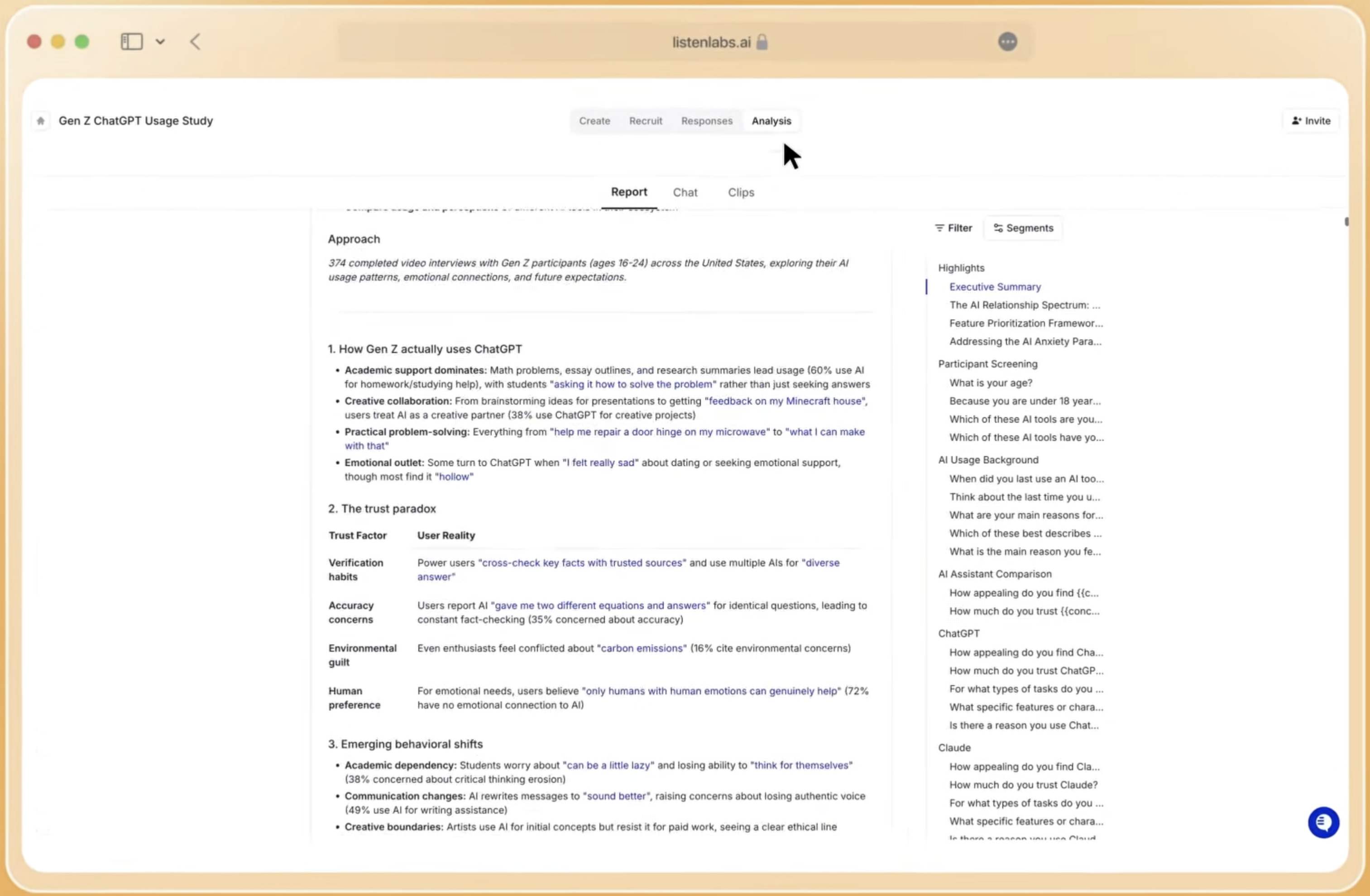
Listen Labs auto-generates research reports in under a minute - Generate automated key findings, themes, and personas directly from interview data.
- Run segmentation comparisons and statistical significance tests via natural-language queries.
- Produce branded slide decks, memos, and video highlight reels in under a minute.
One researcher ran a full buying intent analysis across three user segments in under a minute.
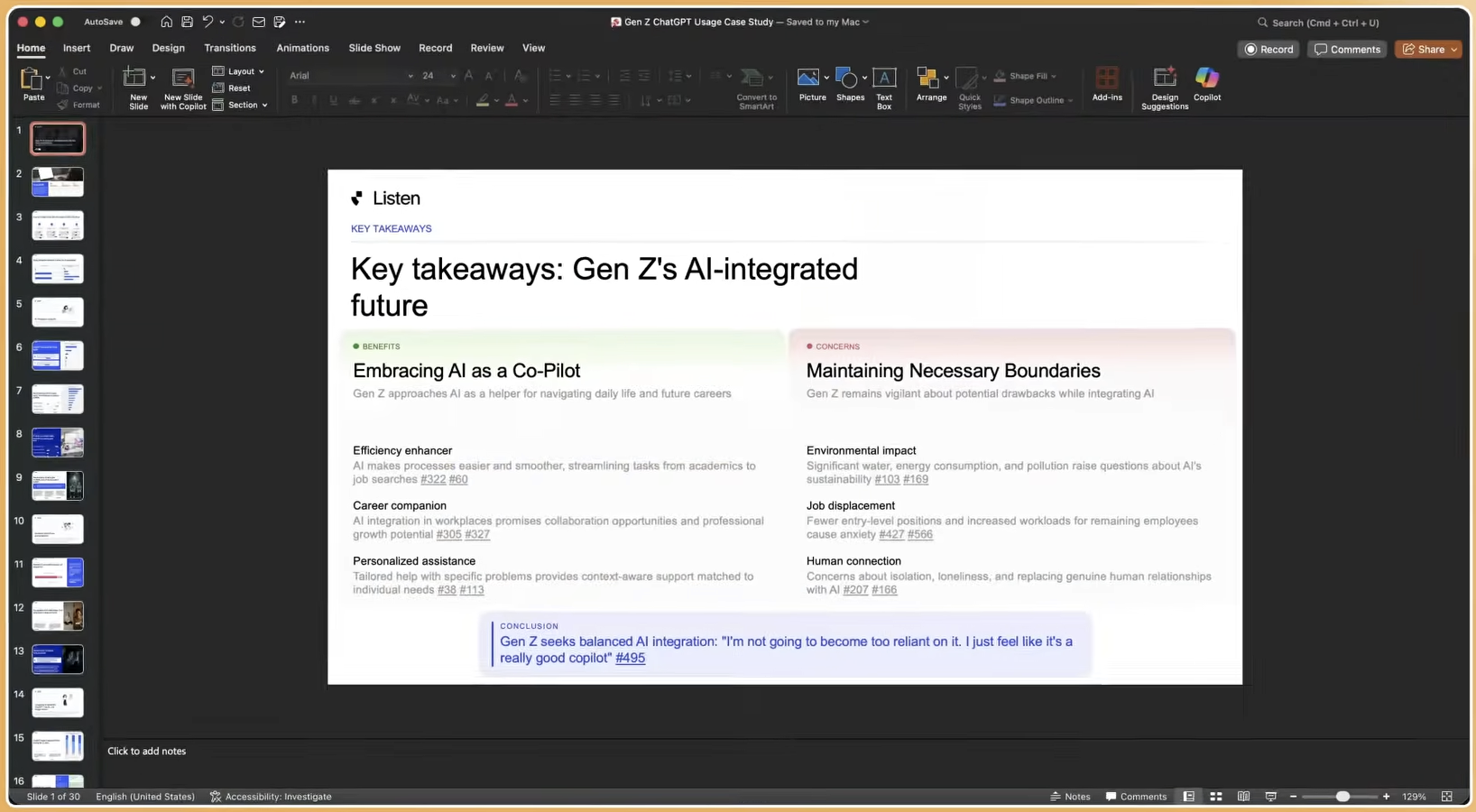
Listen Labs' Research Agent quickly generates consultant-quality PowerPoint slide decks Build a centralized insights repository to eliminate duplicate research requests. A significant share of incoming backlog consists of questions that previous studies already answered. Mission Control serves as the organization’s source of truth for all past research and enables cross-study queries in seconds.
- Index all completed studies in a searchable knowledge base.
- Enable stakeholders to query past findings before submitting new research requests.
- Track customer sentiment and needs over time to identify trend shifts without new studies.
Self-service access to institutional knowledge directly reduces incoming demand. The same deflection dynamic applies to internal research request queues.
Enable self-service study launches for non-researcher stakeholders. Product managers and brand managers generate a large share of research requests. A guided self-service path reduces the volume that reaches the research team’s queue while still producing structured, high-quality data.
- Use AI-assisted study co-design, where stakeholders describe research goals in natural language and the platform drafts objectives, questions, and probing context automatically.
- Provide a template library covering concept testing, brand perception, usability, and pricing research.
- Apply Auto-QA to flag issues in the study guide before launch, without researcher review.
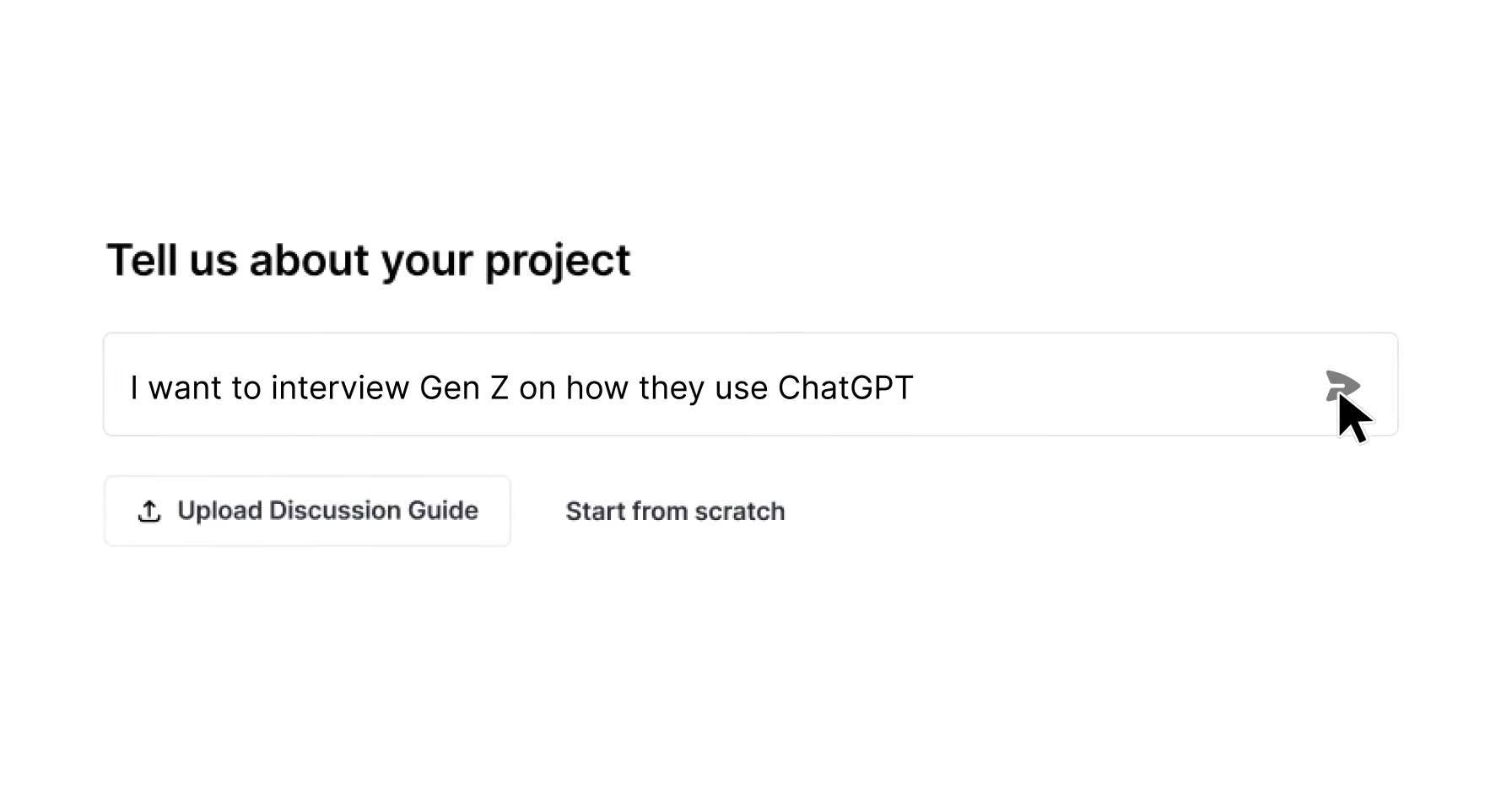
Our AI helps you go from idea to implemented discussion guide in seconds. These self-service capabilities enable organizations to redirect research spend toward faster, lower-cost cycles, a significant opportunity because S&P 500 companies spend tens of billions of dollars annually on consumer polling to test new products, features, and gauge public mood.
Integrate global participant recruitment directly into the research workflow. Recruitment is one of the longest lead-time components in a traditional research cycle. Fragmented vendor relationships, such as separate panel providers, scheduling tools, and recruitment operations, introduce delays at every handoff. Listen Labs’ Listen Atlas integrates recruitment into the same platform as moderation and analysis.
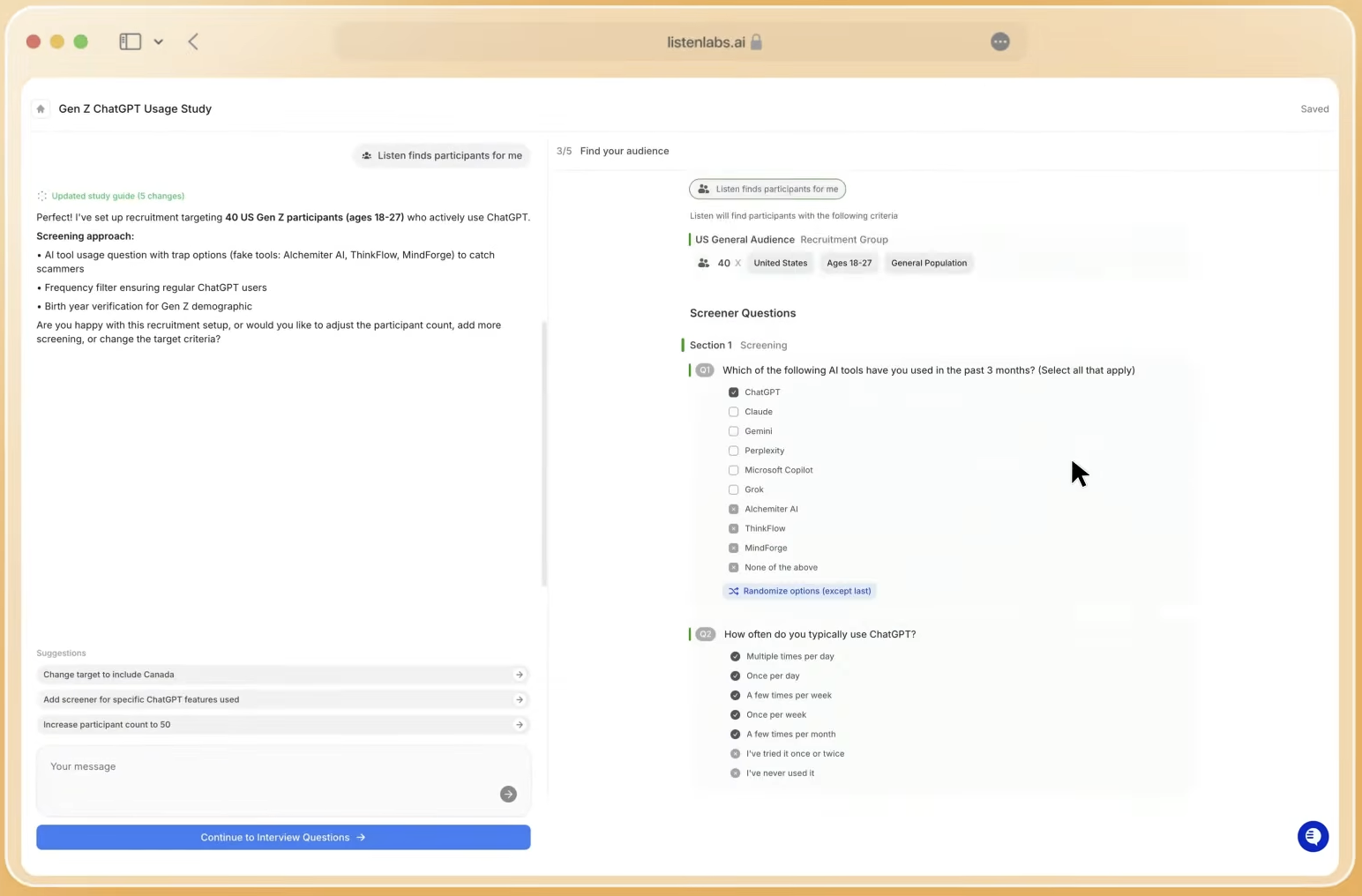
Listen Labs finds participants and helps build screener questions - Access 30M+ verified respondents across 45+ countries and 100+ languages without a separate vendor relationship.
- Use AI orchestration to match and source participants across multiple panel partners simultaneously.
- Engage a dedicated recruitment operations team for hard-to-reach segments below 1% incidence rate.
Microsoft used this capability to collect global customer stories for its 50th anniversary celebration within a day, reaching hundreds of users at one-third of the cost of traditional methods.
Apply real-time quality controls to eliminate fraud-related rework. Low-quality participant data forces researchers to spend time on quality assurance rather than analysis, which compresses the effective capacity of the team. Listen Labs’ Quality Guard monitors every interview in real time.
- Use behavioral matching on intent and past actions, not self-reported demographics.
- Apply real-time AI monitoring across video, voice, content, and device signals to detect fraudulent responses.
- Enforce a limit of three studies per month per participant to eliminate professional survey-takers.
Removing the quality assurance bottleneck returns researcher time to higher-value analysis and delivery work. This shift directly increases throughput without adding headcount.
Add emotional intelligence analysis to eliminate follow-up studies. Studies that capture only what participants say often generate follow-up requests to understand why sentiment diverged from stated preferences. Listen Labs’ Emotional Intelligence layer analyzes tone of voice, word choice, and subconscious micro expressions to surface emotional signals that transcripts alone miss.
- Quantify emotions per question and concept, traceable to exact timestamps and verbatim quotes.
- Identify moments of confusion, hesitation, friction, and delight with timestamp-level precision.
- Apply this capability across creative testing, concept comparison, usability testing, and brand research.
Skims used this depth of insight to validate a global campaign launch overnight, eliminating weeks of recruiting and panel sourcing while securing board-level buy-in from a single study.
Consolidate fragmented tools into a single end-to-end platform. Survey coding and initial data analysis that once took weeks now complete in hours with AI, which compresses overall project timelines from weeks to days. That compression only materializes when the tools are integrated. Fragmented stacks, such as separate recruitment, scheduling, moderation, transcription, and analysis tools, reintroduce delays at every handoff.
- Replace point solutions with a single platform covering study design, recruitment, moderation, analysis, and delivery.
- Eliminate vendor coordination overhead and inter-tool data transfer delays.
- Use clone-past-studies functionality to replicate and adapt previous designs without starting from scratch.
P&G used this consolidated approach to deliver 250+ interviews with quantified themes and verbatim proof in hours. Those findings directly shaped product and brand strategy before market launch.
Coordinating Supply and Demand to Reduce Backlog
Reducing a research backlog requires addressing both the supply side and the demand side simultaneously. On the supply side, the primary lever is compressing cycle time, moving from 4–6 week studies to sub-24-hour turnarounds through AI-moderated interviews and automated analysis. Speed alone cannot eliminate the backlog if new requests arrive faster than the team can complete them. The demand side therefore relies on deflection, where self-service access to past research enables stakeholders to answer lower-complexity questions and reduces the volume of new study requests that reach the research team.
Operationally, teams follow a clear sequence. First, they audit the current backlog to identify which requests are duplicates of past research, which can be answered through self-service, and which require new primary research. Next, they deploy a centralized insights repository to handle the first two categories. For the third category, they implement an AI research platform that compresses the cycle from weeks to hours. Robinhood applied this model to deliver qualitative insights 5x faster and revealed integration flows that boosted product uptake by 30–40%.
Using Consumer Research to Improve Products and Services
Consumer research improves products and services by surfacing the gap between what customers say they want, what they actually do, and what they feel but do not articulate. AI-moderated interviews capture all three layers, including stated preferences through direct questions, behavioral patterns through adaptive follow-up probing, and emotional responses through multimodal signal analysis.
For product teams, this approach supports concept testing and prototype validation with statistically meaningful sample sizes, not just five to ten users, before they commit to development investment. For brand and marketing teams, it supports creative testing that identifies exactly where audiences engage, disengage, or experience confusion, which enables iteration before launch rather than after. For pricing and go-to-market teams, it reveals the motivations and trade-offs that drive purchase decisions across different customer segments and geographies, with results available in hours rather than weeks.
Reducing New Product Failure Risk with Pre-Launch Research
Pre-launch consumer research identifies the specific claims, features, and positioning elements that resonate with target buyers, and those that do not, before production and distribution costs are committed. P&G used Listen Labs to evaluate how men respond to new product claims before market, surfacing where claims felt exaggerated or unclear and showing that comfort, safety, and reliability matter far more than novelty. That finding prevented investment in features consumers would dismiss.
The risk-reduction mechanism centers on speed of iteration. When a research cycle takes 4–6 weeks, teams can run one or two rounds of concept testing before a launch deadline. When the same cycle takes under 24 hours, teams can test multiple concept directions, iterate on the strongest, and validate the revised version, all within a single sprint. Qual-at-scale is ideal when research requires large sample sizes or broad geographic reach, as AI tools can engage hundreds or thousands of participants remotely and asynchronously, which makes multi-round pre-launch testing operationally feasible for the first time.
Evidence from Enterprise Adoption
Moving from legacy enterprise research infrastructure to AI-native customer insight platforms delivers program speed of days to insight rather than weeks. Named enterprise outcomes from Listen Labs deployments illustrate the pattern across industries.
Microsoft cut research wait time from weeks to hours and collected global customer stories within a single day. Anthropic completed 300+ user interviews in 48 hours and received a prioritized list of ten must-fix product items. P&G delivered 250+ interviews with quantified themes in hours, which directly shaped product and brand strategy. Skims identified and qualified thousands of premium consumers overnight, eliminating weeks of panel sourcing. Robinhood applied this compressed cycle to identify that users who view prediction markets as entertainment drive 2.4x higher weekly re-engagement, a behavioral insight that would have taken weeks to surface through traditional research.
With AI-moderated interviews, talking to users at scale is no longer the hard part, and the challenge is understanding what they mean. The Research Agent addresses that challenge by handling the full analysis workflow from raw data to final output. This capability enables the same research team to support a significantly larger volume of studies per quarter.
Risks and Evaluation Considerations for AI Research Platforms
AI research platforms introduce evaluation considerations that procurement and legal teams at Fortune 500 companies assess before deployment. While the outcomes above show the operational impact of AI research platforms, enterprise adoption also requires careful evaluation of data quality, compliance, and organizational readiness.
Data quality. Not all AI interview platforms apply the same quality controls. Evaluation criteria should include fraud detection methodology, participant frequency limits, and whether the platform uses commodity panels or purpose-built recruitment infrastructure. Listen Labs enforces a three-study-per-month participant limit and applies real-time Quality Guard monitoring across video, voice, content, and device signals.
Privacy and compliance. Enterprise deployments require GDPR compliance, SOC 2 Type II certification, and data handling policies that prohibit customer data from being used for AI model training. Listen Labs holds SOC 2 Type II, GDPR, ISO 27001, ISO 27701, and ISO 42001 certifications, with 256-bit encryption and a strict no-training-data policy.
Organizational change. Introducing self-service research capabilities changes the relationship between research teams and internal stakeholders. Research leaders should define clear governance policies for which study types require researcher oversight and which can be launched autonomously. These policies maintain methodological standards while expanding throughput.
AI interview quality. The depth and adaptiveness of AI moderation varies significantly across platforms. Evaluation should include live testing with target audience segments and comparison of follow-up question quality against human-moderated benchmarks. Listen Labs’ in-house research team, with 50+ years of combined expertise, continuously reviews and refines the methodology framework.
Conclusion: Selecting an AI Research Platform That Clears Backlogs
Enterprise research backlogs represent a systemic capacity problem, not a prioritization problem. Prioritization frameworks manage which requests get fulfilled, and they do not increase the rate at which studies can be completed. The only durable solution compresses cycle time while simultaneously reducing incoming demand through self-service access to past research.
End-to-end AI research platforms are the only category that addresses both levers. Evaluation criteria for platform selection should include cycle time from study brief to deliverable, participant network size and quality controls, depth of AI moderation versus surface-level survey automation, integrated analysis and deliverable generation, and compliance certifications required for enterprise deployment.
Listen Labs meets all of these criteria and is deployed across industries from technology and consumer goods to financial services and fashion. Book a demo to see how your team can move from a 4–6 week research cycle to results in under 24 hours.
Frequently Asked Questions
What is the fastest way to reduce an enterprise research backlog?
The fastest path combines two actions, deploying a centralized insights repository so stakeholders can self-serve answers from past research, and switching to an AI research platform that compresses new study cycles from weeks to under 24 hours. The repository addresses the demand side by deflecting requests that existing data can answer. The AI platform addresses the supply side by enabling the same research team to run significantly more studies per quarter without adding headcount. Listen Labs handles both through Mission Control for cross-study knowledge access and its end-to-end AI interview platform for new primary research.
Can AI-moderated interviews match the quality of human-led qualitative research?
For the vast majority of enterprise research needs, including concept testing, brand perception, usability, pricing, and consumer journey studies, AI-moderated interviews deliver comparable qualitative depth at dramatically greater speed and scale. Listen Labs’ AI interviewer asks dynamic follow-up questions based on participant responses and probes short or unexpected answers in the same way a trained human moderator would. The platform’s in-house research team, with over 50 years of combined expertise, continuously reviews and refines the methodology. For highly sensitive or strategically complex studies, the platform supports hybrid approaches where researchers review AI-generated guides and findings before delivery.
How does Listen Labs prevent low-quality or fraudulent participants from corrupting research data?
Listen Labs applies three layers of quality control. First, the platform works exclusively with high-quality, non-commodity panel sources, so no professional survey-takers or incentive-optimized respondents participate. Second, Quality Guard monitors every interview in real time across video, voice, content, and device signals and detects fraud, low-effort responses, AI-generated scripts, and mismatched profiles before they enter the dataset. Third, participants are limited to three studies per month across the platform, which eliminates panel fatigue and repeat-respondent bias. A dedicated recruitment operations team adds a human review layer for hard-to-reach or niche audience segments.
What types of consumer research studies can Listen Labs support?
Listen Labs supports a broad range of study types, including concept and prototype testing, usability testing with screen sharing, creative and ad testing, brand perception studies, consumer journey mapping, multi-market segmentation and localization studies, pricing research, and survey open-end analysis. The platform handles both one-off studies and ongoing continuous research programs. Studies can incorporate qualitative interview questions alongside quantitative formats, such as Likert scales, NPS, sliders, MaxDiff, and grids, within a single session, which eliminates the need for separate qualitative and quantitative workstreams.
How does Listen Labs handle data security and enterprise compliance requirements?
Listen Labs maintains enterprise-grade security with 256-bit encryption. Customer data is never used for AI model training. The platform holds SOC 2 Type II, GDPR, ISO 27001, ISO 27701, and ISO 42001 certifications, which cover information security management, privacy information management, and AI management systems. Enterprise deployments also include SSO integration. Organizations with specific data residency or contractual requirements should discuss those during the evaluation process.