Written by: Anish Rao, Head of Growth, Listen Labs
Key Takeaways for Travel and Hospitality Researchers
- Global travel and tourism hit record economic highs in 2025, yet many brands still rely on outdated research methods that miss the emotional drivers behind traveler decisions.
- Qualitative research reveals the “why” behind booking choices, loyalty behavior, and destination preferences that quantitative data alone cannot capture.
- Post-pandemic traveler motivations now center on wellness, enrichment, rest, and intentional experiences, which surface only through deeper conversations.
- Traditional qualitative research cycles create weeks-long backlogs, while AI-powered platforms now compress the full process from study design to insights into under 24 hours.
- Listen Labs helps travel and hospitality brands run high-quality qualitative studies at scale. Explore Listen Labs for travel research and see what this looks like in practice.
Qualitative Research in Travel: What It Actually Covers
Qualitative research in travel and tourism is the systematic collection and analysis of non-numerical data, such as conversations, observations, and narratives. It explains the motivations, emotions, and decision-making processes behind traveler behavior. Booking analytics and satisfaction scores reveal what travelers do. Qualitative methods reveal why they do it.
Traditional surveys may tell us what people do, but it takes a conversation to understand why. That distinction matters in travel, where a booking decision reflects emotional anticipation, identity expression, and complex trade-offs that rating scales cannot fully capture. The why is what differentiates customer research that is acceptable from customer research that is genuinely useful.
Listen Labs is an end-to-end AI research platform that delivers this depth at scale. It sources participants from a 30M+ verified global network across 45+ countries and 100+ languages, conducts AI-moderated interviews, and generates consultant-quality reports in less than 24 hours.
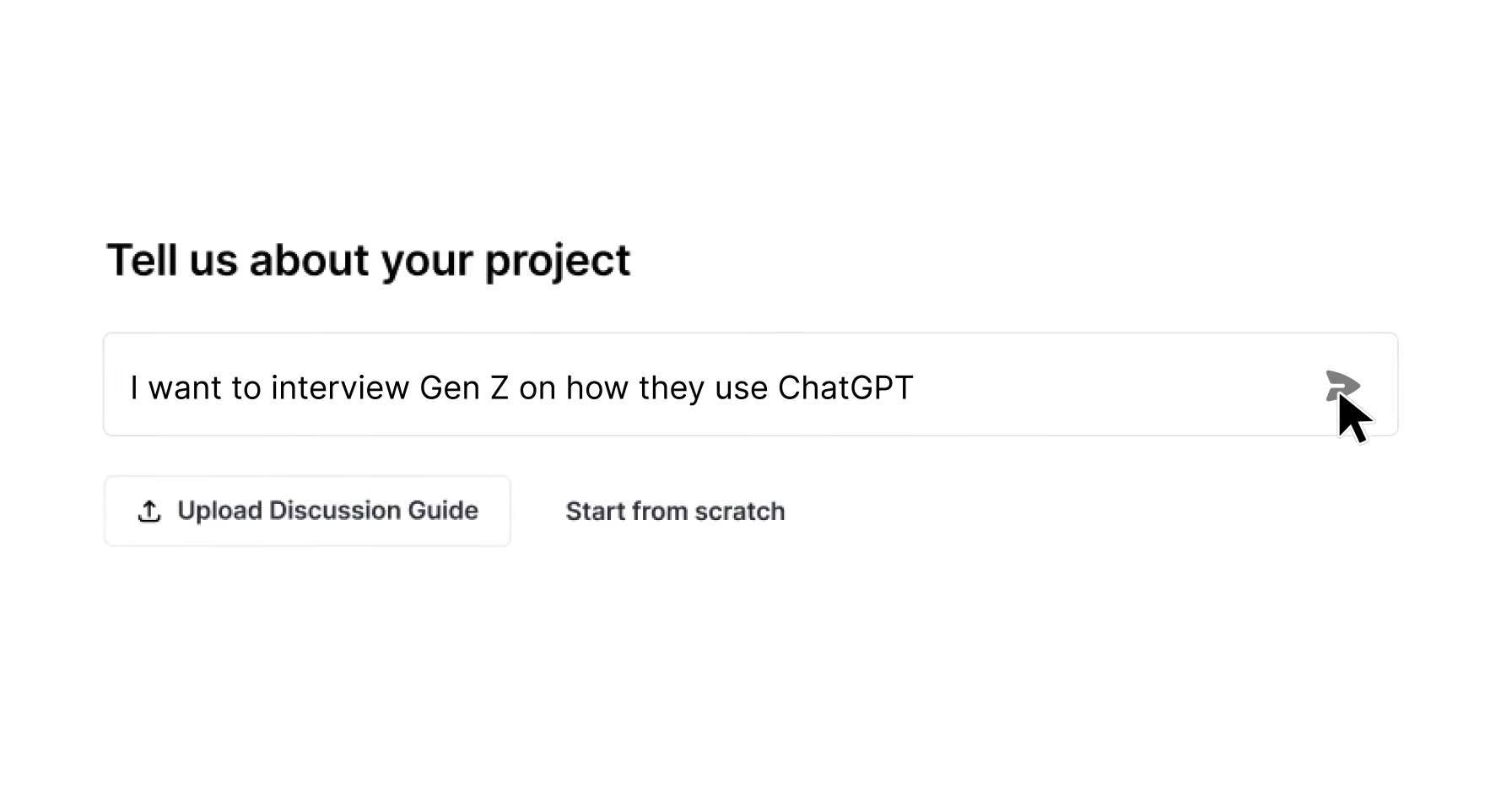
See how Listen Labs delivers qualitative insights in under 24 hours for travel and hospitality enterprises.
Core Qualitative Methods Used in Travel Research
Travel and tourism researchers draw on several established methods, each suited to specific research objectives.
- In-depth interviews (IDIs): One-on-one sessions explore complex decisions such as choosing a cruise line, selecting a loyalty program, or planning international travel. IDIs work well for sensitive topics and high-value traveler segments. Traditionally, a single focus group session can be costly and time-consuming, and IDI programs carry comparable overhead.
- Ethnography: Researchers observe travelers in natural settings such as airports, hotel lobbies, or destination experiences. This approach captures behavior that participants cannot or do not articulate. Field ethnography produces rich insight but remains expensive, slow, and geographically constrained.
- Netnography: Analysts study online communities, review platforms, and social media to understand traveler sentiment and language at scale. Netnography surfaces organic motivations but lacks the adaptive probing of live interviews.
- Diary studies: Participants document their travel planning and experience over time, which captures emotional arcs across the full journey. Diary studies reveal longitudinal shifts but require weeks of data collection and significant participant commitment.
- Usability testing: Task-based sessions evaluate booking flows, app interfaces, or loyalty portals. A hotel brand testing a new mobile check-in experience, for example, uses usability testing to identify friction points before launch.
Among these methods, in-depth interviews remain the most versatile option for travel research. They adapt to a wide range of research questions and provide conversational depth that other methods cannot match. Learning how to run them well creates a foundation for effective qualitative travel research.
Running Effective In-Depth Interviews with Travelers
Effective traveler interviews follow a structured process that balances consistency with flexibility.
- Define the research objective: State whether the study targets booking decision drivers, post-stay loyalty behavior, destination perception, or another specific question. Clear objectives produce focused findings.
- Recruit the right participants: Segment by travel frequency, trip type, destination category, or loyalty tier. Recruiting the wrong audience is the most common source of unreliable qualitative data in travel research, and no discussion guide can fix a misaligned sample.
- Design an adaptive discussion guide: Once you have the right participants, structure questions that move from broad context-setting to specific probing. The guide should invite follow-up on unexpected responses instead of forcing participants through a rigid script.
- Conduct the interview with adaptive probing: The most valuable insights in travel research often appear when an interviewer, human or AI, follows an unexpected thread. A traveler who says “I just needed to feel normal again” after a pandemic disruption opens a line of inquiry that no pre-set survey question would reach.
- Analyze for themes and emotional signals: Transcripts alone miss tone, hesitation, and micro-expressions. Rigorous analysis combines verbal content with emotional signals to create a complete picture.
Post-Pandemic Shifts Reshaping Traveler Psychology
Hilton’s 2026 Trends Report coined the term “whycation” to describe a fundamental shift in travel motivation. People are no longer simply choosing a destination. They are traveling with a specific emotional purpose. Chris Nassetta, Hilton’s President and CEO, called it “a global movement rooted in intentionality, where travel begins not with a destination, but with a motivation.”
Several documented shifts now shape what travelers want and how they decide.
- Health and wellness prioritization: Tourists’ attention to health has significantly increased in the post-pandemic era, with more travelers choosing health tourism to improve physical and mental well-being. The wellness economy stands at $6.8 trillion and is projected to reach $9.8 trillion by 2029.
- Rest and recharge as primary motivation: The 56% figure cited for rest and recharge as a top leisure travel motivation translates into surging demand for nature immersion retreats, spiritual retreats, and silent retreats that focus on restoration rather than stimulation.
- Skill-based and enrichment travel: Seventy-two percent of travelers want to take a “skillcation” to explore a personal passion, skill, or hobby. As Skift’s Editor-in-Chief Sarah Kopit noted, “The common thread is that passive leisure is dead. Every trip has to mean something now.”
- Return journeys for emotional comfort: A 2026 qualitative study of Vietnamese tourists found that returning to familiar destinations functions as a deliberate practice supporting well-being. Familiarity acts as a cognitive release mechanism, and memory serves as a connecting and healing force.
- Intentional off-the-beaten-path exploration: The pandemic prompted travelers to seek lesser-known destinations to avoid crowds, which created a lasting preference for second- and third-tier cities and park-adjacent locations.
Booking data alone cannot reveal these shifts. Researchers need direct conversations with travelers about their motivations, fears, and aspirations.
Why Emotional Signals Shape Travel Experiences
A traveler who rates a hotel stay 8 out of 10 and a traveler who gives the same score while visibly hesitating are not sending the same signal. The number matches, but the emotional reality differs.
Emotion plays a mediating role in the mechanism linking landscape perception to travel intention, moderated by personality traits. In practice, the emotional response a destination or hotel experience triggers often predicts future behavior more accurately than self-reported satisfaction scores.
Listen Labs’ Emotional Intelligence capability analyzes three layers of signal, including tone of voice, word choice, and subconscious micro-expressions. It surfaces emotions that transcripts alone miss. Built on Ekman’s universal emotions framework, the same standard used in clinical psychology, it quantifies emotions such as joy, trust, anticipation, fear, and surprise at the question and concept level. Every emotional label is traceable to the exact timestamp, verbatim quote, and reasoning behind it. Travel brands can pinpoint where a loyalty program pitch triggers genuine enthusiasm versus polite indifference, or where a new hotel concept generates confusion instead of excitement.
This depth of emotional insight matches what travel brands need. Traditional research methods, however, make it slow and expensive to obtain at scale.
Why Traditional Research Cycles Create Insight Backlogs
A standard qualitative research cycle in travel, from study design through recruitment, moderation, analysis, and final report, often takes several weeks. In large enterprises, internal prioritization, budget approval, and team backlogs can extend timelines significantly. By the time findings reach the product or marketing team, the campaign may have launched, the concept may have been shelved, or the competitive window may have closed.
Several structural factors drive this backlog. Recruitment requires sourcing participants across multiple panel providers. Scheduling interviews with the right traveler segments introduces further delays. Moderation requires trained researchers. Analysis of hundreds of hours of interview footage is time-intensive and subject to individual analyst bias. Report writing adds another layer. Each handoff between tools and vendors adds delay and quality risk.
For a VP of Consumer Insights at a hotel group or airline, the result is a research team that functions as a permanent bottleneck. The team fields more requests than it can fulfill, frustrates internal stakeholders, and limits the organization’s ability to act on timely traveler intelligence.
How AI Accelerates and Scales Travel Research
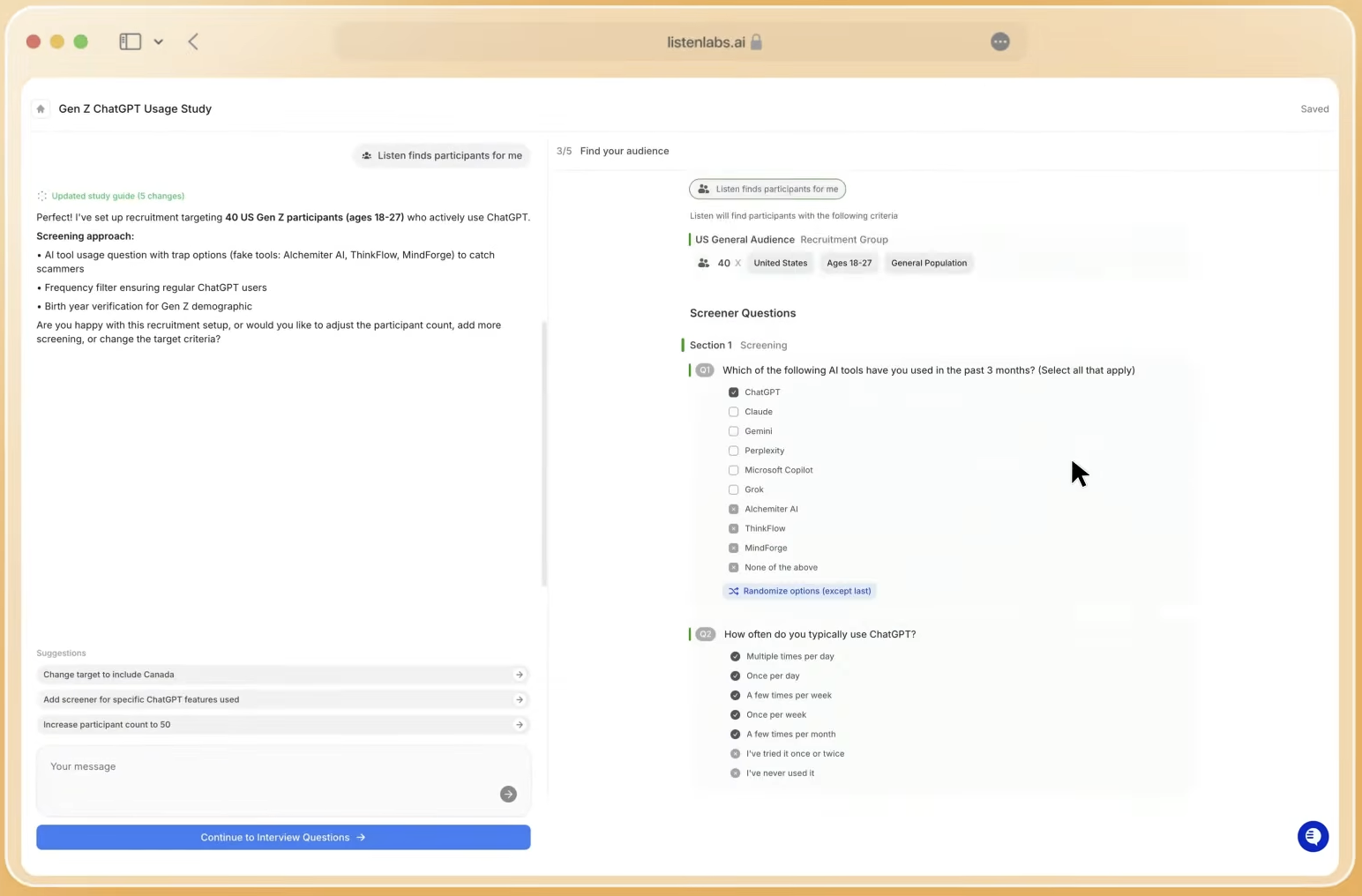
With qual-at-scale, the old trade-off between depth and scale no longer applies. AI-moderated interview platforms compress the entire research lifecycle, including study design, recruitment, moderation, analysis, and reporting, into a single workflow that achieves the speed described earlier.
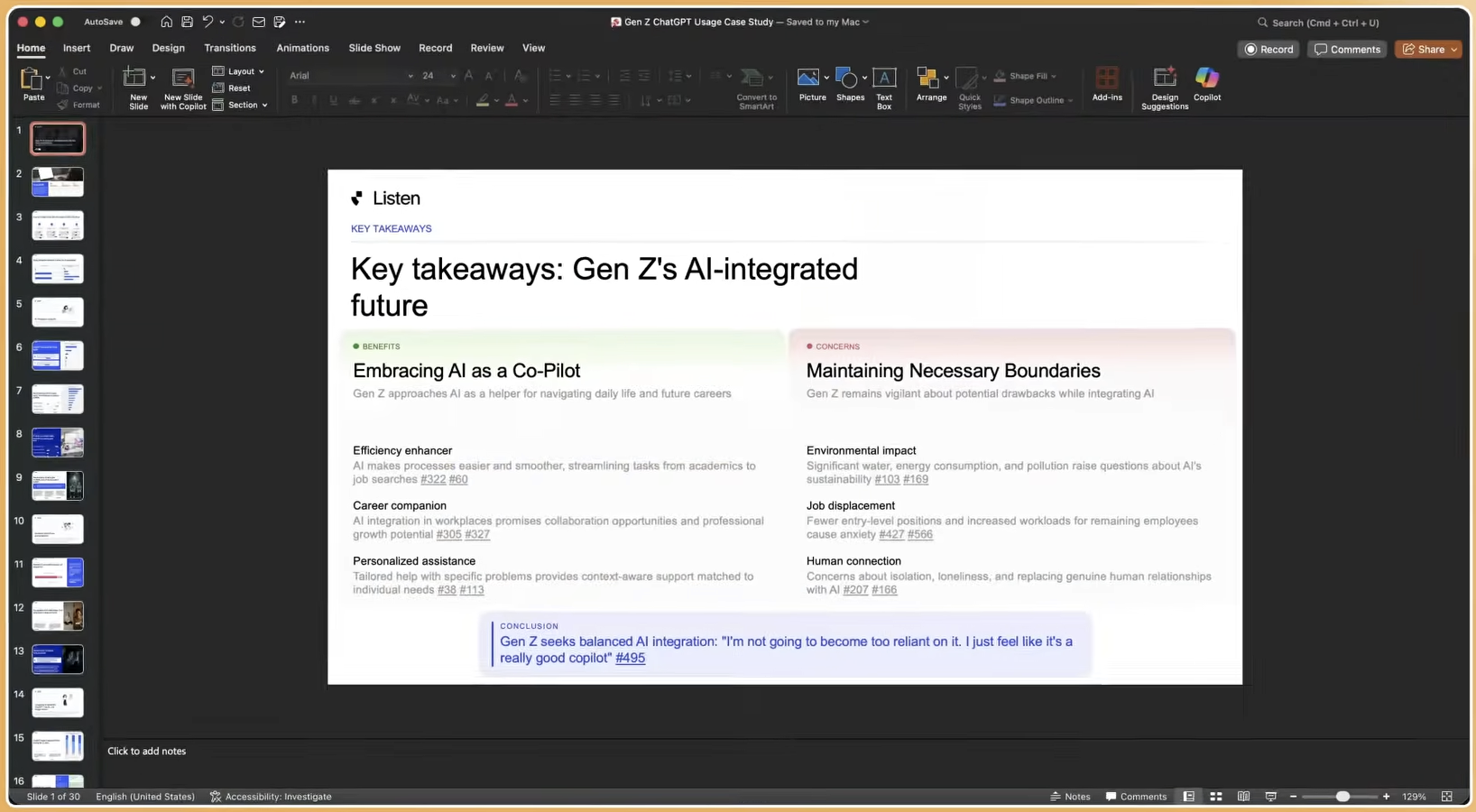
For travel and hospitality enterprises, this unlocks several concrete capabilities.
- Destination marketing: A destination marketing organization can test messaging with travelers across five international markets at the same time. It receives emotionally coded findings before a campaign brief is finalized.
- Hotel concept testing: A hotel brand developing a new wellness offering can conduct more than 200 interviews with target traveler segments overnight. The team identifies which elements resonate and which create confusion before committing capital.
- Loyalty program research: An airline or hotel group can probe the emotional drivers of loyalty tier behavior across thousands of participants in a single study. The research explores why members disengage, what would accelerate upgrade decisions, and how competitors are perceived.
Platforms like Listen Labs add auto-recruiting, transcription, sentiment tagging, and insight summarization so teams move from question to findings in hours, not weeks. Using the global participant network described earlier, Listen Labs conducts AI-moderated video interviews with adaptive follow-up probing and delivers automated slide decks, highlight reels, and statistical analysis through its Research Agent.
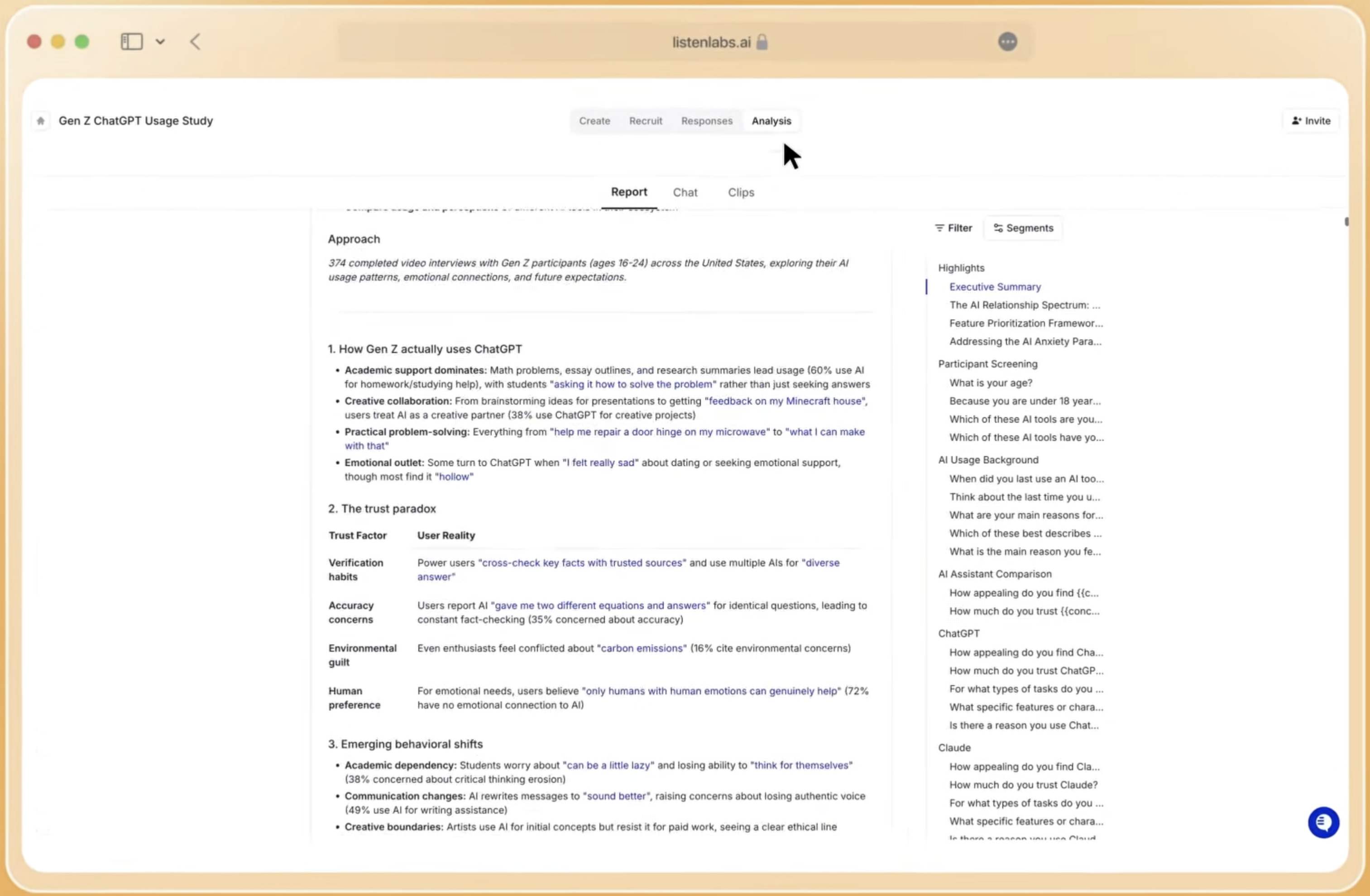
See how Listen Labs compresses a 4–6 week research cycle into a single day for travel and hospitality teams.
Assessing Readiness for AI-Powered Qualitative Research
Before deploying an AI research platform, insights leaders in travel and hospitality can assess readiness across several dimensions.
- Data governance: Confirm that participant consent frameworks, data residency requirements, and privacy compliance standards (GDPR, SOC 2, ISO 27001) are in place. Listen Labs holds all of these certifications and never uses customer data for AI model training. With compliance addressed, the next step is ensuring organizational buy-in.
- Stakeholder alignment: Identify which internal teams, such as product, brand, loyalty, and revenue management, have unmet research requests. A pilot study that addresses a high-priority backlog item builds internal confidence faster than a standalone proof of concept.
- Research maturity: Teams with established study design practices integrate AI moderation more quickly. Teams newer to qualitative methods benefit from AI-assisted study co-design, which drafts structured objectives and discussion guides from a plain-language brief.
- Participant sourcing strategy: Decide whether the organization will use Listen Labs’ global panel, bring its own loyalty database, or combine both. Self-recruited participants from existing traveler databases reduce cost and increase relevance for loyalty and CX studies.
- Pilot scope: A single study, such as destination perception testing, loyalty driver research, or post-stay experience analysis, is sufficient to validate quality and speed before committing to a full program.
Start your pilot study with Listen Labs and focus it on your team’s most pressing research backlog.
Frequently Asked Questions
How do qualitative and quantitative research differ in the travel industry?
Quantitative research in travel, such as surveys, booking analytics, and NPS scores, measures what travelers do and how many of them do it. Qualitative research uncovers why they make those decisions, which emotions drive their choices, and which words they use to describe their experiences. The two methods work best together. Qualitative research generates hypotheses and emotional context, and quantitative research then validates those insights at scale. Listen Labs combines both within a single study, so teams can collect Likert scales, NPS, and MaxDiff alongside open-ended conversational interviews.
How long does qualitative research take in the travel industry with AI?
Traditional qualitative research cycles in travel often take 4–6 weeks from study design to final report and can stretch to six months in large enterprises. Listen Labs compresses the entire cycle, including study design, participant recruitment, AI-moderated interviews, analysis, and deliverable generation, to less than 24 hours. A travel brand can brief a study on Monday morning and present findings to leadership on Tuesday.
Can AI-moderated interviews capture emotional nuance in travel research?
Listen Labs’ AI interviewer conducts adaptive conversations with dynamic follow-up probing, similar to a trained human researcher. Its Emotional Intelligence layer goes further than most human-moderated studies by analyzing tone of voice, word choice, and micro-expressions simultaneously across every interview, not just the handful a human moderator can observe in a day. Every emotional signal is quantified, timestamped, and traceable to the specific verbatim response that triggered it. For travel brands testing destination campaigns or hotel concepts, this reveals moments of genuine delight or hidden confusion that transcript analysis alone would miss.
How does Listen Labs ensure participant quality for travel research?
Listen Labs applies three layers of quality control. It works exclusively with non-commodity panel sources, avoiding professional survey-takers. Quality Guard monitors every interview in real time across video, voice, content, and device signals to detect fraud, low-effort responses, and mismatched profiles. A dedicated recruitment operations team then adds human review for hard-to-reach segments, including frequent international travelers, luxury travel buyers, and loyalty program members. Participants are limited to three studies per month to prevent panel fatigue and incentive-driven responses.
Which travel and hospitality research use cases fit Listen Labs best?
Listen Labs supports the full range of qualitative research needs in travel and hospitality. Its speed and emotional intelligence capabilities work especially well for time-sensitive decisions and emotionally complex traveler motivations, including:
- Destination perception and messaging testing across international markets
- Hotel and resort concept testing before capital commitment
- Loyalty program driver and churn research
- Post-stay experience analysis and service recovery insight
- Traveler segmentation and persona development
- Booking flow and app usability testing
- Campaign creative testing with emotional signal analysis
- Multi-market localization research across 100+ languages