
Written by: Anish Rao, Head of Growth, Listen Labs | Last updated: July 11, 2026
Key Takeaways
- Qualitative research reveals the “why” behind customer decisions through interviews, observations, and diaries that add context to metrics.
- Seven core methods, including in-depth interviews, diary studies, usability testing, focus groups, JTBD interviews, brand perception studies, and ethnographic research, now scale with AI moderation.
- Real-world examples show Listen Labs completing churn investigations, diary studies, usability tests, brand perception, and JTBD interviews in under 48 hours with full analysis and deliverables.
- AI-moderated platforms remove the old depth-versus-scale trade-off, supporting 50–300+ participants while preserving emotional nuance and quality control.
- Listen Labs makes this speed and depth accessible to any team, so your next customer insight project can move from brief to deliverable in under 24 hours.
Five Core Qualitative Methods with Detailed Examples
- In-depth interviews (IDIs): One-on-one conversations that probe motivations, attitudes, and experiences with adaptive follow-up questions.
- Diary studies: Longitudinal self-reporting where participants document experiences over days or weeks to capture real-world behavior in context.
- Usability testing: Task-based sessions where participants interact with a product or prototype while researchers observe friction and confusion.
- Jobs-to-be-Done (JTBD) interviews: Structured conversations that uncover the functional, social, and emotional jobs customers hire a product to perform.
- Brand perception studies: Exploratory interviews and projective techniques that map how customers emotionally and cognitively position a brand.
With qual-at-scale, the old trade-off between depth and scale is no longer a barrier, and AI-moderated platforms now execute each of these methods across hundreds of participants simultaneously.
See all seven methods in action in a personalized demo that shows how Listen Labs runs each approach with qual-at-scale.
The following sections show how these five core methods translate into real customer insight projects, starting with a common use case: understanding why customers leave.
Churn Investigation Exit Interviews Example
Objective: Identify the primary drivers of subscription cancellation and surface actionable retention levers before churn compounds.
Method: AI-moderated in-depth interviews with dynamic follow-up probes on switching triggers, unmet expectations, and competitive alternatives.
Sample size and audience: AI-moderated studies for pattern distribution across segments typically use larger sample sizes to enable statistical theme reporting. To achieve this coverage while maintaining context, target recently churned subscribers within the past 90 days, blending 60% own CRM customers and 40% vetted panel participants so CRM customers provide product-specific detail and panel participants add unbiased external perspectives.
Timeline: Traditional human-moderated exit interview programs can take several weeks and significant costs. Listen Labs delivers results in under 48 hours.
Primary deliverables: Ranked churn driver report, verbatim quote library, competitive migration map, and a prioritized “must-fix” feature list.
Business outcome: Retention teams receive an evidence-based intervention roadmap before churn compounds into revenue loss.
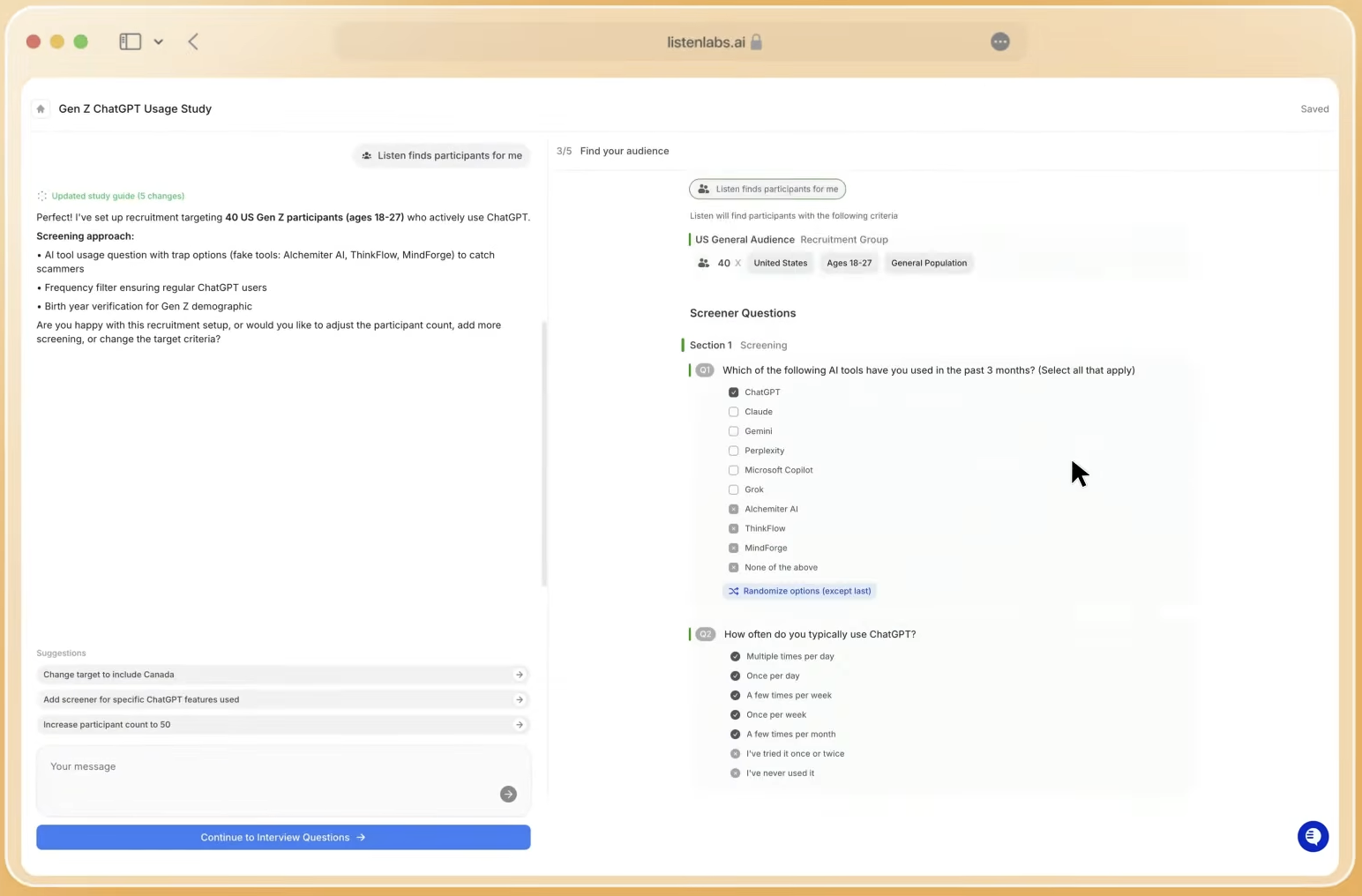
This churn investigation shows how AI moderation removes the usual trade-off between speed and depth. Listen Labs runs this study end-to-end without manual coordination. AI-assisted study design structures the interview guide around cancellation triggers and switching behavior in minutes. Listen Atlas recruits verified churned users from the 30M+ respondent network, and Quality Guard filters out fraudulent profiles while capping participants at three studies per month. The AI moderator conducts personalized video interviews with dynamic follow-ups, while the Emotional Intelligence layer captures hesitation, frustration, and resignation that transcripts alone miss. Research Agent auto-generates the churn driver report, highlight reel, and slide deck. Anthropic used this approach to conduct 300+ user interviews in 48 hours, surface churn drivers five times faster, identify where former Claude users migrate, and receive a prioritized list of ten “must-fix” items, which their Director of Product Strategy described as delivering “a level of clarity and speed we’ve never had before.”

Diary Study Customer Journey Mapping Example
Objective: Capture the end-to-end customer experience across multiple touchpoints over time, including moments of friction and delight that point-in-time interviews miss.
Method: Longitudinal diary study combining daily prompted video check-ins with periodic in-depth interview sessions to contextualize self-reported entries.
Sample size and audience: Qualitative research typically uses small sample sizes of 5–15 participants, and AI-moderated diary platforms extend this to 100+ without proportional cost increases. Target active customers across two to three key lifecycle stages.
Timeline: Complex longitudinal studies typically take years or decades from planning to final insights using traditional methods, largely because recruitment, scheduling, and analysis happen in slow sequence. Listen Labs compresses diary study delivery to days by running participant check-ins asynchronously and analyzing entries in real time, which removes the coordination overhead that stretches timelines.
Primary deliverables: Annotated journey map, friction-point inventory, emotional arc visualization, and segment-level experience comparison.
Business outcome: Product and CX teams receive a prioritized list of journey interventions ranked by emotional impact and frequency.
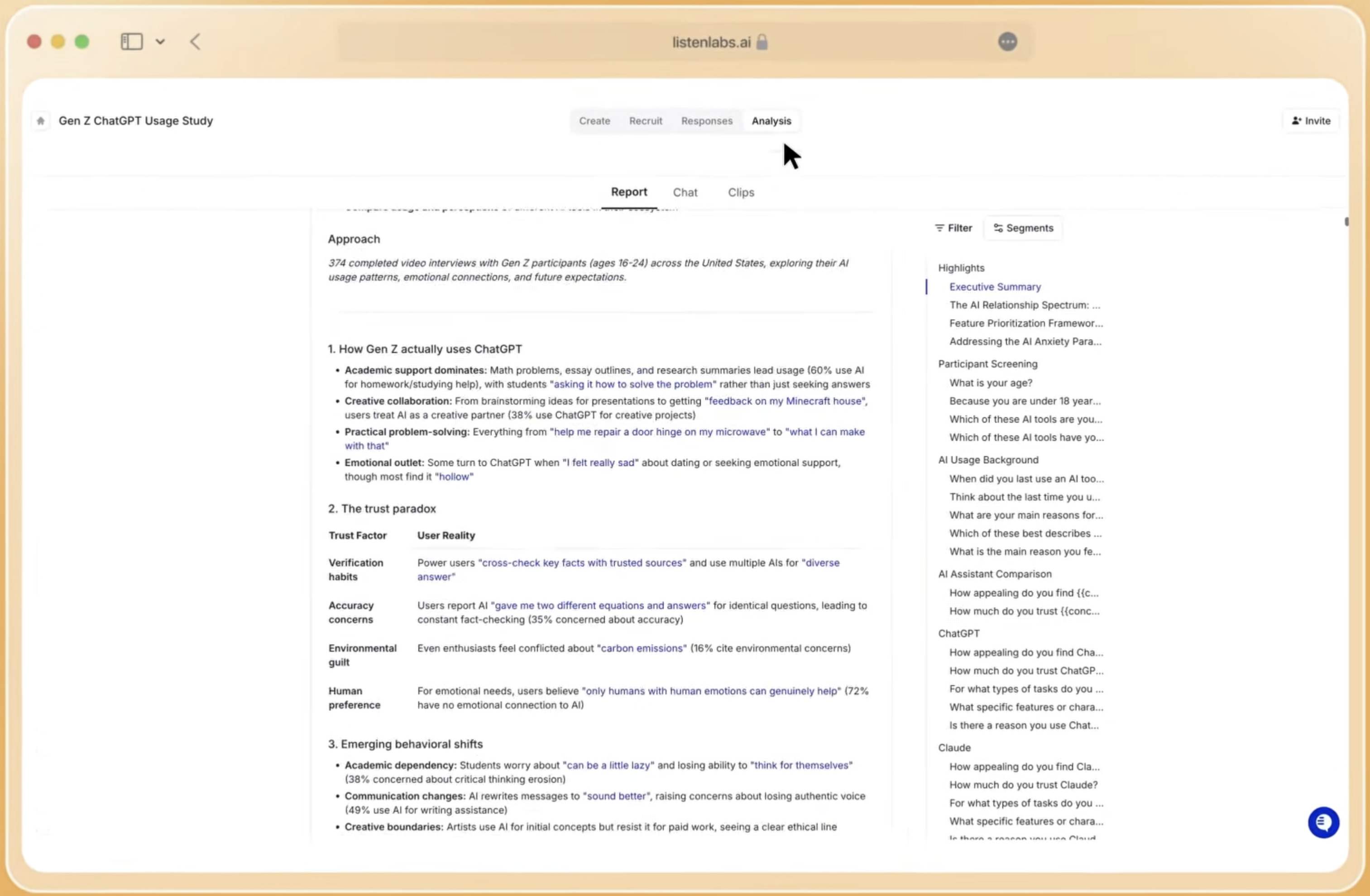
Listen Labs structures diary prompts through AI-assisted study design, then recruits participants via Listen Atlas with behavioral matching on actual product usage, not just self-reported demographics. Participants submit daily video entries asynchronously, and the AI moderator conducts mid-study and closing interviews with adaptive probes. The Emotional Intelligence layer quantifies emotional peaks and troughs at each journey stage, traceable to exact timestamps and verbatim quotes. Research Agent synthesizes entries across all participants into a cross-study journey map with one-click deliverables, including branded slide decks and video highlight reels of the most emotionally significant moments.
Usability Testing Checkout Flow Example
Objective: Identify interface friction, confusion points, and drop-off triggers in an e-commerce or SaaS checkout flow before a production release.
Method: Task-based usability testing with screen recording, think-aloud protocol, and post-task probing on confusion and confidence.
Sample size and audience: Nielsen Norman Group research shows that 5 users surface about 85% of usability issues in qualitative testing, with a practical recommendation of 5–8 participants per distinct user segment. For multi-segment checkout flows, such as new versus returning users or mobile versus desktop, target 15–30 total participants across segments.
Timeline: Technology companies prioritize UX research cycles aligning to two-week agile sprints. Listen Labs fits a complete usability study inside a single sprint, with results available the next day.
Primary deliverables: Annotated screen recording clips, friction heatmap by task step, severity-ranked issue list, and recommended copy or UX fixes.
Business outcome: Engineering and design teams receive a severity-ranked fix list before launch, which reduces post-release conversion drop-off.
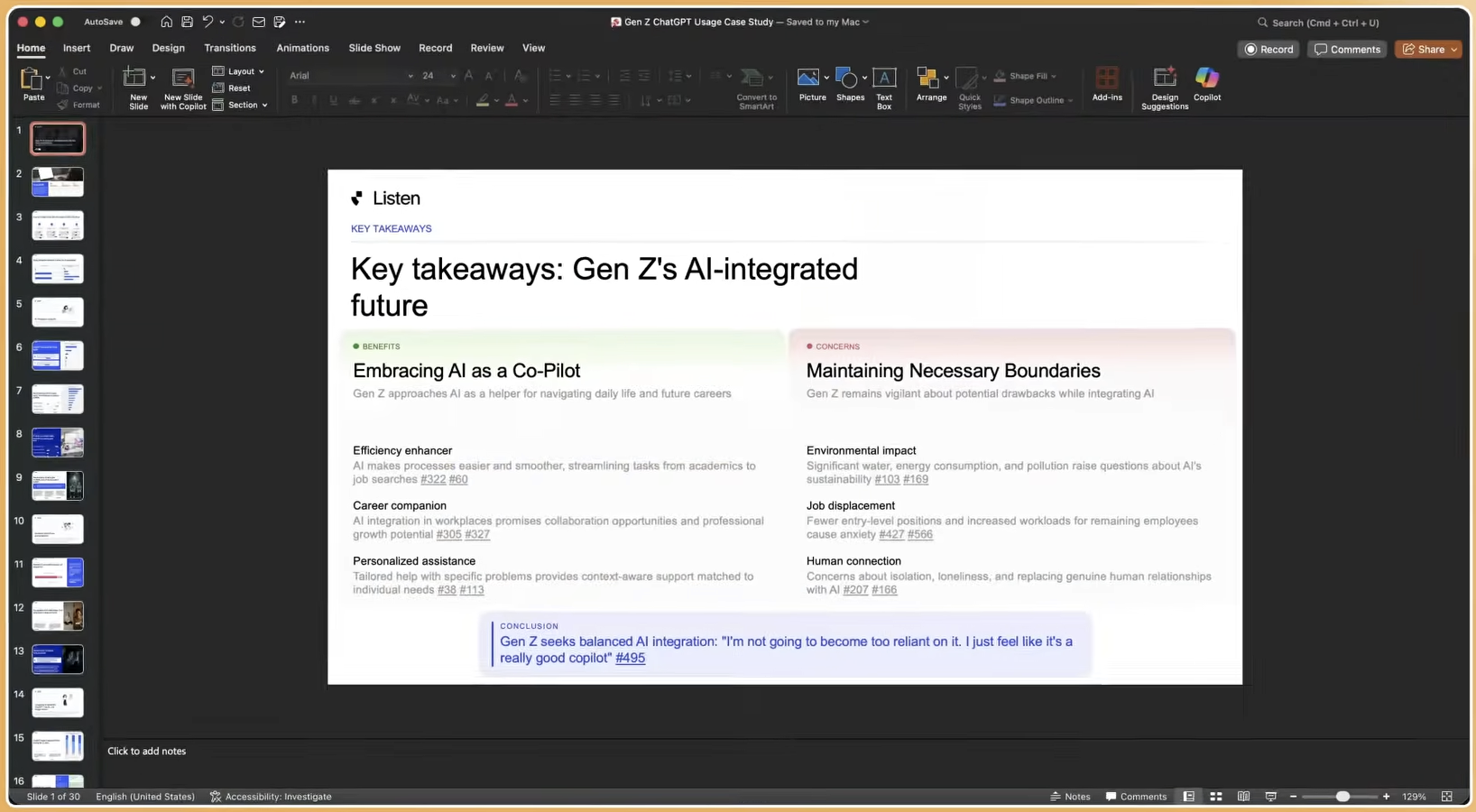
Listen Labs supports live URL and prototype testing with mobile screen recording on iOS, which enables realistic checkout simulations. Listen Atlas recruits participants matching the target buyer profile, including niche segments below 1% incidence rate, within hours. The AI moderator guides participants through defined tasks, probes on hesitation moments, and captures think-aloud commentary. The Emotional Intelligence layer pinpoints exact timestamps where confusion or frustration spikes, even when participants do not verbalize it. Research Agent handles the full analysis workflow: from raw data to final output, and combines severity-ranked issue reports with video clips of the most critical friction moments so teams can act quickly.
The next example shifts from product experience to brand strategy, using the same AI-moderated infrastructure.
Brand Perception Study Example
Objective: Map how target consumers emotionally and cognitively position a brand relative to their expectations and category alternatives.
Method: Semi-structured AI-moderated interviews that combine projective techniques, free association, and direct perception probes with Emotional Intelligence analysis.
Sample size and audience: Fifty to one hundred participants across two to three consumer segments, including brand users, lapsed users, and category non-users for comparative positioning.
Timeline: Traditional agency market research takes 6–12 weeks, and focus group sessions can cost $6,000–$12,000 for 8–10 respondents. Listen Labs delivers a multi-segment brand perception study with the same rapid turnaround described earlier.
Primary deliverables: Brand attribute map, emotional response profile by segment, verbatim quote library, and a gap analysis between intended and perceived positioning.
Business outcome: Brand and marketing teams receive a data-backed brief for repositioning, campaign messaging, or innovation prioritization.
Listen Labs’ Emotional Intelligence layer is particularly valuable in brand perception work, analyzing tone of voice, word choice, and subconscious micro expressions with Ekman’s universal emotions framework across 50+ languages. Every emotional label is traceable to the exact timestamp, verbatim quote, and reasoning behind it, giving brand teams evidence they can present to leadership and tying back to the emotional depth described in earlier sections. Microsoft used Listen Labs to collect global customer stories for its 50th anniversary celebration within a single day, which their Director of Data Science described as reaching “hundreds of users at one third of the cost.”
Jobs-to-be-Done Interviews Example
Objective: Uncover the functional, social, and emotional jobs customers hire a product to perform, and identify unmet jobs that represent innovation opportunities.
Method: JTBD-structured in-depth interviews using the “switch interview” format, which probes the timeline of events leading to a purchase or adoption decision.
Sample size and audience: For qualitative interviews focused on theme identification, a small number of participants often reveals key themes, with saturation reached after additional interviews for tightly scoped questions. For JTBD studies spanning multiple use cases or segments, 30–60 participants provide robust theme coverage.
Timeline: A complete AI-moderated qualitative study fits a 5-day sprint cycle: study design and launch on day one, interviews on day two, analysis on day three, summary shared on day four, and strategy integration on day five.
Primary deliverables: JTBD statement library, ranked job importance matrix, switch timeline narrative, and opportunity scoring by unmet job.
Business outcome: Product and innovation teams receive a prioritized roadmap anchored to real customer demand rather than internal assumptions.
Qualitative data methods make up for limitations in speed and sample size tenfold in their ability to uncover nuance and complexity in human decision-making, and JTBD interviews illustrate this power clearly. Listen Labs’ AI moderator follows the JTBD switch interview structure, probing the timeline of events, the moment of first thought, and the forces pushing and pulling a decision. Listen Atlas recruits participants who have recently made a relevant purchase or adoption decision, which keeps the switch timeline fresh and detailed. Research Agent generates a structured JTBD statement library with supporting verbatims and an opportunity scoring matrix, ready for product planning sessions.
Run your first JTBD study with Listen Labs and receive decision-ready findings on a sprint-friendly timeline.
Additional Methods Supported by AI-Moderated Platforms
Beyond these five foundational use cases, the same AI-moderated infrastructure supports a broader range of customer insight projects. The following examples show how the platform adapts to specialized research needs while maintaining consistent speed and quality.
Concept Testing: Listen Labs presents concepts as images, video, PDFs, or live URLs using monadic or sequential randomization. The AI moderator probes purchase intent, perceived differentiation, and unmet expectations. Research Agent generates a ranked concept scorecard with emotional response profiles and verbatim proof. P&G used this approach to conduct 250+ claim-testing interviews, surface where claims felt exaggerated or unclear before market launch, and directly shape product and brand strategy in hours, not weeks, as their Analytics and Insight Leader confirmed.
Pricing Research: Listen Labs structures pricing interviews with built-in Likert scales, sliders, and open-ended probes, which combine qualitative depth with quantitative pricing signals in a single session. Listen Atlas recruits target buyer profiles across income bands and purchase history segments. Research Agent delivers an acceptable price range analysis with segment breakdowns and verbatim reasoning, ready for finance and product review.
Ad Creative Testing: Platforms like Listen Labs layer on auto-recruiting, transcription, sentiment tagging, and insight summarization so teams jump from question to findings in hours, not weeks. The Emotional Intelligence layer becomes a critical differentiator in ad testing, since two ads may both receive positive verbal ratings while only one triggers genuine joy instead of flat or confused micro expressions. Every emotional signal is quantified per concept and traceable to the exact timestamp, giving creative teams evidence to defend or revise executions before media spend is committed.
Multi-Market Segmentation: Listen Labs conducts parallel interviews across 45+ countries in 100+ languages with automatic translation and transcription, which removes the coordination overhead of multi-vendor global studies. Research Agent compares segment-level findings across geographies with statistical significance testing and delivers a unified global insight report with the same rapid turnaround.
Feature Validation: Research Agent generates a slide deck in your company’s branded template and a downloadable report from feature validation interviews, including a ranked feature priority matrix with supporting verbatims and video clips of the most revealing participant moments. Quality Guard ensures every participant matches the target user profile, with real-time fraud detection across video, voice, content, and device signals.
Frequently Asked Questions
Is AI moderation quality comparable to a trained human researcher?
For most customer insight projects, AI moderation delivers quality comparable to experienced human interviewers and significantly better consistency across large samples. The AI moderator probes deeper on short or interesting answers, adapts follow-up questions in real time, and maintains the same structure and tone across hundreds of simultaneous interviews, which removes variability between human moderators. Listen Labs’ in-house research team, with 50+ years of combined expertise, continuously refines the methodology. Human researchers remain essential for defining objectives and interpreting strategic implications, and Listen Labs handles moderation, coding, and aggregation so researchers can focus on work that requires human judgment.
How does Listen Labs protect participant data and ensure enterprise security?
Listen Labs maintains enterprise-grade security with 256-bit encryption and holds SOC 2 Type II, GDPR, ISO 27001, ISO 27701, and ISO 42001 certifications. Customer data is never used for AI model training. The platform supports enterprise SSO and meets the procurement and legal requirements of Fortune 500 organizations across regulated industries.
Can we use our own customers instead of the Listen Labs panel?
Yes. Listen Labs supports self-recruitment, so organizations can invite participants from their own CRM, user base, or loyalty program at a reduced credit cost. Organizations can also bring their own panel provider. This approach is particularly valuable for churn investigation studies, feature validation with power users, and brand perception studies where existing customer context is essential. The platform handles scheduling, moderation, analysis, and deliverables regardless of participant source.
How can non-researchers run studies without methodology expertise?
Listen Labs’ AI-assisted study co-design lets anyone describe their research goal in plain language and receive a structured interview guide with objectives, questions, and probing context in seconds. The platform then handles recruitment, moderation, analysis, and deliverable generation automatically. Product managers, brand managers, and marketing leaders at enterprises without dedicated research teams use Listen Labs as a self-serve research capability. For teams that want methodological guidance, Listen Labs’ in-house research team is available as a thought and execution partner.
What is the participant quality control process?
Listen Labs applies three layers of quality control. First, Listen Atlas only sources from high-quality, non-commodity panels, so professional survey-takers and incentive-optimizing respondents are excluded. Second, Quality Guard monitors every interview in real time across video, voice, content, and device signals to detect fraud, low-effort responses, AI-generated scripts, and mismatched profiles. Third, participants are capped at three studies per month, which reduces panel fatigue and repeat respondents. A dedicated recruitment operations team adds a human review layer for hard-to-reach segments, including enterprise decision-makers, healthcare workers, and audiences below 1% incidence rate.
Next Steps for Enterprise Insight Teams
Enterprise consumer insights teams considering a shift to AI-moderated qualitative research benefit from starting with an internal readiness audit. Identify three to five study types currently in the backlog that are delayed by recruitment or moderation logistics, and map which of the project examples above align with those requests. A focused pilot, typically a churn investigation or concept test, provides a concrete benchmark for speed, quality, and stakeholder reception before broader adoption.
Listen Labs supports pilot projects with dedicated onboarding and methodology guidance, and the platform’s SOC 2, GDPR, and ISO certifications satisfy enterprise procurement requirements from the first engagement. Plan a pilot with the Listen Labs team to walk through study design and see how your next customer insight project can match the speed and depth described here.