
Written by: Anish Rao, Head of Growth, Listen Labs | Last updated: June 20, 2026
Key Takeaways for Enterprise Research Leaders
- Enterprise research teams face growing backlogs as demand for insights outpaces flat headcount and budgets, which forces shorter studies or delayed decisions.
- Four tool categories, including end-to-end AI platforms, analysis-only tools, panel vendors, and traditional agencies, differ sharply in their ability to cover the full research lifecycle.
- Listen Labs compresses the traditional 4–6 week cycle into under 24 hours while maintaining statistical scale, emotional depth, and enterprise compliance.
- Key differentiators include real-time fraud prevention, multimodal emotional intelligence, adaptive AI moderation, and cross-study knowledge management that competitors lack.
- See Listen Labs in action and experience how it removes the depth-versus-scale trade-off for your research program.
How to Evaluate Qualitative Research Automation Platforms
Enterprise research teams evaluate automation tools against nine criteria, and each one maps to a specific failure mode in traditional research. Cycle time addresses the 4–6 week bottleneck that delays decisions and slows product roadmaps. Depth versus scale balance resolves the trade-off between rich qualitative insight and statistical confidence. Participant quality and fraud prevention counter the rise of AI-generated fake profiles and professional respondents. Global and language reach, emotional signal capture beyond transcripts, analysis transparency and bias reduction, deliverable speed and quality, security and compliance posture, and total cost of ownership determine whether a tool can replace the full vendor stack or simply shift the bottleneck to another stage.
Category-by-Category Evaluation Across the Research Lifecycle
Study Design Capabilities
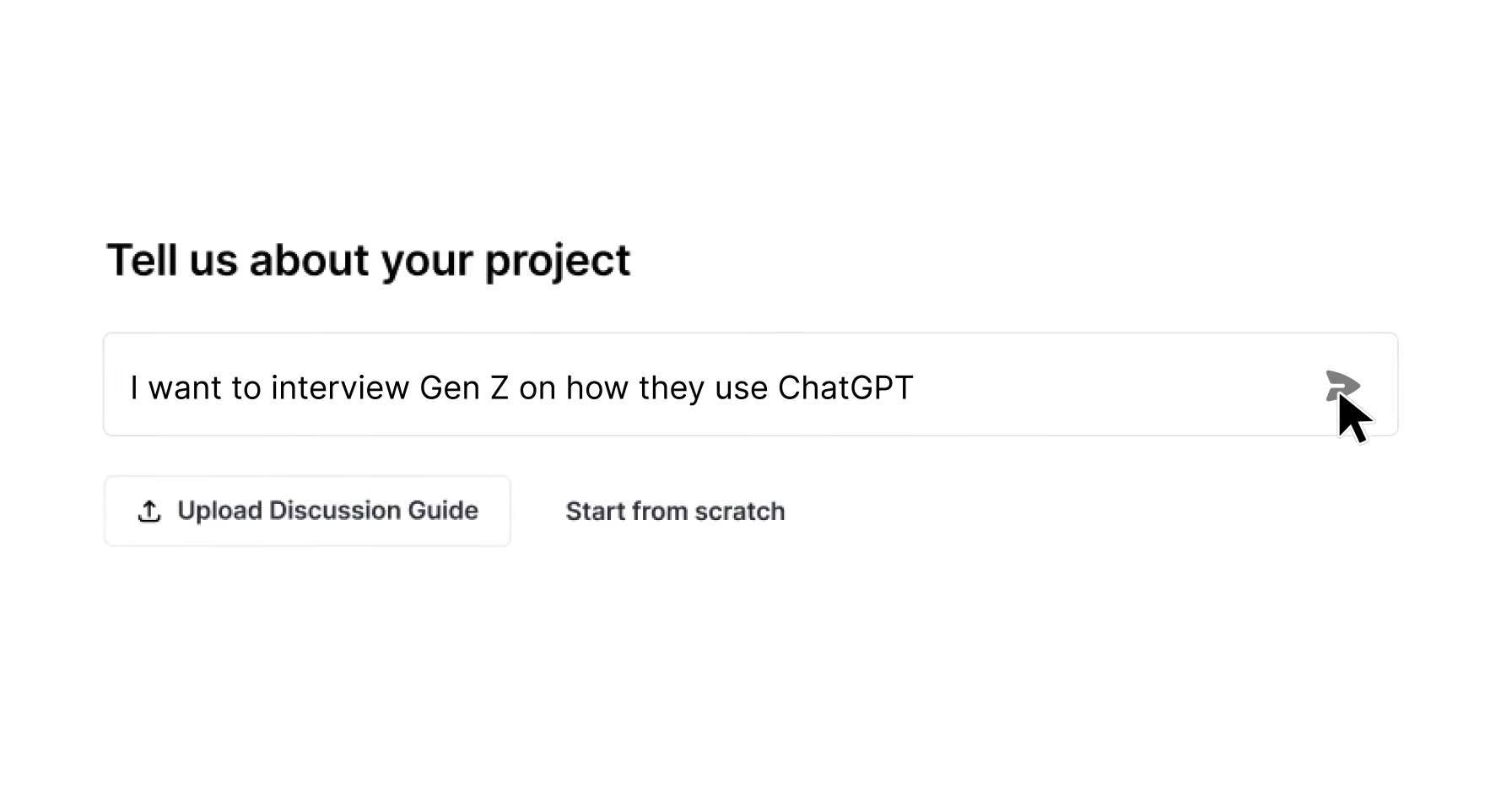
End-to-end AI platforms generate structured study objectives, question sets, and probing logic from a natural-language brief in seconds, with auto-QA that flags methodological issues before launch. Analysis-only tools such as Dovetail have no study design capability and receive data that was designed and collected elsewhere. Panel providers offer templated screeners but no interview guide construction. Traditional agencies provide expert study design, but the process involves multiple briefing rounds and typically adds one to two weeks before fieldwork begins.
Recruitment and Sampling at Enterprise Scale
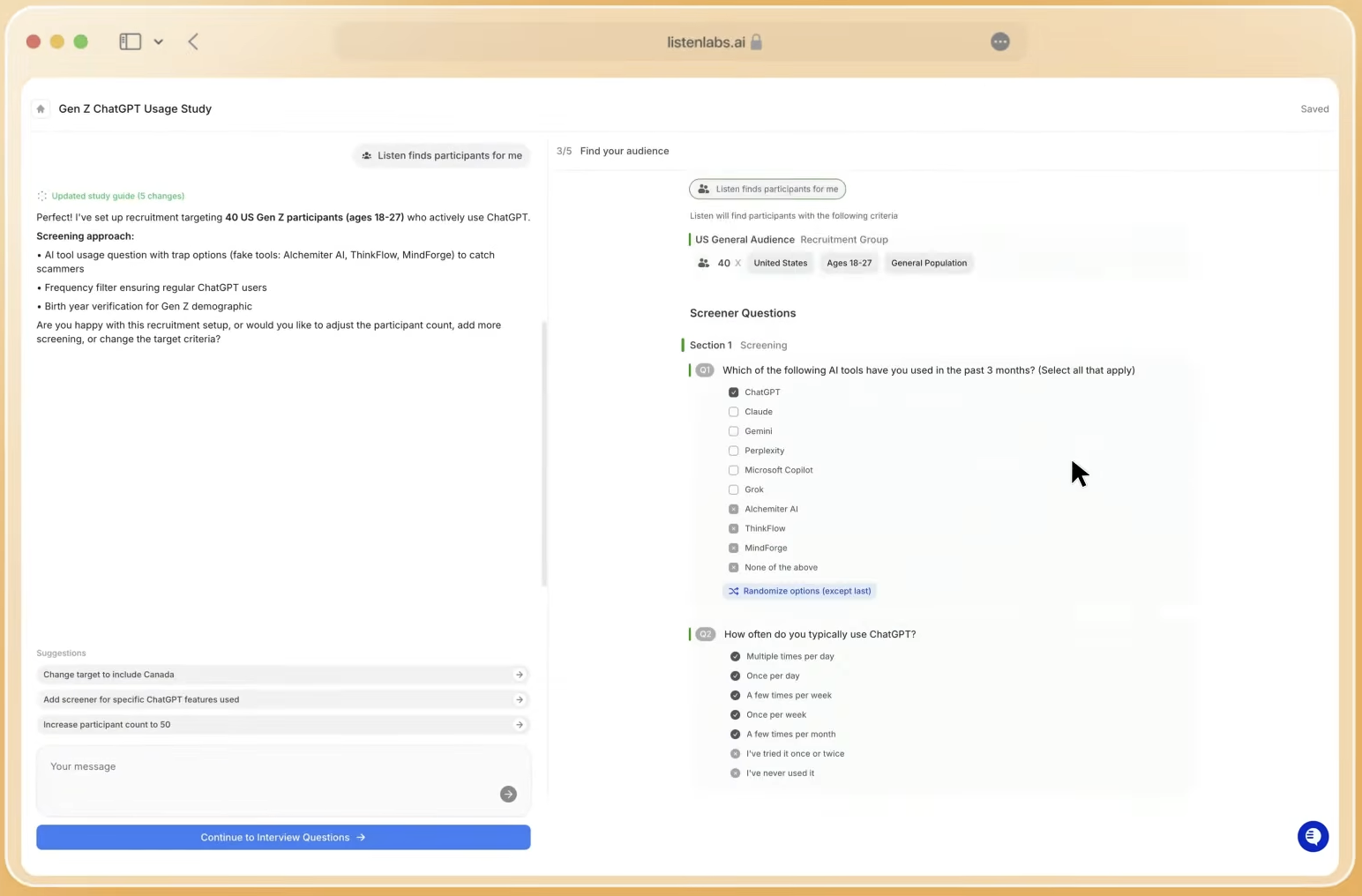
Recruitment is where fragmented stacks break down most visibly. Between recruitment, interviewing, transcription, and qualitative data analysis, research workflows often span multiple systems, and the wrong AI tools shift rather than reduce that complexity. Panel vendors solve sourcing in isolation but hand off to separate moderation and analysis tools, which reintroduces the handoff delays they were meant to eliminate. Analysis-only tools have no recruitment function. Traditional agencies manage recruitment but rely on third-party panels with variable quality controls and geographic limitations. An integrated approach eliminates these handoffs entirely. Listen Labs integrates recruitment directly into the platform through Listen Atlas, an AI orchestration layer that matches across behavioral and intent data across a network of 30M verified respondents spanning 45+ countries and 100+ languages, with a dedicated recruitment ops team for audiences below 1% incidence rate.
Moderation Approach and Throughput
Async AI-moderated formats now account for roughly 80% of new qualitative study starts inside teams that have adopted AI moderation in 2026. End-to-end AI platforms conduct personalized, adaptive conversations with dynamic follow-up questions at any sample size simultaneously. Human-dependent platforms such as UserTesting rely on scheduled moderators, which caps throughput and introduces interviewer variability. Analysis-only tools perform no moderation. Panel providers deliver participants but not moderation. Traditional agencies provide experienced moderators, but session scheduling, no-show management, and sequential interviewing create the primary bottleneck in the 4–6 week cycle.
Data Quality Controls and Fraud Prevention
Generative AI has accelerated the scale and sophistication of criminal operations, enabling fraudsters to target consumers and businesses with greater precision and speed, which creates a direct risk for research panels. Listen Labs addresses this through Quality Guard, which monitors every interview in real time across video, voice, content, and device signals, limits participants to three studies per month, and builds a reputation score across every completed interview. Analysis-only tools apply no pre-collection quality controls. Commodity panel providers vary widely, and many rely on self-reported demographics and post-hoc flagging. Traditional agencies apply human judgment during recruitment screening but have limited real-time fraud detection during fieldwork.
Qualitative Depth at Statistical Scale
Depth is the dimension where analysis-only tools and survey platforms most visibly fall short. Pre-set questions with no adaptive follow-up cannot surface unexpected findings, emotional nuance, or the reasoning behind a stated preference. Platforms like Listen Labs layer on auto-recruiting, transcription, sentiment tagging, and insight summarization so teams jump from question to findings in hours, not weeks. Traditional agencies deliver strong qualitative depth through experienced moderators but at a sample size that limits statistical confidence. End-to-end AI platforms combine adaptive conversation quality with the ability to run hundreds or thousands of simultaneous interviews.
Quantitative Support Within Qualitative Studies
Mixed-method capability, which combines Likert scales, NPS, MaxDiff, and sliders within a qualitative interview, is available only on end-to-end platforms. Analysis-only tools can import quantitative data but do not collect it. Panel providers can field surveys but without conversational depth. Traditional agencies treat qualitative and quantitative as separate workstreams that require separate budgets and timelines.
Analysis Workflow and Time to Insight
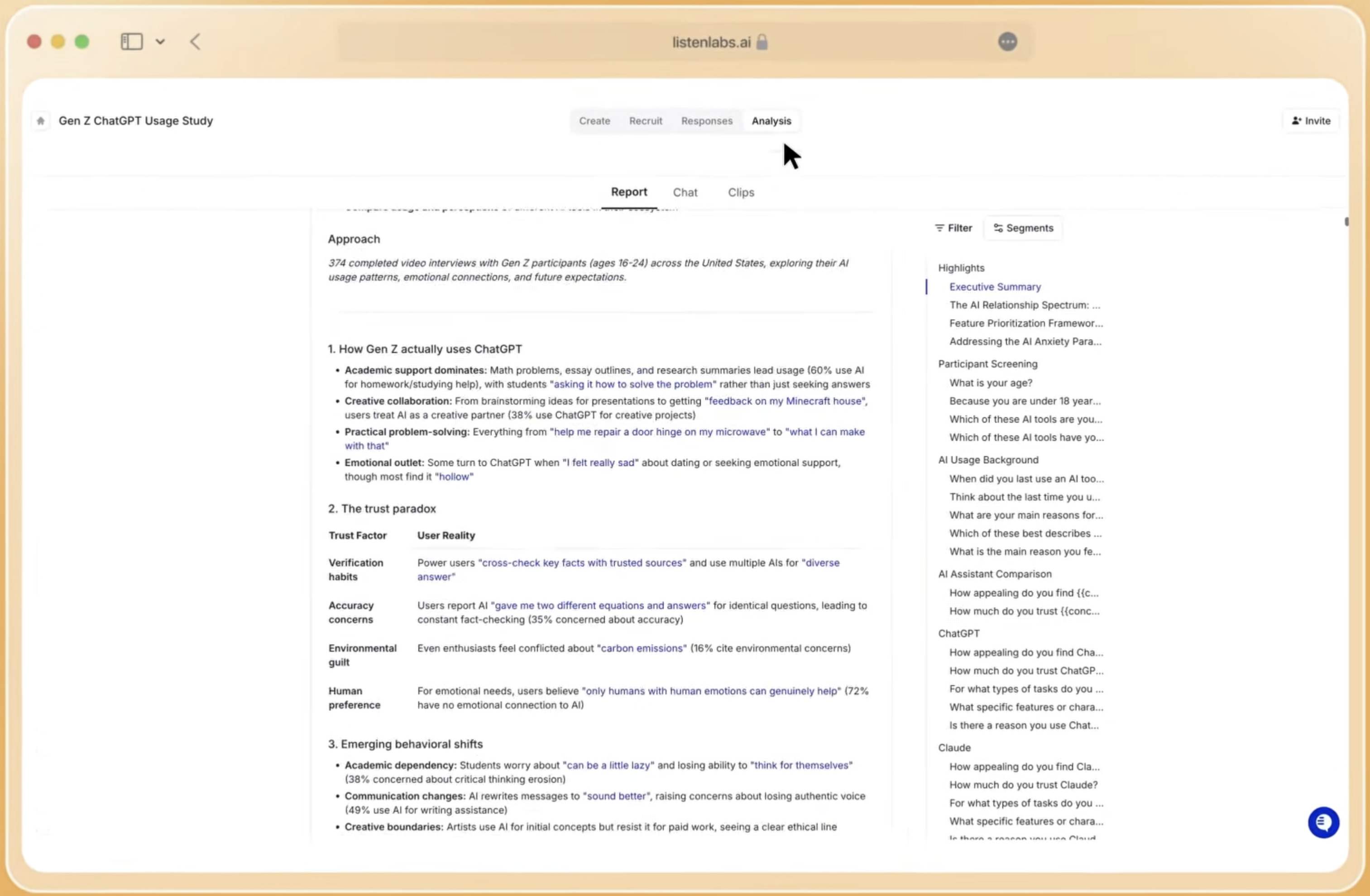
Traditional evidence synthesis typically takes a standard lead time of 4–6 months, and AI-native platforms can reduce this substantially. Analysis-only tools such as Dovetail accelerate the coding and repository stage but require that interviews have already been conducted, transcribed, and imported, which means the upstream time cost remains. End-to-end platforms process all interview data within the same system, eliminate import latency, and maintain traceability from raw response to final theme. One researcher ran a full buying intent analysis across three user segments in under a minute using Listen Labs’ Research Agent.
Deliverable Creation for Stakeholder-Ready Outputs
Research Agent generates a slide deck in a company’s branded template and a downloadable report alongside video highlight reels, statistical charts, and segmentation breakdowns, all in under a minute. Traditional agencies produce consultant-quality deliverables but require manual report writing that adds days to the timeline. Analysis-only tools support deliverable creation but only after data has been imported and coded. Panel providers deliver data files, not synthesized outputs.
Cross-Study Knowledge Management and Reuse
Institutional knowledge loss is a structural problem in fragmented stacks. When studies live across disconnected tools, past findings are inaccessible at the moment a new brief is written. Listen Labs’ Mission Control serves as the organization’s source of truth for everything ever learned from customers, enabling cross-study queries, trend tracking, and answers from past research in seconds. Analysis-only tools provide repository functionality but only for studies conducted elsewhere. Traditional agencies retain institutional knowledge within their own teams, not the client’s systems.
The nine workflow stages above determine whether a platform can execute research at enterprise scale. One capability, multimodal emotional intelligence, separates platforms that capture what participants say from those that capture what they feel.
Multimodal Emotional Intelligence as a Strategic Differentiator
Transcript-only analysis captures what participants say but misses how they feel while saying it. It does not capture a frown during a product demo, a moment of hesitation before answering a pricing question, or the flat affect that accompanies a politely positive rating. Emotion AI technologies use machine learning algorithms, natural language processing, facial expressions, voice intonations, and physiological signals to assess emotional states from multimodal data, which enables systems to understand and respond to human emotions in real time.
Listen Labs’ Emotional Intelligence analyzes three simultaneous signal layers, including tone of voice, word choice, and subconscious micro-expressions, built on Ekman’s universal emotions framework, the same standard used in clinical psychology. Every emotion is quantified per question and concept, and every label is traceable to the exact timestamp, verbatim quote, and reasoning behind it. This approach avoids a black-box sentiment score and instead provides an auditable emotional record across 50+ languages. For creative testing, concept comparison, usability testing, and brand research, this dimension produces findings that transcript-only tools structurally cannot generate. The capability integrates directly with the Research Agent for natural-language queries, charts, and highlight reels of emotionally significant moments.
Scenario-Based Best-Fit Use Cases by Role
Consumer Insights Leaders at Fortune 500 enterprises who run 5–10x more studies without added headcount require an end-to-end platform with enterprise-grade fraud prevention, global reach, and cross-study knowledge management. A traditional agency or fragmented stack cannot meet that throughput requirement within budget. A Director of Data Science at Microsoft noted, “I can reach out to hundreds of users at one third of the cost,” with global customer stories for Microsoft’s 50th anniversary collected within a day.
UX Research Leads who need to test with 50–100+ users per sprint cycle rather than 5–10 require AI moderation with screen-sharing capability and same-day turnaround. Analysis-only tools do not solve the recruitment or moderation bottleneck. Switching to AI-moderated interviews let Chubbies capture hundreds of candid, one-to-one conversations overnight.
Product Managers and Marketing Leaders without dedicated research teams need self-serve study design that converts a natural-language brief into a fielded study without methodology expertise. Survey tools provide scale without depth, and agencies require budget and lead time that most product teams cannot absorb.
Agencies and consultancies operating on client timelines measured in days need global panel access, niche audience recruitment, and deliverables that arrive before the next client meeting. A Director of Product Strategy at Anthropic described the outcome, “Listen Labs lets us understand user churn with a level of clarity and speed we’ve never had before,” with 300+ user interviews completed in 48 hours.
Operational and Long-Term Considerations for Enterprise Rollout
Adopting an end-to-end platform requires stakeholder alignment across research, legal, IT, and procurement, and this alignment effort dominates most implementations. MIT Sloan research found that 80% of implementation effort for an AI agent involved data engineering, stakeholder alignment, governance, and workflow integration rather than prompt engineering or model fine-tuning. This reality makes security and compliance requirements non-negotiable for enterprise deployments. Listen Labs holds SOC 2 Type II, GDPR, ISO 27001, ISO 27701, and ISO 42001 certifications, with 256-bit encryption and a policy of never using customer data for AI model training. Platforms holding SOC 2 Type II and ISO 27001 certifications provide a documented compliance foundation that can simplify IRB review and legal sign-off for enterprise qualitative research programs.
For ongoing global programs, repeatability and performance consistency across markets matter as much as initial study quality. Listen Labs supports 100+ languages for interview moderation with automatic translation and transcription, which enables a single research program to run simultaneously across 45+ countries without separate vendor relationships per region.
Risks and Limitations of Qualitative Research Automation
Rigid study designs that do not allow adaptive follow-up produce shallow data regardless of sample size. The depth advantage of qualitative research depends on the AI’s ability to probe unexpected responses, and platforms that use fixed question sequences replicate the limitations of surveys at higher cost. Slow turnaround from manual workflows persists in hybrid stacks where AI tools handle only one stage, and in those cases the bottleneck simply moves rather than disappears.
Hidden recruitment complexity often goes unrecognized during tool selection. The best market research platforms combine AI analytics, multi-channel collection, and panel access in one system, eliminating the need to juggle multiple disconnected tools, yet platforms that claim end-to-end capability while relying on commodity panel integrations inherit the fraud and quality problems of those panels. Fraud risk in 2026 is not theoretical, because generative AI enables sophisticated identity fabrication at scale, and platforms without real-time multimodal quality controls are exposed.
Overestimating automation also creates risk for research quality. Human researchers must perform the final synthesis and validation stage after NLP-assisted coding, interpreting implications, connecting findings to business context, and stress-testing conclusions against disconfirming evidence before any deliverables are generated. Faster tools do not automatically produce better research; they produce faster outputs that still require researcher judgment to contextualize and apply.
Decision Framework and Practical Checklist
Research leaders benefit from a structured sequence of questions that moves from lifecycle coverage through quality controls to cost structure. The first step confirms whether the platform covers the full lifecycle from study design through deliverable generation or requires upstream or downstream tools that reintroduce delays. If the platform claims end-to-end capability, the next step evaluates recruitment infrastructure, including real-time fraud detection, behavioral matching, and frequency limits, rather than self-reported demographics and post-hoc flagging. Once quality is confirmed, leaders assess whether the platform can conduct adaptive, conversational interviews at the sample sizes required for statistical confidence. Emotional signal capture then comes into focus, and teams check whether analysis extends beyond transcript sentiment to multimodal signals. Security certifications must be current and applicable to the organization’s compliance requirements. Global programs require support for the languages and geographies in scope. Finally, total cost of ownership should be calculated across the full vendor stack being replaced, not just the platform license.
Traditional qualitative studies can cost hundreds of dollars per participant, and AI moderation changes that equation. With AI moderation, the same budget can support substantially more participants, each receiving an adaptive conversation. The cost-per-insight calculation shifts the evaluation entirely when applied across an annual research program.
Frequently Asked Questions
How long does a full qualitative study take with automation tools in 2026?
Timelines vary by tool category and by how many workflow stages the platform actually covers. Traditional agencies running a full qualitative study, from study design through final report, typically require 4–6 weeks, and in enterprise settings with internal prioritization queues, the timeline can extend to several months. Analysis-only tools do not reduce fieldwork time and accelerate only the coding and synthesis stage after data has already been collected. Panel providers reduce recruitment lead time but do not address moderation or analysis. End-to-end AI platforms compress the entire cycle by keeping every stage in one system. Listen Labs delivers results in less than 24 hours by handling study design, recruitment from its 30M+ verified panel, AI-moderated interviews, automated analysis, and deliverable generation within a single platform, which enables weekly or even higher-frequency studies for continuous research programs.
How do end-to-end platforms source and verify participants compared with panel vendors?
Panel vendors source participants and hand them off to separate moderation and analysis tools, with quality controls that vary widely by provider. Many commodity panels rely on self-reported demographics and incentive-driven participation, which increases the risk of professional survey-takers and fraudulent profiles. End-to-end platforms with integrated recruitment infrastructure apply quality controls at every stage. Listen Labs’ Listen Atlas uses behavioral and intent data, not just demographics, to match participants, while Quality Guard monitors every interview in real time across video, voice, content, and device signals. Participants are limited to three studies per month to reduce panel fatigue and professional respondents. A dedicated recruitment ops team handles niche audiences below 1% incidence rate, including enterprise decision-makers, healthcare workers, and specialized consumer segments. Organizations can also bring their own participants and study them at reduced cost.
What is the difference between AI-moderated and human-moderated interviews for depth and scale?
Human-moderated interviews deliver strong qualitative depth when conducted by experienced researchers, but the moderation model caps throughput at the number of available moderators and scheduled sessions. A typical human-moderated study reaches 15–30 participants over several weeks. AI-moderated interviews run simultaneously across hundreds or thousands of participants, with each conversation personalized and adaptive, and the AI probes deeper on short or unexpected answers in a way that mirrors a trained interviewer. The depth-versus-scale trade-off that defined qualitative research for decades reflects human bandwidth rather than methodology. AI moderation removes that constraint. Listen Labs’ AI-moderated interviews support 100+ languages, collect video, audio, text, and screen recordings, and combine qualitative conversation with quantitative formats in a single session, which produces more actionable findings than a small human-moderated study for most research objectives.
Which qualitative research automation tools best support multilingual enterprise programs?
Multilingual support varies significantly across categories and often determines whether a platform can support global programs. Analysis-only tools may offer translation features for imported transcripts but do not conduct interviews in participants’ native languages. Panel providers can source participants in multiple markets but depend on separate moderation tools for language support. Traditional agencies typically manage multilingual programs through regional partners, which adds coordination overhead and timeline risk. End-to-end platforms with native multilingual moderation eliminate these dependencies. Listen Labs supports 100+ languages for interview moderation with automatic translation and transcription, covers 45+ countries across the Americas, Europe, APAC, and MEA, and delivers Emotional Intelligence analysis across 50+ languages. A single study brief can field simultaneously across global markets without separate vendor relationships, regional scheduling coordination, or post-hoc translation workflows.
How do security and compliance requirements differ across automation platforms?
Security and compliance posture varies substantially across the qualitative research automation landscape and often determines whether a platform clears legal review. Analysis-only tools typically hold SOC 2 certifications covering their repository and coding functions. Panel providers maintain compliance frameworks for participant data but may not cover the full data lifecycle once participants enter a third-party moderation environment. Traditional agencies operate under contractual data handling agreements that vary by engagement. Enterprise deployments require a platform that maintains certifications covering the full research lifecycle, including collection, storage, analysis, and deliverable generation. Listen Labs holds SOC 2 Type II, GDPR, ISO 27001 for information security management, ISO 27701 for privacy information management, and ISO 42001 for AI management systems, with 256-bit encryption and a firm policy against using customer data for AI model training. For organizations subject to IRB review or operating in regulated industries, the combination of ISO 42001 and a traceable audit trail linking every AI-generated code to its source verbatim provides the documented compliance foundation that legal and procurement teams require.
Conclusion: Choosing a Platform That Matches Enterprise Demands
The qualitative research automation tools landscape in 2026 spans four distinct categories with fundamentally different capability profiles. Analysis-only tools accelerate one stage of a process that still requires separate vendors for every other stage. Panel providers solve recruitment without addressing moderation, analysis, or deliverables. Traditional agencies deliver quality at a speed and cost that cannot support the volume of research modern enterprises require. End-to-end AI platforms remove many of these trade-offs when the platform covers the full lifecycle with enterprise-grade quality controls, multimodal emotional intelligence, and cross-study knowledge management built in.
Listen Labs is the only platform trusted by Microsoft, P&G, Anthropic, Robinhood, Google, Sony, and other global enterprises that meets all nine evaluation criteria simultaneously, a combination that analysis-only tools, panel vendors, and traditional agencies cannot match because of the architectural trade-offs discussed throughout this guide. Listen Labs has run over 1 million AI-powered customer interviews and raised $69 million in Series B funding at a valuation over $500 million, which signals enterprise validation that point solutions and fragmented stacks cannot match.