
Written by: Anish Rao, Head of Growth, Listen Labs | Last updated: July 9, 2026
Key Takeaways on 2026 Qualitative Research Costs
- Traditional qualitative research in 2026 remains expensive. Twenty in-depth interviews cost $15,000–$30,000, and focus group programs often exceed $90,000 because multiple vendors and long timelines drive up labor and overhead.
- Five main cost drivers shape most budgets: recruitment and screening, participant incentives, moderation, analysis and reporting, and project management. Together they create 4–6 week project cycles and limit how many studies teams can run.
- AI-powered platforms like Listen Labs cut costs by about two-thirds by running the entire research lifecycle in a single system. This consolidation removes handoff delays and much of the manual work.
- Enterprise clients such as Microsoft, Anthropic, P&G, and Skims have validated these savings. They report faster turnaround and richer data at significantly lower cost than traditional agency models.
- Listen Labs delivers equivalent or superior insight at roughly one-third the price in under 24 hours, so you can compare your next qualitative study cost against traditional agency pricing with real numbers.
Why Traditional Qualitative Research Projects Still Cost So Much
Traditional qualitative research still relies on a fragmented vendor stack, which keeps costs high. A typical project requires a panel provider, a recruiter, a moderator, a transcription service, an analyst, and a report writer, often from separate firms. Each handoff adds time, cost, and quality risk.
S&P 500 companies spend tens of billions of dollars annually on consumer polling to test products, features, and public sentiment. This fragmented infrastructure matters because the largest line items, such as recruitment, moderation, and analysis, remain heavily human-dependent in traditional agency models. As a result, teams face 4–6 week cycles that create backlogs, limit study volume, and force trade-offs between depth and scale.
2026 Cost Ranges by Qualitative Methodology
The ranges below reflect full-service agency pricing in the United States for common qualitative methodologies in 2026.
In-Depth Interviews (IDIs) — 20 interviews: $15,000–$30,000
IDIs — B2B Specialist — Per respondent (doctors, C-suite): $2,000–$5,000
Focus Groups — 4–6 groups, 2–3 markets: $24,000–$90,000
Ethnographic / Field Studies — Multi-city, multi-week: $15,000–$35,000+
Moderated Usability Study — agency-run: varies by scope
A single 60-minute human-moderated IDI costs $500–$1,500 when moderator preparation, conduct, transcription, and preliminary analysis are included. Traditional focus groups run $4,000–$12,000 per 90-minute session and take 3–5 weeks to complete. Remote or online focus groups often cost less than equivalent in-person sessions, but the structural cost drivers, such as recruitment, moderation, and analysis, remain the same.
Primary Cost Drivers in Qualitative Research Budgets
Clear visibility into where budgets go helps teams control spend. A standard 20-interview IDI project typically breaks down across five cost categories:
- Recruitment and screening (15–25%): Screening, confirmation, and no-show management drive this cost. For hard-to-reach B2B audiences, lower incidence rates multiply the cost per qualified recruit.
- Participant incentives (15–30%): General consumers receive $75–$150 incentives, while specialist professionals receive $200–$500.
- Moderation (15–25%): Senior US/UK focus group moderators typically charge $75–$150 per hour. A 20-interview project at 60 minutes per session generates substantial moderator fees before analysis even begins.
- Analysis and reporting (20–30%): Manual transcript coding for a 20-interview study consumes significant time. Additional hours for thematic synthesis add $4,500–$15,000 at fully loaded analyst rates.
- Project management (10–15%): Scheduling, client communication, and quality control add overhead that compounds across every other line item.
These five categories represent the visible line items in most qualitative research budgets, but they do not capture the full cost picture. Participant fraud and low-quality panels introduce a hidden cost that rarely appears as its own line item yet compounds across multiple categories. Commodity panels carry professional survey-takers and fraudulent profiles that inflate recruitment volumes and corrupt data quality, which forces extra quality-assurance rounds that consume analyst time and budget.
How Listen Labs Cuts Qualitative Research Costs by Two-Thirds
Listen Labs replaces the fragmented stack of panel providers, moderators, transcription services, and analysts with a single end-to-end platform. The entire research lifecycle, including study design, recruitment, AI-moderated interviews, analysis, and deliverables, runs inside one system. This consolidation removes handoff costs and delays that inflate traditional project budgets.
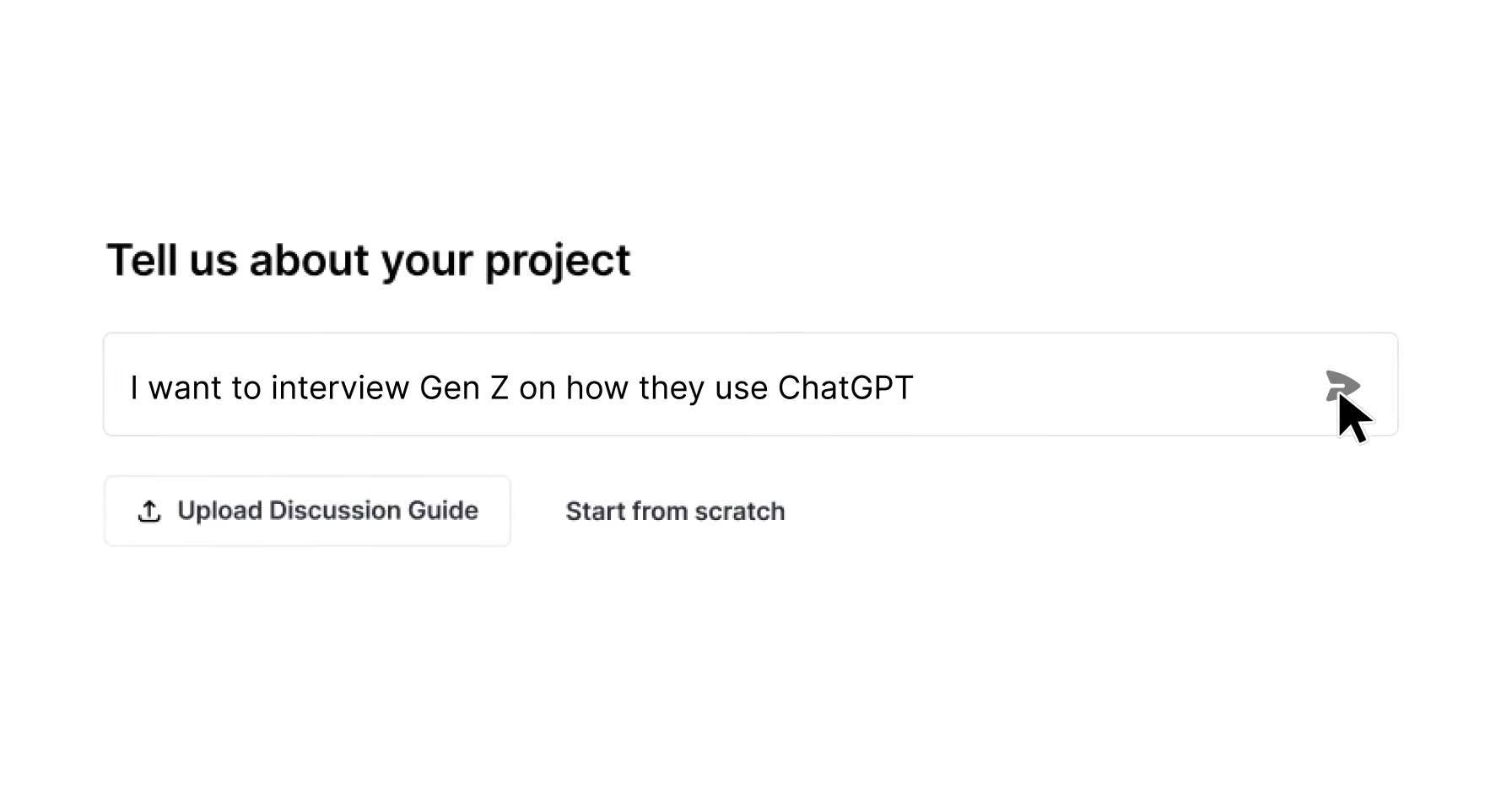
Two proprietary systems directly address the cost drivers described above. Listen Atlas, the platform’s AI orchestration layer, matches and recruits participants across a network of 30M verified respondents in 45+ countries, removing the manual screening overhead that represents the largest single cost category. Quality Guard monitors every interview in real time for fraud, low-effort responses, and repeat respondents, and limits participants to three studies per month. This approach eliminates the professional survey-taker problem that inflates recruitment costs and corrupts data.
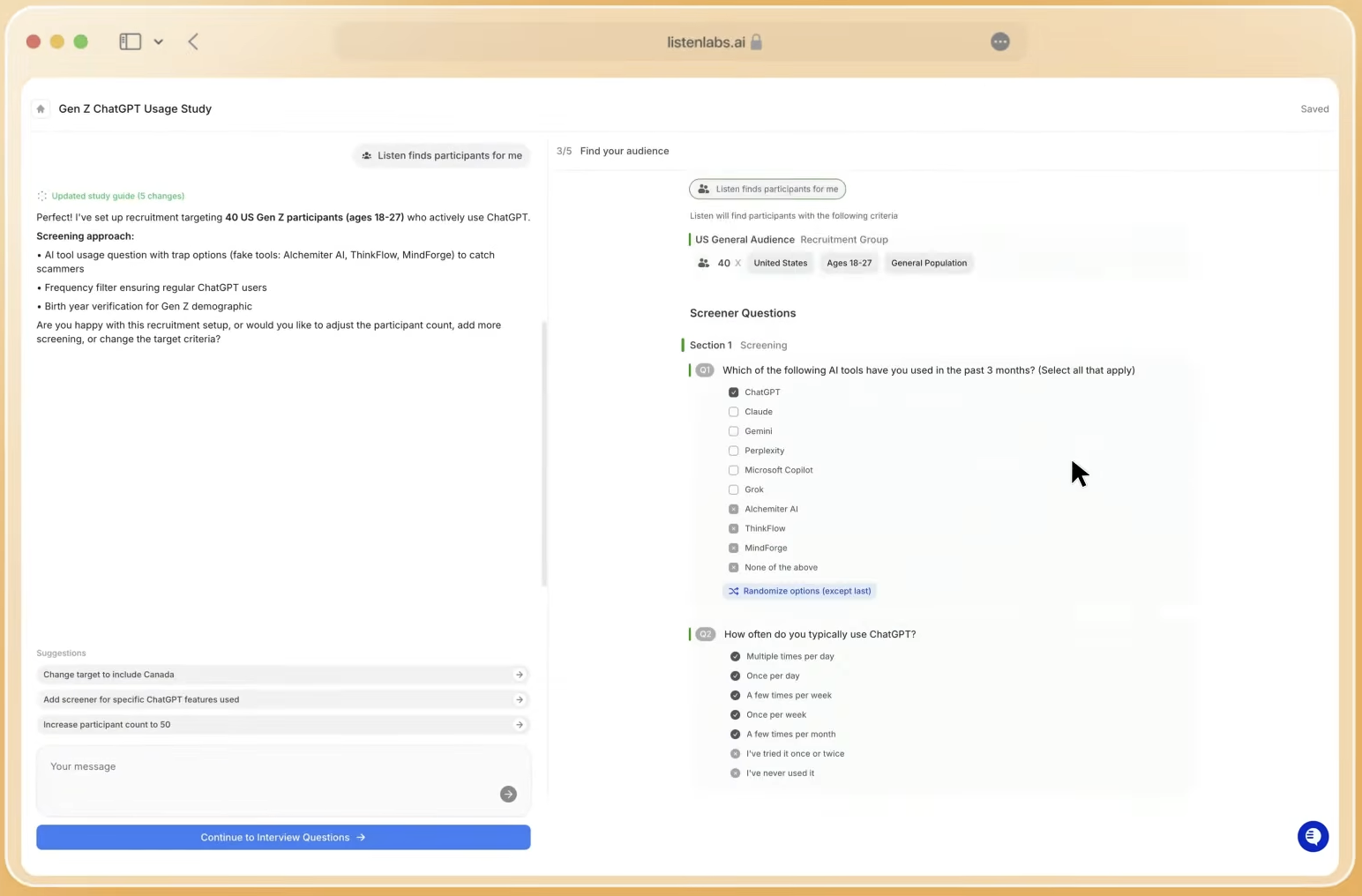
These architectural advantages translate directly into measurable cost and speed improvements. Enterprise clients across technology, consumer goods, and fashion have validated these savings at scale:
- Microsoft collected global customer video stories for its 50th anniversary within a single day. The Director of Data Science at Microsoft noted, “I can reach out to hundreds of users at one third of the cost.”
- Anthropic completed 300+ user interviews in 48 hours to surface churn drivers for Claude Code, moving about five times faster than traditional methods, and received a prioritized list of 10 must-fix product items.
- P&G delivered 250+ interviews with quantified themes and verbatim proof in hours, which directly shaped product and brand strategy before market launch.
- Skims identified and qualified thousands of premium consumers overnight, removed weeks of recruiting, and enabled board-level buy-in on a global campaign launch.
AI Qualitative Research Cost Savings Explained
AI-powered platforms create structural savings rather than small discounts. A 20-interview IDI project that costs $15,000–$30,000 through a traditional agency typically delivers results in 4–6 weeks. The same scope on an AI platform can deliver results in 5–10 days at significantly lower cost. At five markets, traditional IDI costs can exceed $75,000, while AI-moderated interviews cover the same scope for a fraction of that spend.
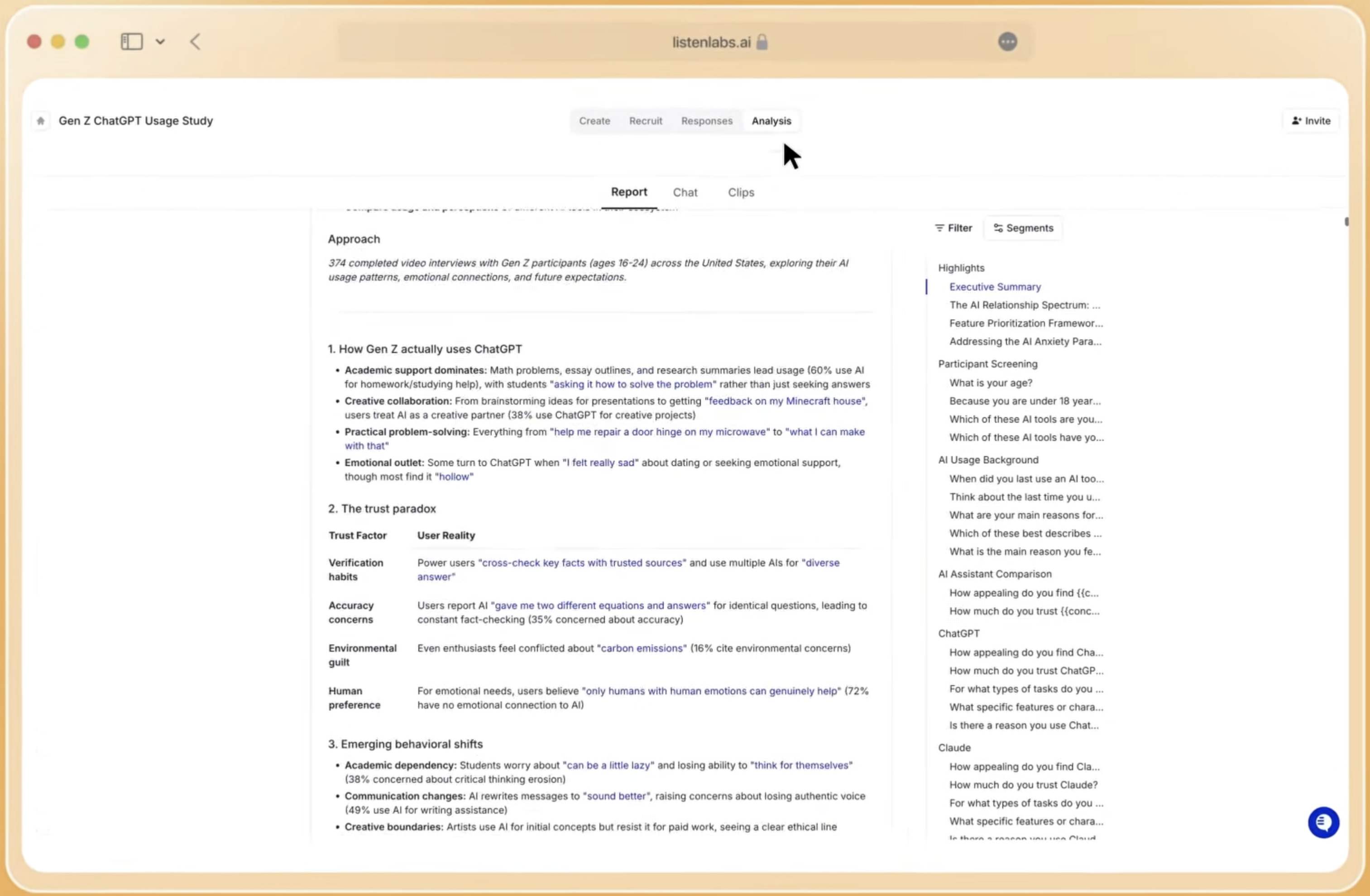
AI also removes the historic trade-off between depth and scale. Listen Labs conducts hundreds of AI-moderated interviews at the same time, and each interview uses dynamic follow-up questions that probe deeper on interesting or short answers. This mirrors how a trained human interviewer behaves. AI-moderated interviews generate more insightful words per respondent than traditional surveys, which produces richer data at a fraction of the cost.
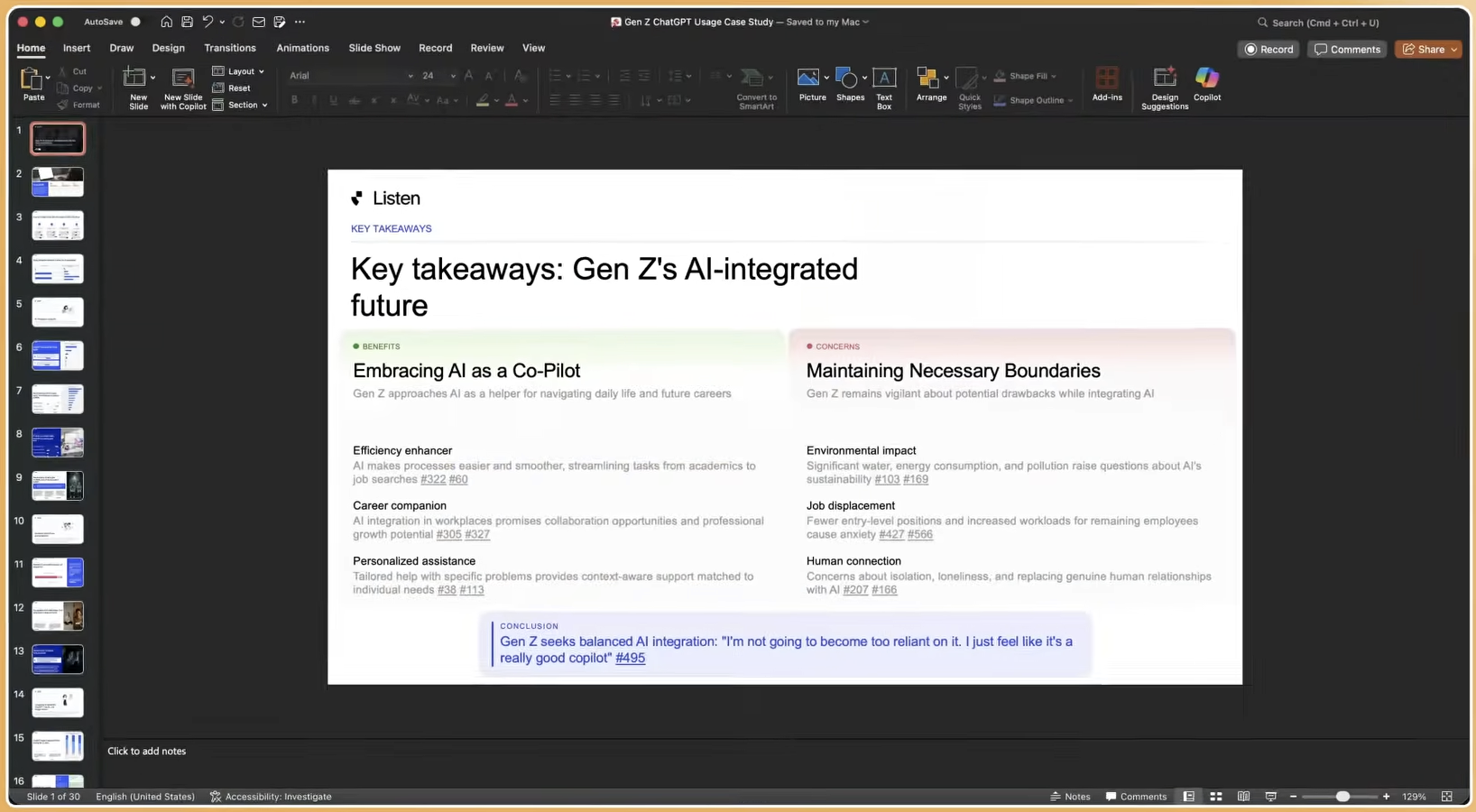
Choosing Between Traditional Agencies and AI Platforms
Different research objectives call for different approaches, so teams benefit from a clear decision framework. The guidelines below map stakeholder constraints to the most appropriate methodology.
Traditional agencies remain appropriate when:
- The study requires in-person ethnographic observation or physical product interaction that cannot be replicated remotely.
- Regulatory requirements, such as FDA-regulated medical device usability testing, mandate specific moderation protocols.
- The audience is so specialized that bespoke sourcing through niche networks is the only viable path.
AI platforms deliver equivalent or superior insight when:
- The research objective involves concept testing, brand perception, consumer journey mapping, creative testing, churn analysis, or product feedback, which represent the majority of enterprise qualitative workloads.
- Speed to insight is a competitive requirement, such as sprint cycles, campaign launches, or product decisions.
- Scale is needed, for example 50–500+ interviews that would be cost-prohibitive under a human moderation model.
- Multi-market coverage is required without proportional budget increases.
On data security, Listen Labs holds SOC 2 Type II, GDPR, ISO 27001, ISO 27701, and ISO 42001 certifications. Customer data is never used for AI model training, and all data is protected with 256-bit encryption. Enterprise SSO is supported, which meets the governance requirements of Fortune 500 procurement and legal teams.
Readiness Checklist for Adopting an AI Research Platform
Insights leaders can reduce adoption risk by working through a simple readiness checklist before committing to an AI research platform.
- Data governance: Confirm that the platform holds relevant certifications (SOC 2, GDPR, ISO 27001) and that its data handling policies align with your organization’s requirements.
- Stakeholder alignment: Identify internal champions in product, brand, and marketing who will benefit from faster turnaround, and build the business case around their specific backlogs.
- Research maturity: Evaluate whether your team has the study design expertise to brief an AI platform effectively, or whether you need a platform with built-in AI-assisted study co-design.
- Pilot scope: Select a study type you run repeatedly, such as concept testing, creative testing, or churn interviews, as a controlled pilot to benchmark quality and cost against your existing baseline.
- Participant strategy: Decide whether you will use the platform’s panel, bring your own participants, or combine both approaches to balance cost and quality.
Frequently Asked Questions About Qualitative Research Costs
This section addresses common questions about qualitative research costs, timelines, and methodology choices.
Why is qualitative research so expensive?
Five compounding factors drive the cost of qualitative research: participant recruitment and screening, participant incentives, human moderation, manual analysis and reporting, and project management overhead. Each factor is labor-intensive and time-dependent. Recruitment and screening, the largest single cost driver mentioned earlier, becomes particularly expensive for hard-to-reach B2B audiences where incidence rates are lower. When all five cost drivers operate simultaneously across a 4–6 week timeline, total project costs for a standard 20-interview IDI study reach the ranges established above even before agency margins are applied.
How does sample size affect project budget?
In traditional qualitative research, cost scales almost linearly with sample size because each additional interview requires more recruitment, moderation, transcription, and analysis time. Adding 10 interviews to a 20-interview project can add $8,000–$15,000 to the total budget. On AI platforms like Listen Labs, the marginal cost per additional interview is substantially lower because moderation and analysis are automated. Larger sample sizes, such as 50, 100, or 500 interviews, become economically viable for the first time in qualitative research, which collapses the historical trade-off between depth and scale.
When should I choose traditional agencies versus AI platforms?
Traditional agencies fit studies that require in-person ethnographic observation, physical product interaction, or regulatory moderation protocols that cannot be replicated in an AI-moderated environment. For the majority of enterprise qualitative workloads, including concept testing, brand perception, creative testing, consumer journey mapping, churn analysis, and product feedback, AI platforms deliver equivalent methodological rigor at significantly lower cost and with faster turnaround. The decision should reflect the specific research objective, timeline requirements, budget constraints, and whether the audience can be reached through a verified global panel.
How do AI platforms ensure participant quality and data privacy?
Listen Labs addresses participant quality through three layers. First, it uses a curated network of 30M verified respondents that excludes commodity panels. Second, Quality Guard real-time monitoring detects fraud, low-effort responses, and repeat respondents during every interview. Third, a participant frequency limit of three studies per month per person removes professional survey-takers from the pool. On data privacy, Listen Labs maintains SOC 2 Type II, GDPR, ISO 27001, ISO 27701, and ISO 42001 certifications. Customer data is protected with 256-bit encryption and is never used for AI model training. Enterprise SSO is supported for organizations with centralized identity management requirements.
Next Steps: Audit and Modernize Your Research Spend
Auditing your current research spend provides a concrete baseline for potential savings. Focus on three dimensions: total annual budget allocated to qualitative studies, average time from study brief to final deliverable, and the number of research requests that go unfulfilled each quarter because of capacity or budget constraints.
With those three numbers, you can calculate the cost of your current backlog and model the impact of compressing timelines from weeks to hours. Organizations running 10–20 qualitative studies per year at traditional agency rates typically spend $200,000–$600,000 annually on work that an AI platform can deliver for $60,000–$200,000, while also increasing study volume and speeding up decisions.
Listen Labs supports a structured pilot process for enterprise teams. You select a study type you run repeatedly, run it in parallel on Listen Labs, and then compare quality, cost, and timeline against your existing baseline. The pilot is scoped to your specific research objectives, audience, and deliverable requirements.