
Written by: Anish Rao, Head of Growth, Listen Labs | Last updated: June 29, 2026
Key Takeaways for CX Phenomenology
- Phenomenological research in CX uncovers the emotional essence of customer experiences instead of relying only on behavioral metrics or survey ratings.
- Bracketing assumptions, recruiting information-rich participants, and using AI-moderated interviews create rigorous, scalable phenomenological studies.
- Emotional signals such as tone, micro-expressions, and word choice are captured and quantified to add depth beyond verbal transcripts alone.
- Structured analysis frameworks like Colaizzi, Moustakas, and IPA are accelerated by AI while preserving researcher-led validation and member checking.
- Listen Labs makes it possible to complete full phenomenological studies from brief to deliverable in under 24 hours, so see how in a live walkthrough.
Step 1: Bracketing and Reflexive Journaling for CX Teams
Bracketing, also called epoché in the Husserlian tradition, requires researchers to identify and set aside their prior assumptions, hypotheses, and theoretical frameworks before engaging with participant data. Without this step, analyst bias contaminates theme extraction and undermines the validity of findings.
Every team member involved in study design or analysis keeps a reflexive journal that documents expectations about the customer experience under investigation. Entries record assumed pain points, anticipated emotional responses, and any organizational pressures that might skew interpretation. These journals form an audit trail that peer reviewers and stakeholders can inspect to confirm that emergent themes arise from participant data rather than researcher projection. For enterprise teams running multiple concurrent studies, a shared bracketing protocol, reviewed during study kickoff, standardizes this practice across analysts.
Step 2: Recruiting Information-Rich Participants at Scale
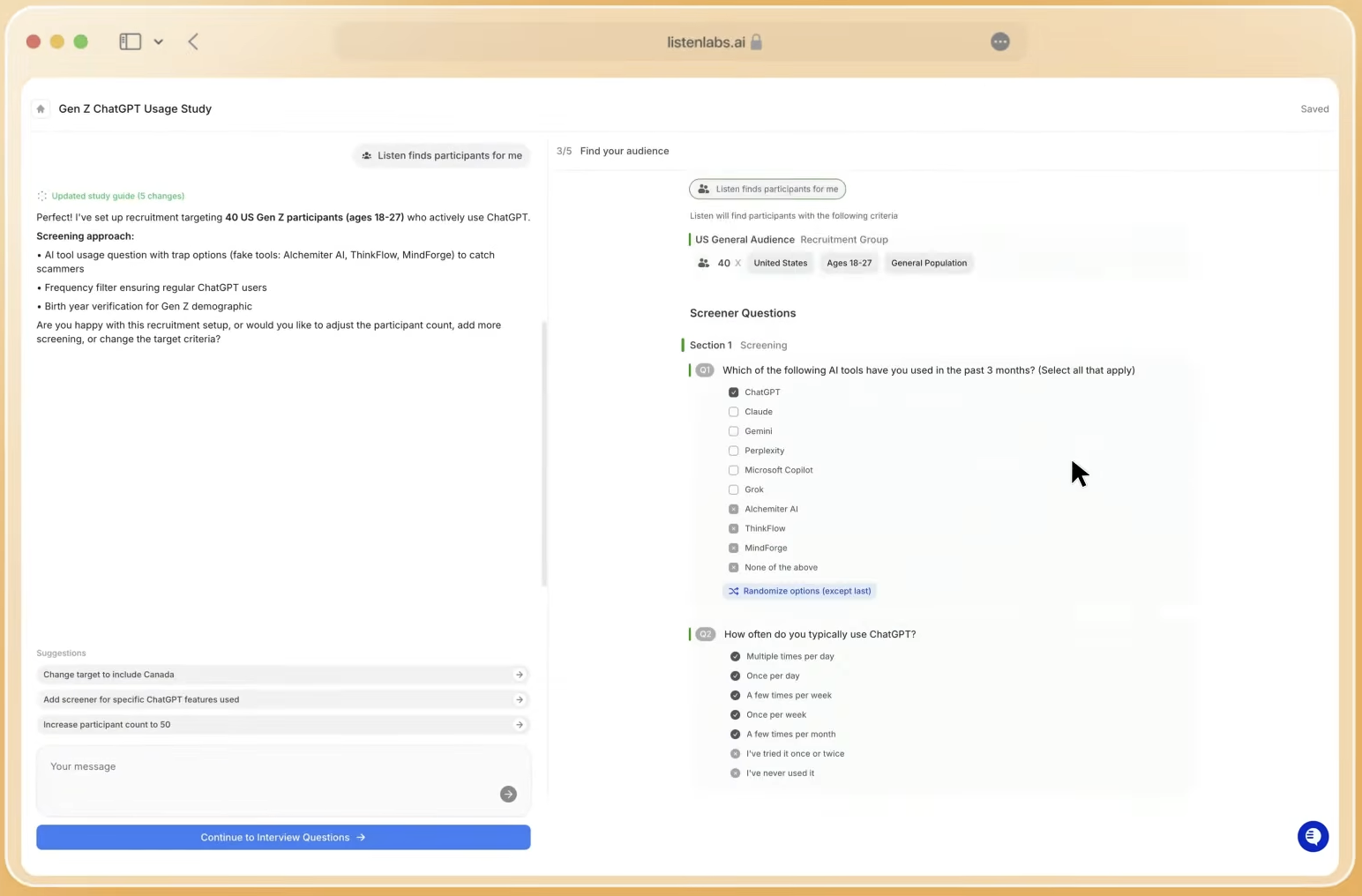
Phenomenological sampling prioritizes information richness over statistical representativeness. Purposive sampling targets individuals who have lived the specific experience under study, such as customers who abandoned a checkout flow, users who switched subscription tiers, or shoppers who returned a product within 48 hours. Incidence rates for these segments routinely fall below 1%, which makes recruitment the primary bottleneck in traditional studies. This bottleneck is what Listen Labs’ recruitment infrastructure is designed to eliminate.
Phenomenological sampling requires matching participants to the lived experience under study, not just demographic checkboxes. Listen Labs’ Listen Atlas panel of 30M verified respondents, spanning 45+ countries and 100+ languages, is orchestrated by an AI layer that matches on behavioral and intent signals rather than self-reported demographics alone, so recruitment targets lived experience instead of proxies. For segments that fall below 1% incidence, a dedicated recruitment operations team sources enterprise decision-makers, healthcare workers, and other hard-to-reach participants without relying on commodity panels. Once participants are recruited, Quality Guard monitors every session in real time across video, voice, content, and device signals, and limits participants to three studies per month, which eliminates professional survey-takers and protects data integrity.
Step 3: Designing AI-Moderated Phenomenological Interviews
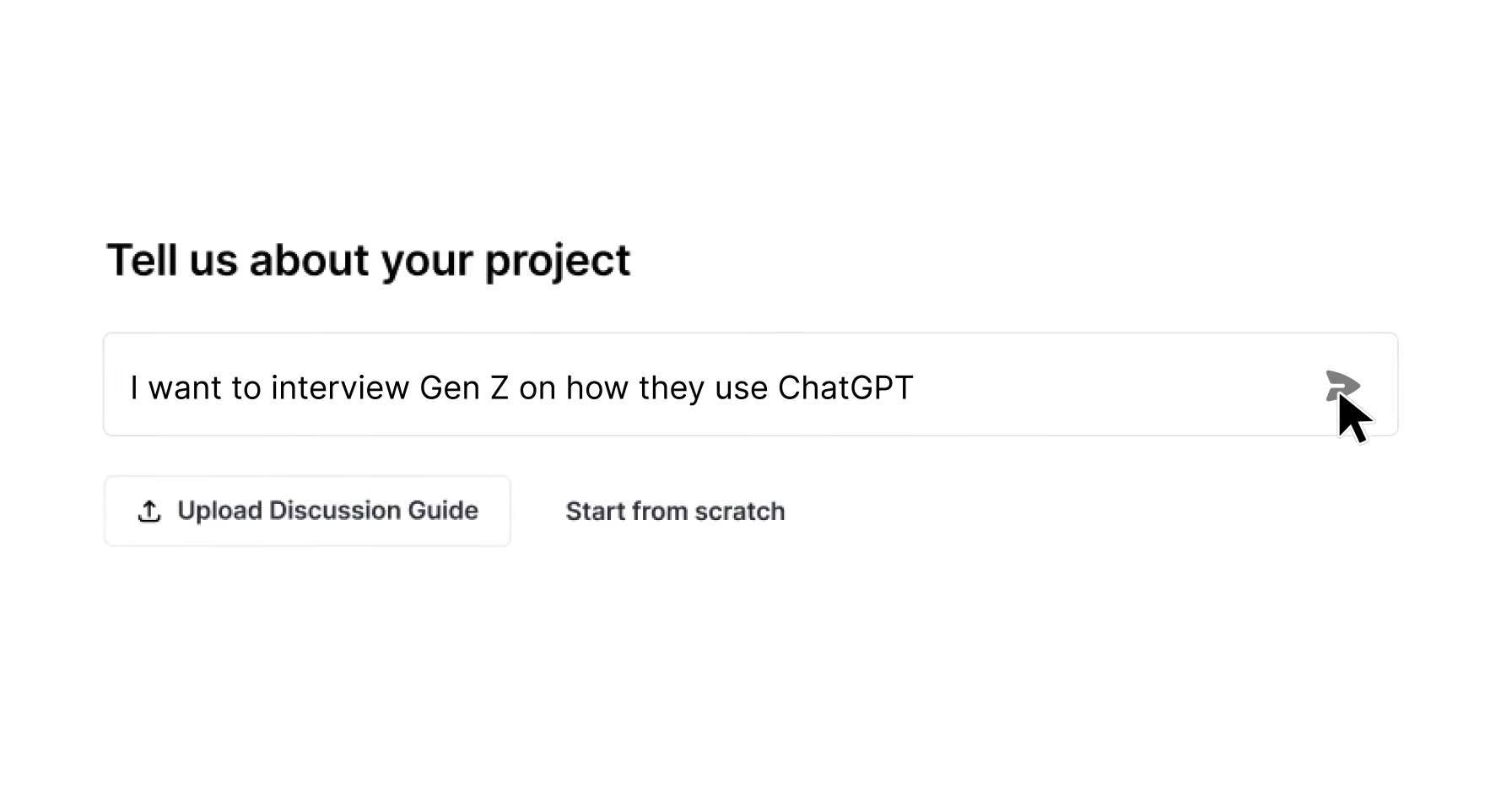
Phenomenological interviews are non-directive and experience-centered. The opening prompt invites participants to narrate a specific episode rather than offer opinions: “Walk me through the last time you used [product] to solve [problem]. Start from the moment you decided to use it.” Subsequent probes deepen description without leading: “What were you feeling at that moment?” “What did that mean to you?” “What would have made that moment different?”
Listen Labs’ AI moderator conducts personalized, adaptive video interviews that probe deeper on short or ambiguous answers, similar to a trained human interviewer. With AI-moderated interviews, talking to users at scale is no longer the hard part; the challenge is understanding what they mean. Branching logic, skip conditions, and stimulus presentation such as images, video, prototypes, and live URLs can all be embedded in the interview guide. This setup enables concept testing and journey mapping within a single phenomenological session. Traditional surveys may tell us what people do, but it takes a conversation to understand why, and that why is what separates adequate customer research from research that truly changes decisions.
Step 4: Capturing and Quantifying Emotional Signals
Phenomenology is explicitly concerned with emotional texture, yet most research tools capture only verbal content. Transcripts miss the frown that accompanies a positive rating, and without that frown the rating looks like genuine satisfaction instead of polite compliance. They miss the hesitation before a confident-sounding answer, which signals uncertainty that the words conceal. They also miss the micro-expression of disgust that precedes a polite compliment, which can turn a negative reaction into false positive feedback.
Listen Labs’ Emotional Intelligence addresses this gap by analyzing three layers of signal, tone of voice, word choice, and subconscious micro expressions, using Ekman’s universal emotions framework, the same standard used in clinical psychology and UX research, to track anger, anticipation, disgust, fear, joy or happiness, sadness, trust, and surprise. Every emotion is quantified per question and concept, with every label traceable to the exact timestamp, verbatim quote, and AI reasoning behind it, which transforms emotional data from impressionistic annotation into auditable evidence required for rigorous phenomenological validity.
Step 5: Colaizzi Seven-Step Analysis Workflow at Scale
Colaizzi’s method is the most widely applied descriptive phenomenological framework in applied CX and health research. The seven steps are: (1) read all transcripts to acquire a sense of the whole, (2) extract significant statements, (3) formulate meanings from each statement, (4) organize meanings into theme clusters, (5) integrate clusters into an exhaustive description, (6) reduce the description to its fundamental structure, and (7) return findings to participants for validation. This method is rigorous, but its manual execution becomes the constraint when sample sizes exceed traditional phenomenological norms.
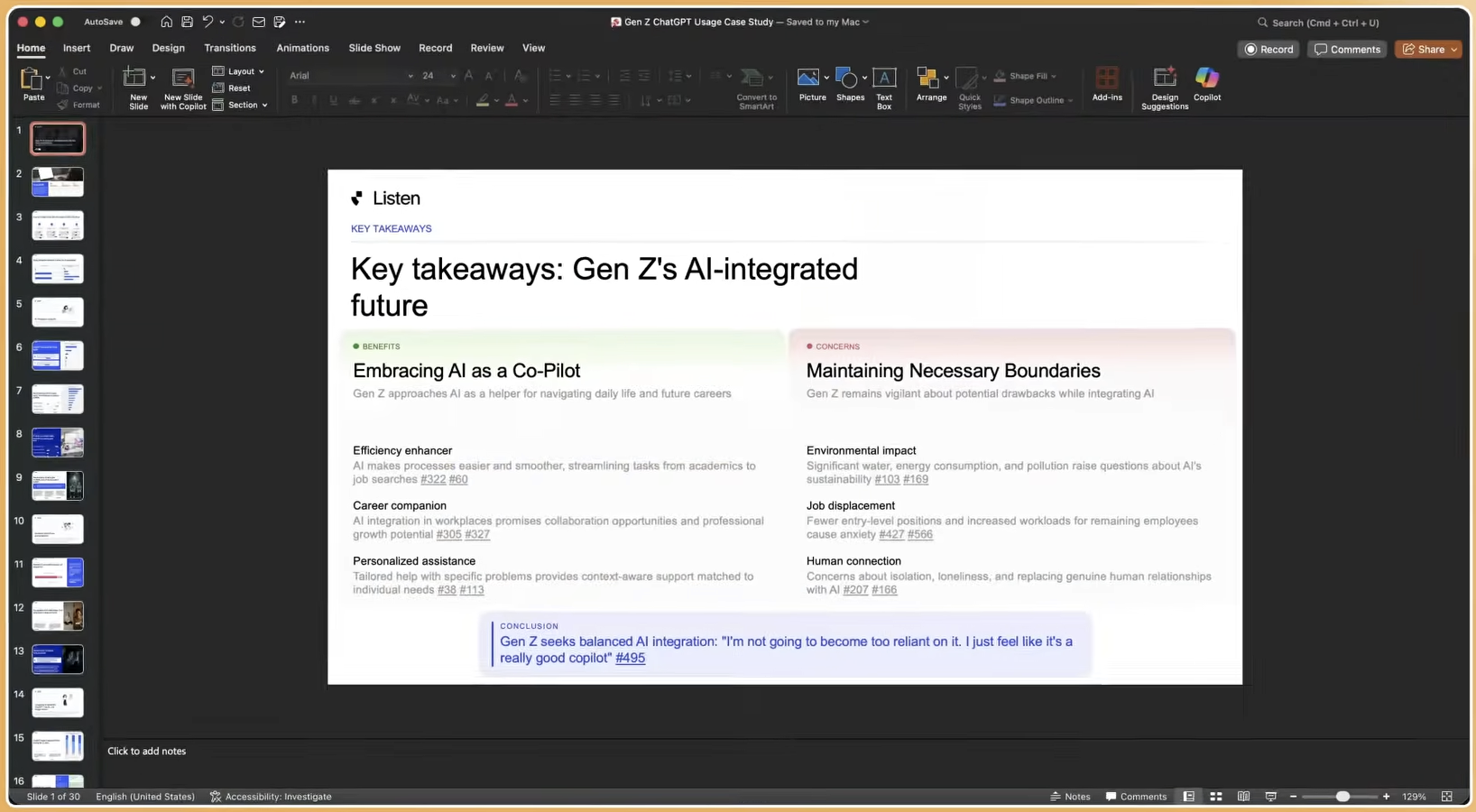
At 100 or more interviews, steps one through four are prohibitively time-intensive for human analysts. Listen Labs’ Research Agent processes all interview data simultaneously, extracting significant statements, formulating meaning units, and clustering themes across the full dataset without the confirmation bias that affects human analysts working sequentially. Every insight links directly to the underlying response data, so analysts can inspect the verbatim evidence behind every theme cluster before advancing to the exhaustive description in step five. Steps five through seven remain researcher-led, which preserves the interpretive judgment that Colaizzi’s method requires while eliminating the mechanical labor that makes large-sample phenomenology impractical.
Step 6: Applying Moustakas and IPA to CX Journeys
Moustakas’ transcendental phenomenology extends Colaizzi by adding textural and structural description. Textural description captures what participants experienced. Structural description captures how they experienced it, including conditions, contexts, and variations that shaped the experience. The synthesis of both yields the essence of the phenomenon. For CX applications, this distinction maps cleanly onto journey mapping, where texture describes the emotional content of each touchpoint and structure describes the sequence, triggers, and contextual factors that produced it.
Interpretive Phenomenological Analysis, or IPA, takes a more idiographic path and analyzes each participant’s account in depth before moving to cross-case patterns. IPA suits studies where individual variation in lived experience is theoretically significant, such as understanding how high-value customers versus churned customers construct meaning around the same product feature. Listen Labs supports both workflows. The Research Agent generates per-participant summaries that IPA requires, then enables cross-participant pattern analysis with segmentation by demographics, cohort, or behavioral attribute. Moustakas’ structural analysis is supported through comparative theme mapping across segments, with natural-language queries surfacing structural variations that would otherwise require days of manual cross-tabulation.
Validation Through Member Checking and Essence Synthesis
Member checking, returning preliminary findings to a subset of participants to confirm that the researcher’s interpretation reflects their lived experience, is the primary validity mechanism in phenomenological research. In traditional studies, this step adds one to two weeks and is frequently skipped under time pressure.
Listen Labs supports asynchronous member checking by re-engaging participants through the platform with a structured follow-up interview that presents the preliminary essence statement and invites correction or elaboration. Participant responses feed directly into the Research Agent, which enables rapid revision of the essence synthesis before final reporting. Essence synthesis, the distilled and transferable description of the phenomenon, is generated as a consultant-quality memo, slide deck, or highlight reel, with every claim linked to the timestamp-level evidence from which it was derived. Each of these steps, from bracketing through member checking, traditionally requires days or weeks of sequential work. The key question for CX teams is whether this sequence can be compressed without sacrificing rigor.
24-Hour Research Timeline for CX Decisions
Listen Labs enables phenomenological studies to move from brief to deliverable in under 24 hours by compressing each stage of the workflow. AI-assisted study co-design shortens kickoff. The Listen Atlas 30M+ panel removes recruitment delays. Parallel AI-moderated video interviews collect rich narratives in a single fieldwork window. Automated theme extraction and emotional analysis accelerate Colaizzi, Moustakas, or IPA workflows, while asynchronous follow-up capabilities support rapid member checking and essence refinement.
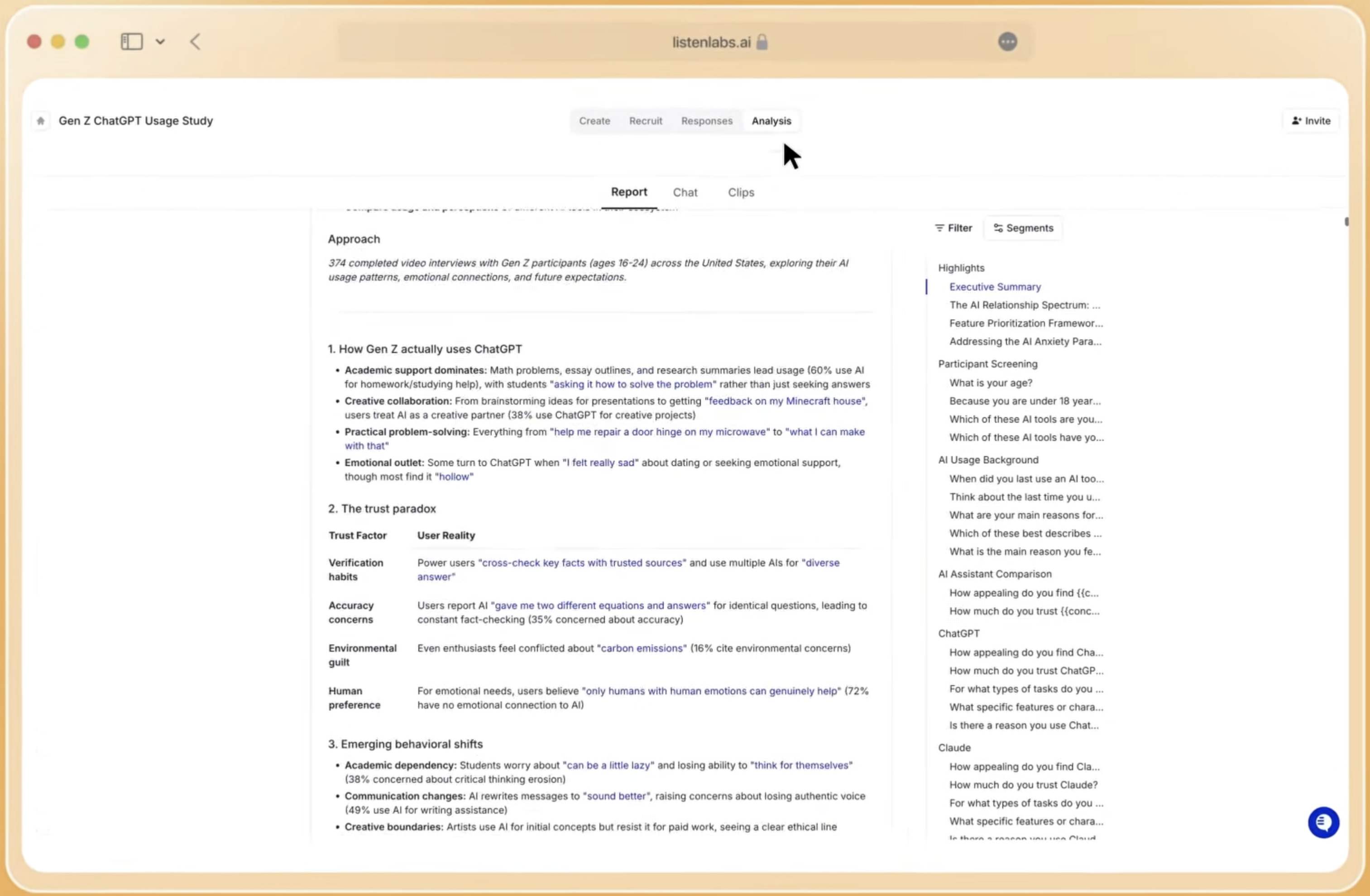
Walk through a live phenomenological study from brief to deliverable in under 24 hours.
Strengths and Weaknesses of Phenomenology in CX
Phenomenological methods produce findings that no survey instrument can replicate, such as the emotional texture of a customer’s first unboxing experience, the meaning a long-term subscriber attaches to a price increase, or the precise moment in a digital journey where trust erodes. These findings directly inform product positioning, service design, and communication strategy in ways that aggregate ratings cannot.
The primary limitation is transferability. Phenomenological findings describe essence rather than frequency, so they do not support claims about the proportion of customers who share a given experience. Teams address this by combining phenomenological depth with quantitative follow-up, a workflow Listen Labs supports natively through mixed-method study design that embeds Likert scales, NPS, and MaxDiff alongside open-ended interview questions. A second limitation is researcher influence. The bracketing and member-checking steps described above exist to manage this risk, and the timestamp-level traceability of Listen Labs’ emotional and thematic data provides an audit trail that strengthens methodological defensibility. With qual-at-scale, the old trade-off between depth and scale is no longer a barrier, but the interpretive rigor that makes phenomenology credible must still be built into the workflow.
Enterprise Considerations: Privacy, Consent, and Compliance
Phenomenological interviews collect sensitive first-person accounts of lived experience, often including emotional disclosures that participants may not anticipate sharing. Enterprise deployments require explicit informed consent protocols, clear data retention policies, and compliance with regional privacy regulations across every market where fieldwork is conducted.
The platform’s global reach, detailed in Step 2, extends to compliance and consent protocols tailored to each jurisdiction. Listen Labs holds SOC 2 Type II, GDPR, ISO 27001, ISO 27701, and ISO 42001 certifications. Customer data is never used for AI model training, and all data is protected with 256-bit encryption. Enterprise SSO is supported. For studies involving sensitive populations or disclosures, the platform’s consent flow can be customized to meet IRB-equivalent standards, and the recruitment operations team applies jurisdiction-specific screening protocols to ensure participant eligibility and informed participation.
Frequently Asked Questions
Can AI-moderated interviews maintain the non-directive stance that phenomenological research requires?
Yes. Listen Labs’ AI moderator is designed to follow participant-led narratives rather than steer toward predetermined answers. The interview guide uses open, experience-centered prompts, and the AI probes deeper on participant responses rather than redirecting toward researcher hypotheses. The bracketing protocol documented in Step 1 governs how the guide is constructed, which ensures that probes invite elaboration rather than confirmation. The result is a non-directive conversational structure that preserves the phenomenological requirement to let meaning emerge from participant accounts.
How does Listen Labs prevent fraudulent or low-effort responses from contaminating phenomenological data?
Three layers of protection operate simultaneously. First, Listen Labs works exclusively with high-quality, non-commodity panel sources, so professional survey-takers are excluded. Second, Quality Guard monitors every interview in real time across video, voice, content, and device signals, flagging and removing fraudulent responses, AI-generated scripts, and mismatched profiles before they enter the analysis dataset. Third, participants are limited to three studies per month, which prevents panel fatigue and incentive-driven participation. A dedicated recruitment operations team adds a human review layer for hard-to-reach segments.
How does emotional signal capture integrate with Colaizzi or IPA analysis workflows?
Emotional Intelligence data is embedded directly into the Research Agent, so every theme cluster and significant statement extracted during Colaizzi or IPA analysis carries associated emotional quantification. The timestamp-level traceability described in Step 4 means that when a theme cluster around “trust erosion” emerges, the analyst can immediately query which emotional signals co-occurred with those statements and in which participant segments. This integration strengthens both the textural description in Moustakas and the meaning-formulation step in Colaizzi without requiring a separate emotional analysis pass.
What sample sizes are realistic for phenomenological studies conducted through Listen Labs?
Traditional phenomenological studies typically involve 5–25 participants, constrained by the time required for manual analysis. Listen Labs removes this constraint, and the Research Agent processes 100, 250, or 300+ interviews with the same analytical rigor applied to each. Anthropic’s Claude Code team completed 300+ user interviews in 48 hours, surfacing churn drivers five times faster than traditional methods. Larger samples strengthen transferability claims and enable segmentation by persona, market, or behavioral cohort, which is methodologically impossible at traditional phenomenological sample sizes.
How does Listen Labs handle multi-market phenomenological studies requiring localization?
The platform supports interview moderation in 100+ languages with automatic translation and transcription, and Emotional Intelligence is available across 50+ languages. Recruitment spans 45+ countries through Listen Atlas, with the AI orchestration layer matching participants on behavioral signals within each market. Study guides can be localized with market-specific stimuli, branching logic, and cultural adaptation, while the Research Agent synthesizes cross-market findings into a unified essence description or produces market-by-market structural comparisons for Moustakas-style analysis.
Conclusion
Phenomenological research delivers one of the most rigorous accounts of lived customer experience available to consumer insights teams, yet its traditional execution timeline of four to six weeks, combined with sample sizes too small for enterprise decision-making, has kept it at the margins of mainstream CX practice. The six-step framework above, bracketing, purposive recruitment, AI-moderated interviewing, emotional signal capture, Colaizzi or Moustakas or IPA analysis, and member-checked essence synthesis, applies full phenomenological rigor to hundreds of interviews while achieving the timeline compression described above.
Platforms like Listen Labs layer on auto-recruiting, transcription, sentiment tagging, and insight summarization so teams jump from question to findings in hours, not weeks. For consumer insights leaders managing growing research backlogs, that compression is not a convenience, it is the condition under which rigorous phenomenology becomes operationally viable at enterprise scale.
Run your first AI-enabled phenomenological study in under 24 hours.