
Written by: Anish Rao, Head of Growth, Listen Labs
Key Takeaways for 2026 Research Leaders
-
Enterprise research teams in 2026 still face a depth-versus-scale trade-off between Outset.ai’s conversational AI moderation and UserTesting’s human-panel network, which often creates fragmented vendors and uneven quality.
-
Listen Labs delivers the full research lifecycle on a single platform, including AI-assisted study design, global participant sourcing from a 30M verified network, adaptive AI-moderated interviews with emotional intelligence analysis, and consultant-quality deliverables in under 24 hours.
-
Key differentiators include proprietary recruitment infrastructure with real-time fraud prevention, multilingual support across 100+ languages and 45+ countries, and traceable, bias-reduced analysis through the Research Agent and Mission Control.
-
Security and compliance certifications (SOC 2, GDPR, ISO 27001/27701/42001) plus enterprise SSO and data-ownership guarantees position Listen Labs for regulated industries and large-scale deployments.
-
Listen Labs’ end-to-end architecture removes the depth-versus-scale trade-off that forces teams to choose between conversational richness and large-sample execution.
Evaluation Criteria for AI-Moderated Research Platforms
A rigorous platform evaluation in 2026 requires assessing seven criteria: research speed (time from brief to deliverable), insight depth versus scale (whether the platform sustains qualitative richness at hundreds of simultaneous interviews), participant sourcing and quality (panel size, verification methodology, and fraud prevention), moderation approach (adaptive probing versus scripted or human-led), analysis and deliverables (automation depth and output formats), global reach (language and country coverage), and security and compliance (certifications and data governance). The sections below apply each criterion to Listen Labs and its closest alternatives.
Study Setup and Design Assistance Across Platforms
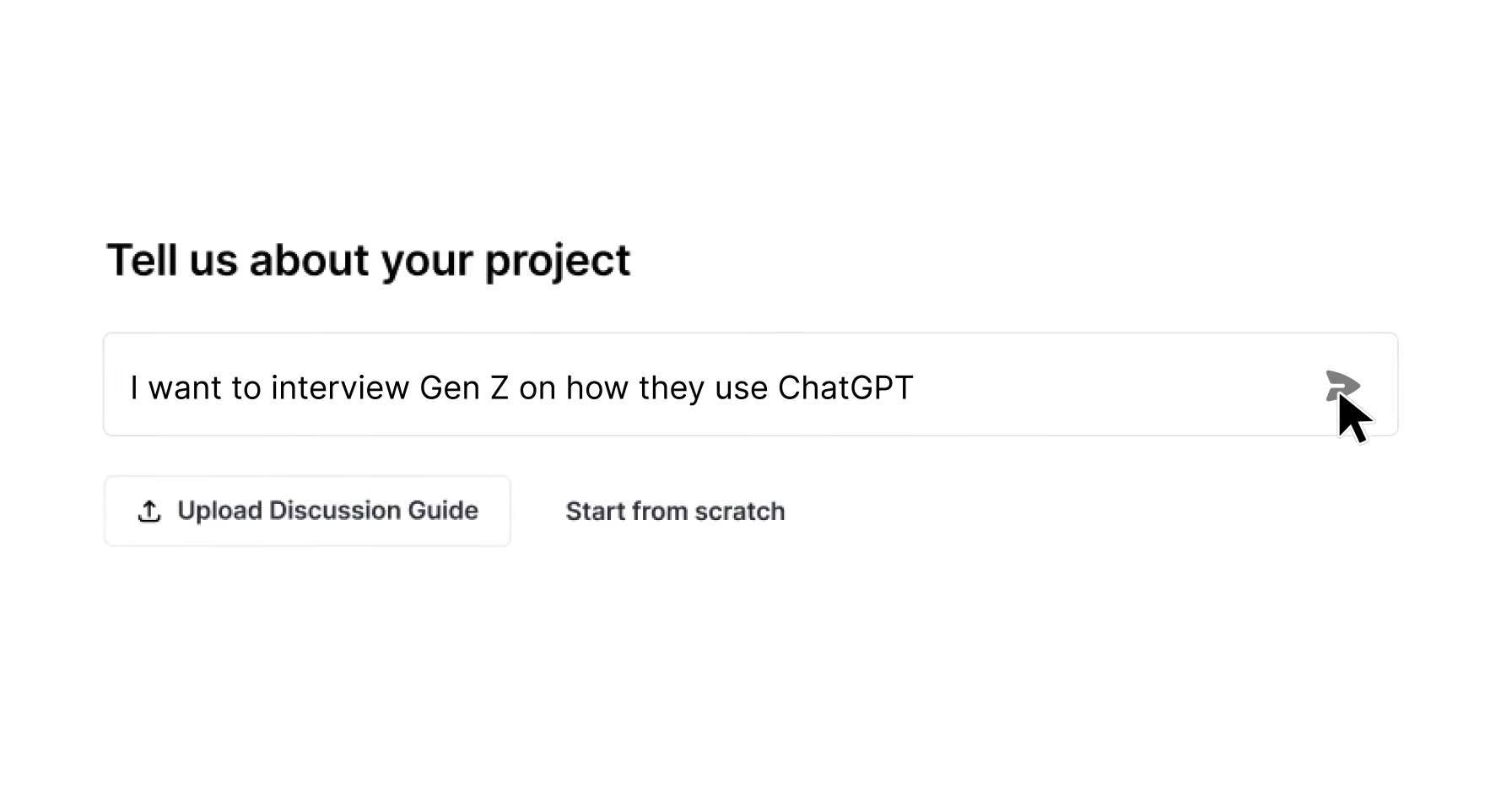
Study setup determines how quickly teams move from a business question to a launch-ready guide. Outset.ai uses a prompt-based conversational setup where researchers define objectives and the AI constructs a discussion guide. This model suits teams comfortable writing research prompts, but it offers limited stimulus logic or auto-QA before launch, so researchers must manually verify guide quality.
UserTesting takes a different approach with task-oriented templates optimized for think-aloud usability protocols. These templates work well for structured screen-based testing, yet they constrain open-ended exploratory research because they center on task completion instead of conversation depth.
Listen Labs bridges both needs with AI-assisted co-design. Researchers describe goals in natural language and the platform drafts structured objectives, questions, and probing context in seconds. The platform then layers in advanced stimuli support, including images, video, PDFs, live URLs, and prototypes, along with monadic or sequential randomization, branching, skip logic, piping, and version control. An auto-QA pass flags guide issues before launch, and teams can clone and adapt past studies, which reduces setup time for recurring research programs.
Recruitment Infrastructure and Fraud Prevention Quality
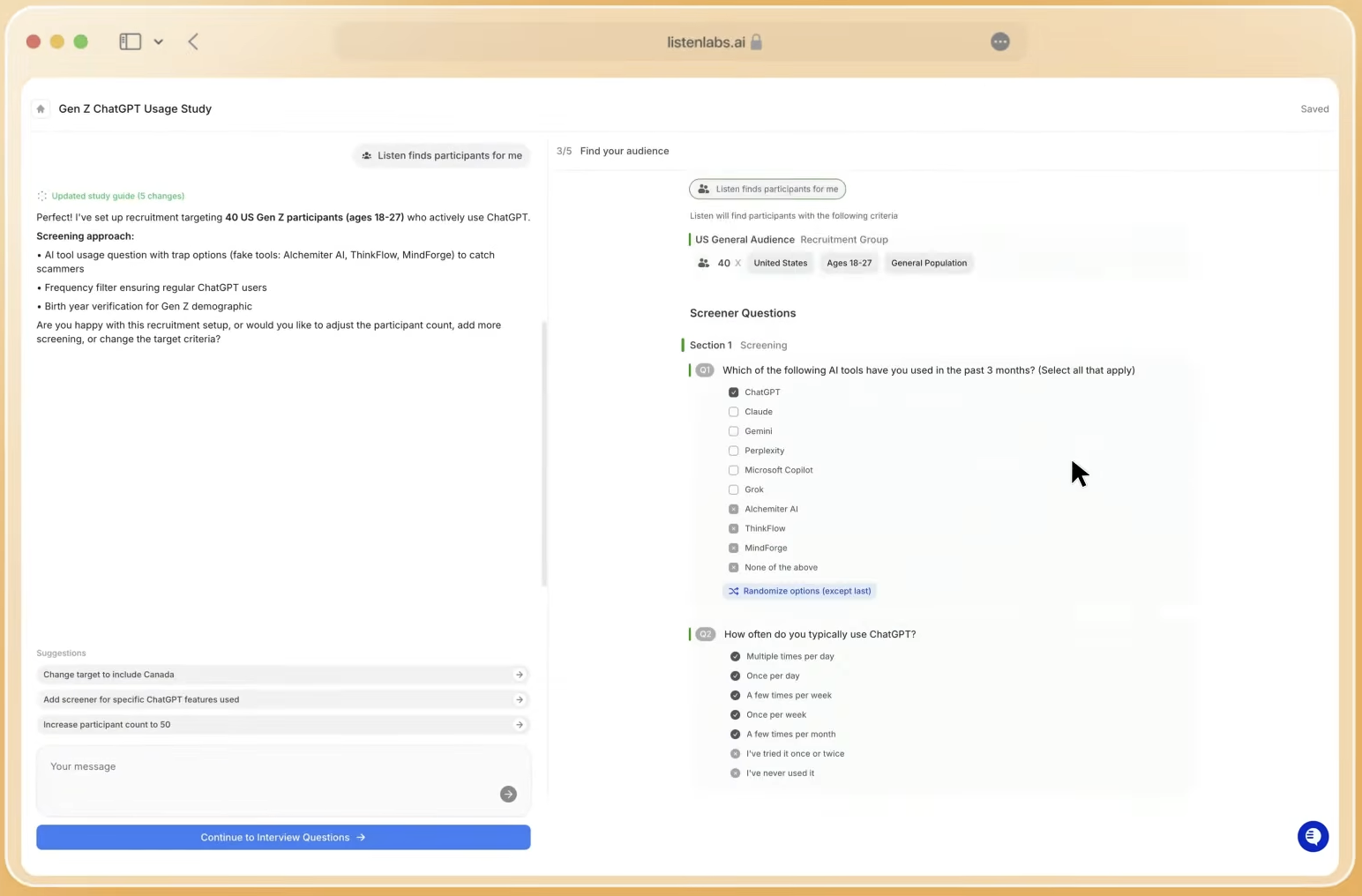
Participant quality directly determines whether findings hold up under scrutiny. Once a study is designed, the next critical factor is recruitment, because sophisticated guides cannot compensate for fraudulent or low-quality respondents.
Outset.ai integrates with vetted panel partners but does not operate proprietary recruitment infrastructure, so quality control depends on each panel provider’s standards. UserTesting maintains a proprietary network optimized for usability testing recruitment, with participant profiles skewed toward task-based screen interaction rather than in-depth conversational research.
Listen Labs operates Listen Atlas, a global panel of 30M verified respondents across 45+ countries. Unlike platforms that rely on a single panel provider, Listen Atlas uses an AI layer to match and bid across multiple consumer and B2B panel partners alongside Listen Labs’ proprietary database, which supports both scale and quality. Quality Guard then applies three layers of verification.
First, it uses behavioral matching on intent and past actions rather than self-reported demographics, which are easier to fake. Second, it monitors every interview in real time across video, voice, content, and device signals to catch fraud, low-effort responses, and AI-generated scripts as they occur. Third, it enforces a hard limit of three studies per month per participant, which removes professional survey-takers who would otherwise dominate the panel.
A dedicated recruitment operations team supports hard-to-reach segments such as enterprise decision-makers, healthcare workers, and audiences below 1% incidence rate, adding human review that commodity panels cannot match. Reputation scoring compounds across every interview on the platform, creating a quality flywheel that strengthens over time.
Interview Execution and Emotional Signal Capture Depth
Interview execution shapes both the richness of responses and the emotional nuance teams can access. Outset.ai conducts real-time AI-moderated probing within a conversational framework, which generates richer open-ended responses than static surveys. Industry analysis from KS&R notes that conversational AI systems can draw out richer open-ended answers than static surveys because they can ask clarifying follow-ups in the moment, but also that AI moderation can fall back on generic prompts, miss the emotional center of a response, or move on too early.
UserTesting relies on think-aloud protocols moderated by humans from its contributor network. This model introduces scheduling latency, moderator variability, and throughput ceilings that prevent simultaneous large-scale execution.
Listen Labs conducts adaptive AI-moderated video interviews that probe deeper on interesting or short answers in a way that mirrors a trained human interviewer. The platform captures video, audio, text, and screen recordings, including mobile iOS sessions. Beyond transcript-level data, Listen Labs’ Emotional Intelligence feature analyzes three signal layers, including tone of voice, word choice, and subconscious micro expressions, to surface emotions that transcripts alone miss.
Built on Ekman’s universal emotions framework, every emotion is quantified per question and concept, with each label traceable to the exact timestamp, verbatim quote, and AI reasoning behind it. This capability works across more than 50 languages and applies directly to creative testing, concept comparison, usability testing, and brand research. A Listen Labs study of 50 participants found that 92% reported top comfort levels in AI-moderated sessions, matching the 92% comfort rate in human-moderated sessions, which supports the validity of AI moderation for sensitive and in-depth topics.
Data Analysis Workflow and Bias Reduction Methods
Analysis workflow determines how quickly teams move from raw interviews to defensible insights. Outset.ai provides automated theme clustering and summary outputs, which speed analysis relative to manual coding but offer limited traceability between AI-generated themes and underlying verbatims. UserTesting delivers session recordings and human-annotated highlights, which preserve raw evidence but require significant analyst time to synthesize across large sample sets.
Both approaches carry the risk that human analysis of qualitative data is time-consuming and prone to confirmation bias, with analysts unconsciously emphasizing findings that confirm pre-existing hypotheses.
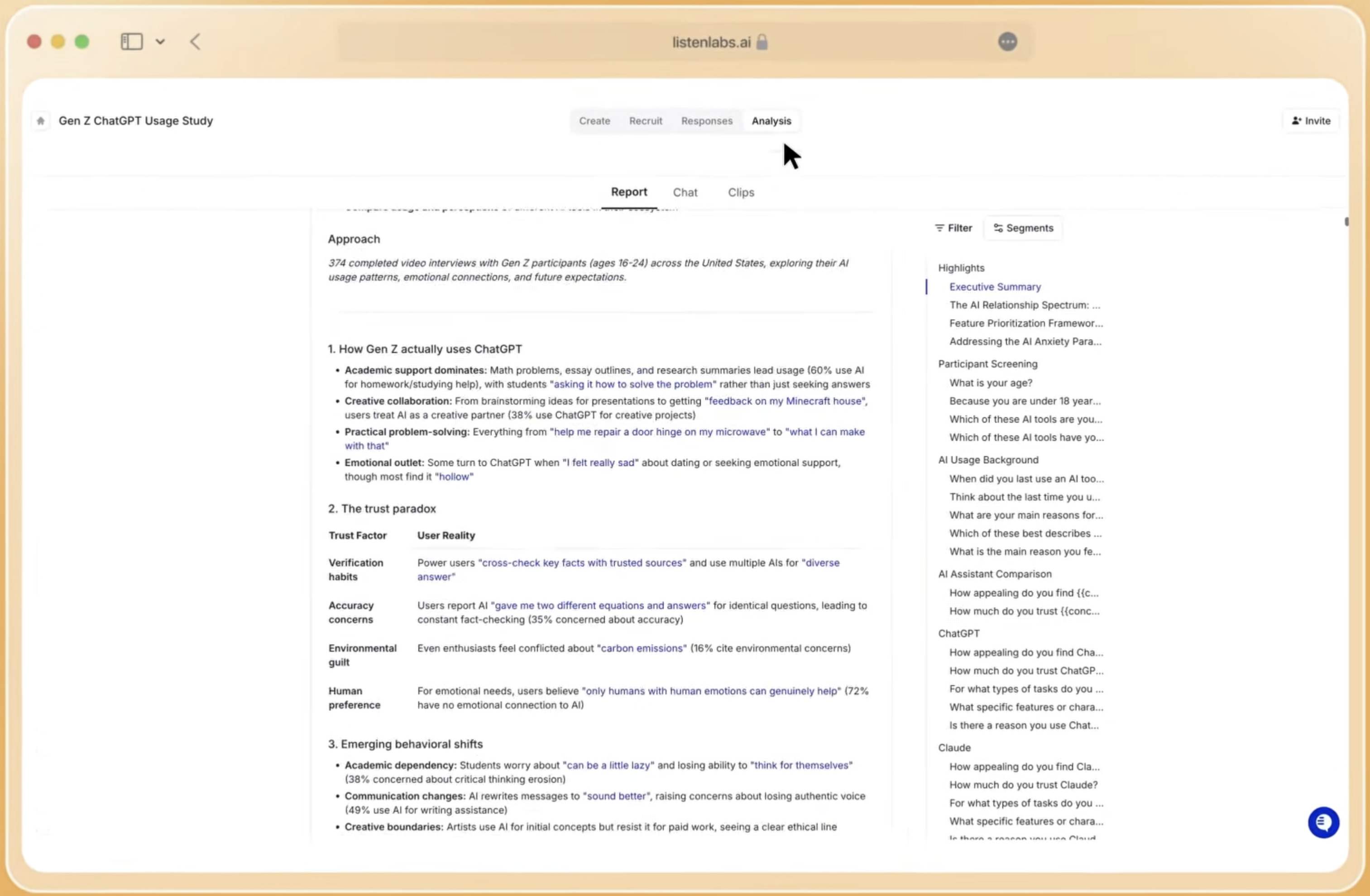
Listen Labs’ Research Agent handles the full analysis workflow from raw data to final output. It processes all interview data to identify patterns, themes, and insights across hundreds of responses without human bias, while every insight links directly to the underlying response data to maintain full traceability. Researchers can query findings in natural language, run segment comparisons with significance testing, and build charts or segmentations on demand.
Mission Control extends this capability across studies. Teams can run cross-study queries, track trends, and build institutional knowledge so they stop re-researching questions already answered in prior programs.
Reporting Transparency and Speed of Deliverables
Reporting speed and clarity influence how quickly insights reach decision-makers. UserTesting turnaround depends on human moderator availability and session scheduling, which typically ranges from days to more than a week for studies that require multiple moderated sessions. Outset.ai compresses this timeline through AI moderation but still requires post-collection analysis and manual report assembly before stakeholder-ready outputs exist.
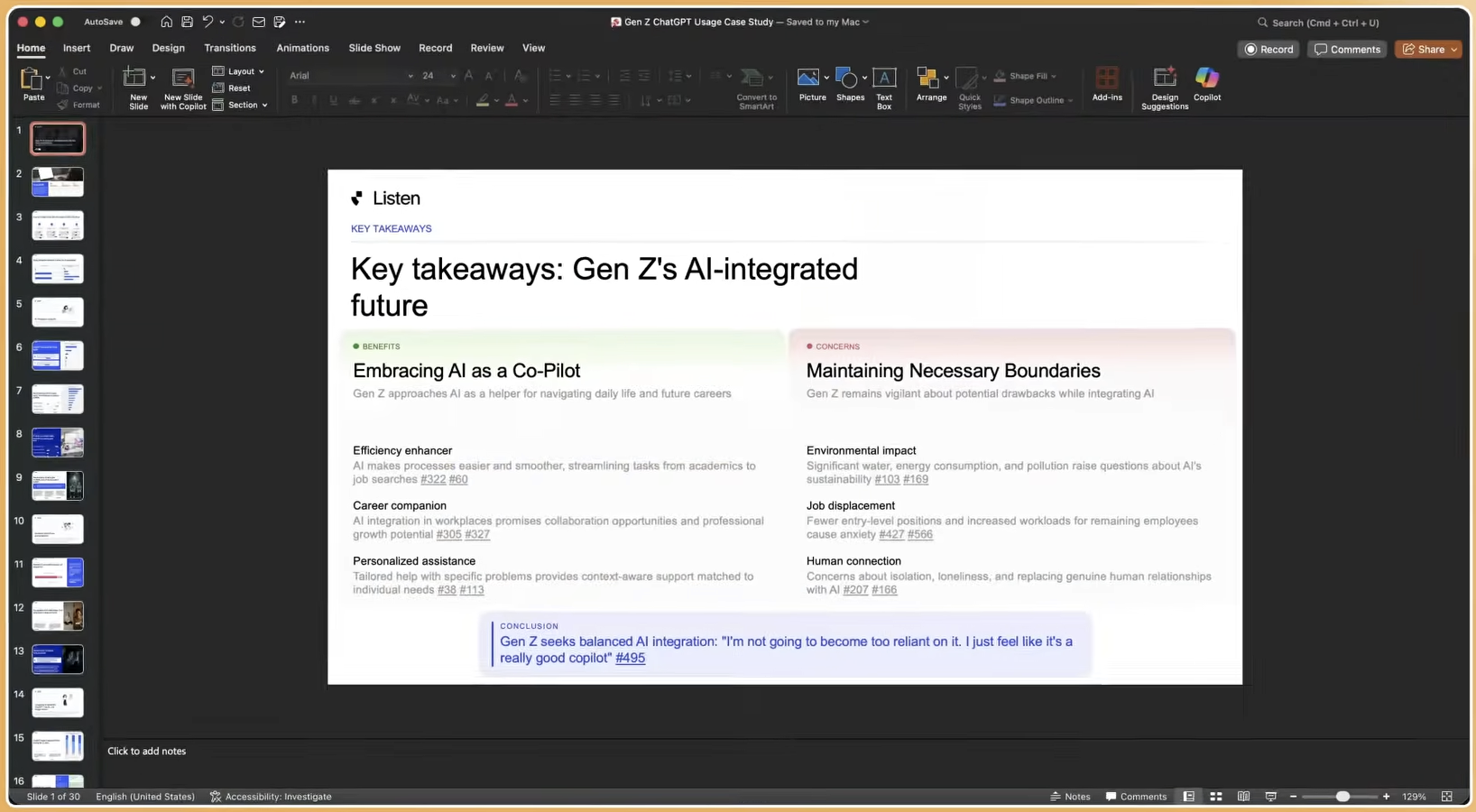
Listen Labs’ Research Agent generates a slide deck in a company’s branded template and a downloadable report alongside memo-style reports, video highlight reels, statistical charts, and custom segmentation breakdowns, all in under 24 hours from study launch. The Microsoft team used Listen Labs to collect global customer stories for the company’s 50th anniversary celebration within a single day, with the Director of Data Science at Microsoft noting: “Our leadership team was very thrilled at both the speed and the scale that Listen Labs enabled. I can reach out to hundreds of users at one third of the cost.”
Book a demo to see Listen Labs deliver consultant-quality research deliverables in under 24 hours.
Global and Multilingual Reach plus Security Posture
Global reach and security posture determine whether a platform can support enterprise-scale, multi-market programs. Outset.ai supports multiple languages for interview moderation but does not operate proprietary global recruitment infrastructure, which creates dependency on panel partners for international studies. UserTesting’s contributor network is concentrated in English-speaking markets, which limits its utility for multi-market or non-English research programs.
The Forrester Wave™: Experience Research Platforms, Q1 2026 found high excitement among researchers regarding AI moderators, a capability that requires both multilingual moderation and global participant sourcing to deliver in practice.
Listen Labs supports more than 100 languages for interview moderation with automatic translation and transcription, covers 45+ countries across the Americas, Europe, APAC, and MEA, and sources participants through the Listen Atlas global network. On the security side, Listen Labs holds SOC 2, GDPR, ISO 27001, ISO 27701, and ISO 42001 certifications, maintains 256-bit encryption, supports enterprise SSO, and does not use customer data for AI model training. ETR’s January 2026 survey of 1,357 technology leaders identified data quality, lineage, and governance as gating factors for AI success, which reinforces that enterprise procurement teams will scrutinize certification posture before committing to a research platform at scale.
Having evaluated Listen Labs across the criteria above, the next section outlines which platform best fits specific research scenarios.
Scenario-Based Best-Fit Guidance for Common Use Cases
Enterprise consumer insights teams running continuous research programs across multiple markets benefit most from Listen Labs. The platform handles global recruitment, multilingual moderation, emotional signal capture, and cross-study knowledge management within a single governed environment.
UX research leads who need rapid usability feedback on specific task flows with human session recordings can continue to use UserTesting as a focused point solution, although its throughput ceiling and scheduling dependency limit its value for large-sample or time-sensitive programs.
Product managers and marketing leaders without dedicated research teams can use Listen Labs’ AI-assisted study co-design and self-serve interface to run independent research without deep methodology expertise. Consultancies and agencies operating under tight client timelines with niche audience requirements gain value from Listen Labs’ dedicated recruitment operations team and sub-24-hour turnaround, which address the constraints that make traditional agency research difficult at project pace.
Operational Considerations and Long-Term Implications
Adopting any new research platform requires change management and clear role definition. Listen Labs functions as a force multiplier for existing research teams rather than a replacement. Researchers shift from logistics management to strategic analysis, while the platform handles recruitment, moderation, and initial synthesis.
With qual-at-scale, the old trade-off between depth and scale is no longer a barrier, so teams can run significantly more studies with the same headcount. For global programs, Listen Labs’ multilingual infrastructure and country coverage remove the need for separate regional vendors.
Mission Control’s cross-study query capability means that institutional knowledge compounds over time instead of fragmenting across disconnected reports, which reduces redundant research spend. Data ownership remains with the client organization, and the platform’s certification posture supports procurement approval in regulated industries.
Risks and Limitations of Current Approaches
UserTesting’s human-dependent moderation model introduces slower turnaround and scheduling variability that make it unsuitable for research programs that require rapid iteration or large simultaneous sample sizes. Outset.ai’s reliance on external panel sourcing creates commodity panel risk. Paid participation on crowdsourcing platforms does not guarantee data integrity, and creative, study-specific quality checks are increasingly necessary due to growing use of generative AI and deceptive respondent tactics.
Point solutions that capture only transcript-level data miss emotional signals such as hesitation, micro-expressions, and tonal shifts that determine whether a concept genuinely resonates or merely receives socially acceptable responses. Basic theme clustering without traceable reasoning creates audit risk for enterprise teams that must defend research conclusions to senior stakeholders.
AI moderation remains less effective than skilled human moderation for emotionally loaded, identity-driven, or strategically exploratory topics where the moderator must read hesitation and decide whether to push, pause, or reframe, which represents a limitation for all AI-moderated platforms and should guide study design decisions.
Criteria-Based Decision Framework for Platform Selection
Teams that prioritize speed, scale, and emotional depth across global markets with enterprise governance requirements should evaluate Listen Labs as the primary platform. Its end-to-end architecture removes the vendor fragmentation that results from combining Outset.ai’s moderation with a separate panel provider and a separate analysis tool.
Teams with a narrow, well-defined usability testing use case and existing infrastructure for recruitment and analysis may find UserTesting’s human-moderated sessions adequate for that specific workflow, as long as turnaround time is not a constraint. Teams evaluating Outset.ai for conversational AI moderation should assess whether their panel sourcing strategy addresses fraud risk and whether their analysis workflow can produce traceable, stakeholder-ready deliverables without additional tooling.
Any team running research across multiple languages, markets, or business units, or seeking to build cumulative customer intelligence rather than one-off study outputs, will encounter the ceiling of point solutions before they encounter the ceiling of Listen Labs. Listen Labs has run over 1 million AI-powered customer interviews for companies including Microsoft, Perplexity, and Sweetgreen, which provides the enterprise-scale evidence base that procurement and research leadership teams require before committing to a production platform.
Frequently Asked Questions
How long does it take to get results from an AI-moderated research study on Listen Labs?
Listen Labs compresses the full research cycle, including study design, participant recruitment, AI-moderated interviews, analysis, and deliverable generation, to under 24 hours. Traditional qualitative research typically takes four to six weeks from brief to final report, and enterprise prioritization queues can extend that to six months.
Listen Labs replaces that timeline with AI-assisted study co-design, automated recruitment from Listen Atlas, simultaneous AI-moderated interviews, and one-click generation of slide decks, highlight reels, and statistical reports. The Microsoft team collected global customer video stories for a major anniversary campaign within a single day using the platform.
How does Listen Labs ensure participant quality and prevent fraudulent responses?
Listen Labs applies three layers of quality control. First, the platform works exclusively with high-quality, non-commodity panel sources and enforces a hard limit of three studies per month per participant, which eliminates professional survey-takers. Second, Quality Guard monitors every interview in real time across video, voice, content, and device signals to detect fraud, low-effort responses, AI-generated scripts, and mismatched profiles.
Third, a dedicated recruitment operations team adds human review for hard-to-reach segments and niche audiences. Behavioral matching operates on intent and past actions rather than self-reported demographics, and reputation scoring compounds across every interview conducted on the platform, which creates a quality flywheel that strengthens as the client base grows.
What security certifications does Listen Labs hold, and how is customer data handled?
Listen Labs holds SOC 2, GDPR, ISO 27001, ISO 27701, and ISO 42001 certifications, maintains 256-bit encryption, supports enterprise SSO, and does not use customer data for AI model training. The ISO 27701 certification covers privacy information management, and ISO 42001 addresses AI management systems, both directly relevant to enterprise procurement teams evaluating research platforms that process consumer data at scale. Data ownership remains with the client organization throughout the research lifecycle.
Can Listen Labs support research in languages other than English and across multiple markets simultaneously?
Listen Labs supports more than 100 languages for interview moderation with automatic translation and transcription across all supported languages. The platform covers 45+ countries across the Americas, Europe, APAC, and MEA through Listen Atlas, its global participant network.
Multi-market studies can run simultaneously with localized moderation, which removes the need for separate regional vendors or manual translation workflows. Emotional Intelligence analysis is available across more than 50 languages, enabling consistent emotional signal capture across markets within a single study program.
What types of research studies can Listen Labs support beyond standard in-depth interviews?
Listen Labs supports a broad range of study types, including concept and prototype testing, usability testing with screen sharing and mobile iOS screen recording, creative testing, brand perception studies, consumer journey mapping, multi-market segmentation studies, ad testing, pricing research, and survey open-end analysis. The platform combines qualitative interview formats with quantitative response types such as Likert scales, NPS, sliders, grids, and MaxDiff within a single study.
Advanced stimuli support includes images, video, audio, PDFs, prototypes, and live URLs with monadic or sequential randomization. Mission Control enables cross-study queries so findings from any study type contribute to a cumulative organizational knowledge base.
Conclusion: Why Listen Labs Fits Enterprise Research in 2026
The Outset.ai versus UserTesting evaluation highlights a structural problem. Both platforms address part of the research lifecycle but leave enterprise teams managing fragmented vendors, variable participant quality, and the persistent depth-versus-scale trade-off.
Platforms like Listen Labs layer on auto-recruiting, transcription, sentiment tagging, and insight summarization so teams jump from question to findings in hours, not weeks, and Listen Labs is the only platform that delivers this end-to-end, from study design through global recruitment, adaptive AI moderation, emotional intelligence analysis, and stakeholder-ready deliverables, within a single enterprise-grade environment.
For consumer insights leaders, UX research leads, and product and marketing stakeholders who need to increase research output without adding headcount, managing multiple vendors, or accepting the limitations of point solutions, Listen Labs offers a production-ready choice that combines depth, scale, and governance.