
Written by: Anish Rao, Head of Growth, Listen Labs
Key Takeaways
-
Enterprise research teams often wait 4 to 6 weeks for traditional results, while Listen Labs delivers comparable or deeper insights in under 24 hours through AI-moderated interviews and automated analysis.
-
Listen Labs removes the historical trade-off between qualitative depth and quantitative scale by running hundreds of adaptive AI-moderated interviews at once while preserving conversational nuance and statistical confidence.
-
The platform’s 30M+ verified participant network across 45+ countries and 100+ languages, combined with real-time fraud prevention through Quality Guard, protects data integrity at enterprise scale.
-
Listen Labs’ Emotional Intelligence and Research Agent capabilities capture emotional signals and generate consultant-quality deliverables with full traceability, cutting analysis time from weeks to minutes.
-
Listen Labs offers an end-to-end AI research platform that resolves speed, depth, and quality limitations for enterprise teams. See how it transforms your research operations in a personalized demo.
Why Enterprise Teams Need AI Research Platforms in 2026
Enterprise insights teams now face constant pressure to answer complex questions in days, not months. Traditional research methods create trade-offs between speed, depth, and quality that slow decisions and frustrate stakeholders. AI research platforms promise to remove these trade-offs by combining automated recruitment, AI-moderated interviews, and instant analysis in a single workflow. The sections below evaluate how Listen Labs performs against the core challenges that matter most to enterprise teams, from turnaround time and panel quality to fraud prevention, emotional depth, and long-term operational impact.
How This Guide Evaluates AI Research Platforms
Enterprise insights teams face a core problem. Traditional methods force painful trade-offs between research speed, depth of understanding, and data quality. A platform that delivers results in 24 hours but relies on low-quality participants creates unreliable insights. A platform that protects rigor but needs six weeks per study cannot support fast-moving product and marketing decisions. The evaluation criteria below map directly to these challenges and show how modern platforms address them across recruitment, fraud prevention, emotional analysis, and operational burden.
Research Speed and Turnaround Time
AI-powered market research companies are expanding the use of conversational and adaptive surveys that blend qualitative depth with quantitative scale, which resets expectations for turnaround time. Traditional qualitative research cycles often span 4 to 6 weeks from study design to final deliverables. Generative AI reduces manual coding bottlenecks in market research, shifting researcher time from 80% on data collection and 20% on interpretation to 5% on collection, 5% on synthesis, and 90% on high-level strategy.
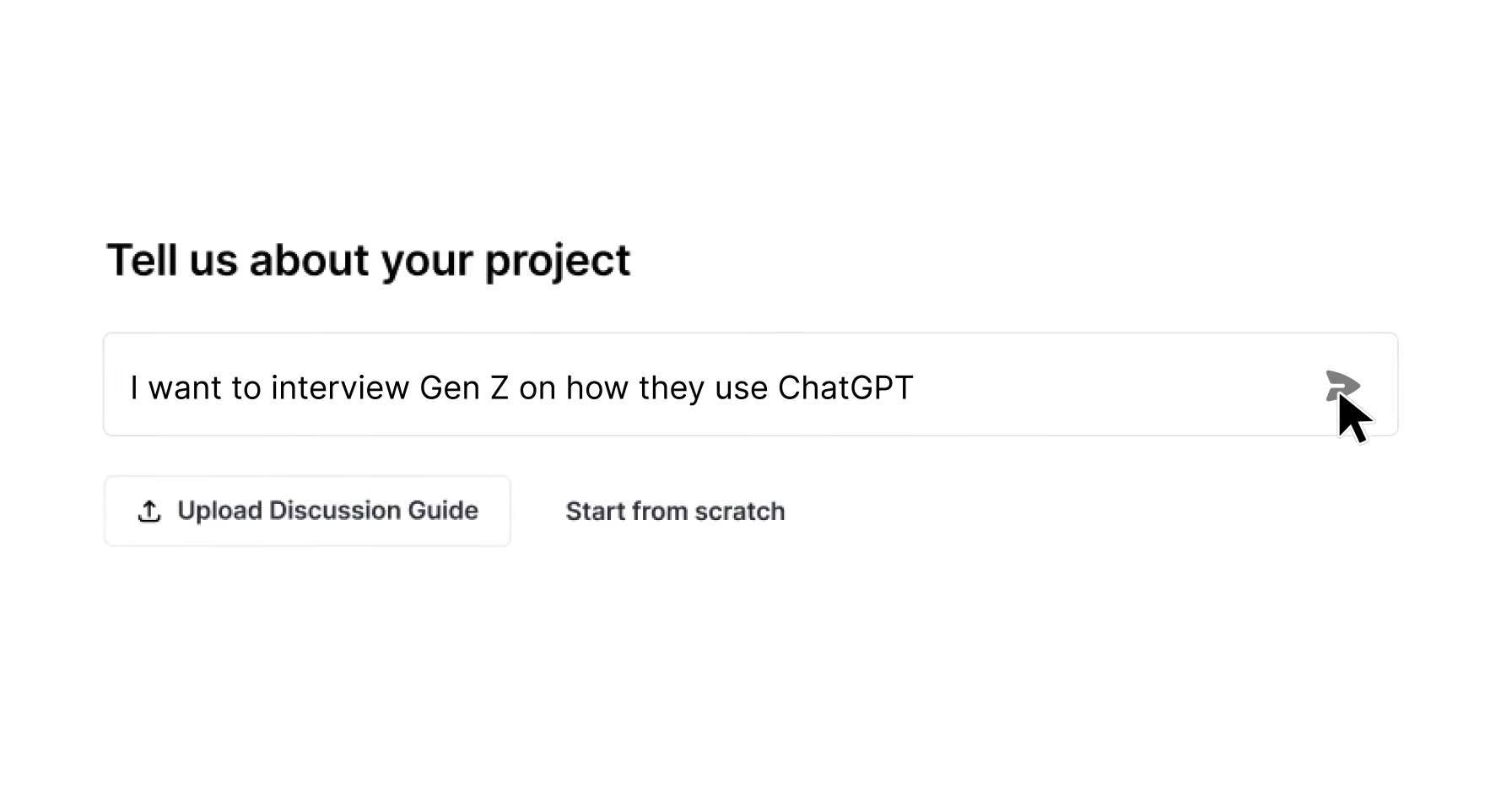
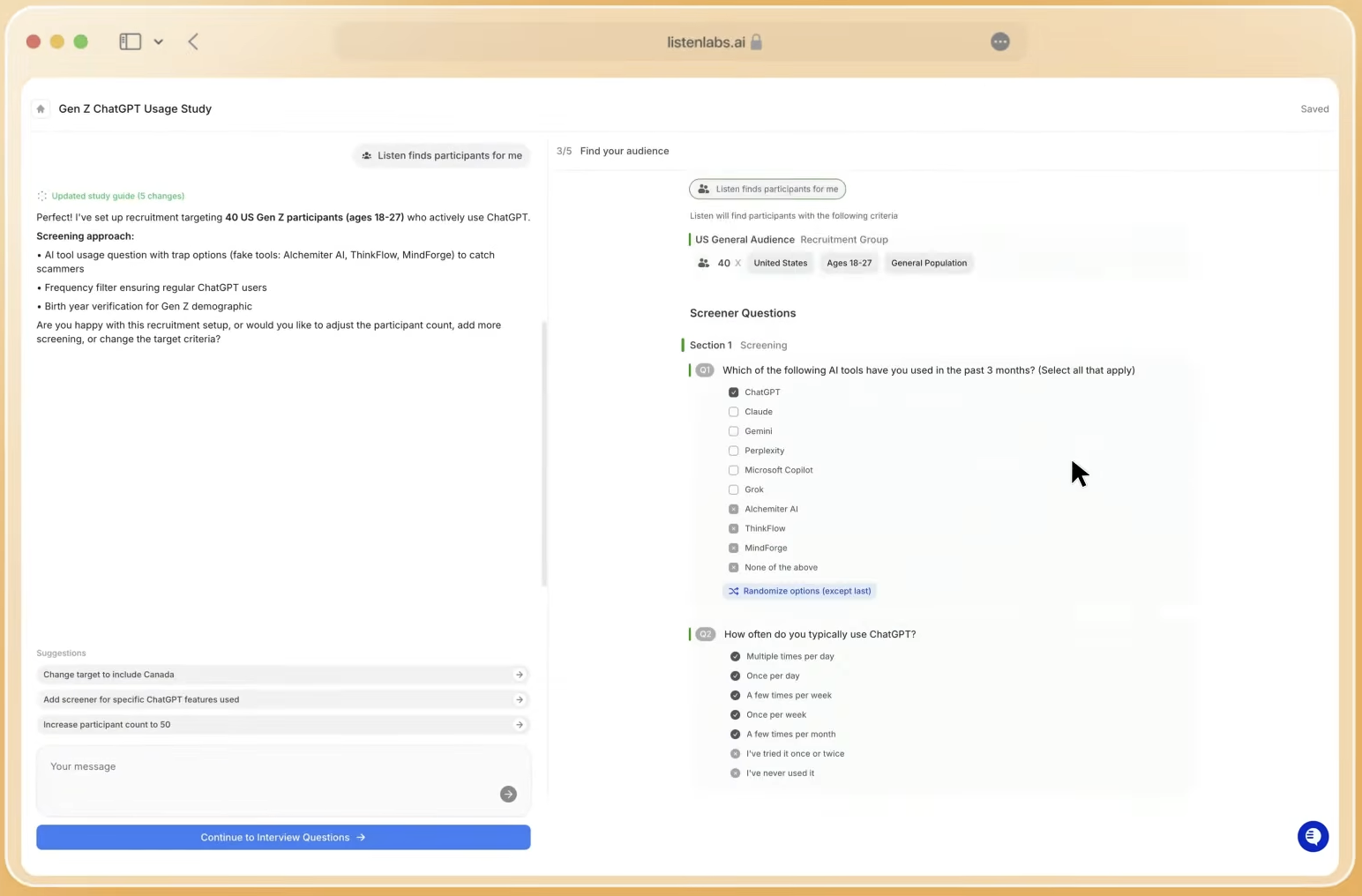
Listen Labs compresses the entire research lifecycle to under 24 hours through AI-assisted study design, automated participant recruitment from its 30M+ verified network, simultaneous AI-moderated interviews, and instant analysis generation. This speed reduction from 4 to 6 weeks to under 24 hours lets insights teams respond to urgent business questions while still maintaining methodological rigor.
Balancing Depth of Insight and Research Scale
Speed alone cannot solve the enterprise research challenge if it weakens insight quality. The historical trade-off between qualitative depth and quantitative scale has constrained enterprise research programs for decades. Generative AI breaks the long-standing tradeoff between speed and depth in market research, enabling rigorous qualitative insights at quantitative scale through advanced automation.
Listen Labs conducts hundreds of adaptive AI-moderated interviews at the same time while preserving conversational nuance through dynamic follow-up questions and contextual probing. Each interview keeps the depth of a one-on-one human conversation and still delivers the statistical confidence of large sample sizes. This structure removes the usual compromise between rich insights and robust data that limits traditional research methods.
Participant Sourcing and Panel Quality
Panel quality represents a major vulnerability in scaled research programs. Fraud through disengaged responses, dishonest answers, or survey hacking can significantly distort findings. Commodity panels often include professional survey-takers and fraudulent profiles that erode data integrity.
Listen Labs operates a 30M+ verified participant network across 45+ countries and 100+ languages. Unlike commodity panels that rely on self-reported demographics, Listen Labs uses behavioral matching based on intent and past actions so participants actually reflect the target audience. For segments that remain rare even in a large network, such as enterprise decision-makers, healthcare workers, or consumers below 1% incidence rates, a dedicated recruitment operations team sources participants through specialized channels. This layered approach, with a verified network for common segments and specialist recruitment for hard-to-reach audiences, reduces dependence on commodity panels and supports authentic engagement.
Fraud Prevention and Data Integrity
High-volume research requires fraud prevention systems that work in real time across thousands of interviews. Strong fraud controls also reinforce the panel quality described above by keeping low-effort and fraudulent participants out of future studies. Listen Labs’ Quality Guard monitors every interview using video, voice, content, and device signals to detect fraudulent responses, AI-generated scripts, and mismatched profiles. Participants face a limit of three studies per month to prevent panel fatigue, and reputation scores build across interviews to strengthen audience quality over time.
This multi-layered system includes a dedicated operations team that adds human review for complex recruitment scenarios. The combination of automated checks and targeted human oversight protects data integrity at scale without recreating the manual bottlenecks that slow traditional research operations.
Emotional Intelligence and Affective Analysis
Traditional research tools capture explicit verbal responses but miss emotional signals that drive real behavior. Emotional intelligence platforms detect, analyze, and interpret human emotions during research interactions using video, audio, and behavioral signals to reveal how participants truly feel beyond what they say.
Listen Labs’ Emotional Intelligence analyzes three signals: tone of voice, word choice, and subconscious micro expressions. It uses Ekman’s universal emotions framework and tracks eight emotions, including anger, anticipation, disgust, fear, joy or happiness, sadness, trust, and surprise. Every emotion is quantified per question and concept with traceable AI reasoning, which helps teams pinpoint confusion, hesitation, friction, and delight with timestamp-level precision across 50+ languages.
Analysis Workflow, Bias Reduction, and Deliverables
AI enables large-scale qualitative analysis by transcribing interviews with near-perfect accuracy, identifying themes across hundreds of conversations in seconds, and processing data volumes that would overwhelm human researchers. Manual analysis introduces subjective bias and often requires weeks of coding that delay insight delivery.
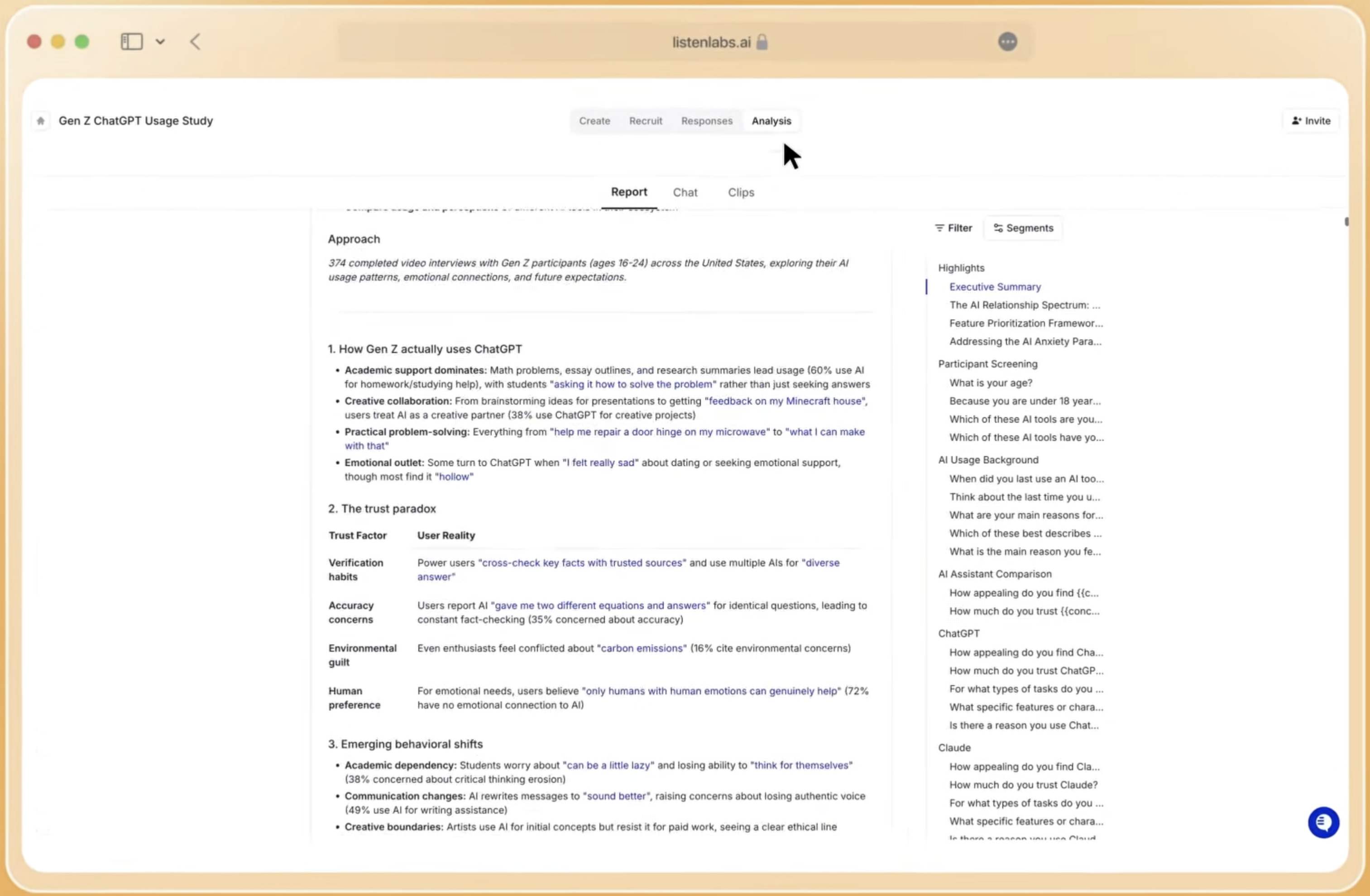
Listen Labs’ Research Agent manages the full analysis workflow from raw data to final output. It generates consultant-quality slide decks, statistical charts, highlight reels, and custom reports in under a minute. Every insight links directly to the underlying response data, which preserves transparency and lets teams drill into specific findings without losing traceability to source material.
Best-Fit Use Cases for Different Teams
The capabilities above translate into specific advantages for different types of teams. Large enterprise insights teams gain the most from Listen Labs’ ability to multiply research output without proportional headcount increases, which helps clear chronic research backlogs that frustrate stakeholders. UX research leads use screen-sharing and usability testing at scale to validate products at the same pace as development cycles.
Non-researcher product and marketing leaders gain self-serve research through natural language study design, which reduces dependence on specialized researchers for routine feedback. Agencies and consultancies rely on rapid turnaround for client projects and due diligence work where time-to-insight shapes competitive advantage.
Operational and Long-Term Considerations
Listen Labs’ Mission Control serves as a source of truth for customer insights, enabling cross-study queries and trend tracking that build institutional knowledge over time. The platform meets enterprise security requirements with certifications such as SOC 2, GDPR, and ISO standards for information security, privacy, and AI governance.
Risks, Limitations, and Common Misconceptions
AI-moderated research platforms face valid concerns around data depth, hidden recruitment complexity, and automation limits. A 2025 PLOS One study testing Microsoft Copilot for thematic analysis found minimal overlap with human-generated themes, frequent fabricated quotes, and a tendency to draw themes from early parts of the dataset rather than the full data.
At the same time, a 2025 Ipsos UK and University of Southampton paper found that LLMs Claude and GPT-o1 produced narrative analysis judged credible and thorough, comparable to human analysis, and sometimes contributed additional insights that enhanced the human work. Platform-specific training data and methodological frameworks create the real performance gap, not generic AI capability alone.
Teams should treat faster tools as amplifiers rather than automatic quality upgrades. Successful implementation still depends on sound study design, accurate audience targeting, and skilled interpretation of AI-generated insights within business context.
Decision Framework: Matching Platforms to Your Research Goals
Enterprise insights teams should evaluate platforms against concrete operational constraints and strategic objectives. Relevant factors include current research backlog size, required turnaround times, global market coverage, participant quality standards, emotional depth needs, integration with existing workflows, compliance and security mandates, and total cost of ownership including vendor management overhead.
Teams running 50 or more studies per year with global scope and strict compliance requirements often lose 15 to 20 percent of research operations time to vendor coordination. At this volume, comprehensive platforms like Listen Labs reduce fragmentation by consolidating recruitment, moderation, and analysis into one workflow. Below roughly 20 studies per year, the learning curve and integration effort may outweigh coordination savings, so point solutions for specific needs such as recruitment-only or analysis-only tools can deliver faster return. The right choice depends on whether your main bottleneck is study volume, geographic complexity, or compliance pressure. Assess platform fit for your research portfolio in a demo tailored to your operational requirements.
Conclusion: Selecting the Right AI Research Platform
The 2026 AI research landscape finally offers credible alternatives to the broken traditional model that forces trade-offs between speed, depth, and quality. Listen Labs provides an end-to-end platform that addresses these constraints through verified global recruitment, real-time fraud protection, emotional intelligence analysis, and automated insight generation at enterprise scale.
Organizations that keep relying on fragmented vendors and manual processes will lag behind competitors that use integrated AI research platforms to deliver faster and deeper customer understanding. The decision now centers on which platform can support your team’s specific requirements while scaling research output to match business demand. Experience the weeks-to-hours transformation in a demo that shows how Listen Labs maintains the methodological rigor your stakeholders expect.
Frequently Asked Questions
How quickly can AI-moderated platforms deliver results in 2026?
Leading AI-moderated platforms like Listen Labs compress the entire research cycle from study design to final deliverables into under 24 hours. This shift represents a dramatic improvement over traditional qualitative research that typically requires 4 to 6 weeks. The speed comes from automated study design assistance, instant participant recruitment from verified networks, simultaneous AI-conducted interviews, and automated analysis that generates consultant-quality reports, slide decks, and highlight reels in minutes instead of weeks of manual coding and report writing.
What participant quality controls exist beyond basic screening?
Enterprise-grade AI research platforms use multi-layered quality controls. These include behavioral matching based on intent and past actions instead of self-reported demographics, real-time monitoring during interviews to detect fraudulent responses and low-effort participation, reputation scoring systems that build participant profiles across multiple studies, and frequency limits that prevent professional survey-takers from dominating samples. Dedicated recruitment operations teams also source hard-to-reach segments through specialized networks rather than relying only on commodity panels.
How does Emotional Intelligence improve insight depth compared with transcripts alone?
Emotional Intelligence closes the gap between what participants say and what they actually feel during research sessions. Transcripts record only verbal responses. Emotional analysis examines tone of voice, word choice patterns, and subconscious micro-expressions to flag moments of confusion, hesitation, genuine excitement, or skepticism that participants may not verbalize. This multimodal approach quantifies emotions per question and concept using established psychological frameworks, which lets researchers pinpoint exactly when and why participants react emotionally to specific stimuli, concepts, or product features with timestamp-level precision.
Which platform best supports global multilingual research at enterprise scale?
Listen Labs leads in global research capabilities with a 30M+ verified participant network spanning 45+ countries and 100+ languages, automated translation and transcription across all supported languages, and cultural nuance detection that surfaces region-specific insights that Western-centric analysis might miss. Emotional Intelligence analysis works consistently across 50+ languages using universal emotion frameworks. The platform’s AI orchestration layer matches optimal participants across multiple panel partners and proprietary databases, while dedicated recruitment operations teams handle complex international sourcing requirements that commodity panels cannot fulfill.
How do AI research platforms handle enterprise security and compliance requirements?
Enterprise-grade platforms maintain comprehensive security certifications including SOC 2 Type II, GDPR, ISO 27001, ISO 27701, and ISO 42001 compliance. Data protection measures include 256-bit encryption for all data transmission and storage, strict policies that keep customer data out of AI model training, enterprise SSO integration for access control, and detailed audit trails for compliance reporting. These platforms also provide data residency options for organizations with geographic requirements and maintain dedicated security teams that monitor and update protections as regulations evolve.