
Written by: Anish Rao, Head of Growth, Listen Labs
Key Takeaways
- Traditional fragmented research tools force manual handoffs between recruitment, moderation, analysis, and reporting, stretching timelines to weeks or months.
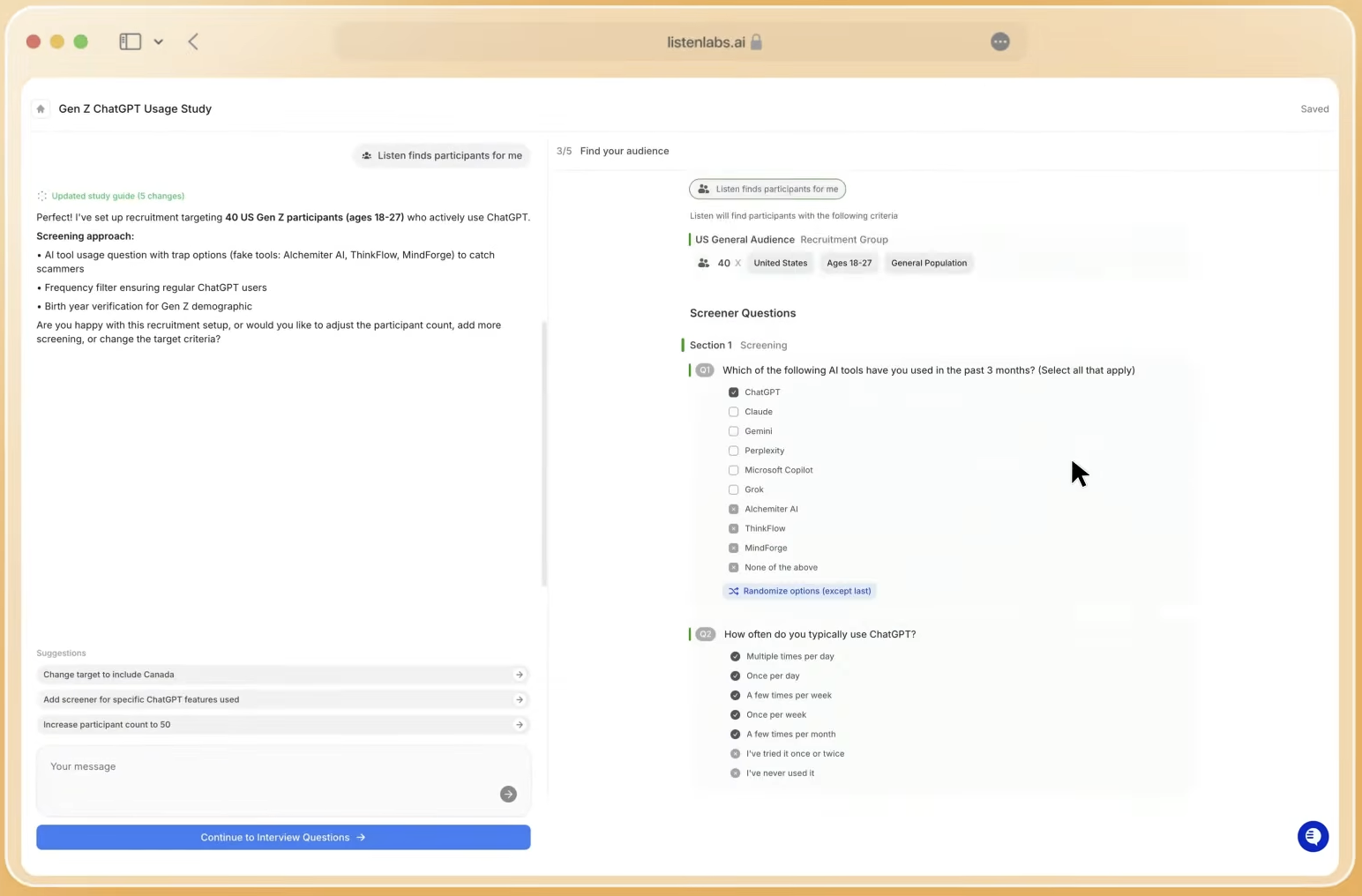
- Listen Labs removes these delays by combining study design, global recruitment, AI-moderated interviews, emotional analysis, and instant deliverables in one no-code platform.
- AI-moderated interviews resolve the classic depth-versus-scale trade-off, enabling hundreds or thousands of rich conversations while maintaining statistical confidence.
- Enterprise-grade fraud prevention plus SOC 2 Type II, GDPR, and ISO certifications protect participant quality and data security across 45+ countries and hard-to-reach audiences.
- Ready to compress your research cycle from weeks to under 24 hours? See how Listen Labs delivers results in under 24 hours — book your demo today.
Six Core Evaluation Criteria for Any No-Code Research Tool
Every insights leader comparing platforms should apply six core criteria before committing to a solution: research speed from brief to report, depth versus scale, participant quality and fraud prevention, emotional intelligence, operational fit for different team types, and enterprise security compliance. Any platform that cannot satisfy all six forces a workaround, and workarounds reintroduce the manual steps the tool was supposed to eliminate.
Research Speed from Brief to Report
Traditional focus groups take 3–5 weeks and $4,000–$12,000 per 90-minute session. Research agencies add further delays for internal prioritization, budget approval, and report writing. Some enterprise cycles stretch to six months.
Panel and recruitment platforms such as Prolific, User Interviews, and Respondent solve sourcing but hand the moderation and analysis work back to the team. Survey tools like SurveyMonkey and Qualtrics launch quickly but produce no conversational data. Repository tools like Dovetail organize past research but cannot conduct new studies.
The remaining friction in every fragmented approach is the handoff. Teams move from brief to recruiter, recruiter to moderator, moderator to analyst, and analyst to report writer. Each handoff adds days.
Platforms like Listen Labs add auto-recruiting, transcription, sentiment tagging, and insight summarization. Teams move from question to findings in hours, not weeks. When every step lives inside one platform, handoff cost drops to zero and the timeline compresses to under 24 hours.

Depth Versus Scale: Breaking the Old Trade-Off
Qualitative interviews deliver nuanced understanding but traditionally cover only 5–15 participants. Quantitative surveys reach thousands but capture surface-level, pre-set responses with no ability to probe.
Qual-at-scale works well when research requires large sample sizes or broad geographic reach. AI tools can engage hundreds or thousands of participants remotely and asynchronously.
AI-moderated interviews resolve the trade-off by running personalized, adaptive conversations at scale simultaneously. Listen Labs has run over 1 million AI-powered customer interviews for companies including Microsoft, Perplexity, and Sweetgreen. This track record shows that statistical confidence and qualitative depth can coexist when the moderation layer is fully automated.
Participant Quality and Fraud Prevention
Commodity panels carry a well-documented risk of professional respondents who focus on incentives instead of honest answers. Researchers on forums regularly flag repeat participants, AI-generated scripts, and mismatched demographic profiles. These issues contaminate data and can undermine entire studies.
Listen Labs addresses this through three layers. First, the platform works exclusively with non-commodity panel sources, avoiding professional survey-taker pools. Second, Quality Guard applies real-time behavioral monitoring across video, voice, content, and device signals to detect fraud, low-effort responses, and mismatched profiles during the interview itself.
Third, participants are capped at three studies per month. This cap reduces panel fatigue and incentive gaming that inflate response rates on commodity platforms. A dedicated recruitment operations team adds a human review layer for hard-to-reach segments, including enterprise decision-makers, healthcare workers, and audiences below 1 percent incidence rate.
Emotional Intelligence: Capturing What Transcripts Miss
Once participant quality is under control, the next priority is capturing the full story behind their responses. Transcripts record what participants say. They do not record a frown during a product demo, a pause before answering a pricing question, or the flat expression that follows a supposedly positive rating.
Two concepts can both receive favorable verbal scores while triggering very different emotional responses. Only multimodal signal analysis can surface that distinction.
Listen Labs' Emotional Intelligence layer analyzes tone of voice, word choice, and subconscious micro-expressions against Ekman's universal emotions framework, the standard used in clinical psychology and UX research. Every emotion is quantified per question and concept. Each label links to the exact timestamp, verbatim quote, and reasoning behind it.
The capability works across 50+ languages and connects directly with the Research Agent for natural-language queries, charts, and highlight reels of emotionally significant moments. Teams use it for creative testing, concept comparison, usability friction detection, and brand perception research.
Ready to capture what your participants actually feel, not just what they say? See Emotional Intelligence in action — schedule your demo now.
Scenario-Based Guidance for Different Team Types
Enterprise consumer insights groups running 20+ studies per year need a platform that handles global recruitment across 45+ countries. They also need multi-market localization and cross-study trend tracking through a persistent knowledge base. Listen Labs' Mission Control serves as the organizational source of truth and enables cross-study queries in seconds instead of hours of report archaeology.
UX research leads on sprint cycles need same-day participant access, screen-sharing and mobile recording for usability studies, and the ability to test with 50–100+ users. Manual scheduling usually limits them to 5–10 participants, so this shift changes the scope of what they can validate.
Product managers and brand leaders without dedicated research staff need natural-language study design. They describe the goal, and the AI drafts structured objectives, questions, and probing context automatically.
Agencies and consultancies operating on client timelines measured in days need global reach and niche audience sourcing. As noted earlier, Listen Labs' ability to conduct hundreds of interviews simultaneously makes it especially effective for agencies working under compressed deadlines.
Operational Considerations and Change Management
Adopting an end-to-end no-code research tool starts with internal stakeholder education on what AI moderation can and cannot do. This clarity sets realistic expectations and prevents misalignment later.
Once stakeholders understand the capabilities, data governance alignment with legal and security teams becomes the next step. This alignment ensures the platform meets compliance requirements before any data is collected.
Finally, a structured pilot before scaling to always-on programs allows teams to validate output quality in a controlled environment. Listen Labs holds SOC 2 Type II, GDPR, ISO 27001, ISO 27701, and ISO 42001 certifications, and customer data is never used for AI model training. These safeguards reduce the compliance review burden for enterprise procurement teams.
Starting with a defined pilot scope, typically two to three studies on familiar research questions, helps teams compare AI-generated findings against known benchmarks. This comparison builds confidence before they expand usage.
Risks and Limitations of AI-Moderated Research
AI moderation performs at a high level for most consumer insights and UX research use cases. Some highly sensitive topics still benefit from human moderator oversight. Clinical research, crisis communications, or studies involving legally privileged conversations fall into this category.
Niche audiences below 1 percent incidence rate sometimes require manual sourcing beyond automated panel matching. Listen Labs' recruitment operations team can handle this work, although it adds coordination time.
Early studies on a new platform should be validated by comparing AI-generated themes against a manual review of a sample of transcripts. This practice establishes baseline confidence before teams scale their programs.
Every insight in the Research Agent links directly to the underlying response data. Spot-checking becomes straightforward because researchers can trace any finding back to the exact interview and timestamp instead of trusting a black-box summary.
Decision Framework Checklist for Your Team
Before selecting a no-code research tool for customer interviews, define your team's constraints and goals. Start with study volume. How many studies does your team need to run per quarter, and how many can you currently deliver?
Clarify your acceptable time from brief to report. Identify whether you need global recruitment across multiple languages and markets. Map your current tool stack for recruitment, moderation, analysis, and reporting, and estimate what each handoff costs in time.
Confirm whether your organization requires SOC 2, ISO, or GDPR compliance from research vendors. Note any need for niche or hard-to-reach audiences. Decide whether you need emotional signal data beyond transcripts and cross-study trend tracking for institutional knowledge retention.
If your answers point toward speed, scale, quality, and compliance at the same time, a fragmented toolset will struggle to satisfy all of them together.
Frequently Asked Questions
Can AI moderation replace human researchers?
AI moderation does not replace human researchers. It removes the logistical and operational work that consumes most of a researcher's time.
Recruiting participants, scheduling sessions, moderating interviews, transcribing recordings, coding themes, and formatting deliverables are tasks that Listen Labs automates end-to-end. Human researchers focus on strategic work instead. They frame the right questions, interpret findings in business context, and advise stakeholders on decisions.
Teams using Listen Labs typically multiply their research output with the same headcount rather than reducing it. The platform's in-house research team, with 50+ years of combined expertise, continuously refines the methodology framework to maintain the rigor that enterprise clients require.
How does pricing work for a no-code research tool like Listen Labs?
Listen Labs uses a subscription model. Enterprise clients pay for platform access, which includes a set number of studies and credits, and then spend credits per participant recruited.
Credit cost varies based on audience difficulty. General population studies cost fewer credits than niche or hard-to-reach segments such as enterprise decision-makers or healthcare professionals.
Companies with more than 100 employees go through a demo and pilot process to size the right subscription tier. Smaller organizations can access the self-serve platform directly.
The total cost of running research through Listen Labs is typically one third of the cost of an equivalent traditional agency-led approach. This comparison accounts for panel fees, moderator costs, transcription, and report writing.
Can I still use my own participants?
Yes. Listen Labs supports self-recruitment, so organizations can study their own customer base, user panel, or CRM list at a reduced credit cost. You can also bring your own panel provider.
The platform's AI moderation, analysis, and deliverable generation apply regardless of whether participants come from Listen Atlas, a third-party panel, or your own database. This flexibility helps UX research teams that maintain existing user communities and enterprises that want to combine proprietary customer data with broader market samples in the same study.
How is data privacy handled?
Listen Labs maintains enterprise-grade security with 256-bit encryption. The platform holds SOC 2 Type II, GDPR, ISO 27001, ISO 27701, and ISO 42001 certifications. Customer data is never used to train AI models.
Enterprise SSO is supported. For organizations operating across multiple jurisdictions, the combination of GDPR compliance and ISO 27701 privacy information management and ISO 42001 AI management systems covers the most common regulatory requirements that enterprise procurement and legal teams encounter during vendor review.
Conclusion: Moving from Fragmented Tools to an End-to-End Platform
Fragmented tools such as agencies, standalone panels, survey platforms, and repository tools each solve one part of the research lifecycle. They also reintroduce manual steps at every handoff.
AI can schedule and conduct the interview, analyze the transcripts for themes, and generate quantitative insights from those interviews. The full time saving appears only when all of those capabilities live inside a single platform.
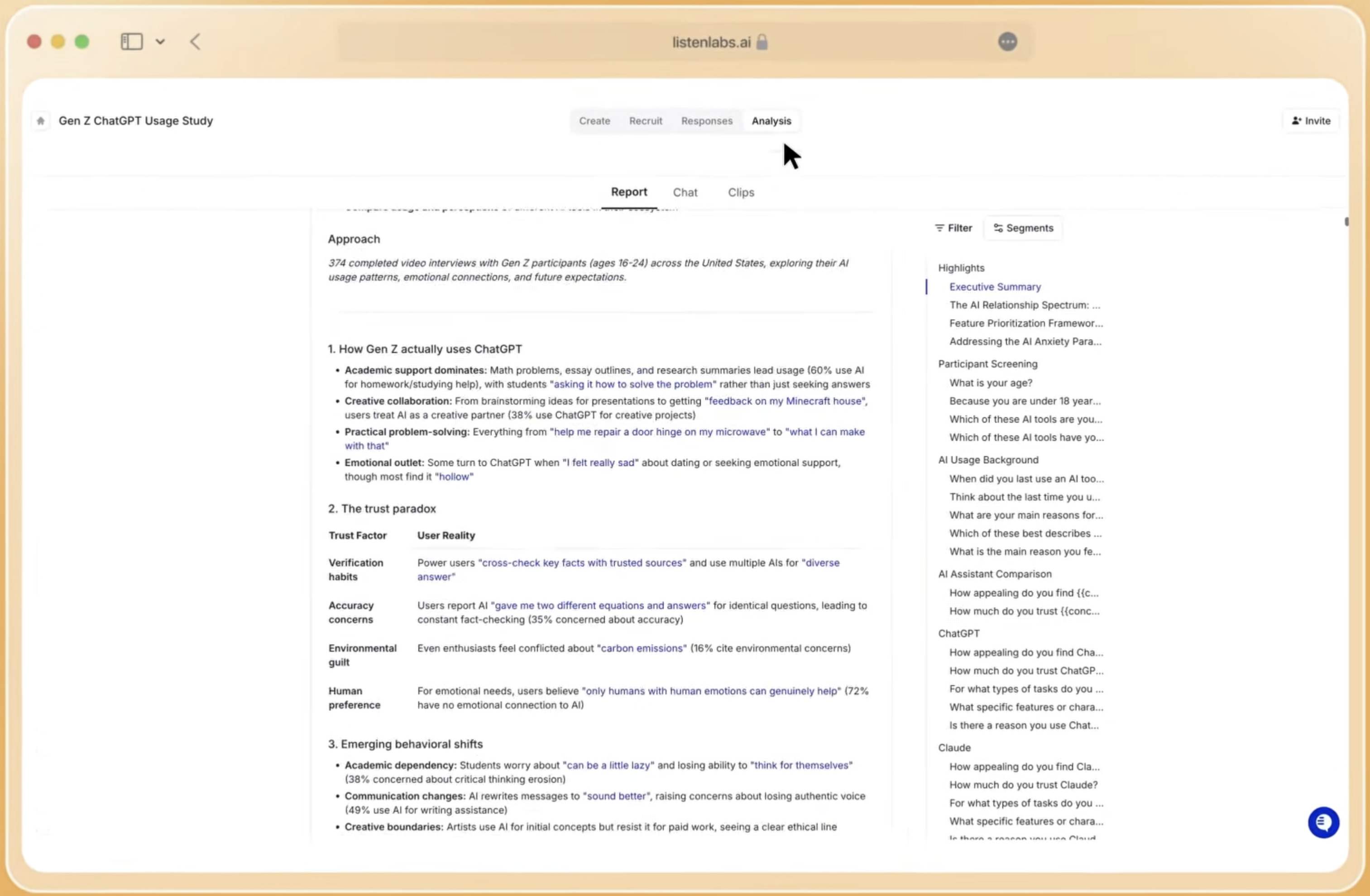
With AI-moderated interviews, talking to users at scale is no longer the hard part. The challenge is understanding what they mean, which requires an analysis layer built into the same system, not bolted on afterward.
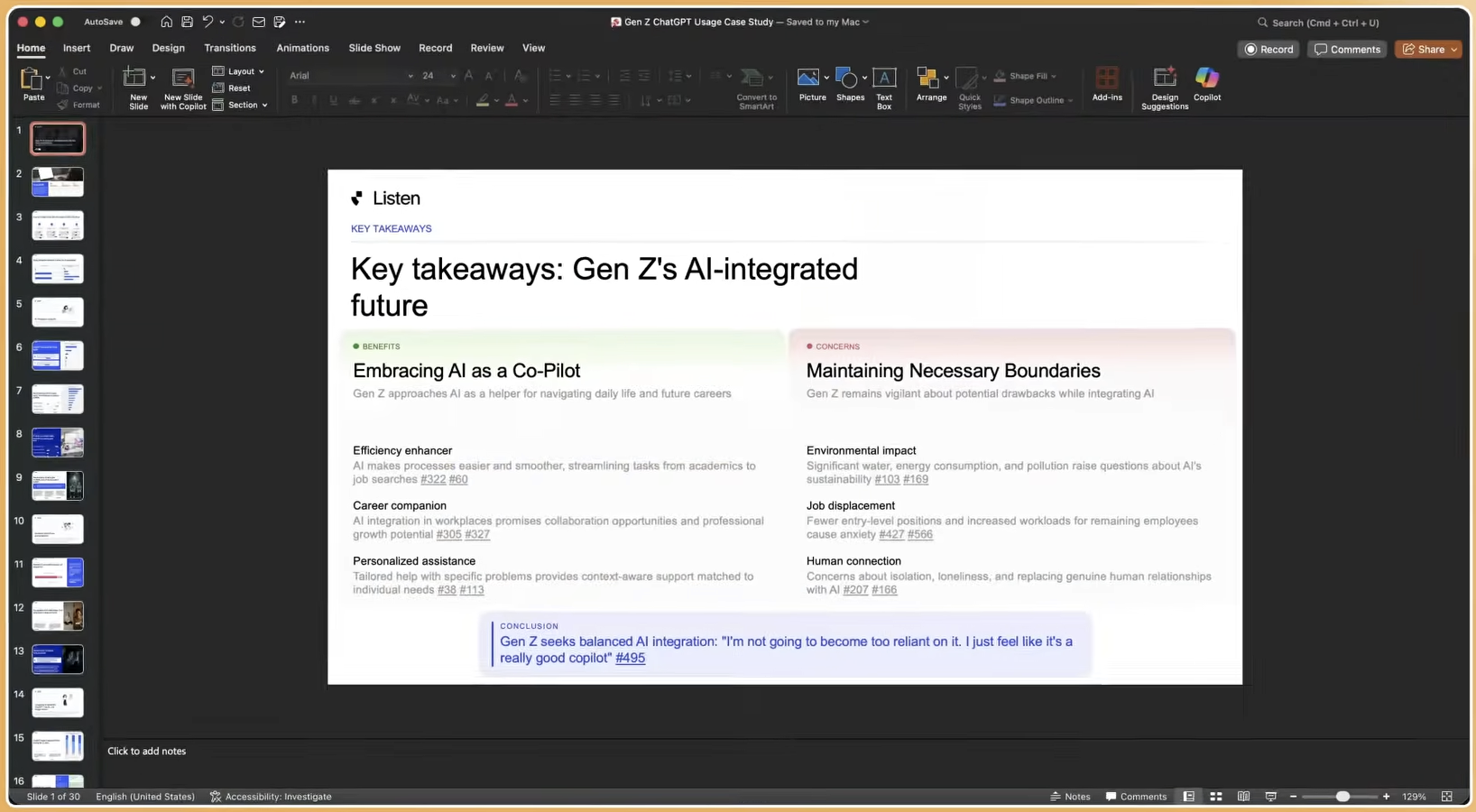
Listen Labs is an end-to-end AI platform that covers study design, global recruitment from 30 million verified respondents across 45+ countries, AI-moderated video interviews, emotional intelligence analysis, and instant deliverables. All of this operates within enterprise-grade SOC 2, ISO, and GDPR compliance.
Ready to turn weeks of research into results in under 24 hours? Schedule your demo and see the platform in action.