Written by: Anish Rao, Head of Growth, Listen Labs | Last updated: July 6, 2026
Key Takeaways
- Modern enterprise customer insights programs in 2026 prioritize continuous, decision-first research over traditional project-based approaches that cannot keep pace with business needs.
- Traditional 4–6 week research cycles are collapsing into under-24-hour insight sprints through AI-enabled platforms that handle recruitment, moderation, analysis, and delivery in one workflow.
- Qual-at-scale removes the historical depth-versus-scale trade-off by running hundreds of adaptive, AI-moderated interviews simultaneously while maintaining methodological rigor and statistical confidence.
- Multi-layer quality controls, including behavioral matching, real-time fraud detection, and participant frequency limits, protect data integrity far beyond commodity panels while meeting enterprise governance standards.
- Listen Labs delivers an end-to-end platform that makes continuous insight programs operationally viable at Fortune 500 scale. See how insight sprints accelerate decision velocity.
The Problem: Speed Constraints in Traditional Research Cycles
A standard qualitative research cycle includes study design, recruitment, scheduling, moderation, transcription, analysis, and reporting. This multi-week cycle mentioned earlier stems from fragmentation across the research stack. Internal prioritization queues, budget approval workflows, and vendor coordination can extend that timeline to six months in large organizations. By the time a report lands, the product decision it was meant to inform has already been made on incomplete information, or the competitive context has shifted entirely.
Fragmentation across vendors slows every step. Recruitment sits with one vendor, scheduling with another, moderation with a third, transcription and analysis with a fourth. Each handoff introduces delay, quality risk, and coordination overhead. Research teams operating as internal service providers face growing backlogs. Many stakeholder requests are never fulfilled at all.
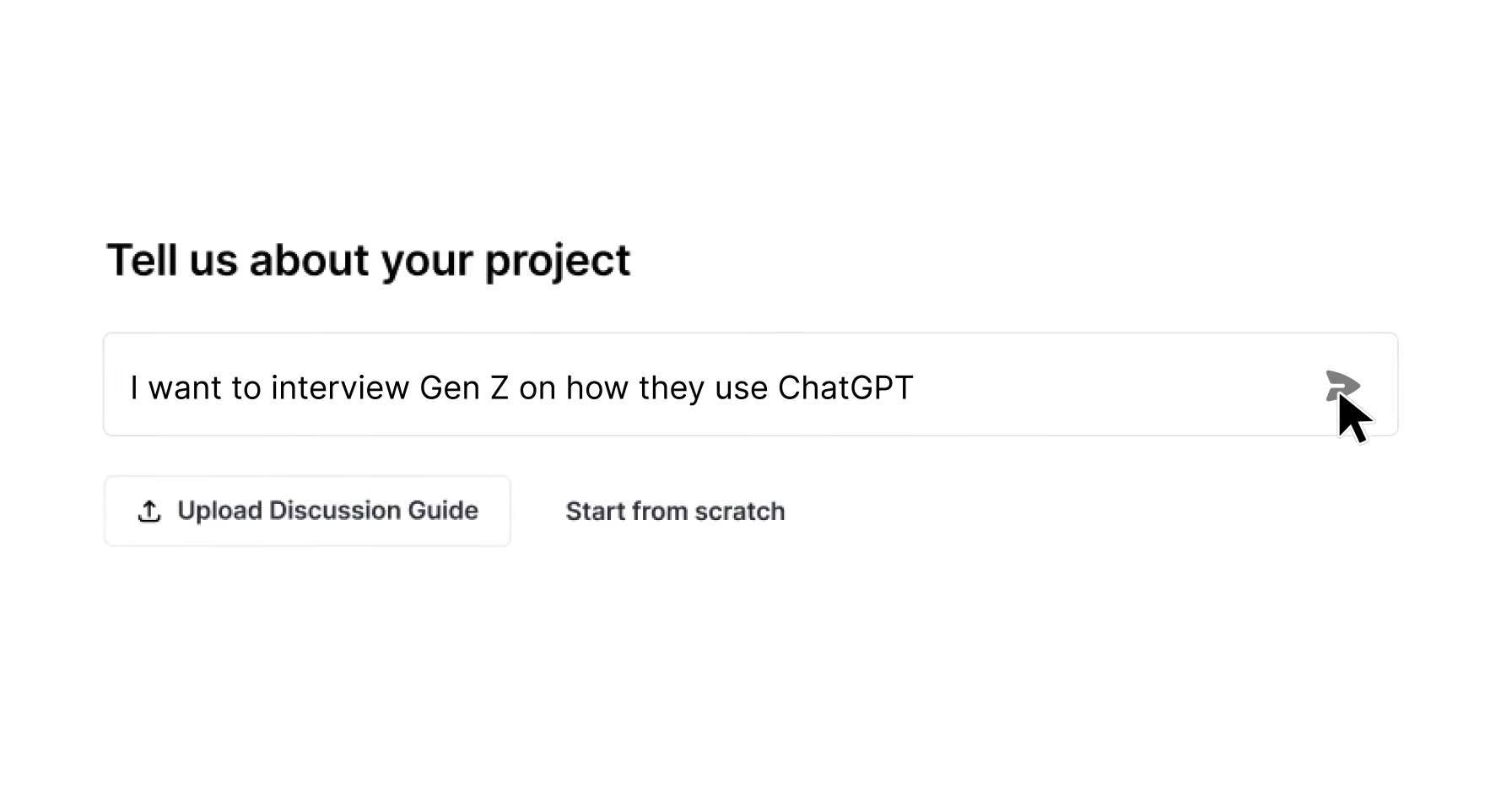
Incremental fixes cannot solve this structural problem. AI-assisted study design drafts structured objectives and question guides from a natural-language brief in seconds, removing the blank-page delay. Global recruitment through a verified participant network removes the multi-week sourcing bottleneck. AI-moderated adaptive interviews run in parallel across hundreds of participants, with dynamic follow-up probing built in. The result is a complete study, from brief to deliverable, in under 24 hours.
Insight Sprints: How Listen Labs Collapses Research Timelines
Listen Labs operationalizes this model through an insight sprints framework that covers every stage of the research lifecycle on a single platform. Study co-design uses AI to translate research goals into structured guides, with support for branching logic, stimuli display, monadic testing, and quota controls. Once the study design is finalized, recruitment runs through Listen Atlas, an AI orchestration layer that matches and bids across a global network of 30M+ verified respondents in 45+ countries and 100+ languages. A dedicated recruitment operations team handles sub-1% incidence audiences such as enterprise decision-makers, healthcare workers, and engineers.
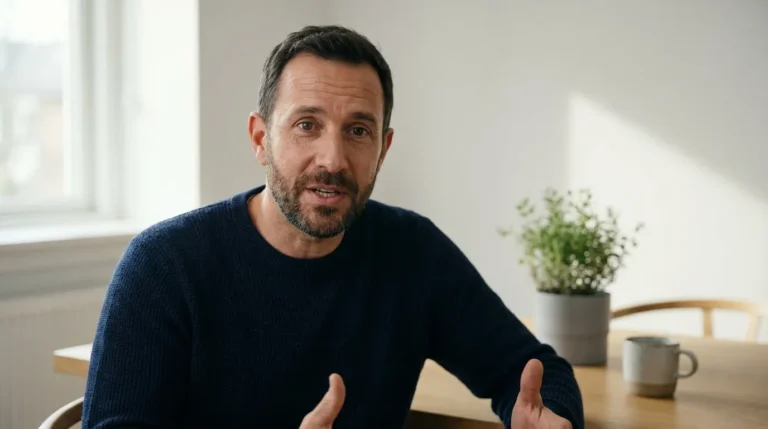
Interviews then run through an AI moderator that conducts personalized, adaptive conversations and probes deeper on short or unexpected answers the way a trained human interviewer would. With qual-at-scale, the old trade-off between depth and scale is no longer a barrier, because hundreds of simultaneous one-on-one interviews deliver both statistical confidence and qualitative nuance. An Emotional Intelligence layer analyzes tone of voice, word choice, and subconscious micro-expressions using Ekman's universal emotions framework. It surfaces signals that transcripts alone miss and quantifies them per question and concept with timestamp-level traceability.
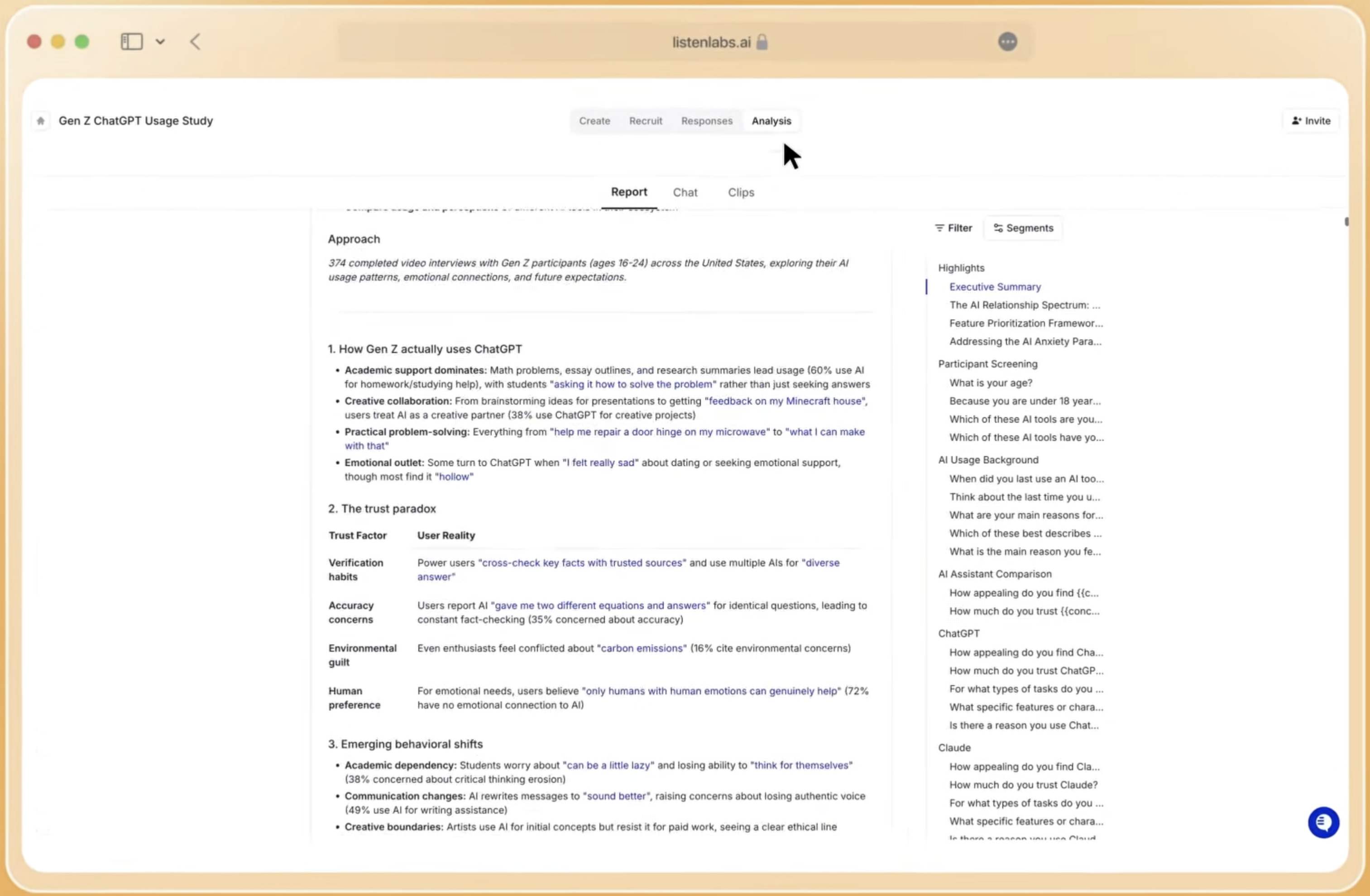
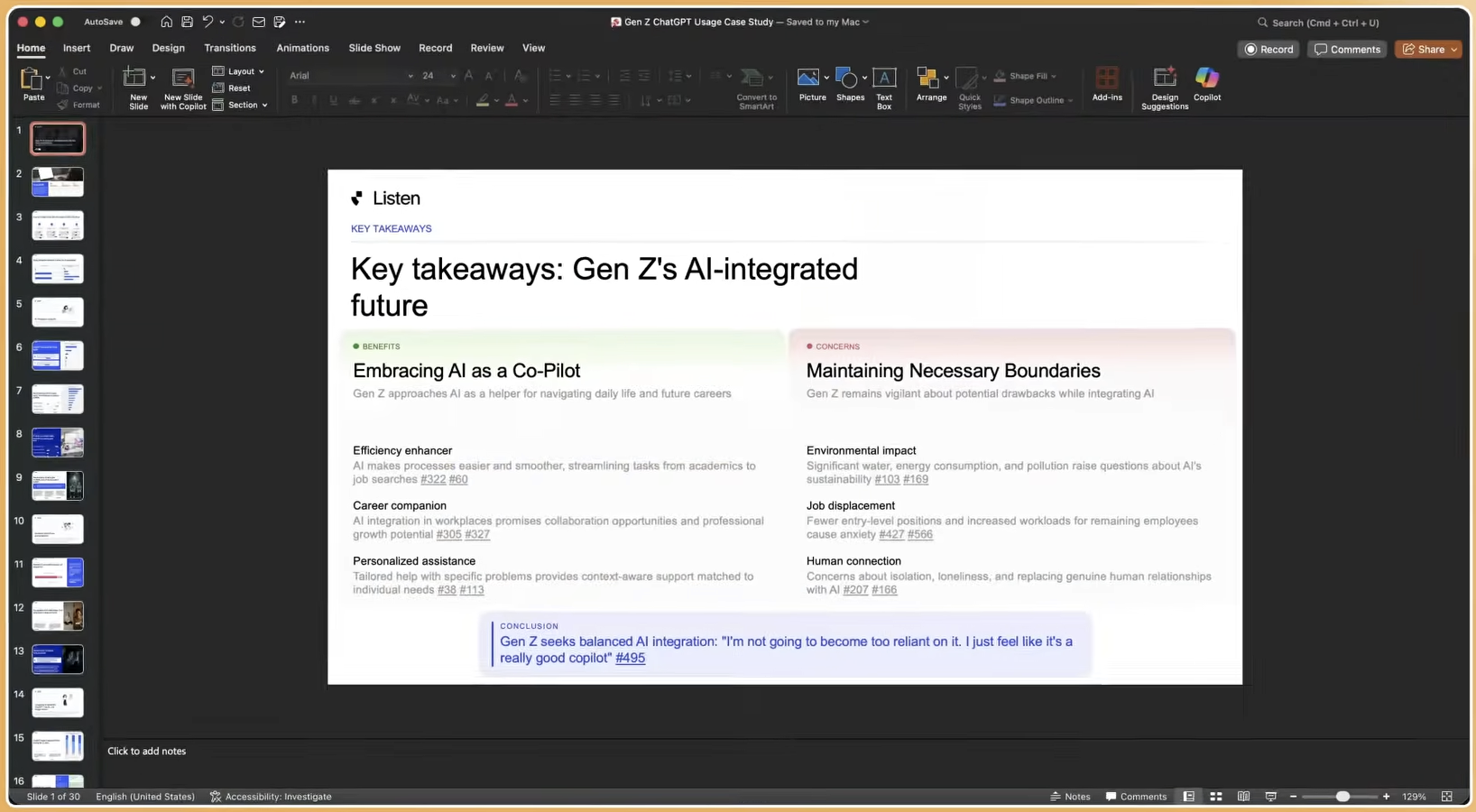
Analysis flows through the Research Agent, which processes all interview data objectively and generates slide decks, memos, highlight reels, statistical charts, and segmentation breakdowns. One researcher ran a full buying intent analysis across three user segments in under a minute. Mission Control then stores each study in a persistent knowledge base, enabling cross-study queries and trend tracking so institutional knowledge compounds rather than evaporates after each project.
The Problem: Depth-versus-Scale Trade-off and Participant Quality Issues
Sample size has historically constrained qualitative consumer research. Rich, adaptive interviews deliver the nuance needed for real decision-making, but traditional moderation limits studies to 5–15 participants. That sample is too small for statistical segmentation or cross-market comparison. Quantitative surveys scale but replace conversation with checkboxes, removing the follow-up probing that surfaces unexpected findings.
Participant quality issues intensify this constraint. Commodity panels carry well-documented risks, including professional survey-takers optimizing for incentive payouts, fraudulent or AI-generated profiles, and repeat respondents who have learned to give socially desirable answers. Researchers spend significant time on quality assurance that should be spent on analysis. Low-quality data undermines the entire research investment regardless of how sophisticated the analysis layer is.
Traditional focus groups take 3–5 weeks and $4,000–$12,000 per 90-minute session, creating a cost and timeline structure that makes iterative or continuous research economically unviable for most enterprise teams. The depth-versus-scale trade-off is not a methodological preference. It is a structural constraint of the traditional research infrastructure.
Qual-at-Scale: Merging Depth, Scale, and Data Quality
Qual-at-scale is ideal when research requires large sample sizes or broad geographic reach, as AI tools can engage hundreds or thousands of participants remotely and asynchronously, while each interview remains personalized and adaptive. Listen Labs conducts simultaneous AI-moderated interviews that combine qualitative open-ended questions with quantitative formats such as Likert scales, NPS, MaxDiff, and sliders in a single session. This structure removes the need to run separate qual and quant studies.
Three layers protect participant quality. Listen Atlas uses behavioral matching on intent and past actions rather than self-reported demographics alone. Quality Guard monitors every interview in real time across video, voice, content, and device signals, detecting fraud, low-effort responses, AI-generated scripts, and mismatched profiles. Participants are capped at three studies per month, which removes the professional survey-taker problem at the source.
Responsible AI governance further strengthens this foundation. Fewer than one in 100 organizations has implemented full responsible AI practices according to a 2026 World Economic Forum report, so multi-layer compliance infrastructure becomes a meaningful differentiator. Listen Labs holds SOC 2 Type II, GDPR, ISO 27001, ISO 27701, and ISO 42001 certifications.
The Emotional Intelligence layer adds a dimension unavailable in any survey format. It provides quantified emotional response per concept, traceable to the exact timestamp, verbatim quote, and reasoning behind each label. Two concepts can receive identical verbal ratings while triggering measurably different emotional profiles, a distinction that determines which one to launch.
The Problem: Analysis Burden and Insight-to-Action Gaps
Researchers spend the bulk of their time in analysis: finding patterns, quantifying insights, testing significance, adding macro context, and formatting results for stakeholders who each need something different. Human analysis of qualitative data is also prone to confirmation bias. Analysts may unconsciously weight findings that confirm pre-existing hypotheses while underweighting unexpected signals.
Even when analysis is completed rigorously, the insight-to-action gap often remains. Findings live in slide decks and reports that are rarely revisited. Past studies are not queryable. When a new business question surfaces that a previous study partially answered, that institutional knowledge is effectively inaccessible. Organizations repeatedly commission research on questions they have already answered, at full cost and full timeline.
In 2026, AI synthesis quality has become the primary competitive moat for customer insights platforms, shifting focus from data collection to turning hundreds of conversations into traceable, decision-grade insights in hours rather than weeks. The analysis bottleneck, not the data collection bottleneck, now acts as the primary constraint on research velocity.
Mission Control and Research Agent: Closing the Action Gap
Research Agent handles the full analysis workflow from raw data to final output. It processes all interview responses objectively to identify patterns, themes, and segments without human bias. Every insight links directly to the underlying response data, preserving the auditability that enterprise governance requires. One-click deliverables such as slide decks, memos, highlight reels, and statistical charts are generated in under a minute and formatted for different stakeholder audiences.
Decision-velocity KPIs replace the traditional research metric of studies completed per quarter. The relevant measure becomes time from business question to decision-grade answer. Emotional and thematic data remain fully traceable, enabling teams to show not just what customers said but why a specific insight should drive a specific decision. Mission Control converts each completed study into a searchable asset, so the ROI of past research compounds over time rather than depreciating in a shared drive.
Explore how Mission Control turns past research into a searchable, compounding asset for your team.
Enterprise Outcomes That Show Modern Insight Practices in Action
The following enterprise outcomes show how insight sprints and qual-at-scale translate into measurable business impact across storytelling, product strategy, churn reduction, and engagement. Microsoft needed to collect global customer stories for its 50th anniversary celebration at a speed incompatible with traditional research timelines. Listen Labs has run over 1 million AI-powered customer interviews for companies including Microsoft, Perplexity, and Sweetgreen. The Microsoft team collected user video stories within a single day. The Director of Data Science at Microsoft noted, "Our leadership team was very thrilled at both the speed and the scale that Listen Labs enabled. I can reach out to hundreds of users at one third of the cost."
Procter & Gamble used Listen Labs to evaluate how men respond to new product claims before market launch. The study delivered 250+ interviews with quantified themes and verbatim proof in hours. The work surfaced where claims felt exaggerated or unclear and confirmed that comfort, safety, and reliability outweighed novelty as purchase drivers. These findings directly shaped product and brand strategy.
Anthropic needed to understand why Claude users cancel their subscriptions. Listen Labs delivered 300+ user interviews in 48 hours, identifying where former users migrate, what triggers switching, and a prioritized list of ten must-fix items. The Director of Product Strategy at Anthropic described the outcome as "a level of clarity and speed we've never had before." Skims validated a global campaign direction with thousands of high-income buyers overnight, enabling board-level buy-in before launch. Robinhood's qual interviews revealed that users who view prediction markets as entertainment drive 2.4x higher weekly re-engagement than income-motivated users, a segmentation insight that informed integration design and contributed to projected uptake increases of 30–40%.
Addressing Common Concerns About AI-Moderated Research
The most common concern about AI-moderated interviews is whether they match the quality of a trained human researcher. Purpose-built AI-moderated platforms can conduct hundreds of simultaneous in-depth interviews while maintaining conversational depth and follow-up probing, producing depth comparable to human-moderated studies when the platform is built on research methodology rather than general-purpose AI. Listen Labs is built by a team with 50+ years of combined research expertise, and the AI moderator is continuously refined against tens of thousands of completed studies. For the vast majority of enterprise research needs, the output is comparable in quality and dramatically superior in speed and scale.
Fraud prevention represents another frequent concern. Quality Guard's real-time monitoring across video, voice, content, and device signals, combined with participant frequency limits and behavioral matching, addresses the quality risks that commodity panels carry. The platform does not use commodity quantitative panels. Platforms like Listen Labs layer on auto-recruiting, transcription, sentiment tagging, and insight summarization so teams jump from question to findings in hours, not weeks, with quality controls embedded throughout rather than applied as a post-hoc filter.
Listen Labs does not replace research teams. It multiplies their output. Researchers are freed from logistics, recruitment coordination, transcription, and manual analysis so they can focus on strategic interpretation, stakeholder communication, and program design. UX and product teams are increasingly adopting AI in research workflows, a shift that reflects AI as an amplifier of research capacity, not a replacement for research judgment.
Evaluation Criteria and Next Steps for Continuous Insight Systems
Enterprise leaders evaluating platforms for continuous customer insights programs should focus on five dimensions that collectively define decision-ready research. Speed covers time from brief to deliverable. Rigor includes methodological controls, fraud prevention, and AI governance certifications. Scale reflects participant network depth and geographic coverage. Analysis quality includes objectivity, traceability, and deliverable formats. Actionability depends on institutional knowledge infrastructure and cross-study query capability. BCG's Center for Customer Insight approach deliberately integrates research into broader strategic decision-making rather than treating it as disconnected analysis, a standard that continuous insight programs must meet to justify enterprise investment.
The practical next step for most enterprise insights leaders is a pilot. One study is scoped to a live business decision and run through the full insight sprints workflow. The team then measures results against its current cycle time and cost baseline. The comparison is concrete and the timeline is days, not months.
The questions below address the most common concerns enterprise leaders raise when evaluating continuous insight systems, including decision design, program structure, governance standards, and when AI moderation is appropriate.
Frequently Asked Questions
What distinguishes a decision-first research design from a traditional project-based approach?
A decision-first research design begins with the business decision that needs to be made, including its deadline, the options under consideration, and the specific information gap that research must close, then works backward to study design. Traditional project-based research often begins with a research question or a stakeholder request and produces findings that may or may not map to a pending decision. In practice, decision-first design means scoping studies to answer one or two high-stakes questions rather than producing comprehensive reports. It also means setting a delivery deadline tied to the decision timeline rather than the research team's capacity and treating the insight as an input to a specific action rather than a standalone deliverable. Continuous programs operationalize this by maintaining a live queue of decision-linked research questions, running studies in parallel, and building institutional knowledge that reduces the need to re-research foundational questions.
How do continuous customer insights programs differ from running more frequent one-off studies?
Frequency alone does not constitute a continuous program. A continuous customer insights program has three structural characteristics that distinguish it from a high-cadence project model. First, it maintains a persistent knowledge base, so every study adds to a searchable repository rather than producing a standalone report. Second, it tracks signals over time, enabling trend detection across sentiment, needs, and pain points rather than point-in-time snapshots. Third, it is integrated into decision workflows at the organizational level, with research outputs routed directly to the stakeholders and systems where decisions are made. Running more frequent one-off studies increases research volume but does not produce compounding institutional knowledge or systematic decision integration. Platforms like Listen Labs support continuous programs through Mission Control, which enables cross-study queries, trend tracking, and knowledge building that accumulates value with each completed study.
What governance and data quality standards should enterprise teams require from AI-powered qualitative research platforms?
Enterprise teams should require, at minimum, SOC 2 Type II certification, GDPR compliance, and ISO 27001 for information security management. For AI-specific governance, ISO 42001 certification, the international standard for AI management systems, is the relevant benchmark. Beyond certifications, teams should evaluate fraud detection architecture. Real-time monitoring across multiple signal types, including video, voice, content, and device, is more robust than post-hoc flagging. Participant frequency limits and behavioral matching on intent data, rather than self-reported demographics alone, reduce the professional survey-taker problem structurally. Methodological rigor requires that every AI-generated insight be traceable to the underlying response data, including the specific verbatim, timestamp, and reasoning behind each label. Teams should also confirm that customer data is not used for AI model training, a contractual and technical control that is standard for enterprise-grade platforms but not universal across the market.
Can AI-moderated interviews replace human moderators for sensitive or complex research topics?
AI-moderated interviews are well-suited to the majority of enterprise consumer research use cases, including concept testing, claim evaluation, brand perception, churn analysis, usability testing, and segmentation research. For topics requiring clinical sensitivity, crisis communication, or highly specialized domain expertise where the moderator's professional judgment is itself part of the research instrument, human moderation remains appropriate. The more relevant consideration for most enterprise teams is whether the research backlog they currently cannot fulfill, due to capacity, cost, or timeline constraints, could be addressed through AI moderation. In practice, AI moderation enables teams to run studies that would otherwise never happen, expanding total research output rather than substituting for a narrow set of high-complexity engagements. The Listen Labs platform is designed to multiply existing research team capacity, with the in-house research team available as a methodology partner for study design and interpretation.