Written by: Anish Rao, Head of Growth, Listen Labs | Last updated: June 24, 2026
Key Takeaways
-
Market research is a structured way to gather and interpret data about markets, customers, and competitors so teams can make confident, evidence-backed decisions.
-
Business teams use research to validate ideas, understand customer motivations, analyze competitors, and reduce decision risk before committing budget or headcount.
-
The 5 P’s framework (Product, Price, Promotion, Place, People) groups research questions around the levers that most directly influence business performance.
-
AI-powered platforms now compress traditional 4–6 week research cycles into under 24 hours by automating recruitment, moderation, and analysis in a single workflow.
-
Listen Labs helps teams without dedicated research staff run rigorous studies in under 24 hours, so they can move from idea to evidence in a single day.
How market research supports everyday business decisions
For business teams, market research serves four practical goals that map directly to common pressures Product Managers and Brand Managers face without a dedicated research staff.
1. Validate ideas before committing resources
-
Test product concepts, messaging, or pricing hypotheses with real customers before development begins.
-
Replace gut-feel decisions with evidence that survives stakeholder scrutiny.
-
Reduce the cost of being wrong at launch by catching issues while they are still cheap to fix.
2. Understand customers at depth
-
Traditional surveys may tell us what people do, but it takes a conversation to understand why.
-
Uncover motivations, frustrations, and unmet needs that behavioral data alone cannot surface.
-
Build personas and journey maps grounded in direct customer evidence instead of internal assumptions.
3. Analyze competitors and market conditions
-
Map how customers perceive competing products relative to yours.
-
Identify white space in positioning before a competitor claims it.
-
Track shifts in customer expectations across market segments over time.
4. Reduce decision risk
-
Replace assumptions with data before a campaign, product launch, or pricing change goes live.
-
Give leadership a defensible evidence base for budget and strategy decisions.
-
Catch misaligned messaging or product claims before they reach the market.
Teams without dedicated research staff face a compounding problem: research backlogs grow faster than they can be cleared, budget limits restrict the number of studies per year, and internal requests often go unfulfilled entirely. These issues share a root cause, because without a clear definition of what market research is and what it accomplishes, teams cannot prioritize requests, justify budget, or separate high-value studies from low-value ones. Establishing that shared definition is the first step toward fixing the operational backlog.
See how it works — watch a live walkthrough of a complete study cycle, from brief to findings, running in under 24 hours.
Using the 5 P’s to focus your research questions
Understanding what market research is and why it matters creates a foundation, and the next step is deciding what to study first. The 5 P’s framework provides that structure by mapping each research question to one of five strategic levers that influence performance.
Product
Research focused on whether a product or feature solves a real problem, and how well it does so relative to alternatives. A Product Manager launching a new feature uses product research to confirm that the use case is real, the design is intuitive, and the value proposition is clear before engineering investment is committed.
Price
Research that identifies what customers are willing to pay, how price signals quality, and where pricing creates friction. A Brand Manager evaluating a premium tier uses price research to test whether the target segment perceives sufficient value, and to pinpoint the price at which purchase intent drops.
Promotion
Research that tests whether messaging, creative, and channel strategy resonate with the intended audience. A marketing team preparing a campaign launch uses promotion research to identify which claims feel credible, which visuals drive engagement, and which messages create confusion before spend is committed.
Place
Research that examines where and how customers prefer to discover, evaluate, and purchase. A growth team expanding into a new market uses place research to understand channel preferences, retail versus direct-to-consumer trade-offs, and regional differences in buying behavior.
People
Research that builds a precise picture of who the customer is, including demographics, psychographics, behaviors, and decision-making process. A cross-functional team building a go-to-market plan uses people research to align product, brand, and sales around a shared, evidence-based customer profile rather than competing internal assumptions.
Choosing between primary and secondary research under real-world constraints
Once you know what to research using the 5 P’s framework, the next decision is how to gather that data. The choice between primary and secondary research affects both the specificity of your answers and the speed at which you can act on them.
Primary research, data collected directly from participants for a specific research question:
-
Higher cost per study, because it requires recruitment, moderation, and analysis.
-
Delivers answers specific to your exact question, audience, and context.
-
Traditional timelines run 4–6 weeks from study design to final report.
-
Modern platforms reduce this to under 24 hours, the speed advantage mentioned earlier, which makes primary research viable even when decision deadlines are tight.
-
Best for: validating new concepts, understanding customer motivations, and testing messaging before launch.
Secondary research, analysis of existing data sources such as industry reports, published studies, and competitive intelligence:
-
Lower cost, because data already exists and is often accessible immediately.
-
Cannot answer questions specific to your product, brand, or customer segment.
-
Risk of outdated data, especially in fast-moving categories.
-
Best for: sizing a market, benchmarking industry trends, and informing a research brief before primary fieldwork begins.
The practical trade-off for non-research teams:
-
Secondary research is the right starting point when budget is constrained and a directional answer is sufficient.
-
Primary research becomes necessary when the decision is high-stakes, the question is specific, or existing data is too generic to guide action.
-
Modern AI-powered primary research has significantly reduced the cost and time barrier, which makes direct customer input accessible for teams that previously relied on secondary data by default.
Modern research execution that fits 24-hour decision cycles
That new accessibility comes from a specific methodological shift called qual-at-scale, which uses AI to automate the entire research lifecycle. With qual-at-scale, the old trade-off between depth and scale no longer blocks fast, detailed insight work.
What modern execution looks like for non-research teams:
-
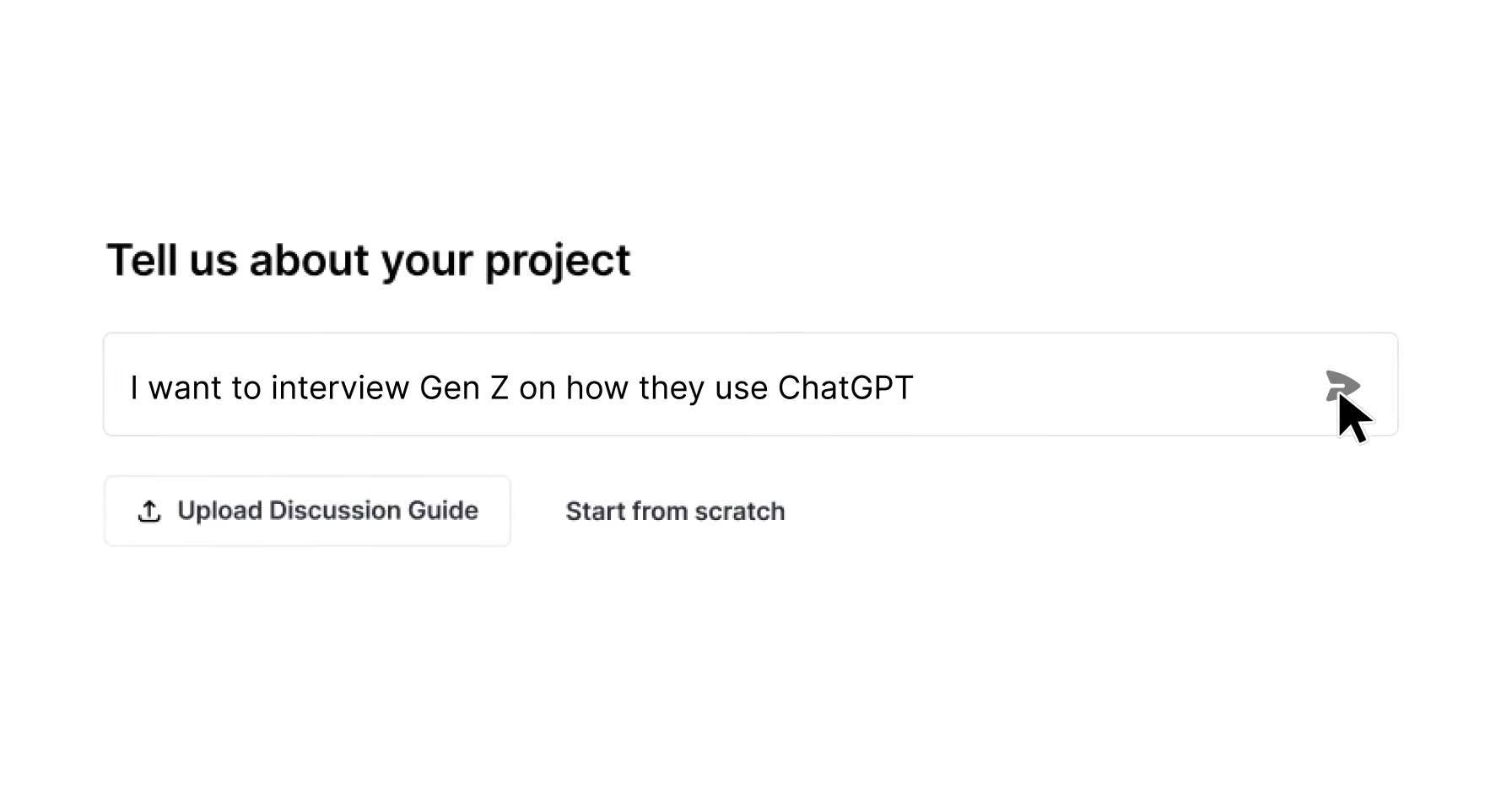
Study design in minutes: Teams describe research goals in natural language, and AI drafts structured objectives, questions, and probing context automatically.
-
Recruitment from verified global panels: Platforms with large verified respondent networks match participants by behavioral and intent data, not just self-reported demographics, which removes the manual sourcing bottleneck.
-
AI-moderated interviews at scale: Hundreds of adaptive, one-on-one video interviews run simultaneously, each with dynamic follow-up questions. Platforms like Listen Labs layer on auto-recruiting, transcription, sentiment tagging, and insight summarization so teams move from question to findings in hours, not weeks.
-
Automated analysis: AI identifies themes, patterns, and segments across all responses without manual coding, which removes the analyst bottleneck.
-
Instant deliverables: Slide decks, memos, highlight reels, and statistical charts generate automatically from interview data.
Qualitative methods historically traded speed and sample size for nuance and depth in human decision-making. Modern platforms remove most of those constraints while preserving the rich context that makes qualitative data so valuable.
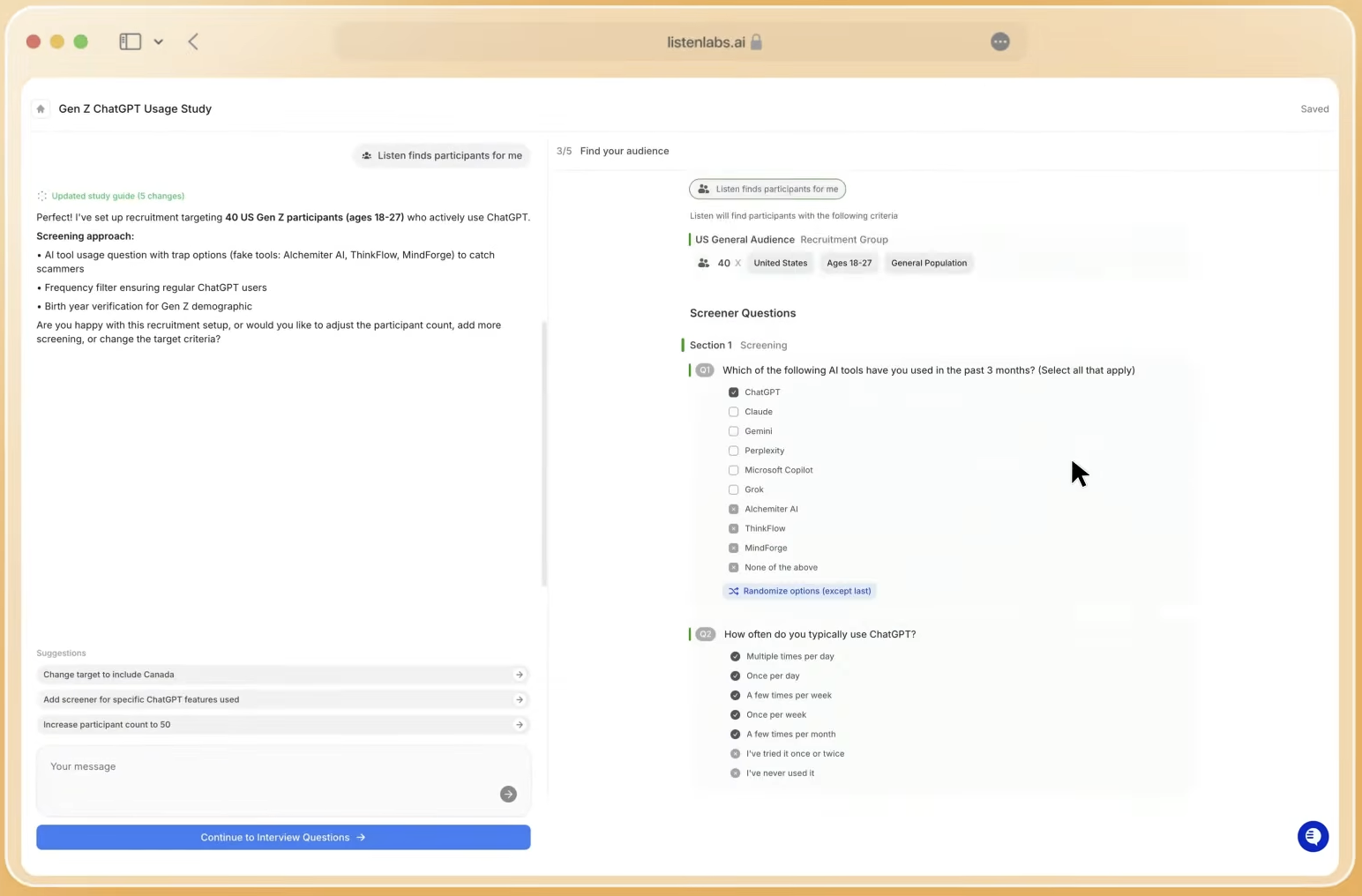
Watch the platform in action to see recruitment, moderation, and analysis running simultaneously in a single automated workflow.
Quick-start research brief template for clear study design
The difference between a study that delivers actionable insights and one that produces ambiguous findings often comes from how clearly the research question was defined before fieldwork began. This template structures the nine elements that separate a clear brief from a vague one, so teams can move from question to fieldwork with confidence that the study design will answer the decision at hand.
Copy and paste this template into any document or research platform:
Research Objective: [One sentence: what decision will this research inform?]
Key Research Questions: [List 3–5 specific questions the research must answer.]
Target Audience: [Who are the participants? Include demographics, behaviors, or use-case criteria.]
Method: [Primary or secondary? If primary: qualitative interviews, quantitative survey, or mixed?]
Sample Size: [How many participants are needed for confidence in the decision?]
Timeline: [When is the decision being made? Work backward to set a fieldwork deadline.]
Stimuli: [Will participants review a concept, prototype, creative asset, or pricing option?]
Deliverable Needed: [Slide deck, memo, highlight reel, or raw data export?]
Stakeholders: [Who receives the findings and what action will they take?]
Readiness checklist before you launch fieldwork
Even with a complete research brief, teams often discover critical gaps only after fieldwork has begun, such as missing stimuli, unclear screening criteria, or misaligned stakeholder expectations that force expensive mid-study corrections. This checklist surfaces those gaps before recruitment starts, when they are still easy to fix.
Before launching a study, confirm each of the following:
-
Research objective is specific: The question is narrow enough that a clear answer will change a decision.
-
Target audience is defined: Participant criteria are documented with enough specificity to recruit accurately.
-
Stakeholder alignment is confirmed: Decision-makers have agreed on the research question and will act on findings.
-
Sample quality requirements are set: Incidence rate, geographic scope, and screening criteria are documented before recruitment begins.
-
Data governance requirements are clear: Privacy obligations, consent requirements, and data retention policies are confirmed for the target audience’s jurisdiction.
-
Stimuli are finalized: Any concepts, creatives, or prototypes participants will review are ready before fieldwork launches.
-
Timeline is realistic: The fieldwork window aligns with the decision deadline, with buffer for analysis and stakeholder review.
Get expert guidance — our research team (50+ years combined experience) will help you design and launch your first study using this framework.
Frequently Asked Questions
What is the simplest definition of market research that works in a business meeting?
Market research is the systematic process of gathering, analyzing, and interpreting data about a target market, consumers, and competitors to support confident business decisions. That definition works across product, brand, pricing, and growth contexts because it focuses on the outcome, a decision, rather than the method. When presenting to stakeholders, frame every research initiative around the specific decision it will inform and the risk it will reduce.
How do I choose between primary and secondary research when I have limited time and budget?
Start with secondary research to establish baseline context such as market size, industry trends, and competitive landscape. If existing data answers the question with sufficient confidence, stop there. If the decision is high-stakes, the question is specific to your product or audience, or existing data is no longer current, primary research becomes necessary. AI-powered primary research platforms have significantly reduced the cost and time barrier, which makes direct customer input viable even for teams with constrained resources.
How long should a market research study realistically take?
Traditional qualitative research cycles run 4–6 weeks from study design to final report, and in large enterprises with internal prioritization processes, timelines can stretch to several months. As noted earlier, AI-powered platforms compress this to under 24 hours, and the realistic timeline for any given study depends on audience difficulty and the complexity of the stimuli being tested, not the research method itself.
How do non-researchers ensure study quality without methodology expertise?
Three practices reduce quality risk for non-research teams. First, use a structured research brief to define the objective, audience, and key questions before any fieldwork begins, because vague briefs produce vague findings. Second, use platforms with built-in quality controls such as verified participant panels, real-time fraud detection, and AI-assisted study design that flags methodological issues before launch. Third, validate findings against the original decision criteria, and if the data does not clearly inform the decision, refine the study design before acting on results.
What privacy and data governance requirements apply to market research?
Requirements vary by geography and audience type. Studies involving EU residents are subject to GDPR data handling obligations, which require a lawful basis that may be consent or another ground such as legitimate interests. Studies involving minors, healthcare workers, or other protected categories carry additional requirements. At minimum, every study should include informed consent, a clear data retention policy, and documentation of how participant data will be stored and used. Enterprise research platforms should hold recognized security certifications, and SOC 2, ISO 27001, and GDPR compliance are standard benchmarks to verify before selecting a platform or vendor.
Can a Product Manager or Brand Manager run a rigorous study without a research background?
Yes, with the right tools and guardrails. The highest-risk areas for non-researchers are study design, such as leading questions and insufficient screening criteria, and interpretation, such as confirmation bias in analysis. AI-assisted study design tools that draft and review question sets before fieldwork reduce design risk significantly. Automated analysis that surfaces themes objectively across all responses, rather than relying on manual review alone, reduces interpretation bias. The Quick-start Research Brief Template above provides a repeatable starting structure. For high-stakes decisions, pairing self-serve tools with access to an experienced research team for review adds an additional quality layer without requiring full agency engagement.