
Written by: Anish Rao, Head of Growth, Listen Labs
Key Takeaways for Telecom Research Buyers
- Syndicated telecom platforms excel at infrastructure forecasting but do not deliver fast, primary customer or buyer insight.
- Listen Labs enables fully customized AI-moderated studies to launch the same day a research question is formed, compressing the full cycle to under 24 hours.
- Enterprise-grade quality controls, a 30M+ verified respondent network, and support for 100+ languages make Listen Labs suitable for global, multi-market telecom programs.
- AI Emotional Intelligence and one-click deliverables provide richer insight than static syndicated reports while maintaining Fortune 500 compliance standards.
- For teams needing rapid primary customer intelligence, schedule a platform walkthrough with Listen Labs to see how the platform can replace weeks of traditional research with results delivered in a single day.
How to Evaluate Enterprise Telecom Research Platforms
Procurement and insights teams gain speed when they align on shared evaluation criteria before comparing vendors. The following eight dimensions apply to both syndicated platforms and AI interview solutions, and each carries different weight depending on the research use case.
The first six dimensions cover core research capabilities. Research speed measures the time from a new question to usable findings. For fast-moving topics such as operator benchmarking or reaction to a new 5G service tier, speed often decides the winner. Depth versus breadth of insight distinguishes wide-coverage infrastructure forecasts from tools that reveal motivations, emotions, and decision drivers for individual customers or enterprise buyers. Both matter, yet most tools specialize in one or the other.
Sample quality and fraud controls determine whether any insight can be trusted. Commodity panels carry well-documented risks from professional survey-takers and incentive-driven responses. Global and language reach becomes critical for multi-market programs that span APAC, MEA, and Latin America alongside North America and Europe. Methodological flexibility covers whether a single platform can support concept tests, operator benchmarking, usability sessions, and longitudinal trackers without stitching together multiple vendors.
Total cost of ownership includes subscription or per-study fees plus internal labor for recruitment, moderation, analysis, and reporting. Beyond direct costs, enterprise buyers must clear two additional gates. The first is security and compliance posture, including SOC 2, GDPR, ISO 27001, and ISO 42001 certifications, which is non-negotiable for Fortune 500 procurement. The second is workflow integration, which determines whether findings flow into existing knowledge systems or stay locked inside a vendor portal.
Study and Report Setup: Static Scopes vs Same-Day Custom Studies
Syndicated telecom research platforms run on subscriptions where vendor analysts pre-scope each report. Buyers gain access to a report or research stream, such as a quarterly private 5G market sizing forecast or an annual operator capex benchmarking study. Setup effort for the buyer stays low, but customization options stay low as well. When a team needs a precise answer, such as how enterprise IT decision-makers in Southeast Asia evaluate AI-driven network API pricing, and no existing report matches that scope, the buyer must either commission bespoke research at higher cost and longer timelines or accept a proxy answer from the closest available report.
In contrast, Listen Labs uses AI-assisted study co-design to remove this customization bottleneck. A researcher states the objective in natural language, such as “understand why mid-market telecom buyers in Germany are delaying private 5G procurement decisions.” The platform then drafts structured research objectives, an interview guide, probing context, and screening criteria in seconds. The study can include images, video, PDFs, live URLs, or prototype links, and supports branching logic, quotas, and randomization. Auto-QA flags issues in the guide before launch. For 2025–2026 topics such as AI-driven network API adoption or private 5G market sizing, this enables same-day fielding as described above, instead of waiting for the next syndicated report cycle.
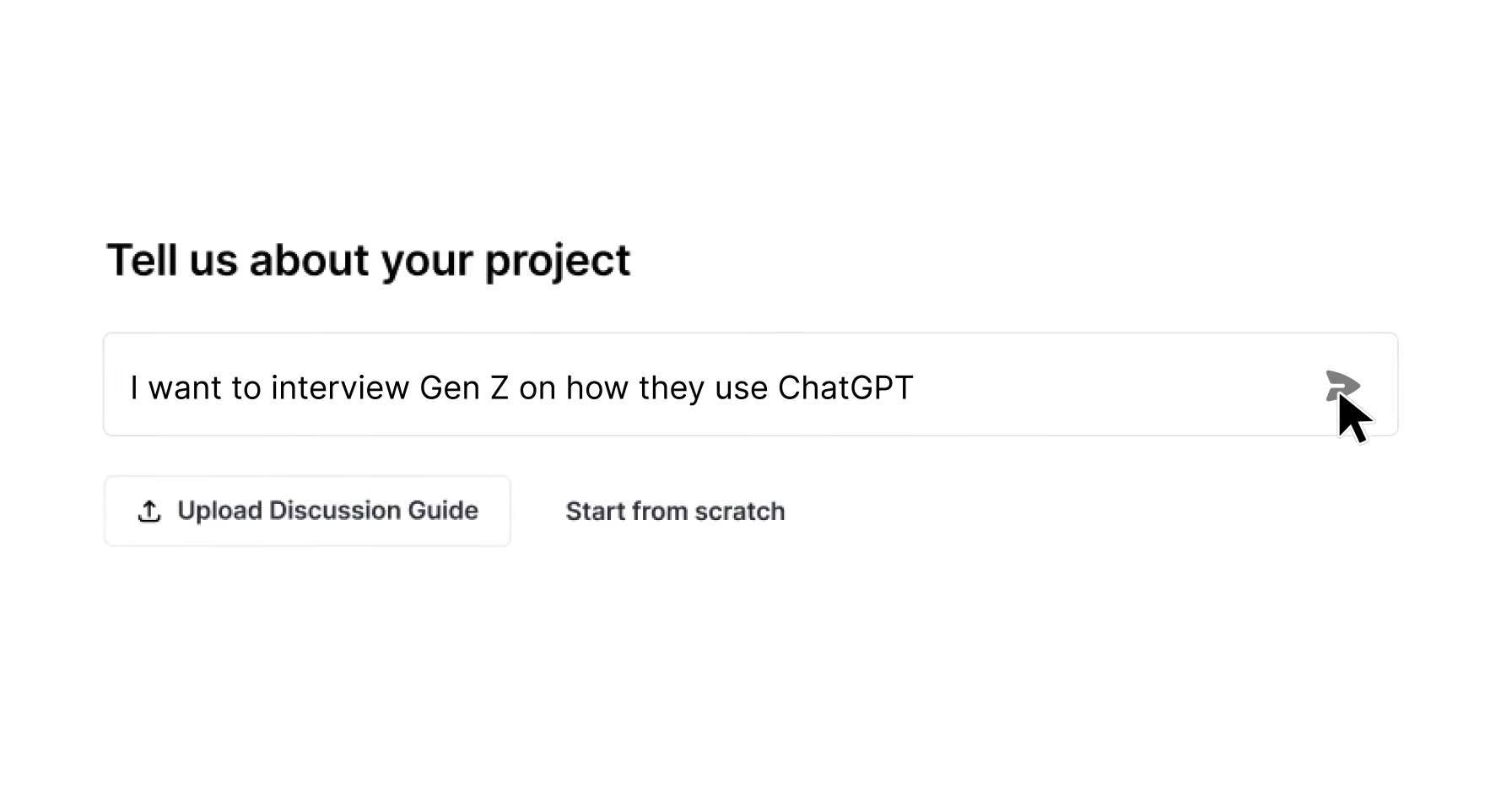
The operational impact is clear. Syndicated setup moves quickly for pre-scoped questions and slowly for novel ones. AI interview setup moves quickly for any question a team can clearly articulate.
Participant and Data Sourcing: Analyst Networks vs Verified Global Respondents
Syndicated telecom research platforms source data through analyst networks, operator interviews, vendor briefings, and regulatory filings. These inputs create authoritative datasets for infrastructure metrics such as port capacity, wavelength pricing, and capex trends. They do not, however, capture the voice of enterprise buyers, consumers, or frontline IT decision-makers at scale. When a team needs to understand how a specific customer segment perceives a new connectivity offer, syndicated data provides context but not the primary signal.
To address this gap in primary customer voice, Listen Labs sources participants through Listen Atlas, a global network of 30 million verified respondents across 45+ countries and 100+ languages. An AI orchestration layer automatically matches and bids across multiple consumer and B2B panel partners, including specialized B2B networks such as NewtonX, plus Listen Labs' proprietary database. A dedicated recruitment operations team focuses on hard-to-reach segments such as enterprise IT decision-makers, network engineers, procurement leads, and telecom-adjacent healthcare or financial services buyers. For audiences below 1% incidence, the team partners with niche communities and specialized networks.
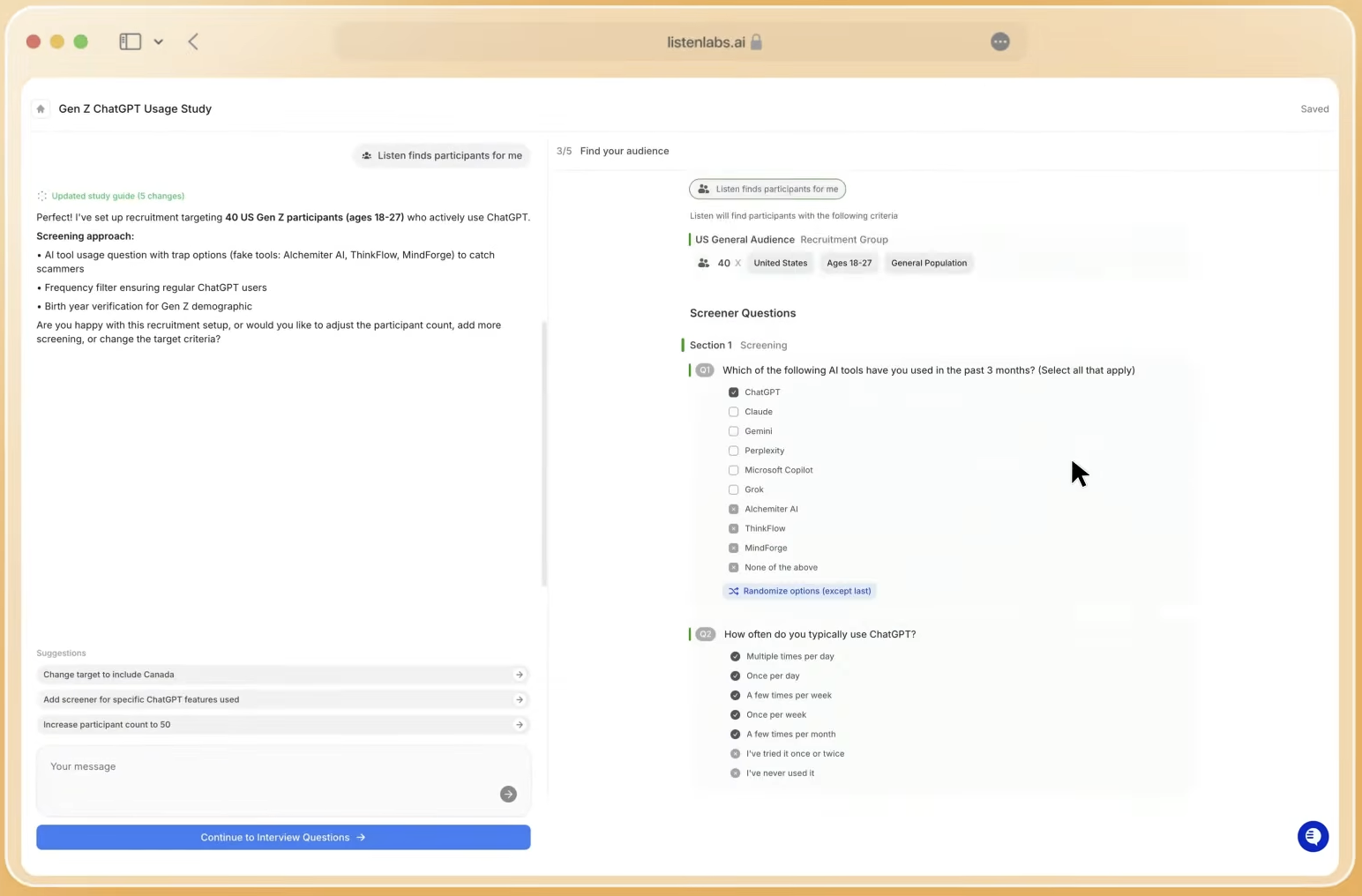
Organizations can also bring their own participants, including existing customers, beta users, or partner contacts, at reduced cost. This model works especially well for telecom operators running ongoing customer experience programs and for enterprise technology vendors studying their installed base. The combination of the 30M+ verified network and bring-your-own-participant flexibility means sourcing rarely becomes the bottleneck that it often is with traditional panel providers.
Moderation and Data Collection: Static Reports vs AI-Led Conversations
Syndicated platforms deliver static reports where data collection finished long before the buyer logs in. Buyers cannot probe an unexpected finding or ask follow-up questions. Bespoke research through a traditional agency introduces human moderators, yet scheduling, no-show rates, and sequential interviews mean a 30-person qualitative study can still take three to four weeks.
Listen Labs conducts AI-moderated video interviews where the platform holds personalized, adaptive conversations with each participant. When a respondent gives a short or unexpected answer, the AI follows up, similar to a trained human interviewer. Interviews capture video, audio, text, and screen recordings, including mobile screen recording on iOS. Teams can combine qualitative questions with quantitative formats such as Likert scales, NPS, sliders, and MaxDiff in a single session, which removes the need for a separate survey.
The Emotional Intelligence layer adds a dimension that static reports and traditional surveys cannot match. It analyzes tone of voice, word choice, and subconscious micro-expressions to surface emotions that transcripts alone miss. Built on Ekman's universal emotions framework, every emotion is quantified per question and concept, and traceable to exact timestamps and verbatim quotes. For telecom use cases such as testing a new service offer or evaluating operator brand perception, teams see not only what customers say but also how they feel, which directly shapes product and messaging decisions.
Quality, Analysis, Deliverables, and Knowledge Management in Practice
Quality assurance in syndicated platforms rests on analyst expertise and source triangulation. This approach works well for infrastructure data. For primary customer insight, quality depends on the sample size and recruitment method behind the analyst's survey or interview program, and those details are rarely disclosed in full.
Listen Labs' Quality Guard monitors every session in real time across video, voice, content, and device signals. It detects fraud, low-effort responses, AI-generated scripts, and mismatched profiles before they pollute the dataset. Participants can join only three studies per month, which removes professional survey-takers. A reputation score compounds across every interview on the platform, creating a quality flywheel that strengthens as volume grows.
On analysis, syndicated platforms provide pre-written analyst commentary. Listen Labs' Research Agent instead processes all interview data objectively, identifying patterns, themes, and insights across hundreds of responses without human bias. Teams ask questions in natural language and receive answers, charts, statistical tests, and segmentation breakdowns. One-click deliverables such as consultant-quality slide decks, memo-style reports, video highlight reels, and custom charts generate in under a minute. Mission Control acts as a persistent knowledge repository, enabling cross-study queries and trend tracking so that institutional knowledge from every telecom research program accumulates instead of scattering across files.
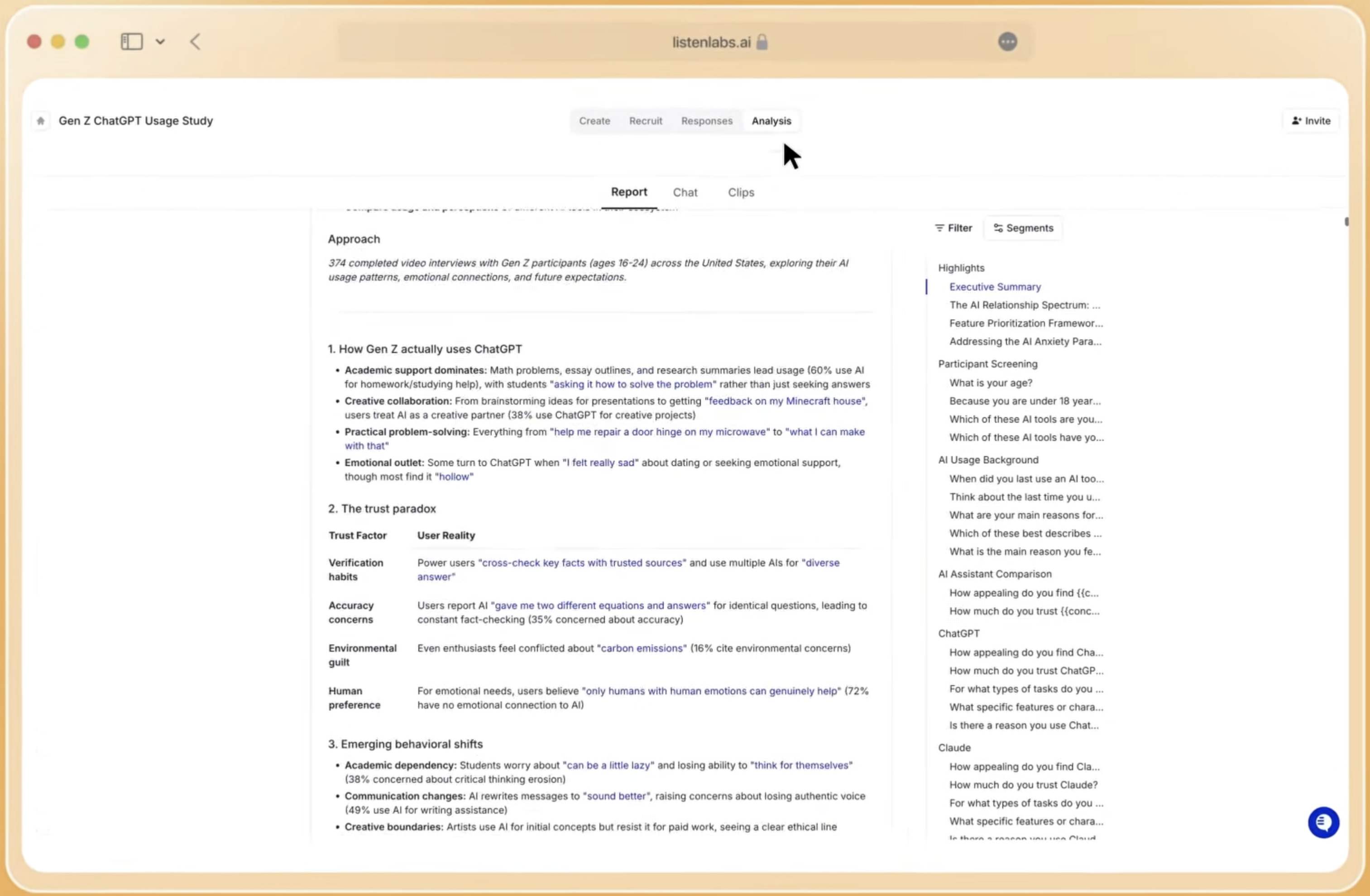
For ongoing global programs such as quarterly operator benchmarking, annual consumer segmentation, or continuous brand tracking, Mission Control's cross-study intelligence ensures each new study builds on prior findings instead of starting from zero.
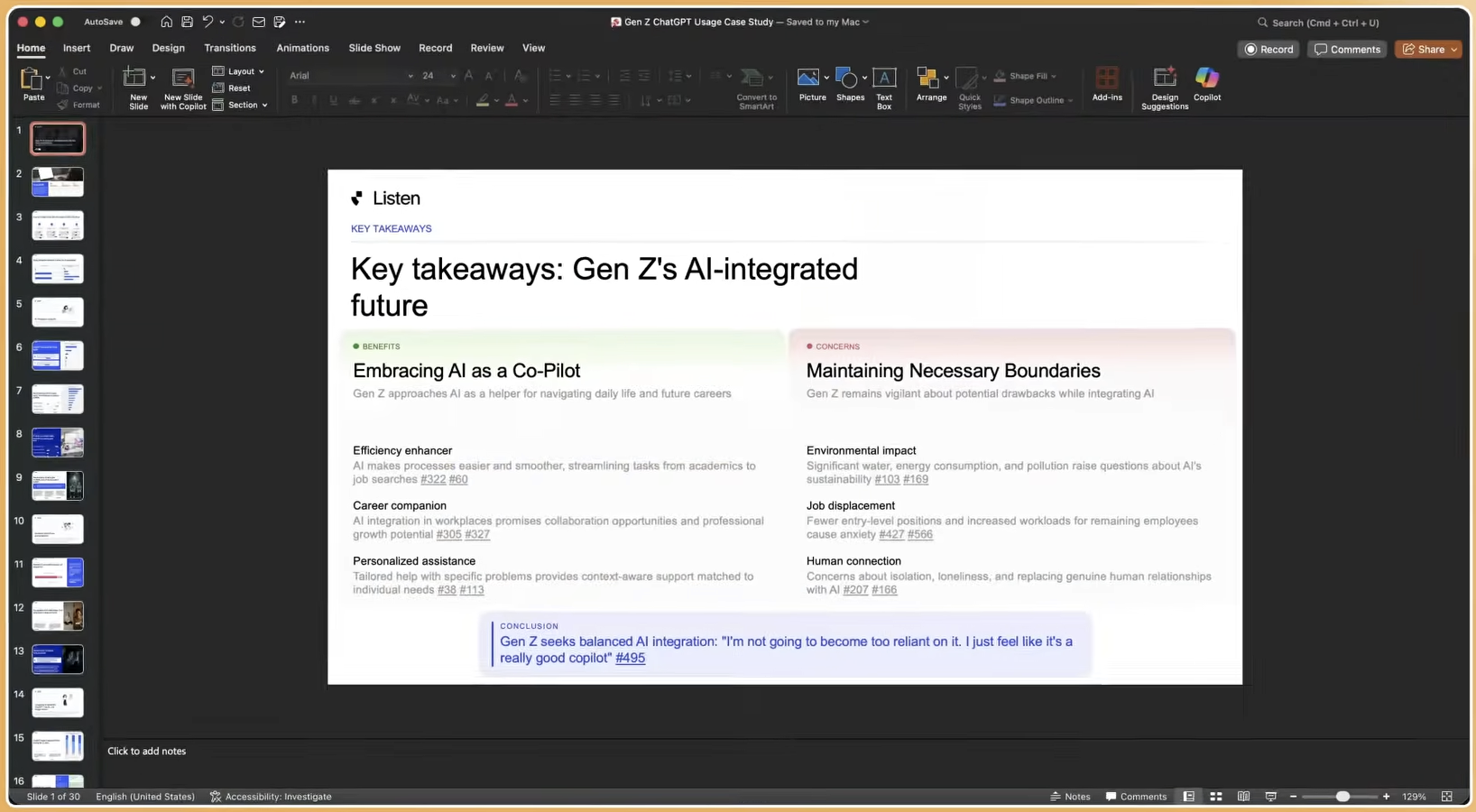
See these capabilities in action for an enterprise telecom use case, including Quality Guard, the Research Agent, and Mission Control.
When to Use Syndicated Platforms vs Listen Labs
Syndicated telecom research platforms work best when the core question is infrastructure-centric. Typical examples include capex forecasting, wavelength pricing trends, operator market share by region, or technology adoption curves for private 5G and SD-WAN. These providers have spent years building proprietary datasets from operator filings, vendor briefings, and regulatory sources that primary research cannot quickly reproduce.
Listen Labs becomes the primary tool, or an essential complement, when the question involves customers, buyers, or end users. Operator benchmarking teams need to understand not only what market data shows but also why enterprise IT buyers choose one operator over another, which objections arise during procurement, and which service attributes drive loyalty or churn. UX and product teams launching new connectivity services need rapid concept validation with target segments before committing to development. Marketing leaders must see how consumers in different markets emotionally respond to a new 5G proposition before a campaign launches. Consultancies running due diligence on a telecom asset need primary buyer interviews completed in days, not weeks.
Across these scenarios, syndicated data sets the market context and Listen Labs supplies the customer intelligence that turns that context into concrete decisions.
Operational and Long-Term Factors for Enterprise Teams
Stakeholder alignment sits at the center of operational planning. Syndicated subscriptions usually live with a single team, such as strategy or competitive intelligence, and broader stakeholders access findings through a portal. Listen Labs is built for shared use. Insights teams, product managers, brand leaders, and UX researchers can each run studies without waiting in line behind a central research function.
Internal expertise requirements differ as well. Syndicated platforms require analysts who can interpret infrastructure data and triangulate across sources. Listen Labs requires researchers who can state a clear business question, and the platform then handles study design, recruitment, moderation, and analysis. The in-house research team at Listen Labs, with 50+ years of combined expertise, can partner with teams that are launching their first AI-moderated research program.
Compliance remains a firm requirement for Fortune 500 procurement. Listen Labs holds SOC 2 Type II, GDPR, ISO 27001, ISO 27701, and ISO 42001 certifications, supports enterprise SSO, and does not use customer data for AI model training. For multi-country programs, the platform's multilingual support, covering 100+ languages with automatic translation and transcription as noted earlier, removes the localization overhead that often adds weeks to global research timelines.
Risks, Limitations, and Misconceptions to Watch
A common risk with syndicated telecom platforms arises when teams treat infrastructure data as a stand-in for customer insight. A forecast showing private 5G adoption rates by vertical does not explain why a specific enterprise buyer chose a particular operator, which objections they raised, or what would accelerate their next procurement decision. Teams that rely only on syndicated data for customer-facing decisions work with an incomplete picture.
A common misconception about AI interview platforms is that faster means shallower. Listen Labs runs hundreds of AI-moderated qualitative interviews at the same time, each personalized and adaptive. This approach delivers the statistical confidence of large samples and the nuance of one-on-one conversations. The traditional depth-versus-scale trade-off reflects limits of human moderation, not of AI-moderated interviews.
Hidden recruitment complexity appears when sourcing, moderation, and analysis sit on different platforms. When recruitment, scheduling, moderation, transcription, and analysis each involve separate vendors, every handoff introduces delay, cost, and quality risk. Listen Labs removes these handoffs by integrating the full research lifecycle in a single platform.
Overestimating automation creates a different risk. AI-assisted study design accelerates setup, yet the clarity of the research question still determines the value of the insight. Teams that treat the platform as a black box and skip careful objective-setting will receive fast results that miss the mark.
Decision Framework for Enterprise Telecom Buyers
Teams whose primary need involves infrastructure forecasting, operator capex benchmarking, or technology adoption curve analysis should anchor on a syndicated telecom research subscription from providers such as TeleGeography, ABI Research, or Dell'Oro Group. These platforms hold proprietary datasets that primary research cannot match on short timelines.
Teams whose primary need involves understanding customer behavior, buyer decision-making, consumer sentiment, or operator brand perception, or who must validate product concepts and service offers or run rapid competitive consumer-understanding studies, should anchor on Listen Labs. As noted in the evaluation criteria, Listen Labs compresses the primary research cycle to under 24 hours while delivering enterprise-grade quality controls and compliance certifications at roughly a third of the cost of traditional research.
Many organizations need both categories. Syndicated data provides market context. Listen Labs provides the customer intelligence that makes that context actionable. The real decision concerns which platform anchors which research need, and whether the combined total cost of ownership aligns with the value of faster, deeper, and more operationally efficient insight.
Teams facing a two-week shortlist deadline, a growing research backlog, and multi-market programs that currently take four to six weeks per study will see a clear operational case for Listen Labs. The platform compresses research timelines, reduces vendor fragmentation, and builds institutional knowledge with every completed study.
Bring a live telecom research question to a demo, and the Listen Labs team will show how the platform would design, field, and analyze that study within 24 hours.
Frequently Asked Questions
What turnaround times should buyers expect from enterprise telecom research platforms?
Syndicated telecom research platforms deliver pre-published reports on schedules set by vendor analysts, often quarterly or annually for major forecast series, with ad hoc updates after major market events. Bespoke research through a traditional agency or consultancy typically takes four to six weeks from briefing to final deliverables, and enterprise approval cycles can extend that timeline to several months. As described earlier, Listen Labs compresses study design, participant recruitment, AI-moderated interviews, analysis, and deliverables into a cycle of less than 24 hours. For telecom teams responding to competitive moves, preparing for board discussions, or running operator benchmarking ahead of procurement, the shift from weeks to days has material operational impact.
How do sourcing and quality controls differ between syndicated platforms and AI interview solutions?
Syndicated telecom platforms source data through analyst networks, operator briefings, vendor interviews, and regulatory filings. They rarely disclose sourcing at the participant level, and buyers cannot specify sample composition. Listen Labs instead draws from the verified global network described earlier, spanning 30 million respondents across 45+ countries and 100+ languages, with an AI orchestration layer that matches participants on behavioral and intent data rather than self-reported demographics alone. Quality Guard monitors every interview in real time for fraud, low-effort responses, AI-generated scripts, and mismatched profiles. Participants can join only three studies per month, which prevents panel fatigue and removes professional survey-takers. A dedicated recruitment operations team adds human review for hard-to-reach segments, including enterprise IT decision-makers and specialized B2B audiences relevant to telecom research.
What are the key moderation differences when comparing traditional reports to AI-led interviews?
Traditional syndicated reports involve no live moderation when the buyer accesses them, because data collection has already finished and the buyer receives a static document. Bespoke research through a traditional agency uses human moderators, which introduces scheduling complexity, no-show risk, and the constraint that one moderator can only conduct one interview at a time. Listen Labs instead runs AI-moderated video interviews where the platform holds personalized, adaptive conversations with many participants at once. The AI probes deeper on short or unexpected answers, blends qualitative and quantitative question formats in a single session, and captures video, audio, text, and screen recordings. The Emotional Intelligence capability, described earlier, analyzes tone of voice, word choice, and micro-expressions to surface emotional signals that transcripts alone miss, which static reports cannot provide and human moderators struggle to deliver consistently at scale.
Which approach best supports multilingual global programs and enterprise security requirements?
Syndicated telecom research platforms usually publish in English, with some regional language variants for major markets. They offer strong global coverage for infrastructure data but uneven coverage for primary customer insight in emerging markets. Listen Labs supports interview moderation in 100+ languages with automatic translation and transcription, as noted above, covering 45+ countries across the Americas, Europe, APAC, and MEA. This allows a single global program to field in German, Mandarin, Portuguese, Arabic, and English at the same time without separate vendors or localization delays. On security, Listen Labs maintains the enterprise security certifications detailed earlier, including SOC 2 Type II, GDPR, ISO 27001, ISO 27701, and ISO 42001, supports enterprise SSO, uses 256-bit encryption, and does not use customer data for AI model training. These controls meet Fortune 500 procurement standards and align with expectations for any enterprise SaaS platform handling sensitive research data.
Conclusion: Matching Platforms to Your Telecom Research Needs
The central trade-off in this guide sits between pre-built infrastructure intelligence and on-demand primary customer insight. Syndicated telecom research platforms such as TeleGeography, ABI Research, Dell'Oro Group, and Juniper Research have built authoritative datasets for infrastructure forecasting, operator benchmarking, and technology adoption analysis over many years. They remain the right tool for questions those datasets were designed to answer.
Listen Labs addresses the questions syndicated data cannot answer, such as why enterprise buyers choose one operator over another, how consumers emotionally respond to a new 5G service proposition, which objections block private 5G procurement in a given vertical, or which product concept resonates most with a target segment in Southeast Asia. It delivers these primary customer insights at the speed established earlier, under 24 hours, at roughly a third of the cost of traditional research, with enterprise-grade quality controls, multilingual support, and a knowledge repository that compounds in value with every study.
For enterprise telecom strategy, procurement, and competitive-intelligence teams that need both market context and customer intelligence, syndicated platforms and Listen Labs work together. The key decision concerns which platform anchors which research need, and whether the combined total cost of ownership aligns with the speed, depth, and operational efficiency of the insights delivered. Listen Labs makes the case for anchoring the primary customer insight side of that equation.