Written by: Anish Rao, Head of Growth, Listen Labs | Last updated: June 21, 2026
Key Takeaways
- Effective focus groups start with a single, agreed-upon research question that ties directly to a business decision.
- Recruitment quality, including verified screeners and behavioral checks, determines whether findings are trustworthy or tainted by professional respondents.
- Skilled moderation plus pre-written exercises and devil’s-advocate roles help limit conformity bias and dominant-speaker effects.
- Thematic analysis should be peer-reviewed and supported by verbatim evidence from multiple sessions before any claim enters the final report.
- Listen Labs removes the depth-versus-scale trade-off by running hundreds of AI-moderated interviews in parallel and delivering stakeholder-ready deliverables in under 24 hours—see how we deliver in under 24 hours.
Step 1: Set Clear Research Objectives and Confirm Focus Group Fit
Every focus group failure traces back to an ambiguous brief. The research objective must answer three points before recruitment starts. First, state what decision this research will inform. Second, clarify what the team already knows. Third, decide whether group interaction or individual narrative will best answer the question.
Focus groups work best when the goal is to observe how people discuss, debate, and negotiate meaning together, such as concept reactions, messaging tests, brand meaning-making, and early-stage hypothesis generation. One-on-one interviews fit deep individual experiences, expert opinions, or sensitive topics where confidentiality is crucial.
Conditions that favor individual interviews include sensitive financial or health topics, B2B or senior professional audiences, complex individual decision journeys, and any objective that requires clear attribution of views to specific participants. Focus groups flatten variation and depth when used for topics better suited to individual interviews, producing group-level generalizations instead of individual accounts.
Document the objective in a one-sentence research question before proceeding. If the team cannot agree on that sentence, the study is not ready to launch. Once that objective is locked, the next decision is who should be in the room and how to find them.
Step 2: Build a Participant Profile and Recruitment Plan That Protect Data Quality
Participant selection shapes every insight that follows. Focus groups commonly include 6–10 participants per group, with adjustments depending on topic complexity and sensitivity. Projects often run multiple groups per segment to build a reliable overall sample.
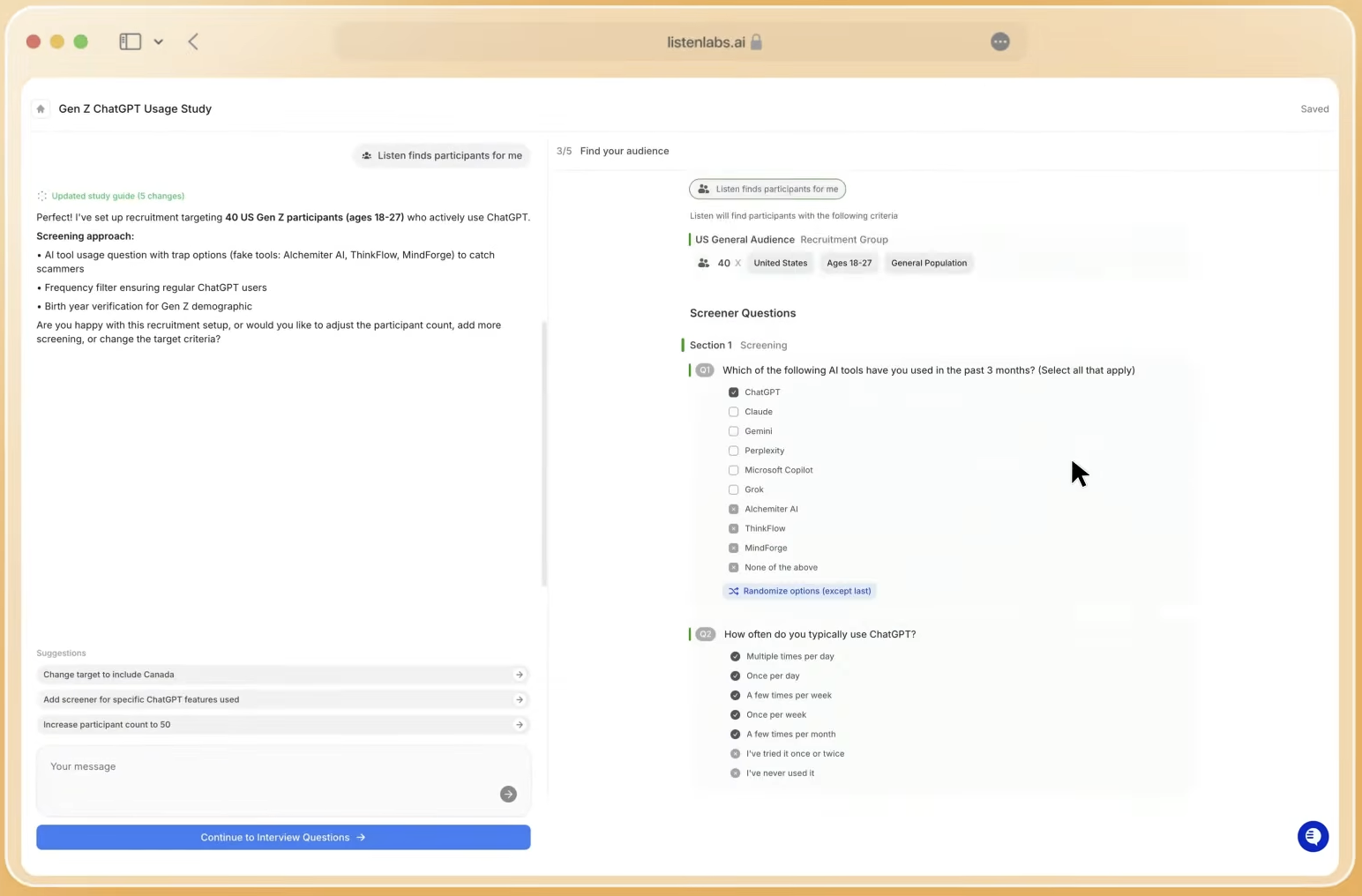
Recruitment quality is the single largest driver of data quality. Screeners should contain under 15 questions, embed key qualifying criteria without telegraphing desired answers, and include disqualification criteria such as excluding people who work in closely related fields or have participated in a focus group very recently. A practical screener flow moves from demographics to behavioral questions confirming topic relevance, then to availability and logistics, with each question producing a clear pass or fail outcome.
Over-recruit in-person groups to account for no-shows and confirm attendance 48 hours prior. Even with confirmation, incentive design still shapes who shows up, so payments should be meaningful enough to motivate attendance without attracting purely reward-driven participants who contribute little substance. Beyond attendance, verification practices that cross-check stated demographics against behavioral signals reduce the risk of fraudulent or low-quality respondents that inflate cost and corrupt findings.
Step 3: Write a Semi-Structured Discussion Guide That Flows Naturally
A discussion guide works as a roadmap, not a rigid script. It should use a structured sequence of 5–7 open-ended questions organized from broad to specific, with probing prompts attached to each. A typical flow moves through warm-up and context-setting, category exploration, stimulus or concept introduction, reaction and evaluation, then closing reflection.
Here is an example question flow for a product concept test. First, “Walk me through the last time you [relevant behavior].” Next, “What frustrates you most about how you currently handle [problem]?” Then show the stimulus and ask, “What’s your first reaction?” Follow with, “What would need to be true for this to fit into your life?” Close with, “If this existed today, who would you tell about it, and what would you say?”
Stimuli order affects responses. Show images, video, or prototypes only after establishing baseline attitudes, so reactions reflect genuine response rather than anchoring to the first thing seen. When testing multiple concepts, use monadic or sequential randomization to control order effects.
Step 4: Lock Down Logistics for In-Person and Virtual Sessions
Strong logistics prevent avoidable failures such as technology drops, consent gaps, and poor recording quality. A pre-session checklist should cover both in-person and virtual needs. For in-person sessions, confirm facility access, recording equipment, consent forms, and moderator materials 48 hours in advance.
Virtual focus group best practices include testing the video platform with all moderators and co-moderators before the session, sending participants a technology check link 24 hours prior, and using a platform that records both video and audio natively. Collect written consent digitally before the session begins, and avoid mixing virtual and in-person participants in the same session, as moderators unconsciously favor those physically present.
Online focus groups reduce geographic barriers and cost but may offer less visibility into body language and group dynamics than in-person sessions. Plan for this by building more explicit verbal probing into the guide and assigning a co-moderator to monitor participant video feeds for nonverbal cues.
See how we automate research logistics—Listen Labs handles recruitment, consent, recording, and real-time quality monitoring in a single platform, eliminating the overhead that delays traditional studies.
Step 5: Moderate Group Dynamics to Surface Depth and Limit Bias
Effective moderation balances depth with distortion control. Techniques fall into two categories, and both matter for reliable findings.
To surface depth, use clarification probes such as “When you say ‘quality,’ what does that look like to you?” and elaboration probes such as “Tell me more about that,” and use deliberate silence after a participant finishes speaking. Silence signals that more is expected and often produces the most candid responses.
To prevent distortion, redirect dominant speakers with “Thank you, that’s really helpful. I’d love to hear from some others on this,” and invite quieter participants with “I noticed you nodding, what’s your take?” Assign at least one participant the explicit role of devil’s advocate to surface dissenting views and prevent premature consensus. Use brief written exercises before open discussion so participants form independent views before hearing others.
The conformity risk in group settings is quantified and significant. In Asch’s Conformity Line Study, participants went along with an obviously wrong majority about 32% of the time, and 75% conformed at least once. Skilled moderation reduces but does not eliminate this effect. Separate managers from non-managers and never pair a manager with their direct reports, because deference to seniority suppresses honest input.
Step 6: Capture, Transcribe, and Analyze Sessions with a Clear Framework
Analysis starts during the session, not after. The co-moderator’s notes should capture what was said, who said it, what triggered a shift in the room, and which moments produced the strongest nonverbal reactions. Immediately after each session, the moderator and co-moderator should debrief to record initial impressions before memory degrades.
Thematic analysis follows a structured sequence. First, transcribe all sessions verbatim. Next, read transcripts without coding to absorb the full picture. Then apply an initial coding framework derived from the research objectives. After that, identify emergent themes not anticipated in the guide. Finally, test theme prevalence across all sessions, not just the most memorable quotes.
Confirmation bias is the primary analysis risk. Have analysis peer-reviewed by a second person after the session to identify moderator or analyst biases introduced during facilitation or interpretation. Require that every theme be supported by verbatim evidence from multiple participants across multiple sessions before it enters the final report.
Step 7: Turn Findings into Decisions and Plan the Next Study
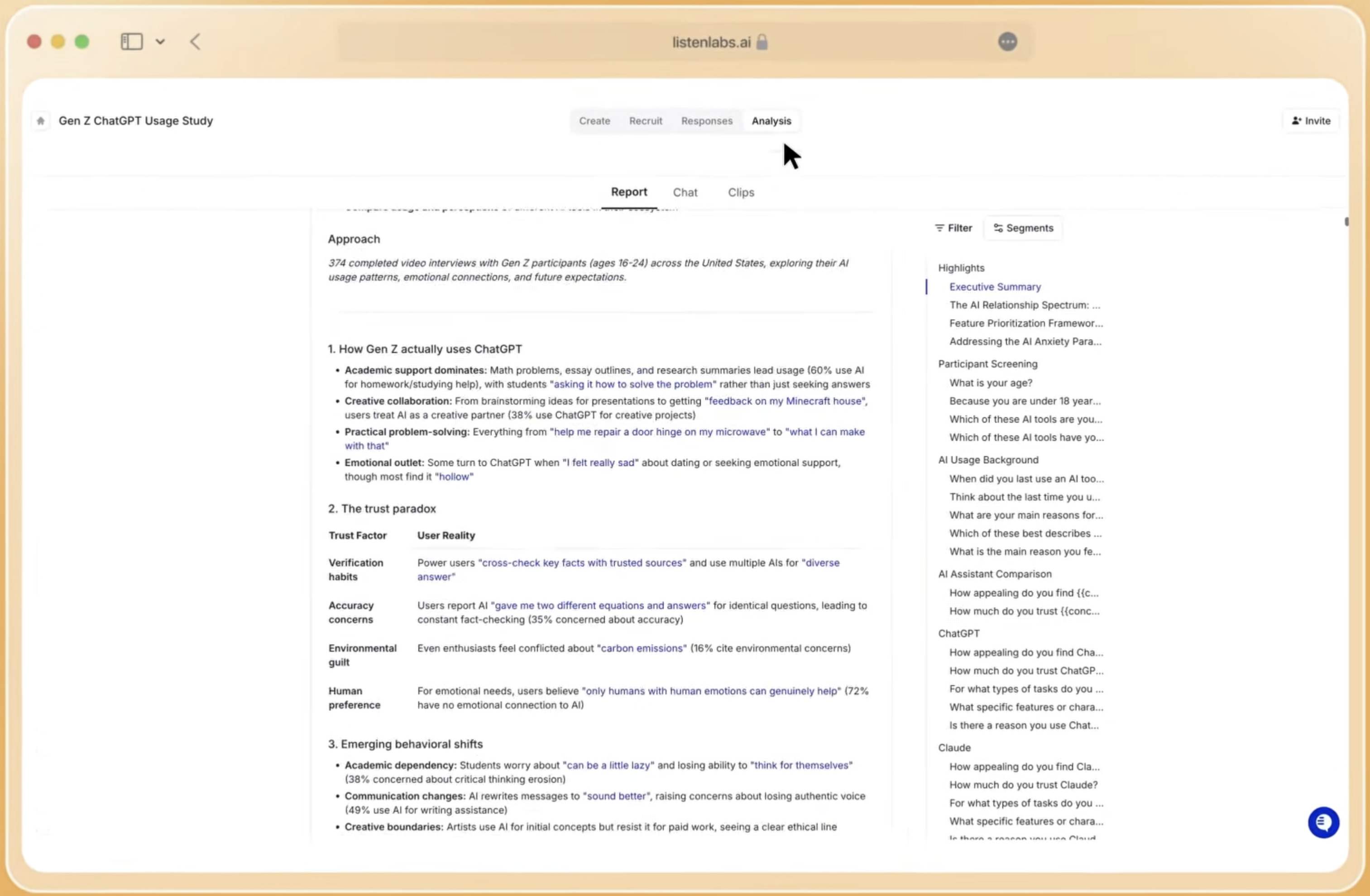
Insights only matter when they shape decisions. Deliverables must match the decision the research was designed to inform. For product teams, that usually means a prioritized list of findings with direct implications. For brand teams, it often means verbatim quotes and emotional signals organized by audience segment. For executives, it typically means a one-page summary with a clear recommendation.
Several signals show that findings are synthesis-ready. Themes should appear consistently across at least two groups. Verbatim evidence should exist for every major claim. Someone who did not moderate the sessions should have reviewed the findings. The research question from Step 1 should have a clear, defensible answer.
Teams should decide next steps before closing the project. Some findings require validation at scale. Others surface new questions that warrant a follow-on study. A common research sequence runs focus groups first to generate hypotheses and map vocabulary, then individual interviews to go deep on the most important themes. When the next phase requires speed and scale, AI-led interviews compress that cycle from weeks to hours.
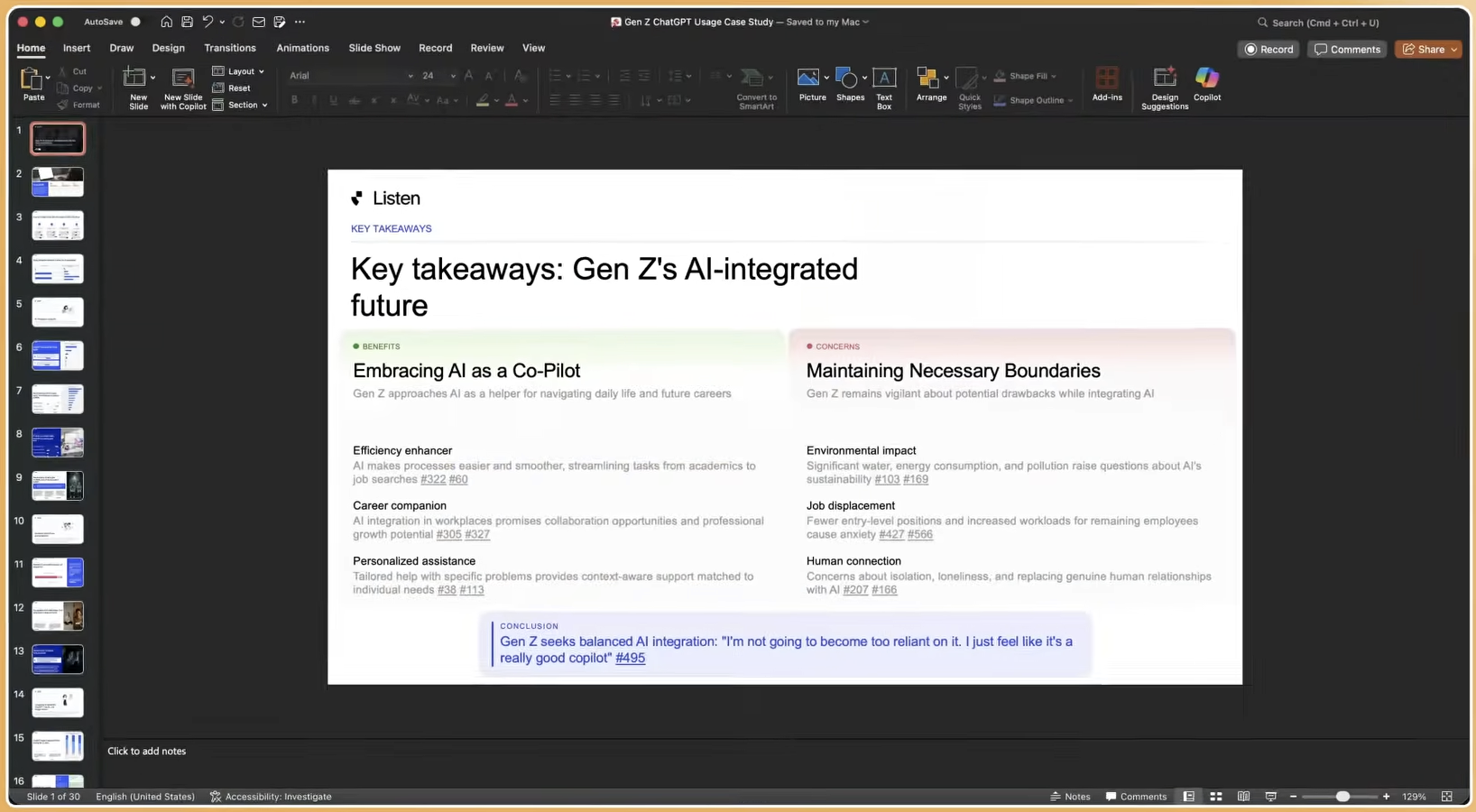
See automated deliverable generation in action—Listen Labs’ Research Agent creates slide decks, memos, video highlight reels, and statistical charts from hundreds of interviews in under a minute.
Common Focus Group Challenges and How to Mitigate Them
Unclear objectives produce unfocused guides and unactionable findings. An early-warning signal appears when the team cannot agree on a one-sentence research question before recruitment begins. The mitigation is simple: require a signed-off research brief before any vendor is engaged.
Low-quality recruits corrupt data and waste budget. A substantial portion of a primary market research budget goes toward respondent recruitment and vendor fees, yet commodity panels carry high fraud risk. An early-warning signal appears when screener completion rates are unusually high, which suggests participants are gaming eligibility questions. Mitigation involves embedding behavioral verification questions and using platforms with real-time fraud detection.
Dominant voices skew perceived prevalence of views. An early-warning signal appears when the same two or three participants account for most of the speaking time. Mitigation involves applying the redirection and written pre-exercise techniques from Step 5 before the pattern becomes entrenched.
Analysis overload delays delivery and increases bias risk. Focus group data analysis is usually very time consuming due to the quantity of data produced. An early-warning signal appears when the analysis phase has already exceeded its planned timeline by more than 20%. Mitigation involves using structured coding frameworks from the start and assigning peer review as a scheduled task, not an afterthought.
How to Measure Focus Group Program Success
Clear metrics help teams judge whether focus groups are working. Objective indicators include participation rate at or above 80% of recruited participants and finding consistency across independent groups covering the same topic. Stakeholder usage rate also matters, measured as the share of findings that are cited in a product, brand, or strategy decision within 90 days. Decision impact can be tracked through retrospectives that ask whether the research changed or confirmed a planned course of action.
Simple tracking via post-project retrospectives, run within two weeks of deliverable delivery, captures these indicators without adding significant overhead. Over time, this data builds the case for research investment and highlights which study designs consistently produce actionable output.
Advanced Considerations for Mature Research Teams
Once teams have mastered the seven-step process outlined above, they encounter enterprise-scale challenges that require different solutions. These include multi-market studies that require consistent moderation across languages and cultures, always-on research programs that demand continuous participant supply, and integration of qualitative findings with behavioral data from product analytics or CRM systems.
Multi-market studies require localized discussion guides, not just translated ones, and moderators with cultural fluency in each market. Always-on programs require a participant pipeline that refreshes continuously without relying on the same respondents repeatedly. Integration with behavioral data creates the most value when qualitative findings explain patterns already visible in quantitative data, rather than generating hypotheses that quantitative data could have surfaced faster.
At this level of maturity, the depth-versus-scale trade-off becomes the binding constraint. AI-led one-on-one interviews conducted simultaneously across hundreds of participants, with dynamic follow-up questions, automatic transcription, and real-time analysis, remove that constraint. Listen Labs compresses a research cycle that previously took several weeks into under 24 hours, across 45+ countries and 100+ languages, without adding headcount.
Frequently Asked Questions
How many participants do focus groups typically require?
Focus group projects often involve multiple groups per audience segment, with about 6–10 participants per group for standard topics. Complex or sensitive topics may work better with smaller groups, while simpler topics can sometimes accommodate larger ones. Total sample sizes vary by project. Many teams also over-recruit to account for no-shows and confirm attendance 48 hours before each session.
When should a team choose one-on-one interviews instead of focus groups?
One-on-one interviews outperform focus groups when the topic is sensitive, the target audience is B2B or senior professionals, the research goal is to understand individual decision journeys, or clear attribution of views to specific participants is required. Focus groups are the stronger choice when group interaction itself is a data point, such as when researchers want to observe how people negotiate meaning, react to stimuli socially, or form shared vocabulary around a category.
What is the biggest source of bias in focus group research, and how is it controlled?
Conformity pressure, also called groupthink, is the most documented bias in focus group settings. As the Asch study mentioned earlier demonstrates, participants adjust their stated views to align with perceived group consensus, particularly when a dominant voice speaks early and confidently. Mitigation tactics include using brief written exercises before open discussion, explicitly inviting dissent, assigning a devil’s advocate role, and redirecting dominant speakers with neutral phrases. Moderator bias, where the facilitator’s own hypotheses shape probing and interpretation, is controlled through structured guides, co-moderator debriefs, and peer review of analysis.
How does Listen Labs address the limitations of traditional focus groups?
Listen Labs conducts AI-moderated one-on-one interviews at scale, which eliminates groupthink and dominant-voice effects by design. Each interview is a private, adaptive conversation where the AI probes deeper on interesting or short answers in the same way a trained human interviewer would, but without the social dynamics that distort group sessions. The platform handles the entire research lifecycle: AI-assisted study design, recruitment from a global network of 30M verified respondents across 45+ countries, automated transcription and analysis, and delivery of consultant-quality reports, slide decks, and video highlight reels. Work that traditionally takes several weeks is completed in under 24 hours. Enterprises including Microsoft, P&G, and Anthropic use Listen Labs to run more studies with the same team, at a third of the cost of traditional research.
What compliance and data security standards does Listen Labs meet?
Listen Labs holds SOC 2 Type II, GDPR, ISO 27001, ISO 27701, and ISO 42001 certifications. Customer data is encrypted at 256-bit and is never used for AI model training. The platform supports enterprise SSO and meets the security requirements of Fortune 500 procurement processes. For teams running multi-market studies, Listen Labs covers 45+ countries with built-in localization and automatic translation across 100+ languages.
Conclusion
Running effective focus groups in qualitative research requires disciplined execution across seven stages. Teams must set clear objectives and confirm the method fits the question, build a quality-focused recruitment plan with verified screeners, design a semi-structured discussion guide with 5–7 open-ended questions, prepare logistics for in-person or virtual sessions, moderate to manage group dynamics and reduce conformity bias, capture and thematically analyze data with peer review, and synthesize findings into stakeholder-ready deliverables tied to a specific decision.
That process, executed well, produces reliable qualitative insight. It does not, however, solve the depth-versus-scale trade-off that limits enterprise research output to a handful of studies per quarter. Listen Labs eliminates that trade-off. The platform sources the right participants from a network of 30M verified respondents, conducts thousands of AI-moderated in-depth interviews simultaneously, analyzes all responses without human bias, and delivers results in under 24 hours, without groupthink, without logistics overhead, and without added headcount.
Teams that have mastered how to run effective focus groups in qualitative research are best positioned to recognize when a faster, more scalable alternative produces better outcomes. See how to multiply your research output with the same team.