
Written by: Anish Rao, Head of Growth, Listen Labs
Key Takeaways for Financial Services Teams
- DIY customer interviews in financial services shorten research cycles from weeks to days by focusing on real customer life events instead of abstract metrics.
- Compliant recruitment relies on verified first-party lists or specialized panels, tight screener design, and documented incentives to avoid professional respondents and regulatory exposure.
- Behavior-based questions that explore past actions, decision context, and emotions deliver more reliable insight than preference or prediction questions.
- Consent, NDA, and PII protocols, including data minimization, pseudonymization, and retention schedules, must be in place before any interview to satisfy GDPR, CCPA, and GLBA.
- When DIY customer interviews in financial services hit recruitment or scale limits, explore how Listen Labs provides verified participants and AI-moderated interviews in hours.
Step 1: Define Objectives Around Specific Customer Life Events
Every compliant, high-quality interview study starts with a precise learning objective tied to a customer life event, not a business metric. Life events such as opening a first checking account, missing a loan payment, receiving an inheritance, or switching insurers after a claim denial reveal the most honest and observable financial behavior.
The research funnel framework structures these objectives. At the top, exploratory objectives ask what is happening and why. In the middle, evaluative objectives examine how customers respond to a specific solution. At the bottom, validating objectives confirm whether a solution performs as expected in context. Each level uses different question types, sample sizes, and timelines.
Teams at this stage need a clear business decision the research will inform, a named decision-maker who will act on findings, and a realistic deadline for when insight is required. Typical stakeholders include the product manager or marketing lead sponsoring the study, a compliance officer who approves topic scope, and the researcher designing the guide.
Consider two examples. A banking team might ask, “understand what triggers a customer to consider refinancing their mortgage within 90 days of a rate change.” An insurance team might ask, “identify the emotional and informational factors that lead a policyholder to lapse a life insurance policy in the first two years.” Both objectives are specific, anchored to a life event, and actionable.
The depth-versus-scale trade-off appears immediately. A single exploratory objective usually fits within 8–12 interviews conducted over five to seven business days. Multiple objectives across segments require a larger sample or a phased plan, which extends timelines and raises the risk of scope creep.
Step 2: Build a Compliant, High-Quality Recruitment Plan
Recruiting verified financial services customers without commodity panels is often the most demanding part of DIY qualitative research. Commodity panels create a real risk of professional respondents, who focus on incentives instead of honest answers. That risk is especially harmful in financial services, where self-reported behavior about debt, savings, or claims history must be credible.
Effective recruitment methods for finance segments include first-party customer lists with appropriate consent and CRM governance. Partnerships with credit unions or community banks can support opt-in outreach. Screened panels from providers that use behavioral matching, not only demographic self-reporting, also help. For hard-to-reach segments such as high-net-worth individuals or customers in financial stress, incidence rates can fall below 2%. At that point, DIY recruitment becomes difficult without a dedicated sourcing operation.
The screener must confirm the qualifying life event while avoiding language that reveals the study’s hypothesis. A screener for a debt-stress study should confirm that the participant made a late payment in the past six months. It should avoid phrases like “financial difficulty,” which encourage socially desirable answers. Screener length should stay under ten questions. Longer screeners increase dropout and introduce self-selection bias.
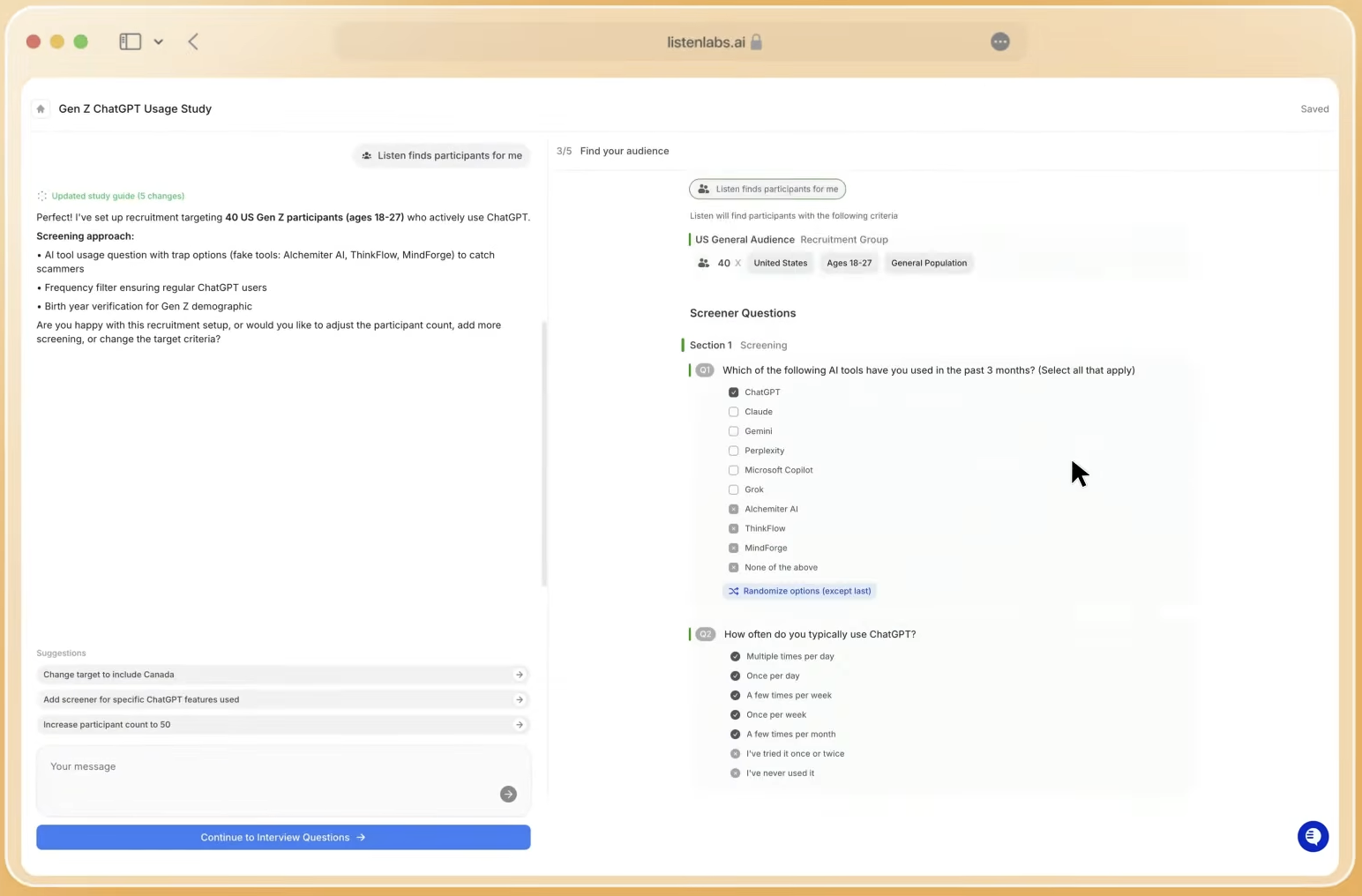
Incentives for financial services interviews usually vary by segment and session length. General consumer segments receive lower amounts than small business owners or licensed professionals. Because incentive payments can accumulate across multiple studies, teams must document them for tax compliance in the United States when payments exceed $600 annually to a single recipient.
Key stakeholders here include legal or compliance teams that approve outreach language and incentive structure, CRM or data teams that pull first-party lists, and the researcher who manages scheduling logistics. Recruitment planning and execution often require several business days for general consumer segments, with additional time for low-incidence or professional audiences. When DIY recruitment stalls, see how Listen Labs sources verified participants across 45+ countries in hours.
Step 3: Draft Behavior-Based Questions That Surface Real Decisions
Behavior-based questions ask participants to recall specific past actions instead of predicting future behavior or stating general preferences. In financial services, this distinction matters because stated preferences about saving, investing, or switching providers are consistently more optimistic than actual behavior.
The core question framework for financial life events uses three layers.
- Event elicitation: “Tell me about the last time you missed a payment, reviewed your insurance coverage, or moved money between accounts. Walk me through what happened.” This opens the story without leading.
- Decision anatomy: “What were you thinking about at that point? What information did you look for? Who else was involved in that decision?” This reveals the cognitive and social context.
- Emotional and counterfactual probing: “How did you feel when you realized that situation? What would have needed to change for you to take a different action?” This uncovers emotional drivers that surveys rarely capture.
For debt-stress studies, questions should reference a specific payment or account action instead of the word “debt,” which carries stigma and suppresses disclosure. For retirement trigger studies, anchoring to a life event such as a job change, health diagnosis, or spouse’s retirement produces more reliable data than asking about retirement planning in general. For switching events, questions should begin with the first moment of dissatisfaction, not the final switch, because decisions often start weeks or months earlier.
Mixed-methods sampling helps when teams need both qualitative depth and quantitative validation. A common pattern runs 10–15 qualitative interviews to generate hypotheses, then fields a quantitative survey to measure prevalence. The qualitative phase shapes the survey’s answer options and reduces the risk of forcing respondents into categories that do not match their experience.
Question drafting and internal review usually take two to three business days. This window includes a compliance review for any question that references specific account types, credit products, or claims history.
Step 4: Set Consent, NDA, and PII Protocols Before Fieldwork
Financial services interviews always involve sensitive personal data. Participants may share account balances, credit events, claims history, or income information. Each data type carries jurisdiction-specific regulatory obligations that teams must address before the first interview.
Under GDPR, consent must be freely given, specific, informed, and unambiguous when used as the lawful basis for processing. For research conducted under legitimate interests, teams must document a balancing test. CCPA/CPRA requires notice of collection and opt-out rights in most cases, and financial data shared in interviews can trigger additional duties. GLBA requires financial institutions to disclose data collection and sharing practices, maintain a written information security program, and provide opt-out rights before sharing data with non-affiliated third parties, with fines up to $100,000 per violation.
NIST guidance recommends combining operational safeguards such as policies, training, and data minimization with privacy safeguards like anonymization, de-identification, and pseudonymization. Security controls such as access enforcement, least privilege, and audit review complete the protection of PII. Financial account numbers are often considered sensitive personal information because they can directly identify an individual and cause harm if exposed.
A compliant consent package for DIY financial services interviews works as a single system with several parts.
- A plain-language consent form that specifies data types collected, purpose of collection, retention period, and the participant’s right to withdraw at any time without penalty.
- An NDA or confidentiality acknowledgment when the study covers unreleased product concepts or proprietary pricing information.
- A recording authorization that clearly lists formats such as video, audio, and transcript, along with the internal teams that will have access.
- A data minimization statement that instructs participants not to share specific account numbers, social security numbers, or passwords, and confirms that moderators will redirect if such information appears.
- A Data Protection Impact Assessment (DPIA) for studies that use new technology or process sensitive data at scale.
Teams must pseudonymize transcripts before sharing them internally. Participant names should be replaced with codes such as P01 or P02, and any incidental account details should be redacted. Retention periods for recordings and transcripts should be defined in advance and enforced through a documented deletion schedule. Before selecting any transcription or analysis vendor, verify that the vendor has a signed Data Processing Agreement, geographic data storage options, a clear data retention policy, and SOC 2 Type II certification.
Legal counsel, a compliance officer, and the data protection officer, when present, own this step. Initial protocol development usually takes three to five business days, followed by ongoing review for each new study topic.
Step 5: Follow a 30–45-Minute Interview Structure That Builds Safety
A structured 30–45-minute interview flow balances depth with participant comfort on financial topics. Debt stress, insurance claims, and retirement anxiety carry emotional weight, so the structure must create psychological safety before exploring sensitive details.
A recommended flow uses five stages.
- Opening (5 minutes): Introduce the study purpose, confirm consent and recording authorization, and state that there are no right or wrong answers. Remind the participant not to share specific account numbers or passwords.
- Warm-up (5 minutes): Ask about the participant’s general relationship with the product category, such as how long they have been a customer and what they use the product for, without mentioning the life event yet.
- Core narrative (20–25 minutes): Use the behavior-based framework from Step 3 to walk through the life event in order. Follow the participant’s story when new information appears, even if it diverges from the guide.
- Probing and clarification (5–10 minutes): Return to moments that felt vague, emotionally charged, or inconsistent with earlier statements. Request specific examples instead of general descriptions.
- Close (5 minutes): Ask whether anything important about the experience has not been covered. Confirm next steps for incentive payment and data handling.
The depth-versus-scale trade-off becomes most visible during moderation. Skilled moderators can probe unexpected directions and respond to discomfort. Inexperienced moderators who follow a rigid script often miss the richest data. For DIY teams without trained moderators, a semi-structured guide with explicit probing prompts at each question reduces this risk.
Stakeholders include the moderator, a note-taker when sessions are not recorded, and a compliance observer for studies that involve regulated product disclosures. Scheduling and conducting 10 interviews usually requires five to eight business days, including no-shows and rescheduling. To see how AI-moderated interviews support depth and compliance for DIY financial services research at scale, explore the Listen Labs platform.
Step 6: Analyze Transcripts with a Simple, Auditable Spreadsheet
Qualitative analysis of financial services interviews works best with a method that remains systematic and auditable. Two approaches fit DIY teams particularly well: thematic analysis and framework analysis.
Thematic analysis involves familiarizing with interview data, generating initial codes, grouping related codes into broader themes, and defining those themes to identify recurring patterns of meaning, with memos that document analytic decisions for transparency. Framework analysis uses familiarization, an analytic framework, indexing, charting into matrices, and interpretation across cases, which suits applied research that needs transparency and systematic comparison.
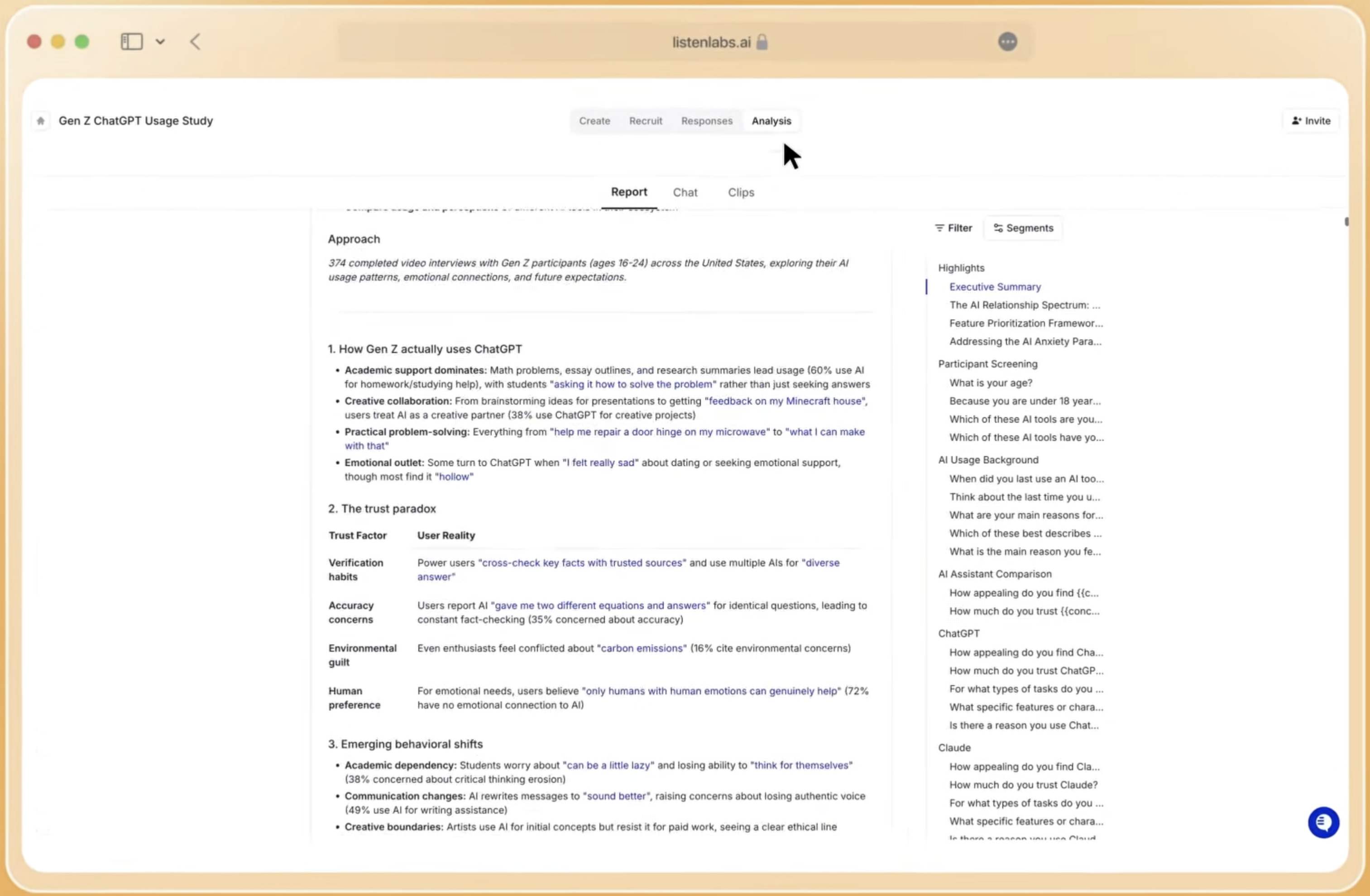
A spreadsheet version of framework analysis keeps the structure simple.
- Use one row per participant and one column per theme or question area.
- Place a verbatim quote and a one-sentence interpretation in each cell.
- Add a summary row that records the pattern across participants, such as “7 of 10 participants described the trigger as a specific notification, not a general awareness of rates.”
- Create a separate tab that logs analytic decisions, including why a quote received a particular code and when themes were merged or split, to support audits.
Teams protect privacy during analysis by working only with pseudonymized transcripts. The mapping between participant codes and real identities should live in a separate location, remain accessible only to the study lead, and be deleted at the end of the retention period.
Dovetail is a leading tool for qualitative synthesis in fintech contexts, with GDPR-compliant data handling, and can replace spreadsheets for teams that run more than two or three studies per quarter. For single studies, a well-structured spreadsheet remains sufficient and avoids additional vendor review.
Analysis of 10 interviews with this framework usually takes two to four business days for a single researcher. Stakeholder review and report writing add another two to three days.
Common Challenges and Practical Remedies
Four challenges appear frequently in DIY financial services interview programs, and each has an early-warning signal and a clear remedy.
Unclear objectives: The early-warning signal is a study guide with more than five distinct question areas, which indicates that the study is trying to answer too many questions at once. The remedy is to return to Step 1 and force a single primary learning objective before moving forward. Studies with multiple objectives often produce findings that satisfy no stakeholder fully.
Low-quality recruits: The early-warning signal is participants who cannot recall specific details of the life event or whose screener responses do not match their interview narrative. The remedy is to add a verification question to the screener that requires a concrete behavioral detail, such as “In what month did you last review your coverage?” and to end interviews early when the qualifying event cannot be confirmed.
Analysis bottlenecks: The early-warning signal is a backlog of unanalyzed transcripts more than five business days after the last interview. The remedy is to begin analysis after the third interview instead of waiting for the full sample and to use early findings to refine probing in later sessions.
Stakeholder misalignment: The early-warning signal is a stakeholder asking for findings that the study was never designed to produce. The remedy is a one-page study brief, approved by all stakeholders before recruitment, that clearly states what the study will and will not answer.
Measuring Success in DIY Financial Services Interviews
Objective indicators show whether a DIY interview program in financial services is working.
- Study cycle time: Measure the time from approved brief to delivered findings. Cycle time should align with the timelines established in Step 1.
- Completion rate: Track the proportion of recruited participants who complete the full interview. Rates below 70% signal recruitment or scheduling issues.
- Finding consistency: Compare theme assignments when two researchers independently code the same transcript. Agreement should reach at least 80% of coded segments. Lower agreement suggests an ambiguous coding framework.
- Downstream usage: Monitor how often study findings appear in product decisions, campaign briefs, or strategic documents within 90 days. Low usage indicates a gap between research objectives and business needs.
Short-term signals such as cycle time and completion rate appear in the first study. Finding consistency and downstream usage require two to three studies to establish a baseline. Trend validation, such as tracking whether debt-stress triggers shift after a rate cycle, needs a longitudinal program with consistent methodology across waves.
Advanced Considerations for Scaling Beyond DIY
DIY interview programs eventually reach their limits as demand for customer insight grows. Three conditions signal that a team is ready to move beyond DIY to an always-on platform.
- The research backlog regularly exceeds the team’s capacity to deliver within the decision window.
- Recruitment for low-incidence segments under 5% of the population often pushes cycle time beyond fifteen business days.
- Stakeholders request simultaneous studies across multiple markets or languages that exceed the coordination capacity of a small DIY team.
Global multi-market studies introduce additional compliance complexity. GDPR applies to EU residents regardless of the research organization’s location. Studies that include California residents trigger CCPA/CPRA obligations. Studies involving participants in financial stress may require extra ethical review in some jurisdictions. A phased rollout that starts with a single-market pilot, validates the compliance framework, and then expands helps reduce regulatory risk.
AI-moderated interviews at scale represent the next stage of maturity. Platforms that combine verified participant recruitment, adaptive AI moderation, automated analysis, and compliance-grade data handling remove much of the manual coordination that limits DIY programs. Teams can evaluate such a platform by running the same study design both on the platform and through the DIY process, then comparing cycle time, finding consistency, and cost per insight.
The DIY approach in this guide builds core research competency and serves teams with limited study volume. It does not replace always-on consumer intelligence infrastructure when the organization’s decision velocity demands continuous insight.
Frequently Asked Questions
How long does a complete DIY financial services interview study take from brief to findings?
A well-executed ten-participant study with a single learning objective typically completes in ten to fifteen business days. This window includes two to three days for objective definition and screener development, five to eight days for recruitment and scheduling, two to three days of interviews, and three to four days for analysis and reporting. Studies with low-incidence targets or multiple compliance review cycles will take longer.
What incentive amounts are appropriate for financial services interview participants?
Incentives for financial services interview participants vary by audience and session details. General consumer segments usually receive lower amounts than small business owners, licensed financial professionals, or participants recruited on low-incidence criteria. Incentive payments to US-based individuals that exceed $600 in a calendar year from a single payer require a 1099 form under IRS rules. Document all incentive payments with participant name, amount, date, and study reference for tax and audit purposes.
Which regulations apply when interviewing customers about financial products?
The applicable regulations depend on participant jurisdiction and data type. The regulations discussed in Step 4, including GDPR for EU residents, CCPA/CPRA for California residents, and GLBA for US financial institutions, each impose specific requirements on consent, notice, and data handling. Studies involving health-related financial products, such as long-term care insurance, may also trigger HIPAA obligations. Engage legal counsel to confirm which framework applies before designing the consent package.
When should a DIY study be repeated or retired?
Teams should repeat a study after a significant market event such as a rate change, regulatory shift, or competitive launch that may alter customer behavior, or when stakeholders need updated data for a new decision. Teams should retire a study when the learning objective has been answered with sufficient confidence, when the customer segment has changed materially, or when findings have not influenced any business decision within 90 days. Repeating a study with identical methodology across waves enables trend tracking, while changing the method between waves breaks comparability.
How do you handle hard-to-reach segments like high-net-worth individuals or customers in active financial distress?
Hard-to-reach segments require recruitment strategies beyond standard panels. For high-net-worth individuals, professional networks, wealth management firm partnerships, and referral chains from existing participants often outperform general consumer panels. For customers in active financial distress, community organizations, credit counseling services, and first-party customer lists with appropriate consent provide more reliable access than screened panels, where participants may underreport distress to qualify. Incidence rates below 2% usually make DIY recruitment impractical beyond small pilots, and a dedicated recruitment operation or platform with verified segment access becomes necessary.
Conclusion: Using DIY Interviews as a Launchpad for Scalable Insight
The six-step process in this guide, from life-event-anchored objectives through auditable transcript analysis, gives financial services teams a practical way to run compliant DIY customer interviews in days instead of weeks.
The same process also reveals its own limits. Recruitment for low-incidence segments, multi-market studies, and the interview volume required for always-on consumer intelligence eventually exceed what DIY can support. At that stage, Listen Labs removes the depth-versus-scale trade-off by combining a 30 million participant verified network, AI-moderated interviews, automated analysis, and compliance-grade data handling in a single platform that delivers results in under 24 hours.