Written by: Anish Rao, Head of Growth, Listen Labs
What You Will Get From This CPG Research Playbook
- Traditional CPG research takes 4–6 weeks, but AI-moderated interviews can deliver consultant-grade insights in under 24 hours.
- Clear objectives and upfront incidence screening prevent delays and keep compressed research cycles on track.
- AI-moderated interviews at scale provide the emotional depth and verbatim proof needed for packaging, concept, and messaging decisions.
- Layered syndicated retail data, social listening, and rapid quantification validate qualitative themes without extending timelines.
- Listen Labs powers this entire workflow—see how your next study can finish in under 24 hours.
Step 1: Clarify the Decision and Confirm Incidence Rate
Every compressed research cycle starts with a precise problem statement that anchors the work. Vague briefs produce vague findings, and vague findings cannot drive product, packaging, or messaging decisions. The required inputs at this stage are a single decision the business needs to make, the audience segment whose opinion governs that decision, and the incidence rate, which is the share of the general population that qualifies as that audience.
Incidence rate is the primary cost and timeline driver in any fast-turnaround study. General population studies with incidence above 20% recruit quickly and cost fewer panel credits. Niche segments such as enterprise buyers, category-exclusive purchasers, or consumers below 1% incidence require dedicated recruitment operations and additional screening layers. Teams that identify incidence rate before launch avoid mid-field delays that can stretch a 24-hour target into a multi-day project.
Because incidence rate affects both cost and timeline, stakeholder alignment must happen before recruitment begins. The brand or insights lead who owns the decision, the legal or compliance team when claims are being tested, and any regional market leads for multi-country work should all review and approve the target audience definition. The output of Step 1 is a one-paragraph research brief that names the decision, the audience, and the three to five questions the study must answer, which prevents scope creep once fielding begins.
Step 2: Launch AI-Moderated Qualitative Interviews at Scale
AI-moderated qualitative interviews provide the fastest route to the “why” behind consumer behavior. With qual-at-scale, the old trade-off between depth and scale no longer applies, because hundreds of adaptive, one-on-one conversations run simultaneously. Each conversation probes deeper on short or unexpected answers in the same way a trained human moderator would, while keeping timing predictable.
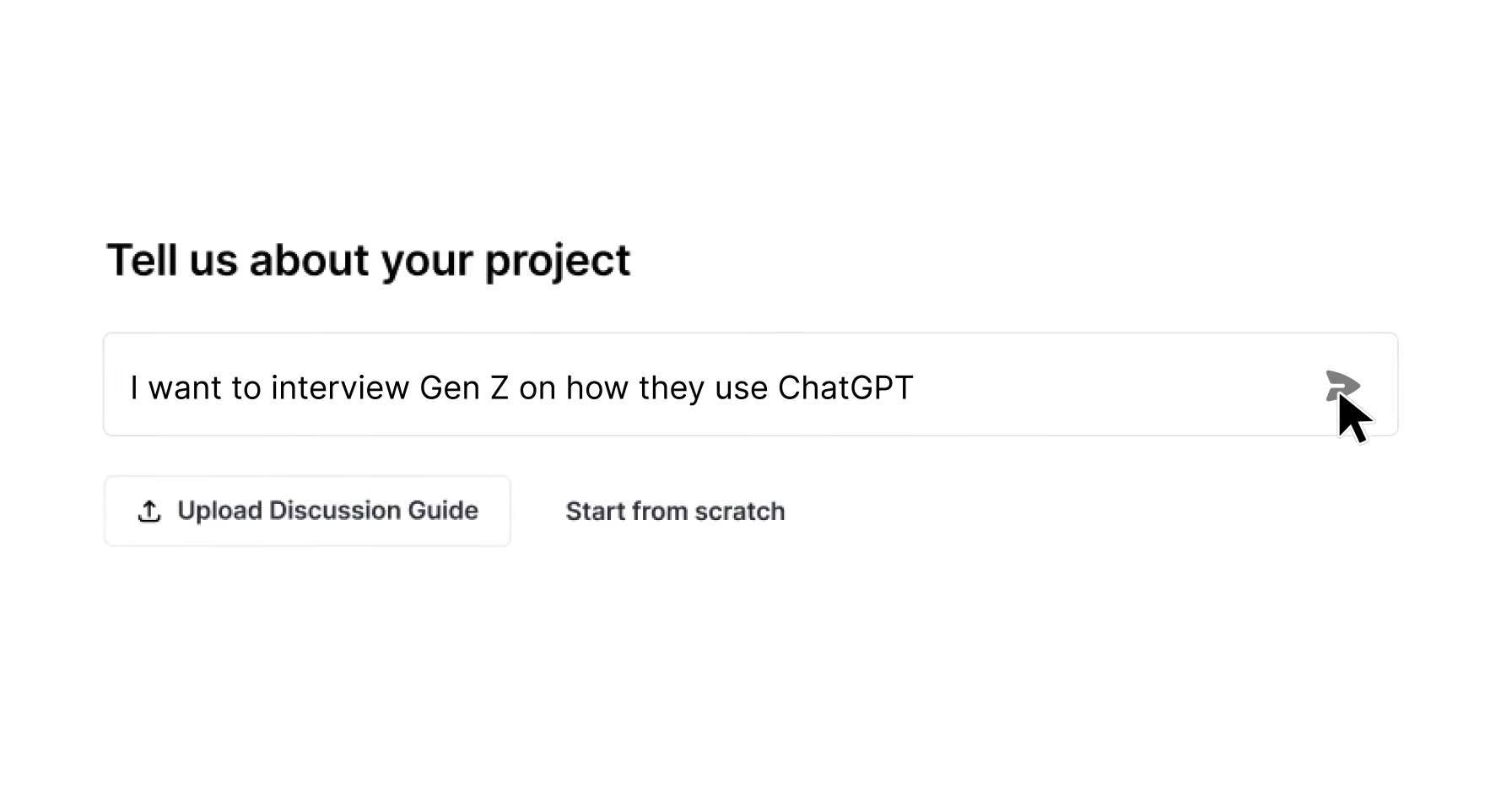
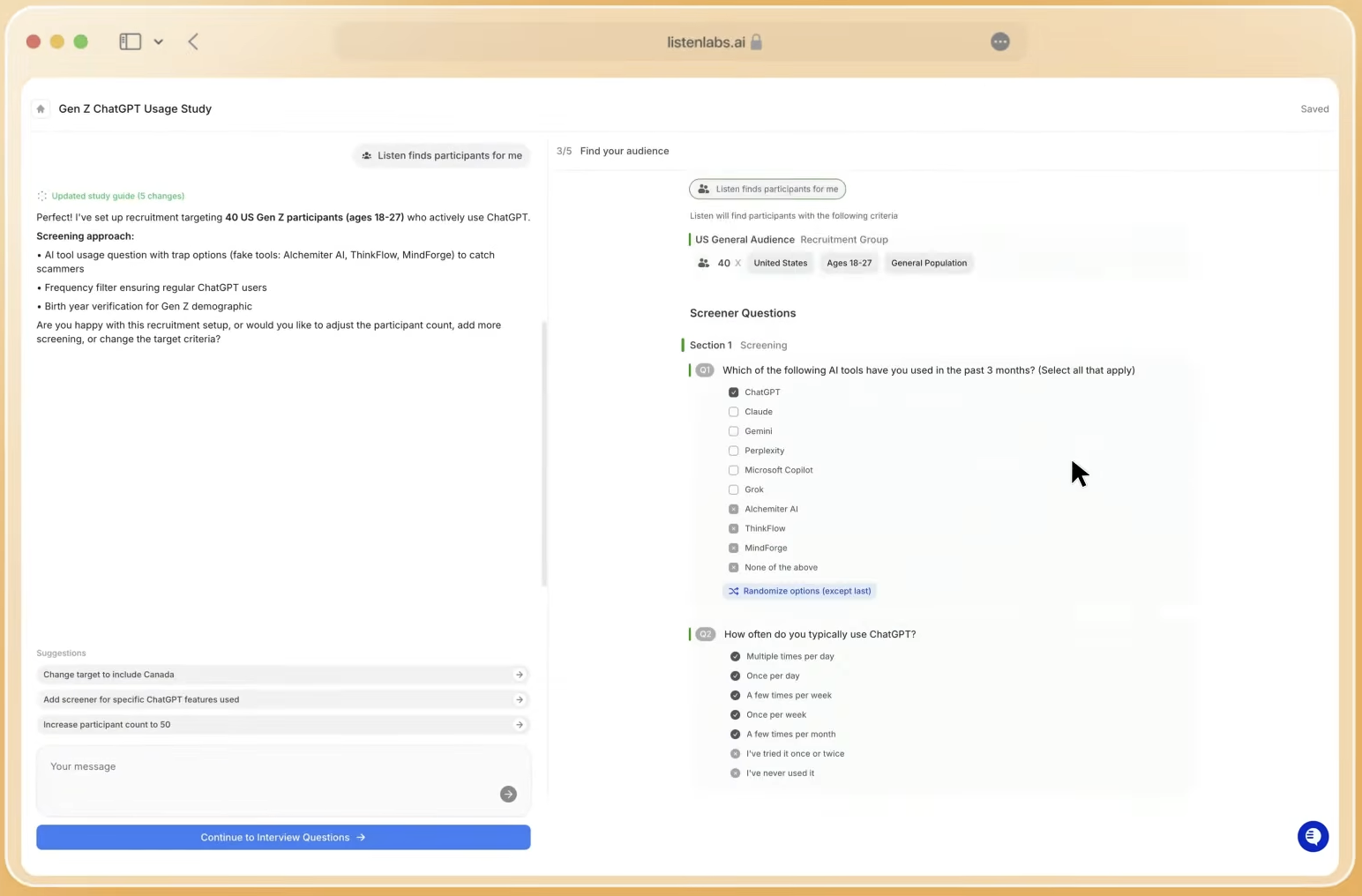
Listen Labs sources participants from its network of 30 million verified respondents across 45+ countries and 100+ languages. Listen Atlas, the platform’s AI orchestration layer, matches participants on behavioral and intent signals rather than self-reported demographics alone, and Quality Guard monitors every interview in real time for fraud, low-effort responses, and repeat respondents. Platforms like Listen Labs add auto-recruiting, transcription, sentiment tagging, and insight summarization so teams move from questions to findings in hours, not weeks.
Listen Labs’ Emotional Intelligence layer adds a second data channel that transcripts alone cannot provide. Built on Ekman’s universal emotions framework, it analyzes tone of voice, word choice, and subconscious micro-expressions to quantify emotions such as joy, trust, confusion, and hesitation at the question and concept level, with every label traceable to a timestamp and verbatim quote. This emotional quantification becomes especially valuable when testing product claims that might trigger skepticism or confusion. When Procter & Gamble used Listen Labs to evaluate how men respond to new product claims, the platform delivered more than 250 interviews with quantified themes and verbatim proof in hours, surfacing where claims felt exaggerated or unclear before they reached market and showing that comfort, safety, and reliability mattered far more than novelty.
For most CPG concept, packaging, and messaging studies, 50–100 interviews per concept provide enough depth to separate systemic patterns from idiosyncratic responses. The full interview cycle, from participant matching to completed transcripts, closes in under 24 hours.
Step 3: Use Syndicated Retail Data to Validate What You Hear
Syndicated data providers such as NielsenIQ and Circana track what consumers buy, including market share, velocity, and distribution, but they do not explain why behaviors occur. A 1.2 share-point loss visible in a Circana report could stem from pricing pressure, a competitor’s reformulation, or a perception shift that only qualitative interviews can surface.
The right moment to pull syndicated retail data is after the AI-moderated interviews have identified the motivational themes. Syndicated data then serves a validation function by confirming that the behavioral patterns consumers describe in interviews align with observed purchase behavior at shelf. If interview participants consistently cite a competitor’s packaging as more trustworthy, and NielsenIQ velocity data shows that competitor gaining share in the same category, the two sources corroborate each other and the finding warrants action.
Secondary research via syndicated data provides category sizing, market trends, and competitive positioning, but cannot explain why shoppers choose one product over another or how they interpret packaging claims, which makes syndicated data and qualitative interviews complementary for CPG decisions rather than competing approaches.
Step 4: Add Social Listening and Rapid Pulse Quantification
Social listening catches flavor complaints trending on TikTok two months before they surface in quarterly tracker data, which gives teams a real-time timing advantage over traditional syndicated behavioral sources. For CPG teams running a compressed cycle, social listening works best as a signal-detection layer that identifies emerging language, sentiment shifts, and category conversations. These signals can sharpen interview discussion guides or flag issues that warrant a follow-up pulse.
Rapid pulse quantification uses a short survey sent to a statistically representative sample when a theme surfaced in qualitative interviews needs a prevalence estimate before a business decision is made. If interviews reveal that 60% of participants associate a packaging color with a competitor brand, a 500-respondent pulse survey can confirm whether that association holds at population scale. Listen Labs supports mixed-method studies that combine qualitative interview questions with Likert scales, NPS, and MaxDiff formats in a single session, which reduces the need for a separate quantitative fielding cycle.
Step 5: Run Analysis Through the Research Agent
With AI-moderated interviews, talking to users at scale is no longer the hard part, and the challenge shifts to understanding what they mean. Listen Labs’ Research Agent addresses that challenge by automating the full analysis workflow from raw interview data to final output.
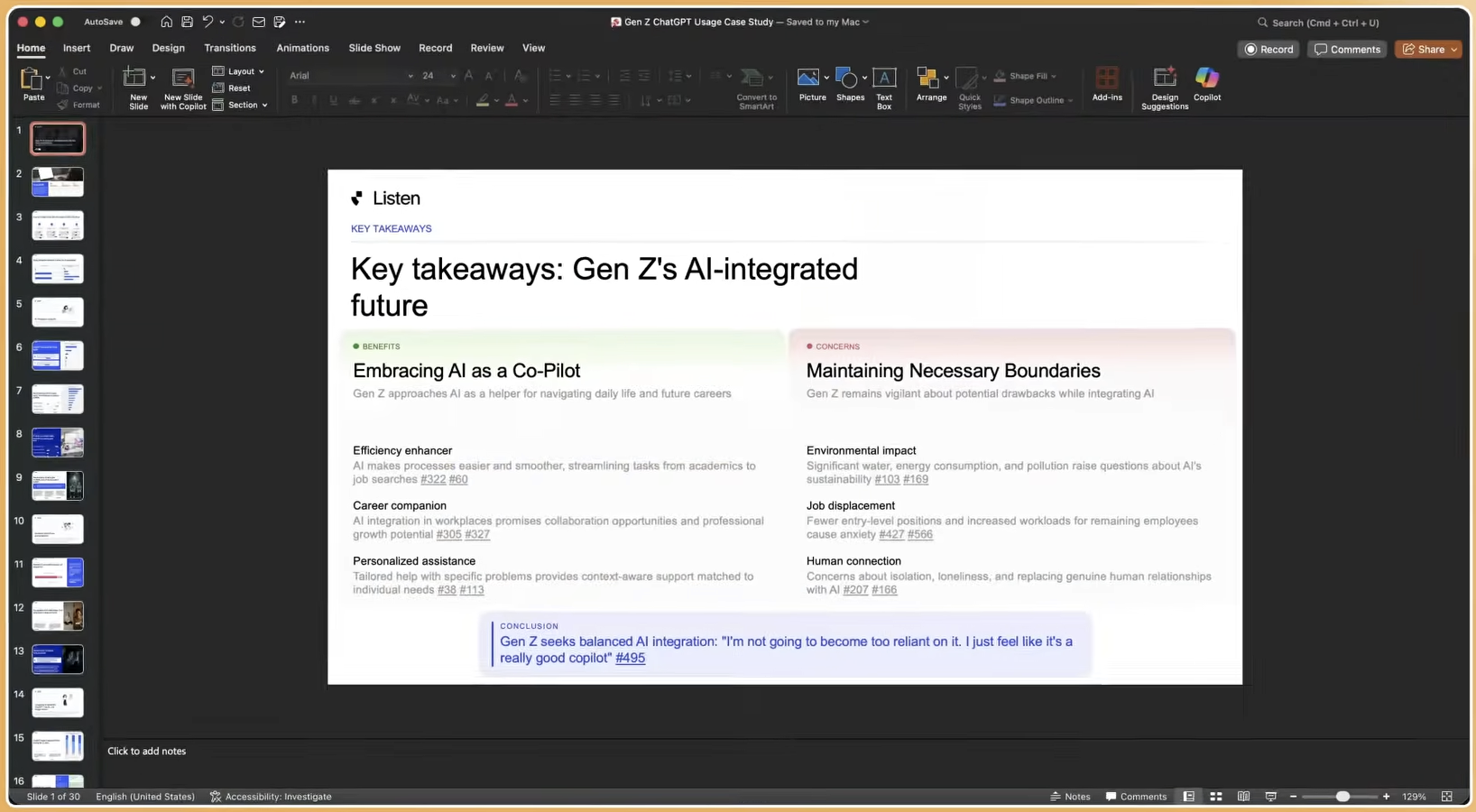
The Research Agent identifies themes, emotional signals, and persona clusters across all interview responses without human bias. Researchers can query the data in natural language, such as “Which concept triggered the most confusion among 35–44-year-old primary shoppers?”, and receive charts, segmentation breakdowns, and statistical comparisons in seconds. One researcher ran a full buying intent analysis across three user segments in under a minute. One-click deliverables include slide decks, memo-style reports, video highlight reels of emotionally significant moments, and custom charts ready for stakeholder review.
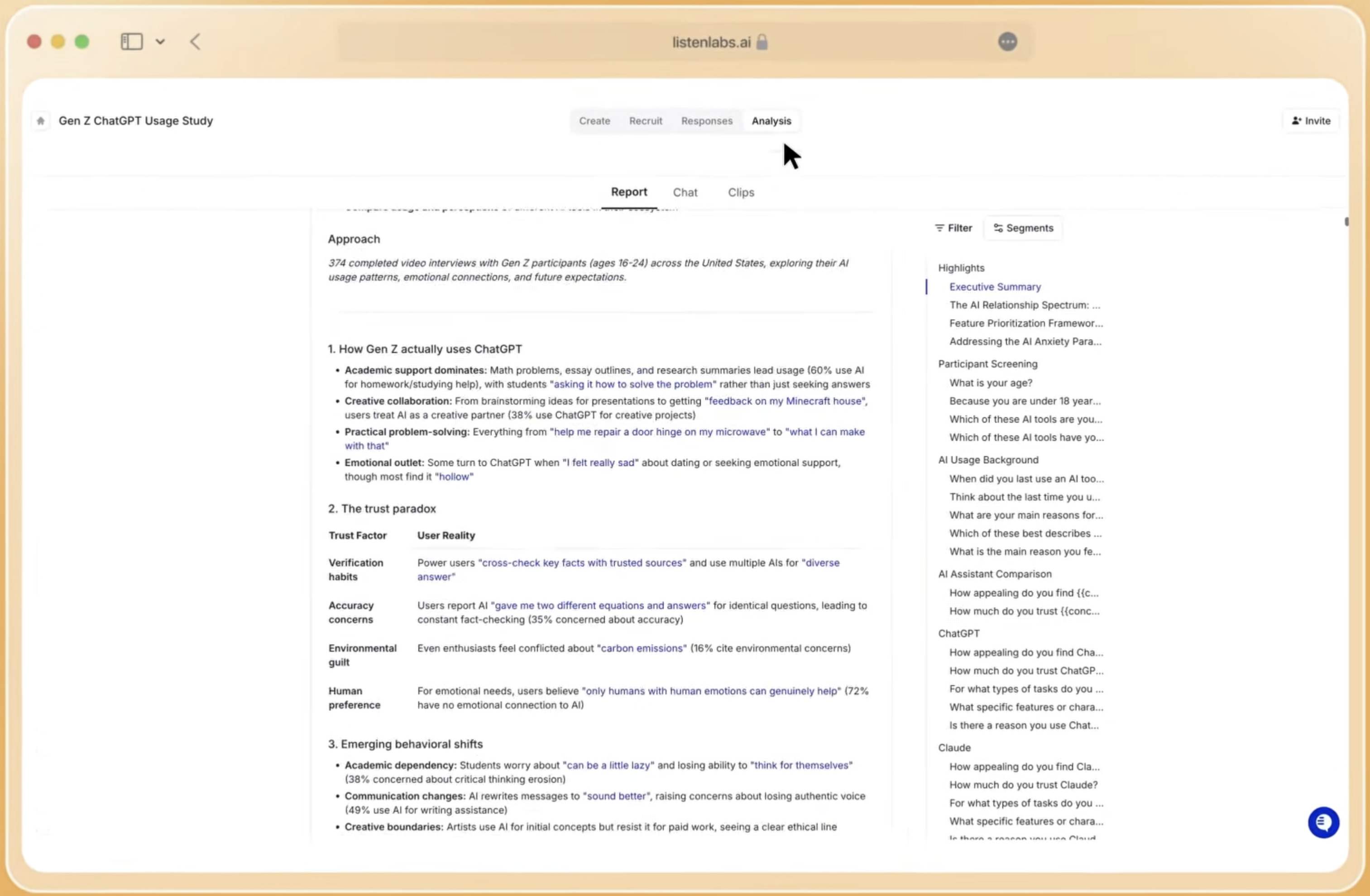
Every insight links back to the underlying verbatim quote and timestamp, so findings stay fully traceable. This traceability supports enterprise compliance and legal review in claims testing and advertising research.
Step 6: Deliver Insights and Build a Searchable Knowledge Base in Mission Control
Stakeholder-ready outputs from the Research Agent, including slide decks, memos, and highlight reels, arrive within the same 24-hour window as the interviews. Mission Control then archives every study as a searchable knowledge base that enables cross-study queries, trend tracking, and institutional memory that persists beyond individual researchers or project teams.
This archival capability means insights compound over time instead of disappearing into slide decks. When Skims needed to validate campaign direction with thousands of high-income buyers overnight, Listen Labs identified and qualified the target audience, tested campaign direction before launch, and delivered qualitative clarity that translated consumer reactions into insights leadership could trust, which helped secure board-level buy-in. Those findings now live in Mission Control, where the team can reference them for future campaign decisions without starting from scratch.
Mission Control turns each completed study into an asset that grows in value. Teams can answer questions from past research in seconds rather than commissioning new studies that duplicate prior work.
Ready to run your first 24-hour consumer insights cycle? See the full workflow live.
Common Pitfalls When Compressing CPG Research Cycles
Three failure modes account for the majority of compressed-cycle breakdowns:
- Unclear objectives: A brief that asks “what do consumers think about our brand?” produces unfocused interviews and unfocused analysis. Every study needs a single decision as its anchor.
- Low-quality respondents: No-show rates for hard-to-reach populations such as executives, healthcare professionals, and shift workers can be significant in synchronous human-moderated interviews. Commodity panels compound the problem with professional survey-takers and fraudulent profiles who game screening questions to qualify for incentives. These quality issues surface as completion rates below 80% or interview responses that are uniformly short and generic, which signals that the panel source itself is compromised. The fix is a recruitment infrastructure with real-time quality monitoring built in from the start, not a panel swap after the fact when the study timeline is already blown.
- Analysis bottlenecks: A human moderator can conduct 4–6 depth interviews per day before fatigue degrades quality, and manual thematic analysis of 200 transcripts can take longer than the interviews themselves. Automated analysis through a Research Agent removes this bottleneck.
How to Measure Success of Fast Consumer Insights Programs
Four objective indicators show whether a compressed research program delivers real value instead of just speed.
- Cycle time: The elapsed hours from study brief to stakeholder-ready deliverable. A well-configured AI-moderated study closes in under 24 hours, and anything beyond 72 hours signals a process or recruitment problem.
- Completion rate: The share of recruited participants who complete the full interview. Rates below 80% indicate screening or recruitment quality issues.
- Stakeholder usage rate: The share of delivered studies whose findings are cited in a product, packaging, or messaging decision within 30 days. Low usage points to a deliverable format or distribution problem, not an insights problem.
- Decision impact: Whether the insight changed or confirmed a decision that had a measurable business outcome. Teams track this retrospectively by comparing pre-study assumptions against post-launch performance data.
Advanced Considerations for Always-On CPG Intelligence
Enterprise CPG teams increasingly treat consumer insights as a continuous program rather than a series of one-off projects. A comprehensive CPG consumer intelligence program includes quarterly brand health tracking, per-launch concept testing, and annual product innovation research.
Global multi-market studies introduce localization requirements that traditional research agencies handle through subcontracted local moderators, which adds weeks and introduces consistency risk. Listen Labs conducts AI-moderated interviews in more than 100 languages with automatic translation and transcription, so a single study can cover multiple markets simultaneously with a consistent discussion guide and comparable outputs.
Emotion-signal analysis represents the next frontier for always-on programs. When emotional response data is tracked across quarterly waves, teams can detect shifts in how consumers feel about a brand or category, not just what they say, before those shifts appear in sales data. Pairing AI-moderated conversational research with behavioral signals is powerful because analytics show what shoppers do while the qualitative interviews explain why.
Qual-at-scale readiness criteria for an always-on program include a defined study cadence, a stakeholder distribution list for each study type, and Mission Control configured as the organization’s single source of truth for consumer knowledge.
Explore how Listen Labs supports always-on CPG intelligence programs at enterprise scale.
Frequently Asked Questions
How quickly can Listen Labs actually deliver CPG consumer insights?
Listen Labs compresses the full research lifecycle, including study design, participant recruitment, AI-moderated interviews, analysis, and deliverable generation, to under 24 hours for most CPG studies. This coverage includes concept testing, packaging evaluation, claims validation, and brand perception research. Studies requiring niche or hard-to-reach audiences may take slightly longer because of recruitment complexity, and the platform’s dedicated recruitment operations team focuses on handling low-incidence segments without the multi-week delays typical of traditional agency sourcing.
Is the quality of AI-moderated interviews comparable to human-moderated research for CPG decisions?
AI-moderated interviews on Listen Labs deliver adaptive, personalized conversations with dynamic follow-up questions that mirror the probing behavior of a skilled human moderator rather than a static survey. The platform’s in-house research team, with more than 50 years of combined expertise, continuously refines the methodology. For the structured research tasks most common in CPG, including concept testing, claims evaluation, packaging feedback, and brand health tracking, the quality matches human moderation at a fraction of the time and cost. AI moderation does not fit sensory evaluation, in-store ethnography, or co-creation workshops that require physical product interaction.
How does Listen Labs handle participant fraud and panel quality for CPG studies?
Listen Labs operates three layers of quality protection. First, the platform works exclusively with high-quality, non-commodity panel sources, which removes professional survey-takers. Second, Quality Guard uses real-time AI monitoring across video, voice, content, and device signals to detect and eliminate fraudulent responses, AI-generated scripts, and mismatched profiles during the interview itself. Third, participants are limited to three studies per month to prevent panel fatigue and incentive-driven behavior. A dedicated recruitment operations team adds a human review layer for hard-to-reach segments. The result is a verified global panel spanning the same 45+ countries mentioned earlier, with quality controls that maintain consistency across all geographies.
When should CPG teams add syndicated retail data or social listening to an AI-moderated interview study?
Syndicated data from providers like NielsenIQ or Circana works best as a validation layer after AI-moderated interviews have identified the motivational themes. It confirms whether behavioral patterns consumers describe align with observed purchase behavior at shelf. Social listening works best as a signal-detection layer before or during study design, because it surfaces emerging language and sentiment shifts that can sharpen discussion guides. Neither source replaces qualitative interviews for explaining the “why” behind consumer behavior, and both complement interview findings by adding behavioral and cultural context.
How does Mission Control prevent CPG teams from re-researching the same questions?
Mission Control serves as the organization’s permanent, searchable source of truth for every study ever conducted on the platform. Each completed study adds to a cumulative knowledge base that supports cross-study queries, trend tracking over time, and institutional memory that persists beyond individual researchers or project cycles. Teams can retrieve answers from past research using the same natural language interface described earlier, searching across all historical studies rather than being limited to the current project. This compounding knowledge base means each new study builds on prior work instead of starting from zero.