Written by: Anish Rao, Head of Growth, Listen Labs
Key Takeaways for CPG Insights Leaders
- Traditional CPG consumer research takes 4–6 weeks and costs $25,000–$75,000 per round, which often misses critical decision windows.
- AI-moderated interviews now deliver 150–250+ depth conversations with emotional signal capture and quantified themes in under 24 hours.
- Fortune 500 brands like P&G, Skims, Nestlé, and Levi’s now use a single end-to-end platform instead of fragmented vendor workflows, receiving consultant-quality deliverables overnight.
- Emotional Intelligence layers capture tone, facial micro-expressions, and word choice, which improves pack testing and creative evaluation accuracy beyond transcript-only analysis.
- Listen Labs compresses CPG research cycles from weeks to hours; schedule a demo to see how and run your next study in 24 hours.
Modern Options for CPG Consumer Insight Generation
The dominant methods in CPG consumer research, such as focus groups, in-person depth interviews, and quantitative panels, were designed for a slower commercial environment. A single round of traditional qualitative consumer insights studies (including CPG focus groups) costs $25,000–$75,000 and takes 6–12 weeks. Traditional focus groups take 3–5 weeks and $4,000–$12,000 per 90-minute session. By the time a report lands, the product brief has often already been finalized.
The structural problem has three parts. A human moderator can conduct only a limited number of depth interviews per day, so 200 interviews take a quarter instead of 24 hours. The research process is fragmented across separate vendors for recruitment, scheduling, moderation, transcription, and analysis, and each handoff introduces delay and quality risk. A CPG company also manages many active innovation projects at once, while qualitative research capacity has remained flat, which forces teams to skip qualitative research or rely solely on quantitative data for many launches.
Turnaround times for AI-powered analysis in CPG consumer insights now measure in hours rather than weeks. This speed lets brands detect emerging trends, diagnose shifts in awareness or consideration, and adjust campaigns in near real time. AI-moderated interview platforms conduct hundreds of depth conversations simultaneously with adaptive follow-up questions, emotional signal capture, and automated synthesis. This approach removes the traditional depth-versus-scale trade-off that has constrained CPG insights teams for decades.
How Leading CPG Teams Compare Consumer Insights Platforms
VP and Director-level insights leaders at Fortune 500 CPG companies evaluate platforms across six dimensions: speed, depth, scale, cost, quality, and emotional signal capture.
Speed acts as the first filter. A platform that cannot deliver findings within a business cycle, ideally under 24 hours for tactical decisions, does not solve the backlog problem. Traditional concept tests take 4–8 weeks, while AI-powered studies complete in days, which enables CPG brands to respond to weekly shifts in category share.
Depth depends on adaptive moderation. Fixed-script surveys cannot uncover unexpected findings. Platforms that probe dynamically, following the participant’s actual response rather than a predetermined path, surface the motivations and emotional reactions that drive purchase behavior.
Scale determines statistical confidence. Researchers typically require 150–200 participants per concept in quantitative CPG concept testing to achieve statistical significance at 95 percent confidence. Platforms must reach that threshold without proportional cost increases.
Cost expectations have shifted. A 100-interview concept test on AI platforms costs approximately $2,500, versus the traditional vendor pricing mentioned earlier. Listen Labs delivers studies at roughly one-third the cost of traditional research approaches.
Quality rests on participant verification. Commodity panels carry fraud risk and professional survey-takers. Listen Labs’ Quality Guard monitors every interview in real time across video, voice, content, and device signals, and participants are limited to three studies per month.
Emotional signal capture has become a key differentiator. What participants say and what they feel represent different data points. Platforms that analyze tone of voice, word choice, and facial micro-expressions alongside transcripts give CPG teams a complete picture of consumer response, which is particularly critical for pack testing and creative evaluation. The following case studies show how leading CPG brands apply these evaluation criteria in practice.
P&G: Accelerating Claim Validation for Men’s Grooming Innovation
Challenge: Procter & Gamble’s analytics and insights team needed to evaluate how men respond to new product claims for a men’s grooming innovation before committing to market. Traditional research timelines would have delayed the decision window.
Research Approach: Listen Labs deployed AI-moderated video interviews sourced from its 30 million verified respondent network, targeting verified male category purchasers. The AI interviewer probed dynamically on claim clarity, emotional resonance, and perceived credibility, capturing both stated reactions and subconscious signals.
Sample Size and Turnaround: The team completed 250+ interviews with quantified themes and verbatim proof, delivered in hours.
Key Findings: The study surfaced where claims felt exaggerated or unclear before they reached market. It showed that comfort, safety, and reliability matter far more to male grooming consumers than novelty. This insight redirected investment away from features consumers would dismiss.
Business Impact: Findings directly shaped product and brand strategy, prevented investment in low-resonance claims, and focused innovation on validated consumer priorities.
Stakeholder Quote: “Listen Labs has been a huge help.” — Analytics and Insight Leader at P&G
CPG and Enterprise Case Studies Using 24-Hour AI Interviews
Skims: De-Risking a Global Campaign Launch Overnight
Skims needed to validate campaign direction with thousands of high-income buyers before a global launch. Listen Labs identified and qualified thousands of premium consumers overnight, which eliminated weeks of recruiting. Qualitative clarity translated customer reactions into insights that secured board-level buy-in. “I always struggled with understanding the why and Listen Labs nails this for me.” — SVP Data, Insights, Loyalty at Skims
Nestlé: Continuous Consumer Intelligence Across Markets
Nestlé, a Listen Labs enterprise client, uses the platform’s 30 million verified respondent network across 45+ countries to run multi-market studies in parallel. Simultaneous testing across US, UK, German, and Japanese consumers in native languages with culturally adapted stimuli was previously a six-figure, multi-month effort. Listen Labs compresses this work to under 24 hours with automatic translation and transcription across 100+ languages.
Levi’s: Packaging and Concept Validation at Speed
Levi’s, another Listen Labs enterprise client, uses AI-moderated interviews for packaging validation and concept testing studies that previously required multi-week agency engagements. The platform’s Emotional Intelligence layer captures micro-expression data at the timestamp level and identifies exactly where consumers feel confusion or delight when evaluating packaging designs, which transcripts alone cannot surface.
Chubbies: Overnight Consumer Feedback for Product Decisions
Switching to Listen Labs AI-moderated interviews let Chubbies capture hundreds of candid, one-to-one conversations overnight. This change replaced a research process that previously took weeks and cost thousands of dollars per session. The speed enabled product decisions before inventory commitments rather than after.
Robinhood: Behavioral Segmentation for Feature Re-Engagement
Robinhood used Listen Labs to assess whether prediction markets felt on-brand and to identify user segments driving the highest re-engagement. Qualitative interviews revealed that users who view the feature as entertainment rather than income drive 2.4 times higher weekly re-engagement. Insights were delivered five times faster than traditional methods, and integration flows identified through the research boosted feature uptake by 30–40 percent.
Anthropic (Claude Code): Churn Driver Analysis at Scale
Anthropic needed to understand why Claude users cancel subscriptions. Listen Labs delivered 300+ user interviews in 48 hours, surfaced churn drivers five times faster than traditional methods, identified competitor migration patterns, and produced a prioritized list of ten must-fix items. “Listen Labs lets us understand user churn with a level of clarity and speed we’ve never had before.” — Director of Product Strategy at Anthropic
Microsoft: Global Customer Stories in Under 24 Hours
Listen Labs has run over 1 million AI-powered customer interviews for companies including Microsoft. For Microsoft’s 50th anniversary, the team needed global customer stories about Copilot within a day. Listen Labs delivered at both the speed and scale required. “I can reach out to hundreds of users at one third of the cost.” — Director of Data Science at Microsoft
Emotional Intelligence for Pack Testing and Creative Evaluation
Standard qualitative transcripts capture what consumers say but not how they react physically. They do not capture the frown during a packaging reveal, the hesitation before answering a claim question, or the widened pupils when a creative concept lands. These subconscious signals often provide the most predictive data in pack testing and creative evaluation, yet they remain invisible to transcript-only analysis.
Listen Labs’ Emotional Intelligence layer analyzes three simultaneous signal streams: tone of voice, word choice, and subconscious facial micro-expressions. The framework uses Paul Ekman’s universal emotions model, the same standard used in clinical psychology and UX research, and tracks anger, anticipation, disgust, fear, joy, sadness, trust, and surprise across every interview.
Every emotion is quantified per question and per concept. Every label is traceable to the exact timestamp, verbatim quote, and the reasoning behind the classification. A CPG insights leader can ask the Research Agent which packaging concept triggered the most confusion among 35–44-year-old female buyers and receive a side-by-side emotional breakdown across stimuli, segments, and markets in seconds.
In creative evaluation, teams can pinpoint the exact moment in an ad where engagement drops or where genuine delight peaks, not just an aggregate rating. Multimodal analysis combines spoken responses with tone shifts, facial cues, and visible context to produce decision-ready evidence, replacing manual coding and transcription. Emotional Intelligence is available across 50+ languages and integrates directly with the Research Agent for natural-language queries, charts, and highlight reels of the most emotionally significant moments.
Step-by-Step Framework for a 24-Hour CPG Insights Study
The following framework reflects how Listen Labs clients execute studies from brief to deliverable in under 24 hours.
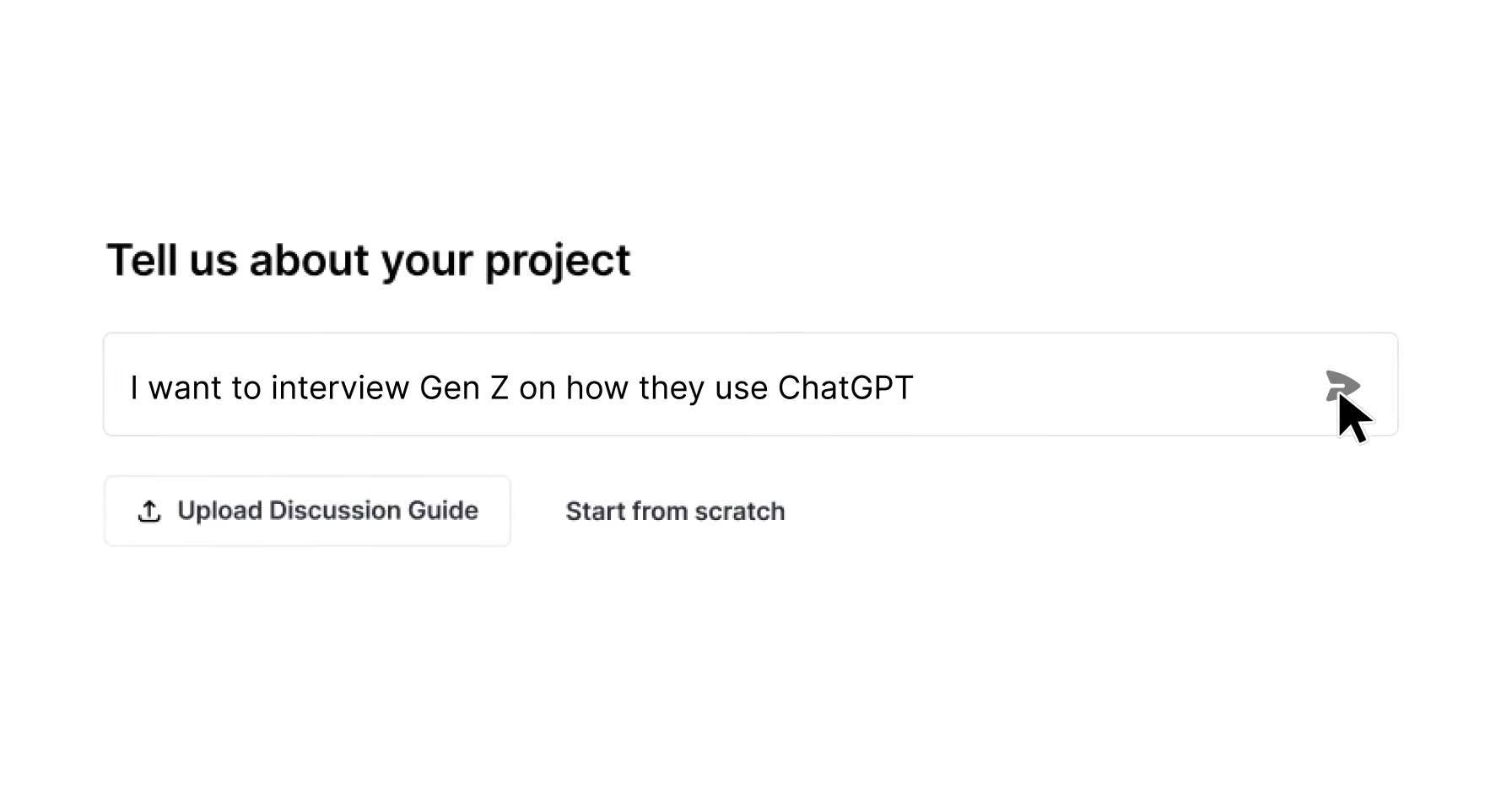
Step 1 — Define the decision, not the topic. Anchor the study to a specific business decision, such as a claim to validate, a concept to rank, or a packaging design to test. Vague briefs produce vague findings. The AI study co-design tool drafts structured objectives and questions from a natural-language description in seconds.
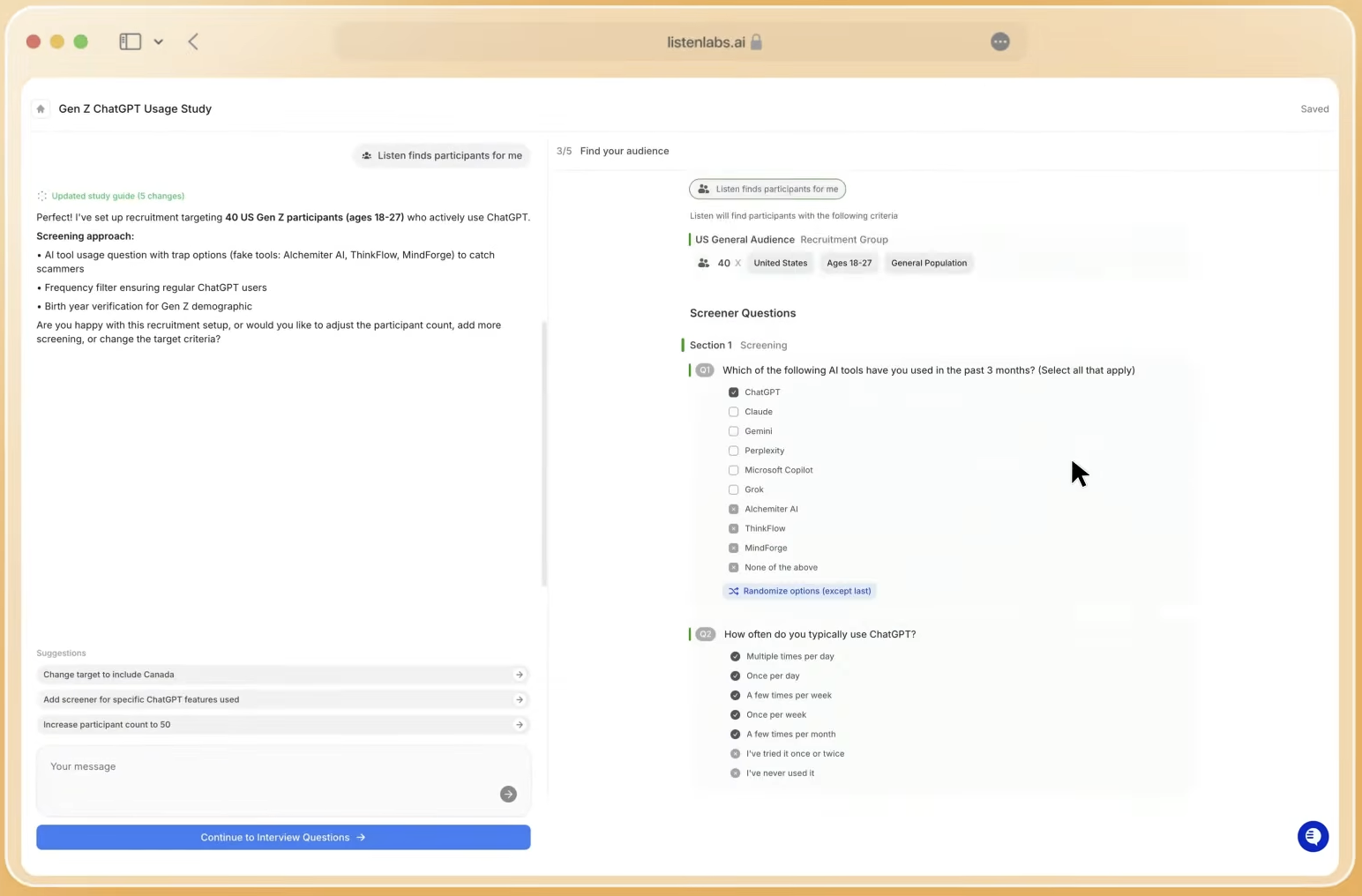
Step 2 — Specify the audience precisely. Define the target participant by purchase behavior, not just demographics. Listen Atlas matches across behavioral and intent data from a 30 million verified respondent network across 45+ countries. For niche segments below a 1 percent incidence rate, the dedicated recruitment operations team sources from specialized networks.
Step 3 — Set sample size for the decision stakes. Researchers typically require 150–200 participants per concept in quantitative CPG concept testing to achieve statistical significance at 95 percent confidence. For directional decisions, 50–75 interviews deliver sufficient signal. Listen Labs conducts all interviews simultaneously, so 200 interviews take the same wall-clock time as one.
Step 4 — Load stimuli and configure logic. Upload packaging images, video concepts, product claims, or live URLs. Set monadic or sequential randomization, quotas, and branching logic. Auto-QA flags issues before launch.
Step 5 — Launch and monitor. Quality Guard monitors every interview in real time for fraud, low-effort responses, and mismatched profiles. Fieldwork for a 200-interview study completes within hours.
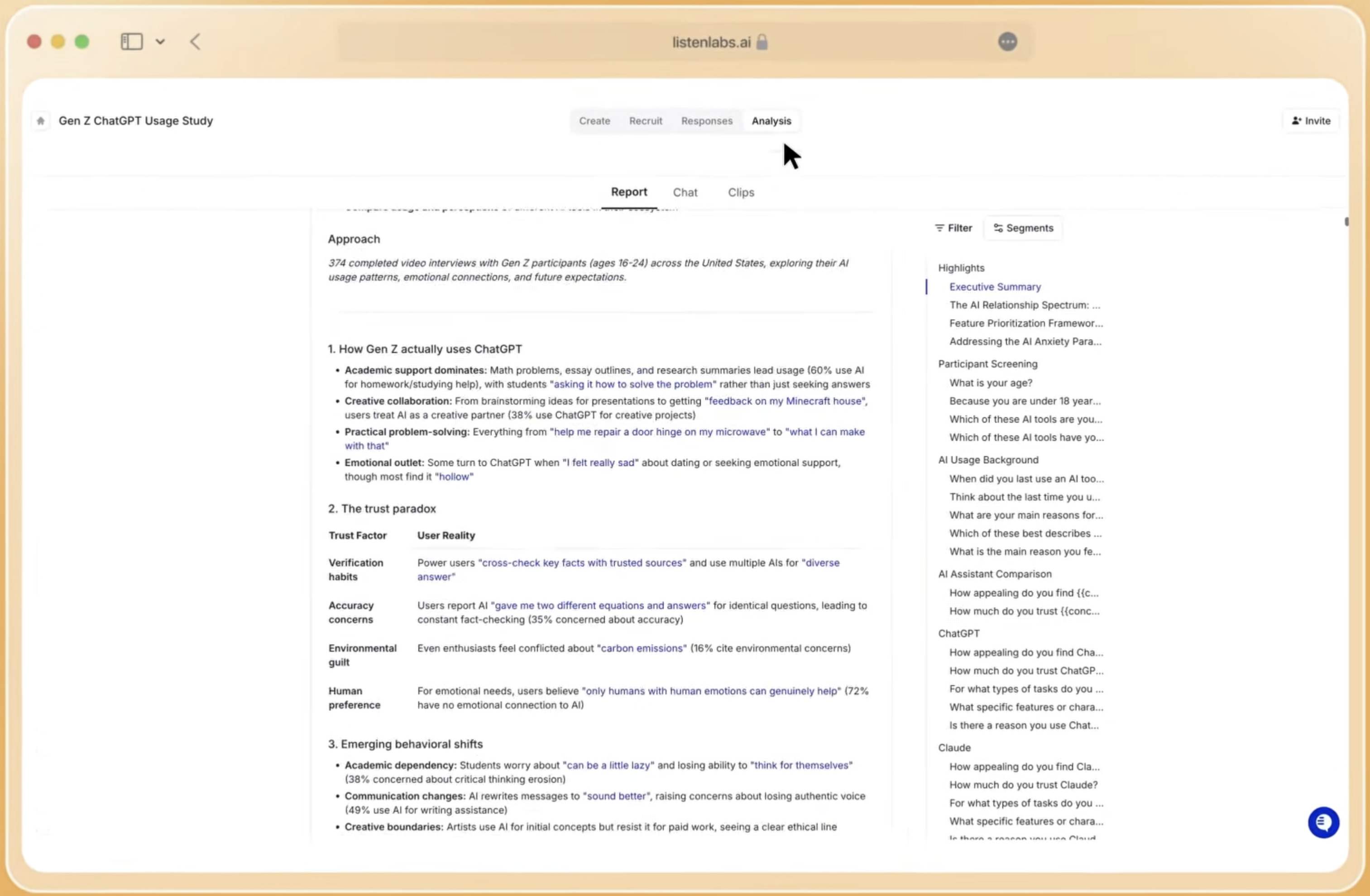
Step 6 — Generate deliverables. The Research Agent produces automated key findings, slide decks, memos, video highlight reels, and statistical charts in under a minute. Emotional Intelligence data is queryable in natural language. Mission Control stores all findings for cross-study queries.
Walk through this framework with a Listen Labs research specialist using your next study brief.
How CPG Brands Measure ROI on Consumer Insights
ROI measurement for CPG consumer insights programs operates across four dimensions: decision impact, efficiency gains, risk reduction, and revenue impact.
Decision impact tracks how frequently and significantly research findings influence major product, brand, or go-to-market decisions. A study that redirects a 5 million dollar innovation investment away from a low-resonance claim, as the P&G men’s grooming study did, generates ROI that dwarfs its cost.
Efficiency gains appear in time-to-market compression and reduction in rework. The CPG researcher’s role shifts from personally moderating 12 interviews per project covering 2–3 projects per month, to designing and interpreting AI-moderated studies covering 8–10 projects per month with broader segment coverage. The same team produces roughly five times more studies at one-third the cost.
Risk reduction quantifies avoided failures. CPG product failure rates have not meaningfully improved in a decade despite massive investment in analytics and testing infrastructure. This pattern signals that speed of insight, not volume of data, is the missing variable. Studies completed before launch commitments prevent costly market failures.
Revenue impact connects research-informed decisions to incremental sales. Robinhood’s 30–40 percent uptake increase from research-identified integration flows and the 2.4 times re-engagement lift from behavioral segmentation illustrate this direct linkage. AI-powered brand tracking demonstrates stronger predictive accuracy than traditional methods, allowing CPG teams to forecast how shifting consumer perceptions will affect sales before results appear in point-of-sale data.
Frequently Asked Questions
What makes a CPG consumer insights case study credible?
A credible CPG consumer insights case study documents the specific business challenge, the research methodology and sample size, the turnaround time, quantified findings tied to a business metric, and a stakeholder attribution. Studies that report only directional themes without connecting to sales, cost, or speed outcomes are difficult to evaluate. The case studies in this article each include sample size, turnaround time, and a measurable business outcome.
Can AI-moderated interviews replace human moderators for CPG research?
AI-moderated interviews deliver comparable methodological rigor to skilled human moderators for the vast majority of CPG research applications, including concept testing, claim validation, packaging research, brand perception, and creative evaluation. The AI probes dynamically based on participant responses, the same way a trained interviewer would, without fatigue or inconsistency across hundreds of simultaneous conversations. Listen Labs’ in-house research team, with 50+ years of combined expertise, continuously refines the methodology. Human moderators remain valuable for highly sensitive topics or executive-level stakeholder interviews where relationship context matters.
How does Listen Labs ensure participant quality for CPG studies?
Three layers of protection operate simultaneously. Listen Labs works exclusively with high-quality, non-commodity panel sources, so no professional survey-takers participate. Quality Guard monitors every interview in real time across video, voice, content, and device signals to detect fraud, low-effort responses, AI-generated scripts, and mismatched profiles. Participants are limited to three studies per month to eliminate panel fatigue. For niche CPG audiences, such as specific category purchasers, regional shoppers, or demographic segments below a 1 percent incidence rate, a dedicated recruitment operations team sources from specialized networks.
What CPG study types does Listen Labs support?
Listen Labs supports concept and prototype testing, packaging validation, claim validation, brand perception studies, creative and ad testing, consumer journey mapping, multi-market segmentation, pricing research, and innovation pipeline screening. The platform handles both one-off studies and continuous consumer intelligence programs. Stimuli support includes images, video, audio, PDFs, and live URLs, with monadic and sequential randomization for controlled comparisons.
How does Listen Labs handle data privacy and compliance for CPG enterprise clients?
Listen Labs maintains SOC 2 Type II, GDPR, ISO 27001, ISO 27701, and ISO 42001 certifications. All data is encrypted at 256-bit, and customer data is never used for AI model training. Enterprise SSO is supported. For multi-geography CPG studies, the platform’s consent and data handling framework covers all 45+ countries in the network.
Conclusion: Moving from 4–6 Week Cycles to 24-Hour Decisions
The 4–6 week CPG research cycle no longer matches the speed of product, brand, and go-to-market decisions. The case studies above, from P&G’s claim validation to Skims’ overnight campaign de-risking to Robinhood’s behavioral segmentation, share a common architecture: verified participants, AI-moderated depth interviews, emotional signal capture, and auto-generated deliverables, all within 24 hours. Listen Labs is the only end-to-end platform that covers the entire research lifecycle, including study design, global recruitment from a 30 million verified network, AI-moderated interviews, emotional intelligence analysis, and consultant-quality deliverables, without stitching together separate vendors or sacrificing depth for scale.
Book your demo and run your first 24-hour CPG consumer insights study with Listen Labs.