
Written by: Anish Rao, Head of Growth, Listen Labs
Key Takeaways
- Traditional retail research relies on fragmented vendors, creating 4–6 week cycles that miss critical decision windows for Consumer Insights leaders.
- A 7-step process that defines decision-tied objectives, mines internal data, selects mixed methods, applies rigorous screening, runs AI-moderated interviews, delivers bias-free analysis, and packages actionable deliverables can compress timelines from weeks to hours.
- AI-moderated platforms remove the depth-versus-scale trade-off by running hundreds of adaptive, one-on-one interviews at once while generating quantified themes and verbatim evidence without manual coding delays.
- Quality controls such as behavioral screeners, real-time fraud detection, and participant frequency limits keep findings anchored in genuine shopper motivations rather than surface trends or professional respondents.
- Listen Labs compresses the entire retail research lifecycle into a single platform that delivers results in under 24 hours. Schedule a live walkthrough to see how.
Step 1: Tie Research Objectives Directly to Retail Decisions
Every research project starts with a specific business decision it will inform. Vague objectives produce vague findings. For the private-label apparel line, the decision might be: “Which of three product positioning concepts should anchor the launch campaign, and which price tier maximizes trial intent among shoppers aged 25–44?”
Stakeholders to align at this stage include the brand team, merchandising, and any category managers who will act on the findings. Key inputs include the decision deadline, the budget envelope, and the acceptable confidence threshold. Each constraint shapes method selection: tight deadlines favor asynchronous approaches, limited budgets may trade sample size for depth, and high confidence thresholds require quantitative scale. Together, these inputs determine whether the study needs depth through qualitative interviews, scale through quantitative data, or a combination of both.
The U.S. Small Business Administration recommends matching direct research methods to specific audience questions, while using secondary data for broader industry and demographic context. Applied to retail, teams define the decision first, then select the method that answers it most efficiently.
Realistic timeline for this step is one to two business days when stakeholders align in advance.
Step 2: Mine Internal Retail Data Before Adding External Research
Once you have decision-tied objectives, the next move is to understand what you already know before paying for external input. Before recruiting a single external participant, mine the data already available. For the apparel line, this means reviewing point-of-sale data for category performance by store cluster, loyalty program data for purchase frequency and basket composition among the target demographic, and web analytics for category browse-to-purchase conversion rates.
Internal data serves two functions. It narrows the research questions to genuine unknowns, and it provides a baseline against which qualitative findings can be validated. Organizations often collect transaction data but ignore the emotional journey, measuring clicks while missing hesitation or tracking conversions while overlooking cart abandonment reasons. Internal data reveals the what, while external research reveals the why.
Step 3: Select Mixed Methods That Deliver Both Depth and Scale
Method selection flows directly from the objectives defined in Step 1 and the gaps revealed in Step 2. For the apparel line study, a mixed-methods design fits well. AI-moderated qualitative interviews surface positioning preferences and emotional responses, while quantitative rating scales embedded within the same interview produce comparable scores across concepts.
With qual-at-scale, the old trade-off between depth and scale no longer applies. AI-moderated platforms can conduct hundreds of adaptive, one-on-one interviews simultaneously. Each interview uses dynamic follow-up questions that probe five to seven levels deep into motivation chains, a technique known as laddering. Method selection should also reflect the decision window. Tighter timelines and broader geographic scope favor asynchronous AI-moderated approaches that support 50+ languages and parallel execution without scheduling constraints.
Sampling strategy at this stage covers the sample frame and the target sample size. A frame for the apparel study might include women and men aged 25–44 who have purchased apparel at a mid-tier retailer in the past 90 days. For qualitative depth, AI-moderated interviews can reach thematic saturation. For quantitative confidence at a 95% level with a ±5% margin of error, 385 completes are the standard minimum.
Step 4: Recruit Qualified Shoppers with Strong Screening and Safeguards
Screener design acts as the most consequential quality control in the entire process. A poorly written screener admits unqualified respondents, while an overly restrictive one drives up incidence rate costs and extends fieldwork timelines.
For the apparel line study, the screener should confirm recent category purchase behavior, household income range, and retailer shopping frequency, not just self-reported demographics. A good consumer insight must be evidence-traced to real consumer language and reflect deep motivation rather than surface trends. That standard requires recruiting participants who genuinely represent the target shopper, not those who simply pass a demographic filter.
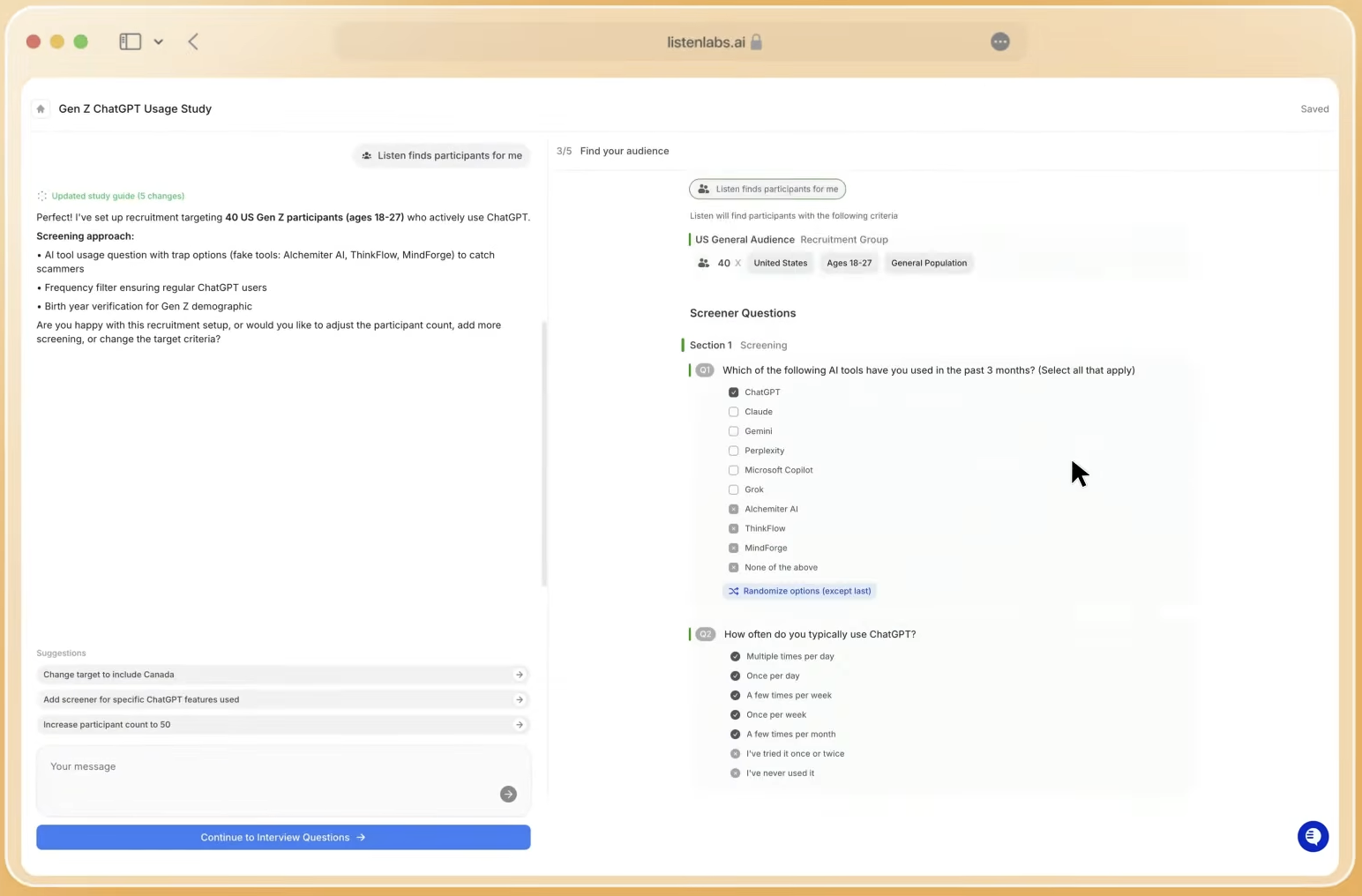
Quality controls during recruitment should include behavioral matching on purchase intent signals, real-time fraud detection across video and device signals, and participant frequency limits to eliminate professional survey-takers. Each layer addresses a different threat to data quality. Behavioral matching ensures relevance, fraud detection catches imposters, and frequency limits prevent professional respondents from dominating your sample. Listen Labs’ Quality Guard applies all three layers simultaneously, with a dedicated recruitment operations team available for audiences below 1% incidence rate.
Step 5: Run AI-Moderated Shopper Interviews or Observations
For most retail shopper research, including positioning tests, pricing perception studies, and private-label concept evaluation, AI-moderated video interviews provide the most efficient execution format. Platforms like Listen Labs add auto-recruiting, transcription, sentiment tagging, and insight summarization so teams move from questions to findings in hours, not weeks.
The AI moderator conducts each interview as a personalized conversation. It probes deeper on short or ambiguous answers and adapts the question sequence based on prior responses. For the apparel line study, the AI can show each participant a different concept image, ask for an unprompted reaction, then ladder into the underlying motivation. For example, it might say, “You mentioned it felt ‘too formal.’ What does that tell you about where you would wear it?” That adaptive depth separates AI-moderated interviews from static surveys.
In-store ethnography and physical planogram testing still suit human observation better. For remote, asynchronous, or multi-market execution, AI-moderated interviews remain the operationally superior choice.
Step 6: Turn Shopper Conversations into Bias-Resistant Themes and Segments
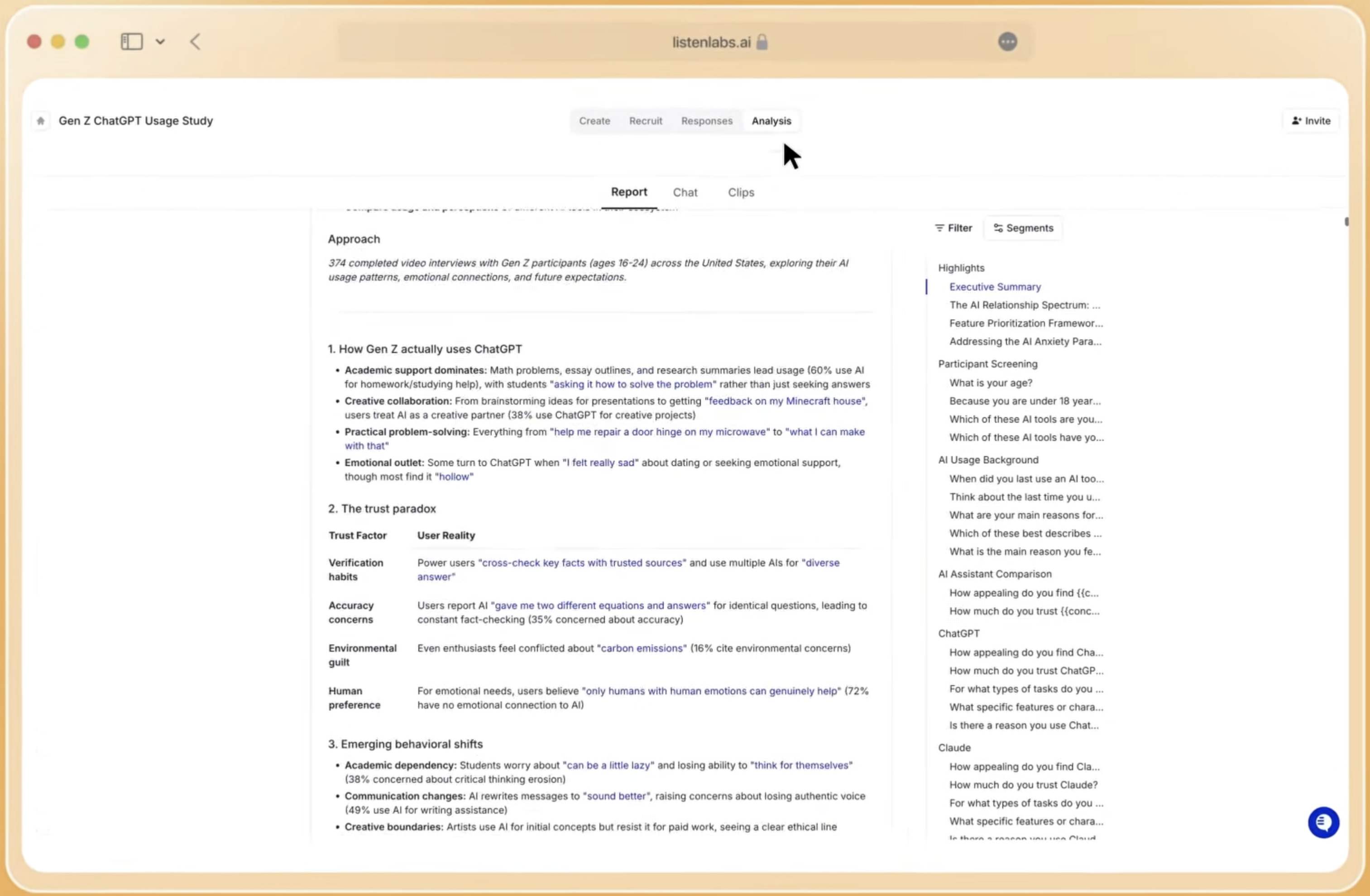
With AI-moderated interviews, talking to users at scale is no longer the hard part. The challenge is understanding what they mean. Human analysis of qualitative data takes time and often carries confirmation bias, as analysts may emphasize findings that confirm pre-existing hypotheses.
Effective analysis frameworks for retail shopper research include thematic coding, sentiment analysis, and emotional signal analysis. Thematic coding groups responses by recurring topics. Sentiment analysis tracks positive, neutral, or negative valence by concept or question. Emotional signal analysis identifies joy, confusion, hesitation, or disgust at the timestamp level. Effective consumer insight programs integrate cognitive, emotional, and contextual insights rather than relying on transactional data alone.
For the apparel line study, segment-level analysis is essential. Younger shoppers may respond differently to the premium positioning concept than older ones. Response patterns may also differ by region. AI analysis engines process all interview data objectively across these dimensions. They generate quantified theme frequencies and verbatim evidence without the delay of manual coding.
See the Research Agent in action to understand how Listen Labs delivers segmented, bias-free analysis in minutes.
Step 7: Convert Insights into Clear Recommendations and Shareable Deliverables
Even the most rigorous analysis has no business impact if it does not reach decision-makers in a format they can act on. Findings that do not reach decision-makers in a usable format have no business impact. The insight-to-action workflow requires two outputs: a prioritized recommendation set and a stakeholder-ready deliverable.
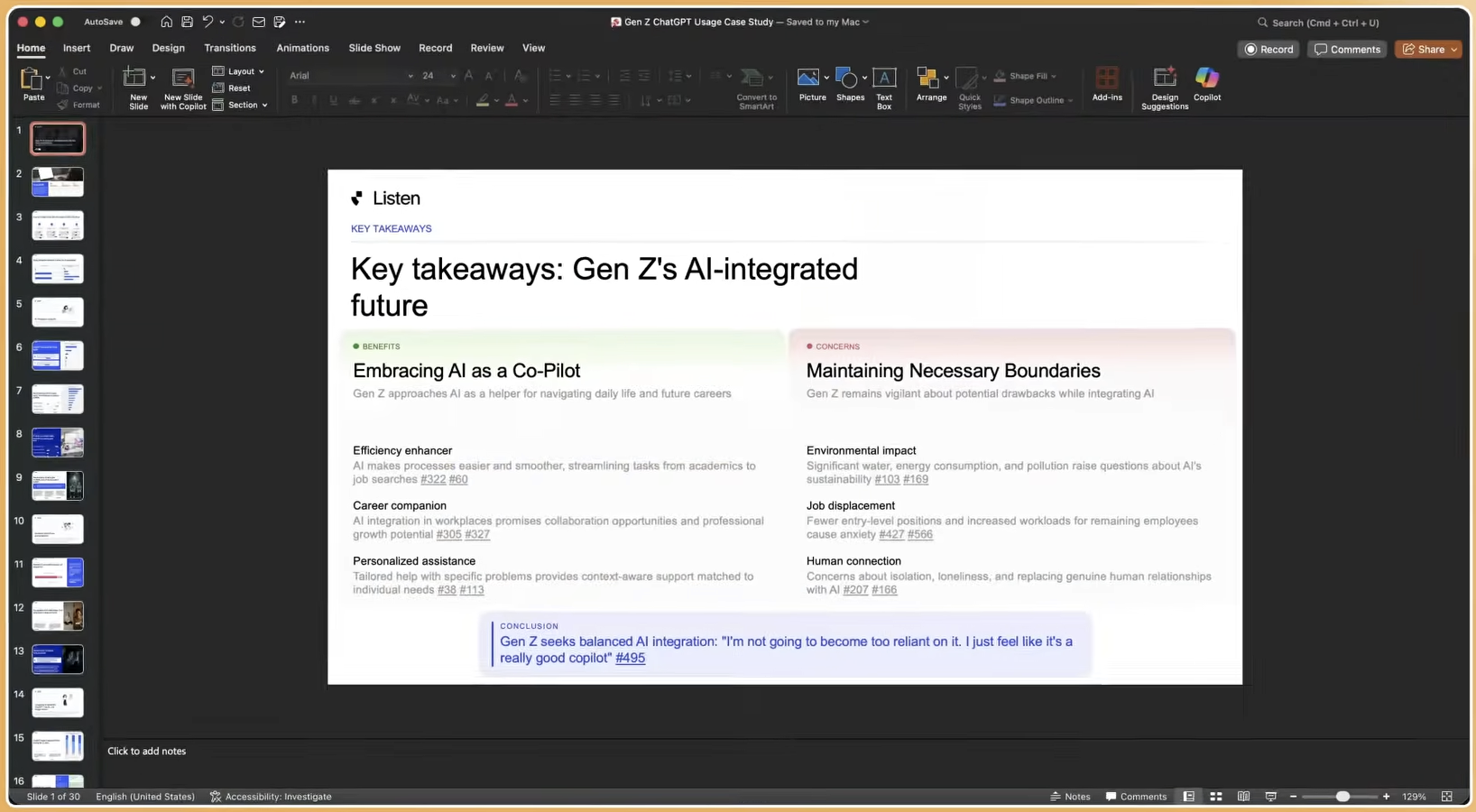
For the apparel line study, the prioritized recommendation set might rank the three positioning concepts by trial intent score, flag the specific language that drove confusion in the lowest-performing concept, and identify the price tier that maximized purchase intent among the primary target segment. Each recommendation should link directly to a verbatim quote or video clip as evidence.
Research Agent handles the full analysis workflow: from raw data to final output, including consultant-quality slide decks, memo-style reports, video highlight reels, and statistical charts, all generated in under a minute. Every insight links back to the underlying response data, so findings can be defended in a debrief without returning to raw transcripts.
Common Challenges and Practical Fixes
Even with a solid 7-step process, research programs can fail when core disciplines break down. Four failure modes recur across retail consumer research programs, and each has a practical fix.
- Unclear objectives: Studies launched without a specific decision to inform produce findings that no one acts on. Fix: require a one-sentence decision statement before approving any study brief.
- Low-quality respondents: Data bias can exclude key segments, and overconfidence in flawed insights can trigger costly strategy errors. Fix: apply the quality controls outlined in Step 4, including behavioral screeners, real-time fraud detection, and participant frequency limits, rather than relying on demographic filters alone.
- Analysis bottlenecks: Manual coding of 100+ interview transcripts can take two to three weeks, erasing the speed advantage of fast fieldwork. The bottleneck comes from sequential processing, with one analyst working through transcripts one at a time. Fix: deploy AI analysis engines that process all responses simultaneously and generate quantified themes with verbatim evidence, collapsing weeks of manual work into minutes.
- Stakeholder misalignment: Findings presented without a clear connection to the original business decision are deprioritized or ignored. Fix: structure deliverables around the decision framework established in Step 1, not around the research methodology.
See how Listen Labs solves these challenges in a single platform that eliminates each of these failure modes.
How to Measure Retail Research Program Success
To determine whether your retail research program is delivering value, track a small set of operational and strategic indicators. These metrics separate high-performing programs from those that consume budget without driving decisions.
- Study cycle time: Measure the time from brief approval to final deliverable. The benchmark for AI-moderated studies is under 24 hours, a stark contrast to the multi-week cycles mentioned earlier.
- Completion rates: Conversational AI interviews complete at roughly four times the rate of equivalent-length surveys, with completion rates of 40–70% versus 5–15% for surveys.
- Consistency of findings: Track whether themes replicate across independent samples drawn from the same population. High consistency indicates methodological rigor.
- Downstream usage: Run quarterly insight audits that review which collected data points actually influenced decisions versus those left unused. Reallocate resources toward collection methods that drive strategic changes.
Short-term validation within 30 days of a study focuses on whether the recommended action was taken. Long-term validation over 90–180 days tracks whether the business outcome matched the research prediction, such as whether the winning positioning concept from the apparel line study produced the projected trial rate at launch.
Live, dialogic feedback methods can shorten the cycle from insight to product change compared with traditional periodic surveys.
Advanced Strategies for Scaling Retail Research
Teams that have mastered the 7-step process can pursue three maturity-level expansions that shift research from project work to a continuous strategic capability.
- Always-on research programs: Instead of running discrete studies, establish a continuous interview cadence tied to product launch calendars and seasonal planning cycles. This approach requires a persistent participant panel, standardized study templates, and a cross-study knowledge repository that surfaces trends over time.
- Global multi-market studies: AI-led interviewing runs hundreds of conversations in parallel across markets and languages, with thematic analysis automatically capturing facial expressions and tone shifts, and every finding linked to original video clips and verbatim quotes. Listen Labs supports 100+ languages and 45+ countries, enabling simultaneous multi-market fieldwork without scheduling constraints.
- Behavioral data integration and emotion analysis: Layering POS, loyalty, and web behavioral data onto qualitative findings produces a richer picture of the gap between what shoppers say and what they do. Across AI-moderated retail shopper interviews, emotional and experiential factors, not stated drivers like price, convenience, or loyalty points, were found to be the true predictors of store switching, basket abandonment, and channel preference. Emotion analysis tools that track micro-expressions, tone of voice, and word choice at the timestamp level surface these signals without relying on self-report.
Organizational maturity for these expansions includes executive sponsorship for always-on budgets, a centralized research operations function, and a data infrastructure that connects behavioral and attitudinal data sources.
Explore enterprise-scale research programs to see how Listen Labs supports always-on retail research at scale.
Frequently Asked Questions
How long does retail consumer research take with modern AI-moderated methods?
A well-scoped AI-moderated retail study, from screener design through final deliverable, can complete in under 24 hours when objectives are defined in advance and the participant panel is pre-qualified. Traditional agency-led qualitative research typically runs 4–6 weeks for the same scope. The primary time variable is screener complexity. Studies targeting audiences below 1% incidence rate, such as shoppers who have purchased a specific private-label category in the past 30 days, require additional recruitment operations time but still complete in days rather than weeks.
How do you protect participant privacy and maintain compliance in retail shopper research?
Compliance requirements for retail consumer research include GDPR for any study involving EU residents, CCPA for California residents, and sector-specific data handling standards where applicable. Listen Labs maintains SOC 2 Type II, GDPR, ISO 27001, ISO 27701, and ISO 42001 certifications. Participant data is encrypted at 256-bit and is never used for AI model training. Informed consent is collected at the start of every interview, and participants retain the right to withdraw. For studies involving sensitive categories, such as health-adjacent apparel or financial wellness products, additional consent language and data minimization protocols apply.
How do you adapt retail research methods for hard-to-reach shopper segments or international markets?
Hard-to-reach segments, such as high-income shoppers, rural consumers, or category-exclusive buyers, require behavioral screeners rather than demographic filters and recruitment operations that extend beyond commodity panels into niche communities and specialized networks. For international markets, the critical adaptations are native-language moderation, culturally localized question framing, and market-specific sampling frames. AI-moderated platforms that support 100+ languages and conduct interviews asynchronously remove the scheduling and time-zone barriers that make multi-market qualitative research operationally difficult. Listen Labs’ dedicated recruitment operations team sources audiences below 1% incidence rate across 45+ countries.
When should a retail research study be repeated or retired?
A study should be repeated when the business context changes materially, such as new competitive entrants, a category pricing shift, a significant change in shopper demographics, or a product reformulation. Tracking studies designed to measure sentiment or awareness over time should run on a fixed cadence, typically quarterly or semi-annually, to enable trend detection. A study should be retired when its findings have been fully acted upon and the underlying decision is no longer live, or when the sample frame no longer reflects the current target shopper. Cross-study knowledge repositories allow teams to query past findings before commissioning new research, preventing redundant studies and building institutional knowledge over time.
What does retail consumer research cost, and how does AI-moderated research compare on cost?
Traditional focus group research often costs $4,000–$12,000 per 90-minute session, with full qualitative programs reaching $25,000 or more when agency fees, recruitment, and analysis are included. AI-moderated retail research on a platform like Listen Labs delivers comparable qualitative depth at a fraction of that cost. Enterprises report running more studies at approximately one-third of the traditional cost. The primary cost variables are audience incidence rate, since harder-to-reach segments require more recruitment effort, and study scope, including number of participants, number of concepts tested, and deliverable format. Listen Labs uses a subscription model with per-participant credit costs that vary by audience difficulty.
Conclusion
Retail consumer research that takes 4–6 weeks to deliver findings is structurally misaligned with the pace of retail decision-making. The 7-step process outlined here, from defining decision-tied objectives through delivering prioritized actions, produces results in hours while maintaining the depth that cross-functional stakeholders trust.
The private-label apparel line example shows that each step becomes a discrete, manageable task when the right infrastructure is in place. The bottleneck comes from a fragmented toolstack that forces teams to stitch together vendors, manage handoffs, and wait for findings that arrive too late to matter.
See the full platform in action, from AI-assisted study design and global participant recruitment to AI-moderated interviews, automated analysis, and consultant-quality deliverables, all in a single platform with same-day turnaround.