Written by: Anish Rao, Head of Growth, Listen Labs | Last updated: June 24, 2026
Key Takeaways
- Market research and competitive analysis work best as one unified workflow that avoids duplicated effort and speeds up decisions.
- The eight-step playbook anchors every study to a single shared decision goal and uses AI-moderated interviews to capture customer needs and competitive perceptions at the same time.
- Emotional Intelligence analysis and real-time Quality Guard surface both verbal feedback and subconscious reactions that traditional methods miss.
- Automated synthesis and one-click deliverables turn raw interview data into prioritized feature, pricing, and messaging recommendations within hours.
- Listen Labs compresses the entire workflow into less than 24 hours, so see the platform in action.
How Competitive Analysis Fits Inside Market Research
Competitive analysis sits inside market research as a focused layer. Market research covers customer needs, segment sizing, trend mapping, and behavioral drivers. Competitive analysis examines how existing players position themselves, where gaps exist, and what whitespace is available. Treating them as separate workstreams creates duplicated effort. Customer interviews conducted for market research contain competitive signal. Competitor positioning data also guides which customer segments to prioritize. A unified workflow captures both at once.
Running Market Research and Competitive Analysis Together
The most efficient approach uses a single eight-step workflow anchored to one shared decision goal. AI-moderated interviews collect customer needs and competitive perception data in the same session. The steps below define inputs, stakeholders, decision points, and timelines for each phase.
Step 1: Define One Shared Decision Goal
Timeline: 2–4 hours
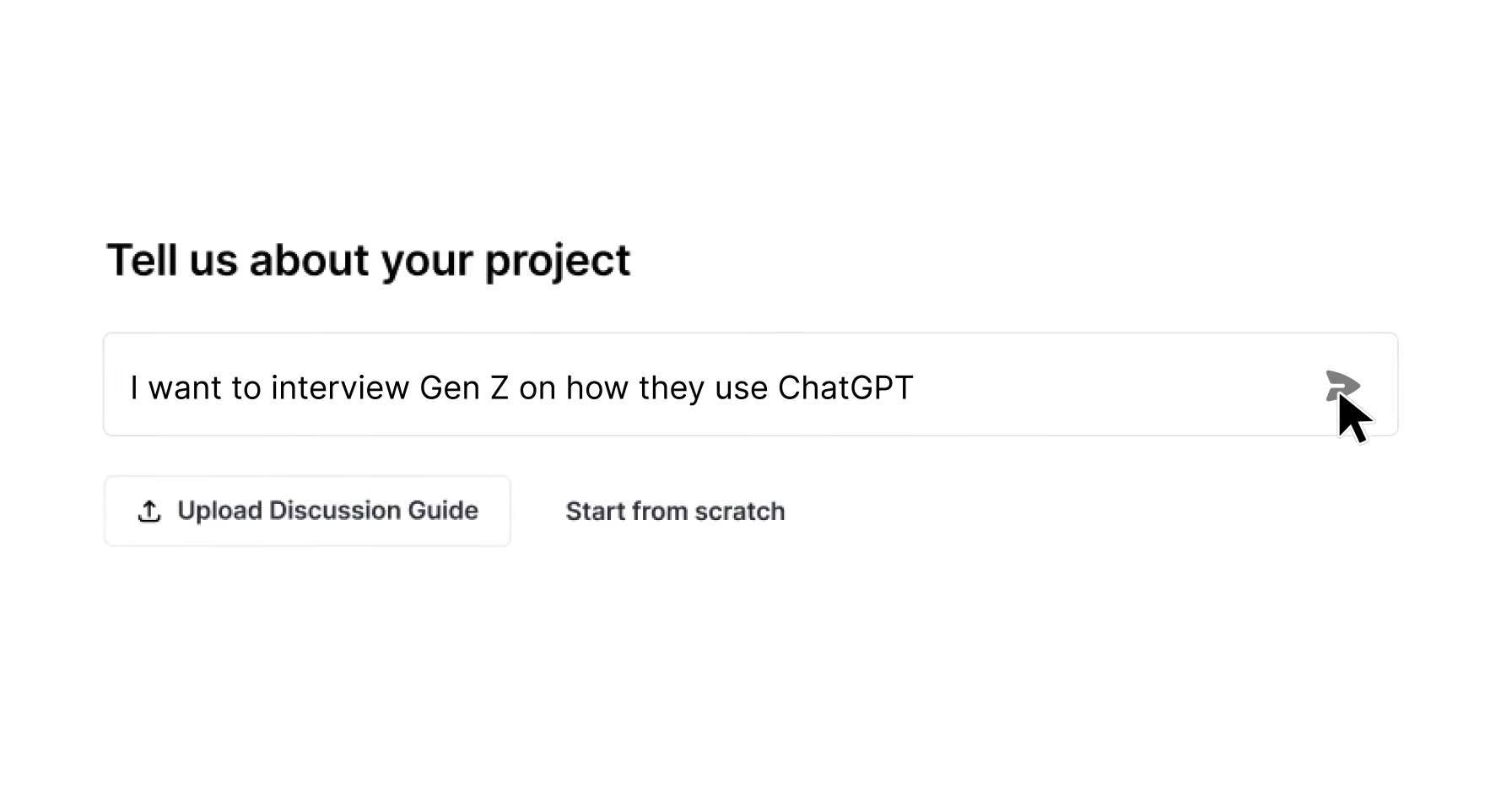
Every integrated study starts with a single, specific decision the business must make, not a general learning objective. Examples include: “Should we reposition our mid-tier plan against Competitor X?” or “Which unmet need in Segment Y justifies a new feature investment?”
- Inputs: Business strategy documents, recent win/loss data, product roadmap priorities
- Stakeholders: Insights lead, product manager or marketing leader, and one executive sponsor
- Decision point: Align on the one question whose answer will change a business action
A vague goal produces unfocused data that cannot drive action. That is why a precise decision goal is essential. It structures every subsequent step and prevents scope creep that extends timelines.
Step 2: Build a Mixed-Methods Sampling Frame
Timeline: 1 day
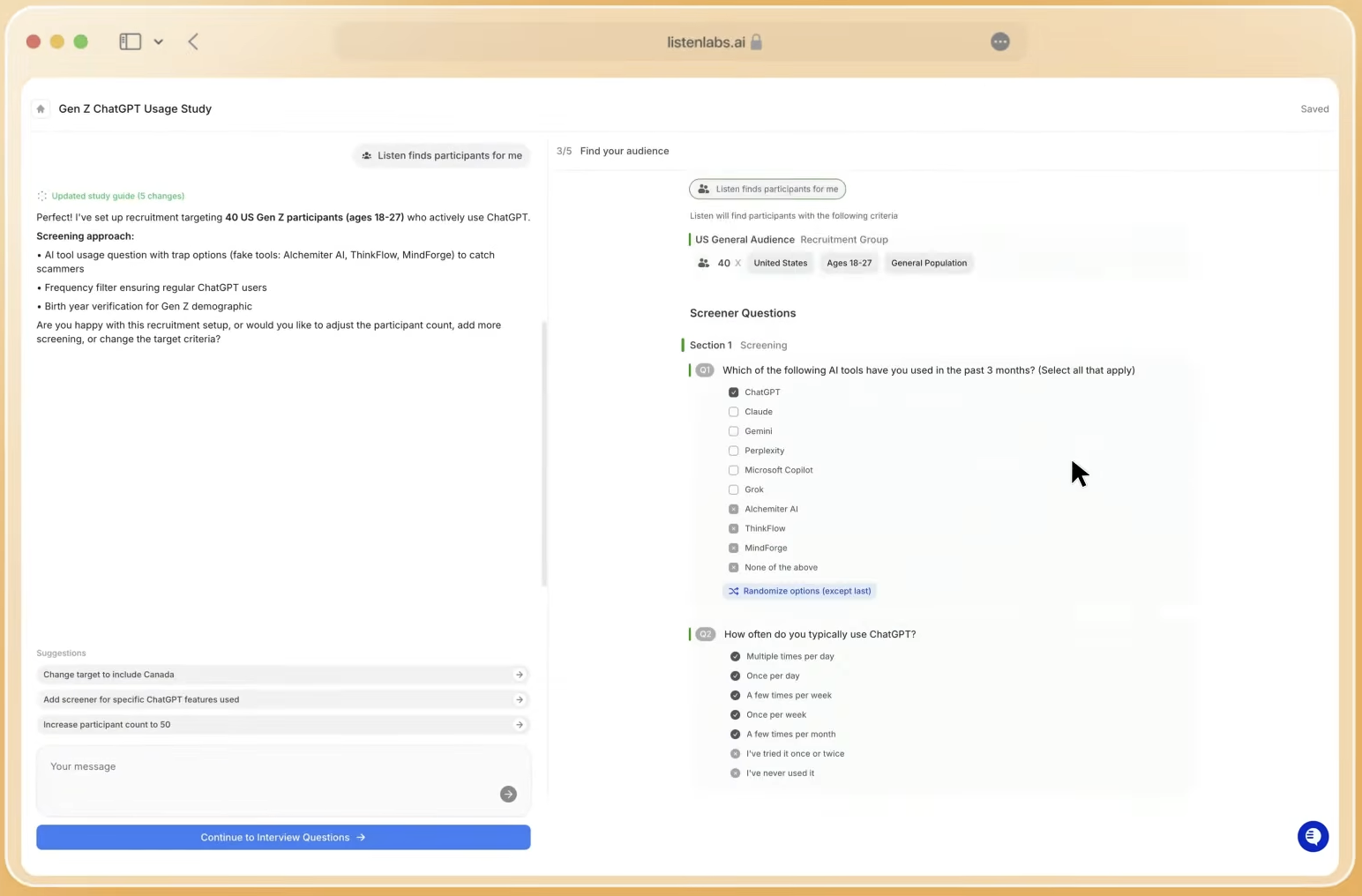
Define who needs to be interviewed and in what proportion. A mixed-methods frame combines a qualitative cohort for depth with a quantitative cohort for validation. Both cohorts come from the same panel to remove source bias.
- Inputs: Decision goal from Step 1, existing customer segments, target competitor user profiles
- Stakeholders: Research lead, recruitment operations
- Trade-off: Larger qualitative samples increase confidence but extend fieldwork. AI-moderated interviews solve this by running hundreds of sessions simultaneously.
Listen Labs’ global panel of 30M verified respondents across 45+ countries lets teams recruit general population and niche audiences, including enterprise decision-makers and healthcare workers, without separate vendor contracts.
Step 3: Map Customer Needs and Market Trends
Timeline: 4–6 hours
Teams document known customer needs and current market trends before fieldwork begins. This work shapes the interview guide and prevents re-researching what is already understood.
- Inputs: CRM data, past research reports, product usage analytics, publicly available trend data
- Stakeholders: Insights lead, product manager, brand or marketing lead
- Trade-off: Thorough desk research improves interview quality but consumes time. Prioritize sources that directly relate to the decision goal.
This step produces a needs-and-trends brief that feeds directly into the interview guide design in Step 5.
Step 4: Identify Competitor Positioning and Whitespace
Timeline: 4–6 hours
Teams map how direct and adjacent competitors position their products across the dimensions most relevant to the decision goal. These dimensions often include price tier, feature emphasis, audience targeting, and messaging tone.
- Inputs: Competitor websites, pricing pages, review platforms, sales team win/loss notes
- Stakeholders: Insights lead, product marketing, competitive intelligence function
- Decision point: Identify two to four positioning dimensions to test in interviews
The output is a market-vs-competitor matrix, a prose-described grid where rows represent customer need dimensions (for example, ease of onboarding, pricing transparency, integration depth) and columns represent your brand and up to three competitors. Each cell contains a positioning descriptor, such as “premium, complex” or “low-cost, limited,” drawn from public evidence. This matrix becomes the stimulus material for Step 5 interviews and lets participants react to real positioning language rather than hypothetical prompts.
Step 5: Run AI-Moderated Interviews at Scale
Timeline: 1 day
With the matrix prepared, teams are ready to collect the core data. AI-moderated interviews combine the qualitative depth of one-on-one conversations with the scale of quantitative surveys by running hundreds of sessions simultaneously.
- Inputs: Needs-and-trends brief from Step 3, market-vs-competitor matrix from Step 4, approved interview guide
- Stakeholders: Research lead monitors fieldwork, with no moderator scheduling required
In 2026, AI-moderated interviews capture three layers of signal that traditional methods miss. Listen Labs’ Emotional Intelligence feature analyzes tone of voice, word choice, and subconscious micro-expressions, built on Ekman’s universal emotions framework, to surface emotions including confusion, trust, and delight at the exact timestamp where they occur. What participants say and what they feel function as different data points. A competitor’s pricing page may receive a positive verbal rating while simultaneously triggering a disgust micro-expression. Capturing both signals produces positioning intelligence that verbal-only methods cannot match.
Each interview includes dynamic follow-up questions, Likert scales, and concept-reaction prompts drawn from the matrix built in Step 4. Quality Guard monitors every session in real time for fraud, low-effort responses, and mismatched profiles.
Step 6: Synthesize Findings with Prioritization Matrices
Timeline: 4 hours
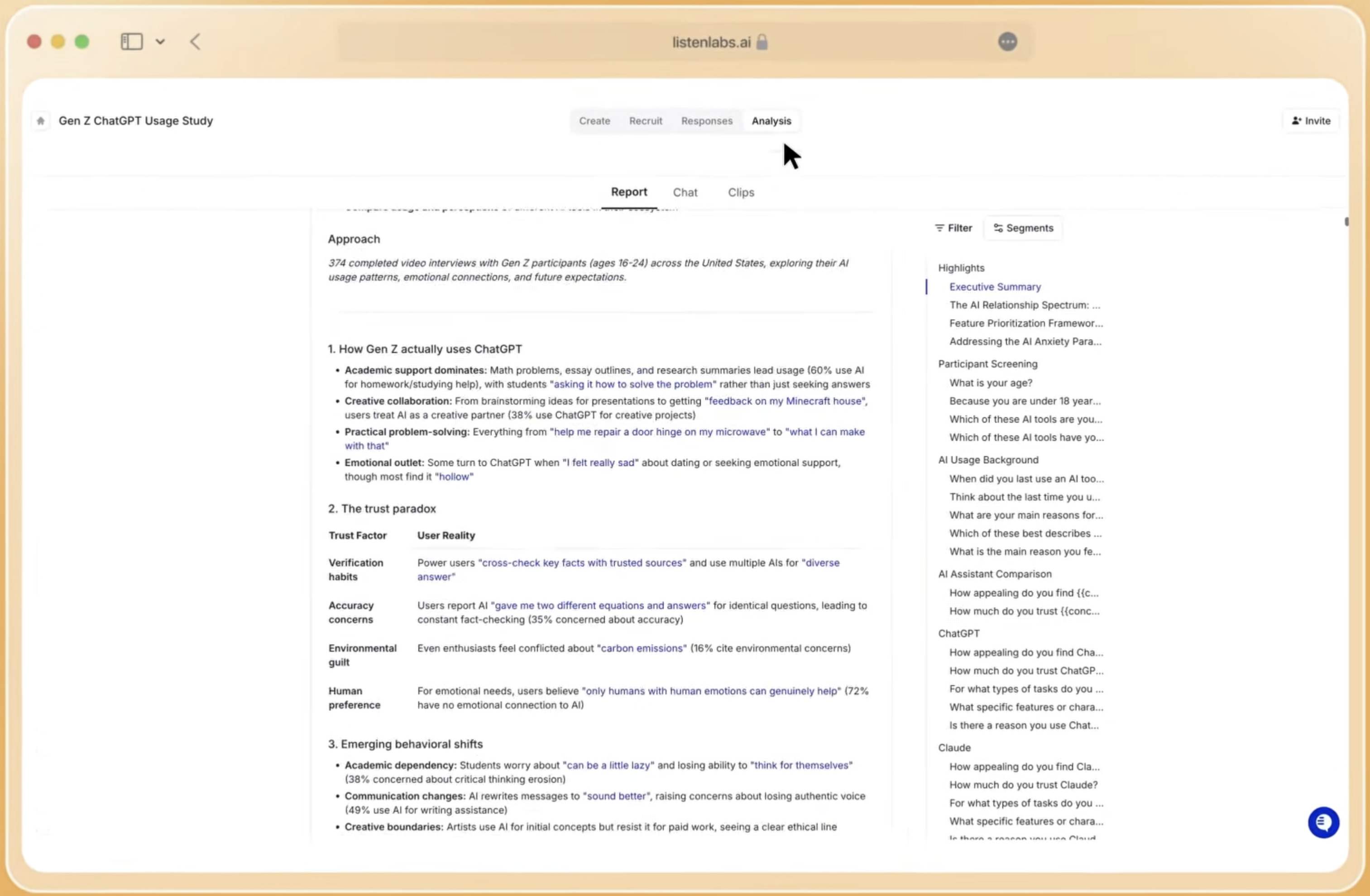
AI analysis processes all interview data at once. It identifies themes, emotional patterns, and competitive perception gaps across every response without human confirmation bias.
- Inputs: Completed interview recordings, transcripts, and emotional signal data
- Stakeholders: Insights lead, research analyst
Listen Labs’ Research Agent generates automated key findings, theme clusters, segmentation breakdowns, and statistical comparisons. With these outputs in hand, teams then apply a prioritization matrix, ranking unmet needs by frequency of mention and emotional intensity. This ranking highlights which gaps represent the highest-value opportunities relative to competitor whitespace identified in Step 4.
Step 7: Turn Insights into Feature, Pricing, or Messaging Decisions
Timeline: 2–4 hours
Synthesis outputs flow directly into three decision categories. Teams use them for feature prioritization, pricing positioning, and messaging hierarchy.
- Inputs: Prioritization matrix from Step 6, market-vs-competitor matrix from Step 4
- Stakeholders: Product manager, brand or marketing lead, pricing lead, executive sponsor
- Decision point: Select one feature, pricing, or messaging action to activate within the current planning cycle
One-click deliverables from the Research Agent, including slide decks, memos, and video highlight reels, give stakeholders evidence-backed recommendations without extra report-writing time.
Step 8: Keep Insight-to-Action Loops Running
Timeline: Ongoing cadence
A single integrated study creates more value when it feeds a continuous intelligence program instead of a one-off report.
- Inputs: Decisions made in Step 7, updated competitive landscape, new product releases
- Stakeholders: Insights lead, product and marketing leadership
Mission Control stores every study’s findings as a searchable knowledge base and enables cross-study queries and trend tracking over time. Teams can answer follow-up questions from past research in seconds instead of commissioning new studies. Repeat the eight-step cycle when a new decision goal emerges, a competitor makes a significant move, or market conditions shift in a material way.
Watch the eight-step workflow in action inside Listen Labs.
Common Challenges and How to Fix Them
Stakeholder misalignment on the decision goal is the most common failure point. When Step 1 produces multiple competing goals, the study design fragments and no single finding is actionable. Teams can prevent this by requiring one named executive sponsor to approve the decision goal before fieldwork begins.
Sampling frame drift occurs when recruitment targets shift mid-study and segments become incomparable. Lock the sampling frame before launching interviews and use quota controls to enforce it.
Emotional signal misinterpretation can appear when emotional data is reviewed without the matching verbatim and timestamp context. Always trace every emotional label back to the specific moment and quote that generated it before drawing conclusions.
Measuring Success of the Integrated Workflow
Three metrics show whether the integrated workflow is working. First, time to decision should fall between 1 and 2 days from study launch to a documented business decision, not weeks. Second, decision confidence should be high, and stakeholders should cite specific participant evidence for each positioning, pricing, or feature choice. Third, study reuse rate should rise as Mission Control is queried for past findings before new studies are commissioned, which means institutional knowledge is compounding instead of being lost.
Advanced Use Cases and Iteration Strategy
Multi-market studies work best when localization happens at the interview level, not just through translation of a single guide. Listen Labs supports 100+ languages for interview moderation with automatic translation and transcription. This capability lets teams test the same decision goal across geographies at the same time without separate fieldwork cycles.
For hard-to-reach audiences, such as enterprise decision-makers, healthcare workers, or consumers below 1% incidence rate, dedicated recruitment operations partner with niche communities and specialized networks. These partnerships source participants that commodity panels cannot reach.
Iteration cadence should match competitive velocity. In fast-moving categories, a quarterly integrated cycle fits the pace of change. In stable categories, semi-annual cycles with continuous Mission Control monitoring of emerging themes often suffice.
How the 5 Classic Competitive Analysis Steps Map Here
Traditional competitive analysis frameworks describe five steps: identify competitors, gather positioning data, assess strengths and weaknesses, map whitespace, and document findings. In the integrated eight-step playbook above, these five steps spread across Steps 1, 4, 5, 6, and 7. They sit inside the broader market research workflow instead of running as a separate project. This integration removes the reconciliation work that appears when competitive findings and customer research findings arrive from different workstreams at different times.
Frequently Asked Questions
How long does an integrated market research and competitive analysis study take?
With AI-moderated interviews and automated analysis, Listen Labs completes the full research cycle from goal definition to actionable deliverables in hours, not weeks. Traditional approaches that run the two workstreams separately often take several weeks.
Do I need a dedicated research team to run this workflow?
No. Product managers and marketing leaders without formal research training can execute the workflow using AI-assisted study design, which translates natural-language research goals into structured interview guides automatically. A research lead adds methodological rigor but is not required for every study. The platform handles recruitment, moderation, and analysis regardless of the user’s research background.
How do I handle privacy and data security when collecting customer and competitive perception data?
Participant data should be collected under informed consent with clear disclosure of how recordings and transcripts will be used. Listen Labs maintains SOC 2 Type II, GDPR, ISO 27001, ISO 27701, and ISO 42001 certifications, and customer data is never used for AI model training. For studies involving sensitive competitive topics, anonymize participant identifiers in deliverables shared beyond the core research team.
When should I repeat or retire an integrated study?
Repeat the study when a competitor makes a significant pricing or positioning change, when your organization launches a new product or enters a new segment, or when Mission Control trend tracking shows a material shift in customer sentiment. Retire a recurring study when the decision it was designed to inform has been made and the competitive landscape in that dimension has stabilized. Avoid running studies on autopilot without a live decision goal attached.
How do I adapt this workflow for international or multi-market research?
Run the sampling frame design in Step 2 with market-specific quotas and recruit participants natively in each target language. Use an interview platform that moderates in the participant’s language and translates findings automatically, rather than translating a single English guide and back-translating responses. Emotional signal analysis should be validated across cultural contexts. The Ekman universal emotions framework provides a cross-cultural baseline, but regional nuance in expression intensity should be noted during synthesis in Step 6.
Schedule your demo to run your first integrated market research and competitive analysis study with Listen Labs.