
Written by: Anish Rao, Head of Growth, Listen Labs | Last updated: June 28, 2026
Key Takeaways
-
Beta testing is the final external validation step, not a complete product testing strategy on its own.
-
A five-stage testing lifecycle surfaces risks earlier and at far lower cost than discovering issues during beta.
-
Skipping early discovery, concept, or prototype validation creates expensive fixes, displaced roadmaps, and reputational damage.
-
Listen Labs supports continuous validation across all pre-beta stages with AI-moderated interviews, Emotional Intelligence analysis, and automated reporting.
-
See how Listen Labs compresses your entire product testing lifecycle into a fast, always-on research program that prevents late-stage surprises.
The 5-Stage Product Testing Lifecycle in Practice
The five-stage product testing lifecycle clarifies where beta testing fits and what each earlier stage must accomplish. Each stage has a specific goal, a recommended research method, and a clear risk if skipped.
Stage 1 (Discovery) identifies unmet needs and real customer problems before any solution is defined. To surface these insights, teams should conduct AI-moderated in-depth interviews with 30–50 participants for directional discovery. Without this foundation, teams risk building a solution to a problem that does not exist or is not painful enough to drive adoption.
Stage 2 (Concept Validation) pressure-tests two to four solution concepts against real customer needs before committing to build. Teams should run AI-moderated concept tests with 100 or more participants for statistical validity, using monadic or sequential stimuli. Skipping this step means investing engineering resources in a concept customers will not pay for or use.
Stage 3 (Prototype Testing) evaluates usability, flow, and desirability of a working prototype before full development. Teams should run moderated usability sessions with screen sharing, using 5–10 participants for usability issues and 50 or more for broader pattern detection. Ignoring this stage locks in UX debt that becomes structurally expensive to reverse after the build.
Stage 4 (Alpha / Internal Testing) validates functional completeness and internal stability before any external exposure. Internal QA, dogfooding, and structured employee feedback sessions work together to confirm readiness. Skipping alpha exposes external users to unstable builds, which damages trust and skews feedback.
Stage 5 (Beta / External Testing) confirms real-world reliability, security, and scalability with a controlled external audience before general availability. Teams typically use open or closed beta, structured feedback collection, and production traffic diversion to gather this signal. Skipping beta risks releasing a product with undetected scalability, security, or real-network failures.
AI-moderated interviews enable teams to reach sample sizes of n=50 to n=500 for generative discovery, concept validation, and churn research, compared to the n=5 threshold at which the marginal value of additional usability participants drops sharply according to Nielsen Norman Group. That scale makes continuous validation across stages one through three economically viable for the first time.
How the Four Technical Testing Levels Relate
The five-stage product testing lifecycle focuses on customer and market validation. Software teams also use a parallel technical testing framework with four levels: unit testing, integration testing, system testing, and acceptance testing.
Unit testing verifies individual components in isolation. Integration testing confirms that combined components interact correctly. System testing evaluates the complete, integrated product against specified requirements. Acceptance testing, which includes both alpha and beta phases, validates the product against real user needs and real-world conditions before release.
Beta testing sits inside acceptance testing as the external-facing subset. It becomes the fourth and final technical testing level, not a comprehensive strategy on its own.
QA Testing vs. Beta Testing: How They Work Together
Quality assurance testing is an internal, controlled process executed by dedicated QA engineers or automated test suites against predefined pass or fail criteria. It occurs before any external user touches the product. Beta testing requires that alpha testing must be completed and formally approved, a stable beta version must be ready, the deployment environment prepared for real users, and tools available to collect feedback before it can begin. In other words, QA is a prerequisite for beta, not a substitute.
QA catches defects against specification. Beta testing surfaces how real users behave in real environments on actual hardware and networks, conditions that lab or staging environments cannot fully replicate.
When Late Feedback Becomes Expensive
Feedback that arrives only at beta often costs far more than feedback gathered during discovery, concept, or prototype testing. Fixing a fundamental positioning flaw, unmet need, or broken user flow at beta means reworking code, delaying roadmap items, and absorbing reputational damage from external users who encounter a broken experience.
As noted earlier, shifting validation to stage one or two, using the 48-hour discovery capability described above, keeps the cost of a wrong turn at the brief level instead of the build level. Beta testing requires dedicated resources to maintain a parallel production environment and to recruit, communicate with, and analyze feedback from testers. Those costs compound when critical issues force an extended beta cycle or a delayed launch.
When to Use Closed Beta, Open Beta, or Skip Beta
Beta testing is not mandatory for every release. The choice between closed beta, open beta, or no beta depends on product maturity, audience risk, infrastructure complexity, and strategic timing.
Run a closed beta when the product is new, the audience is unknown, and real-world reliability data is essential. Exclusive beta invitations are more relevant for new products than subsequent releases because they can attract early-adopting influencers to generate buzz and anticipation ahead of general availability.
Run an open beta when the product is stable, the team needs broad signal across diverse user types, and the infrastructure can absorb unpredictable load. Open beta makes the product available to anyone with messaging indicating it is in beta and a feedback mechanism in place.
Skip beta when all of the following are true. Earlier-stage validation across stages one through three has already resolved the core usability and desirability questions. The release is an incremental update to a well-understood product. QA and alpha testing have confirmed functional stability. The team has a rapid post-launch monitoring and rollback capability. Beta testing can delay product release if critical issues are found, and feedback quality varies depending on users’ experience, which creates disproportionate risk for low-stakes incremental releases where earlier validation has already done the heavy lifting.
How Listen Labs Powers Every Pre-Beta Stage
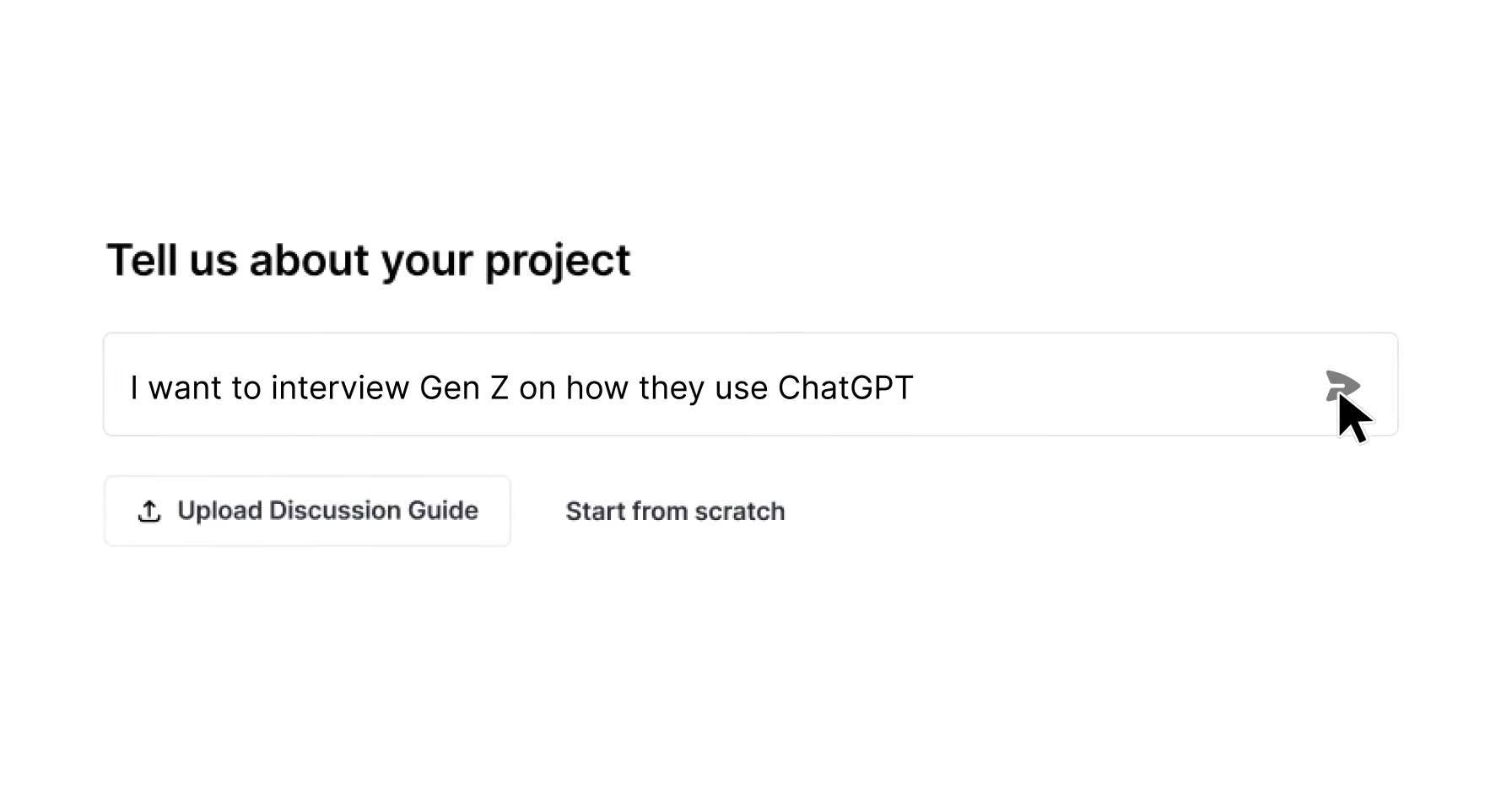
Most teams default to beta because it is the only structured validation step they have the infrastructure to run. Listen Labs changes that pattern by supplying research infrastructure for every stage before beta at a speed and cost that make continuous validation realistic.
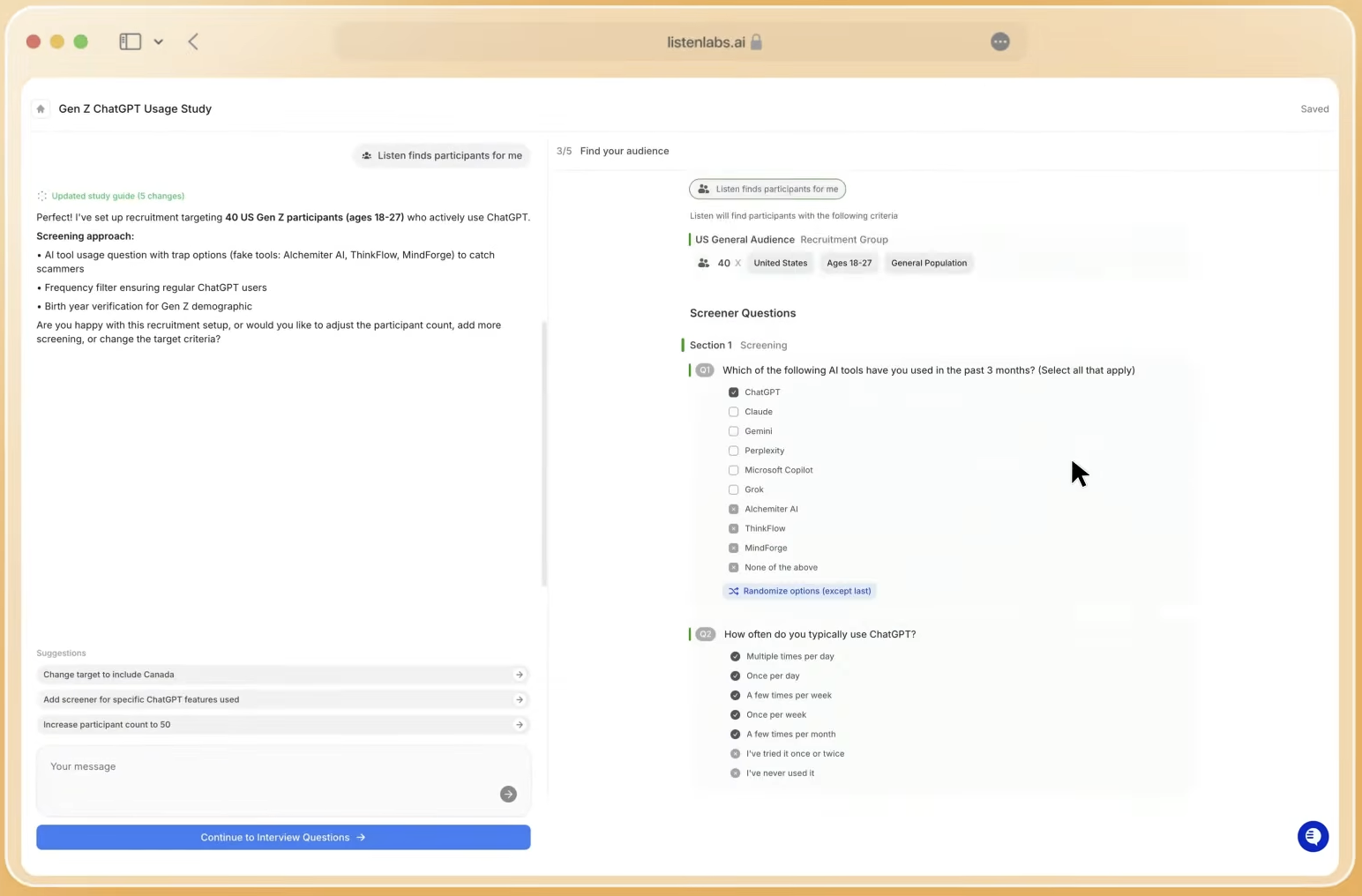
At stages one and two, Listen Labs’ AI-moderated interviews draw from a global panel of 30 million verified respondents across more than 45 countries and over 100 languages. The AI conducts personalized, adaptive conversations with dynamic follow-up questions, delivering the depth of a one-on-one interview at the scale of a quantitative survey. Teams should route high-volume recurring research to AI moderators to reduce late-stage beta risk, while reserving human moderation for inflection points such as new market entry.
At stage three, Emotional Intelligence adds a layer of signal that transcripts alone miss. Built on Ekman’s universal emotions framework, it analyzes tone of voice, word choice, and subconscious micro-expressions to quantify emotions such as anger, trust, confusion, and delight at the timestamp level across every prototype test. Two concepts may both receive positive verbal ratings. Emotional Intelligence reveals which one triggered genuine enthusiasm and which produced polite indifference.
Across all stages, the Research Agent converts raw interview data into consultant-quality slide decks, memos, highlight reels, and statistical charts in under a minute. Mission Control stores every study as a growing institutional knowledge base, so teams stop re-researching questions they have already answered. Together, these capabilities create a single platform that replaces separate recruitment vendors, moderation tools, transcription services, and analysis software, without adding headcount.
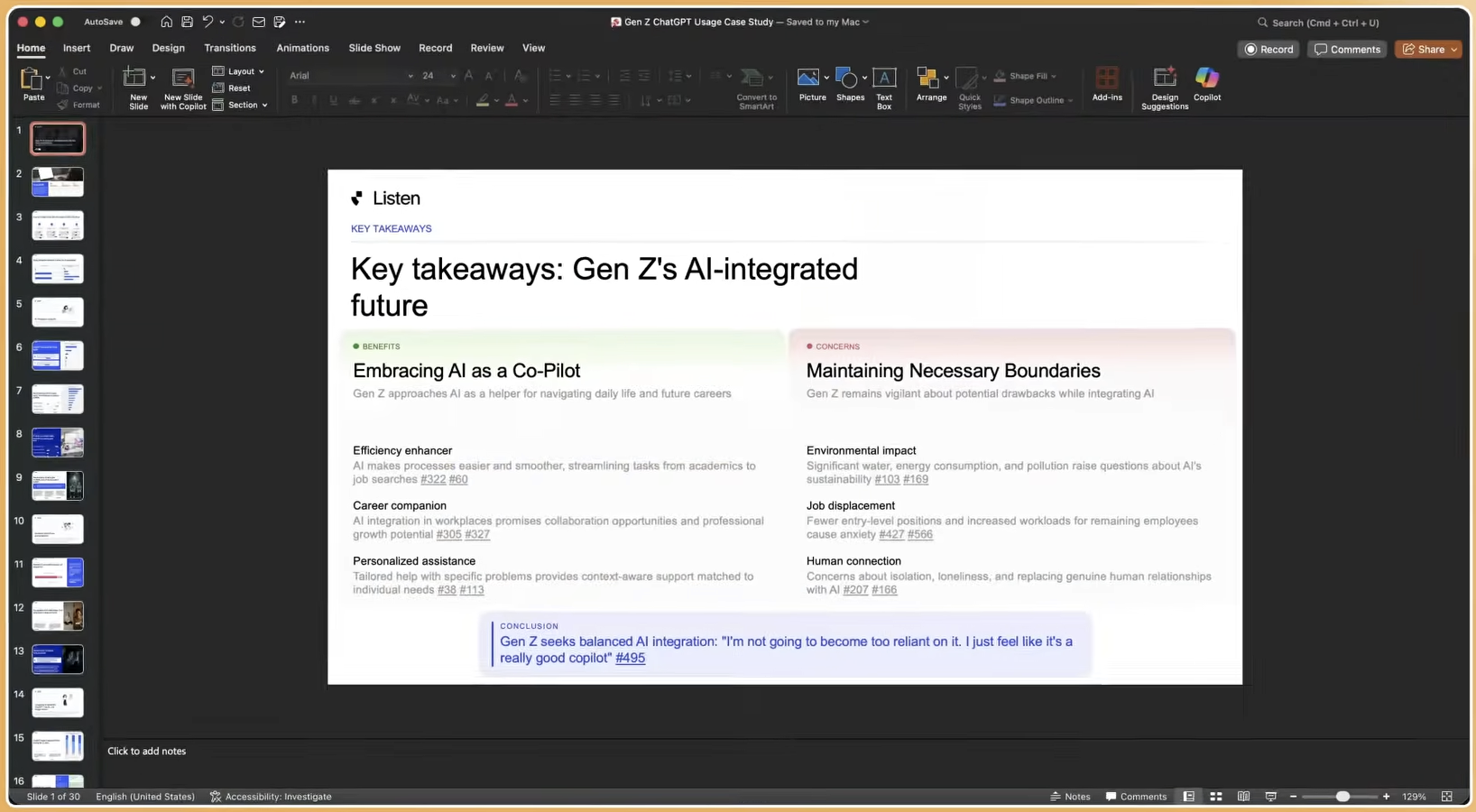
Enterprises including Microsoft, Procter & Gamble, Anthropic, and Skims use Listen Labs to run research that previously took four to six weeks in less than 24 hours. Explore a tailored walkthrough to see how the platform maps to your specific testing lifecycle.
Frequently Asked Questions
How quickly can Listen Labs return results compared to a traditional beta cycle?
Listen Labs compresses the full research cycle, from study design and participant recruitment through AI-moderated interviews, analysis, and deliverables, to less than 24 hours. A traditional beta cycle requires building and maintaining a parallel production environment, recruiting and onboarding testers, collecting and triaging feedback, and resolving issues before re-testing. That process routinely takes weeks. For earlier-stage validation such as discovery, concept testing, and prototype testing, Listen Labs removes the need for a beta cycle to answer questions that could have been resolved in 48 hours at stage one or two.
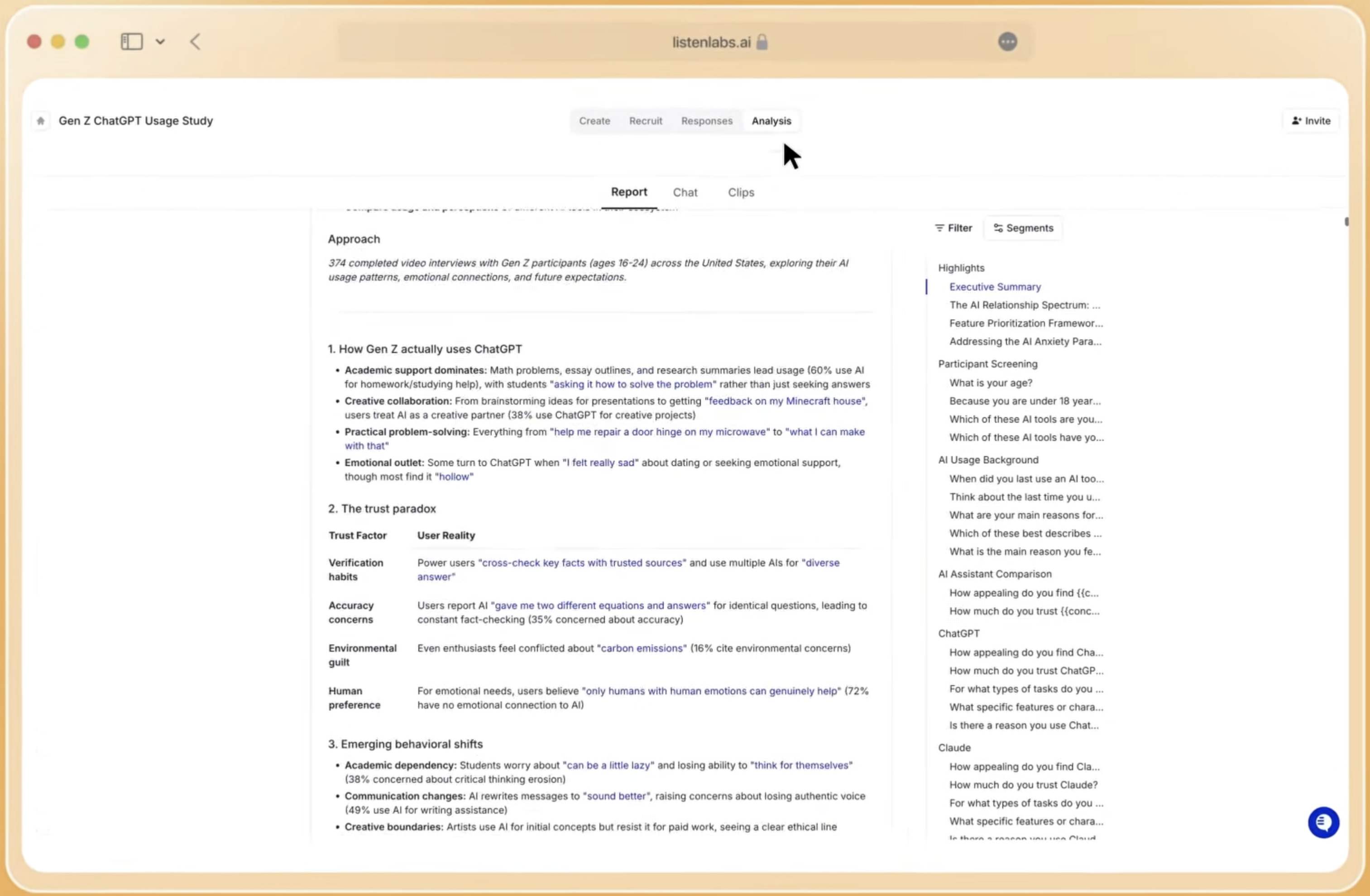
How does Listen Labs ensure participant quality across a 30-million-person panel?
Three layers of protection operate simultaneously. First, Listen Labs works exclusively with high-quality, non-commodity panel sources, avoiding professional survey-takers. Second, Quality Guard applies real-time AI monitoring across video, voice, content, and device signals to detect fraud, low-effort responses, AI-generated scripts, and mismatched profiles. Third, a dedicated recruitment operations team adds a human review layer, and participants are capped at three studies per month to eliminate panel fatigue. For hard-to-reach audiences such as enterprise decision-makers, healthcare workers, or consumers below 1% incidence rate, the recruitment operations team partners with niche communities and specialized networks.
When should a team use open versus closed beta, and when is it appropriate to skip beta entirely?
The key is matching beta scope to validation needs. Teams use closed beta for controlled signal from known or carefully selected segments. They use open beta for broad, diverse signal when the product is already stable. They skip beta when earlier validation has already answered the core questions and remaining risk is low. See the “When to Use Closed Beta, Open Beta, or Skip Beta” section above for detailed criteria.
Can Listen Labs support research across all five stages of the product testing lifecycle?
Yes. Listen Labs supports discovery interviews, concept and prototype testing, usability studies with screen sharing, creative testing, brand perception research, and multi-market segmentation studies. The platform handles both one-off studies and ongoing research programs. Study types include free-flowing in-depth interviews, semi-structured interviews, survey-style questionnaires, diaries, ethnography, and task-based UX testing. Advanced stimuli options such as images, video, audio, PDFs, prototypes, and live URLs support testing at every stage from early concept through near-final prototype.
Decision Checklist: Choose the Right Testing Approach
The five-stage lifecycle translates into seven practical scenarios, because stage five splits into closed beta, open beta, or skipping beta entirely depending on risk and maturity.
Use AI-moderated discovery interviews (Stage 1) when the problem space is undefined, the team is debating which customer need to solve, or there is no existing product data to draw from. Target n=30 for directional signal and n=50 per segment for segment-level analysis.
Use AI-moderated concept testing (Stage 2) when two or more solution directions exist and the team needs to identify which solves a real customer problem before committing engineering resources. Target n=100 or more for statistical validity.
Use prototype testing with Emotional Intelligence (Stage 3) when a working prototype exists and the team needs to identify friction, confusion, and delight at the interaction level, including signals participants do not verbalize.
Use alpha / internal testing (Stage 4) when the build is functionally complete and the team needs to confirm stability before any external exposure. This stage acts as a prerequisite for beta, not a substitute for earlier-stage customer validation.
Use closed beta (Stage 5) when stages one through four are complete, the product is new, and real-world reliability data on actual hardware and networks is required before general availability.
Use open beta (Stage 5) when the product is stable, broad external signal is needed, and the infrastructure can absorb unpredictable load.
Skip beta when earlier validation, incremental scope, and strong monitoring make external testing redundant, as outlined in the criteria above.
The teams that consistently ship successful products validate the right questions at the right stage, so beta becomes a final confirmation instead of a first attempt at understanding their customers. Listen Labs supplies the infrastructure to make that possible at enterprise scale, in any market, in any language, in less than 24 hours.
Map Listen Labs to your product testing lifecycle and see how continuous validation replaces late-stage risk.