
Written by: Anish Rao, Head of Growth, Listen Labs
Key Takeaways for Startup Research Teams
- Traditional surveys and panel recruiters force startups into a trade-off between speed, depth, and cost, which often leaves founders without reliable customer insights before runway runs out.
- Free keyword and trend tools deliver fast secondary signals but provide zero primary customer voice or emotional context behind purchasing decisions.
- Basic panel recruiters solve sourcing but leave moderation, transcription, and analysis as manual burdens that stretch timelines to weeks and exceed most seed budgets.
- This comparison evaluates whether any single platform can meet all seven criteria at once or whether startups still need a fragmented stack.
- Startups ready to replace weeks of fragmented research with hundreds of in-depth customer conversations overnight can see the platform in action today.
Seven Criteria Used to Compare AI Interview Tools
Seven criteria structure every comparison below. Research speed measures the time from study launch to actionable findings. Depth versus scale captures whether a tool surfaces nuanced motivations or only surface-level patterns, and how many participants it can reach simultaneously. Participant quality and fraud protection covers how respondents are sourced, verified, and monitored for low-effort or fraudulent behavior. Total cost includes platform fees, recruitment, moderation, transcription, and analysis, not just the headline subscription price. Ease of use for non-researchers reflects whether a founder or product manager can run a study without methodology training. Language and geographic reach determines whether a tool can access customers in the markets that matter. Actionable deliverables measures whether the platform produces ready-to-use outputs such as slide decks, highlight reels, and theme summaries, or raw data that still requires significant analyst time.
Against this framework, the article evaluates four tool categories in order of increasing sophistication, starting with the platforms most founders try first.
Traditional Survey Tools for Fast, Shallow Feedback
SurveyMonkey, Typeform, and Qualtrics are the default starting point for many early-stage teams because they are fast to deploy and familiar. Against the seven criteria, they perform well on speed, since a survey can go live in hours, and on ease of use for straightforward question sets. Cost is low at the entry tier, although Qualtrics enterprise licensing is substantial.
The main weaknesses appear on depth, participant quality, and deliverables, and these weaknesses compound each other. Surveys capture responses to pre-set questions with no ability to probe an unexpected answer or follow a thread that the researcher did not anticipate. That structural constraint means surveys consistently miss the motivations, emotional context, and unarticulated needs that drive real purchasing decisions. This depth problem then combines with panel quality issues on commodity survey platforms, where professional survey-takers optimizing for incentives inflate response counts without adding signal. Analysis and reporting remain entirely manual, since the platform delivers a spreadsheet, not a conclusion. Geographic and language reach is adequate for English-language markets but narrows quickly for multilingual or emerging-market studies.
Free Keyword and Trend Platforms for Directional Signals
Google Trends, Google Keyword Planner, and SimilarWeb are zero-cost and return data within seconds, which scores them highly on speed and cost. For a founder trying to size a category, understand seasonal demand patterns, or benchmark a competitor’s traffic, these tools provide useful secondary signals.
Against the remaining five criteria, they score near zero. None of these platforms provide access to primary customer voice. They cannot tell a founder why a search trend is rising, what emotional associations a product category carries, or whether a specific value proposition resonates with a target segment. Depth is absent by design. Participant quality is not a relevant concept because there are no participants. Deliverables are raw data exports that require separate interpretation. For pre-idea validation where a founder needs directional signals quickly, these tools are a reasonable first step, but they cannot replace a single customer conversation.
Basic Panel Recruiters for Sourcing Only
Prolific, User Interviews, and Respondent improve meaningfully on participant sourcing compared to commodity survey panels. Prolific in particular has built a reputation for academic-grade respondent quality through attention checks and demographic verification. User Interviews and Respondent specialize in recruiting screened professionals and consumers for moderated sessions.
The gap appears immediately after recruitment and affects every later step. All three platforms stop at sourcing, so the buyer must separately schedule sessions, moderate interviews, transcribe recordings, and analyze findings. That fragmented workflow reintroduces the time and cost that recruitment alone cannot solve. A study requiring 20 moderated interviews still takes one to three weeks end-to-end when moderation, transcription, and analysis are factored in. Fraud and repeat-respondent risk, while lower than commodity panels, persists without real-time behavioral monitoring. Deliverables are entirely the buyer’s responsibility. Geographic reach is reasonable for North America and Western Europe but thinner for APAC, MEA, and Latin America. For a solo founder without a research operations background, the operational burden of stitching these steps together is a significant barrier.
AI-Moderated Interview Platforms with End-to-End Workflows
Listen Labs represents the emerging category of AI-moderated interview platforms that handle the entire research lifecycle. The company has run over one million AI-powered customer interviews for companies including Microsoft, Perplexity, and Sweetgreen. These studies compress a process that traditionally takes four to six weeks into less than 24 hours.
On research speed, Listen Labs collapses the traditional multi-week timeline by automating recruitment, moderation, and analysis in parallel rather than sequence. Platforms like Listen Labs layer on auto-recruiting, transcription, sentiment tagging, and insight summarization so teams jump from question to findings in hours, not weeks. On depth versus scale, the AI moderator conducts adaptive video interviews, probing short answers, following unexpected threads, and adjusting in real time, while running hundreds of sessions simultaneously. AI can schedule and conduct the interview, analyze the transcripts for themes, and generate quantitative insights from those interviews. This approach narrows the historical gap between qualitative and quantitative methods.
Participant quality is protected by three coordinated layers that work as a system. Listen Atlas, a global network of 30 million verified respondents across 45+ countries, uses behavioral and intent matching rather than self-reported demographics. Quality Guard monitors every interview in real time for fraud, AI-generated scripts, and mismatched profiles. A cap of three studies per month per participant removes professional survey-takers from the pool. Switching to Listen Labs AI-moderated interviews let Chubbies capture hundreds of candid, one-to-one conversations overnight, without a separate moderation or transcription budget.
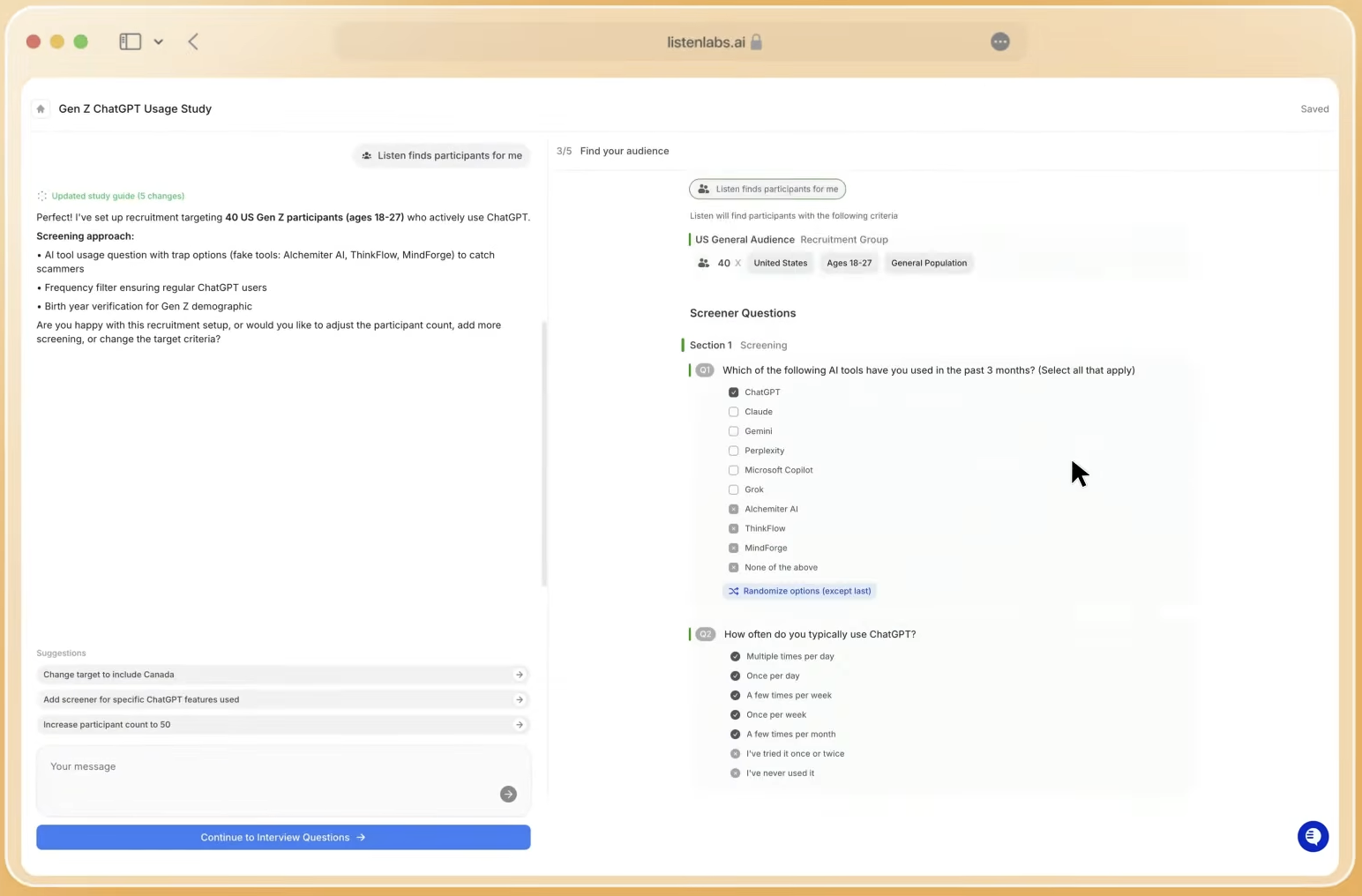
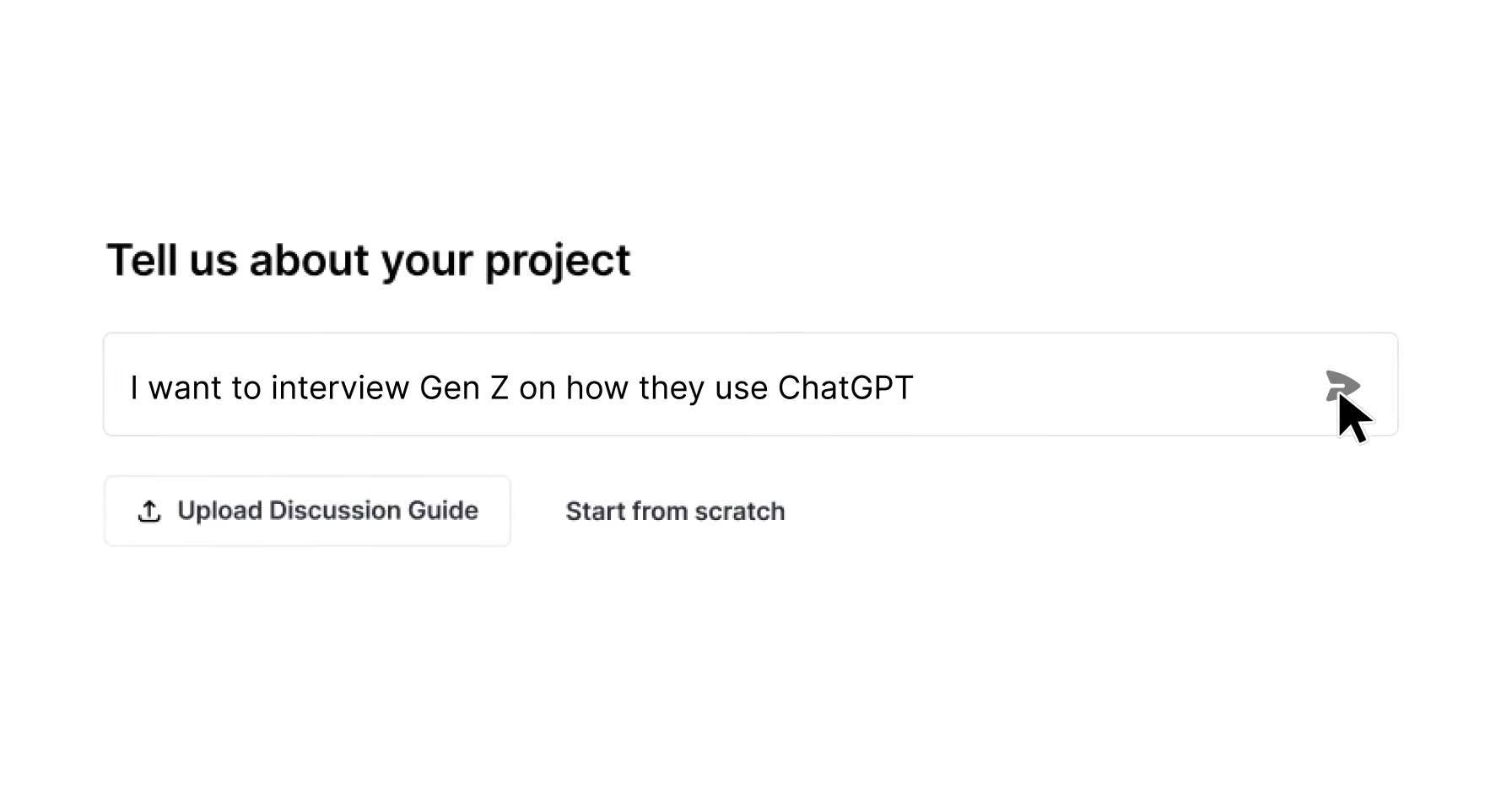
On cost, Listen Labs replaces the fees of a recruiter, moderator, transcription service, and analyst with a single platform subscription. This structure delivers results at a fraction of traditional agency cost. As Listen Labs CEO Alfred Wahlforss stated, companies use it for all kinds of large decisions, and this AI interviewer means that teams can have hundreds of one-on-one interviews run at scale. Ease of use is addressed through AI-assisted study design, where a founder describes research goals in natural language and the platform drafts structured objectives, questions, and probing context automatically. Language and geographic reach covers 100+ languages and 45+ countries. Deliverables such as slide decks, memo-style reports, video highlight reels, and statistical charts are generated by the Research Agent in under a minute, so teams do not need additional analyst headcount.
Listen Labs also includes Emotional Intelligence analysis, which examines tone of voice, word choice, and facial micro-expressions to surface emotions that transcripts alone miss. Built on Ekman’s universal emotions framework, every emotional label is traceable to the exact timestamp and verbatim quote that generated it, which gives founders evidence rather than assertions. See how emotional intelligence analysis works in practice.
Survey Versus Interview Trade-Off for Startup Teams
Early-stage founders often wonder whether a well-designed survey or a general-purpose LLM can substitute for dedicated qualitative research tooling. The answer depends on what the research question actually requires.
Surveys work well when the hypothesis is already formed and the goal is to measure prevalence across a large sample. They do not generate the hypothesis in the first place. General-purpose LLMs can assist with study guide drafting and basic thematic coding, but they lack the proprietary data from tens of thousands of completed studies that informs Listen Labs’ question design, methodology selection, and signal-from-noise separation. Neither surveys nor LLMs conduct adaptive conversations, capture emotional signals, or source verified participants. Qualitative data methods make up for their smaller sample sizes tenfold in their ability to uncover nuance and complexity in human decision-making, and Listen Labs combines that depth with the sample sizes that give statistical confidence.
Choosing Tools by Startup Stage
At the pre-idea validation stage, a founder’s primary need is directional signal at near-zero cost. Free keyword and trend platforms provide category-level demand data quickly. A small number of unmoderated interviews via a basic panel recruiter can add qualitative texture, although the operational overhead is real for a solo operator.
At pre-seed discovery, the research question shifts to understanding specific customer motivations, pain points, and decision criteria. This is where survey tools begin to show their structural limits, because the questions a founder knows to ask are rarely the questions that surface the most valuable insight. AI-moderated interview platforms address this gap by enabling adaptive probing at scale, with verified participants and automated analysis, at a cost accessible to pre-seed budgets.
At seed-stage concept testing, the stakes rise. A founder needs to test specific value propositions, messaging, or product directions with enough participants to distinguish signal from noise, and needs results fast enough to inform a fundraise or a go-to-market decision. Qual-at-scale is ideal when research requires large sample sizes or broad geographic reach, as AI tools can engage hundreds or thousands of participants remotely and asynchronously. At this stage, the cost of a wrong decision exceeds the cost of a proper research platform by a wide margin.
Operational Requirements for Research at Scale
Data security and compliance are non-negotiable for any startup handling customer data, particularly in regulated industries or markets with strong privacy law. Listen Labs holds SOC 2 Type II, GDPR, ISO 27001, ISO 27701, and ISO 42001 certifications, with 256-bit encryption and a policy of never using customer data for AI model training. Enterprise SSO is supported for teams that require it.
Institutional knowledge compounds over time. Mission Control, Listen Labs’ cross-study knowledge base, stores every finding from every study and makes it queryable in natural language. For a startup running multiple research cycles across a funding journey, this structure means later studies build on earlier ones rather than starting from scratch. That approach reduces redundant research spend and accelerates the speed at which the team develops genuine customer understanding.
Decision Framework for Founders
A founder choosing between these tool categories should start with three core considerations. First, the team must define how much time is available before the insight needs to inform a decision. If the answer is days rather than weeks, only AI-moderated interview platforms and free secondary tools can meet that constraint. Second, the team must decide whether the research question requires understanding why customers behave a certain way or only measuring how many do. If the answer is why, surveys and trend platforms are structurally inadequate. Third, the team must assess whether there is internal capacity to handle recruitment, moderation, transcription, and analysis as separate workstreams. If the answer is no, which is the reality for most early-stage teams, a fragmented stack of panel recruiters and survey tools will stall before delivering usable findings. The tool that scores highest across all seven criteria for a resource-constrained founder is the one that handles the entire lifecycle without requiring a research operations background to operate.
Frequently Asked Questions
How fast can I get results from Listen Labs?
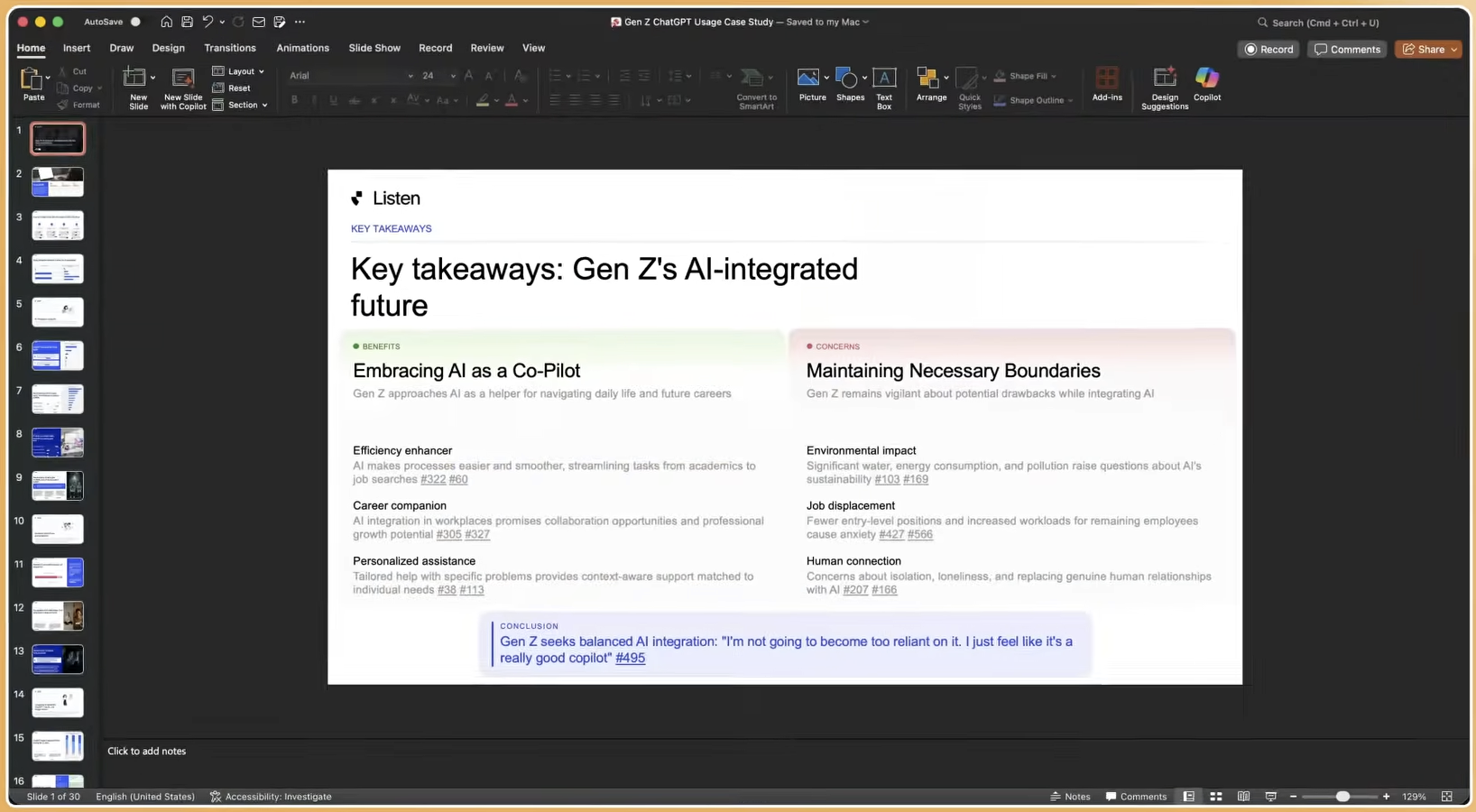
Listen Labs compresses the entire research lifecycle, including study design, participant recruitment, AI-moderated interviews, analysis, and deliverable generation, into a single overnight workflow. Traditional qualitative research agencies typically require four to six weeks for the same output. The Research Agent generates slide decks, memo-style reports, video highlight reels, and statistical charts in under a minute once interviews are complete. For time-sensitive decisions like fundraise preparation or pre-launch concept testing, this turnaround creates a structural speed advantage over every other tool category in this comparison.
How does Listen Labs ensure participant quality?
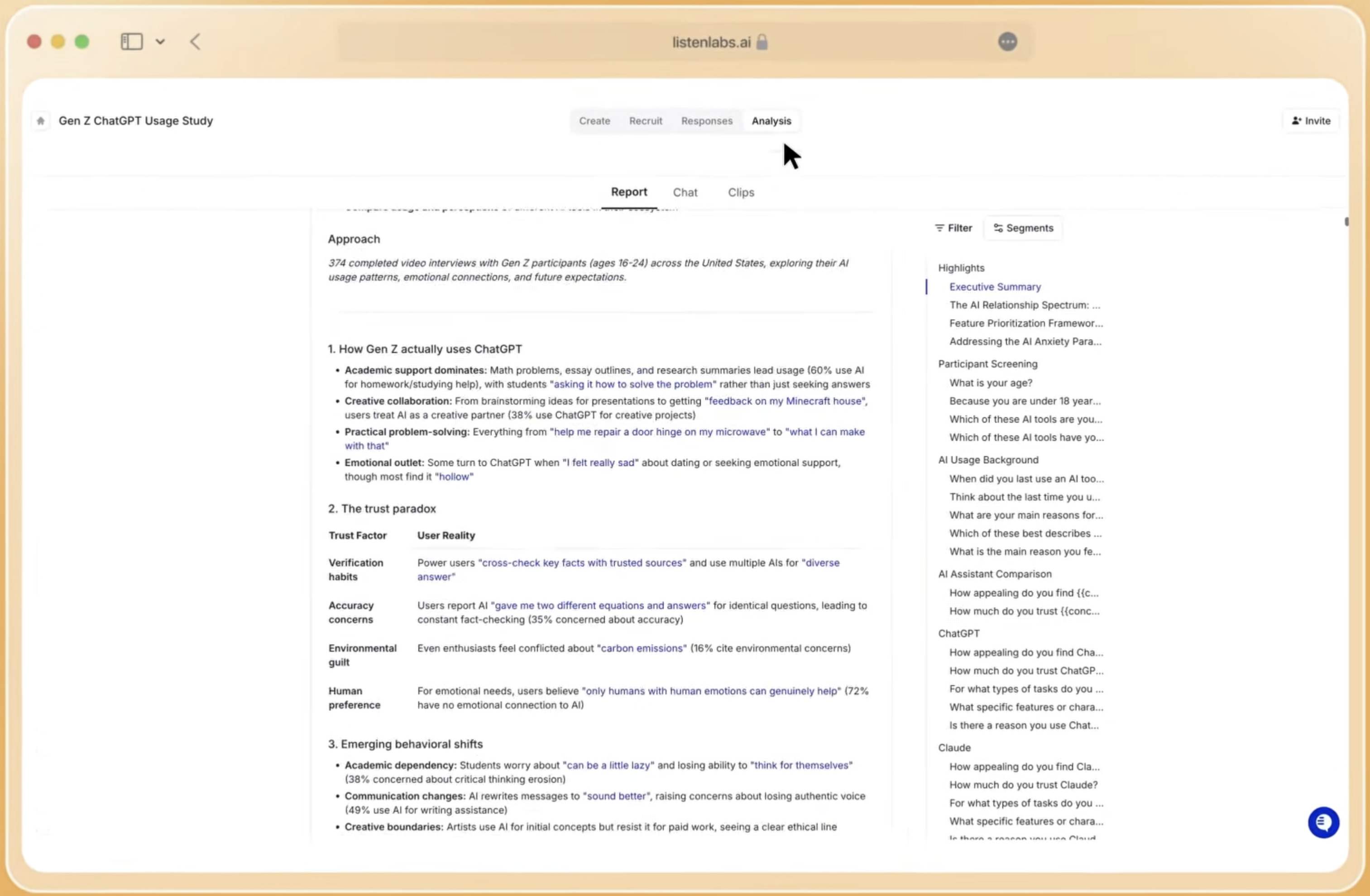
Listen Labs applies three layers of quality control that work together. Listen Atlas, the platform’s global recruitment infrastructure, matches participants using behavioral and intent data rather than self-reported demographics, drawing from a network of 30 million verified respondents across 45+ countries. Quality Guard monitors every interview in real time, using video, voice, content, and device signals to detect fraud, AI-generated responses, low-effort answers, and mismatched profiles. Participants are limited to three studies per month, which eliminates the professional survey-taker problem that undermines commodity panels. A dedicated recruitment operations team adds a human review layer for hard-to-reach segments, including enterprise decision-makers, healthcare workers, and audiences below one percent incidence rate.
What does Listen Labs actually cost for early-stage teams?
Listen Labs uses a subscription model with per-participant credits. Platform access includes a set number of studies and credits, and credit cost varies by audience difficulty, with general population studies requiring fewer credits than niche or hard-to-reach segments. Companies with fewer than 100 employees can access a self-serve tier directly. Relative to the alternative, a research agency engagement that can run into the tens of thousands of dollars for a single study, Listen Labs delivers results at a fraction of the cost while replacing the fees of a recruiter, moderator, transcription service, and analyst simultaneously. The most accurate cost comparison is total research spend per actionable insight, not headline subscription price.
Which languages and countries does Listen Labs support?
Listen Labs supports interviews in 100+ languages with automatic translation and transcription across all supported languages. The participant network spans 45+ countries across the Americas, Europe, APAC, and MEA. Emotional Intelligence analysis is available across 50+ languages. For startups validating product-market fit in multiple geographies simultaneously, or testing localized messaging before a market entry, this reach removes the need to source separate regional research vendors for each market.
Can non-researchers run studies on Listen Labs without extra headcount?
Yes. The platform is designed for product managers, brand managers, and founders who do not have a research methodology background. AI-assisted study co-design allows a user to describe research goals in natural language, and the platform drafts structured objectives, questions, and probing context automatically. Auto-QA flags issues in the study guide before launch. The Research Agent handles analysis and deliverable generation without requiring manual coding or report writing. A solo founder can move from a research question to a consultant-quality slide deck without hiring a researcher, a moderator, or an analyst.
Conclusion: Which Research Stack Serves Startups Best?
The tool categories reviewed here each address a subset of what early-stage customer research actually requires. Survey tools scale but sacrifice depth. Free trend platforms provide secondary signals but no customer voice. Panel recruiters solve sourcing but not moderation or analysis. AI-moderated interview platforms, and Listen Labs specifically, are the only category that meets all seven evaluation criteria simultaneously. They move fast enough for startup timelines, surface motivations in depth, protect against participant fraud, stay affordable relative to agency alternatives, remain operable without a research background, reach customers globally, and produce ready-to-use deliverables without additional headcount.
For a founder who needs to turn weeks of scattered research work into hundreds of in-depth customer conversations delivered overnight, Listen Labs provides a single platform built for that reality.