
Written by: Anish Rao, Head of Growth, Listen Labs
Key Takeaways for First-Time Qual Research
- Non-researchers need tools that handle the full research lifecycle without methodology training or weeks of manual work.
- Traditional QDA software demands setup, separate recruitment, and manual coding that can stretch timelines to four-to-eight weeks.
- Free LLMs offer quick transcript summaries but leave recruitment, moderation, and data-quality controls entirely to the user.
- Dedicated AI interview platforms that integrate sourcing, moderation, and automated analysis deliver results in 24 to 72 hours with a short learning curve.
- Listen Labs stands out by managing the entire workflow, from global participant sourcing to consultant-quality deliverables, in under 24 hours; see the full workflow in action.
How This Guide Evaluates Beginner-Friendly Tools
Beginner-friendly tools reduce setup effort, shorten timelines, and keep research steps connected in one workflow. The criteria below apply consistently across all three categories assessed in this article. For non-researchers, research speed and learning curve usually matter most, because a tool that needs weeks of training fails even if its analysis is strong. The remaining criteria help compare tools that clear that bar but differ in quality, cost, and operational complexity.
- Research speed: Time from initial question to usable results.
- Depth of insight: Whether the tool surfaces nuanced, open-ended findings or only surface-level responses.
- Participant sourcing effort: How much manual work is required to find and recruit qualified respondents.
- Learning curve: Whether the tool requires methodology training, software certification, or coding knowledge.
- Cost for a first study: Licensing, panel fees, and hidden operational costs.
- Language and geographic reach: Ability to conduct research across markets and languages.
- Analysis effort: Whether themes and findings are generated automatically or require manual coding.
- Deliverable quality: The format and usability of outputs for stakeholder communication.
Traditional QDA Tools for Trained Researchers
Study setup requirements. Traditional QDA software such as NVivo, Atlas.ti, MAXQDA, and QualCoder requires either a paid license or open-source installation before any analysis can begin, with most paid vendors offering student discounts but no free general access. Setup alone, including downloading software, configuring a project, and importing data, can consume hours before a first-time user touches a single transcript.
Recruitment and sampling approach. Traditional QDA tools act only as analysis environments. Recruitment remains entirely the user's responsibility and requires separate panel vendors, scheduling tools, and consent management workflows. The software provides no built-in sourcing mechanism.
Moderation method. Users must conduct interviews externally through video conferencing, in-person sessions, or third-party platforms, then import files afterward. Many traditional QDA programs require PDFs to be converted into plain text before analysis, and documents with complex formatting often lose structure during import. These technical steps add friction before analysis even begins.
Data quality controls. Quality assurance remains entirely manual. The tools provide no automated fraud detection, response quality scoring, or participant verification mechanisms.
Qualitative depth. When trained researchers use them correctly, traditional QDA tools support rigorous thematic analysis, grounded theory, and discourse analysis. For beginners without methodology training, the depth of output depends heavily on the quality and consistency of the manual coding applied.
Analysis workflow. Manual coding is the default workflow. Atlas.ti Desktop, MAXQDA, and NVivo require researchers to export and merge project files after separate work sessions rather than supporting real-time collaboration on shared data. Evaluating new product claims from interviews across multiple markets can require several weeks of manual coding.
Reporting transparency. Outputs take the form of researcher-generated documents. The software does not create auto-generated slide decks, highlight reels, or executive summaries. Report quality depends entirely on the analyst's skill and available time.
Dedicated AI Interview Platforms for End-to-End Studies
Study setup requirements. Most dedicated AI interview platforms provide guided study design interfaces that reduce the technical barrier significantly. Research democratization expands in 2026 as AI reduces barriers to conducting basic studies, allowing product managers and designers to run simple research without researcher involvement. Many platforms still expect users to source participants separately through third-party recruitment vendors before using the platform's interview capabilities, which reintroduces complexity for beginners.
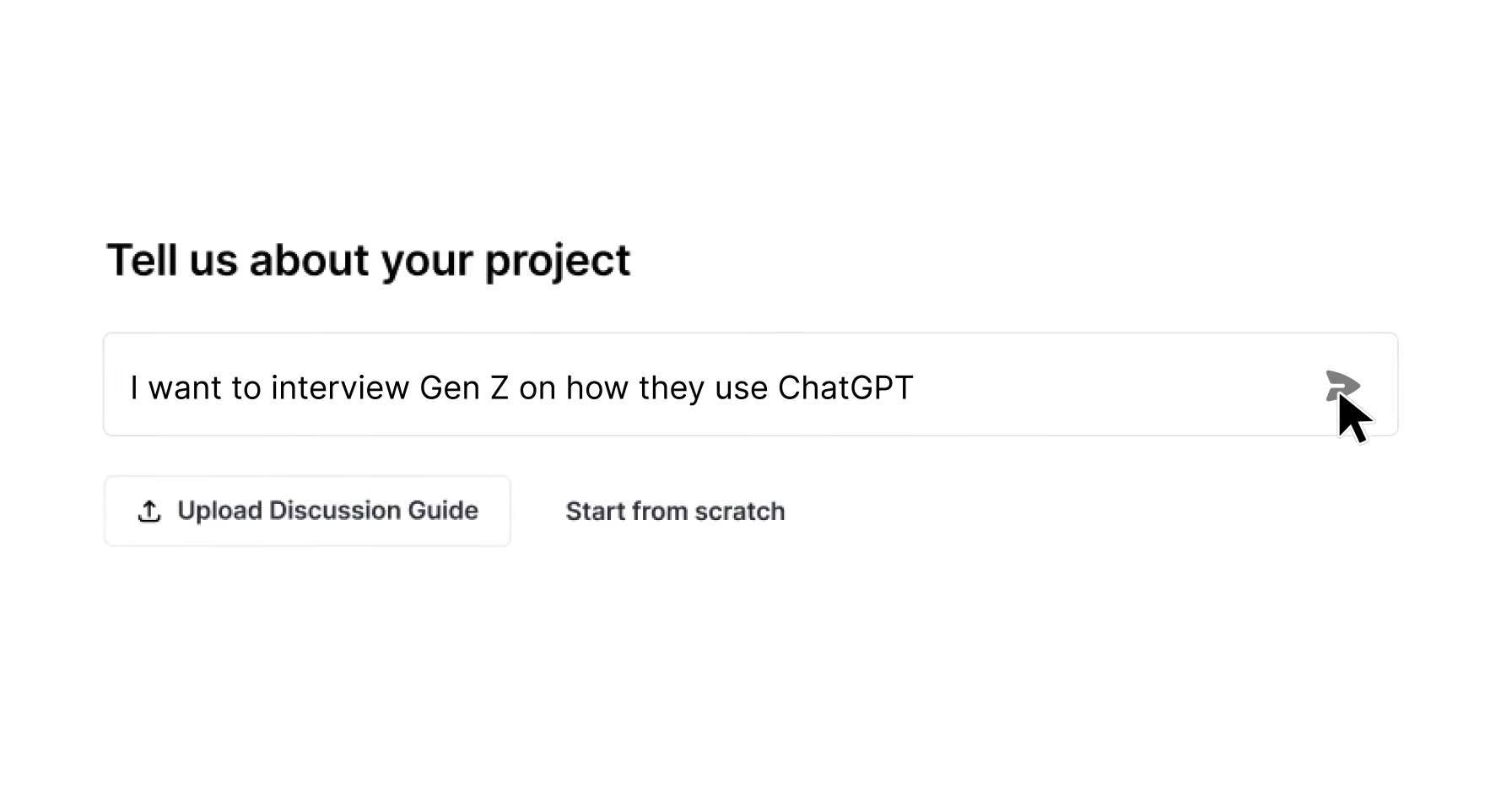
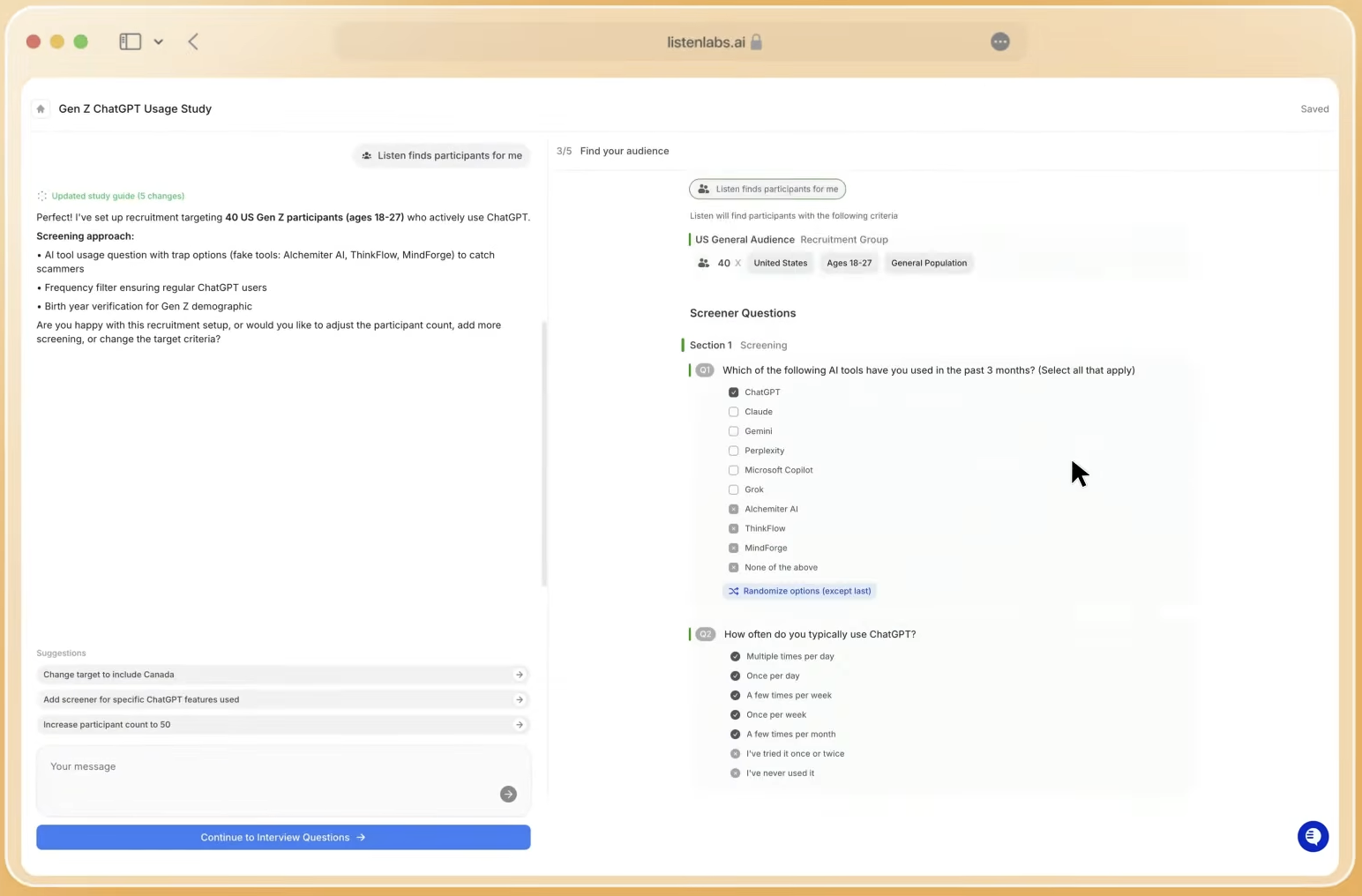
Recruitment and sampling approach. Recruitment design creates the biggest gap between platforms in this category. Several tools require a separate recruitment step, often through Prolific, User Interviews, or similar panel providers, which brings back the fragmented workflow that beginners want to avoid. Listen Labs integrates participant sourcing directly from a global network of 30M verified respondents across 45+ countries and 100+ languages, using an AI orchestration layer that matches across multiple panel partners and its proprietary database.
Moderation method. AI-moderated platforms conduct interviews autonomously with dynamic follow-up questions that adapt to participant responses. AI can schedule and conduct the interview, analyze the transcripts for themes, and generate quantitative insights from those interviews. Listen Labs' AI moderator probes short or interesting answers the way a trained human interviewer would and captures video, audio, and text responses simultaneously.
Data quality controls. Quality controls vary widely across platforms and directly affect the reliability of findings. Listen Labs operates a three-layer system: behavioral matching on intent signals rather than self-reported demographics, real-time Quality Guard monitoring across video, voice, content, and device signals, and a participant frequency cap of three studies per month to eliminate professional survey-takers.
Qualitative depth. With qual-at-scale, the old trade-off between depth and scale is no longer a barrier. AI-moderated platforms can conduct hundreds of personalized conversations simultaneously, each with adaptive follow-up questions that surface unexpected findings. Traditional QDA workflows cannot match this combination of volume and personalization.
Analysis workflow. Platforms like Listen Labs layer on auto-recruiting, transcription, sentiment tagging, and insight summarization so teams move from question to findings in hours, not weeks. The Research Agent generates automated key findings, themes, segmentations, and deliverables from natural-language queries without any manual coding.
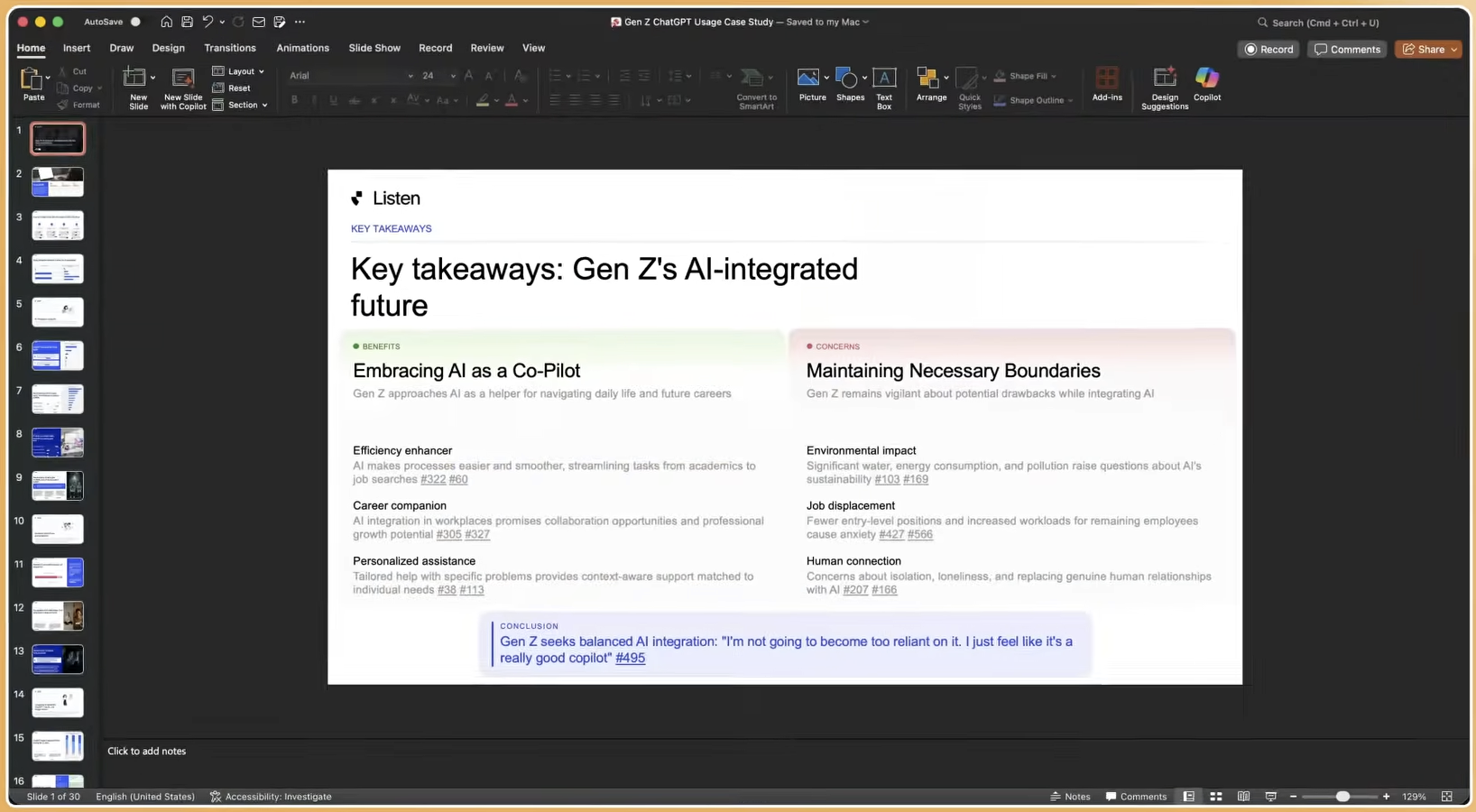
Reporting transparency. Listen Labs delivers consultant-quality slide decks, memo-style reports, video highlight reels, and statistical charts generated in under a minute. Every emotional signal and theme is traceable to the exact timestamp and verbatim quote that produced it. See how this traceability works in a live walkthrough from study design to final deliverable.
Free LLM Starters for Transcript Summaries
Study setup requirements. General-purpose LLMs such as ChatGPT and NotebookLM require no installation and no license fee, which makes them accessible to anyone with a browser. Study design assistance, including drafting discussion guides and generating question sets, becomes available immediately.
Recruitment and sampling approach. Free LLMs provide no built-in recruitment capability. Users must source, screen, schedule, and compensate participants entirely on their own, which remains the most time-intensive part of any qualitative study and the most common point of failure for beginners.
Moderation method. LLMs do not conduct interviews. Users must record and transcribe conversations externally, then upload transcripts manually for analysis. There is no real-time adaptive moderation, no dynamic follow-up questioning, and no video capture, so the richness of the conversation depends entirely on the human moderator.
Data quality controls. These tools provide no participant verification mechanisms, fraud detection systems, or response quality filters. The user remains fully responsible for assessing data integrity before uploading anything for analysis.
Qualitative depth. LLM analysis of uploaded transcripts can identify surface-level themes and summarize content effectively. The quality of analysis stays bounded by the quality of the data uploaded, so weak recruitment or inconsistent moderation directly reduces the value of the LLM output.
Analysis workflow. AI integration at the basic tool level handles discrete tasks such as transcription and simple queries but does not automate the full research lifecycle. Users must manage data privacy compliance manually and confirm that participant data uploaded to a third-party LLM meets applicable consent and data protection requirements.
Reporting transparency. Outputs appear as conversational summaries generated on demand. The tools do not create structured deliverables, video highlight reels, statistical charts, or cross-study knowledge repositories.
Best-Fit Use Cases by Team Type
Different teams benefit from different categories based on timelines, skills, and compliance needs. A product manager running a one-off concept test with a two-day deadline and no research budget faces very different constraints than a marketing team running a multi-market brand study. Traditional QDA tools fit graduate students or trained researchers who already have transcripts, must apply a specific methodology for academic publication, and have weeks available for manual coding. Free LLM starters suit individuals who need to quickly summarize a small number of interviews they have already conducted and have no compliance constraints on data upload. Dedicated AI interview platforms, particularly end-to-end options, serve product managers, brand managers, and small-team leaders who need results this week, have no QDA training, and cannot afford to manage recruitment, moderation, and analysis as three separate workstreams. Switching to AI-moderated interviews let Chubbies capture hundreds of candid, one-to-one conversations overnight, which would have required weeks and significant budget through traditional channels.
Operational Risks Non-Researchers Should Plan For
Several risks apply across all three categories and deserve explicit attention before a first study launches. The most fundamental risk involves internal expertise gaps, because even the most automated platform cannot compensate for unclear research objectives or poorly framed questions. Once objectives are clear, compliance requirements around participant consent, data residency, and IRB approval become the next gate, and web-based QDA options raise data-security considerations that must be reviewed against IRB guidelines and participant agreements. Even with compliant tools, shallow data risk remains when studies use too few participants, poorly screened respondents, or leading questions, so faster tools do not automatically produce better research. This screening challenge connects directly to fraud risk, which becomes particularly acute in free or commodity panel environments where professional survey-takers optimize for incentive payouts rather than honest responses. Finally, repeatability matters for teams that want ongoing research programs rather than one-off studies, because fragmented tool stacks make it difficult to compare findings across studies or build institutional knowledge over time.
Decision Framework Checklist for Your First Study
Start with your timeline constraint: if the timeline is under one week and there is no dedicated research team available, traditional QDA software is not a viable option, because setup, recruitment, and manual coding requirements alone exceed that window. Next, assess your technical capacity: if there is no coding experience and no budget for a research methodology consultant, free LLM starters can handle transcript summarization but cannot replace the recruitment and moderation steps that produce reliable data in the first place. If the study clears both hurdles but requires participants across multiple countries or languages, only platforms with built-in global recruitment infrastructure can realistically deliver within a short timeline. If deliverables need to be stakeholder-ready, including slide decks, highlight reels, and executive summaries, manual analysis workflows in any category add days of work after the data is collected. If data security and compliance are non-negotiable, verify SOC 2, GDPR, and ISO certifications before uploading any participant data to any platform. Listen Labs holds SOC 2 Type II, GDPR, ISO 27001, ISO 27701, and ISO 42001 certifications, and customer data is never used for AI model training.
Frequently Asked Questions
How long does a first study typically take with each category of tool?
Traditional QDA tools require setup time for software installation or licensing, followed by independent recruitment and scheduling, interview moderation, transcription, and manual coding before any analysis begins. A realistic timeline for a first study with no prior experience is four to eight weeks. Free LLM starters can analyze transcripts within minutes of upload, but the time required to recruit, schedule, and conduct interviews manually is entirely the user's responsibility and typically adds one to three weeks depending on audience difficulty. Dedicated AI interview platforms that integrate recruitment, moderation, and analysis in a single workflow compress the full cycle to 24 to 72 hours for most standard studies. Listen Labs compresses this timeline to under a day for studies drawing from its participant network.
What participant quality controls exist across beginner AI options?
Traditional QDA tools and free LLMs have no built-in participant quality controls, so screening, verification, and fraud detection remain entirely the researcher's responsibility. Among dedicated AI interview platforms, quality controls vary significantly. Listen Labs operates a three-layer system: behavioral matching that uses intent and action data rather than self-reported demographics; Quality Guard, which monitors every interview in real time across video, voice, content, and device signals to detect fraud, low-effort responses, and mismatched profiles; and a participant frequency cap of three studies per month per respondent to prevent panel fatigue and eliminate professional survey-takers. A dedicated recruitment operations team adds a human review layer for hard-to-reach segments.
Can these tools handle interviews in multiple languages?
Traditional QDA tools can import and code transcripts in any language, but the researcher must arrange translation, transcription, and multilingual moderation independently. Free LLMs support text analysis in many languages but have no moderation capability and no built-in translation workflow for interview data. Listen Labs supports the full language range mentioned earlier for interview moderation with automatic translation and transcription, and its Emotional Intelligence feature, which analyzes tone of voice, word choice, and micro expressions, is available across 50+ languages. This coverage makes Listen Labs the practical choice for any study requiring simultaneous data collection across multiple markets.
What security and compliance features should beginners verify before uploading data?
Before uploading any participant data to any platform, beginners should verify four things. First, confirm whether the platform holds SOC 2 Type II certification, which shows that security controls are independently audited. Second, check whether it is GDPR-compliant, which is required for any data involving EU residents. Third, confirm whether participant data is used to train the platform's AI models, because this creates a significant privacy risk if consent was not obtained for that purpose. Fourth, review whether the platform's data residency practices align with any applicable IRB or organizational data governance requirements. Listen Labs holds SOC 2 Type II, GDPR, ISO 27001, ISO 27701, and ISO 42001 certifications and does not use customer data for AI model training. For teams using web-based QDA tools or free LLMs, these certifications are not universally present and must be verified individually before any participant data is uploaded.
Conclusion: Picking the Right Path for Your First Study
Non-researchers in 2026 face no shortage of tools, but most options cover only one part of the research lifecycle and leave recruitment, moderation, or analysis as manual, time-consuming steps that require expertise the user does not have. Traditional QDA software works best for trained researchers with weeks available. Free LLMs help summarize data that already exists. Dedicated AI interview platforms close the gap, and only end-to-end platforms remove the upload-and-analysis friction entirely. Listen Labs handles study design, global participant sourcing, AI-moderated interviews in the 100+ languages noted above, automated analysis, and consultant-quality deliverables in a single workflow, which compresses the traditional four-to-six-week process to the sub-24-hour timeline mentioned earlier.
Ready to move from research question to results in hours? Schedule a walkthrough to see the 24-hour research cycle.