
Written by: Anish Rao, Head of Growth, Listen Labs | Last updated: August 7, 2026
Key Takeaways for Enterprise Research Leaders
- Enterprise teams in 2026 choose among web-scraping, social listening, and AI-moderated interview platforms. Each covers different parts of the research lifecycle with distinct trade-offs in depth, speed, and sample quality.
- Web-scraping and SEO tools deliver fast competitive intelligence from public data but provide no qualitative depth, emotional signals, or verified human participants.
- Social listening platforms capture real-time brand sentiment at scale yet cannot probe motivations, reach specific audiences, or produce projectable insights from controlled samples.
- AI-moderated interview platforms close these gaps by running adaptive conversations with recruited participants. Listen Labs is the only end-to-end solution combining a verified global panel, real-time fraud prevention, multimodal emotional intelligence, and automated consultant-grade reports.
Ten Criteria Used to Compare AI Brand Research Tools
This guide evaluates each category against ten consistent dimensions.
- Research speed, measured from study brief to final deliverable
- Depth of insight, including motivations, emotions, and the “why” behind responses
- Sample quality and fraud controls, including verification rigor and protection against low-quality or fraudulent data
- Participant sourcing reach, including geographic coverage, language support, and access to niche audiences
- Methodological flexibility, including support for qualitative, quantitative, and mixed-method designs
- Global and language coverage, including number of countries and languages supported
- Analysis effort, including automation in coding, synthesis, and reporting
- Reporting transparency, including traceability of every insight back to source data
- Security and compliance, including enterprise certifications and data governance standards
- Total operational burden, including vendors, handoffs, and internal resources required
Category 1: Web-Scraping and SEO Intelligence Tools for Competitive Insight
Web-scraping and SEO intelligence platforms such as Perplexity Deep Research, Similarweb, Semrush, and Ahrefs collect and analyze public digital data like search volumes, competitor traffic, backlink profiles, keyword rankings, and web content. They support competitive intelligence, market sizing, and desk research rather than primary consumer understanding.
Study setup and recruitment. These tools require no participant recruitment. Data comes from crawled web sources, search indexes, and third-party data partnerships. Setup is fast, with queries returning results in minutes. The “sample” is whatever the public web contains, with no control over who generated the data or why they did so.
Moderation approach and depth of insight. There is no moderation or conversation. Perplexity’s Deep Research mode generates cited reports by autonomously analyzing hundreds of web sources, which suits quantitative competitive intelligence and desk research. The output synthesizes existing public text instead of capturing live consumer narratives. Emotional signals, purchase motivations, and implicit brand associations remain out of reach.
Sample quality and fraud controls. Quality depends entirely on the integrity of indexed sources. These tools do not apply fraud controls in the consumer-research sense because no human participants are involved. Misinformation, outdated content, and SEO-optimized pages can distort findings.
Analysis effort and reporting transparency. Outputs usually appear as dashboards, keyword reports, traffic estimates, and AI-generated summaries. They answer “what is happening online” but not “why consumers feel or behave this way.” Cross-study knowledge management typically relies on saved queries and exported reports, which limits cumulative learning.
Trade-off summary across the ten criteria. Web-scraping tools excel on speed and low operational burden. They fall short on depth of insight, sample quality, emotional signal capture, methodological flexibility, and reporting transparency for brand perception work. They fit competitive benchmarking and trend detection, not concept testing or brand equity research.
Category 2: Social Listening and Consumer-Sentiment Platforms for Public Conversation
Social listening platforms, with Brandwatch as a leading enterprise example, monitor real-time and historical public conversations across social networks, forums, news, and blogs. Brandwatch specializes in social listening at scale by monitoring real-time mentions and sentiment across over 100 million online sources, producing dashboards, alerts, and trend forecasts. Brandwatch’s Iris AI processes 1.7 trillion historical social conversations dating back to 2010 to power sentiment tracking and trend detection.
Study setup and recruitment. No recruitment occurs because the platform listens to organic, unprompted public discourse. This supports unsolicited brand mentions and crisis detection. It weakens structured brand perception research, where teams must ask specific questions to defined audiences.
Moderation approach and depth of insight. There is no live moderator. Social listening tools analyze sentiment, themes, and patterns from public conversations but lack adaptive probing to uncover deeper motivations behind consumer statements. A tweet expressing frustration signals a problem, yet the platform cannot ask why, what would change the experience, or how the brand compares to alternatives.
Sample quality, emotional signals, and analysis effort. Even with NLP advances, social listening tools can misread sarcasm, irony, or culturally specific language, which makes human review essential for nuanced emotional analysis. Bots, spam accounts, and coordinated inauthentic behavior can skew sentiment scores. Sentiment classification usually stops at positive, negative, or neutral. The richer emotional nuance visible in video interviews, such as hesitation or delight, does not appear in text-only data. Analysis focuses on dashboards and alerts rather than projectable, sample-based insight.
Trade-off summary across the ten criteria. Social listening wins on speed, scale, and continuous monitoring. It loses on depth of insight, verified sample quality, methodological flexibility, and reporting transparency for strategic brand research. It complements, but does not replace, primary research that explains “why.”
See how AI-moderated interviews capture the “why” that social listening misses, and book a demo.
Category 3: AI-Moderated Interview Solutions for Primary Consumer Insight
AI-moderated interview platforms run primary consumer research by conducting adaptive, conversational interviews with recruited participants at scale. Purpose-built platforms handle end-to-end consumer research including AI-moderated interviews, recruiting, and automated synthesis, while point solutions such as Brandwatch focus narrowly on passive data collection like social listening and sentiment analysis.
Study setup and methodological flexibility. Enterprise-grade platforms in this category support AI-assisted study design, stimulus testing with images or video, branching logic, and quota controls. Teams can run qualitative, quantitative, and mixed-method designs. Setup time ranges from minutes to a few hours, depending on complexity.
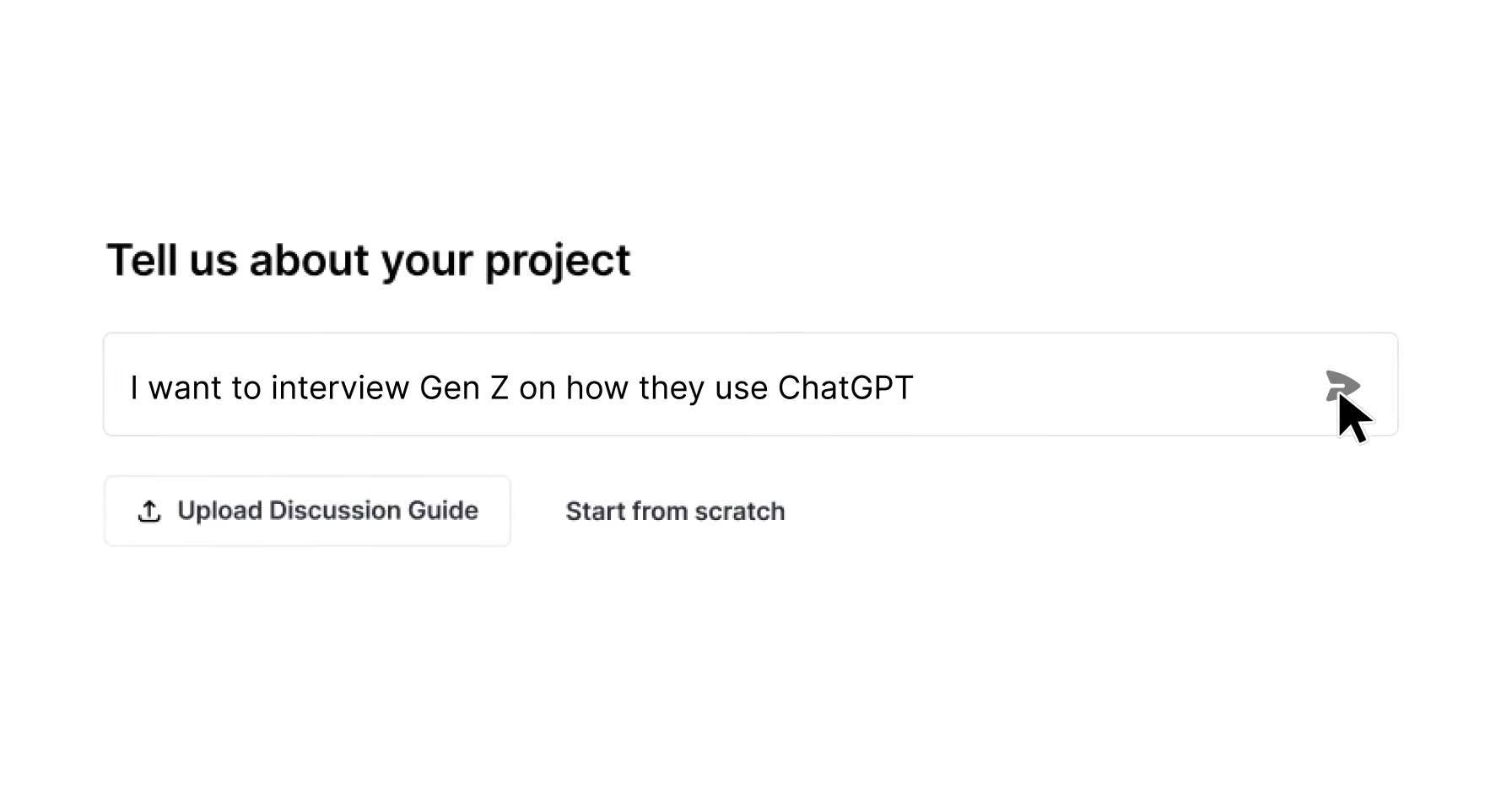
Recruitment, sample quality, and reach. Platforms differ sharply on participant sourcing. Some require teams to bring their own participants. Others provide panel access with varying quality. Panel access is a hidden cost: tools that include verified respondents versus those requiring users to supply their own audience can double or halve the real cost of a study. Global reach, language coverage, and access to niche audiences depend on the underlying panel and recruitment operations.
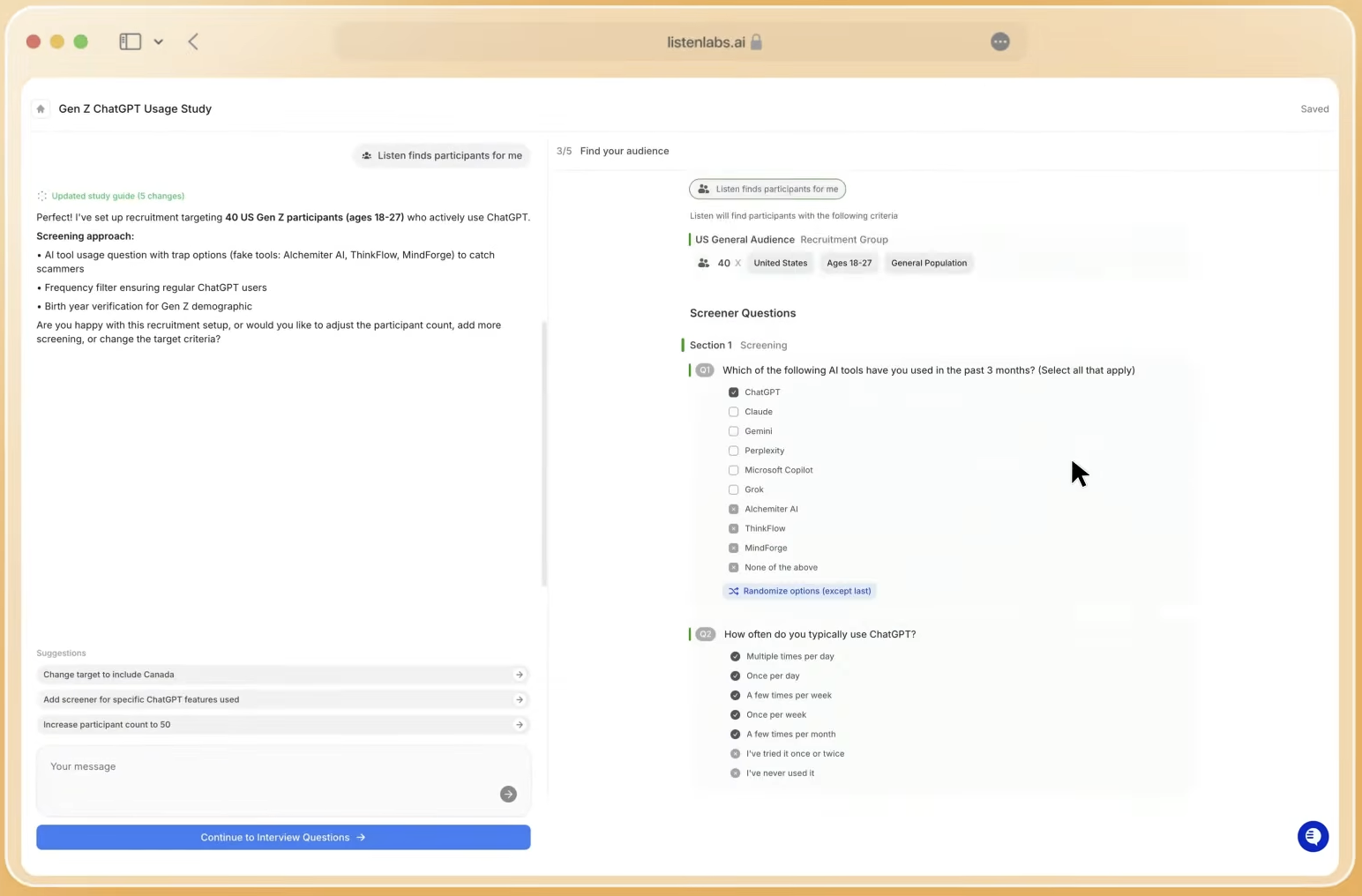
Moderation approach, depth of insight, and emotional signals. AI moderators conduct one-on-one video or text interviews with dynamic follow-up questions. Platforms like Listen Labs layer on auto-recruiting, transcription, sentiment tagging, and insight summarization so teams move from question to findings in hours, not weeks. Ninety-two percent of participants report top comfort levels for both human and AI sessions, and participants rate AI and human interviewers similarly on willingness to disclose information. This structure supports deep “why” exploration and rich emotional data.
Listen Labs: an end-to-end benchmark within this category. Within AI-moderated platforms, coverage of the research lifecycle and panel quality vary widely. Listen Labs is the only platform in this category that covers the entire research lifecycle without external vendors. Four core capabilities distinguish it from point solutions that rely on manual workflows or third parties.
- Listen Atlas provides a global panel across 45+ countries and 100+ languages, with an AI orchestration layer that matches participants on behavioral and intent data, not only self-reported demographics. A dedicated recruitment operations team reaches audiences below 1 percent incidence rate, including enterprise decision-makers, healthcare workers, and engineers.
- Quality Guard delivers real-time fraud prevention across video, voice, content, and device signals, with participant frequency limits of three studies per month to avoid professional survey-takers. Without active quality control, 20–35 percent of online panel completes may contain some form of quality issue, and Quality Guard is designed to remove that risk.
- Emotional Intelligence analyzes tone of voice, word choice, and subconscious micro expressions to surface nuanced emotions that transcripts alone miss. It builds on Ekman’s universal emotions framework and supports over 50 languages. Every emotion is quantified per question and concept, with labels traceable to timestamps, verbatim quotes, and AI reasoning.
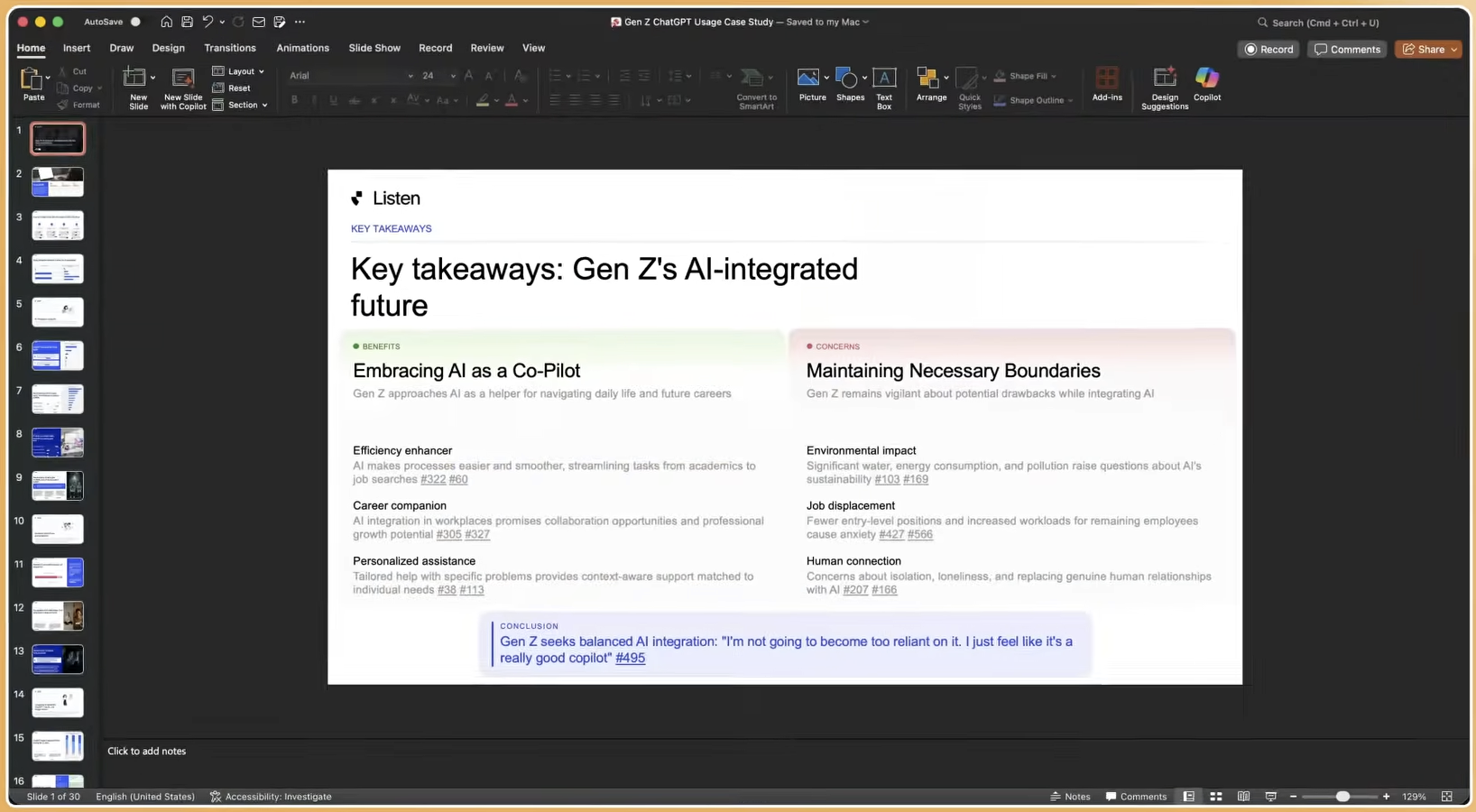
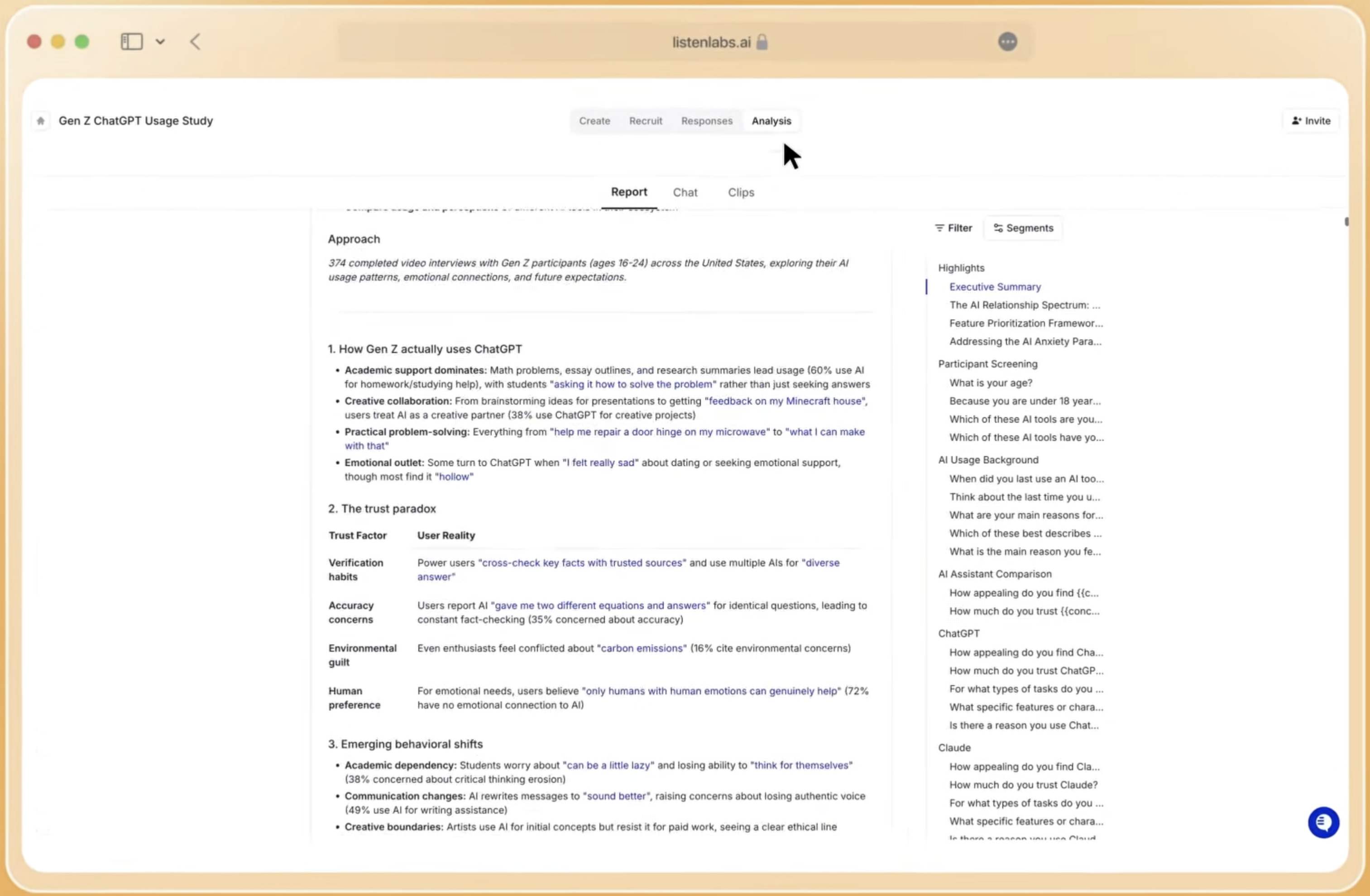
- Research Agent handles the full analysis workflow from raw data to final output, generating slide decks, memos, highlight reels, statistical charts, and segmentation breakdowns. One researcher ran a full buying intent analysis across three user segments in under a minute.
Listen Labs has run over 1 million AI-powered customer interviews for companies including Microsoft, Perplexity, and Sweetgreen, and has raised over 96 million dollars since launching in April 2025. At P&G, the platform delivered hundreds of interviews with quantified themes and verbatim proof in hours, shaping product and brand strategy. At Anthropic, large-scale interviews surfaced churn drivers several times faster than traditional methods. At Skims, it qualified thousands of premium consumers overnight to de-risk a global campaign launch.
Scenario-Based Guidance: Matching Tools to Real-World Use Cases
Teams choose the right tool by aligning specific research goals with the structural strengths of each category.
- Enterprise insights teams running brand perception studies, concept tests, or multi-market segmentation at scale benefit most from AI-moderated interview platforms with verified global panels and automated deliverables. Listen Labs is built for this scenario, and AI-moderated interview platforms can compress the full research cycle to 24 hours in these programs.
- UX researchers validating prototypes or running usability studies need platforms that support screen sharing, task-based flows, and emotional signal capture at sample sizes of 50 to 100 or more, which aligns with AI-moderated interview solutions.
- Product and marketing teams without dedicated researchers need self-serve platforms where natural-language briefs convert into structured designs, with recruitment and analysis handled end to end. AI-moderated platforms with strong automation address this need.
- Agencies and consultancies on tight client timelines require speed, global reach, and access to niche audiences. Listen Labs addresses these requirements through its panel and recruitment operations, while also reducing manual analysis effort.
Operational Requirements for Enterprise-Scale Deployment
Enterprise deployment of any AI research platform involves governance, adoption, and repeatability. Stakeholder alignment across insights, legal, IT, and procurement must occur before the first study launches. Compliance requirements such as GDPR, SOC 2, ISO 27001, ISO 27701, and ISO 42001 need verification against the vendor’s certifications. Listen Labs holds all five, which clears legal and security reviews early in the process.
Beyond compliance, successful deployment depends on change management. Research teams that do not adopt AI are up to four times more likely to see their organizational influence decline, according to the Qualtrics 2026 Market Research Trends Report. Repeatability across ongoing global programs then requires cross-study knowledge management. Listen Labs’ Mission Control serves as a source of truth for everything learned from customers, enabling cross-study queries and trend tracking without commissioning new projects each time.
See how Listen Labs meets enterprise compliance and deployment requirements, and book a demo.
Risks and Limitations to Consider Across All Tool Categories
Every category introduces specific risks that enterprise teams should address before standardizing workflows. The most common issues fall into five patterns.
- Shallow data from rigid methods. Web-scraping and survey-only approaches cannot probe for the “why.” In datasets of thousands of AI-moderated B2B win-loss buyer interviews, when reps log “price” as the loss reason it matches the buyer’s actual primary decision driver less than 30 percent of the time. Methods that stop at surface answers often misdirect strategy.
- Slow turnaround from manual workflows. A Forrester-commissioned study found that data teams spend on average 70 percent of their time prepping new external data sets for analysis versus 30 percent on actual analysis, with most time lost to manual coding and theme clustering.
- Hidden recruitment complexity. Platforms that exclude verified panel access force teams to source participants separately, which adds cost, time, and quality risk. Panel access is a hidden cost that can double or halve the real cost of a study.
- Fraud risk. Many research teams now apply fraud detection to survey responses to protect data quality, which signals how widespread the issue has become across online panels.
- Overestimating automation. AI reliably handles transcription, coding, and first-draft synthesis. It does not replace human judgment for research design, cultural interpretation, or strategic storytelling.
Decision Framework and Practical Checklist
Selecting the right tool starts with matching the research question to each method’s structural capabilities, not marketing claims. The checklist below translates that principle into concrete if-then rules.
- If the goal is competitive benchmarking or trend detection from public data, use web-scraping or SEO intelligence tools.
- If the goal is real-time brand monitoring, crisis detection, or unprompted sentiment tracking, use social listening platforms.
- If the goal is brand perception research, concept testing, emotional signal capture, or understanding the “why” behind consumer behavior at scale, use AI-moderated interview platforms, with Listen Labs for end-to-end delivery.
- If the timeline is extremely compressed and the deliverable must be stakeholder-ready, use Listen Labs Research Agent.
- If the audience is niche, global, or below 1 percent incidence rate, use Listen Labs recruitment operations and panel.
- If enterprise security and compliance are non-negotiable, verify SOC 2, GDPR, ISO 27001, ISO 27701, and ISO 42001 certifications.
- If the team needs to compound knowledge across studies instead of treating each project as a one-off, use Listen Labs Mission Control.
Frequently Asked Questions
How quickly can AI-moderated interview platforms deliver results compared to traditional agencies?
Traditional qualitative research agencies often take four to six weeks from study design to final report, and enterprise prioritization can stretch that to several months. AI-moderated interview platforms can compress the full research cycle to 24 hours. Listen Labs automates study design, recruits from its verified global panel, conducts video interviews with adaptive follow-up questions, analyzes responses, and generates consultant-quality slide decks, memos, and highlight reels through the Research Agent. Microsoft’s Director of Data Science reported collecting global customer stories within a single day at roughly one third of traditional costs.
How does Listen Labs ensure participant quality and prevent fraudulent responses?
Listen Labs applies three layers of quality control. It first works only with high-quality, non-commodity panel sources to avoid professional survey-takers. Quality Guard then monitors every interview in real time across video, voice, content, and device signals to detect fraud, AI-generated scripts, low-effort responses, and mismatched profiles, while limiting participants to three studies per month. A dedicated recruitment operations team finally adds human review, especially for hard-to-reach segments such as enterprise decision-makers, healthcare workers, and audiences below 1 percent incidence rate. This combined approach aims to deliver a zero-fraud standard that commodity panels cannot match.
What is the difference between social listening and AI-moderated brand research?
Social listening platforms analyze unprompted public conversations such as tweets, forum posts, and reviews to track brand sentiment and detect trends. They operate passively and cannot ask follow-up questions, probe motivations, or target specific segments. AI-moderated brand research conducts active, one-on-one interviews with recruited participants, asking structured and adaptive questions about brand perception, associations, and emotional responses. The output is a rich qualitative dataset with verbatim quotes, emotional signals, and traceable themes. Listen Labs’ Emotional Intelligence layer adds analysis of tone, word choice, and micro expressions, which captures what consumers feel as well as what they say.
Can Listen Labs support multilingual and multi-market brand research programs?
Listen Labs supports over 100 languages for interview moderation, with automatic translation and transcription. Its global panel spans more than 45 countries across the Americas, Europe, APAC, and MEA. Emotional Intelligence works across over 50 languages. Enterprises running simultaneous multi-market studies, such as brand perception programs across North America, Western Europe, and Southeast Asia, can field all markets in parallel and synthesize results into a single cross-market deliverable through the Research Agent, which removes the delays of sequential market-by-market work.
What security and compliance standards does Listen Labs meet for enterprise deployment?
Listen Labs maintains enterprise-grade security with 256-bit encryption, and customer data is never used for AI model training. The platform holds the five enterprise certifications detailed in the Operational Requirements section above, which cover information security, privacy, and AI management systems. Enterprise SSO is supported. These standards satisfy the compliance expectations of Fortune 500 procurement, legal, and IT security teams across regulated industries.
Conclusion: Choosing the Right AI Brand Research Stack
Web-scraping tools, social listening platforms, and AI-moderated interview solutions each address a distinct layer of the consumer intelligence stack. Web-scraping delivers competitive and digital intelligence from public sources but produces no primary consumer data. Social listening captures unprompted brand sentiment at scale but cannot probe motivations, reach specific audiences, or capture emotional depth. AI-moderated interview platforms close both gaps. Among these, Listen Labs is the only end-to-end solution that combines a verified global panel, real-time fraud prevention, multimodal emotional signal capture, and the 24-hour delivery standard described earlier. For enterprise insights, UX research, and brand teams evaluating AI brand research tools in 2026, the depth versus scale trade-off no longer needs to be accepted as a given.