
Written by: Anish Rao, Head of Growth, Listen Labs | Last updated: July 28, 2026
Key Takeaways for Enterprise Research Leaders
- Enterprise research teams face growing backlogs because traditional qualitative studies take weeks or months to complete.
- Live AI moderation enables adaptive, real-time interviews that capture emotional signals and scale to hundreds of participants simultaneously.
- Listen Labs delivers full research cycles, from design to deliverables, in under 24 hours while maintaining enterprise-grade security and fraud protection.
- Native-language moderation across 100-plus languages and 45-plus countries removes the coordination overhead of multi-market studies.
- Book a demo with Listen Labs to see how the platform compresses research timelines and removes vendor fragmentation.
Clarifying the Landscape: Live AI Moderation vs Post-Session Analysis
Two distinct categories of AI now shape qualitative research. Post-session tools such as transcription engines, coding assistants, and repository platforms process data after an interview concludes. They organize what was already captured but cannot change what was asked or how deeply a moderator probed.
Live AI moderation operates during the interview itself. AI can schedule and conduct the interview, analyze transcripts for themes, and generate quantitative insights from those interviews in a single continuous workflow. When a participant gives a vague or unexpectedly rich answer, a live AI moderator adapts in real time, asking follow-ups that a static discussion guide would never reach. Emotional-signal capture only works in this live context, because post-session tools rely on transcripts that have already stripped out tone, hesitation, and micro-expression data.
Nine Criteria for Evaluating Live AI Moderation Platforms
Nine criteria determine whether a platform is fit for enterprise-scale live qualitative work. Research cycle time measures how long the full process takes from brief to deliverable. Depth versus scale addresses whether the platform can run hundreds of adaptive conversations simultaneously without sacrificing insight quality.
Participant quality and fraud controls determine whether the data is trustworthy before analysis begins. Emotional-signal capture separates platforms that surface what participants feel from those that only record what they say. Language and geographic reach governs whether a single platform can support a global program.
Analysis effort reflects how much human time is required to move from raw responses to actionable findings. Deliverable speed measures how quickly consultant-quality outputs reach stakeholders. Security certifications confirm that enterprise compliance requirements are met. Total cost of ownership accounts for platform fees, recruitment costs, analyst time, and the cost of fragmented vendor stacks.
Research Cycle Time: From Brief to Decision
Traditional qualitative agencies operate on cycles of four to six weeks from study design to final report. In large enterprises, internal prioritization and budget approval can extend that to six months. Recent industry reports show that AI-moderated studies can reduce the time from question to decision from weeks to days.
As noted in the key takeaways, Listen Labs compresses this timeline to under 24 hours by integrating study design, recruitment, moderation, analysis, and deliverables into a single automated workflow. Microsoft used Listen Labs to collect global customer stories for its 50th anniversary celebration within a single day. Anthropic completed more than 300 user interviews in 48 hours to surface churn drivers, identifying where former Claude users migrate and producing a prioritized list of ten must-fix items. Platforms like Listen Labs layer on auto-recruiting, transcription, sentiment tagging, and insight summarization so teams move from question to findings in hours, not weeks.

Depth Versus Scale in Live Qualitative Work
Human-moderated qualitative research typically caps at eight to twelve interviews per study because of moderator availability and cost. Quantitative surveys scale to thousands of respondents but replace adaptive conversation with fixed-choice questions that cannot probe unexpected answers. With qual-at-scale, the old trade-off between depth and scale is no longer a barrier.
Listen Labs runs hundreds of adaptive, one-on-one AI-moderated interviews simultaneously. Each conversation is personalized, and the AI probes short or interesting answers the way a trained human interviewer would. This approach maintains consistent methodology across every session regardless of volume. AI-moderated studies routinely field hundreds of participants while delivering full synthesis in under four hours. Procter & Gamble used Listen Labs to complete more than 250 interviews with quantified themes and verbatim proof in hours, directly shaping product and brand strategy before market launch.
Participant Quality and Fraud Protection at Scale
Commodity panels carry well-documented fraud risks. Attention-check failure rates tend to be lower on professionally recruited panels than on general-population paid-survey traffic. AI moderation platforms that rely on third-party panels inherit these risks without the infrastructure to address them.
Listen Labs addresses participant quality through three compounding layers. Listen Atlas, the AI orchestration layer, matches participants on behavioral and intent data rather than self-reported demographics alone. Quality Guard monitors every interview in real time across video, voice, content, and device signals to detect fraud, low-effort responses, AI-generated scripts, and mismatched profiles.
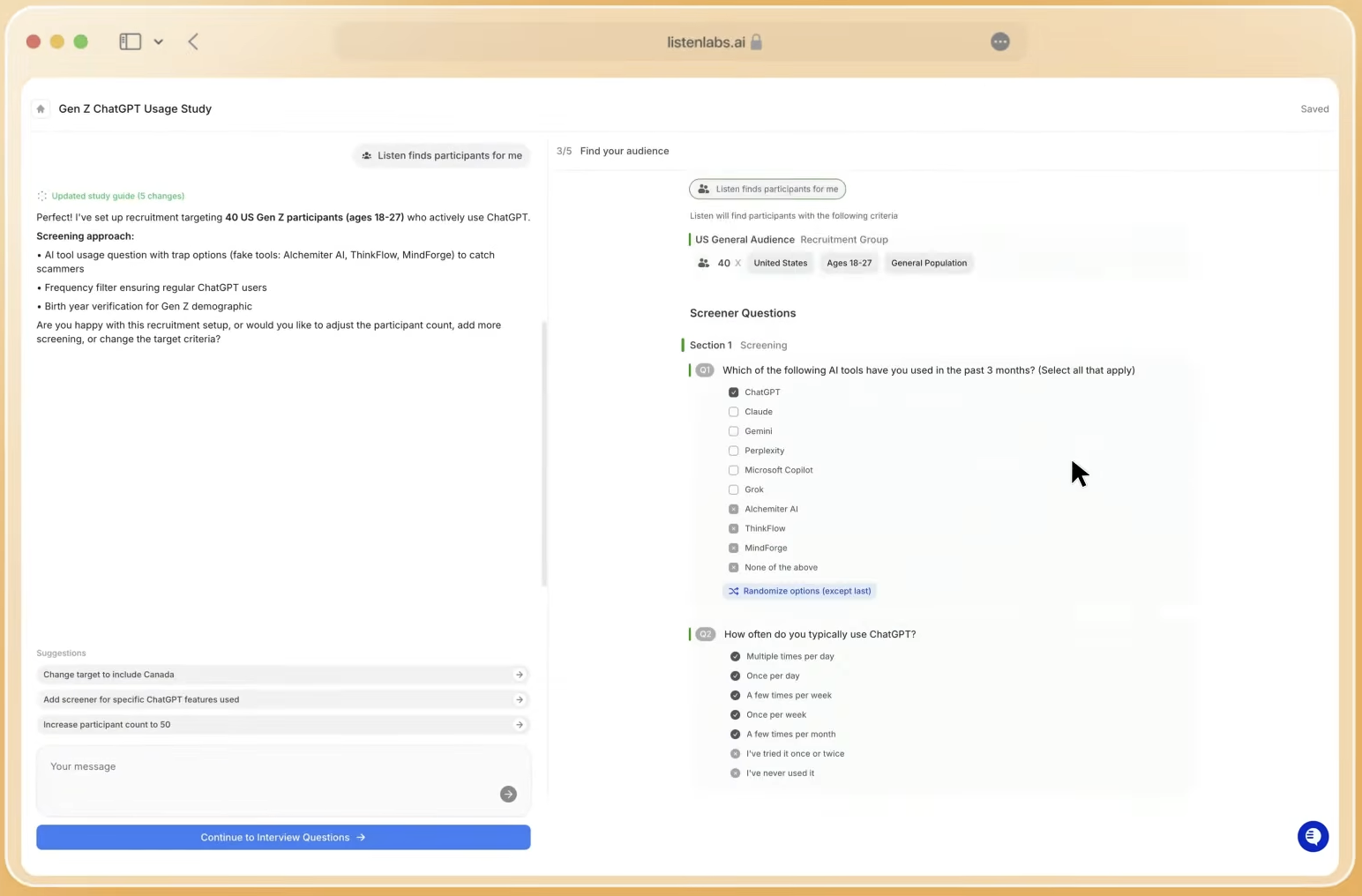
Participants are capped at three studies per month, which removes professional survey-takers from the pool. A dedicated recruitment operations team adds a human review layer for hard-to-reach segments such as enterprise decision-makers, healthcare workers, and audiences below one percent incidence rate. Because each layer feeds data back into Listen Atlas, the quality controls strengthen with every completed study. This feedback loop creates a compounding advantage: the more studies conducted on the platform, the stronger the reputation scoring becomes for every participant in the network.
Emotional-Signal Capture with Multimodal AI
Transcripts record what participants say. They do not record a frown during a product concept reveal, a pause before answering a pricing question, or the flat tone that contradicts a positive rating. Two concepts can both receive favorable verbal responses while triggering entirely different emotional reactions. Only multimodal analysis can surface that difference.
This emotional-signal gap explains why Listen Labs built Emotional Intelligence as a core capability. Listen Labs’ Emotional Intelligence analyzes three signals: tone of voice, word choice, and subconscious micro-expressions. These signals map to Ekman’s universal six emotions framework, the same standard used in clinical psychology and UX research, which identifies anger, disgust, fear, happiness, sadness, surprise, and neutral as the core emotional states. This framework enables quantification, so every emotion is measured per question and concept, with each label traceable to the exact timestamp, verbatim quote, and AI reasoning behind it. Researchers can pinpoint the precise moment a participant becomes confused by a claim, delighted by a feature, or hesitant about a price point, then pull that clip directly into a highlight reel.
This capability integrates directly with the Research Agent. Researchers can ask natural-language queries such as “which concept triggered the most confusion among 35-to-44-year-old women” and receive a side-by-side emotional breakdown across stimuli, segments, and markets. No competing platform in the live AI moderation category offers timestamp-level emotional traceability at this depth.
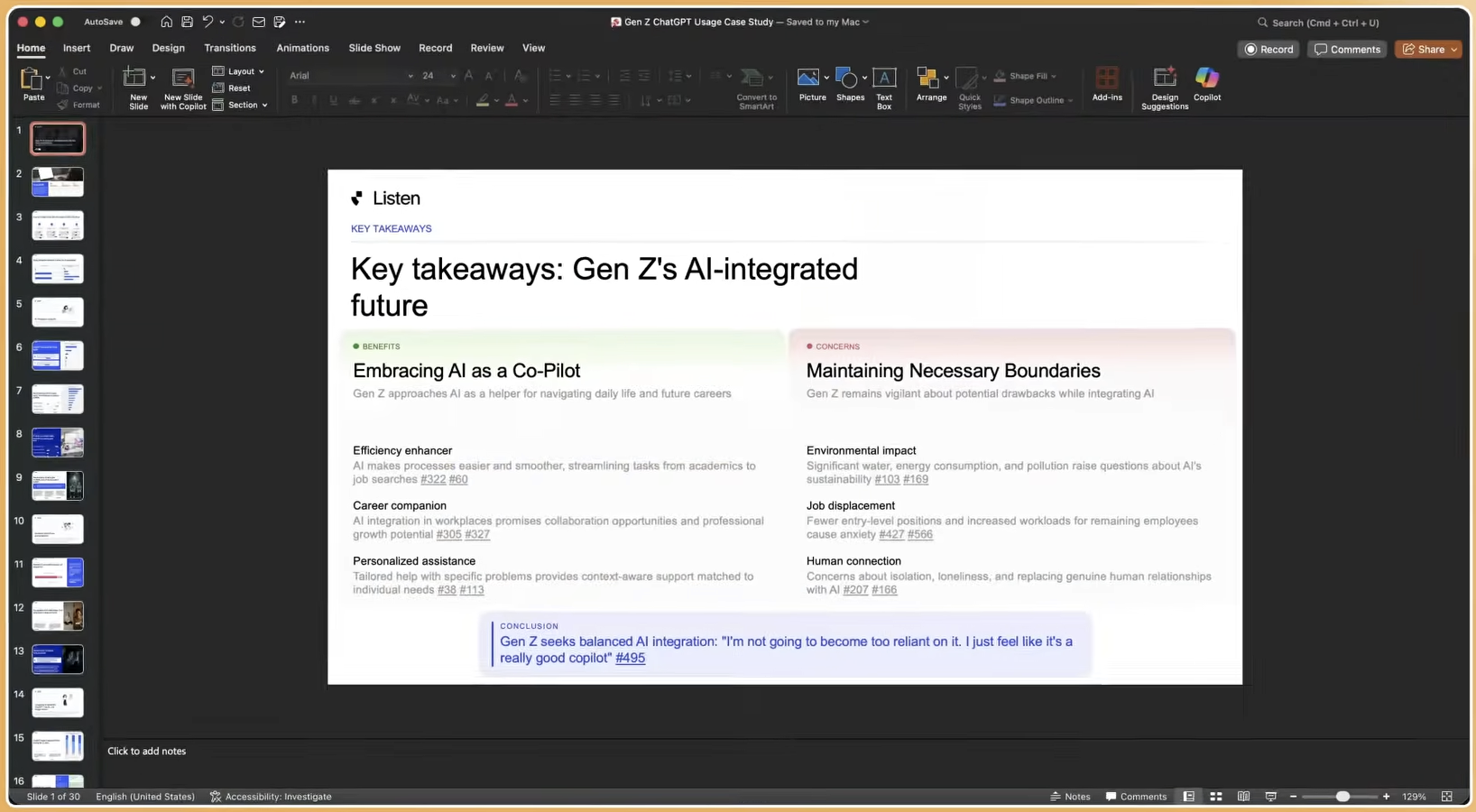
See Emotional Intelligence in action on a live study.
Language and Geographic Reach for Global Programs
Global enterprise programs require more than translated discussion guides. When a participant in Brazil gives an unexpected answer, a translated script cannot generate a culturally appropriate follow-up probe. Native-language moderation sets the practical standard. Qual-at-scale is ideal when research requires large sample sizes or broad geographic reach, as AI tools can engage hundreds or thousands of participants remotely and asynchronously.
Listen Labs supports native moderation in 100-plus languages across 45-plus countries in the Americas, Europe, APAC, and MEA. The 30 million verified respondents in Listen Atlas span all major markets, with consistent screening, fraud prevention, and quality standards applied uniformly across geographies. This breadth enables a single platform to handle global work.
Competing platforms often fall short in this context. Some limit coverage to translated scripts. Others require researchers to source participants separately in each target market through local agencies. Many restrict panel access to a single region. Running simultaneous multi-market studies on one platform removes the coordination overhead that pushes most enterprises toward sequential, budget-driven scheduling.
Analysis Effort and Deliverable Speed with Research Agent
Manual coding of qualitative transcripts is time-consuming and introduces analyst bias. AI-native qualitative synthesis can reduce total time from several weeks to a few hours, but that benefit only appears when the AI handles the full analysis workflow without heavy human intervention.
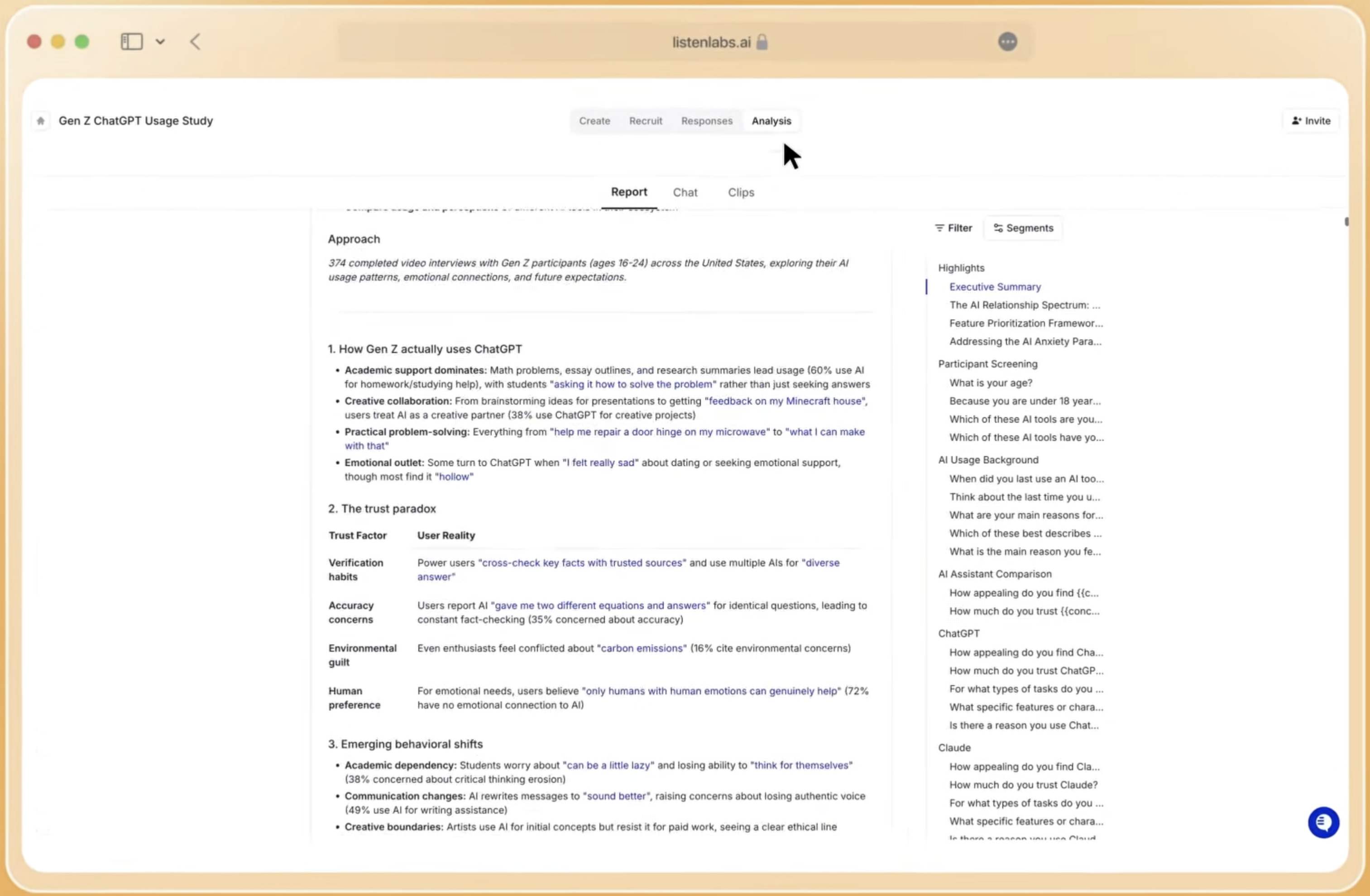
Listen Labs’ Research Agent processes all interview data and generates consultant-quality slide decks, memos, video highlight reels, statistical charts, and segmentation breakdowns in under a minute. Researchers can ask any question in natural language, such as “what are the top three reasons men aged 25–34 hesitate at checkout,” and receive answers with supporting verbatim quotes, charts, and clips. Skims used this capability to validate campaign direction with thousands of high-income buyers overnight, securing board-level buy-in before a global launch. The Research Agent also integrates emotional data, so a query about hesitation returns both the verbal response and the timestamped emotional signal that accompanied it.
Security, Compliance, and Total Cost of Ownership
Enterprise deployment requires verifiable compliance. Listen Labs holds SOC 2 Type II, GDPR, ISO 27001, ISO 27701, and ISO 42001 certifications, with 256-bit encryption and a policy that customer data is never used for AI model training. To support federated identity management, the platform also offers enterprise SSO. What distinguishes this compliance posture is scope, because these certifications cover the full research lifecycle, including recruitment, moderation, analysis, and storage, rather than a single point in the workflow.
Cost structure also changes with an integrated platform. The traditional research stack fragments across recruitment platforms, scheduling tools, moderation vendors, transcription services, analysis software, and report writers. Listen Labs replaces all of these with a single platform. Enterprises run more studies at roughly one-third the cost of the traditional approach. Listen Labs has run over one million AI-powered customer interviews for companies including Microsoft, Perplexity, and Sweetgreen, demonstrating that the cost model holds at enterprise scale.
Live Moderation vs Post-Analysis: Decision Matrix
When live AI moderation is required: Studies that need adaptive probing, where the value of the research depends on following unexpected answers, require live moderation. Concept testing, creative testing, usability research, churn diagnostics, and brand perception studies all fall into this category. Any study where emotional-signal capture is part of the research objective also requires live moderation, because post-session tools work from transcripts that have already lost that data.
When post-session tools may suffice: Repository and analysis tools like Dovetail serve a different function, organizing and querying research that has already been conducted. When the goal is to synthesize findings from past studies or build an institutional knowledge base, post-session tools address that need. They do not replace the need to conduct new research.
When surveys are appropriate: Quantitative surveys remain appropriate for tracking studies with fixed metrics, large-scale preference ranking, and situations where the research question is fully defined and no follow-up probing is needed. They are not appropriate when the goal is to understand the reasoning, emotion, or context behind a response.
Scenario-Based Guidance for Different Teams
Enterprise consumer insights teams managing backlogs of 20-plus pending studies benefit most from an end-to-end platform that handles recruitment, moderation, and analysis without separate vendor coordination. The sub-24-hour turnaround enables continuous consumer intelligence programs rather than quarterly research cycles.
UX research groups at mid-to-large tech companies need faster feedback loops than sprint cycles allow. Listen Labs supports screen sharing, prototype testing, and usability studies with 50-to-100-plus participants. This capability replaces the five-to-ten-user sample that most UX teams default to because of scheduling constraints.
Product and marketing teams without dedicated researchers can describe research goals in natural language and have the platform handle study design, recruitment, moderation, and analysis automatically. The self-serve capability removes the methodology barrier that previously required a research specialist.
Agencies and consultancies operating on client timelines measured in days rather than weeks use Listen Labs to reach niche audiences such as enterprise decision-makers, healthcare workers, and specialized consumer segments. These teams deliver findings before the competitive window closes.
Operational Considerations for Enterprise Rollout
Deploying a live AI moderation platform at enterprise scale requires stakeholder alignment across research, legal, IT, and procurement. Security certifications and data residency requirements should be confirmed before pilot design. Change management for research teams works best when the platform is positioned as a force multiplier, enabling the same team to run five to ten times more studies, rather than a replacement for researcher judgment.
Global programs benefit from establishing consistent study templates and quality standards centrally, then allowing regional teams to adapt stimuli and participant criteria locally. Repeatability across markets becomes a structural advantage of AI moderation. The same probing methodology applies in session one and session five hundred, which removes the moderator drift that affects human-moderated global programs.
Risks and Limitations of Live AI Moderation
Live AI moderation is not appropriate for every research context. Sensitive topics such as mental health, trauma, and complex medical discussions benefit from human moderator empathy and improvised rapport-building that AI moderators do not replicate. C-suite B2B respondents in small-sample executive interviews often require the relationship dynamics of human moderation. Ethnographic studies that depend on observation of physical environments or social interactions fall outside the scope of video-based AI interviews.
Shallow data risk exists when study design is weak regardless of moderation method. AI moderation amplifies the quality of a well-designed study and amplifies the weaknesses of a poorly designed one. Recruitment complexity is real, because hard-to-reach audiences require dedicated sourcing infrastructure, and platforms that rely solely on commodity panels will underdeliver on incidence rates below one percent. Over-estimating automation is a common adoption error. The Research Agent generates deliverables in under a minute, but strategic interpretation of findings still requires researcher judgment. Fraud exposure remains a risk on platforms without multi-layer behavioral monitoring. 92% of participants report top comfort levels in AI-moderated sessions, but comfort does not substitute for active fraud detection.
Practical Decision Checklist for Platform Selection
- Does the platform conduct live AI moderation with adaptive probing, or does it only process data after sessions conclude?
- Can the platform recruit verified participants from a proprietary network, or does it depend entirely on third-party commodity panels?
- Does fraud protection operate in real time during interviews, or only at the recruitment screening stage?
- Does emotional-signal capture operate at the timestamp level with traceable reasoning, or does it produce aggregate sentiment scores without source attribution?
- Does the platform support native-language moderation in the target markets, or does it translate a fixed discussion guide?
- Can the platform deliver consultant-quality slide decks, memos, and highlight reels automatically, or does analysis require significant manual effort?
- Does the platform hold SOC 2, GDPR, ISO 27001, ISO 27701, and ISO 42001 certifications covering the full research lifecycle?
- Is the total cost of ownership calculated against a single integrated platform, or against the sum of recruitment, moderation, transcription, analysis, and reporting vendors?
- Has the platform demonstrated results at Fortune 500 scale with verifiable enterprise case studies?
Walk through this checklist with our team to evaluate your current research stack.
Frequently Asked Questions
How do you use AI during a live interview?
In a live AI-moderated interview, the AI agent opens the session, delivers questions from a researcher-defined guide, listens to each response, and generates adaptive follow-up probes in real time based on what the participant actually said. The AI does not use generic prompts, because it references the specific content of the answer to decide whether to probe deeper, move to the next question, or explore an unexpected direction. Simultaneously, multimodal analysis captures tone of voice, word choice, and facial micro-expressions to build an emotional signal layer alongside the verbal transcript. The researcher monitors the study in real time and receives structured synthesis as responses arrive, rather than waiting for a post-session coding process.
Can you use ChatGPT for qualitative data analysis?
General-purpose large language models can assist with tasks such as summarizing transcripts or drafting discussion guides, but they lack the infrastructure required for enterprise qualitative research. They do not recruit or verify participants, conduct live interviews, apply fraud detection, capture emotional signals, or generate statistically grounded deliverables. Listen Labs is built on tens of thousands of completed studies, giving the platform proprietary understanding of which question types produce better analysis, which methodologies match which research objectives, and how to separate signal from noise at scale. The Research Agent handles the full analysis lifecycle, including themes, segmentation, stat tests, slide decks, and highlight reels, within the same platform that conducted the interviews, maintaining traceability from raw response to final deliverable.
How do you ensure participant quality in AI-moderated research?
Listen Labs applies the three-layer quality control system described earlier: Listen Atlas for behavioral and intent-based matching, Quality Guard for real-time monitoring of fraud and low-effort behavior, and human review for hard-to-reach segments. This approach addresses the full quality lifecycle from recruitment through interview completion and strengthens the reputation scoring system with every study.
Which AI tool is best for live interview questions?
The answer depends on the evaluation criteria that matter most for a given program. For enterprise teams that need sub-24-hour turnaround, verified global participants, Ekman-based emotional-signal capture with timestamp traceability, native moderation in 100-plus languages, and consultant-quality deliverables generated automatically within a single SOC 2, GDPR, and ISO-certified platform, Listen Labs is the only end-to-end solution that meets all of these criteria simultaneously. Platforms that address one or two criteria while requiring separate vendors for the rest reintroduce the fragmentation, delay, and quality risk that live AI moderation is designed to eliminate.
Conclusion: Selecting a Live AI Platform for Enterprise Research
The nine criteria in this guide, including research cycle time, depth versus scale, participant quality and fraud controls, emotional-signal capture, language and geographic reach, analysis effort, deliverable speed, security certifications, and total cost of ownership, define what enterprise-grade live AI moderation requires. Traditional agencies meet some criteria on quality but fail on speed, cost, and scale. Survey tools scale but eliminate depth. Panel platforms solve sourcing without addressing moderation or analysis. Post-session analysis tools organize past research without conducting new research. Other AI moderation platforms address parts of the workflow while leaving recruitment quality, emotional intelligence, and global reach as unresolved gaps.
Listen Labs is the only platform that meets all nine criteria inside a single end-to-end solution, backed by a 30 million verified-respondent network across 45-plus countries. Ribbit Capital founder Micky Malka describes the platform this way: “Listen is the best tool to understand the customer. Instead of having a bored person to ask the questions, this AI engine can engage with you, and modify the questions to go deeper.” Microsoft, Anthropic, Procter & Gamble, Skims, and Robinhood have each used Listen Labs to compress research cycles that previously took weeks into results delivered in hours.
Evaluate Listen Labs for your enterprise program in a personalized demo.