Written by: Anish Rao, Head of Growth, Listen Labs | Last updated: June 19, 2026
Key Takeaways
- AI can turn a job description into a complete interview dossier in under 30 minutes, including questions and STAR stories.
- This nine-step workflow moves from job description signals and role-specific questions to timed mock interviews and a 30-60-90-day prep plan.
- General-purpose AI handles preparation tasks well but falls short when senior roles require verified customer sentiment or emotional-intelligence signals.
- Using AI for research, drafting, and rehearsal is now standard and ethical, while real-time in-interview assistance carries detection risk on 2026 platforms.
- For roles where verified customer insight is a differentiator, explore Listen Labs to access AI-moderated interviews and emotional-intelligence analysis that general tools cannot match.
What “AI research assistant for interviews” means in 2026
AI interview support in 2026 falls into two clear categories. The first is a job-prep workflow that uses generative AI to extract intelligence from a job description, predict interview questions, and rehearse answers. The second is an enterprise research platform that runs and analyzes thousands of verified customer interviews at scale. This article focuses on the job-prep workflow.
Turn a job description into interview questions with AI
Step 1 — Extract the signal from the job description. Paste the full job description into a capable generative AI model. Prompt it to identify the top five technical requirements, the top three soft-skill signals, the implied business problem the role solves, and any language that reveals company culture. Save this output as the foundation of your dossier, because it becomes your reference document for every later step. What would normally take an hour of manual highlighting and note-taking now takes a few minutes.
Generate a role-specific interview question bank
Step 2 — Build a targeted question list. Feed the extracted signal back into the AI with a prompt such as: “Given these requirements and this business context, list the 15 most likely interview questions for a [title] at a [stage/industry] company in 2026.” Recruiters increasingly use AI tools to assemble their own question sets, so your preparation should match that level of structure. Treat this list as your working question bank for the rest of your prep.
Predict behavioral questions with AI
Step 3 — Map competencies to behavioral frameworks. Ask the AI to map each job requirement to a behavioral competency such as leadership, ambiguity tolerance, or cross-functional influence. Have it generate two to three behavioral questions per competency using standard “Tell me about a time…” framing. Then ask it to rank those questions by likelihood based on the seniority level and function. The result is a prioritized behavioral question list that covers most of what final-round panels ask.
Draft strong STAR stories with AI
Step 4 — Draft STAR stories for your top questions. For each top-ranked behavioral question, prompt the AI: “Help me draft a STAR story using these bullet points from my background: [paste bullets]. The story should demonstrate [competency] and be under 90 seconds when spoken.” Iterate until the Situation is concise, the Task is specific, the Action is first-person and detailed, and the Result is quantified. Once a story meets all four criteria, store it in a single document indexed by competency so you can quickly pull the right example during later prep.
Rehearse answers in a real-time AI interview simulation
Step 5 — Run a timed mock interview. Use a conversational AI tool in voice or chat mode and instruct it to act as a senior interviewer for the target role. Set a rule: no pausing and no editing mid-answer. After each response, ask the AI to score conciseness, specificity, and relevance, then suggest one concrete improvement. Three full mock sessions, each using different question sets, will expose filler words, vague language, and missing quantification before the real interview does.
Research customers and competitors with AI and Listen Labs
Step 6 — Build a customer and competitive intelligence layer. Prompt the AI to summarize publicly available customer reviews, analyst commentary, and press coverage for the target company’s core product or service. Ask it to identify the top three customer pain points, the top three praise themes, and any known competitive threats. “Traditional surveys may tell us what people do, but it takes a conversation to understand why”, and public review data has the same limitation.
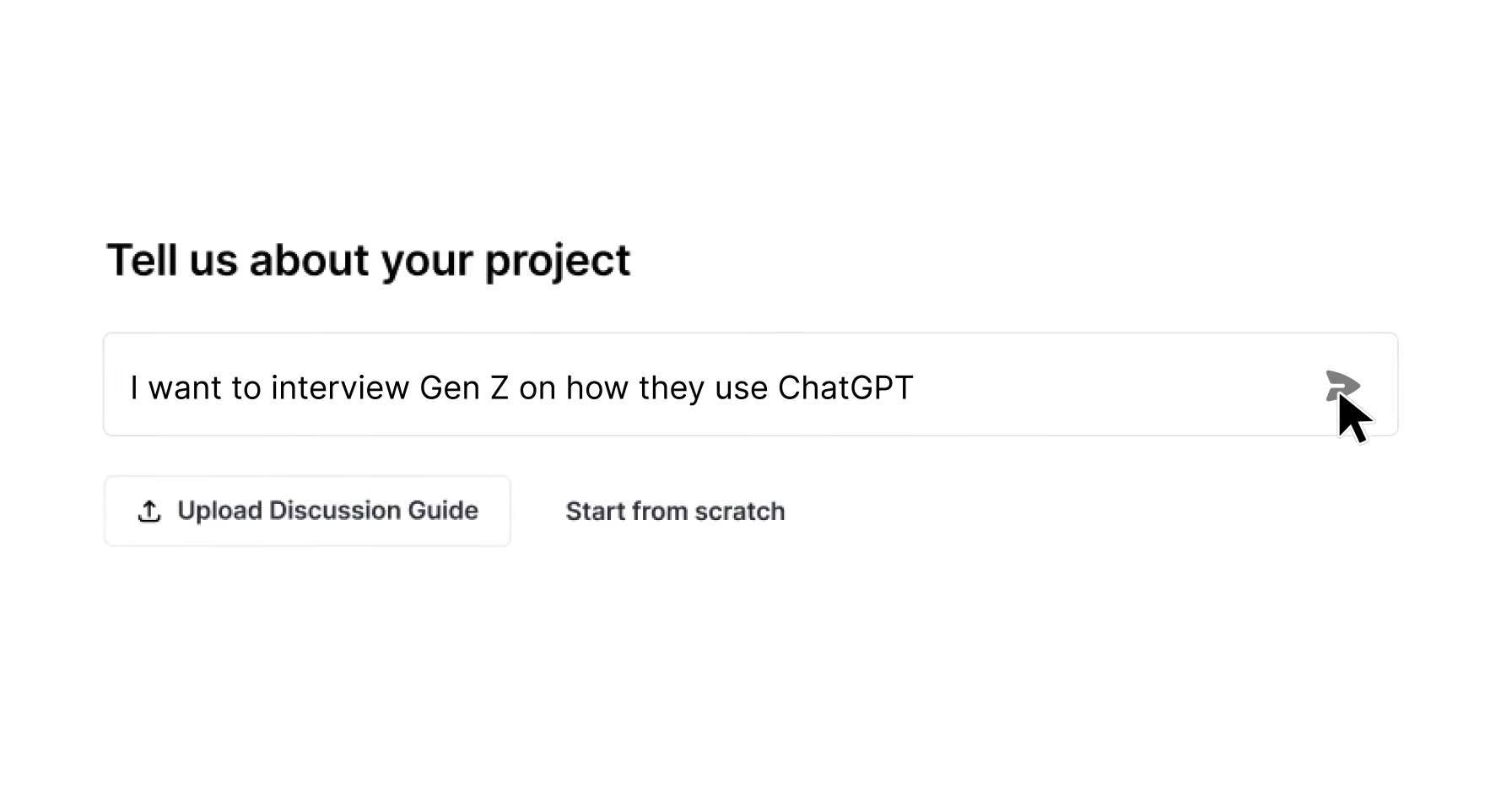
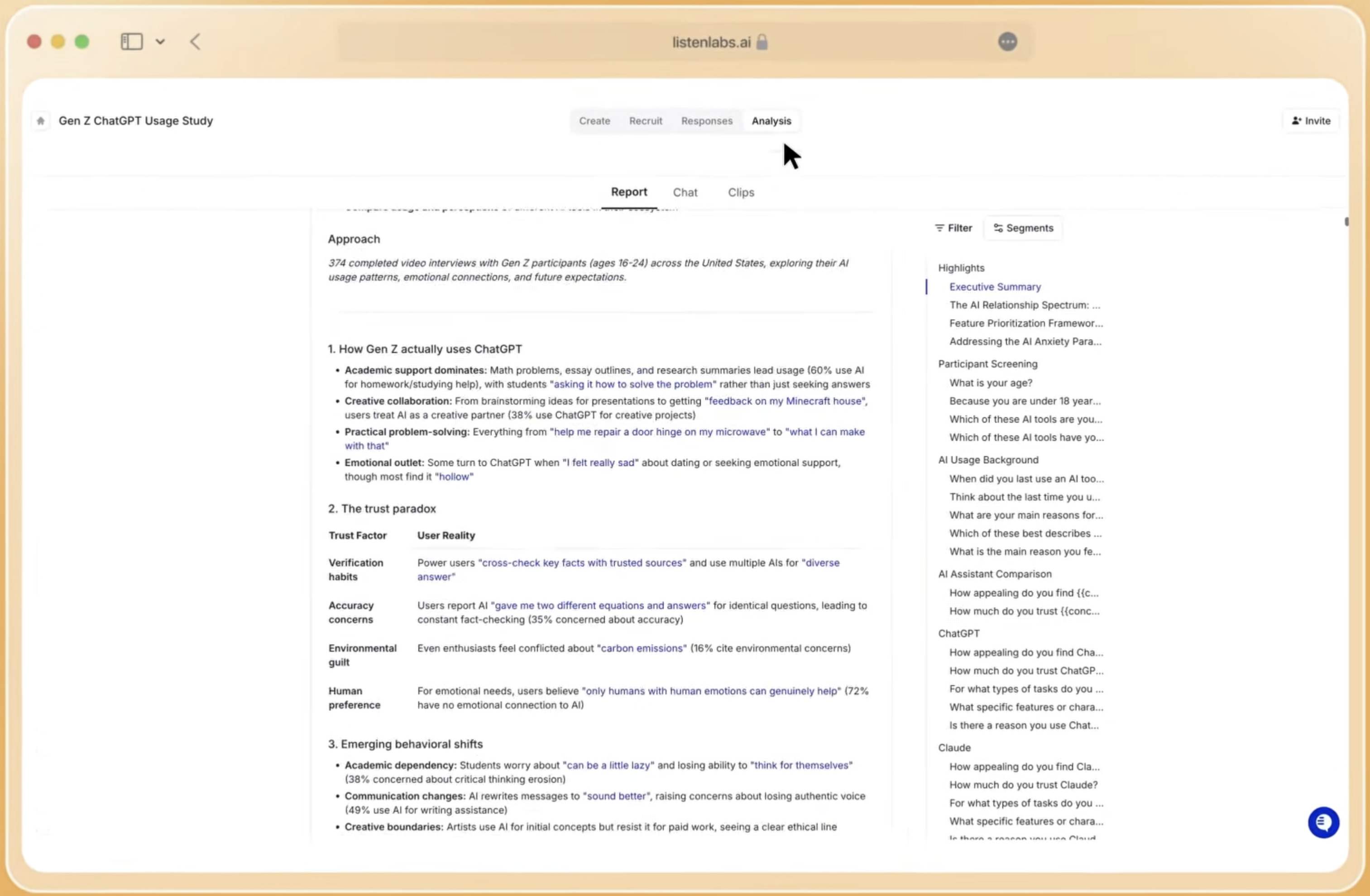
For roles where authentic customer sentiment is a differentiator, such as product, insights, CX, or strategy, general-purpose AI reaches its limit at public data. Listen Labs conducts thousands of AI-moderated interviews with verified participants and surfaces the emotional signals behind what customers say, not just their words. It analyzes tone of voice, word choice, and subconscious micro expressions using Ekman’s universal emotions framework, the same standard used in clinical psychology. See that depth in action with a live demo of Listen Labs’ emotional-intelligence analysis.
Prepare for final-round panels and AI screening
Step 7 — Prepare for panel depth and agentic screening. Final rounds increasingly involve structured competency panels, case presentations, and, at some organizations, AI-assisted screening tools. These systems can compare your answers across multiple conversations and look for consistency. To prepare for that level of scrutiny, ask your AI tool to generate a 10-question rapid-fire panel simulation at executive level. Practice delivering answers that align with your earlier mock sessions, because automated systems tend to flag inconsistency rather than imperfection.
Use AI interview assistants without getting flagged
Step 8 — Use AI for preparation, not in-session assistance. Over 60 percent of U.S. and UK job seekers have used AI in the application process in the last 24 months, so AI-assisted preparation now counts as standard practice. The key line is preparation versus real-time in-session use. Using AI to research, draft, and rehearse before an interview is preparation. Reading AI-generated answers from a hidden screen during a live interview is deception, and 2026 video interview platforms increasingly include behavioral and eye-tracking signals that flag off-screen reading patterns. Prepare thoroughly with AI, then walk into the interview as yourself.
Build a 30-60-90-day interview prep timeline
Step 9 — Structure your preparation across a realistic timeline. Prompt the AI to build a week-by-week prep schedule anchored to your target interview date. A practical structure:
- Days 1–30 (Foundation): Complete Steps 1–4. Build the full dossier, question bank, and STAR story library. Research the company’s customers, competitors, and recent news so you understand the landscape.
- Days 31–60 (Rehearsal): Complete Steps 5–6. Run at least six timed mock sessions to build fluency under pressure. Refine STAR stories based on AI feedback and deepen customer sentiment research for the specific business unit or product line relevant to the role.
- Days 61–90 (Sharpening): Complete Steps 7–8. Simulate final-round conditions to stress-test your answers under time pressure. If the role requires case presentations, dedicate separate practice sessions to that format. Finally, review all materials for consistency and remove any answer that relies on memorization over genuine understanding so you internalize the research instead of reciting it.
Ethics and detection for AI-assisted interview prep
Using AI for interview preparation is ethical and, as noted above, now standard practice. The distinction that matters is preparation versus deception. Researching a company with AI, generating practice questions, drafting STAR stories, and running mock sessions are all forms of preparation, similar in principle to using a career coach or reading a company’s annual report.
Detection risk is real for in-session AI use. Enterprise platforms include candidate authenticity detection and assessment capabilities, and similar capabilities appear in a growing number of enterprise ATS platforms in 2026. Because these systems monitor behavioral signals such as eye movement, response latency, and reading patterns, hidden scripts are increasingly risky. The practical guidance is to invest enough preparation time that AI-assisted research becomes internalized knowledge, not a live script.
When to upgrade to Listen Labs for verified customer insight
For most interview preparation, the nine-step workflow above is enough. The upgrade case appears when the role requires demonstrating genuine understanding of customer sentiment, product perception, or emotional response to a brand, and publicly available data does not go deep enough.
Listen Labs is an end-to-end AI research platform that sources participants from a network of 30 million verified respondents, then conducts AI-moderated interviews at scale and delivers analysis in under 24 hours. Every insight links directly to the underlying response data, which makes findings traceable and credible in a senior-level interview context.
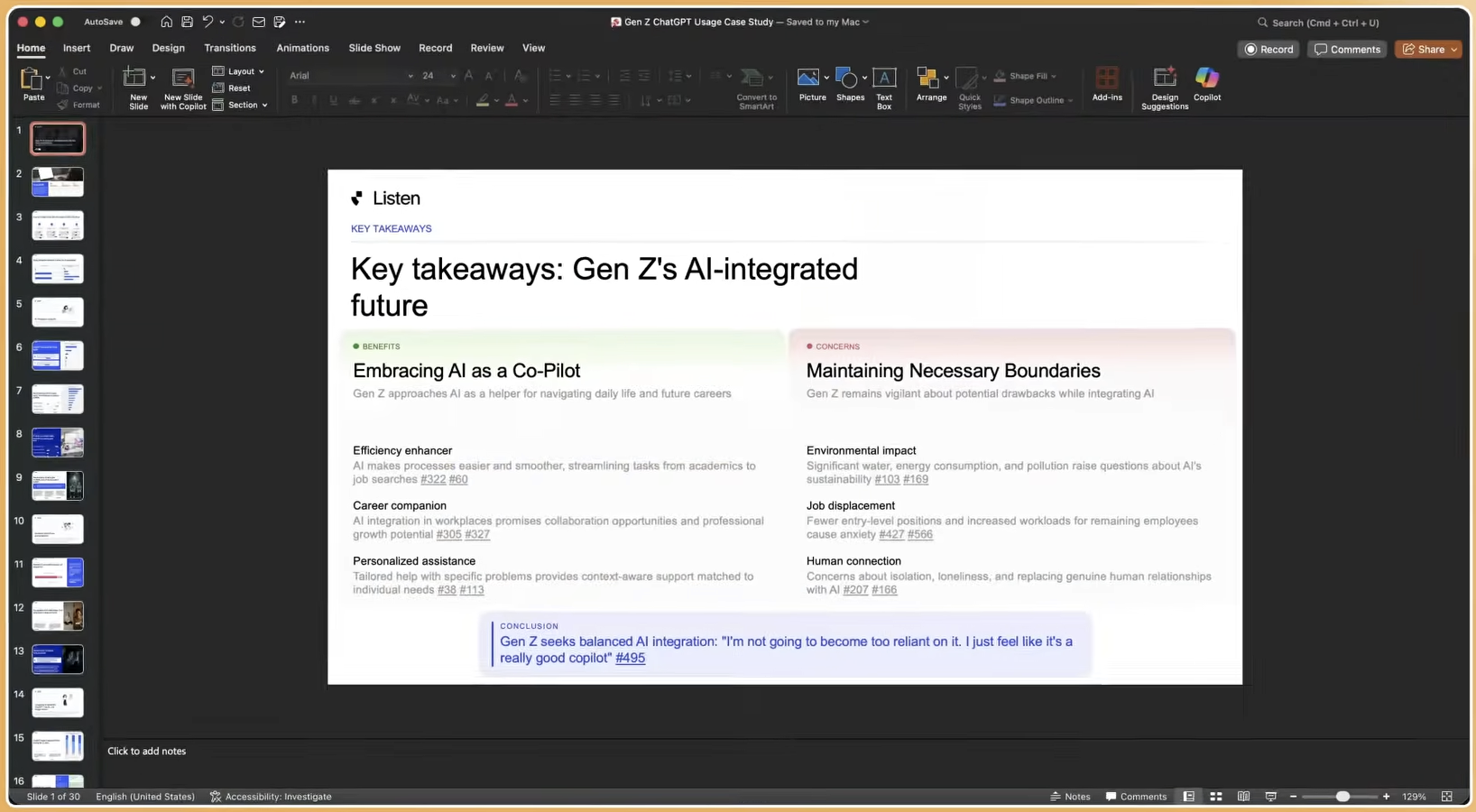
Candidates for roles such as VP of Consumer Insights, Head of Product, or Director of CX at companies like Microsoft, Google, P&G, or Anthropic gain a real edge when they arrive with verified customer sentiment data and emotional-intelligence signals. Listen Labs delivers this level of research in under 24 hours, which fits the timeline of serious final-round candidates. Explore what verified customer insight looks like for your target company’s category in a personalized demo.
Frequently Asked Questions
What is the best AI research assistant for interview preparation in 2026?
The most effective setup combines a general-purpose large language model for dossier building, question prediction, STAR story drafting, and mock interview simulation with a specialized research platform when you need verified customer sentiment. General-purpose tools handle the workflow efficiently but cannot access verified participant data or emotional-intelligence signals. For roles in insights, product, strategy, or CX, that second layer turns solid preparation into a clear differentiator.
Can interviewers detect AI-generated answers in a live interview?
Enterprise ATS and video interview platforms in 2026 increasingly include behavioral analysis, eye-tracking signals, and authenticity detection. Because these systems monitor eye movement and reading patterns, reading from a hidden AI-generated script during a live session carries meaningful detection risk. AI-assisted preparation that focuses on research, drafting, and rehearsal before the interview carries no detection risk and has become standard among competitive candidates.
How long does it realistically take to build a complete interview dossier with AI?
Steps 1 through 4 of the workflow, which cover extracting job description signal, generating a question bank, mapping behavioral competencies, and drafting STAR stories, can be completed in under 30 minutes with a capable generative AI model and a structured prompt sequence. The remaining steps for mock sessions, customer research, final-round simulation, and timeline planning add several hours of focused preparation time.
Is it ethical to use AI for interview preparation?
Yes. Using AI to research a company, predict likely questions, draft practice answers, and simulate interview conditions counts as preparation, similar to working with a career coach, reading industry reports, or practicing with a peer. The ethical boundary sits at in-session deception, which means using AI to generate answers in real time during a live interview without disclosure. Preparation is widely accepted, while in-session scripting is not.
What does Listen Labs do that a general-purpose AI cannot?
Listen Labs runs AI-moderated interviews with verified participants drawn from a network of 30 million respondents across more than 45 countries, then analyzes responses for emotional signals using Ekman’s universal emotions framework. Because the platform controls the entire research process, every finding is traceable to a specific timestamp, verbatim quote, and AI reasoning chain. This end-to-end control is what a general-purpose LLM cannot replicate, since it can summarize public information but cannot access verified participant data, run adaptive interviews at scale, or quantify emotional response per question and concept. For candidates who need to demonstrate authentic customer understanding in a final-round interview, that difference separates public review summaries from verified insight.