
Written by: Anish Rao, Head of Growth, Listen Labs | Last updated: July 29, 2026
Key Takeaways
- Analysis-only tools leave recruitment and moderation bottlenecks untouched, keeping cycle times at 4–6 weeks. End-to-end AI platforms compress the full lifecycle to under 24 hours.
- Listen Labs is the only platform that automates study design, sourcing, AI-moderated interviews, Emotional Intelligence capture, and one-click stakeholder deliverables in a single workflow.
- Quality Guard’s real-time fraud detection, behavioral matching, and three-study-per-month cap deliver higher completion rates and cleaner data than commodity panels or analysis-only repositories.
- Emotional Intelligence layers tone, micro-expressions, and word-choice signals on top of transcripts, revealing unspoken reactions that text-only analysis misses across 50+ languages.
- Enterprise teams at Microsoft, P&G, Anthropic, Skims, and Robinhood rely on Listen Labs to replace fragmented workflows with continuous customer intelligence. Schedule a Listen Labs walkthrough to see the difference.
Ten Criteria for Comparing AI Customer Discovery Platforms
Research leaders need a consistent framework before comparing platform categories. The ten criteria below apply equally to every tool under consideration. The following sections evaluate interview-automation platforms and analysis-only tools against each dimension.
- Research speed, measured from study brief to final deliverable
- Depth of insight, including probing, follow-up, and surfacing the “why” behind responses
- Sample quality and fraud prevention, including verification controls, behavioral matching, and repeat-respondent limits
- Global and language reach, covering countries and languages for moderation and analysis
- Methodological flexibility, spanning IDIs, concept tests, usability studies, diary studies, and mixed-method designs
- Emotional-signal capture, analyzing tone, micro-expressions, and word choice alongside transcripts
- Analysis effort, or how much synthesis, coding, and theme extraction the platform automates
- Deliverable speed, from completed interviews to stakeholder-ready outputs
- Cross-study knowledge management, including querying findings across past studies and building institutional memory
- Enterprise compliance, including SOC 2, GDPR, ISO certifications, SSO, and data-training opt-out guarantees
Interview-Automation Platforms Across the Ten Criteria
Research speed. Platforms like Listen Labs add auto-recruiting, transcription, sentiment tagging, and insight summarization, so teams move from questions to findings in hours, not weeks. Median time-to-insight dropped from 21 days for human-moderated studies to under 48 hours for AI-moderated sessions, with Listen Labs compressing the full lifecycle to under 24 hours.
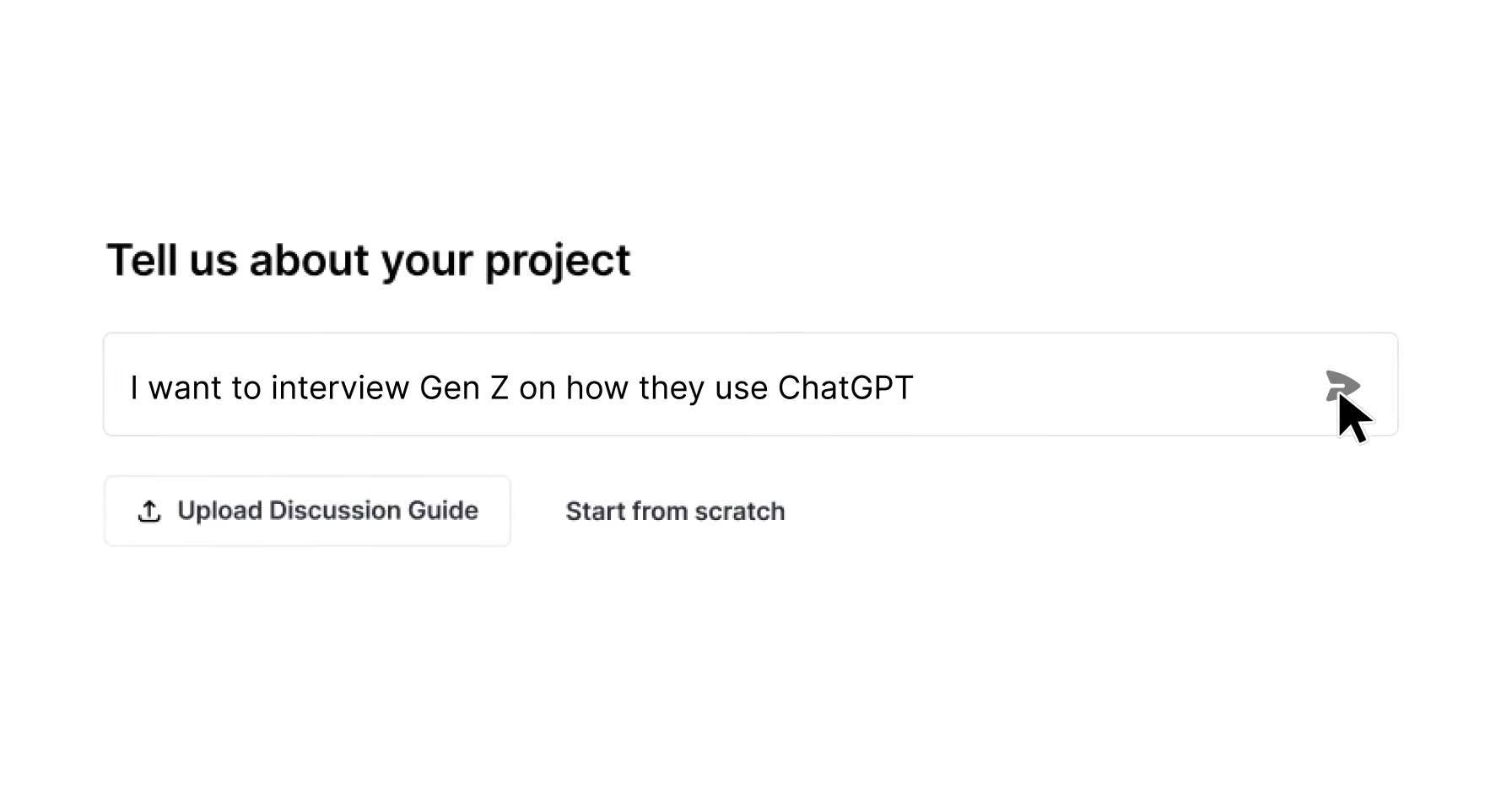
Depth of insight. AI can schedule and conduct interviews, analyze transcripts for themes, and generate quantitative insights from those interviews. The AI probes short or unexpected answers the way a trained human moderator would, without fatigue or social-desirability bias. Ninety-two percent of participants report top comfort levels in AI-moderated sessions, matching human-moderated benchmarks.
Sample quality and fraud prevention. Listen Labs’ Listen Atlas panel of 30M verified respondents is governed by Quality Guard, which applies three automated controls. It uses behavioral matching on intent and past actions, real-time monitoring across video, voice, content, and device signals, and a three-study-per-month cap per participant to eliminate professional survey-takers. For audiences that automated matching cannot reliably reach, such as enterprise decision-makers or segments below 1% incidence rate, a dedicated recruitment operations team adds a human review layer so quality extends to even the most specialized populations.
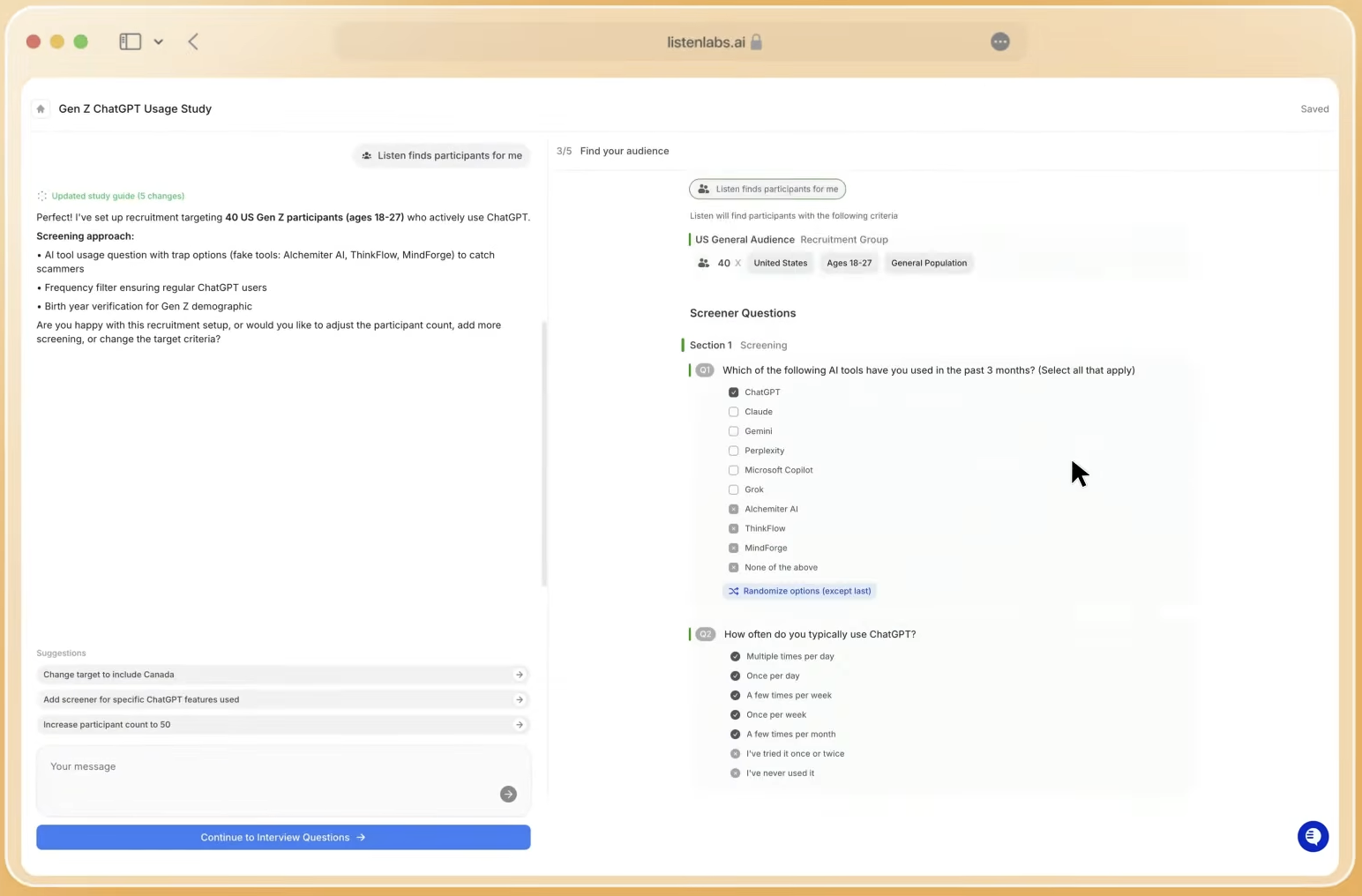
Global and language reach. Listen Labs covers 45+ countries and supports 100+ languages for interview moderation, with automatic translation and transcription. Qual-at-scale works well when research requires large sample sizes or broad geographic reach, because AI tools can engage hundreds or thousands of participants remotely and asynchronously.
Methodological flexibility. Listen Labs supports free-flowing IDIs, semi-structured interviews, concept and prototype testing, usability studies with screen sharing, diary studies, and mixed-method designs. Teams can combine Likert scales, NPS, MaxDiff, and open-ended questions in a single session while keeping a consistent protocol.
Emotional-signal capture. Listen Labs’ Emotional Intelligence layer analyzes tone of voice, word choice, and micro-expressions simultaneously. It quantifies emotions per question and concept with timestamp-level traceability. The next section explains how Emotional Intelligence works and where teams use it most often.
Analysis effort and deliverable speed. Research Agent handles the full analysis workflow from raw data to final output. It generates slide decks, memos, highlight reels, and statistical charts in under a minute. Every insight links directly to the underlying response data, which preserves auditability for enterprise stakeholders.
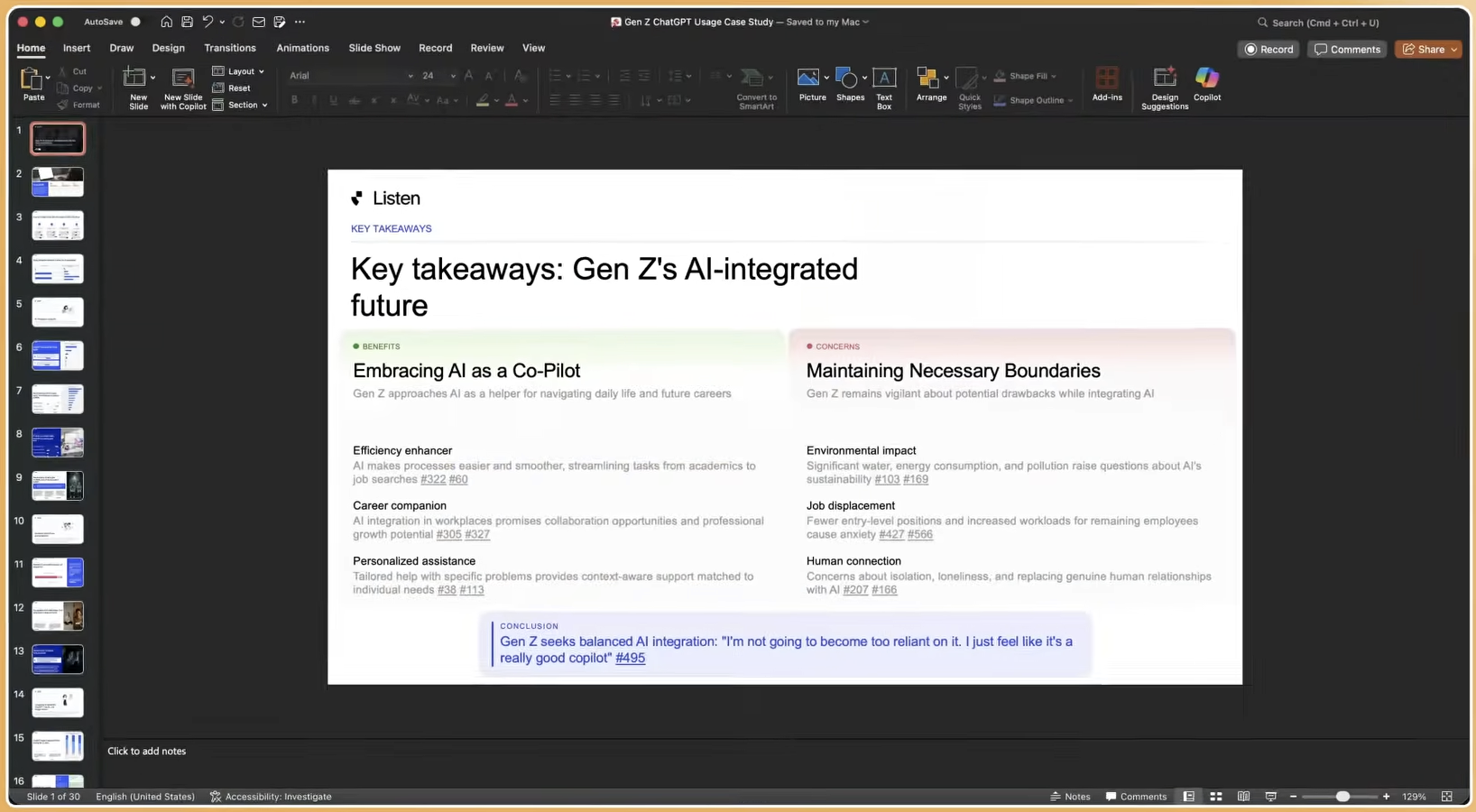
Cross-study knowledge management. Mission Control serves as the organization’s source of truth across all studies. Teams can run cross-study queries, track trends, and build institutional knowledge that compounds with every new study.
Enterprise compliance. Listen Labs holds SOC 2 Type II, GDPR, ISO 27001, ISO 27701, and ISO 42001 certifications. The platform supports enterprise SSO and applies 256-bit encryption, with a guarantee that customer data is never used for AI model training.
Listen Labs has run over 1 million AI-powered customer interviews for companies including Microsoft, Perplexity, and Sweetgreen, and raised $69 million in Series B funding at a valuation over $500 million as of January 2026.
Analysis-Only Tools Across the Same Criteria
Research speed. Tools such as Dovetail, Looppanel, and Vistaly require recordings to be collected, scheduled, and moderated before any analysis can begin. Because these platforms only process data after interviews are complete, they cannot address the recruitment and moderation bottlenecks that drive 4–6 week cycle times. Analysis-only tools such as Dovetail assume interviews have already occurred and focus on storage, search, and post-hoc clustering of transcripts or recordings.
Depth of insight. Analysis-only platforms process whatever recordings teams upload. The quality of probing, follow-up, and adaptive questioning depends entirely on the human moderator who ran the original session. This dependency introduces variability and caps the volume of interviews any team can realistically conduct.
Sample quality and fraud prevention. These platforms have no recruitment infrastructure. Teams must source participants through separate vendors such as Prolific, User Interviews, or Respondent and manage quality controls independently, which adds cost, time, and coordination overhead.
Global and language reach. Multilingual support usually stops at transcription and translation of uploaded content. There is no mechanism for recruiting participants across 45+ countries or conducting AI-moderated interviews in 100+ languages natively.
Methodological flexibility. Analysis-only tools are constrained by the study designs and moderation approaches used in the recordings they receive. They cannot enforce consistent probing protocols, randomize stimuli, or combine qualitative and quantitative question formats within a single session.
Emotional-signal capture. Text-based analysis of uploaded transcripts cannot access tone of voice or facial micro-expressions from recordings unless teams integrate a separate affective computing layer. Dovetail, Looppanel, and Vistaly do not offer this capability natively.
Analysis effort and deliverable speed. AI-assisted theme clustering and quote extraction reduce manual coding time. Synthesis, reporting, and deliverable generation still require significant researcher involvement. Teams do not have a one-click slide deck or highlight reel generated directly from interview data.
Cross-study knowledge management. Repository functionality is the core strength of analysis-only tools. Without integrated recruitment and moderation, the repository only grows as fast as the team can manually conduct and upload studies. This constraint compounds the backlog problem instead of solving it.
Enterprise compliance. SOC 2 and GDPR coverage varies by vendor. None of the analysis-only tools in this category offer the full ISO 27001, ISO 27701, and ISO 42001 stack that enterprise security teams increasingly require for AI-processed customer data.
Among the ten evaluation criteria, sample quality and fraud prevention deserve deeper examination. These controls determine whether insights rest on real customer signals or on professional survey-takers and AI-generated scripts.
Participant Quality and Fraud Risks in 2026
Participant quality is the most consequential variable in any customer discovery program. Commodity panels carry well-documented risks such as professional survey-takers optimizing for incentives, AI-generated response scripts, and mismatched demographic profiles that invalidate segmentation. AI-moderated interview platforms achieved an 87% completion rate versus 34% for human-led video studies on the same recruit pool, which directly improves effective throughput and reduces time-to-insight.
Listen Labs addresses fraud at three layers that operate in sequence. First, Listen Atlas uses behavioral matching on intent and past actions rather than self-reported demographics alone, sourcing participants whose actual behavior aligns with the target profile. Second, Quality Guard monitors every interview in real time across video, voice, content, and device signals, flagging and removing fraudulent responses, low-effort answers, and AI-generated scripts before they enter the analysis pipeline. Third, a hard cap of three studies per month per participant eliminates the repeat-respondent problem that degrades commodity panel data.
For hard-to-reach audiences such as enterprise decision-makers, healthcare workers, engineers, and segments below 1% incidence rate, a dedicated recruitment operations team partners with niche communities and specialized networks. This human review layer works alongside AI orchestration so automation and expert judgment reinforce each other.
The compounding effect of Quality Guard’s reputation scoring means that the more studies Listen Labs runs, the stronger its audience quality becomes. Panel-only vendors and analysis-only tools cannot replicate this flywheel.
Emotional Intelligence: Going Beyond the Transcript
Transcripts capture what participants say but not how they feel while saying it. They miss the hesitation before a word, the flicker of confusion during a concept reveal, or the flat affect behind a nominally positive rating. Emotional Intelligence analyzes three signals: tone of voice, word choice, and subconscious micro-expressions. Two concepts can receive identical verbal ratings while generating measurably different emotional responses, which often determines the right direction for a campaign or product feature.
Listen Labs built Emotional Intelligence using Ekman’s universal emotions framework, tracking anger, anticipation, disgust, fear, joy or happiness, sadness, trust, and surprise. Every emotion is quantified per question and concept, with each label traceable to the exact timestamp, verbatim quote, and AI reasoning behind it. Researchers can see why a response was coded as “fear” rather than only seeing the label.
Teams already use Emotional Intelligence for creative testing, concept comparison, brand research, and usability testing. In usability work, the layer surfaces moments of hesitation and friction that participants do not verbalize, such as silent drops in engagement that a transcript alone would miss. In creative testing, it identifies exactly where viewers light up or disengage, enabling precise edits instead of directional guesses. The feature works across 50+ languages and integrates directly with the Research Agent for natural-language queries, charts, and highlight reels of the most emotionally significant moments.
See Emotional Intelligence in action during a live demo of a concept test or usability study.
With the platform capabilities established, the next step is understanding which features matter most for different enterprise roles. The following scenarios map Listen Labs’ strengths to the specific needs of consumer insights leaders, UX researchers, product managers, and consultancies.
Scenario-Based Guidance for Enterprise Teams
Different enterprise personas have distinct primary needs from an AI customer discovery platform.
- Consumer insights leaders at Fortune 500 enterprises face growing research backlogs and need to multiply study output without proportional headcount increases. Listen Labs compresses a 4–6 week study to under 24 hours, enabling more studies per quarter at roughly a third of the cost of traditional methods. The Director of Data Science at Microsoft noted, “I can reach out to hundreds of users at one third of the cost.”
- UX research leads at mid-to-large tech companies need faster feedback loops to keep pace with sprint cycles. Listen Labs supports screen sharing, prototype testing, and usability studies with 50–100+ participants instead of the 5–10 that human-moderated logistics typically allow. UX teams using Perspective AI for AI-moderated interviews complete studies in under 48 hours instead of the previous 21-day timeline.
- Product managers and marketing leaders without dedicated research teams can describe goals in natural language and have Listen Labs handle study design, recruitment, moderation, and analysis automatically. They do not need formal methodology training to run credible studies.
- Consultancies and agencies running client engagements or investment due diligence benefit from Listen Labs’ global reach, niche audience sourcing, and sub-24-hour turnaround. The Director of Product Strategy at Anthropic stated, “Listen Labs lets us understand user churn with a level of clarity and speed we’ve never had before.”
Operational Considerations and Scaling
End-to-end AI customer discovery platforms require a different operating model than simply adding AI to existing workflows. Teams that only added AI to 2019-era workflows achieved just 28–35% time savings, largely because they continued running interviews sequentially with human moderators and skipped synthesis quality checks. Real efficiency gains come from restructuring around continuous discovery cadences and enabling self-serve research for product and marketing stakeholders.
Listen Labs acts as a force multiplier for existing research teams rather than a replacement. The in-house research team, with 50+ years of combined expertise, serves as a thought and execution partner during onboarding and ongoing program design. Study templates, auto-QA on study guides, and clone functionality reduce the expertise barrier for non-researcher stakeholders who run their own studies.
For global programs, the platform’s 45+ country coverage and 100+ language support for moderation remove the need to coordinate separate regional vendors. Mission Control aggregates findings across markets into a single queryable knowledge base, enabling trend tracking and cross-market comparisons without manual data consolidation. As noted earlier, this sub-24-hour turnaround also eliminates the need to juggle multiple vendors for global work.
Decision Framework: Questions Research Leaders Should Answer
Before selecting a platform, research leaders should be able to answer the following questions about any vendor under consideration.
- Does the platform handle recruitment, moderation, analysis, and deliverable generation in a single workflow, or does it require external tools for any of these steps?
- What fraud prevention controls operate at the participant level, and are they applied in real time during the interview or only after data collection?
- Can the platform reach the specific audience segments required, including niche, low-incidence, and international populations, without relying on commodity panels?
- Does the analysis layer capture emotional signals beyond transcript text, and are those signals traceable to specific timestamps and verbatims?
- What is the realistic time from study brief to stakeholder-ready deliverable, including recruitment, fielding, analysis, and report generation?
- Does the platform hold SOC 2 Type II, GDPR, ISO 27001, ISO 27701, and ISO 42001 certifications, and does it guarantee that customer data is never used for model training?
- How does the platform build institutional knowledge across studies, and can researchers query past findings without digging through archived reports?
Frequently Asked Questions
How quickly does Listen Labs deliver results?
Listen Labs compresses the full research lifecycle, including study design, participant recruitment, AI-moderated interviews, analysis, and deliverable generation, to under 24 hours. This window includes consultant-quality slide decks, memos, video highlight reels, and statistical charts generated by the Research Agent. For large-scale global programs, turnaround times vary by audience complexity and study size, yet the platform still delivers results in hours rather than the 4–6 weeks required by traditional qualitative methods.
How does Listen Labs source and verify participants?
Listen Labs operates Listen Atlas, a global panel of 30M verified respondents across 45+ countries and 100+ languages. An AI orchestration layer automatically matches and bids on the best participants across multiple consumer and B2B panel partners alongside Listen Labs’ proprietary database. Organizations can also self-recruit from their own user base at reduced cost. For hard-to-reach segments such as enterprise decision-makers, healthcare workers, engineers, and audiences below 1% incidence rate, a dedicated recruitment operations team partners with niche communities and specialized networks.
What makes Listen Labs’ sample quality different from commodity panels?
Quality Guard’s three-layer system, detailed in the Participant Quality section, combines upfront behavioral matching, real-time fraud detection, and a per-participant study cap. Unlike commodity panels that rely on self-reported demographics, Listen Labs’ reputation scoring system compounds with every study, so audience quality improves continuously rather than degrading over time. Listen Labs does not work with commodity quantitative panels.
How does AI moderation compare to human moderation in terms of insight quality?
AI moderation delivers comparable qualitative depth to human moderation for the vast majority of consumer insights and UX research use cases while enabling 10–100 times the volume at a fraction of the cost. The AI probes short or unexpected answers with open, non-leading follow-up questions and applies identical methodology across every session without fatigue or social-desirability bias. It also supports mixed-method designs that combine open-ended questions with Likert scales, NPS, MaxDiff, and other quantitative formats. Human moderation remains preferable for highly sensitive clinical topics, in-person ethnographic observation, and high-stakes executive interviews that require personal rapport.
What security certifications does Listen Labs hold, and how is customer data protected?
As noted in the platform evaluation, Listen Labs maintains the full ISO certification stack required by enterprise security teams. The platform applies 256-bit encryption for data at rest and in transit, supports enterprise SSO integration, and provides role-based access controls. Customer data is never used to train or fine-tune AI models. These controls include data residency options, granular deletion support for data subject access requests, and immutable audit logs, which meet the enterprise security requirements that analysis-only tools and emerging AI platforms frequently cannot satisfy.
Conclusion: Selecting the Right AI Customer Discovery Partner
The category distinction is clear. Analysis-only tools organize research that teams have already conducted, while end-to-end AI customer discovery platforms remove the bottlenecks that make research slow and expensive. Recruitment delays, moderation constraints, manual synthesis, and fragmented vendor stacks are operational problems that post-hoc analysis alone cannot solve.
Listen Labs combines a 30M verified panel, Quality Guard fraud controls, AI-moderated interviews in 100+ languages, Emotional Intelligence capture built on the Ekman framework, and a Research Agent that produces stakeholder-ready deliverables in under a minute. All of this operates within a SOC 2 Type II, GDPR, ISO 27001, ISO 27701, and ISO 42001 compliant environment. For enterprise teams at Microsoft, P&G, Anthropic, Skims, and Robinhood, that combination has replaced fragmented workflows with a single source of continuous customer intelligence.
See the full research lifecycle in action and explore how Listen Labs delivers results in under 24 hours at enterprise scale.