
Written by: Anish Rao, Head of Growth, Listen Labs
Key Takeaways for Enterprise Insights Leaders
- AI moderation lets enterprises run hundreds of in-depth qualitative interviews at once, so teams gain both depth and scale.
- Five non-negotiable quality guardrails define enterprise-ready AI moderation: verified sourcing, real-time fraud detection, adaptive probing, emotional signal capture, and governance.
- Listen Labs delivers the full research lifecycle on one platform, compressing weeks-long studies into under 24 hours with native support for 100+ languages and consultant-quality deliverables.
- AI and human moderation work best together. AI handles large-scale theme discovery while humans run targeted follow-ups, and AI synthesis combines both data sources.
- Listen Labs combines a 30-million verified panel, real-time fraud protection, and Ekman-based emotional intelligence to deliver enterprise-grade qualitative research at scale. See how it works in a live walkthrough.
Where AI Moderation Fits in Today’s Research Stack
Backlinko’s 2026 report found that 47% of researchers worldwide now use AI regularly in their market research activities, a tipping point that signals AI moderation has moved from experimental to mainstream. The infrastructure behind that adoption has matured considerably.
Listen Labs runs the full research lifecycle on a single platform. Study design starts with an AI co-pilot that turns a plain-language brief into structured objectives, screener logic, and a discussion guide in seconds. Recruitment draws from Listen Atlas, a global network of 30 million verified respondents across 45+ countries, with an AI orchestration layer that matches participants on behavioral and intent signals rather than self-reported demographics alone. A dedicated recruitment operations team handles segments below 1% incidence, such as enterprise decision-makers, healthcare workers, and engineers, without routing requests to external vendors.
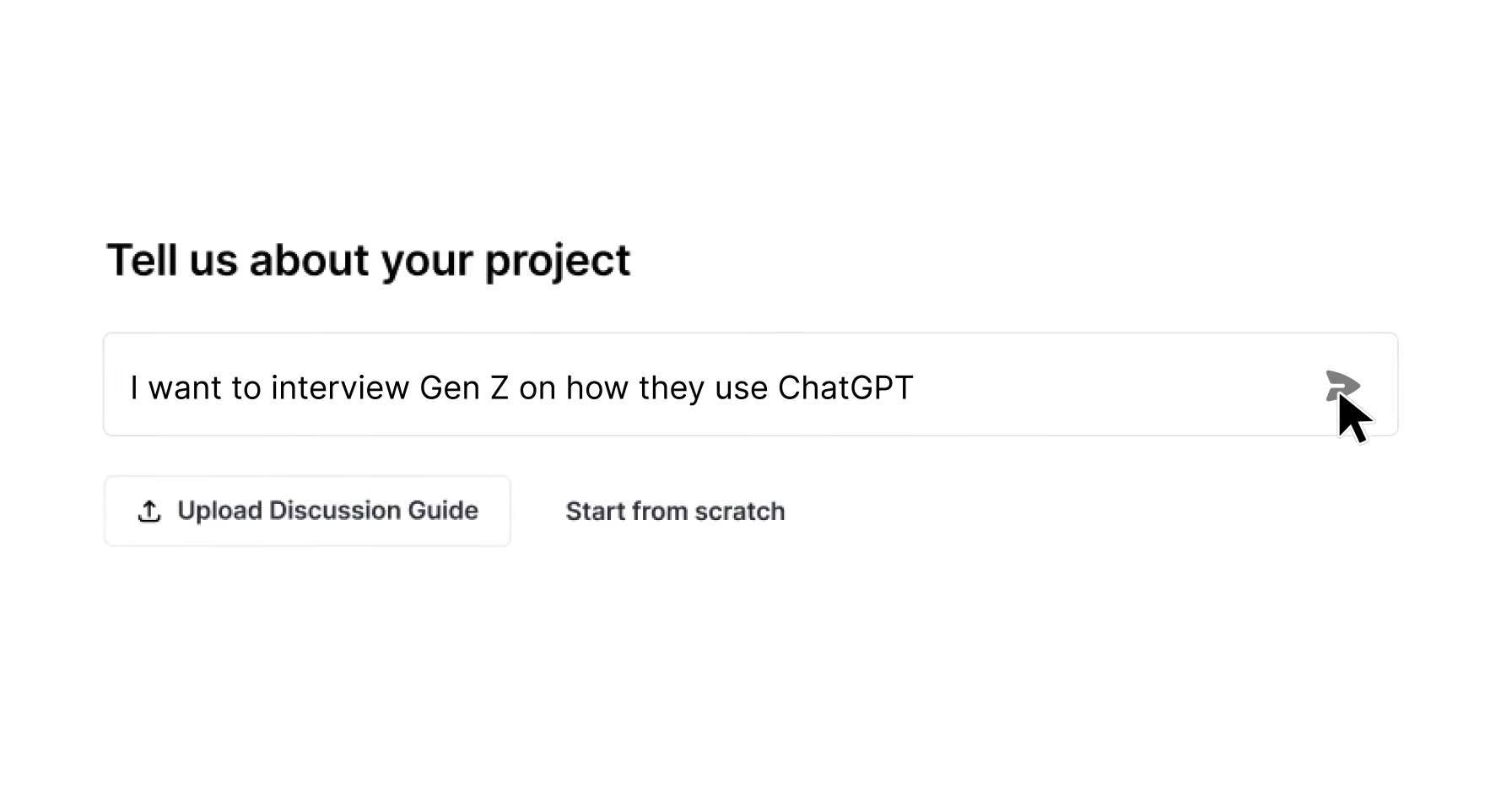
Once fielded, the AI moderator conducts video interviews simultaneously across all enrolled participants and probes deeper on short or ambiguous answers the way a trained human interviewer would. The platform’s native multilingual support, covering over 100 languages with automatic transcription and translation, means a single study can span markets without separate fieldwork cycles. Platforms like Listen Labs layer on auto-recruiting, transcription, sentiment tagging, and insight summarization so teams jump from question to findings in hours, not weeks. Work that previously required a 4–6 week cycle, and sometimes six months in complex enterprises, now delivers consultant-quality reports, slide decks, and video highlight reels within that same timeframe.
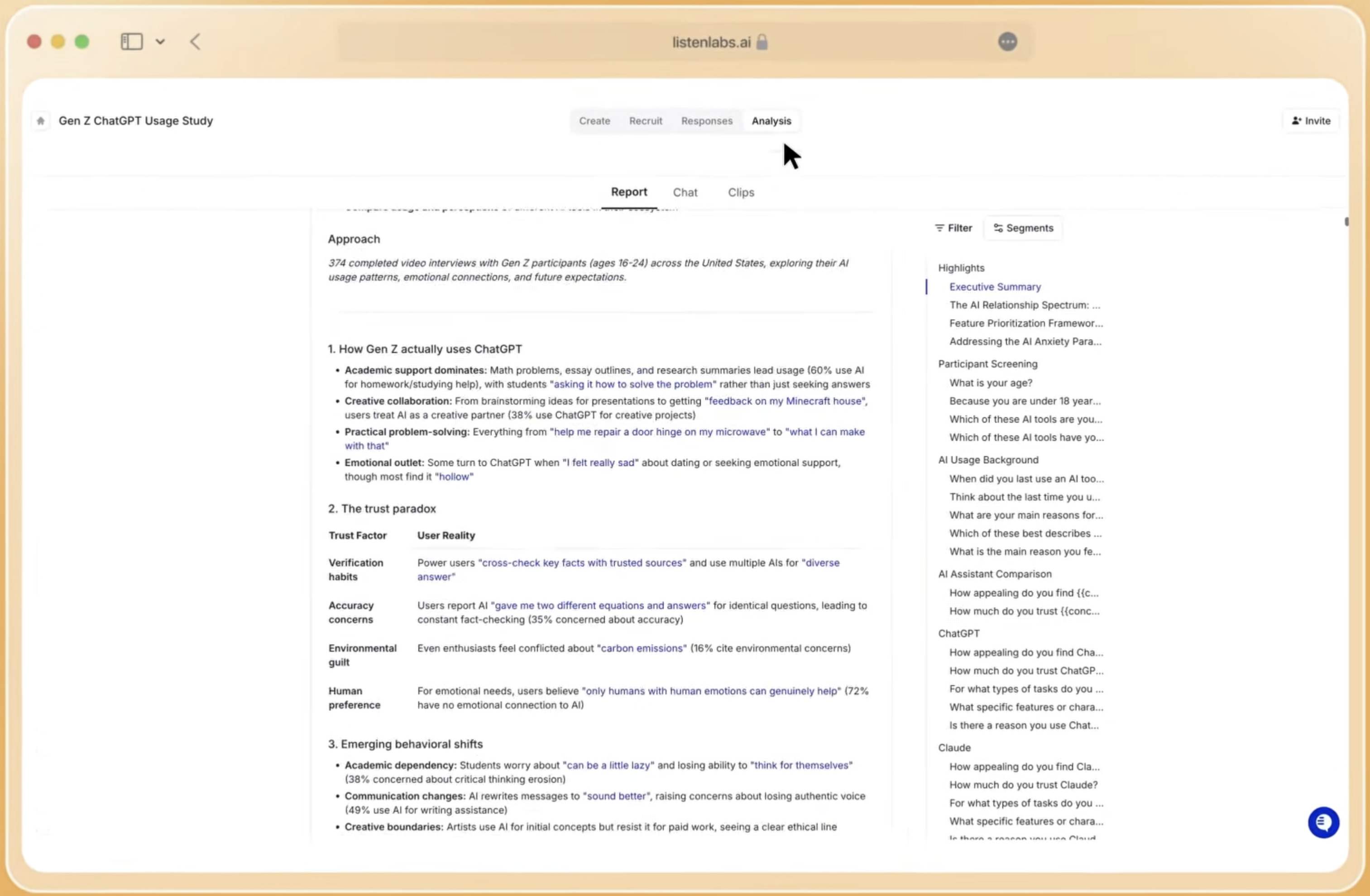
Ready to compress your research cycle? See a live study move from brief to final report in our platform demo.
When to Use AI Moderation vs. Human Moderators
Nielsen Norman Group’s 2026 evaluation of AI-moderated interview tools concluded that AI interviewers are appropriate for product feedback collection, recruitment screening, multilingual interviews, and structured studies requiring consistency, while humans retain an edge in exploratory research where the right questions are unknown and in high-stakes strategic decisions that require real-time domain judgment.
On measurable dimensions, AI moderation matches or exceeds human performance on probe consistency across hundreds of interviews, avoidance of leading questions, full discussion guide coverage, and multilingual fluency. A single skilled human researcher can realistically conduct about 12–15 interviews per week. AI moderation removes this constraint by running hundreds of interviews simultaneously and asynchronously.
A study comparing AI and human moderation found that 92% of participants reported top comfort levels in both formats, with AI preferred for sensitive topics such as personal finances, politics, and mental health because it reduces social judgment and offers flexible scheduling.
The practical 2026 workflow treats AI and human moderation as complementary. The optimal approach uses AI moderation for the top of the funnel, running 100 to 500 interviews to surface themes and identify interesting respondents, and human moderation for 5–10 follow-up in-depth interviews, with AI synthesis combining both data sources. Listen Labs is built to support this hybrid model, giving research teams a force multiplier rather than a replacement.
Fraud Controls That Keep Large-Scale Qualitative Data Trustworthy
That force multiplier only delivers value when the underlying data is trustworthy. Professional survey-takers and incentive-driven low-effort responses are the most cited quality failure in scaled qualitative research. Listen Labs addresses this through three reinforcing layers that work together to prevent fraud at different stages.
First, Listen Atlas sources participants exclusively from high-quality, non-commodity panels and applies behavioral and intent matching rather than relying on self-reported demographic screeners. This approach filters out professional survey-takers before they ever enter a study. Second, Quality Guard provides multi-layered fraud detection that validates participant identity and response quality in real time during AI-moderated interviews, monitoring video, voice, content, and device signals simultaneously. This layer catches fraud attempts that pass initial screening. Third, participants are capped at three studies per month across the platform, which structurally eliminates the repeat-respondent problem that undermines commodity panels even when individual responses appear acceptable.
A dedicated recruitment operations team adds a human review layer for hard-to-reach segments, and every output links directly back to specific participant quotes, video timestamps, or interview moments, enabling researchers to audit responses when quality is questioned. The Quality Guard system compounds over time. As more studies run on the platform, reputation scoring strengthens, creating a quality flywheel that point-solution competitors cannot replicate.
How Listen Labs Captures Emotion Beyond the Transcript
Emotional signals often explain why a concept succeeds or fails, and transcripts alone miss those cues. Transcripts capture what participants say. They do not capture the frown during a product demo, the hesitation before answering a pricing question, or the widened pupils when a concept lands. Two concepts can receive identical verbal ratings while triggering entirely different emotional responses.
Listen Labs built Emotional Intelligence using Ekman’s universal emotions framework, analyzing three signals: tone of voice, word choice, and subconscious micro expressions, available across 50+ languages. Every emotion is quantified per question and concept, and every label is traceable to the exact timestamp, verbatim quote, and the reasoning behind the classification. Researchers can ask which concept triggered the most confusion and receive a side-by-side emotional breakdown across stimuli, segments, and markets.
Microsoft used Listen Labs to collect global customer stories for its 50th anniversary within a single day, replacing a 6–8 week timeline. The Director of Data Science at Microsoft noted, “I can reach out to hundreds of users at one third of the cost.” Skims validated campaign direction with thousands of premium consumers overnight. The SVP of Data, Insights, and Loyalty at Skims observed, “I always struggled with understanding the why and Listen Labs nails this for me.” Emotional Intelligence is available across 50+ languages and connects directly to the Research Agent for natural-language queries, charts, and highlight reels of the most emotionally significant moments.
Explore how Emotional Intelligence captures what transcripts miss. Request a demo focused on timestamp-level emotion data from a live study.
ROI Benchmarks from Enterprise-Scale Deployments
Maze’s Future of User Research 2026 report found that 22% of organizations now use research at every level of business strategy, up from 8% a year prior, with AI moderation identified as the single biggest driver behind the increase. The enterprise case studies behind Listen Labs’ platform show how that shift translates into speed, savings, and strategic impact.
Four enterprise deployments illustrate the pattern: speed and cost advantages translate directly to strategic impact. Microsoft compressed global qualitative fieldwork to the sub-24-hour cycle mentioned earlier at one-third of traditional cost. Anthropic ran 300+ user interviews in 48 hours to surface Claude subscription churn drivers, moving 5x faster than prior methods, and delivered a prioritized list of ten must-fix items including feature gaps and migration patterns to competing platforms. Procter & Gamble completed 250+ interviews evaluating men’s product claims, with quantified themes and verbatim proof delivered in hours rather than weeks, which directly shaped product and brand strategy before market launch. Skims identified and qualified thousands of premium consumers overnight, removed weeks of recruiting and panel sourcing, and secured board-level buy-in on a global campaign direction before launch.
CPG brands using AI-moderated research have achieved faster research cycles and significant cost savings compared with traditional qualitative methods. No 2024 University of Melbourne HCI Lab study on AI-moderated interview data richness, volume, or cost was found; the only Melbourne paper addresses ethical AI game moderation instead. Listen Labs has now conducted over 1 million AI-powered customer interviews for enterprises including Microsoft, Perplexity, and Sweetgreen.
Implementation Readiness and Governance for Insights Teams
Enterprise adoption of AI moderation depends on governance alignment as much as on feature depth. Listen Labs holds SOC 2 Type II, GDPR, ISO 27001, ISO 27701, and ISO 42001 certifications. Customer data is encrypted at 256-bit and is never used for AI model training, which satisfies the data residency and model-training restrictions that legal and security teams routinely flag during procurement.
For stakeholder alignment, the most effective pilot scope runs a single study type, such as concept testing or churn research, against an audience the team already knows well. This approach lets internal stakeholders validate output quality against existing institutional knowledge. Organizations with more than 100 employees typically move through a demo and structured pilot process. Self-serve access is available for smaller teams. Bring-your-own-panel options let organizations study their own user base at reduced credit cost, which lowers the barrier to a first deployment.
Start with a scoped pilot. Schedule a consultation to map Listen Labs to your current research backlog.
Frequently Asked Questions
Does AI moderation replace human researchers?
No. Listen Labs is designed as a force multiplier for existing research teams. The platform handles recruitment, moderation, transcription, and initial analysis, which are the logistical and time-intensive tasks that consume most of a research team’s capacity. Researchers focus on strategic interpretation, stakeholder communication, and study design decisions that require domain expertise. Teams running Listen Labs typically increase their study output significantly without adding headcount.
What data privacy certifications does Listen Labs hold?
Listen Labs maintains SOC 2 Type II, GDPR, ISO 27001, ISO 27701, and ISO 42001 certifications. All data is encrypted at 256-bit. Customer data is never used to train AI models. These certifications cover the full research lifecycle, including participant data collected during AI-moderated interviews.
Can Listen Labs reach niche or low-incidence audiences?
Yes. The 30 million verified respondent network covers general population and consumer segments across 45+ countries. For audiences below 1% incidence, such as enterprise decision-makers, licensed healthcare workers, engineers with specific technology stacks, or highly specialized consumer profiles, a dedicated recruitment operations team partners with niche communities, micro-creators, and specialized networks to source the right participants. Organizations can also self-recruit from their own user base at reduced cost.
How is Listen Labs different from using a general-purpose LLM for research?
General-purpose LLMs can help draft discussion guides or summarize text, but they do not conduct interviews, recruit participants, detect fraud, or analyze multimodal signals. Listen Labs is built on tens of thousands of completed studies, giving the platform proprietary understanding of which question types produce better analysis, which methodologies match which research objectives, and how to separate signal from noise at scale. The platform covers the entire research lifecycle, including study design, recruitment, moderation, emotional analysis, and deliverable generation, in a single workflow that no general-purpose LLM replicates.
What deliverables does Listen Labs produce?
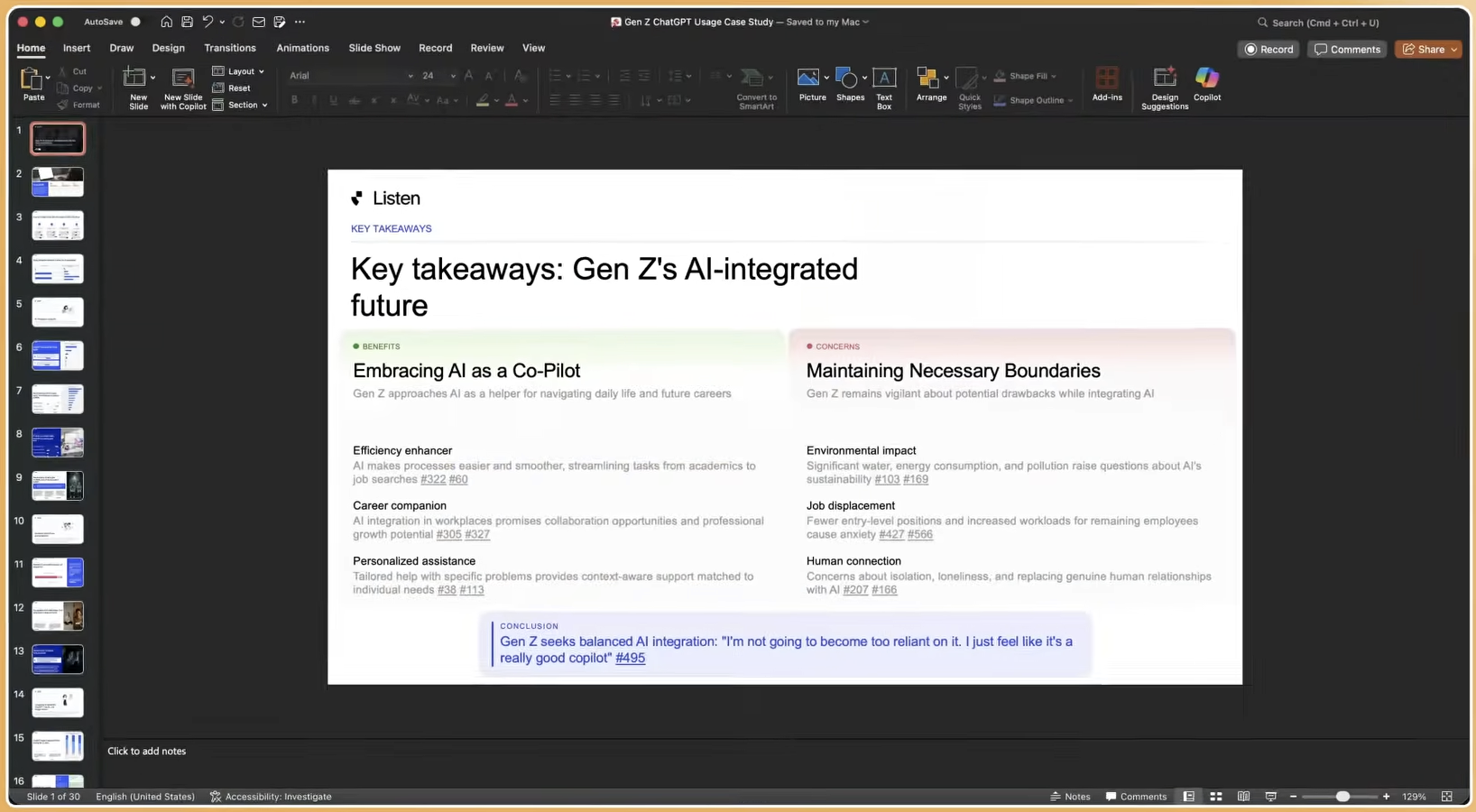
The Research Agent generates automated key findings and thematic analysis, consultant-quality PowerPoint slide decks, memo-style reports, video highlight reels, statistical charts with significance testing, segmentation breakdowns by demographics or custom cohorts, and responses to any natural-language query against the full interview dataset. Every insight links back to the underlying participant quote, video timestamp, or interview moment, so findings are auditable and stakeholder-ready without additional analyst work.
Conclusion: Scaling Qualitative Research Without Losing Depth
The depth-versus-scale trade-off that has constrained enterprise qualitative research for decades is a structural problem with a structural solution. AI moderation, when built on a verified panel, real-time fraud protection, Ekman-based emotional analysis, and a full-stack delivery pipeline, removes that constraint entirely. Qual-at-scale is ideal when research requires large sample sizes or broad geographic reach, with AI tools engaging hundreds or thousands of participants remotely and asynchronously.
Listen Labs is the only platform that combines the verified panel scale described above, Quality Guard real-time fraud detection, Ekman-based Emotional Intelligence with timestamp traceability, the multilingual reach described earlier, and the rapid delivery described above in a single end-to-end workflow. Enterprises such as Microsoft, Anthropic, P&G, and Skims rely on this stack to run continuous customer intelligence programs at scale.
See how Listen Labs fits your team’s workflow and research priorities in a tailored platform demo.