
Written by: Anish Rao, Head of Growth, Listen Labs
Key Takeaways
- Discuss.io and UserTesting rely on manual setup, scheduling, and sequential workflows that stretch research cycles to four to six weeks.
- Listen Labs uses AI-assisted study design, parallel AI-moderated interviews, and automated analysis to deliver results in under 24 hours.
- Quality Guard and a verified 30-million-respondent network provide real-time fraud prevention and high-quality participants across 45+ countries.
- Emotional Intelligence layers tone, word choice, and micro-expressions onto transcripts, delivering deeper insight than traditional moderated platforms.
- Teams ready to compress research cycles from weeks to hours can see the platform in action and walk through a live study from setup to deliverables.
Evaluation Criteria for Discuss.io Alternatives
Any rigorous evaluation of moderated interview platforms in 2026 should apply the same nine criteria across every option: research speed, depth of insight, sample quality and fraud prevention, participant sourcing reach, methodological flexibility, global and language coverage, analysis effort, reporting transparency, security and compliance, and total operational burden. These criteria cover the full research lifecycle, from study design through data collection to final deliverables, so no critical dimension gets overlooked. Applying them consistently prevents teams from optimizing for one dimension, usually speed or cost, while accepting hidden trade-offs in another, such as fraud risk or shallow analysis.
Study Setup and Recruitment Comparison
Discuss.io and UserTesting both require manual study setup, participant screening, and scheduling coordination before a single interview begins. Recruitment timelines on human-moderated platforms typically extend the total research cycle to four to six weeks from brief to final report. In enterprise settings with internal approval layers, that window often stretches even further.
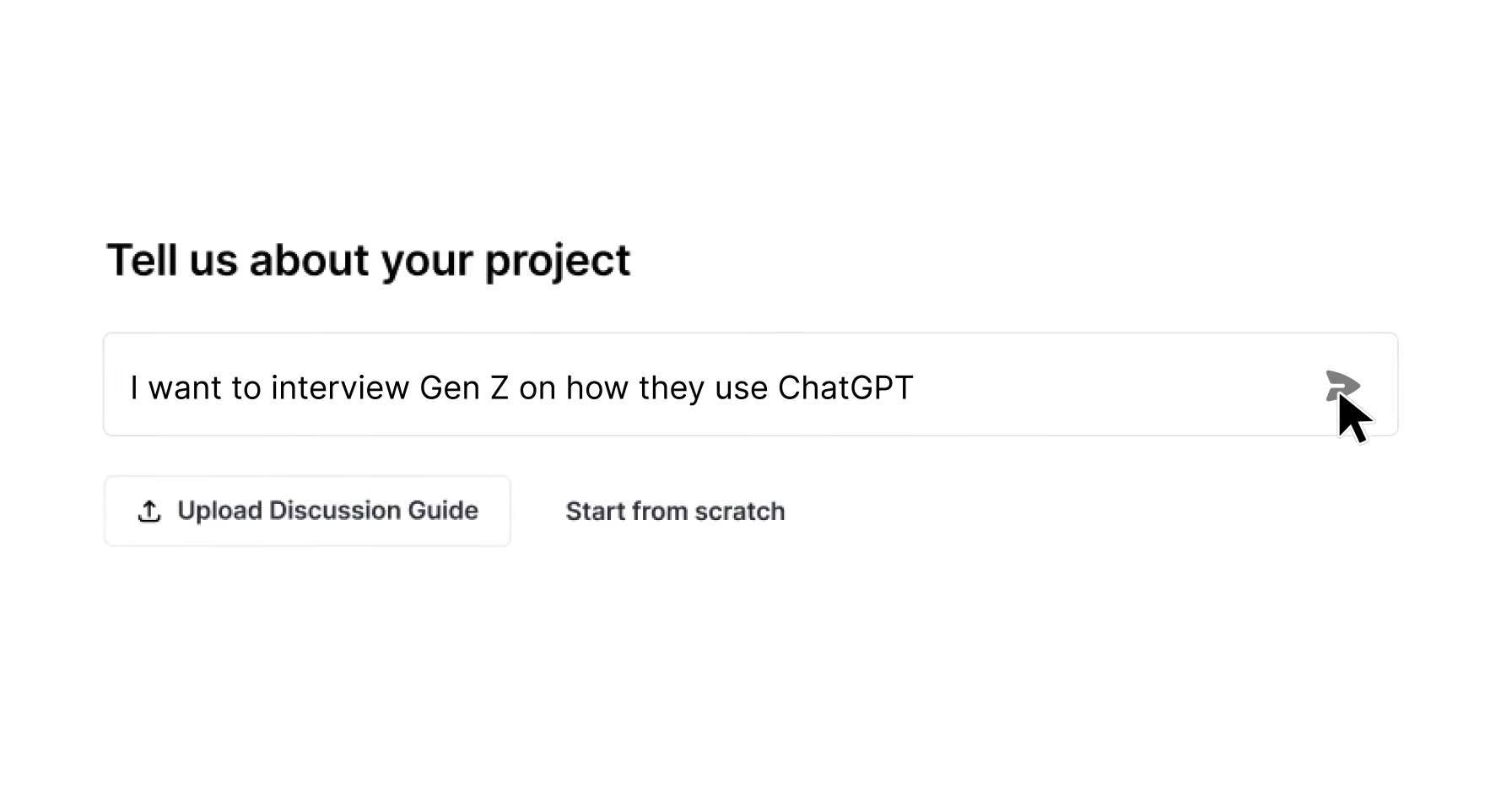
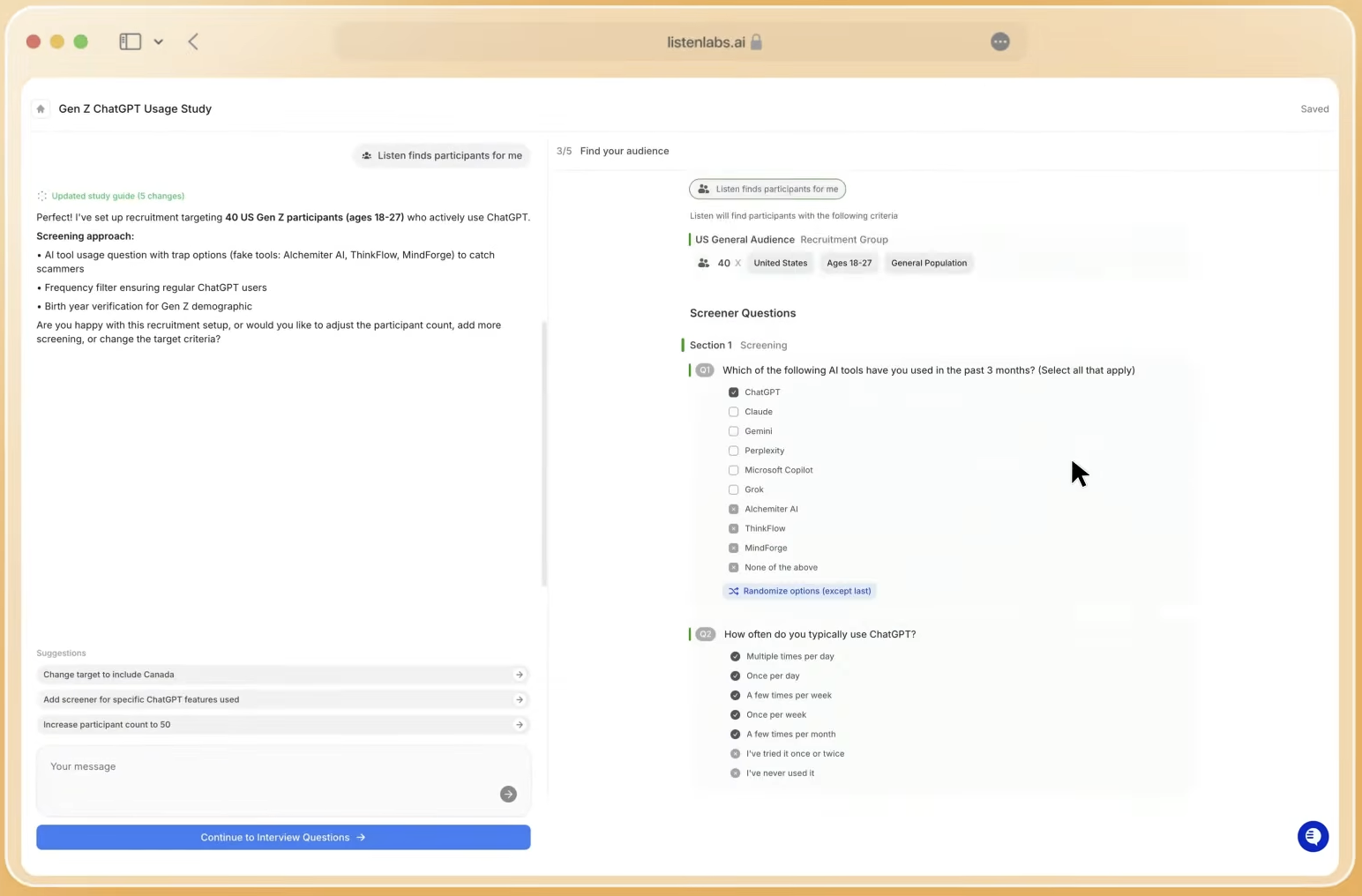
Listen Labs compresses setup through AI-assisted study co-design. Researchers describe goals in natural language and the platform drafts structured objectives, questions, and probing context automatically. Recruitment draws from a verified network of 30 million respondents across 45+ countries, with an AI orchestration layer called Listen Atlas that matches and bids across multiple panel partners and a proprietary database simultaneously. A dedicated recruitment operations team handles hard-to-reach segments such as enterprise decision-makers, healthcare workers, and audiences below 1% incidence rate, without requiring the client to manage separate panel vendors.
Recruitment speed only creates value when the participants are real and unique. YouGov’s annual benchmarking program found an average fraud detection rate of 16.6% and an average duplicate respondent rate of 11.4% across traditional panels, which means a large share of responses may be unreliable. Studies of web-based survey projects show that researchers often remove a substantial percentage of respondents after fraud review. Listen Labs addresses this at the sourcing stage through Quality Guard, which applies real-time monitoring across video, voice, content, and device signals, and enforces a limit of three studies per month per participant to eliminate professional survey-takers.
Moderation Approach and Data-Quality Controls
UserTesting and Discuss.io both depend on human moderators, which introduces scheduling dependencies, moderator variability, and a hard ceiling on how many interviews can run in parallel. Quality is tied to individual moderator skill, and scaling requires proportionally more human resources.
Listen Labs removes that ceiling entirely. It conducts AI-moderated video interviews that run simultaneously across hundreds or thousands of participants. The AI probes deeper on short or interesting answers the same way a trained human interviewer would, adapting dynamically to each response. A study comparing AI and human moderation found that 92% of participants reported top comfort levels in both formats, and 32% explicitly stated they feel less judged with AI moderation, which creates a clear advantage for sensitive topics where social desirability bias suppresses honest answers in human-moderated sessions.
Real-time quality controls operate throughout every interview, not just at recruitment. Quality Guard monitors behavioral signals continuously, and the platform’s reputation scoring compounds over time. The more studies run on Listen Labs, the stronger the audience quality becomes, creating a flywheel that human-moderated platforms cannot structurally match.
See the 24-hour research cycle in action by scheduling a walkthrough of a live study.
Qualitative Depth, Quantitative Support, and Emotional Intelligence
A persistent concern about AI-moderated interviews is whether they sacrifice conversational depth, meaning the nuanced follow-up questions that skilled human interviewers provide. That trade-off existed when AI moderation followed rigid scripts and rules. The depth-versus-scale trade-off is no longer a structural barrier when AI can conduct adaptive, personalized conversations at scale and probe deeper on interesting answers. Listen Labs combines qualitative interview questions with quantitative formats such as Likert scales, NPS, sliders, and MaxDiff within a single study, which removes the need to run separate qual and quant workstreams.
The more significant differentiation in 2026 is Emotional Intelligence. Most moderated platforms, human or AI, capture only what participants say. Listen Labs’ Emotional Intelligence analyzes three signal layers, tone of voice, word choice, and subconscious micro expressions, to surface emotions that transcripts alone miss. The system is built on Ekman’s universal emotions framework, the same standard used in clinical psychology and UX research. Every emotion is quantified per question and concept, with every label traceable to the exact timestamp, verbatim quote, and AI reasoning behind it. Teams using Listen Labs for creative testing, concept comparison, usability testing, and brand research gain a data layer that neither Discuss.io nor UserTesting provides.
Analysis Workflow, Deliverables, and Knowledge Reuse
On human-moderated platforms, analysis begins after all interviews are complete and requires manual review of transcripts, tagging, theme synthesis, and report writing. This stage often consumes the most time in the research cycle and introduces the most subjective bias.
Listen Labs’ Research Agent handles the full analysis workflow from raw data to final output. Researchers can ask any question in natural language and receive answers, charts, statistical tests, and segmentation breakdowns. One researcher ran a full buying intent analysis across three user segments in under a minute. Every insight links directly to the underlying response data, preserving the traceability that enterprise stakeholders require. Deliverables such as slide decks in branded templates, memo-style reports, and video highlight reels are generated automatically rather than written manually.
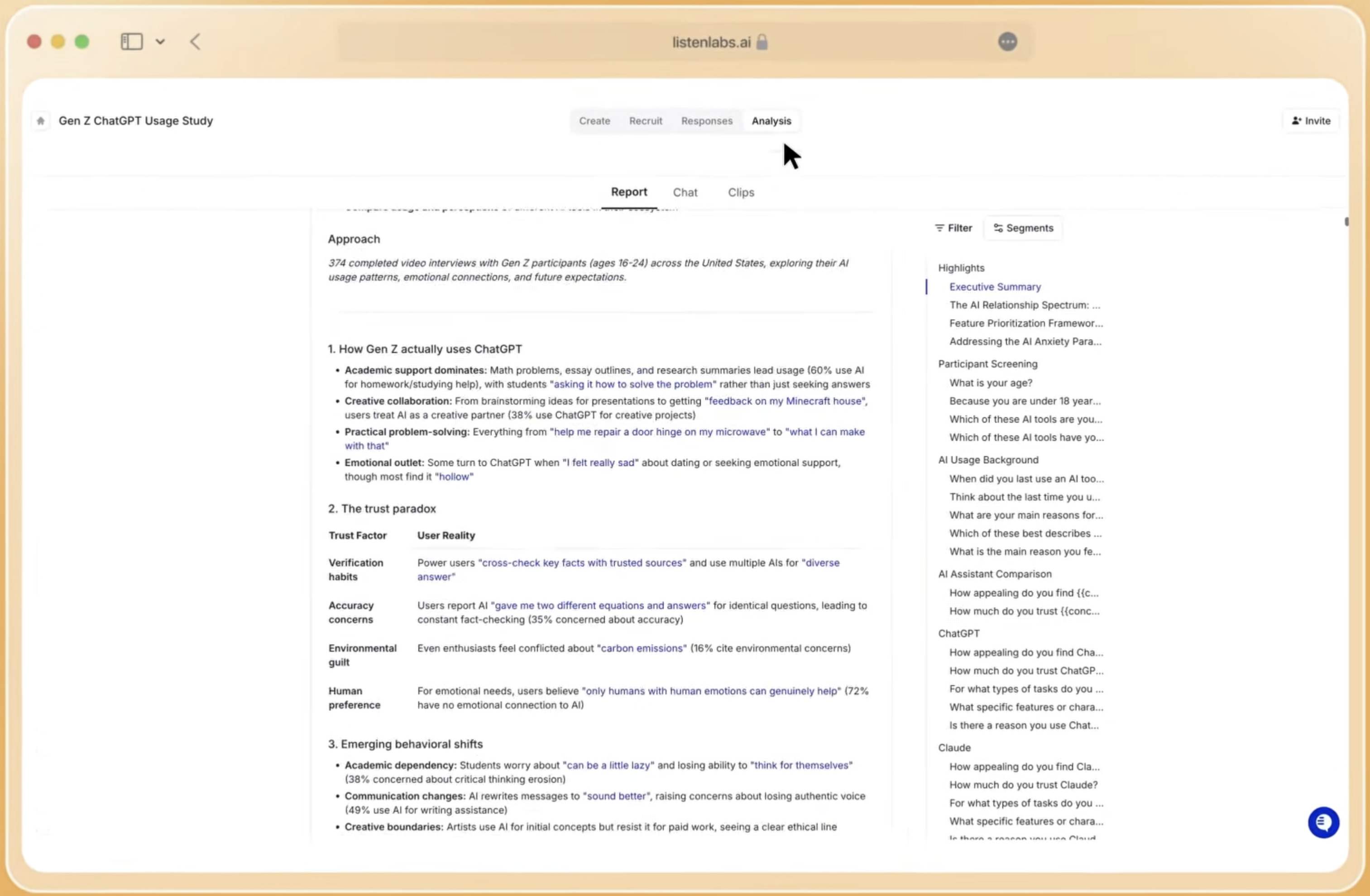
Mission Control extends this further by serving as a persistent knowledge base across all studies. Teams can query past research in seconds, track sentiment trends over time, and avoid re-researching questions that have already been answered. This is particularly valuable for enterprise insights teams managing large study backlogs that must respond to executive questions in hours, not weeks. Deloitte’s 2026 Global Human Capital Trends report identifies being fast and nimble, the ability to adapt quickly to changing needs, as the primary competitive strategy for most leaders. Four-to-six-week research cycles cannot support that strategy, while Mission Control’s instant access to historical data can.
Best-Fit Use Cases by Team Type
Enterprise insights teams running continuous research programs benefit most from Listen Labs’ combination of scale, automated deliverables, and Mission Control’s cross-study knowledge base. The Microsoft team used Listen Labs to collect global customer stories for Microsoft’s 50th anniversary within a day, a timeline that human-moderated platforms cannot match structurally.
UX research leads needing to keep pace with sprint cycles gain the ability to test with 50 to 100+ participants instead of the 5 to 10 that scheduling constraints typically allow on human-moderated platforms. Screen sharing and mobile screen recording are supported natively.
Product and marketing teams without dedicated researchers can describe research goals in natural language and have the platform handle study design, recruitment, moderation, and analysis end-to-end. Anthropic’s team used Listen Labs to conduct 300+ user interviews in 48 hours to surface churn drivers, a scope that would require weeks of coordination on Discuss.io or UserTesting.
Agencies and consultancies with client timelines measured in days rather than weeks can use Listen Labs’ global panel reach and automated deliverables to run bespoke research at a pace that traditional moderated platforms cannot support.
Operational and Long-Term Considerations
Switching moderated interview platforms involves more than a feature comparison. Teams should evaluate stakeholder alignment requirements, internal methodology expertise, compliance obligations, and whether the platform supports ongoing programs or only one-off studies.
On the compliance dimension, Listen Labs holds SOC 2 Type II, GDPR, ISO 27001, ISO 27701, and ISO 42001 certifications, with 256-bit encryption and a policy that customer data is never used for AI model training. These certifications satisfy the security review requirements of most enterprise procurement processes. The platform supports Enterprise SSO and is designed for multi-team deployment, which matters for organizations running research across product, brand, and insights functions simultaneously.
For global programs, Listen Labs supports 100+ languages for interview moderation with automatic translation and transcription, and Emotional Intelligence is available across 50+ languages. Human-moderated platforms must scale moderator headcount to reach similar coverage, which adds time and cost for multi-market studies.
Risks, Limitations, and Common Misconceptions
Teams evaluating AI-moderated platforms sometimes assume that automation produces shallow data. The evidence does not support this. AI-moderated interviews avoid the social biases, including groupthink, conformity, and dominant voices, that reduce data quality in human-moderated group formats, and adaptive follow-up questioning produces the same conversational depth as skilled human moderation for the majority of research objectives.
A more legitimate risk is overestimating what any platform can do without clear research objectives. Poorly scoped studies lead to vague questions, misaligned audiences, and data that cannot answer stakeholder decisions. Automated analysis surfaces patterns from the data provided, and no analysis layer can repair a flawed research design. Listen Labs addresses this through AI-assisted study co-design and an auto-QA function that flags issues in the study guide before launch.
Hidden recruitment complexity is another risk on platforms that require buyers to source their own participants. Even high-quality panel providers apply rigorous screening, which means the effective yield from external panels is often lower than headline panel size figures suggest. Listen Labs’ integrated recruitment infrastructure and dedicated ops team remove this burden from the client entirely.
Decision Framework and Checklist
Use the following criteria to match a platform to your team’s actual constraints.
Choose Listen Labs if speed, scale, or automation are non-negotiable constraints for your team. Specifically, choose it if you need results in less than 24 hours, if you need to run more than 20 interviews per study, if your team lacks bandwidth to manage recruitment, moderation, and analysis separately, if you need emotional signal data beyond transcripts, if you operate across multiple markets or languages, or if you need automated, stakeholder-ready deliverables without manual report writing. These conditions all point to the same underlying need, a platform that handles the full research lifecycle without manual bottlenecks.
Consider Discuss.io if your research requires a human moderator for highly sensitive clinical or legal contexts where AI moderation is not yet accepted by your compliance function, and turnaround time is not a constraint.
Consider UserTesting if your primary need is lightweight usability testing with a pre-screened panel and you do not require conversational depth, emotional intelligence, or cross-study knowledge management.
For all options, verify fraud prevention methodology and documented fraud rates, panel sourcing transparency, compliance certifications relevant to your industry, whether analysis is manual or automated, and whether the platform supports ongoing programs or only one-off studies.
Frequently Asked Questions
How quickly can each platform deliver moderated interview results in 2026?
Human-moderated platforms like Discuss.io and UserTesting are constrained by scheduling, moderator availability, and sequential analysis workflows. A typical cycle runs four to six weeks from study brief to final report. Listen Labs delivers results in less than 24 hours by running AI-moderated interviews in parallel across its full participant network and generating automated deliverables immediately after data collection closes. This compression is not marginal and changes what research can practically inform, enabling teams to use insights within the same sprint or campaign cycle rather than after it has ended.
What participant sourcing and quality controls differentiate the platforms?
Discuss.io and UserTesting rely on their own panels or require clients to source participants externally. Listen Labs operates the verified 30-million-respondent network described earlier, with an AI orchestration layer that matches across multiple panel partners and a proprietary database simultaneously. Quality Guard applies real-time monitoring across video, voice, content, and device signals throughout every interview, and a participant frequency limit of three studies per month eliminates professional survey-takers. A dedicated recruitment operations team handles niche audiences below 1% incidence rate without requiring client-side panel management.
How do moderation styles affect insight depth and participant honesty?
Human moderation introduces variability based on individual moderator skill and creates social dynamics that can suppress honest answers on sensitive topics. AI moderation applies consistent probing logic across every interview and removes the interpersonal judgment dynamic that causes participants to self-censor. Research comparing the two formats found equivalent comfort levels for both, with nearly one-third of participants explicitly reporting they feel less judged with AI moderation, as detailed earlier. For topics involving personal finances, health behaviors, or brand criticism, AI moderation consistently produces more candid responses. Human moderation retains an advantage in highly empathetic or complex clinical discussions where nuanced emotional attunement is required.
Which option best supports multilingual research and enterprise security requirements?
Listen Labs supports the broad language coverage described above for interview moderation with automatic translation and transcription, and Emotional Intelligence across dozens of languages. Human-moderated platforms require sourcing moderators fluent in each target language, which adds cost and time for multi-market studies. On security, Listen Labs holds SOC 2 Type II, GDPR, ISO 27001, ISO 27701, and ISO 42001 certifications, supports Enterprise SSO, uses 256-bit encryption, and does not use customer data for AI model training. These certifications cover the compliance requirements of most enterprise procurement and legal review processes across North America, Europe, and APAC.
Conclusion
The core trade-off in this evaluation is straightforward. Human-moderated platforms like Discuss.io and UserTesting offer familiar workflows but impose the multi-week timelines and scale limits described earlier, along with shallower emotional data. The old trade-off between depth and scale is no longer a barrier for teams willing to move to an AI-native platform. Listen Labs delivers sub-24-hour results, 30 million verified respondents across 45+ countries, Emotional Intelligence built on Ekman’s framework, and automated Research Agent deliverables, all within a single platform that has been trusted by Microsoft, Anthropic, P&G, Skims, and Robinhood at enterprise scale. Listen Labs has run over one million AI-powered customer interviews and is the only platform in this comparison that covers the full research lifecycle from study design through recruitment, moderation, analysis, and deliverables without requiring separate vendors for any step.
For teams where research speed and quality are both non-negotiable, the decision framework points consistently toward Listen Labs.