Written by: Anish Rao, Head of Growth, Listen Labs
Key Takeaways
- Traditional brand research takes 4–6 weeks and costs hundreds of thousands of dollars, which forces teams to choose between statistical scale and qualitative depth.
- AI brand research tools now fall into distinct categories, including social listening, competitive intelligence, quantitative surveys, and end-to-end AI interview platforms, and each category solves a different part of the research lifecycle.
- Listen Labs stands out as the only platform offering complete end-to-end coverage with AI-moderated interviews, global recruitment from 30M verified respondents, multimodal emotional intelligence, and automated deliverables in under 24 hours.
- Emotional intelligence and qual-at-scale capabilities remove the historical depth-versus-scale trade-off by capturing both stated responses and subconscious emotional signals across hundreds or thousands of participants.
- Consumer insights leaders ready to compress research cycles from weeks to hours can see Listen Labs in action.
The Problem: Why Traditional Brand Research Falls Short
A typical qualitative research cycle runs 4–6 weeks from study design to final report. In large enterprises, internal prioritization and budget approval can stretch that to six months. AI market research platforms now replace the majority of traditional agency execution tasks, including recruitment, moderation, transcription, coding, and reporting, at roughly one-tenth the cost while shortening timelines from weeks to days. Most organizations still rely on fragmented vendor stacks with one tool for recruitment, another for scheduling, another for transcription, and another for analysis. Each handoff introduces delay and quality loss.
The deeper problem is methodological. Quantitative surveys scale to thousands of respondents but capture only surface-level, stated responses with no ability to probe. Qualitative interviews deliver the nuance surveys miss but are limited to sample sizes of 5–15 people, which is too small to be statistically meaningful. AI sentiment analysis can flag negativity, but it will not necessarily explain the cultural or situational factors causing it, which keeps the depth-versus-scale trade-off in place for most tools. Between 74% and 90% of consumers report being influenced by social media ads, ratings, or online reviews when making purchases. That influence makes the inadequacy of existing tools a direct business risk.
How AI Brand Research Tools Are Organized in 2026
To address these limitations, the AI brand research market has evolved into specialized categories, and each category solves a different part of the research challenge described above. Understanding which category fits your use case is the first step toward removing the depth-versus-scale trade-off. AI brand research tools in 2026 fall into several distinct categories, including competitive intelligence monitors, social listening platforms, quantitative survey engines, panel and recruitment networks, analysis repositories, and end-to-end AI interview platforms. The most capable platforms integrate participant recruitment, adaptive AI-moderated interviewing, multimodal emotional analysis, and automated reporting into a single workflow. With qual-at-scale, the old trade-off between depth and scale is no longer a barrier, provided the platform can handle the entire research lifecycle rather than one step of it.
Ready to see what end-to-end AI brand research looks like in practice? Request a walkthrough.
2026 Best AI Brand Research Tools by Use Case
The following tools represent leading options across the major categories. As you evaluate them, focus on three questions. Does the tool cover your entire research workflow, or will you need to stitch together multiple vendors. Does it capture only stated responses, or does it also measure emotional signals. Can it scale to the sample sizes, markets, and timelines your business requires.
For End-to-End Brand Perception Research: Listen Labs
Listen Labs is the only platform in this group that covers the complete research lifecycle. It supports AI-assisted study design, global participant recruitment from a 30M-verified-respondent network across 45+ countries, AI-moderated video interviews with adaptive follow-up questions, multimodal emotional analysis, and automated deliverables including slide decks, memos, and highlight reels. Listen Labs has run over 1 million AI-powered customer interviews for companies including Microsoft, Perplexity, and Sweetgreen. Turnaround is under 24 hours for most studies, and pricing operates on a subscription-plus-credits model. The primary limitation is that the platform is purpose-built for qualitative and mixed-methods research, not for social listening or competitive intelligence monitoring.

For Continuous Social Sentiment Monitoring: Brandwatch
Brandwatch specializes in monitoring brand mentions, sentiment trends, and audience conversations across social media, news, forums, and review sites. It excels at continuous, always-on brand perception tracking at volume, with near real-time turnaround for trend data. The core limitation is that Brandwatch captures what people say publicly, not what they feel privately. It cannot conduct interviews, probe motivations, or surface the emotional nuance behind a sentiment score, which makes it a strong complement to interview-based research rather than a substitute.
For Competitive Positioning and Market Moves: Crayon
Crayon monitors competitor messaging, pricing changes, product updates, and marketing shifts across digital channels. Sixty percent of competitive intelligence teams now use AI tools daily, up 25% from the prior year, and teams that enable sales daily with AI-summarized intel report an 84% lift in competitive sales effectiveness. Crayon fits that enablement use case well. Its limitation for brand research is that it tracks competitor behavior, not consumer perception. It does not recruit participants, conduct interviews, or measure how consumers emotionally respond to brand stimuli.
For Audience Sizing and Benchmarking: GWI
GWI provides syndicated quantitative data on consumer attitudes, behaviors, and demographics across global markets. Teams use it for audience sizing, segmentation, and trend benchmarking, and turnaround is immediate for pre-existing data cuts. The limitation is that GWI data is survey-derived and pre-collected, which means it cannot answer bespoke brand perception questions, test new creative concepts, or capture the emotional response to a specific campaign. It works as a starting point for audience understanding, not as a tool for deep brand insight.
For Enterprise-Scale Surveys and Tracking: Qualtrics
Qualtrics is the dominant enterprise survey platform and can deploy large-scale quantitative studies with sophisticated logic, branching, and statistical analysis. It supports brand tracking surveys, NPS programs, and customer satisfaction measurement at scale. AI can make brand research faster and more scalable by automating time-intensive data collection and analysis, for example by quickly analyzing thousands of customer reviews to identify common themes and sentiments. Qualtrics has added AI analysis layers, but the underlying data remains survey-derived. Pre-set questions with no adaptive follow-up cannot uncover unexpected findings or emotional context.
For Self-Serve Quantitative Polling: SurveyMonkey
SurveyMonkey serves teams that need fast, low-cost quantitative data without enterprise infrastructure. It is accessible and widely used for brand awareness tracking and simple sentiment polling. The depth limitation is structural, because surveys deliver checkbox responses, not conversations. There is no mechanism for probing a surprising answer, capturing hesitation, or understanding the reasoning behind a rating, which makes survey-only approaches incomplete for brand perception studies that require emotional or motivational insight.
For Desk Research and Landscape Scans: Perplexity
Perplexity functions as an AI search engine that synthesizes publicly available information into cited summaries. Teams use it for rapid secondary research, competitive landscape scans, and desk research on brand positioning. It does not recruit participants, conduct primary research, or analyze consumer sentiment from proprietary data. Its outputs reflect what is already published, not what consumers currently feel about a brand.
For Digital Traffic and Online Presence: Similarweb
Similarweb tracks website traffic, digital audience behavior, and channel performance across competitors. It is a strong tool for understanding digital brand presence and benchmarking online reach. Like Crayon, it measures digital behavior rather than consumer perception. It cannot explain why traffic patterns shift, what emotional associations consumers hold, or how a brand’s positioning resonates in a specific market segment.
For Organizing Existing Qualitative Data: Dovetail
Dovetail organizes, tags, and analyzes qualitative research that has already been conducted elsewhere. It is a strong tool for teams managing large volumes of past interview data and wanting to surface cross-study themes. The limitation is that Dovetail does not conduct research, which means teams still need a separate recruitment tool, a separate interview tool, and a separate moderation process before its analysis capabilities become relevant. Listen Labs’ Mission Control provides equivalent repository and cross-study intelligence as part of a complete end-to-end platform.
For Lightweight AI Interviews: Perspective AI
Perspective AI enables deployment of a first qualitative study in under one day using pre-built templates for brand positioning, buyer persona, or market research interviews. It represents the emerging category of AI conversational research tools. Compared to Listen Labs, Perspective AI has a smaller panel network, less mature fraud controls, and does not offer multimodal emotional intelligence analysis. It is a viable option for smaller teams running straightforward studies but lacks the enterprise-grade recruitment infrastructure, emotional analysis depth, and proven Fortune 500 track record of Listen Labs.
Emotional Intelligence Capabilities That Reveal Real Reactions
Several tools in the list above claim to offer sentiment analysis or emotional insights, yet there is a critical difference between analyzing what people say and measuring what they actually feel. Most tools in this list capture what participants say, and none except Listen Labs captures what participants feel at the moment they say it. Listen Labs’ Emotional Intelligence analyzes three layers of signal simultaneously, including tone of voice, word choice, and subconscious micro-expressions, which are the involuntary facial movements that reveal genuine emotional states before conscious filtering occurs.
The framework is built on Ekman’s universal emotions model, the same standard used in clinical psychology and UX research, and it tracks anger, anticipation, disgust, fear, joy, sadness, trust, and surprise. Every emotion is quantified per question and per concept, and every label is traceable to the exact timestamp, verbatim quote, and AI reasoning behind it. Two ads can both receive positive stated ratings while triggering entirely different emotional profiles, with one generating genuine delight and the other producing flat or confused expressions. Without multimodal emotional analysis, brand teams make creative and positioning decisions on incomplete data. This capability applies directly to creative testing, concept comparison, brand perception studies, and usability testing.
Qualitative Brand Research at Scale Without Bandwidth Limits
Emotional intelligence solves the depth problem, yet even the richest emotional data is limited if you can only collect it from 5–15 people. The second breakthrough in AI brand research removes the scale ceiling entirely. Traditional qualitative research is limited by human bandwidth, and a skilled moderator can conduct 4–6 interviews per day. Traditional focus groups take 3–5 weeks and cost $4,000–$12,000 per 90-minute session. AI-moderated platforms remove that ceiling entirely.
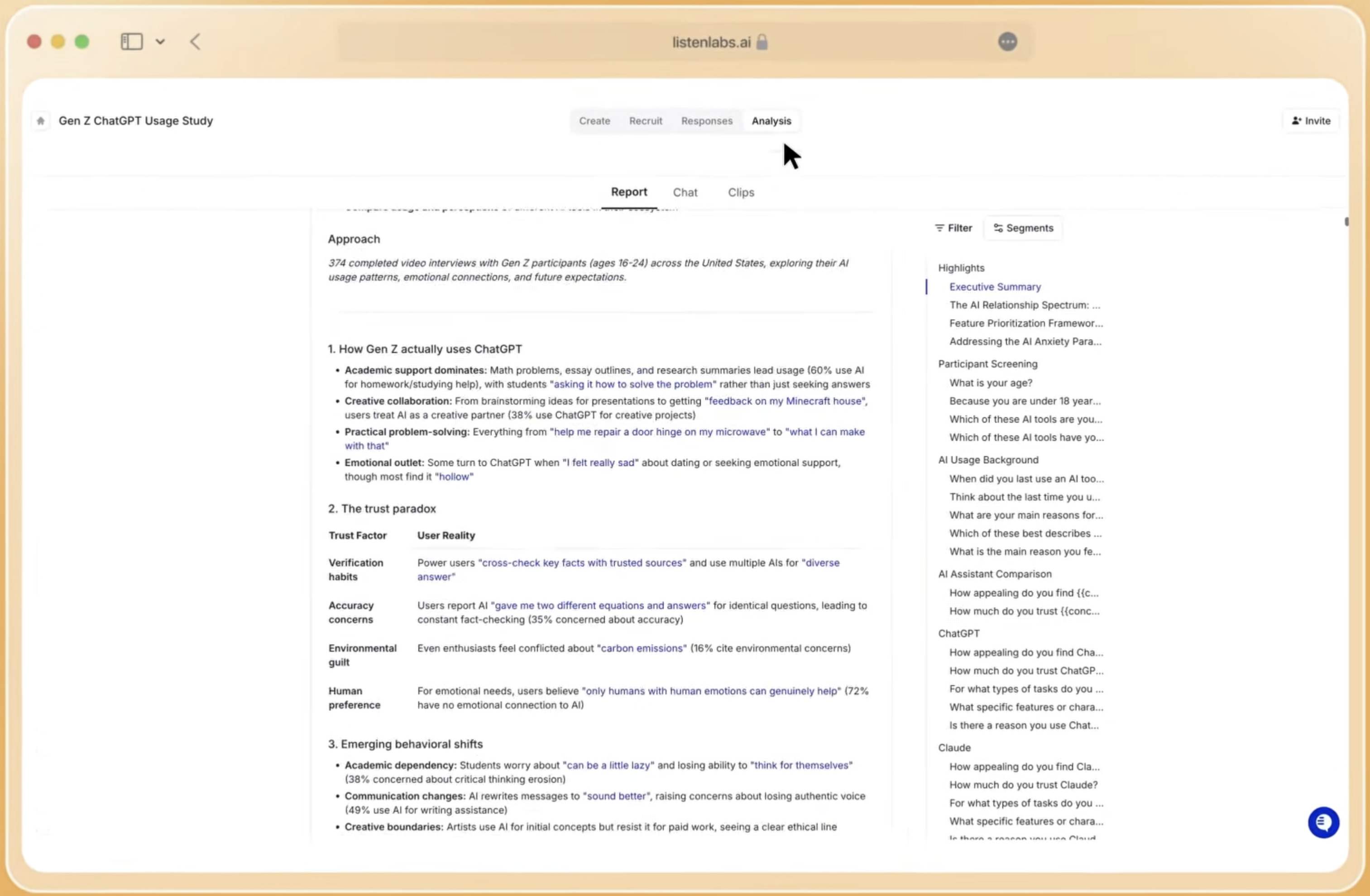
Qual-at-scale is ideal when research requires large sample sizes or broad geographic reach, because AI tools can engage hundreds or thousands of participants remotely and asynchronously. Enterprise results validate this at scale. Anthropic’s Claude Code team ran 300+ user interviews in 48 hours and surfaced churn drivers five times faster than previous methods. Microsoft collected global customer stories for its 50th anniversary within a single day. P&G delivered 250+ interviews with quantified themes that directly shaped product and brand strategy in hours. Skims validated campaign direction with thousands of high-income buyers overnight and eliminated weeks of recruiting. Robinhood received insights five times faster and revealed integration flows that boosted uptake 30–40%.
One benchmark report attributes four times faster responses to market shifts to continuous AI-augmented customer-listening programs when compared with annual research cycles. Listen Labs compresses the entire research cycle, including study design, recruitment, moderation, analysis, and deliverables, to under 24 hours at roughly one-third the cost of traditional research approaches.
See how enterprises run 300+ brand research interviews in under 48 hours. Schedule a consultation.
Addressing Common Objections to AI-Moderated Research
The most frequent concern about AI moderation is whether it matches human researcher quality. Listen Labs maintains methodological rigor equivalent to an experienced in-house research team, and the platform is built by researchers with 50+ combined years of expertise who continuously refine the methodology. The AI probes deeper on short or surprising answers the same way a trained interviewer would and removes the inconsistency that comes from under-resourced or fatigued human moderators.
Participant quality is protected through three layers. Listen Labs works exclusively with non-commodity panel sources. Quality Guard applies real-time AI monitoring across video, voice, content, and device signals to detect fraud, low-effort responses, and mismatched profiles. Participants are limited to three studies per month, which eliminates professional survey-takers. A dedicated recruitment ops team adds human review for hard-to-reach segments including enterprise decision-makers, healthcare workers, and audiences below 1% incidence rate.
Data security concerns are addressed through SOC 2 Type II, GDPR, ISO 27001, ISO 27701, and ISO 42001 certifications. Customer data is never used for AI model training. On team replacement, Listen Labs functions as a force multiplier. The platform enables existing research teams to run significantly more studies with the same headcount and frees researchers for strategic analysis rather than logistics.
Scenario-Based Best-Fit Guidance for Different Teams
Consumer Insights Leaders managing growing backlogs at Fortune 500 companies need a platform that multiplies research output without adding headcount. Listen Labs is the direct fit, with end-to-end automation from study design through deliverables, enterprise security, and proven results at Microsoft, P&G, and Anthropic scale.
UX Research Leads needing faster feedback loops for sprint cycles benefit from Listen Labs’ screen-sharing capabilities, 50–100+ participant studies, and same-day turnaround, which replaces the scheduling overhead and no-show risk of human-moderated sessions.
Product Managers and Brand Managers without dedicated research teams can describe goals in natural language and have Listen Labs handle study design, recruitment, moderation, and analysis automatically, which removes the need for deep methodology expertise.
Agencies and consultancies facing client deadlines measured in days, not weeks, benefit from Listen Labs’ global reach across 45+ countries, niche audience recruitment, and the ability to deliver consultant-quality reports in under 24 hours.
Decision Framework for Enterprise Teams
Teams prioritizing speed above all else need a platform with built-in recruitment, not a separate panel vendor plus a separate interview tool, because every vendor handoff adds days to the timeline. Speed alone is not enough if the data lacks depth, which is why teams requiring emotional insight need multimodal analysis, not transcript-only sentiment scoring. For global brands, that depth must extend across markets, which requires verified panels across 45+ countries with 100+ language support and automatic translation.
Budget-conscious teams face an additional constraint, because a single platform that replaces multiple vendors costs less than a stack of point solutions, each with its own contract and integration overhead. None of these capabilities matter if participant quality is compromised, which makes behavioral fraud controls, not just demographic screening, non-negotiable. Listen Labs is the only platform in this evaluation that satisfies all five criteria simultaneously. Listen Labs raised $69 million in a Series B funding round led by Ribbit Capital, achieving a valuation over $500 million as of January 2026, which reflects the enterprise validation behind that claim.
Frequently Asked Questions
What turnaround can I expect with AI brand research tools?
Turnaround varies significantly by tool category. Social listening platforms like Brandwatch deliver near-real-time data on public sentiment. Quantitative survey tools like Qualtrics or SurveyMonkey can field and close a survey in 24–72 hours depending on sample size and audience difficulty. Traditional qualitative research through agencies takes 4–6 weeks. Listen Labs compresses the entire qualitative research cycle, including study design, recruitment, AI-moderated interviews, analysis, and deliverables, to under 24 hours for most studies. Enterprise cases including Microsoft and Anthropic have received results within 24–48 hours for studies involving hundreds of participants.
How are participants sourced and quality controlled?
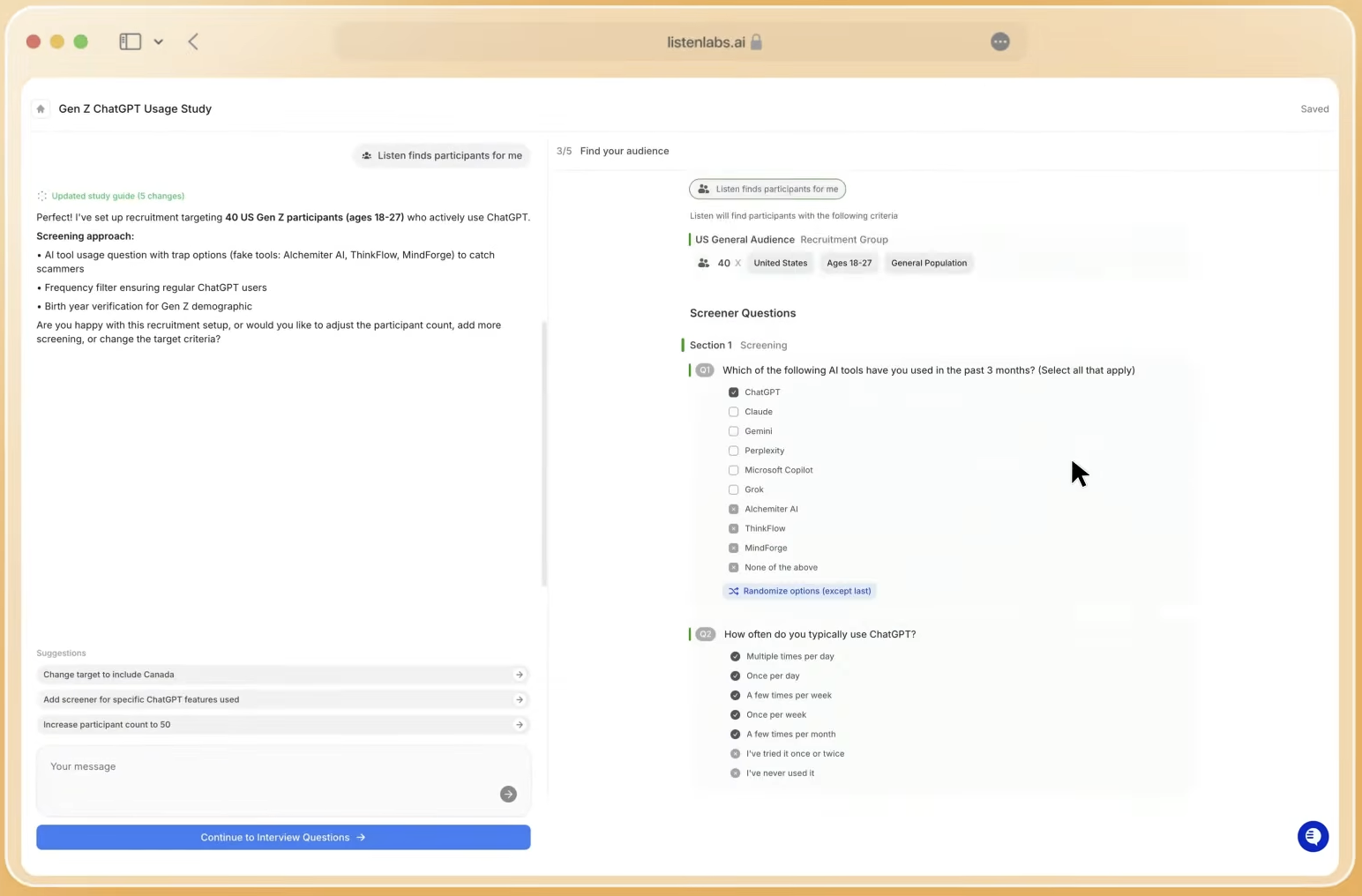
Listen Labs sources participants from a global network of 30 million verified respondents across 45+ countries, orchestrated by an AI layer called Listen Atlas that matches participants on behavioral and intent data rather than self-reported demographics alone. Quality Guard monitors every interview in real time across video, voice, content, and device signals to detect fraud, low-effort responses, AI-generated scripts, and mismatched profiles. Participants are capped at three studies per month to eliminate professional survey-takers. A dedicated recruitment operations team handles hard-to-reach segments including enterprise decision-makers, healthcare workers, engineers, and audiences below 1% incidence rate. Organizations can also bring their own participants or panel providers.
Does the platform support 100-plus languages and multilingual studies?
Yes. Listen Labs supports 100+ languages for interview moderation, with automatic translation and transcription across all supported languages. The Emotional Intelligence feature is available across 50+ languages. This coverage makes Listen Labs suitable for global brand perception studies, multi-market concept testing, and localization research without separate vendors or manual translation workflows. The platform covers 45+ countries across the Americas, Europe, APAC, and MEA.
What security and compliance certifications are available?
Listen Labs holds SOC 2 Type II, GDPR, ISO 27001, ISO 27701, and ISO 42001 certifications. The platform uses 256-bit encryption, and customer data is never used for AI model training. Enterprise SSO is supported. These certifications meet the security and privacy requirements of Fortune 500 enterprises in regulated industries including financial services, healthcare, and consumer goods.
Can I use my own participants or recruit niche audiences?
Yes on both counts. Listen Labs supports self-recruitment, which allows organizations to study their own customer base at a reduced credit cost. For niche audiences, the dedicated recruitment operations team partners with specialized networks, niche communities, and micro-creators to source participants that commodity panels cannot reach, including enterprise decision-makers, engineers, healthcare workers, and consumer segments below 1% incidence rate. This capability is particularly relevant for B2B brand research, category-specific studies, and hard-to-reach demographic segments.
Conclusion
The depth-versus-scale trade-off discussed earlier is a product of human bandwidth constraints, not an inherent property of qualitative methodology. Platforms like Listen Labs layer on auto-recruiting, transcription, sentiment tagging, and insight summarization so teams jump from question to findings in hours, not weeks. No other platform in this evaluation combines a 30M-respondent verified panel, adaptive AI-moderated interviews, multimodal emotional intelligence built on Ekman’s framework, and automated consultant-quality deliverables in a single end-to-end workflow. For Consumer Insights Leaders, Brand Managers, and research teams facing growing backlogs and shrinking timelines, that combination provides brand perception research that is simultaneously fast, deep, and statistically meaningful.
Ready to run brand perception research ten times faster? Get started today.