
Written by: Anish Rao, Head of Growth, Listen Labs
Key Takeaways for 2026 Research Leaders
-
Recruitment-only platforms like User Interviews handle sourcing but leave study design, moderation, analysis, and reporting scattered across tools and manual workflows.
-
Full-lifecycle AI research platforms keep everything in one place, handling the entire research cycle from design through deliverables in a single system.
-
AI-moderated interviews reach greater depth at scale, with real-time quality monitoring, adaptive probing, and fraud prevention that manual processes cannot match.
-
Enterprise teams running continuous, multi-market research gain the most from automated analysis, instant deliverables, and a searchable knowledge base that compounds insights over time.
-
Listen Labs provides an end-to-end AI research platform that compresses research cycles to under 24 hours; see how we deliver results in under 24 hours.
Seven Criteria Enterprise Leaders Use to Compare Research Platforms
VP- and Director-level insights leaders face a consistent challenge: choosing between recruitment-only tools and full-lifecycle platforms requires more than a feature checklist. Through interviews with 50+ enterprise research leaders, seven criteria emerged that reliably predict whether a platform will actually reduce bottlenecks or simply add another vendor.
Research speed measures how quickly a team moves from approved brief to stakeholder-ready deliverable. Depth versus scale asks whether the platform can deliver rich, adaptive qualitative conversations at sample sizes large enough to be statistically meaningful.
Participant quality and fraud prevention covers how the platform screens, monitors, and limits respondents to protect data integrity. Global and multilingual reach determines whether a single platform can support multi-market programs without separate regional vendors.
Analysis and reporting effort quantifies how much human time is required to turn raw interview data into a usable output. Security and compliance addresses certifications, data residency, and privacy obligations relevant to regulated industries. Total cost of ownership accounts for platform fees, per-participant costs, analyst time, and the hidden cost of stitching together multiple tools.
See how Listen Labs performs across all seven criteria in a live walkthrough.
How Recruitment-Only Platforms Perform Across the Research Lifecycle
Study design. Recruitment-only platforms do not assist with study design. Researchers write their own discussion guides, define screening criteria, and configure quotas before the platform becomes relevant. The workflow includes no AI-assisted co-design, no automatic QA on question logic, and no template library informed by prior study performance.
Recruitment and sampling. Recruitment-only platforms are strongest at sourcing. They provide access to panels of opted-in participants and allow researchers to filter by demographic and behavioral criteria. The matching logic relies heavily on self-reported data, and panel depth varies significantly by geography and audience type.
Moderation approach. Recruitment-only platforms stop at sourcing and hand everything else back to the team. Once participants are recruited, researchers must schedule sessions separately, moderate interviews themselves or hire a third-party moderator, and manage no-shows independently. Traditional interview processes often report no-show rates ranging from 20 to 50 percent depending on the industry, and recruitment platforms do not structurally solve this problem.
Data quality controls. Quality assurance remains largely manual. Researchers review transcripts after the fact, flag suspicious responses, and re-recruit if sample quality falls short. The workflow lacks real-time monitoring of video, voice, or device signals during the session itself.
Qualitative depth at scale. Running more than 20 to 30 in-depth interviews requires proportionally more moderator hours, scheduling coordination, and analyst time. The platform scales the sourcing layer but not the moderation or analysis layers, so complexity grows quickly as sample sizes increase.
Analysis workflow. Raw transcripts and recordings are exported to separate tools such as transcription services, analysis platforms like Dovetail, or manual coding in spreadsheets. Each handoff introduces delay and increases the risk of inconsistent interpretation across analysts.
Deliverable creation. Reports, slide decks, and highlight reels are produced manually by researchers or agencies. Traditional qualitative research run through agencies or manual interview workflows typically takes four to ten weeks from brief to final report.
Cross-study knowledge management. Findings from past studies often live in scattered files and individual researchers’ memories. Recruitment-only platforms do not provide a searchable knowledge base, so teams repeatedly re-research questions that have already been answered.
How Full-Lifecycle AI Research Platforms Perform Across the Research Lifecycle
Study design. Listen Labs starts with AI-assisted co-design so teams move from idea to launch quickly. Researchers describe their goals in natural language and the platform drafts structured objectives, questions, and probing context in seconds. Auto-QA flags logic errors before launch. Advanced stimuli support for images, video, PDFs, live URLs, and prototypes combines with branching, skip logic, quotas, and monadic randomization.
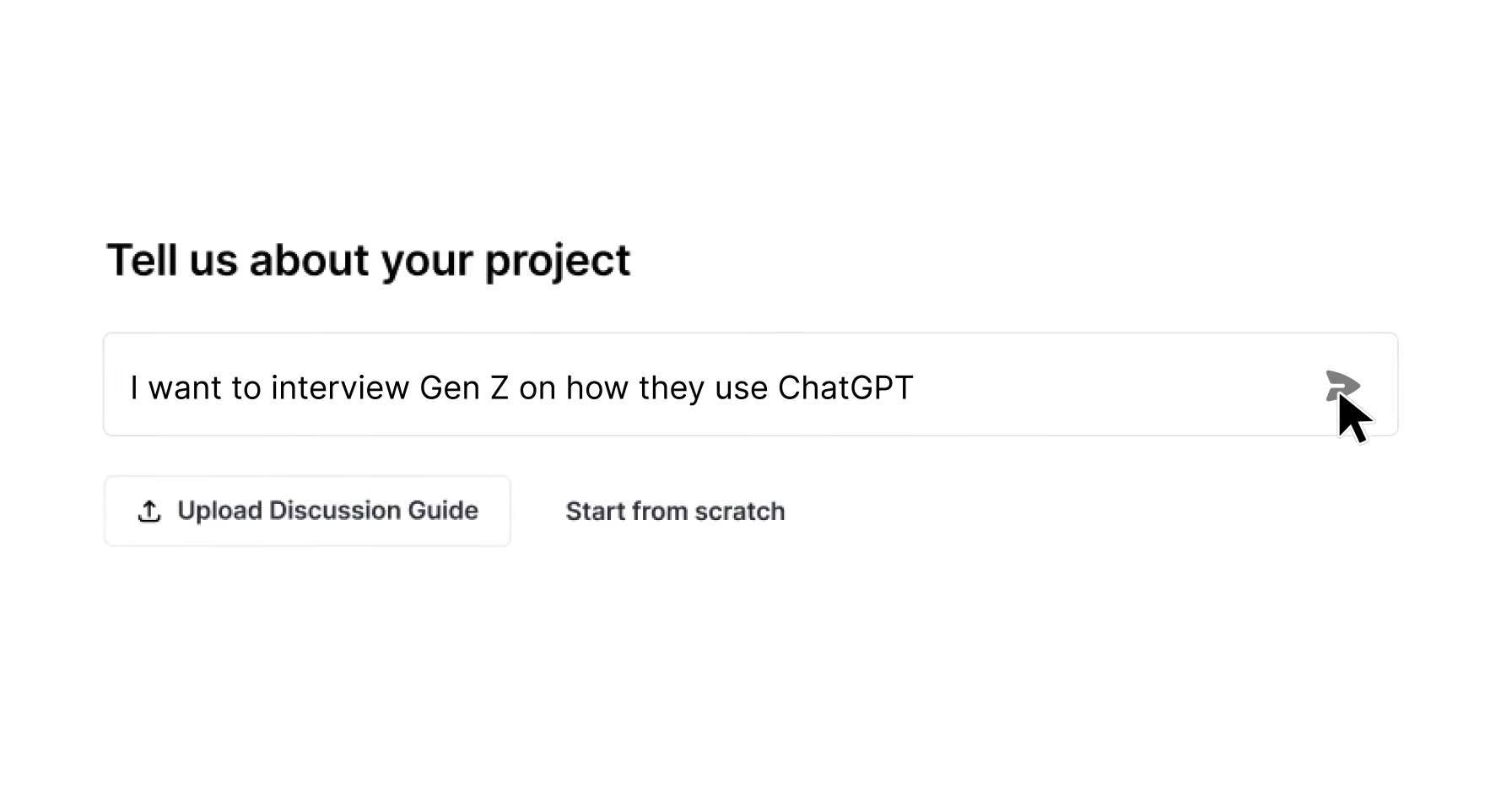
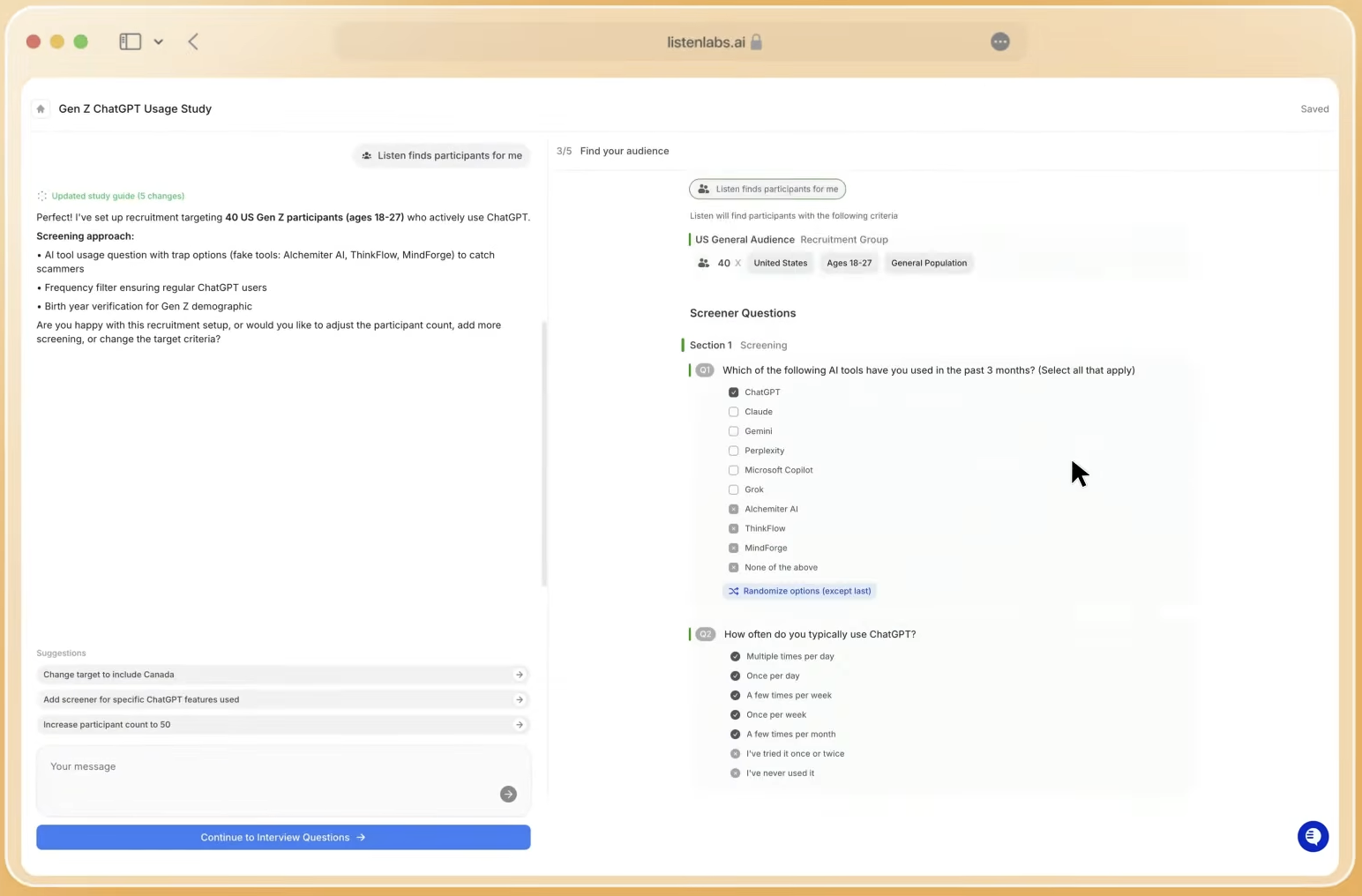
Recruitment and sampling. Listen Atlas, Listen Labs’ AI orchestration layer, automatically matches and bids across a global network of 30 million verified respondents spanning more than 45 countries. It uses behavioral and intent data, not just self-reported demographics, to identify the right participants. A dedicated recruitment ops team handles hard-to-reach segments including enterprise decision-makers, healthcare workers, and audiences below a 1 percent incidence rate. Organizations can also bring their own participants at reduced cost.
Moderation approach. AI moderators generate longer and more substantive responses than static question formats because they use adaptive probing and respond in real time to what participants actually say. The AI conducts personalized video interviews, probes deeper on short or interesting answers, and runs hundreds of sessions simultaneously without fatigue or inconsistency. Participants often share more candidly with AI interviewers than with human moderators, likely because there is less perceived social pressure or judgment involved.
Data quality controls. Quality Guard monitors every interview in real time across video, voice, content, and device signals to detect fraud, low-effort responses, AI-generated scripts, and mismatched profiles. Participants are capped at three studies per month, which removes professional survey-takers from the pool. Reputation scoring compounds across every interview conducted on the platform, creating a quality flywheel that strengthens over time.
Qualitative depth at scale. AI can schedule and conduct interviews, analyze transcripts for themes, and generate quantitative insights from those interviews, all at the same time. Listen Labs has run over 1 million AI-powered customer interviews for companies including Microsoft, Perplexity, and Sweetgreen, which demonstrates enterprise-grade scalability. Anthropic’s Claude Code team ran more than 300 user interviews in 48 hours, surfacing churn drivers five times faster than previous methods.
Analysis workflow. The Research Agent processes all interview data automatically, identifying patterns, themes, and insights across hundreds of responses without human bias. Emotional Intelligence adds a multimodal layer by analyzing tone of voice, word choice, and micro-expressions, built on Ekman’s universal emotions framework and available across more than 50 languages. Every emotional label traces back to a specific timestamp, verbatim quote, and the reasoning behind it.
Deliverable creation. Platforms like Listen Labs layer on auto-recruiting, transcription, sentiment tagging, and insight summarization so teams jump from question to findings in hours, not weeks. The Research Agent generates consultant-quality slide decks, memo-style reports, video highlight reels, statistical charts, and segmentation breakdowns in under a minute.
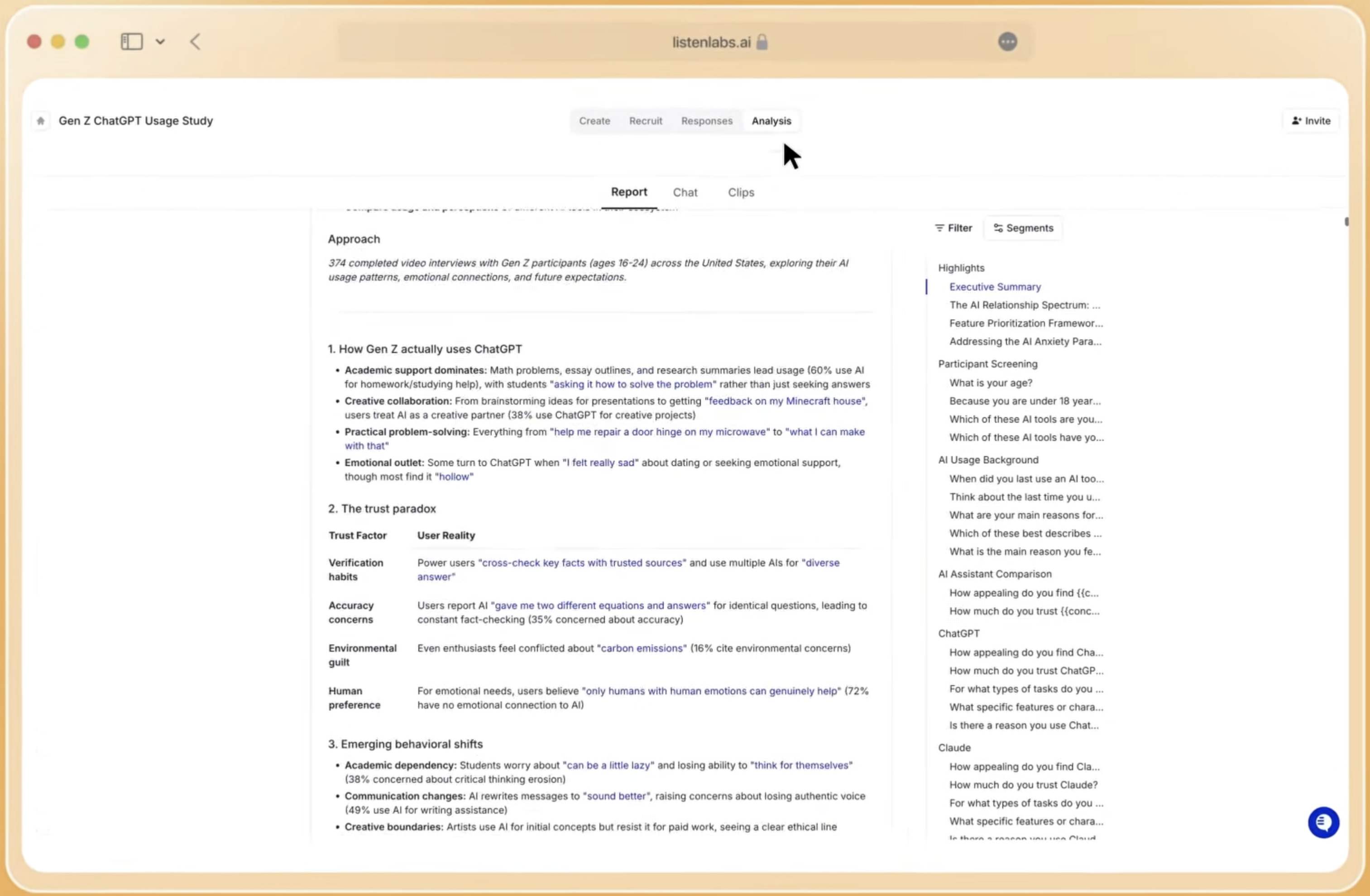
Cross-study knowledge management. Enterprise teams require cross-study infrastructure, such as a searchable knowledge base, so findings accumulate and compound over time instead of remaining isolated study artifacts. Mission Control serves as the organization’s source of truth for everything ever learned from customers, enabling cross-study queries and trend tracking in seconds.
Scenario-Based Use Cases for Each Platform Type
Enterprise insights departments. Teams running 20 or more studies per year with growing internal backlogs need a platform that multiplies output without adding headcount. A recruitment-only tool adds one more vendor to coordinate. An end-to-end platform like Listen Labs compresses the full cycle. P&G delivered more than 250 interviews with quantified themes and verbatim proof in hours, directly shaping product and brand strategy before market launch.
UX research teams. Researchers validating concepts and testing prototypes within sprint cycles cannot work with four to six week recruitment timelines. Listen Labs supports screen sharing, mobile screen recording on iOS, and usability task flows. These capabilities allow teams to test with 50 to 100 or more users instead of the 5 to 10 that manual scheduling allows.
Product managers and marketing leaders without dedicated researchers. Non-researchers who need data-informed decisions but lack methodology expertise benefit from a self-serve platform that handles study design, recruitment, moderation, and analysis automatically. Describing research goals in natural language and receiving a structured study guide removes the expertise barrier entirely.
Agencies and consultancies. Client timelines measured in days, not weeks, make recruitment-only tools a liability. Listen Labs’ global reach across more than 45 countries, dedicated ops for niche audiences, and one-click deliverables allow agencies to run bespoke research for each engagement without proportional resource increases.
Operational and Long-Term Considerations for Enterprise Rollout
Switching from a fragmented workflow to an integrated platform requires alignment across research, IT, legal, and procurement. The compliance profile becomes a gating factor. Listen Labs holds SOC 2 Type II, GDPR, ISO 27001, ISO 27701, and ISO 42001 certifications, with 256-bit encryption and a policy of never using customer data for AI model training. Enterprise teams evaluate native CRM, data warehouse, and BI integrations, modern compliance certifications, and pricing transparency, especially for regulated industries.
For ongoing global programs, the compounding advantage of a unified platform grows with every study. Each project adds to Mission Control’s knowledge base, which reduces redundant research and enables trend tracking across quarters. Recruitment-only platforms do not accumulate institutional knowledge, so every study effectively starts from scratch.
Walk through our compliance and security framework to see how Listen Labs fits into your existing requirements.
Risks, Limitations, and Common Misconceptions About Each Approach
Shallow data from rigid methods. Recruitment-only platforms paired with static survey tools produce structured responses with no adaptive follow-up. AI-moderated interviews are conversational, since the AI listens to each response and decides in real time whether to ask a follow-up, request clarification, or move forward, whereas AI surveys present a predetermined set of questions in a fixed order. Teams that treat a screener-plus-survey workflow as qualitative research consistently underestimate the depth they are missing.
Slow turnaround from manual workflows. Even with fast recruitment, manual moderation and analysis remain the bottleneck. Adding a recruitment tool to an otherwise manual workflow does not compress the overall timeline in a meaningful way.
Hidden recruitment complexity. Niche audiences such as enterprise decision-makers, healthcare professionals, and consumers below a 1 percent incidence rate are not reliably available on standard panels. Recruitment-only platforms often cannot source these segments without significant lead time and cost overruns.
Fraud risks. Commodity panels carry meaningful fraud exposure. Without real-time behavioral monitoring across video, voice, and device signals, fraudulent or low-effort responses contaminate datasets that analysts then spend hours cleaning.
Overestimating automation benefits. AI moderation handles the execution layer well, asking questions, probing adaptively, running thousands of sessions in parallel, and doing so consistently across languages without fatigue, which frees researchers to focus on study design, interpreting nuance in findings, and translating insights into strategic recommendations. Automation does not replace researcher judgment. It removes the logistics that prevent researchers from applying that judgment at scale.
Decision Framework: Matching Platform Type to Your Reality
Use the following criteria to match platform category to your team’s actual constraints and goals.
Choose a recruitment-only platform if your research volume and complexity align with a manual workflow. This scenario means your team has dedicated moderators with available capacity to conduct sessions, since recruitment-only tools stop at sourcing and do not handle moderation.
You also run fewer than five studies per quarter, which keeps coordination overhead manageable. Your audiences are general population and easy to source, and you already have analysis infrastructure in place because recruitment-only platforms export raw transcripts without processing them.
Turnaround times of two to four weeks must be acceptable to internal stakeholders, since manual moderation and analysis add significant time after recruitment completes.
Choose a full-lifecycle AI research platform if your team faces a growing research backlog and needs results in under 24 hours for many projects. You require qualitative depth at sample sizes above 30 participants and run programs that span multiple markets and languages. You also need fraud protection beyond self-reported screening, and your analysts spend more time on logistics than on insight generation. Leadership expects deliverables that are immediately shareable without additional formatting work.
Additional signals that favor an end-to-end platform include ongoing research programs rather than one-off studies, a need for cross-study trend tracking, operation in a regulated industry with strict data security requirements, or teams that include non-researchers who still need to run studies independently.
Frequently Asked Questions
How quickly can I move from study brief to results with each platform category?
With a recruitment-only platform, the timeline depends on how many additional tools and people are involved after sourcing. Recruitment itself may take three to seven days for standard audiences and longer for niche segments. Moderation, transcription, analysis, and report writing then add additional weeks, which puts the typical end-to-end cycle at four to six weeks for enterprise studies.
With a full-lifecycle AI platform like Listen Labs, the entire cycle compresses to the sub-24-hour timeline mentioned earlier, a speed that applies to standard audiences, while niche segments may require slightly longer recruitment windows. Microsoft collected global customer video stories for its 50th anniversary within a single day using Listen Labs.
Where do recruitment-only tools and end-to-end platforms source participants, and how do they handle quality?
Recruitment-only platforms draw from opted-in panels filtered by self-reported demographics and behavioral criteria. Quality control is largely post-hoc, since researchers review responses after sessions and flag problems manually. End-to-end platforms like Listen Labs use an AI orchestration layer, Listen Atlas, that matches across behavioral and intent data, not just demographics, across a network of 30 million verified respondents in more than 45 countries.
Quality Guard monitors every session in real time across video, voice, content, and device signals. Participants are limited to three studies per month to prevent panel fatigue, and a dedicated recruitment ops team adds a human review layer for hard-to-reach segments. The result is a zero-fraud guarantee that manual post-hoc review cannot replicate.
What is the difference in moderation approach and resulting data depth?
Recruitment-only platforms do not moderate interviews. Researchers either conduct sessions themselves, hire a third-party moderator, or use a separate interview tool, which introduces scheduling overhead, no-show risk, and inconsistency across moderators.
Listen Labs’ AI moderator conducts personalized video interviews with dynamic follow-up questions, probing deeper on short or interesting answers in the same way a trained human interviewer would. This dynamic, the reduced social pressure noted earlier, leads to more candid responses, especially on sensitive topics where participants might otherwise self-censor.
Emotional Intelligence adds a further layer by analyzing tone of voice, word choice, and micro-expressions to surface emotional signals that transcripts alone miss, built on Ekman’s universal emotions framework and traceable to the exact timestamp and verbatim quote behind every label.
How do analysis effort, multilingual support, security certifications, implementation complexity, and scalability compare?
Analysis effort with recruitment-only platforms falls entirely on the research team, since exporting transcripts, coding themes, building charts, and writing reports are all manual tasks. Listen Labs’ Research Agent automates this layer, generating key findings, themes, personas, slide decks, memos, highlight reels, and statistical comparisons in under a minute.
For multilingual programs, Listen Labs supports more than 100 languages for interview moderation with automatic translation and transcription, and Emotional Intelligence operates across more than 50 languages, while recruitment-only platforms do not provide moderation or analysis in any language. On security, Listen Labs holds SOC 2 Type II, GDPR, ISO 27001, ISO 27701, and ISO 42001 certifications with 256-bit encryption and no use of customer data for AI model training.
Implementation involves a demo and pilot process for enterprise accounts, after which the platform handles the full workflow without requiring additional vendor integrations. Scalability is structural, because moderation and analysis are automated, so running 300 interviews requires no more analyst time than running 30.
Conclusion: Choosing the Platform That Matches Your Research Goals
Recruitment-only platforms solve one stage of a multi-stage problem. They source participants, then hand the workflow back to researchers who must moderate, transcribe, analyze, and report manually, with every handoff adding time, cost, and quality risk. For enterprise teams running continuous research programs across multiple markets, this fragmentation becomes the primary reason backlogs grow and insights arrive too late to influence decisions.
Listen Labs is the end-to-end AI research platform that removes this fragmentation by handling every stage in a single workflow. The system covers AI-assisted study design, global recruitment via Listen Atlas, real-time quality protection through Quality Guard, AI-moderated interviews with Emotional Intelligence, automated analysis through the Research Agent, and institutional knowledge accumulation in Mission Control.
As Listen Labs CEO Alfred Wahlforss has stated, “Companies use it for all kinds of large decisions. This AI interviewer means that you can have hundreds of one-on-one interviews run at scale.” The result is a research cycle that moves from brief to consultant-quality deliverable in less than 24 hours, using the same platform trusted by the enterprise clients mentioned earlier, plus Google, Anthropic, Skims, and Nestlé.
See how to compress your research cycle to under 24 hours and multiply your team’s output without adding headcount.