Written by: Anish Rao, Head of Growth, Listen Labs
Key takeaways for enterprise research leaders
- AI moderated interviews have become the standard for Fortune 500 research teams that need qualitative depth without 4–6 week timelines.
- The complete lifecycle, from research brief through consultant-grade deliverables, can now fit into under 24 hours using Listen Labs’ enterprise playbook.
- Core steps include defining precise objectives, designing adaptive studies, securing high-quality participants through verified networks, and applying emotional intelligence analysis.
- Advanced AI features like Research Agent and Mission Control automate analysis, deliver branded reports, and maintain institutional knowledge across studies.
- Enterprise clients including Microsoft, Skims, and Robinhood have achieved 5x faster research cycles at one-third the cost, so see how Listen Labs can transform your research process.
Step 1: Define research objectives for AI moderated customer interviews
Clear objectives shape question design, participant targeting, and the metrics used to evaluate findings. Vague briefs produce vague insights.
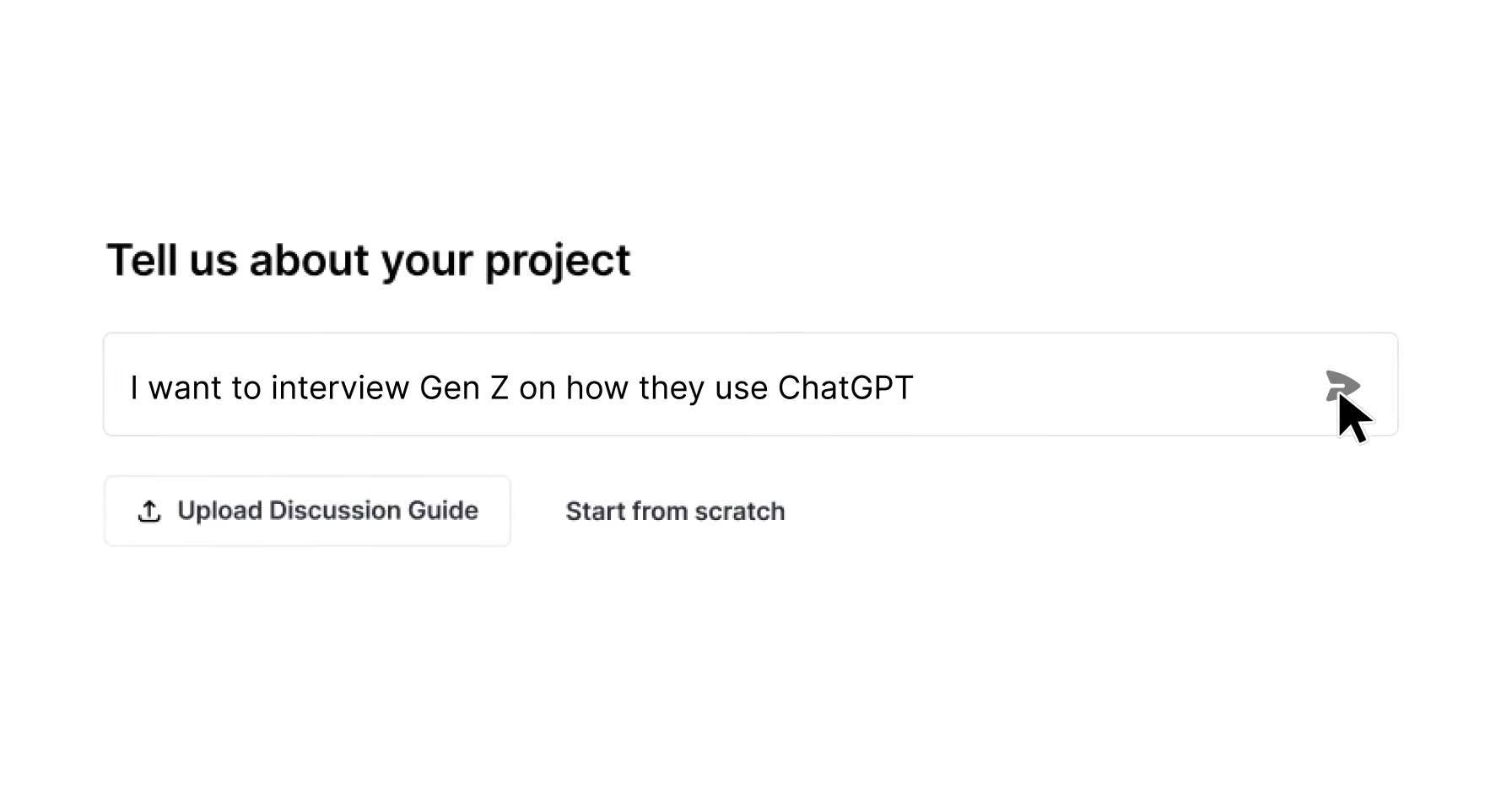
Listen Labs uses AI-assisted study co-design to translate natural-language goals into structured research objectives in seconds. A team can describe a business question, such as “Why are high-income buyers hesitating at checkout?”, and the platform drafts a structured objective, a set of core questions, and probing context aligned to that goal. By generating this scaffolding automatically, the platform eliminates the blank-page problem and ensures the study is scoped correctly before a single participant is recruited.
Step 2: Design adaptive studies for AI moderated user interviews
Study design for AI moderated qualitative research requires the same methodological rigor as human-moderated work, with added configuration for adaptive logic.
Listen Labs supports branching logic, monadic and sequential randomization, quotas, skip logic, piping, and version control. These tools let teams tailor paths to different segments while keeping the core structure consistent. Stimuli such as images, video, audio, PDFs, prototypes, and live URLs embed directly into the interview flow so participants react in context. An auto-QA layer flags structural issues in the guide before launch, and past studies can be cloned and adapted, which accelerates repeat research programs and keeps designs consistent over time.
Step 3: Recruit participants and protect quality in AI interviews
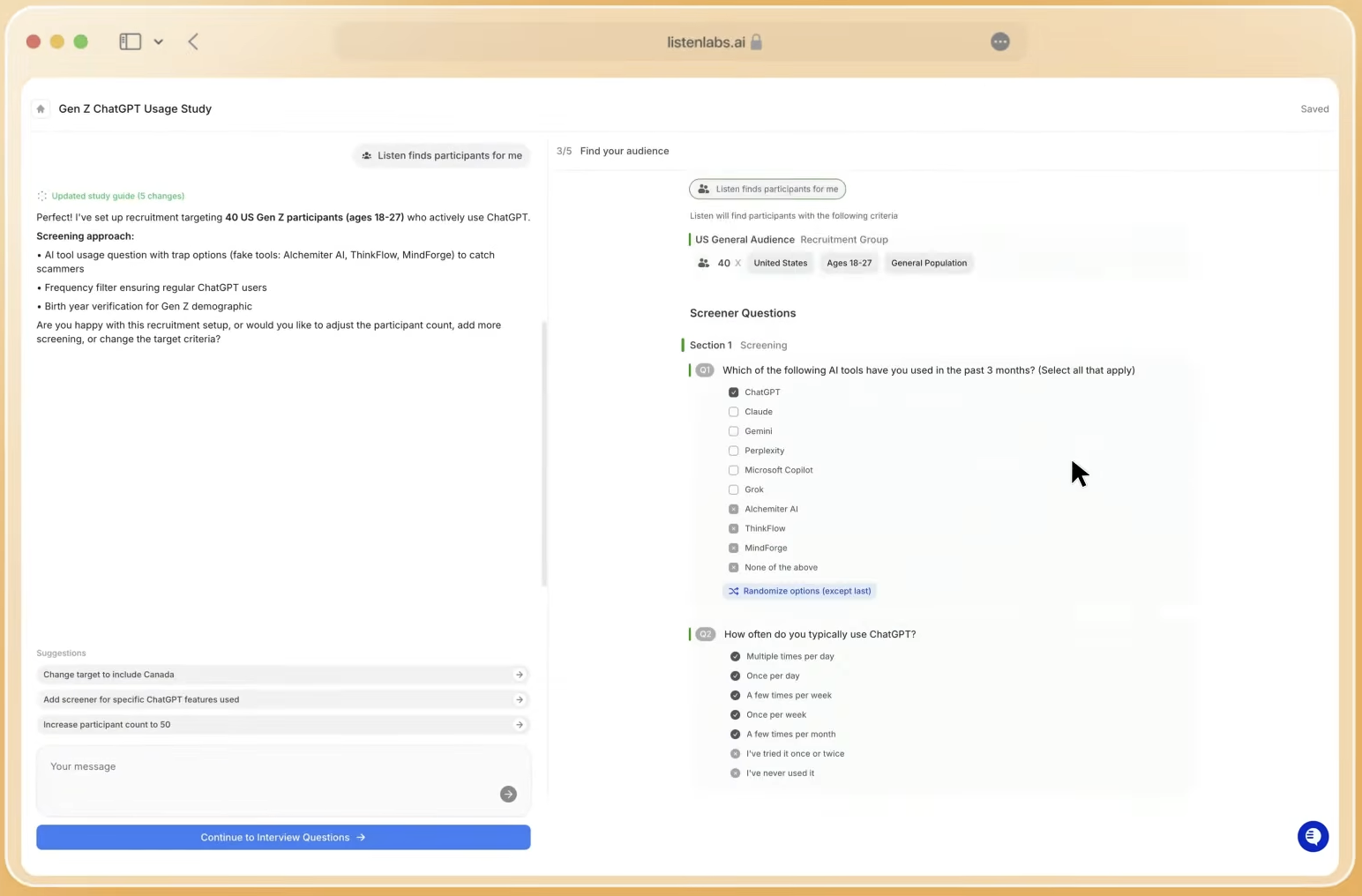
Once your study design is locked, the next critical factor is who you are interviewing. Participant quality is the single largest source of wasted research investment in scaled qualitative work. Commodity panels introduce professional survey-takers, fraudulent profiles, and incentive-driven responses that corrupt findings before analysis begins.
Listen Labs addresses this through Listen Atlas, a global network of 30M verified respondents across 45+ countries and 100+ languages. An AI orchestration layer matches and bids across multiple panel partners using behavioral and intent data, not just self-reported demographics. Three additional quality layers work together to keep data clean:
- Quality Guard monitors every interview in real time across video, voice, content, and device signals to detect fraud, low-effort responses, and AI-generated scripts, removing bad data before it reaches analysis.
- Participant frequency limits cap each respondent at three studies per month, which reduces panel fatigue and filters out professional survey-takers.
- A dedicated recruitment ops team sources hard-to-reach segments, including enterprise decision-makers, healthcare workers, and consumers below 1% incidence rate, so automated panels are not your only option.
Organizations can also self-recruit from their own user base at reduced cost or bring an existing panel provider, while Quality Guard still applies across all sources.
Step 4: Launch AI moderated qualitative research at scale
Qual-at-scale is ideal when research requires large sample sizes or broad geographic reach, and AI moderation enables hundreds of simultaneous conversations that human scheduling cannot support. One hundred conversations can be completed in the same window that traditional scheduling allows for ten.
Listen Labs conducts AI-led video interviews with dynamic follow-up questions that probe deeper on short or interesting answers, mirroring the behavior of a trained human interviewer. The platform supports 100+ languages for interview moderation, with automatic translation and transcription so global teams can review results in a single language. Mixed-method formats combine open-ended qualitative questions with quantitative formats such as Likert scales, NPS, sliders, grids, and MaxDiff within a single study, which keeps all feedback in one dataset.
Step 5: Apply AI interview emotional intelligence analysis
What participants say and what participants feel are different data points. Two concepts can both receive positive ratings while triggering entirely different emotional responses, and transcript analysis alone often misses that gap.
Listen Labs’ Emotional Intelligence analyzes three signals: tone of voice, word choice, and subconscious micro expressions using Ekman’s universal emotions framework to track anger, anticipation, disgust, fear, joy or happiness, sadness, trust, and surprise. Research on multimodal sentiment analysis shows that combining voice tone analysis with transcript content can reduce sentiment misclassification compared with text-only methods.
Every emotion is quantified per question and concept, and every label is traceable to the exact timestamp, verbatim quote, and the reasoning behind the classification. This emotional layer strengthens several common research scenarios:
- Creative testing, where teams need to pinpoint the exact moment an ad triggers delight or confusion.
- Concept evaluation, where emotional breakdowns across stimuli, segments, and markets reveal which ideas feel credible or risky.
- Usability testing, where hesitation and frustration often appear in facial expressions or tone before participants verbalize issues.
- Brand research, where emotional response to your brand versus competitors shows whether loyalty comes from trust, excitement, or something else.
Emotional Intelligence is available across 50+ languages and integrates directly with the Research Agent for natural-language queries and highlight reels of emotionally significant moments.
Step 6: Turn AI interviews into reusable deliverables at scale
With emotional signals captured alongside transcripts, the next step is synthesis. With AI moderated interviews, talking to users at scale is no longer the hard part, and the challenge becomes understanding what they mean. Research Agent handles the full analysis workflow, from raw data to final output.
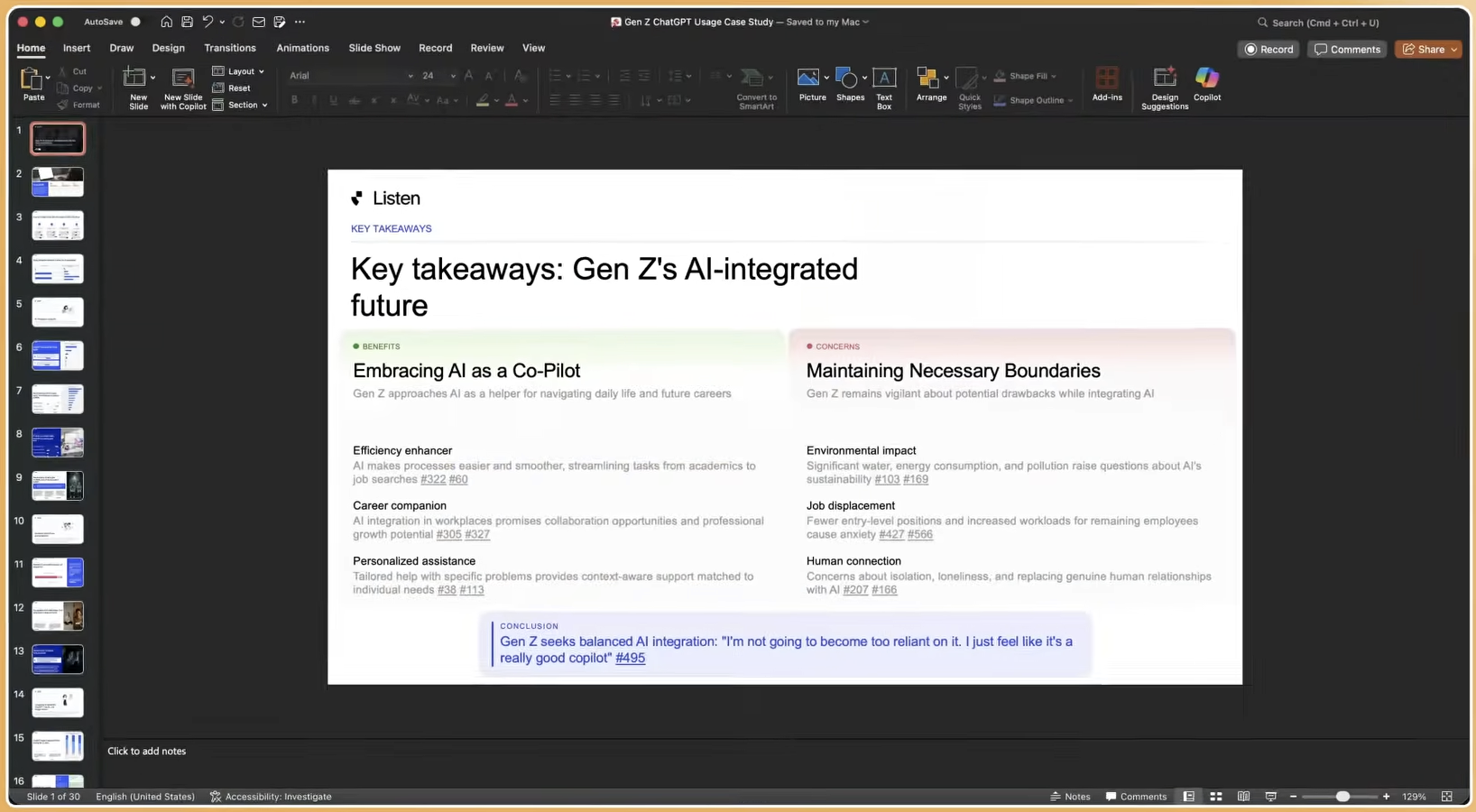
The Research Agent delivers:
- Automated key findings, themes, and persona summaries
- Chat-based analysis, where you ask any question in natural language and receive answers, charts, stat tests, and segmentations
- Slide decks in your company’s branded template and downloadable memo-style reports
- Video highlight reels automatically generated from interview recordings
- Segmentation breakdowns by demographics, cohorts, and custom audience groups
Mission Control serves as the organization’s cross-study knowledge base, a persistent source of truth for everything learned from customers. Each new study grows the institutional knowledge base, which enables cross-study queries and trend tracking without digging through archived reports.
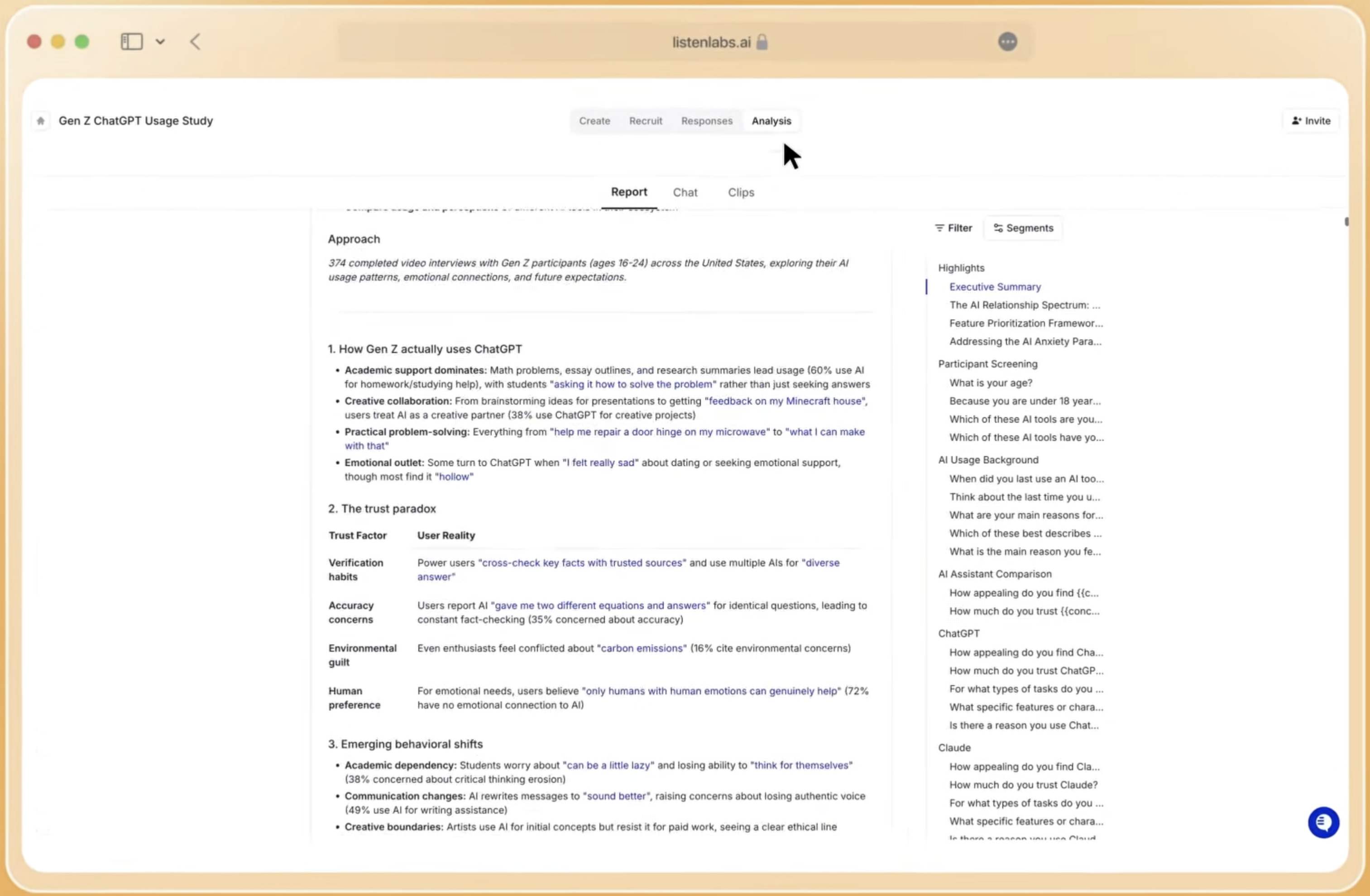
See Research Agent and Mission Control in action.
Step 7: Validate with pilot testing before full rollout
Pilot testing protects your budget before you scale to hundreds of interviews. Run a pilot batch of 15–30 participants to confirm that AI moderation quality, question flow, and participant targeting are performing as expected. Sample sizes of 15–30 interviews are appropriate for exploratory validation before scaling to 50–100 for full thematic saturation.
Review the pilot transcripts, emotional signal data, and Research Agent output against your original objectives. Adjust branching logic, refine probing context, or tighten audience targeting before committing the full study budget. This step protects research investment and ensures the scaled dataset is clean and analytically sound.
Enterprise proof points from 2026
These results from Listen Labs clients show how the seven-step playbook performs at Fortune 500 scale:
- Microsoft collected global customer video stories for its 50th anniversary celebration within a single day. The Director of Data Science at Microsoft noted, “I can reach out to hundreds of users at one third of the cost.”
- Anthropic completed 300+ user interviews in 48 hours to surface Claude subscription churn drivers 5x faster than previous research cycles, identifying where former users migrate and delivering a prioritized list of 10 must-fix items.
- P&G ran 250+ interviews with quantified themes and verbatim proof to evaluate how men respond to new product claims, surfacing where claims felt exaggerated before market launch and shaping product and brand strategy in hours, not weeks.
- Skims identified and qualified thousands of premium consumers overnight to validate a global campaign direction before launch, delivering qualitative clarity that secured board-level buy-in.
- Robinhood used qual interviews to reveal experience patterns and showed that users who view prediction markets as entertainment drive 2.4x higher weekly re-engagement, with insights delivered 5x faster than prior research methods.
Frequently asked questions
Is AI moderation quality comparable to a trained human researcher?
For the vast majority of enterprise research needs, Listen Labs maintains the same methodological rigor as an experienced in-house research team. The AI probes dynamically on short or unexpected answers, maintains consistency across hundreds of simultaneous sessions, and never introduces moderator bias. The platform is built and continuously refined by a team with 50+ years of combined research expertise. Your existing research team focuses on strategic interpretation while the platform handles facilitation and first-pass analysis.
How does Listen Labs handle data security and enterprise compliance?
Listen Labs holds SOC 2 Type II, GDPR, ISO 27001, ISO 27701, and ISO 42001 certifications. All data is encrypted at 256-bit, and customer data is never used to train AI models. Enterprise SSO is supported. These certifications cover the full research lifecycle, including recruitment, moderation, storage, and analysis.
Can we use our own participants instead of the Listen Atlas panel?
Yes. Listen Labs supports self-recruitment, allowing organizations to study their own customer or user base at a reduced credit cost. You can also bring an existing panel provider. The Quality Guard layer applies regardless of participant source, which maintains data integrity across all recruitment paths.
Will Listen Labs replace our research team?
No. The platform acts as a force multiplier for existing research teams. It removes the logistical overhead of recruitment, scheduling, moderation, transcription, and manual analysis, which frees researchers to focus on strategic interpretation, stakeholder communication, and study design. Teams run significantly more studies with the same headcount rather than replacing the researchers who give those studies their strategic value.
What types of studies does the platform support?
Listen Labs supports concept and prototype testing, usability testing with screen sharing, creative testing, brand perception studies, consumer journey mapping, multi-market segmentation studies, ad testing, pricing research, and survey open-end analysis. The platform handles both one-off studies and continuous always-on research programs.
Conclusion and next step
The seven-step playbook, which includes defining objectives, designing the study, recruiting verified participants, launching at scale, applying emotional intelligence analysis, generating deliverables, and validating with a pilot, covers the complete lifecycle of AI moderated customer interviews. Each step is handled within a single platform at Listen Labs, replacing the fragmented vendor stack that has historically stretched research cycles to 4–6 weeks.
Enterprise teams at Microsoft, Anthropic, P&G, Skims, and Robinhood have used this process to achieve the speed and cost advantages outlined earlier while reaching hundreds of verified participants globally and delivering consultant-grade reports.