
Written by: Anish Rao, Head of Growth, Listen Labs
Key Takeaways
- AI predictive analytics helps enterprises move from slow, reactive surveys to proactive, model-driven decisions that forecast behavior, demand, and trends.
- The market is expanding quickly across AI segments, with strong growth and accelerating adoption in BFSI, healthcare, retail, and technology.
- Agentic and generative AI now power predictive pipelines by running autonomous workflows and turning unstructured data like interviews into quantified behavioral forecasts.
- Continuous learning and high-quality, verified inputs prevent model drift and bias so predictive models stay accurate as consumer signals change.
- Listen Labs delivers enterprise-grade predictive data inputs in under 24 hours through verified participants and AI-moderated interviews; Book a demo to see how it accelerates your research program.
From Reactive Research To Predictive Advantage
Enterprises that rely on quarterly surveys and static trackers make decisions on stale data. By the time results arrive, consumer sentiment has already shifted. AI predictive analytics changes this dynamic by turning continuous consumer signals into forward-looking forecasts.
Once this shift happens, market growth numbers become proof that the change is underway, not a distant trend. The following section summarizes how fast the market is expanding and how much research cycles are compressing.
2026 Market Size and CAGR
The AI predictive analytics market spans several overlapping segments. Leading analyst firms, combined with Listen Labs internal benchmarks on research cycle compression, provide the following estimates.
Grand View Research estimates the global AI market at USD 390.91B in 2025, projected to reach USD 3,497.26B by 2033 at a 30.6% CAGR (2026–2033). Precedence Research projects the AI in economic analytics market to reach USD 227.14B by 2035. Coherent Market Insights places the AI in retail market at USD 27.3 billion in 2026, projected to reach USD 60.5 billion by 2033 at a 12.1% CAGR. Mordor Intelligence projects the global AI market to reach USD 434.42 billion in 2026 and USD 2,503.13 billion by 2031, at a 41.95% CAGR, with generative AI projected to grow at 34.82% CAGR from 2026 to 2031. Rising demand for predictive analytics is a key driver across these segments. Listen Labs benchmarks show research cycle compression to less than 24 hours end-to-end versus the 4–6 week industry baseline, delivering 5× faster insight delivery.
See how Listen Labs compresses research cycles to under 24 hours and walk through a live deployment.
Where AI Predictive Analytics Is Taking Hold By Industry
This market expansion does not look the same in every sector. Adoption rates and use cases vary by vertical, with BFSI, healthcare, retail, and technology leading in both investment and operational deployment.
BFSI: The Banking, Financial Services, and Insurance segment is a leading vertical in the AI in data management market, driven by fraud detection, AML compliance, and predictive risk modeling. Eighty-five percent of financial institutions already use AI in at least one business area, with AI-driven personalization enabling up to 92% higher digital engagement.
Healthcare: Health system leaders expect AI to reduce costs by standardizing and automating workflows. Predictive models now support symptom triage, treatment planning, and patient engagement at scale.
Retail and CPG: Seventy-one percent of CPG leaders had adopted AI in at least one business function according to a 2024 McKinsey survey, with consumer products companies reporting up to 69% revenue increases and 72% cost reductions through AI-driven forecasting and supply chain automation. Retailers using AI report 5–15% annual revenue growth and up to 30% reduction in operational costs.
How New AI Architectures Expand Predictive Analytics
First-generation predictive models relied on structured, tabular data and manual workflows. The next wave, driven by agentic and generative AI, expands what predictive analytics can ingest and how autonomously it can operate.
AI is moving from passive analysis to agentic AI, where autonomous agents independently plan, execute, and verify entire analytical workflows with minimal human oversight. For market research, this shift means predictive models can ingest new consumer signals, retrain, and surface updated forecasts without manual intervention.
Generative AI is forecast to grow at a 34.82% CAGR from 2026 to 2031 per Mordor Intelligence, and its integration with predictive pipelines is reshaping how unstructured data such as interview transcripts, open-ended survey responses, and social feeds gets converted into quantified behavioral forecasts. Agentic AI adoption reached 48% in telecommunications and 47% in retail and CPG, the highest rates among industries surveyed, which shows that autonomous model execution has moved into mainstream use.
AI can schedule and conduct interviews, analyze transcripts for themes, and generate quantitative insights from qualitative conversations, bridging the gap between rich consumer narratives and the structured inputs predictive models require.
Why Continuous Learning Keeps Models Accurate
Model drift occurs when accuracy degrades because customer behavior changes over time, while model bias arises when training data reflects historical inequalities. Routine performance monitoring, regular training-data audits, and automated retraining workflows when performance falls below defined thresholds reduce both risks.
Forecast accuracy in AI predictive analytics for market research depends on three factors: data quality, market stability, and regular model recalibration. Recalibration frequency matters most in volatile markets. A model trained on consumer sentiment from six months ago will misread current demand signals because preferences shift faster than the model’s training window, particularly in fast-moving categories like fintech, CPG, or consumer tech.
Around 402.74 million terabytes of data are created every day, which makes continuous signal processing mandatory. AI must process reviews, support tickets, and conversations as they appear rather than rely on periodic scheduled studies. Continuous learning keeps predictive models calibrated to this real-time signal environment.
High-Value Predictive Use Cases For Market Trends
Demand forecasting, sentiment modeling, and consumer behavior prediction deliver the highest value from AI predictive analytics in market research. Predictive analytics in retail supply chains cuts logistics costs by 10–20%, while AI-driven inventory optimization has been shown to reduce stockouts by varying amounts such as 20–79% depending on the case and implementation.
Sentiment analysis powered by large language models processes unstructured consumer data such as interview transcripts, open-ended responses, and social commentary, then converts it into directional signals that feed demand and churn models. Predictive analytics in market research uses machine learning to turn observed patterns from NLP-processed unstructured data into forecasts of future consumer behavior, helping teams anticipate market shifts.
The critical dependency is data quality at the input stage. AI trained on fraudulent survey responses or biased datasets produces unreliable insights that can lead to costly business decisions. Participant verification and behavioral matching, not just demographic screening, determine whether a predictive model is trustworthy.
7-Step Framework To Operationalize Predictive Research
Understanding the technical requirements for predictive analytics is one step. Operationalizing them across an enterprise research program requires a structured approach. This framework applies the BCG 10/20/70 principle: 10% of value from algorithms, 20% from data and technology, and 70% from people and process integration.
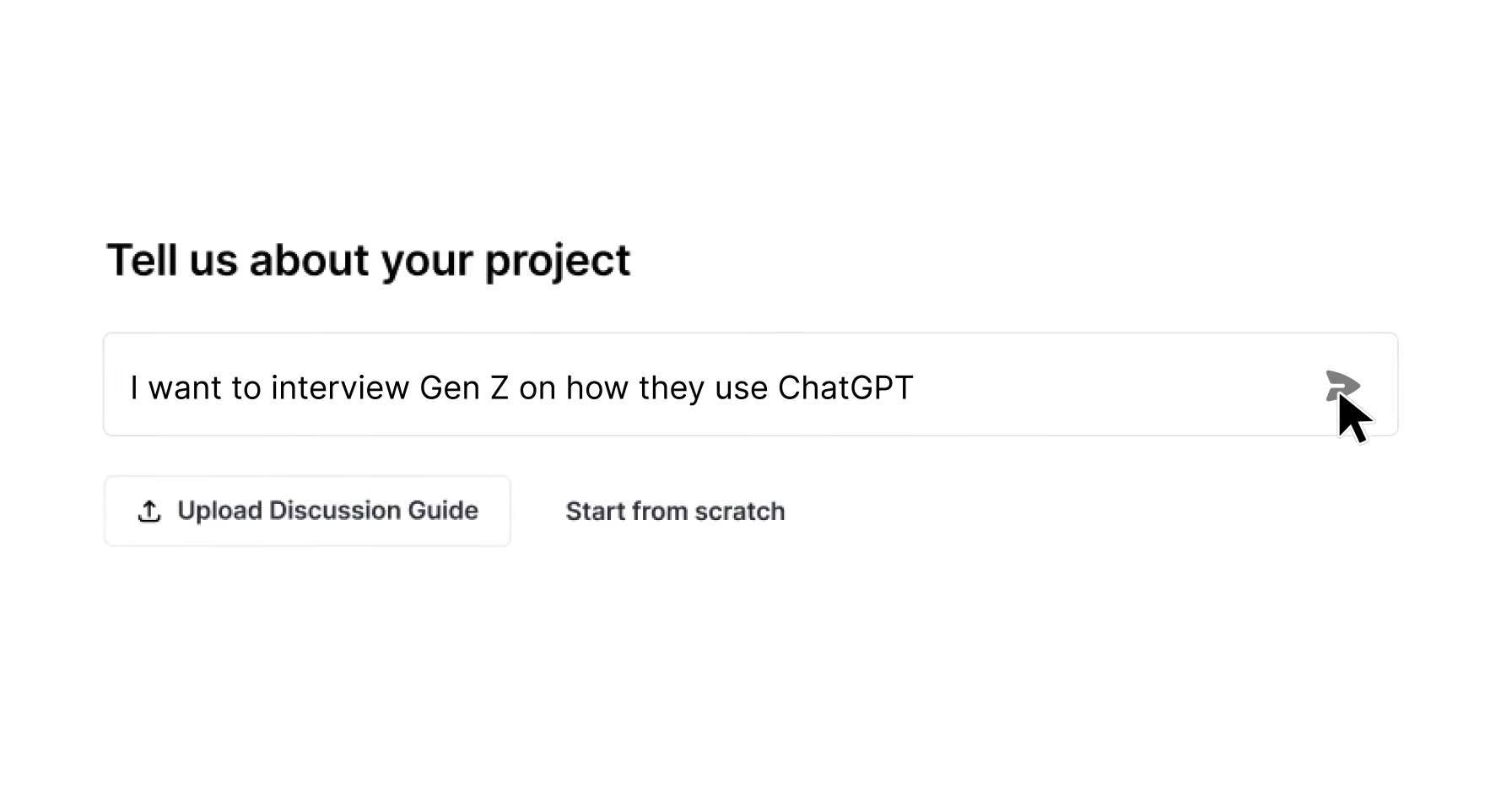
- Define research objectives and scope. Specify core goals, target segments, geographies, timeframes, methodology mix, and expected outputs before selecting any AI tool. Misaligned objectives are the leading cause of unusable model outputs.
- Audit data sources and quality. Evaluate quality, accessibility, governance, and completeness across every data source the AI solution will touch. Gartner predicts that through 2026, organizations will abandon 60% of AI projects unsupported by AI-ready data.
- Source verified, behaviorally matched participants. Predictive models require high-fidelity consumer inputs. Use platforms with real-time fraud detection to catch bots and scripted responses, participant frequency limits to eliminate professional survey-takers, and behavioral, not just demographic, matching so participants have real experience with the category. Together, these filters ensure that every interview contributes signal rather than noise.
- Conduct adaptive qualitative interviews at scale. Qual-at-scale is ideal when research requires large sample sizes or broad geographic reach, with AI tools engaging hundreds or thousands of participants remotely and asynchronously. This approach generates the emotionally rich, unstructured data that feeds NLP-based predictive pipelines.
- Run a controlled pilot on one use case. A controlled pilot on a single use case allows teams to measure results against a control group and refine workflows before scaling predictive analytics across an organization.
- Integrate model outputs into operational workflows. Predictive analytics platforms must integrate insights via APIs and connectors directly into operational systems so that predictions automatically trigger workflows rather than remain trapped in isolated dashboards.
- Establish governance, monitoring, and retraining cycles. Ongoing monitoring should include scheduled model retraining cycles, data drift detection, accuracy degradation checks, and bias emergence monitoring. Designate an AI officer and maintain audit trails for compliance.
Ready to map this framework to your research program? Schedule a walkthrough with our team.
How Leading Brands Use Listen Labs
As Listen Labs CEO Alfred Wahlforss explains, “Companies use it for all kinds of large decisions. This AI interviewer means that you can have hundreds of one-on-one interviews run at scale.” The following deployments show what that scale looks like in practice.
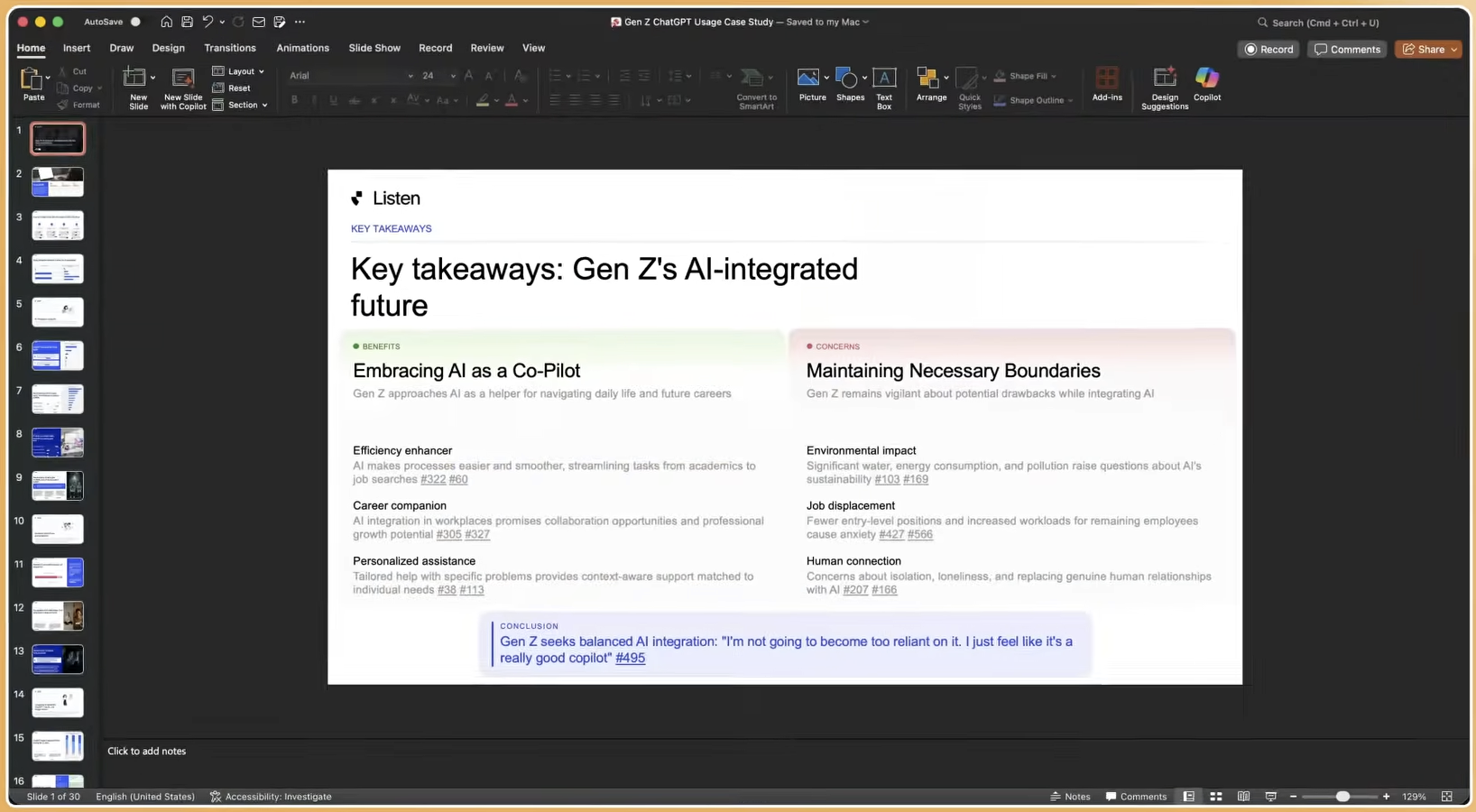
Microsoft: Traditional research took 6–8 weeks. Using Listen Labs, the team collected global customer video stories for Microsoft’s 50th anniversary within a single day. “I can reach out to hundreds of users at one third of the cost.” — Director of Data Science at Microsoft.
Anthropic (Claude Code): Listen Labs has run over 1 million AI-powered customer interviews for enterprise clients. For Anthropic, 300+ user interviews in 48 hours surfaced churn drivers 5× faster, identified competitor migration patterns, and delivered a prioritized list of 10 must-fix product items.
Procter & Gamble: More than 250 interviews with quantified themes and verbatim proof shaped product and brand strategy in hours. The research surfaced where product claims felt exaggerated before market launch and helped avoid costly downstream investment in features consumers dismiss.
Skims: Thousands of high-income buyers were validated overnight to de-risk a global campaign launch. Qualitative clarity translated customer reactions into insights that secured board-level buy-in. “I always struggled with understanding the why and Listen Labs nails this for me.” — SVP Data, Insights, Loyalty at Skims.
Robinhood: Qualitative interviews revealed experience patterns that feel on-brand with Robinhood’s core offering. Users who view prediction markets as entertainment rather than income drive 2.4× higher weekly re-engagement. Insights delivered 5× faster revealed integration flows boosting uptake 30–40%.
Data-Quality Differentiators That Protect Predictive Models
Predictive model performance is bounded by the quality of its training inputs. Listen Labs addresses this constraint at three layers.
Quality Guard monitors every interview in real time across video, voice, content, and device signals to detect fraud, low-effort responses, AI-generated scripts, and mismatched profiles. Fraud detection alone cannot prevent professional survey-takers who pass initial screening, so participants are limited to three studies per month. This frequency cap works with a reputation score that compounds across every interview, rewarding thoughtful, on-topic participants and filtering out low-effort ones. As more studies run on the platform, overall audience quality improves.
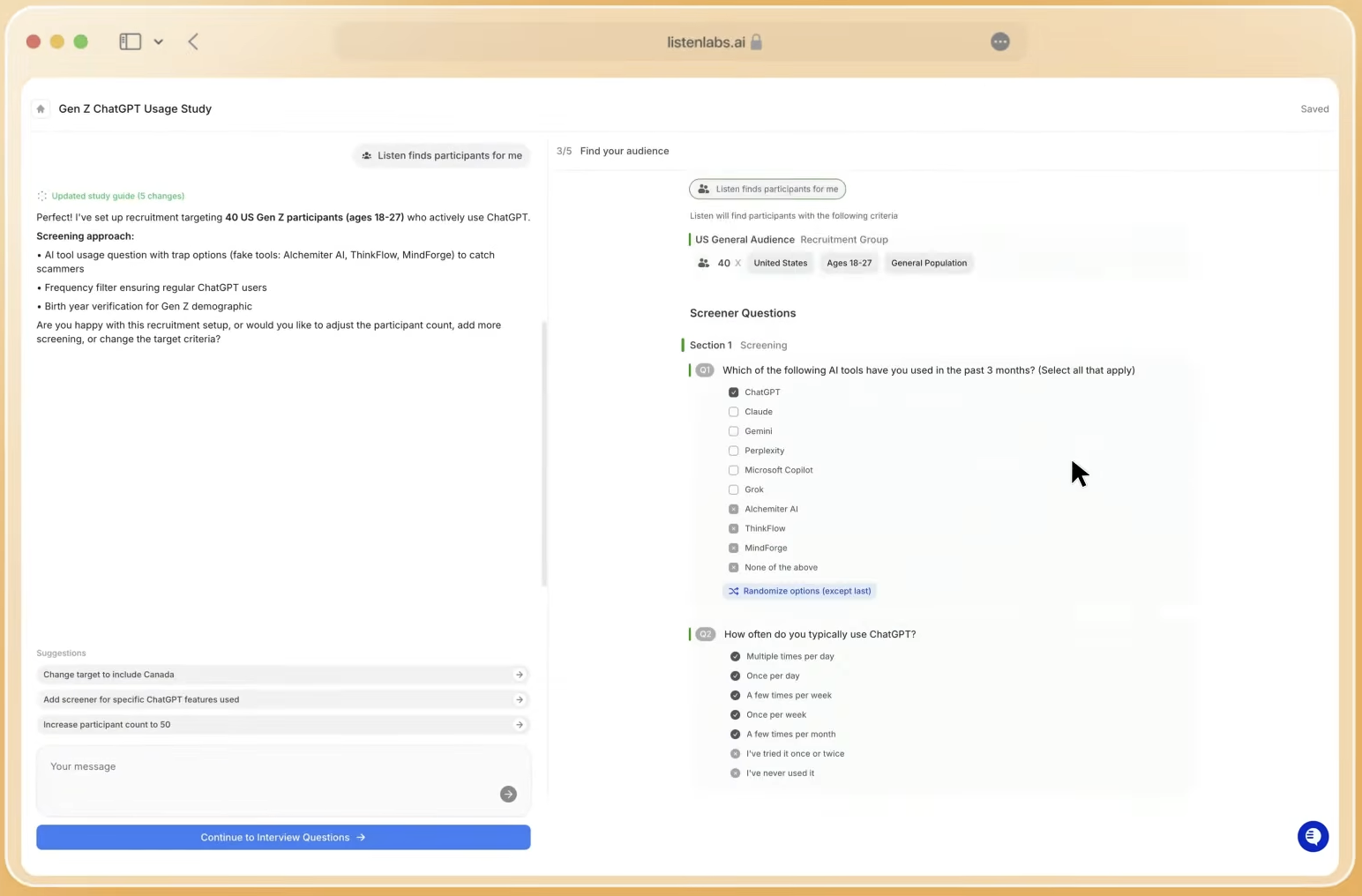
Listen Atlas matches participants on behavioral and intent data, not just self-reported demographics. The 30M-person verified network spans 45+ countries and 100+ languages, with a dedicated recruitment ops team sourcing audiences below 1% incidence rate such as enterprise decision-makers, healthcare workers, and highly specialized consumer segments.
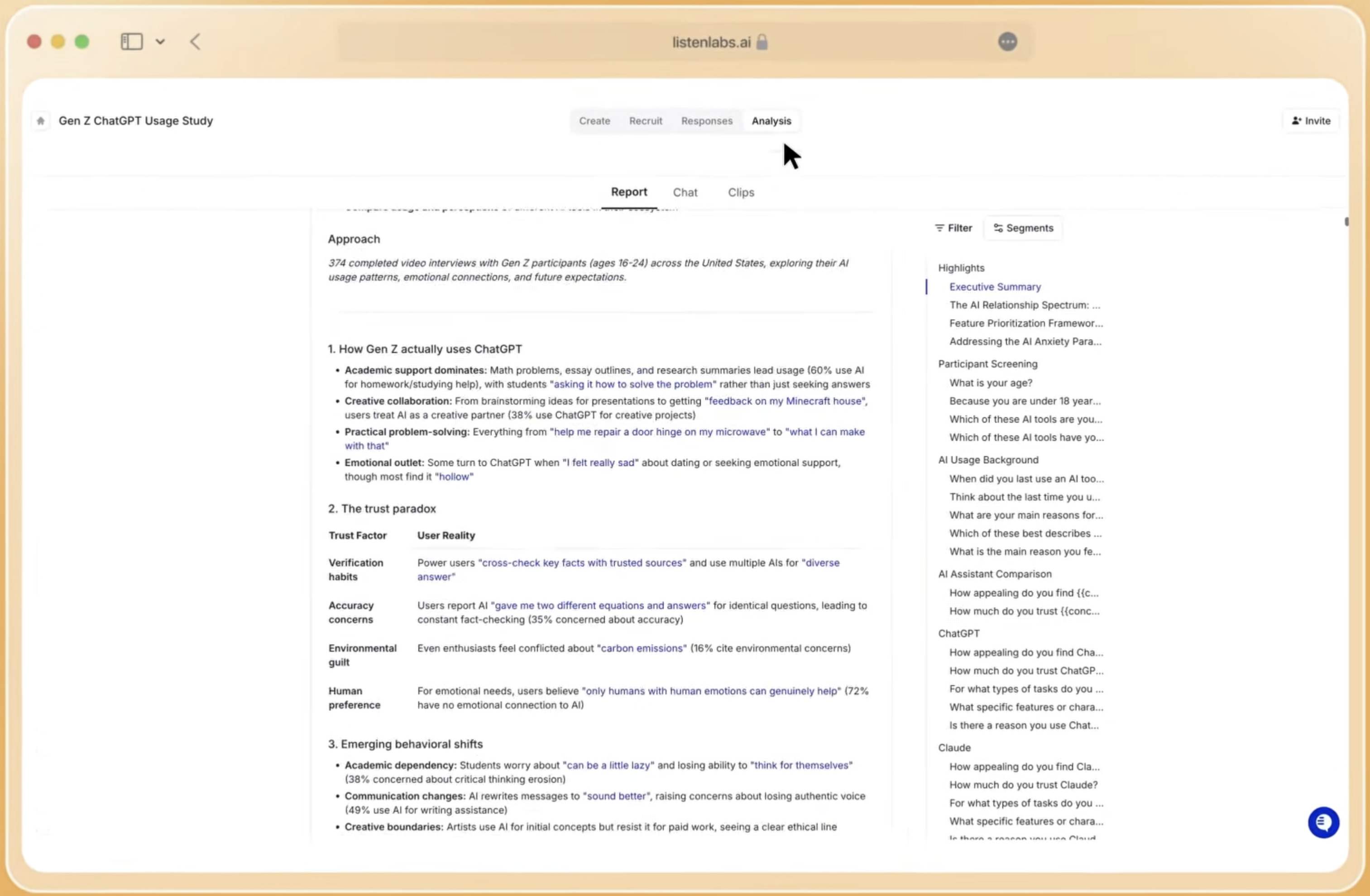
Emotional Intelligence analyzes tone of voice, word choice, and subconscious micro-expressions to surface emotional signals that transcripts alone miss. Built on Ekman’s universal emotions framework, every emotion is quantified per question and traceable to the exact timestamp and verbatim quote. Platforms like Listen Labs layer on auto-recruiting, transcription, sentiment tagging, and insight summarization so teams jump from question to findings in hours, not weeks.
Common Pitfalls And How To Avoid Them
Even with strong data-quality controls, several failure modes can undermine predictive analytics programs. Three stand out as the most common and most preventable.
Data bias: Models trained on historical data in market research AI can reproduce existing stereotypes and biases at scale, making regular bias audits and diverse training data necessary safeguards. Behavioral participant matching and real-time quality monitoring reduce bias at the data-collection stage before it propagates into the model.
Model transparency: Explainable AI is becoming mandatory in finance and government applications to ensure transparency, auditability, trust, safety, and compliance in AI-driven decisions. Every insight generated by Listen Labs’ Research Agent is traceable to the source interview, timestamp, and verbatim quote, not a black-box summary.
Compliance: Key risks of AI in market research include privacy and compliance issues with sensitive data, which can be mitigated by following standards such as GDPR. Listen Labs holds SOC 2 Type II, GDPR, ISO 27001, ISO 27701, and ISO 42001 certifications. Customer data is never used for AI model training.
Frequently Asked Questions
What is AI predictive analytics in market research?
AI predictive analytics in market research uses machine learning models trained on consumer interview data, behavioral signals, and historical research outputs to forecast future demand, churn, sentiment shifts, and emerging trends. Unlike traditional surveys that describe what happened, predictive models anticipate what is likely to happen next and enable teams to make proactive product, pricing, and messaging decisions rather than reactive ones.
How does data quality affect predictive model accuracy?
Predictive model accuracy is directly bounded by the quality of its training inputs. Models trained on fraudulent survey responses, professional survey-takers, or demographically mismatched participants produce unreliable forecasts. Listen Labs addresses this through Quality Guard’s real-time fraud detection, behavioral participant matching via Listen Atlas, and a three-study-per-month participant frequency cap. The result is emotionally rich, verified consumer data that feeds more reliable predictive pipelines.
How quickly can Listen Labs deliver research inputs for predictive models?
Listen Labs compresses the full research cycle, including study design, participant recruitment, AI-moderated interviews, analysis, and deliverables, to under 24 hours. Traditional qualitative research takes 4–6 weeks per study. For enterprises running continuous consumer intelligence programs that feed always-on predictive models, this speed difference determines whether model inputs are current or stale.
Can Listen Labs support research across multiple markets and languages?
Yes. Listen Labs covers 45+ countries across the Americas, Europe, APAC, and MEA, with interview moderation supported in 100+ languages and automatic translation and transcription across all supported languages. The dedicated recruitment ops team sources hard-to-reach segments, including enterprise decision-makers, healthcare workers, and consumers below 1% incidence rate, in any target market.
What compliance certifications does Listen Labs hold?
Listen Labs maintains SOC 2 Type II, GDPR, ISO 27001, ISO 27701, and ISO 42001 certifications. All data is encrypted at 256-bit, and customer data is never used for AI model training. Enterprise SSO is supported for secure organizational access.
Conclusion: Turning Predictive Ambition Into Daily Practice
AI predictive analytics in market research has become a 2026 operational requirement for enterprises that compete on consumer intelligence. Growth across AI segments, rising adoption in BFSI, healthcare, retail, and technology, and widening performance gaps all point in the same direction.
The binding constraint is not the predictive model itself. It is the quality, speed, and emotional depth of the consumer data feeding it. With qual-at-scale, the old trade-off between depth and scale is no longer a barrier. Listen Labs sources verified participants from a 30M-person global network, conducts thousands of adaptive AI-moderated interviews simultaneously, and delivers the consultant-quality analysis described earlier within the sub-24-hour cycle that separates current insights from stale ones.
Microsoft, P&G, Anthropic, Skims, and Robinhood have already replaced weeks-long research cycles with sub-24-hour insight delivery. The 7-step framework above provides a practical path to the same outcome for your organization.