Written by: Anish Rao, Head of Growth, Listen Labs | Last updated: July 4, 2026
Key Takeaways
- AI brand perception analysis measures how LLMs represent, rank, and emotionally frame brands versus competitors across visibility, sentiment, and entity associations.
- AI mention rate, Share of Model, and sentiment scoring form the core metrics for tracking LLM visibility, with scores below 8 indicating pre-visibility and 75–100 signaling category dominance.
- Discovery, evaluation, and sentiment-probe prompts across ChatGPT, Gemini, Perplexity, Claude, and Google AI Overviews reveal where LLM outputs diverge from actual customer sentiment.
- AI-moderated interviews with Emotional Intelligence validate LLM outputs by quantifying tone, word choice, and micro-expressions to surface perception gaps in under 24 hours.
- Listen Labs combines LLM visibility tracking with qual-at-scale interviews to close perception gaps fast, so you can see the full playbook in action.
Running AI-Moderated Interviews That Validate LLM Outputs
LLM visibility data shows what AI systems say about a brand. AI-moderated consumer interviews reveal whether those descriptions match how actual customers think and feel. With qual-at-scale, the old trade-off between depth and scale no longer blocks this work, because AI can schedule and conduct interviews, analyze transcripts for themes, and generate quantitative insights from qualitative data at the same time.
Listen Labs runs this validation loop through three integrated components: participant sourcing, quality monitoring, and emotional analysis. Listen Atlas, a global network of 30M+ verified respondents across 45+ countries, sources participants matched to the exact consumer segments surfaced in LLM outputs. Quality Guard monitors every interview in real time for fraud, low-effort responses, and repeat respondents, with participants capped at three studies per month to eliminate professional survey-takers.
Listen Labs’ Emotional Intelligence analyzes three signal layers, including tone of voice, word choice, and subconscious micro expressions, to surface emotions that transcripts alone miss. It is built on Ekman’s universal emotions framework, the same standard used in clinical psychology and UX research. Every emotion is quantified per question and traceable to the exact timestamp and verbatim quote. When an LLM describes a brand as “trusted” but interview micro-expression data shows widespread hesitation at the word “reliable,” that divergence becomes a measurable perception gap, not an interpretation.
This same methodology has been validated across multiple enterprise use cases. Anthropic used this approach to conduct 300+ churn interviews in 48 hours, surfacing where former Claude users migrate and delivering a prioritized list of must-fix items. P&G ran 250+ claim-testing interviews to identify where product claims felt exaggerated before they reached market. Microsoft collected global customer stories for its 50th anniversary within a single day.
Four-Stage Workflow to Fix Perception Gaps Fast
A repeatable perception-gap closure cycle operates in four connected stages that typically complete in about 24 hours.
Stage 1 — LLM audit (hours 1–4): Run the three prompt categories across five AI platforms. Log mention rate, position, sentiment classification, and entity associations per model. Flag divergences where models disagree on brand attributes or where LLM sentiment contradicts known customer satisfaction data.
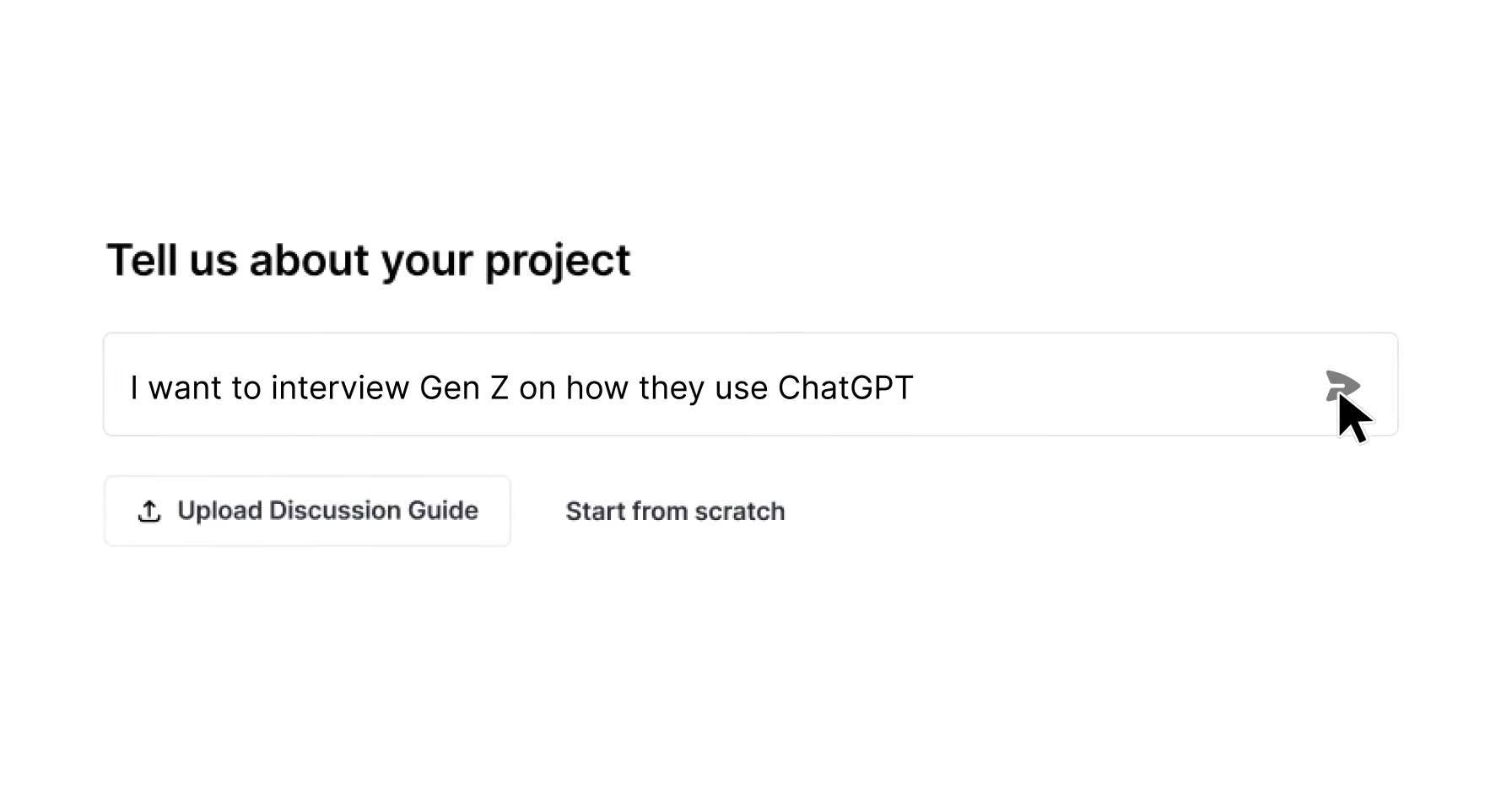
Stage 2 — Interview design and launch (hours 4–6): Use Listen Labs’ AI-assisted study co-design to convert the highest-priority divergence points into interview questions. Once the study design is finalized, launch it to a targeted participant cohort from Listen Atlas, where Quality Guard screens in real time throughout fieldwork to ensure response quality.
Stage 3 — Emotional Intelligence validation (hours 6–18): As interviews complete, Emotional Intelligence quantifies emotional responses per question. Teams use Emotional Intelligence for brand research to understand how people feel about a brand versus competitors. Timestamp-level precision highlights moments of confusion, hesitation, or delight.
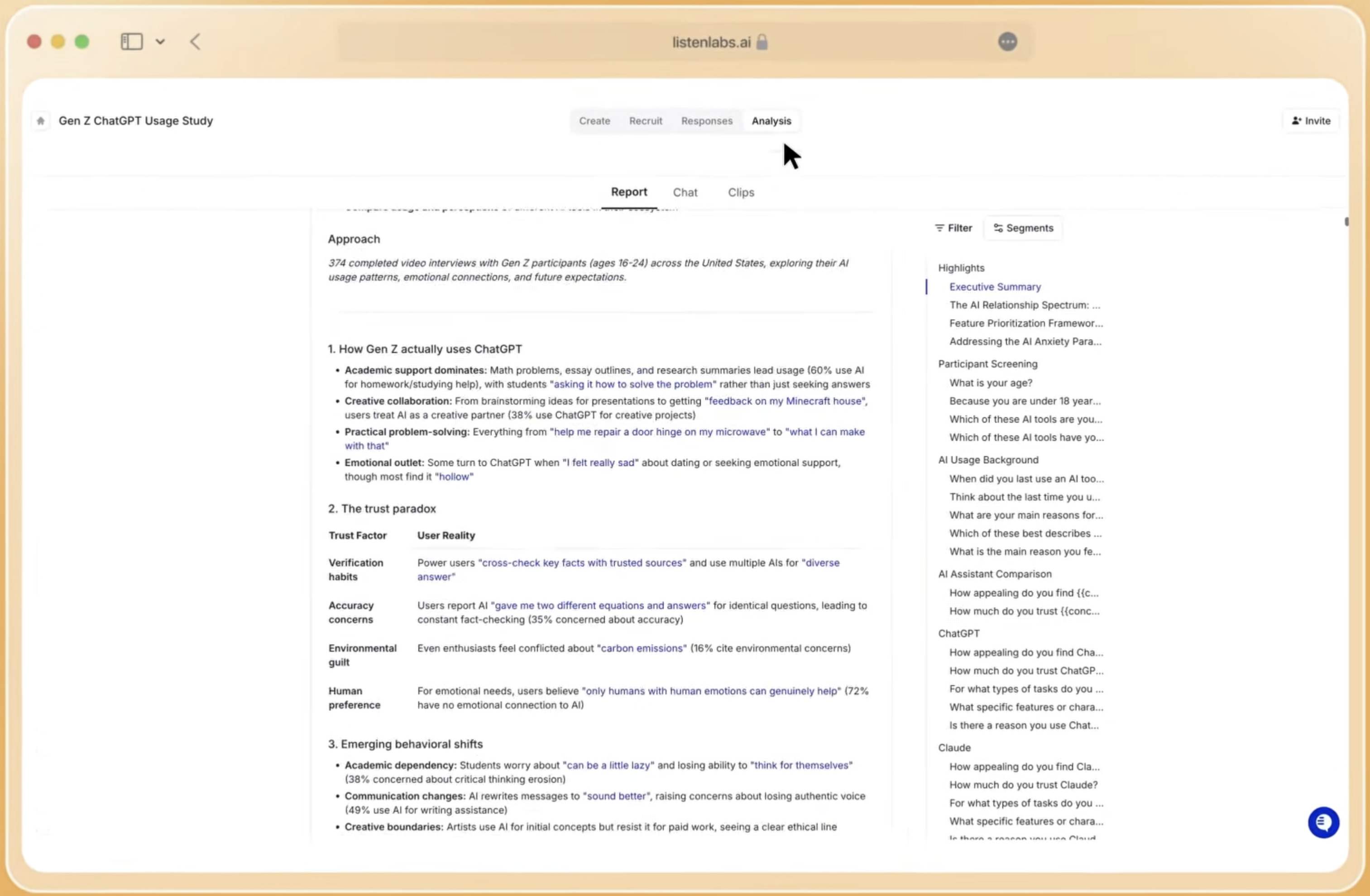
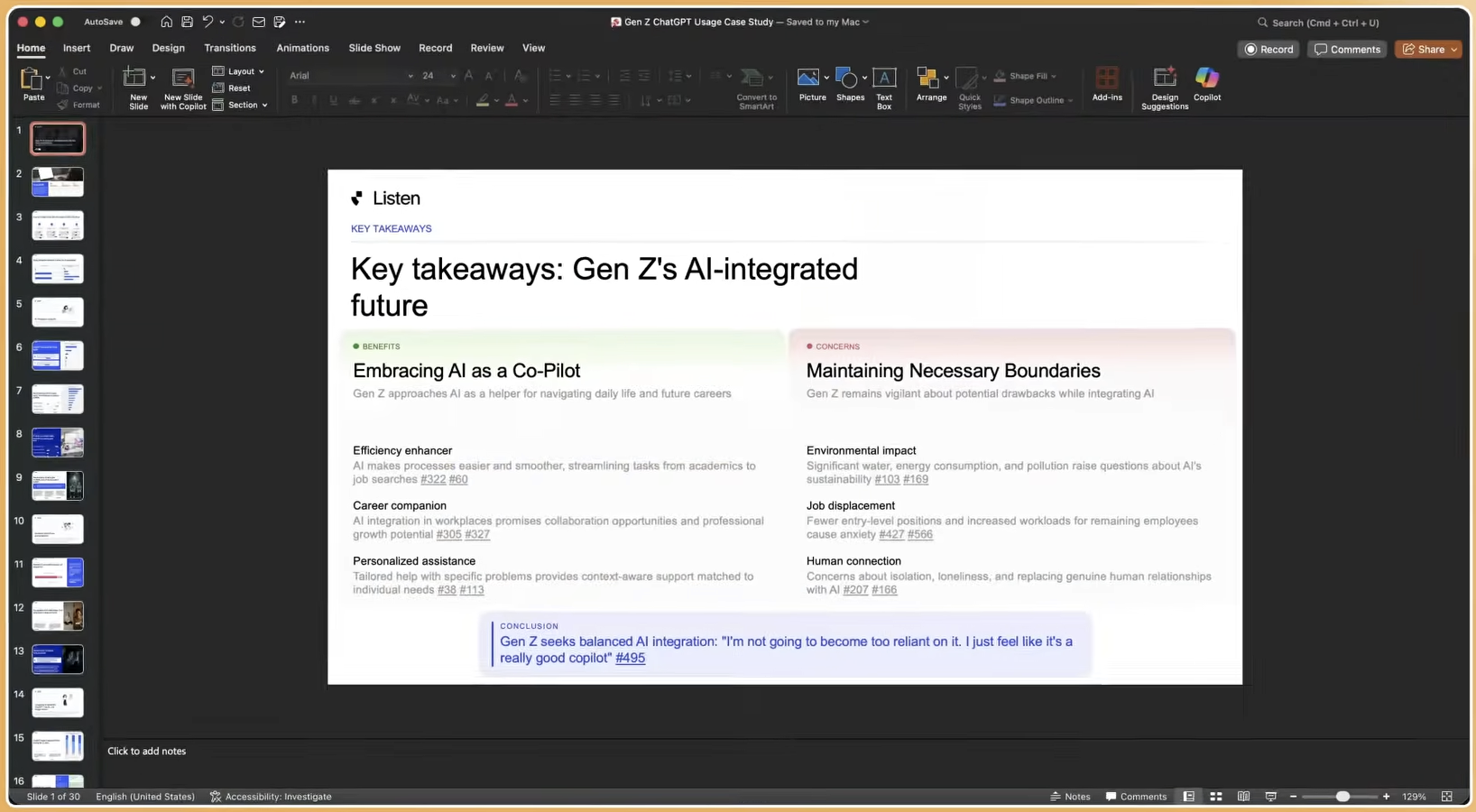
Stage 4 — Closed-loop reporting (hours 18–24): Research Agent handles the full analysis workflow from raw data to final output. It generates slide decks, memos, highlight reels, and statistical comparisons. Every insight links directly to the underlying response data, giving Consumer Insights leaders the traceability required for enterprise stakeholder presentations.
One common objection to LLM brand perception analysis is that AI models may contain outdated information. This same four-stage loop addresses that concern directly. Quality Guard flags hallucinated or stale brand attributes during interview analysis. Research Agent’s cross-study queries in Mission Control surface whether the same misperception has appeared in prior studies, which enables teams to prioritize correction efforts against the highest-frequency distortions.
Walk through the full 24-hour perception-gap playbook with a Listen Labs research specialist.
Frequently Asked Questions
What data privacy and compliance standards does Listen Labs meet?
Listen Labs maintains enterprise-grade security with 256-bit encryption and holds SOC 2 Type II, GDPR, ISO 27001, ISO 27701, and ISO 42001 certifications. Customer data is never used for AI model training. Enterprise SSO is supported, and the platform is designed to meet the compliance requirements of Fortune 500 legal and security teams.
How does Listen Labs ensure participant quality in AI-moderated interviews?
Three layers operate simultaneously. Listen Atlas sources participants from this verified respondent network using behavioral and intent matching, not just self-reported demographics. Quality Guard monitors every interview in real time across video, voice, content, and device signals to detect fraud, low-effort responses, and AI-generated scripts. A dedicated recruitment operations team adds human review for hard-to-reach segments, and participants are capped at three studies per month to prevent panel fatigue and eliminate professional survey-takers.
Can non-researchers use Listen Labs without methodology expertise?
Yes. The platform’s AI-assisted study co-design accepts research goals described in plain language and drafts structured objectives, questions, and probing context automatically. Research Agent then handles analysis and generates deliverables, including slide decks, memos, highlight reels, and charts, without requiring the user to configure analytical frameworks manually. Brand managers, product managers, and marketing leaders regularly run studies independently on the platform.
Does Listen Labs support languages other than English?
The platform supports 100+ languages for interview moderation, with automatic translation and transcription across all supported languages. Emotional Intelligence is available across 50+ languages. Listen Labs covers 45+ countries across the Americas, Europe, APAC, and MEA, which makes it suitable for multi-market brand perception studies run from a single platform.
Can organizations use their own participants instead of the Listen Labs panel?
Yes. Listen Labs supports self-recruitment, allowing organizations to invite participants from their own customer base at a reduced credit cost. Organizations can also bring their own panel provider. This option is commonly used for brand perception studies where the research team needs to interview existing customers rather than a general population sample.
What does the Research Agent deliver at the end of a study?
Research Agent delivers a connected set of outputs that move from insight discovery to stakeholder-ready communication. It generates automated key findings and theme analysis, consultant-quality PowerPoint slide decks, and memo-style reports that summarize the story. It also produces video highlight reels of emotionally significant moments, statistical charts and significance tests, and segmentation breakdowns by demographics or custom cohorts. Finally, it answers any natural-language query against the full dataset. Every output links back to the underlying interview data for full traceability, and deliverables are generated in under a minute after fieldwork closes.
Conclusion
The brands that will succeed in the AI era are those that measure how LLMs describe them, validate those descriptions against real consumer emotional responses, and close the gaps between the two on a continuous cycle, not a quarterly one. Traditional surveys and basic sentiment tools were not built for this loop. Listen Labs is.
By combining AI visibility tracking across major LLMs, qual-at-scale interviews sourced from Listen Atlas, and multimodal Emotional Intelligence built on Ekman’s framework, Listen Labs gives Consumer Insights leaders a single platform to run the full perception-gap cycle in under 24 hours at enterprise compliance standards, in 100+ languages, across 45+ countries.
See how your team can go from LLM audit to validated consumer insight in less than 24 hours.