
Written by: Anish Rao, Head of Growth, Listen Labs | Last updated: July 10, 2026
Key Takeaways for Enterprise Research Leaders
- Traditional qualitative research cycles of 4–6 weeks and costs of $17,000–$28,000 no longer match modern product and brand decision speed.
- Listen Labs replaces manual recruitment, scheduling, and human moderation with AI-assisted study design, global respondent access, and parallel AI-moderated interviews that deliver results in under 24 hours.
- Emotional Intelligence captures tone, micro-expressions, and behavioral signals beyond transcripts, while the Research Agent converts findings into consultant-quality deliverables in under a minute.
- Mission Control builds a persistent, searchable knowledge base across studies, turning one-off projects into compounding institutional intelligence for continuous research programs.
- Enterprise teams evaluating alternatives to Discuss.io can see how Listen Labs performs on all eight evaluation criteria in a live demo with a single end-to-end platform.
Eight Criteria for Replacing Discuss.io with an AI Platform
Enterprise teams need a consistent framework when comparing qualitative research platforms. The eight criteria that distinguish enterprise-grade AI research platforms from legacy tools are:
- Research cycle time from brief to deliverable
- Ability to combine qualitative depth with large sample scale
- Participant quality and fraud prevention mechanisms
- Global reach and multilingual support
- Emotional signal capture beyond transcripts
- Analysis speed and deliverable quality
- Enterprise security and compliance certifications
- Total cost of ownership across tools, headcount, and agency fees
The following sections evaluate Listen Labs against these eight criteria, covering study design, recruitment, moderation, emotional intelligence, analysis, knowledge management, security, and cost.
Study Design, Recruitment, and Research Cycle Time
Discuss.io’s model centers on live video focus groups and human-moderated sessions, which makes recruitment a sequential, manual process. Coordinators source participants, schedule sessions across time zones, and manage no-shows, with each step adding days before a single interview begins.
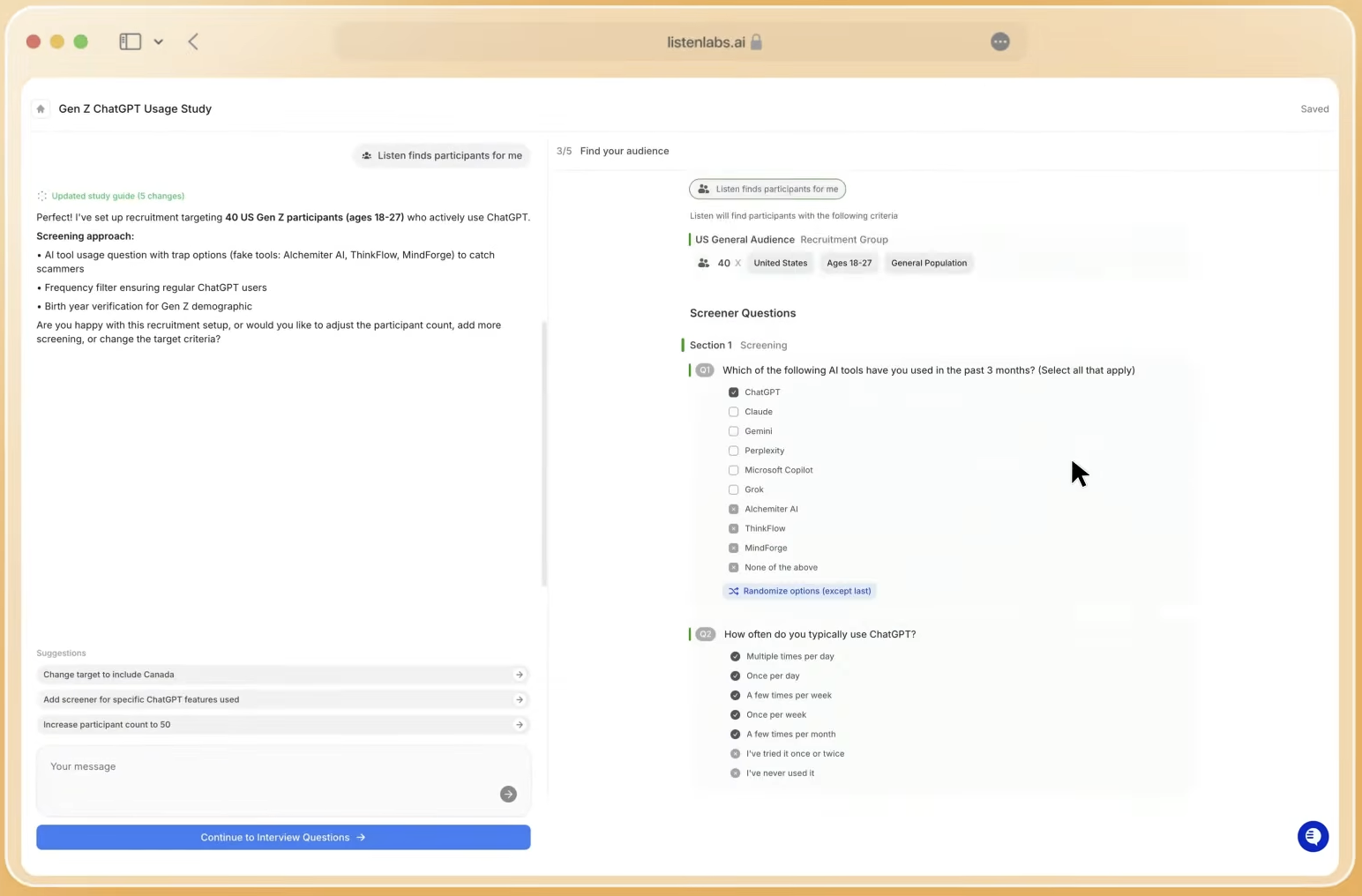
Listen Labs replaces this with AI-assisted study co-design. Researchers describe goals in natural language and the platform drafts structured objectives, discussion guides, and probing context in seconds. Recruitment draws from Listen Labs’ global network of 30M verified respondents spanning 45+ countries and 100+ languages, with an AI orchestration layer, Listen Atlas, that automatically matches and bids across multiple consumer and B2B panel partners.
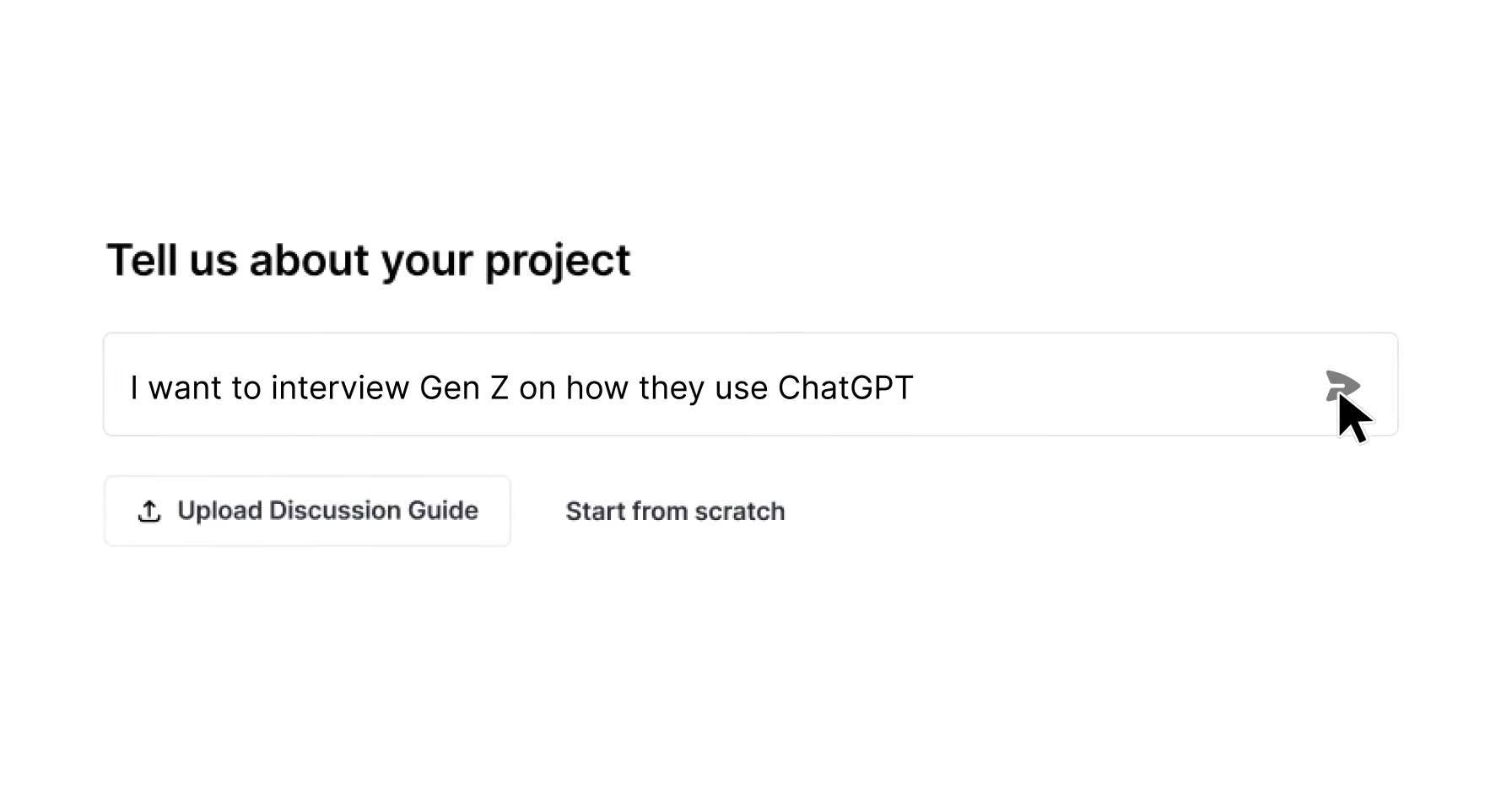
A dedicated recruitment operations team handles hard-to-reach segments including enterprise decision-makers, healthcare workers, and audiences below 1% incidence rate. Organizations can also bring their own participants at reduced cost. Qual-at-scale tools can engage hundreds or thousands of participants remotely and asynchronously, which removes the scheduling bottleneck that defines legacy platforms and shortens the full cycle from weeks to under a day.
Moderation Scale, Participant Quality, and Fraud Controls
Human moderation on platforms like Discuss.io is limited to 4–6 interviews per day per researcher, creating a hard ceiling on throughput. Scheduling dependencies, moderator availability, and session logistics compound this constraint. Professional respondents, who game incentive structures across multiple panels, remain a persistent quality risk on commodity panels.
Listen Labs addresses both scale and quality together. AI-moderated interviews conduct personalized, adaptive conversations with dynamic follow-up questions at any scale, running hundreds of sessions in parallel. This scale advantage would be meaningless without strong quality controls, so Quality Guard operates in real time across video, voice, content, and device signals to detect fraud, low-effort responses, AI-generated scripts, and mismatched profiles.
To prevent the professional survey-taker problem that undermines data integrity on open panels, participants are limited to three studies per month. This structural safeguard keeps data cleaner than volume-focused panels. Platforms like Listen Labs layer on auto-recruiting, transcription, sentiment tagging, and insight summarization, so teams move from question to findings in hours instead of weeks.
Emotional Intelligence, Depth at Scale, and Analysis Speed
Standard qualitative platforms, including Discuss.io, capture what participants say. Transcripts, session recordings, and moderator notes form the raw material for analysis, which then requires human analysts to tag themes, identify patterns, and write reports. Moderator time alone runs $150–$300 per hour for experienced researchers, and analysis effort scales linearly with interview volume.
Listen Labs introduces two capabilities that have no equivalent in legacy platforms. Emotional Intelligence analyzes three simultaneous signal layers, tone of voice, word choice, and subconscious micro-expressions, using Ekman’s universal emotions framework, the same standard applied in clinical psychology and UX research. Every emotion is quantified per question and concept, traceable to the exact timestamp, verbatim quote, and reasoning behind the classification.
This approach captures confusion, hesitation, delight, and friction that participants never articulate aloud. The Research Agent then converts all interview data into consultant-quality deliverables, including slide decks, memos, video highlight reels, statistical charts, and segmentation breakdowns, in under a minute. The old trade-off between depth and scale no longer applies when analysis and reporting run at this speed.
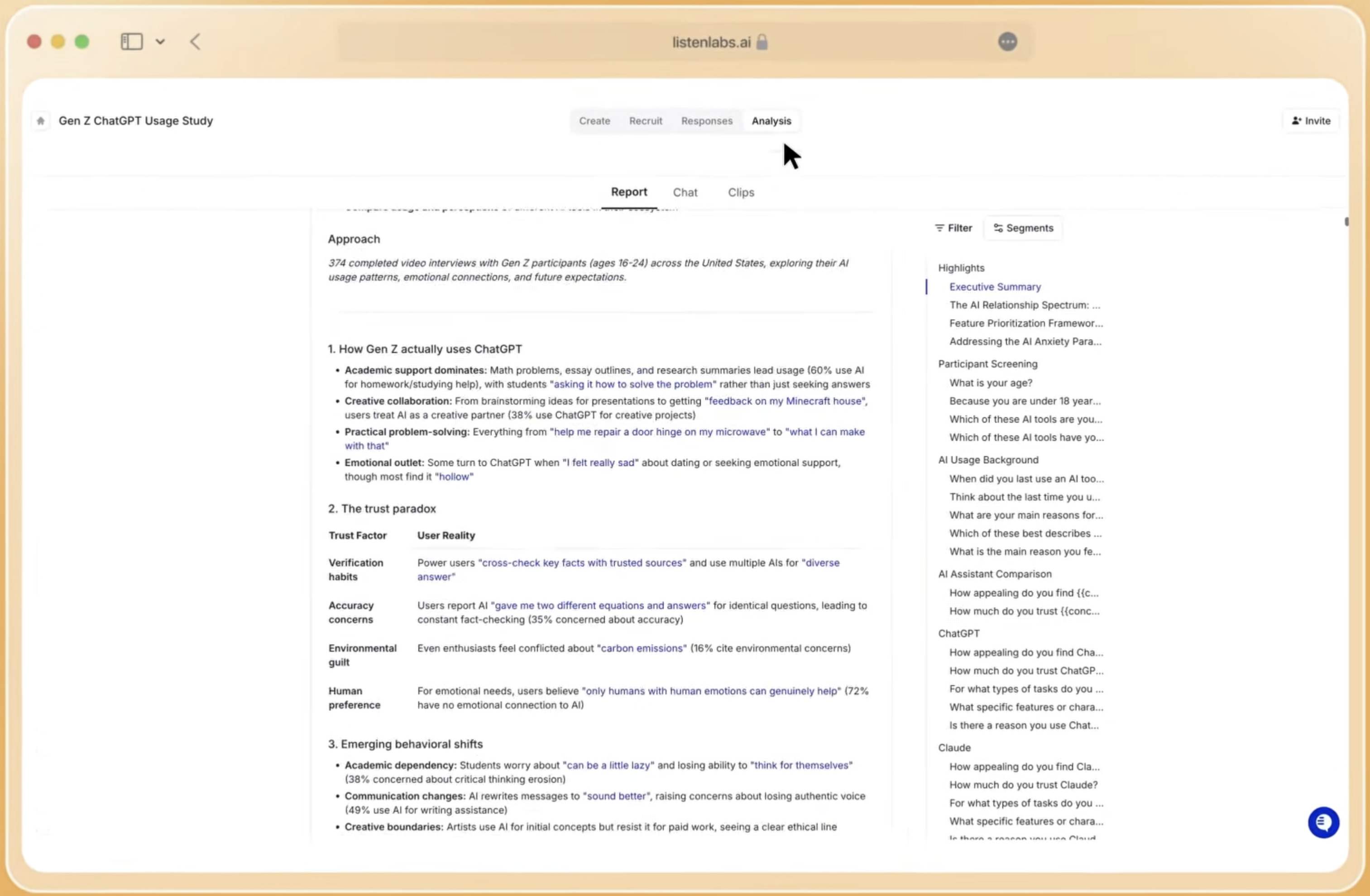
Request a demo to watch Emotional Intelligence and the Research Agent work on your own research questions and see the analysis workflow end to end.
Beyond individual study execution, enterprise teams also need to consider how research insights accumulate over time, which depends heavily on platform architecture.
Mission Control, Knowledge Management, and Operational Change
Discuss.io and similar platforms produce study-level outputs, such as recordings, transcripts, and reports that live in separate files or shared drives. Institutional knowledge from past research becomes hard to access without manual retrieval, and teams often re-research questions that earlier studies already answered.
Listen Labs’ Mission Control functions as a persistent organizational source of truth. Every completed study grows a searchable knowledge base, enabling cross-study queries, trend tracking over time, and retrieval of past findings in seconds. For enterprise teams running continuous consumer intelligence programs rather than one-off projects, this knowledge base compounds in value with each study added.
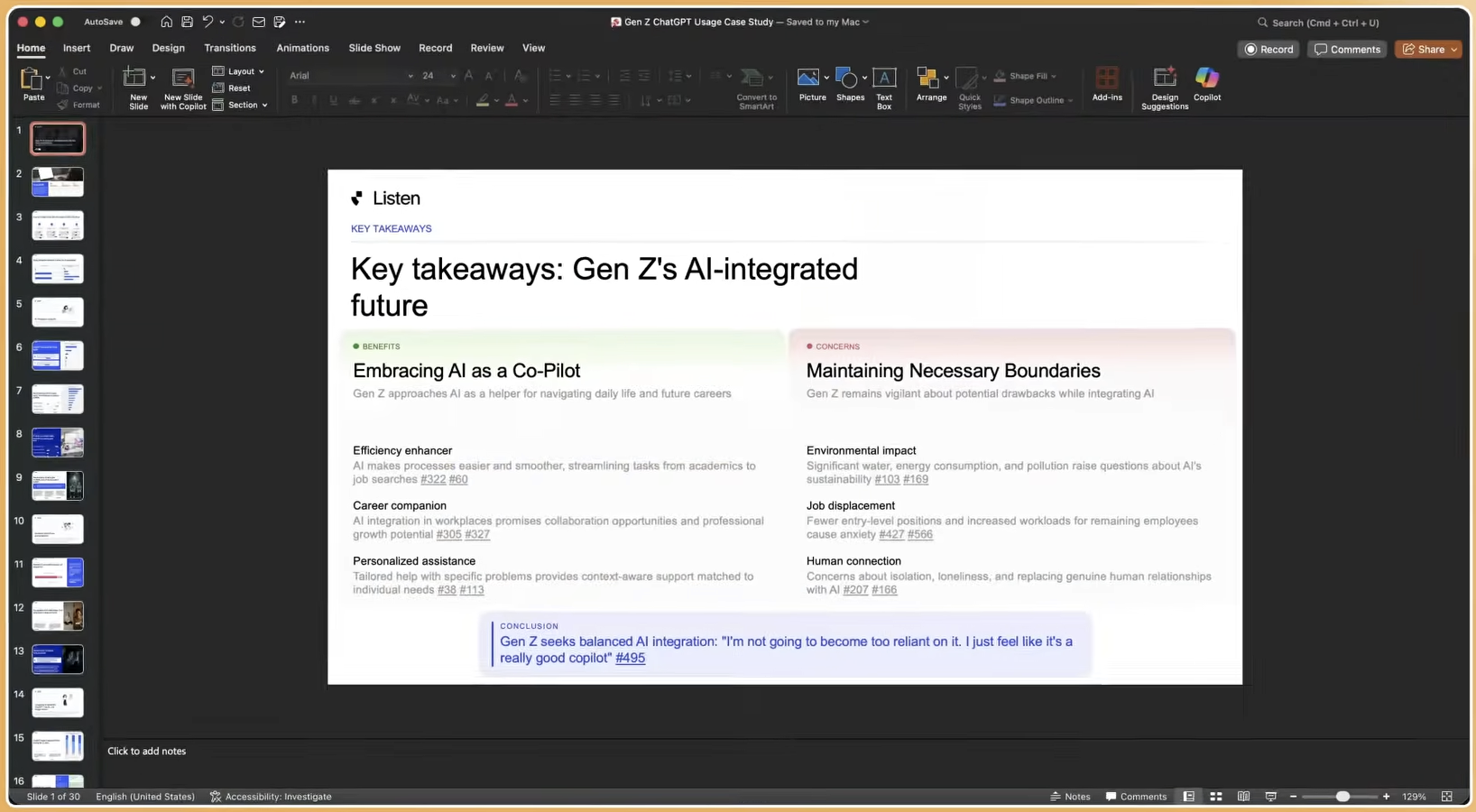
Change management still matters. Teams transitioning from human-moderated workflows need to recalibrate expectations around moderator involvement and build internal fluency with AI-generated deliverables. Listen Labs’ in-house research team, with 50+ years of combined expertise, supports this transition as a methodology partner and helps teams redesign processes around faster cycles.
Global Reach, Multilingual Support, and Enterprise Security
Global brands require consistent research quality across markets, languages, and regulatory environments. Legacy platforms often rely on regional vendors and fragmented tooling, which increases coordination time and security risk.
Listen Labs supports interview moderation in 100+ languages with automatic translation and transcription across all supported languages. Emotional Intelligence is available across 50+ languages, which allows teams to compare emotional response patterns across regions. The platform covers 45+ countries across the Americas, Europe, APAC, and MEA, supporting multi-market segmentation, global brand tracking, and localization studies within a single environment.
Enterprise security remains a core evaluation criterion. Listen Labs holds SOC 2 Type II, GDPR, ISO 27001, ISO 27701, and ISO 42001 certifications. The platform uses 256-bit encryption, and customer data is never used for AI model training. Enterprise SSO is supported, which aligns with the compliance requirements of Fortune 500 procurement and legal teams.
Total Cost of Ownership and Best-Fit Use Cases
Enterprise teams care about the full cost of research, not just per-project fees. Legacy stacks often combine agency retainers, panel vendors, transcription tools, and separate analysis software, which inflates total cost of ownership and slows delivery.
Listen Labs consolidates these functions into one platform, which reduces spend on external agencies and point tools while freeing internal researcher time from manual tasks. The 24-hour cycle time also reduces opportunity cost by allowing more tests within the same budget window.
The enterprise proof points from 2026 show where Listen Labs delivers the clearest advantage over legacy platforms:
- Consumer insights leaders at large enterprises: Microsoft collected global customer video stories for its 50th anniversary celebration within a single day. The Director of Data Science at Microsoft noted, “I can reach out to hundreds of users at one third of the cost.”
- UX research and product teams: Anthropic ran 300+ user interviews in 48 hours to surface Claude subscription churn drivers 5x faster than previous methods, identifying where former users migrate and delivering a prioritized list of must-fix items. The Director of Product Strategy at Anthropic stated, “Listen Labs lets us understand user churn with a level of clarity and speed we’ve never had before.”
- Brand and innovation teams at CPG companies: P&G conducted 250+ interviews with quantified themes to evaluate how men respond to new product claims before market launch, shaping product and brand strategy in hours rather than weeks.
- Campaign validation and consumer validation: Skims validated campaign direction with thousands of high-income buyers overnight, eliminating weeks of recruiting and enabling board-level buy-in. The SVP of Data, Insights, and Loyalty at Skims noted, “I always struggled with understanding the why and Listen Labs nails this for me.”
- Product and engagement research: Robinhood assessed whether prediction markets feel on-brand and identified user segments driving 2.4x higher weekly re-engagement, with insights delivered 5x faster than prior research cycles.
Listen Labs has run over 1 million AI-powered customer interviews for companies including Microsoft, Perplexity, and Sweetgreen. These proof points demonstrate platform maturity at scale, and they set the stage for a clear view of risks and limitations.
Risks, Limitations, and a Practical Decision Framework
Any honest evaluation of AI research platforms must address three categories of risk that buyers frequently underestimate, because these risks shape long-term value and adoption.
The first risk is shallow data from rigid methods. AI moderation excels at adaptive follow-up within a structured guide, but a skilled human moderator chasing a flicker of hesitation, reading tone and body language, and probing the hardest emotional terrain is not yet fully replaceable by AI moderation in every context. Listen Labs’ Emotional Intelligence layer partially addresses this gap by capturing non-verbal signals, but teams with highly sensitive or clinically complex research objectives should evaluate this carefully.
The second risk is hidden recruitment complexity. Not all audiences are equally accessible through standard panel networks. Niche B2B segments, regulated industries, and sub-1% incidence populations require dedicated recruitment operations, a capability Listen Labs provides but that many point solutions do not.
The third risk is overestimating automation readiness. Teams accustomed to human-moderated workflows may underestimate the internal change management required to trust AI-generated deliverables and shift researcher time toward strategic interpretation.
A practical decision checklist for platform selection helps teams compare options consistently:
- Does the platform cover the full research lifecycle, including design, recruitment, moderation, analysis, and delivery, or does it require additional vendors?
- What fraud prevention mechanisms operate in real time, and are participant frequency limits enforced?
- Can the platform reach your specific audience segments, including niche or hard-to-find populations?
- Does emotional signal capture go beyond transcripts to include tone, micro-expressions, and behavioral signals?
- What enterprise security certifications does the platform hold (SOC 2, GDPR, ISO 27001)?
- How does the platform support institutional knowledge accumulation across studies over time?
- What is the total cost of ownership when replacing agency fees, panel vendors, transcription tools, and analysis software?
Frequently Asked Questions
How long does it take to get results from Listen Labs compared to Discuss.io?
Listen Labs compresses the entire research cycle, from study design through recruitment, moderation, analysis, and deliverable generation, to under 24 hours. Traditional human-moderated platforms like Discuss.io depend on sequential scheduling, moderator availability, and manual analysis, which extends the multi-week timelines described earlier. For enterprise teams running continuous research programs, this difference compounds significantly across a quarter or year of studies.
How does Listen Labs source and verify participants?
Listen Labs operates Listen Atlas, an AI orchestration layer that draws from the global respondent network described earlier. The platform matches participants using behavioral and intent data rather than self-reported demographics alone. A dedicated recruitment operations team handles hard-to-reach segments including enterprise decision-makers, healthcare workers, and audiences below 1% incidence rate. Organizations can also bring their own participants or panel providers at reduced cost.
What makes AI moderation different from human moderation on platforms like Discuss.io?
AI-moderated interviews on Listen Labs conduct personalized, adaptive conversations with dynamic follow-up questions, probing deeper on short or interesting answers the same way a trained human interviewer would. The key operational difference is scale. AI moderation runs hundreds of sessions simultaneously without scheduling constraints, while human moderation is limited to a small number of sessions per day per researcher.
Listen Labs also adds Emotional Intelligence analysis, capturing tone, word choice, and micro-expressions, which goes beyond what standard transcription and human note-taking capture in a Discuss.io session.
Does Listen Labs support multilingual and global research programs?
Listen Labs supports interview moderation in 100+ languages with automatic translation and transcription across all supported languages. Emotional Intelligence is available across 50+ languages. The platform covers 45+ countries across the Americas, Europe, APAC, and MEA, which makes it suitable for multi-market segmentation studies, global brand research, and localization programs that would otherwise require multiple regional vendors on a legacy platform.
What security and compliance certifications does Listen Labs hold?
Listen Labs holds SOC 2 Type II, GDPR, ISO 27001, ISO 27701, and ISO 42001 certifications. The platform uses 256-bit encryption, and customer data is never used for AI model training. Enterprise SSO is supported. These certifications meet the compliance requirements of Fortune 500 procurement and legal teams evaluating research platform vendors.
Conclusion: Selecting a Platform That Scales Qualitative Depth
Legacy human-moderated platforms like Discuss.io were built for a research environment where depth and scale were mutually exclusive, and where multi-week cycles were the industry standard. That environment no longer reflects how enterprise product, brand, and insights teams operate in 2026.
Switching to AI-moderated interviews lets teams capture hundreds of candid, one-to-one conversations overnight, which changes what research can deliver within a product sprint, a campaign timeline, or a quarterly planning cycle.
Listen Labs is an end-to-end platform that collapses the depth-versus-scale trade-off while guaranteeing participant quality through Quality Guard, capturing emotional signals through Ekman-based Emotional Intelligence, and delivering consultant-quality results in under 24 hours. Mission Control ensures that every study compounds into institutional knowledge rather than disappearing into a shared drive.
For enterprise consumer insights, UX research, and product leaders who need faster, higher-quality qualitative research without increasing headcount or agency spend, Listen Labs is built to meet all eight evaluation criteria simultaneously.