
Written by: Anish Rao, Head of Growth, Listen Labs
Key Takeaways
- Discuss.io pricing starts at $89 per user one time, with enterprise projects often exceeding $15,000 due to custom fees and recruitment add-ons.
- Listen Labs delivers complete AI-powered research cycles in under 24 hours at roughly one-third the cost of traditional platforms, which enables major increases in study volume.
- AI platforms like Listen Labs provide global recruitment, adaptive moderation, and automated analysis across more than 100 languages for consistent, repeatable insights.
- Traditional platforms like Discuss.io struggle with speed, scale, and cost transparency when compared with unified AI research infrastructure that manages the full project lifecycle.
- Enterprise teams achieve operational transformation with Listen Labs’ SOC 2 compliance and Mission Control, and can calculate specific ROI projections with a personalized Listen Labs demo.
How Discuss.io and Listen Labs Differ in Scope
Discuss.io operates as a video-based qualitative research platform focused on interviews, focus groups, and participant recruitment through proprietary panels. The platform serves enterprise research teams that run traditional moderated sessions with human oversight and manual analysis workflows. In contrast, end-to-end AI research platforms like Listen Labs integrate study design, global recruitment, AI-moderated interviews, automated analysis, and instant deliverable generation in a single environment. This unified approach replaces fragmented tool chains with a research infrastructure that handles the complete lifecycle from brief to final report.
Key Evaluation Criteria for Choosing a Research Platform
Enterprise research leaders evaluate platforms across seven critical dimensions: speed to insights, total cost of ownership, participant quality and global reach, research depth and scalability, analysis automation capabilities, emotional intelligence capture, and enterprise security compliance including SOC 2 and GDPR standards. Traditional platforms deliver strong human-moderated depth but struggle with speed and scale. AI-powered solutions provide statistical confidence through large sample sizes while preserving conversational depth that previously existed only in small qualitative studies. This shift in capability means evaluation frameworks must expand beyond traditional quality metrics and account for both immediate project costs and long-term operational efficiency gains that human-only workflows could not achieve.
Discuss.io Pricing Structure and Total Cost Analysis
Discuss.io’s subscription model starts at $89 per user one time, which creates baseline platform fees before any research activities begin. For enterprise teams, this structure means monthly platform costs accrue even before a single study launches. End-to-end qualitative research projects typically range from $15,000 to $27,000 per study, bundling recruitment, incentives, translation, and transcription services. Comparable enterprise projects often exceed $15,000 after including custom fees, so total spend depends heavily on negotiated terms and study complexity rather than transparent per-session rates.
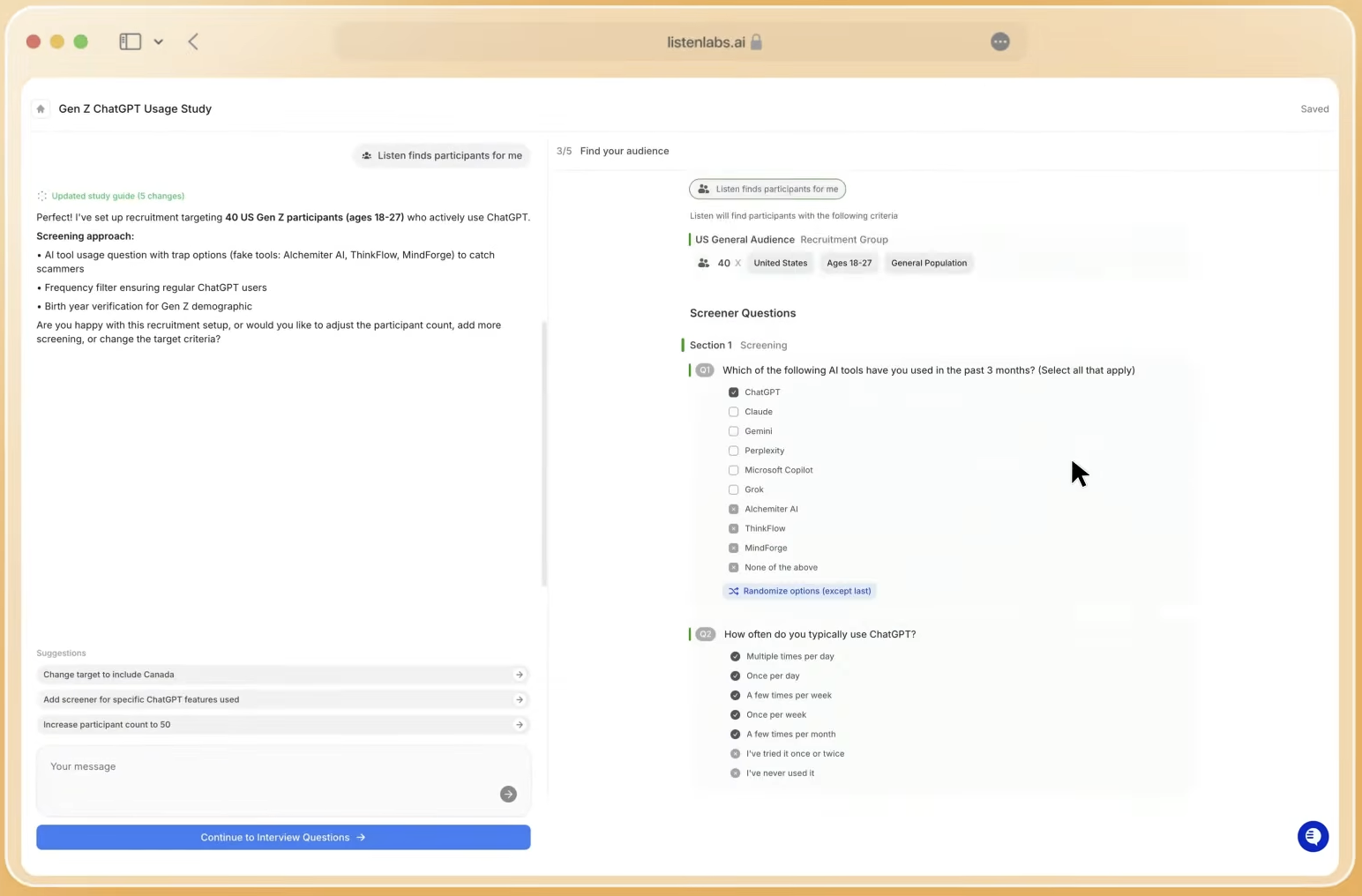
Listen Labs removes subscription minimums through a credit-based model where organizations pay per participant recruited, with self-recruitment options that can reduce costs further. The platform delivers complete research cycles, from AI-assisted study design through recruitment, moderated interviews, and automated analysis, at roughly one-third of typical traditional platform costs. Teams can model their projected ROI and cost per study in a Listen Labs demo based on actual research volume and audience requirements.
Side-by-Side Platform Capabilities
Study Setup and Participant Recruitment
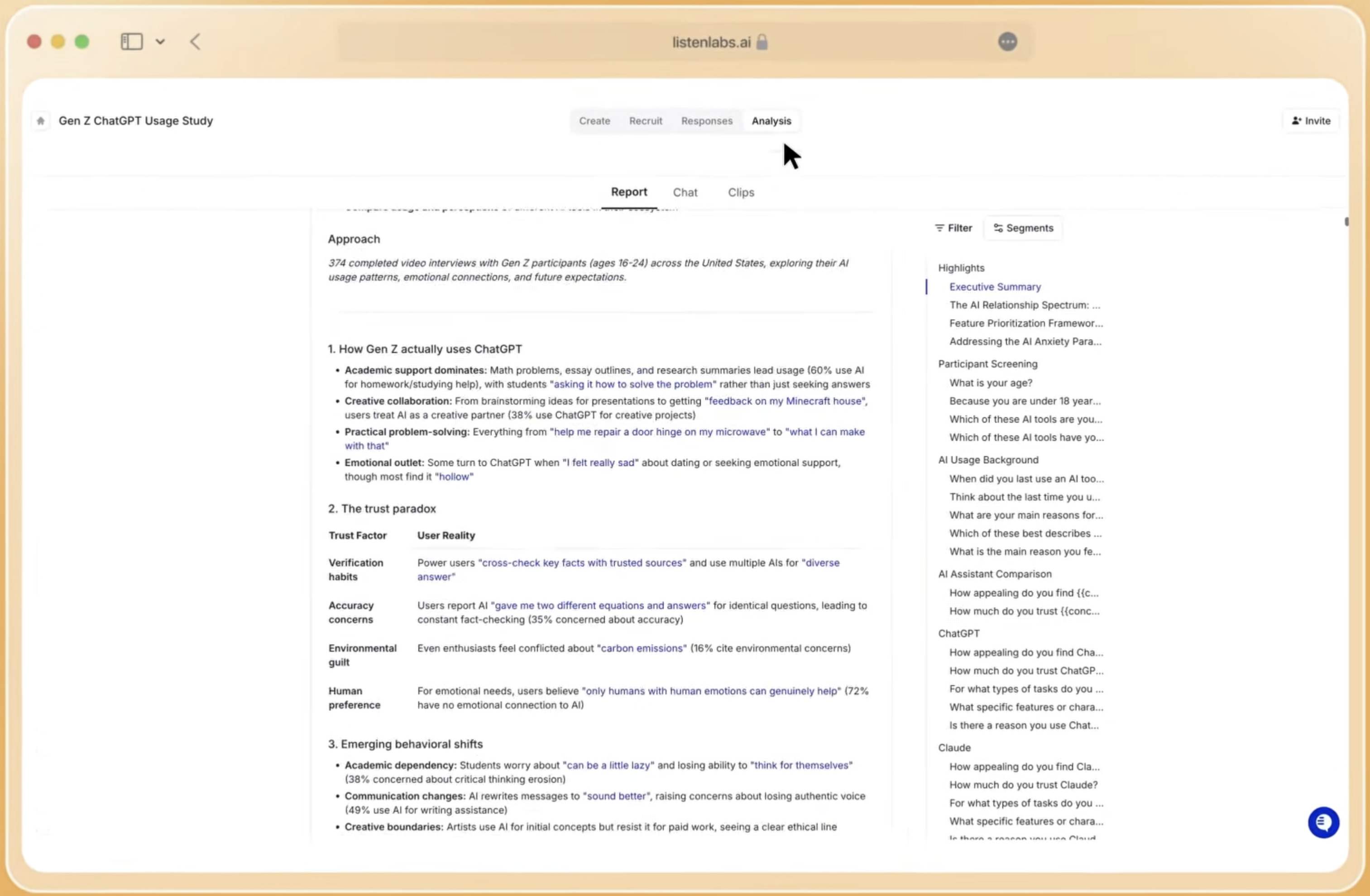
Discuss.io requires manual study design and relies on proprietary panels with limited global reach and demographic targeting capabilities. Recruitment often involves multiple vendor relationships and extended timelines for specialized audiences, which slows project kickoff and increases coordination overhead. These constraints mean research teams may wait weeks to assemble modest sample sizes for niche or global segments. Listen Labs provides AI-assisted study co-design that turns natural language briefs into structured objectives and questions, then uses Listen Atlas to orchestrate recruitment across a large, verified participant network spanning dozens of countries and languages. A dedicated recruitment operations team sources hard-to-reach segments, including enterprise decision-makers and consumers below 1 percent incidence rates, so teams can launch complex studies far faster.
Interview Moderation and Data Quality
Traditional platforms depend on human moderators with variable availability and consistency, which creates scheduling bottlenecks and no-show risks that can bias sample composition. Discuss.io’s human-dependent model limits parallel session capacity and introduces subjective interpretation differences across moderators. Listen Labs conducts thousands of simultaneous AI-moderated interviews with adaptive follow-up questions that maintain conversational depth while removing scheduling constraints. Quality Guard monitors every interview in real time for fraud, low-effort responses, and repeat participants, and a three-study monthly limit reduces professional survey-taker contamination.
Analysis and Insight Generation
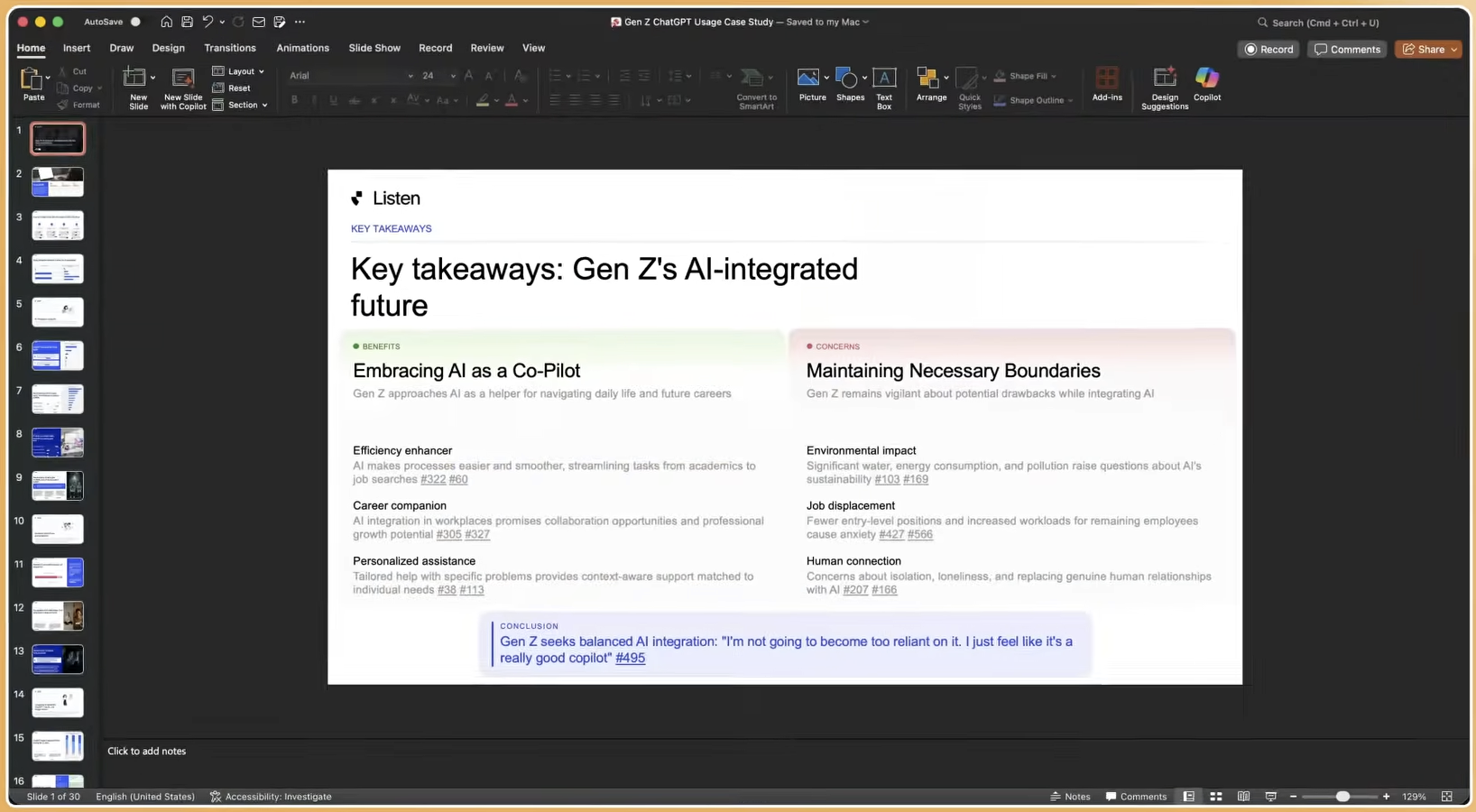
Manual analysis workflows often require weeks for theme identification, report writing, and deliverable creation, which increases labor costs and introduces confirmation bias and inconsistent interpretation across studies. Listen Labs’ Research Agent processes all interview data objectively, identifies patterns, and generates consultant-quality slide decks, highlight reels, and statistical comparisons in under one minute. The platform’s Emotional Intelligence capability analyzes tone, word choice, and micro-expressions across more than 50 languages, and it quantifies emotions per question with timestamp-level traceability that manual analysis cannot match.
Scalability and Operational Efficiency
Traditional platforms require proportional resource increases for higher study volumes, which creates linear cost scaling and team capacity constraints. This linear relationship means that doubling research output usually requires a similar increase in headcount and budget. Listen Labs breaks this pattern by enabling research teams to multiply output without expanding headcount, conducting hundreds of parallel interviews while maintaining individual conversation depth and quality standards.
When Discuss.io or Listen Labs Is the Better Fit
Discuss.io serves enterprise teams that conduct occasional, high-stakes qualitative research where human moderation oversight justifies extended timelines and premium pricing. The platform fits organizations with established research workflows and dedicated vendor management resources that can handle complex coordination. Listen Labs suits research teams facing growing backlogs, tight deadlines, and pressure to scale insights without proportional budget increases. The platform supports product managers who need rapid user feedback loops, UX researchers running usability testing with screen sharing, and consumer insights leaders managing global market research across multiple languages and cultures at the same time.
Long-Term Operational and Compliance Considerations
Traditional platform total cost of ownership includes subscription fees, per-project charges, recruitment markups, transcription services, and analysis labor costs that compound over time. These layered expenses can make annual budgets unpredictable and limit experimentation with new research questions. Listen Labs’ unified platform removes many separate vendor relationships while maintaining enterprise security standards including SOC 2 Type II, GDPR, ISO 27001, and ISO 27701 compliance. Mission Control functions as organizational memory, enabling cross-study queries and trend tracking that reduce redundant research investments and support long-term knowledge management.
Platform Limitations and Risk Assessment
Discuss.io’s human-dependent workflows create inherent speed and scale limitations, and recruitment through limited panel networks may struggle with niche audience requirements or broad global coverage. Quality assurance relies on manual oversight that cannot match AI-powered fraud detection capabilities, which increases the risk of low-quality responses. These factors combine to raise both project timelines and uncertainty around data reliability. Listen Labs addresses traditional qualitative research limitations through zero-fraud guarantees, unbiased AI analysis, and statistical confidence from large sample sizes. The platform’s large participant network and AI orchestration reduce recruitment bottlenecks while preserving research depth through adaptive conversation flows.
Strategic Decision Framework for Research Leaders
Research platform selection should align speed requirements, scale ambitions, budget constraints, and quality standards with organizational research objectives. Teams that prioritize sub-24-hour turnaround, broad global reach, statistical confidence from large samples, and cost efficiency will gain the most from AI-powered platforms. Organizations that require human moderation oversight and accept traditional timelines may prefer to maintain existing workflows. Leaders who want to compare capabilities and costs directly can run a side-by-side evaluation of Listen Labs against their current platform using real project scenarios.
Frequently Asked Questions
How much does Discuss.io cost per research session?
Discuss.io does not publish transparent per-session pricing, instead using subscription models starting at $89 per user one time plus project-based fees for complete qualitative studies. Total costs depend on team size, study complexity, recruitment requirements, and enterprise customization needs. The platform bundles recruitment, incentives, transcription, and analysis services within project pricing rather than offering itemized per-session rates.
What is the typical cost range for qualitative research platforms in 2026?
Traditional qualitative research platforms typically cost $4,000-$12,000 per focus group session and require 3-5 weeks for completion, while individual interviews vary in cost per participant including recruitment and moderation. AI-powered platforms like Listen Labs deliver comparable research depth at roughly one-third of those costs with sub-24-hour turnaround. This shift allows research teams to run more studies within existing budgets while achieving greater statistical confidence through larger sample sizes.
Does Discuss.io charge extra for participant recruitment?
Discuss.io includes recruitment within project-based pricing but does not provide transparent breakdowns of recruitment versus platform costs. Enterprise projects often include recruitment markups and incentive management fees that increase total study costs beyond base subscription rates. Organizations that prioritize cost transparency and recruitment flexibility may prefer platforms with self-recruitment options or clear per-participant pricing structures.
How do AI research platforms compare to traditional moderated interviews?
AI-moderated interviews maintain conversational depth through adaptive follow-up questions while removing human moderator scheduling constraints, bias, and availability limitations. Platforms like Listen Labs conduct thousands of simultaneous interviews with consistent quality standards and capture emotional intelligence through tone and expression analysis that manual moderation cannot quantify. This approach delivers statistical confidence from large samples while preserving individual conversation depth that previously existed only in small qualitative studies.
What security and compliance features should enterprise research teams evaluate?
Enterprise research platforms must maintain SOC 2 Type II, GDPR, ISO 27001, and ISO 27701 compliance to meet data protection and privacy requirements. Listen Labs provides enterprise-grade security with 256-bit encryption and guarantees that customer data is never used for AI model training. The platform supports single sign-on integration and maintains audit trails for compliance reporting, while still delivering research speed, scale, and cost efficiency that traditional platforms cannot match.