
Written by: Anish Rao, Head of Growth, Listen Labs
Key Takeaways
-
AI-moderated research uses AI to run adaptive video interviews, delivering deep qualitative insights with dynamic probing across the full research lifecycle.
-
Teams achieve 92% faster turnaround with 24-hour studies versus 4–6 week traditional cycles, at roughly one-third the cost and with unbiased global reach.
-
Listen Labs provides an end-to-end platform with integrated recruitment from 30+ million participants, emotional intelligence analysis, and automated reporting.
-
Enterprise case studies from Microsoft, Anthropic, and P&G show hundreds of interviews completed in days, uncovering actionable insights at scale.
What Is AI-Moderated Research?
AI-moderated research uses artificial intelligence to conduct one-on-one video interviews with participants and ask follow-up questions dynamically based on their responses. This approach differs from Scale AI’s data labeling platform and focuses on scaling qualitative customer insights rather than annotation workflows. The core elements include:
-
AI-assisted study design that translates research objectives into structured interview guides
-
Global participant recruitment from panels spanning 30+ million verified respondents across 45+ countries and 100+ languages
-
AI-conducted interviews with adaptive questioning, screen-sharing capabilities, and real-time probing
-
Emotional Intelligence analysis that captures tone, micro-expressions, and sentiment across 50+ languages
-
Automated analysis and deliverable generation through Research Agent technology
-
Mission Control dashboards that provide cross-study intelligence and institutional knowledge building
These core elements work together across the research lifecycle, from initial study design through final deliverable generation. The most mature platforms integrate all these capabilities into a single workflow rather than requiring researchers to stitch together multiple tools.
How AI Moderated Research Runs End to End
The AI-mediated research process compresses traditional research cycles by automating key tasks at every stage.
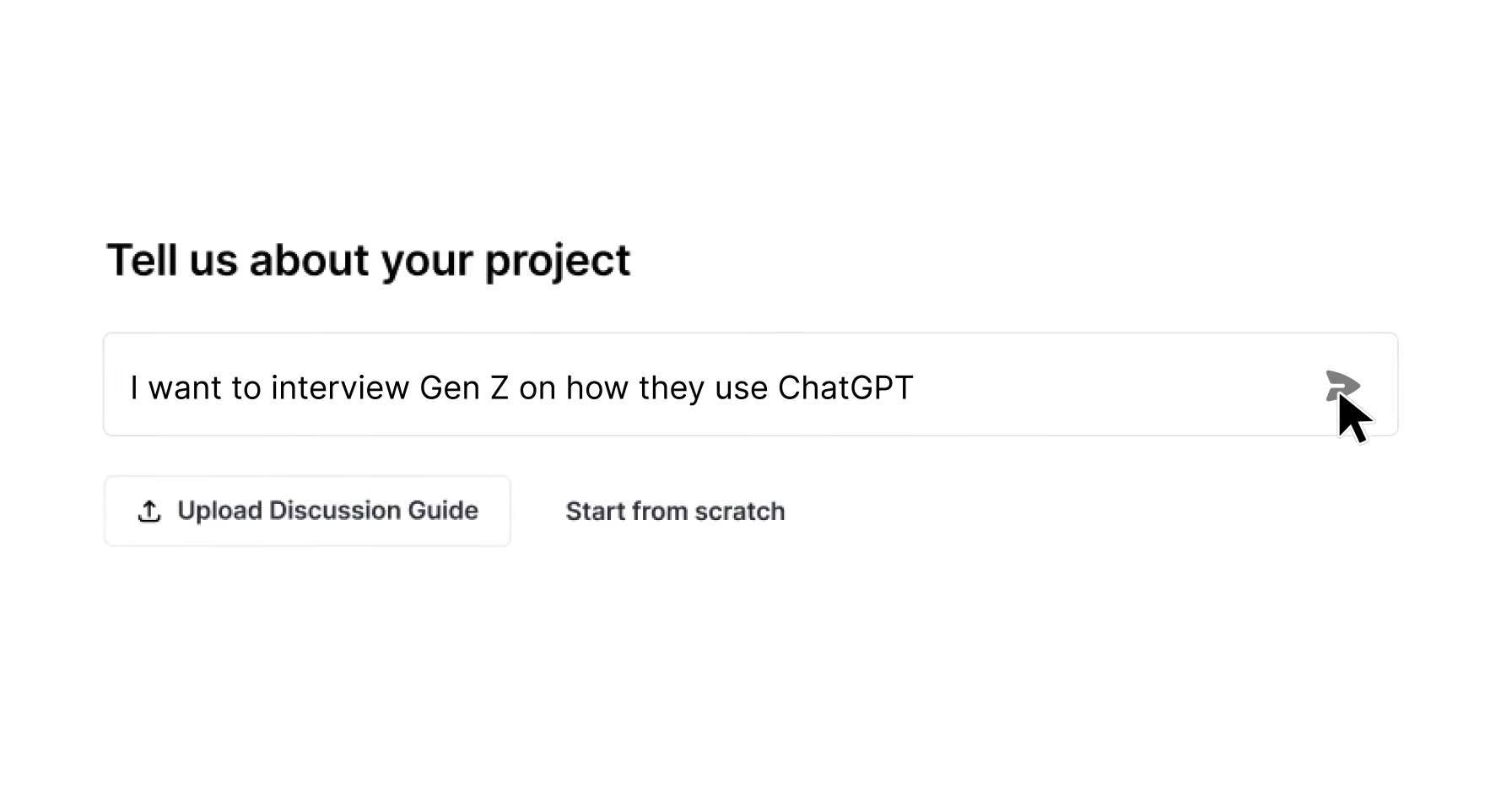
Study Design: The process begins with study design. AI co-design tools help researchers translate business objectives into structured interview guides with appropriate probing questions, logic flows, and stimulus integration. Once the interview structure is defined, the platform moves to recruitment.
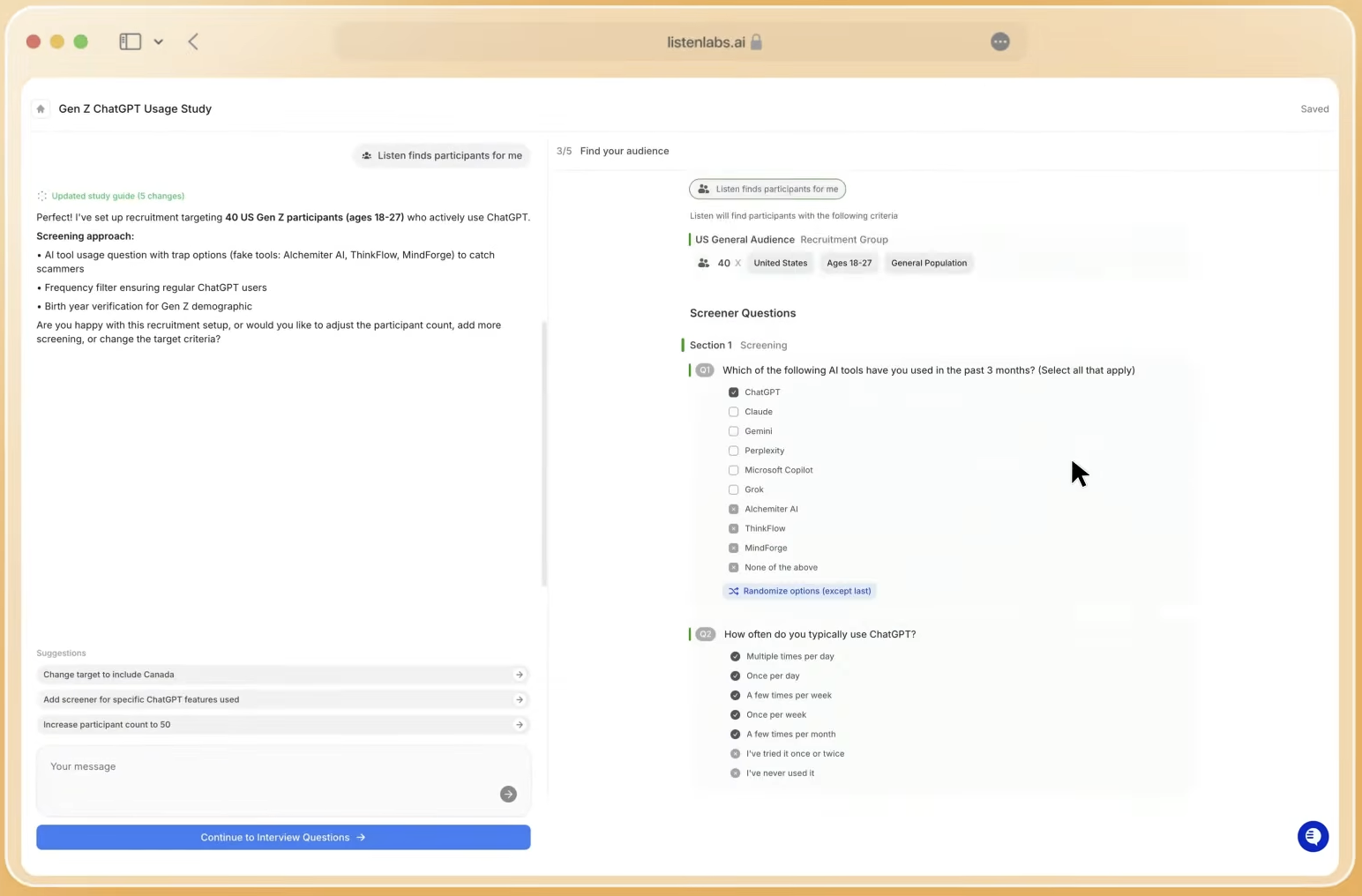
Recruitment: Listen Atlas orchestrates participant matching across multiple panel sources, using behavioral and intent data rather than just demographics. Quality Guard monitors every interaction for fraud detection, and dedicated recruitment operations teams handle hard-to-reach segments such as enterprise decision-makers or niche consumer groups.
Interview Execution: AI moderators conduct personalized video conversations with dynamic follow-up questions, screen-sharing for usability testing, and real-time adaptation based on participant responses. Each interview captures video, audio, and behavioral data for later analysis.
Emotional Intelligence: Advanced analysis examines tone of voice, word choice, and micro-expressions to surface emotions that transcripts miss. This capability proves especially valuable for creative testing, where teams can pinpoint moments of confusion, delight, or hesitation with timestamp precision.
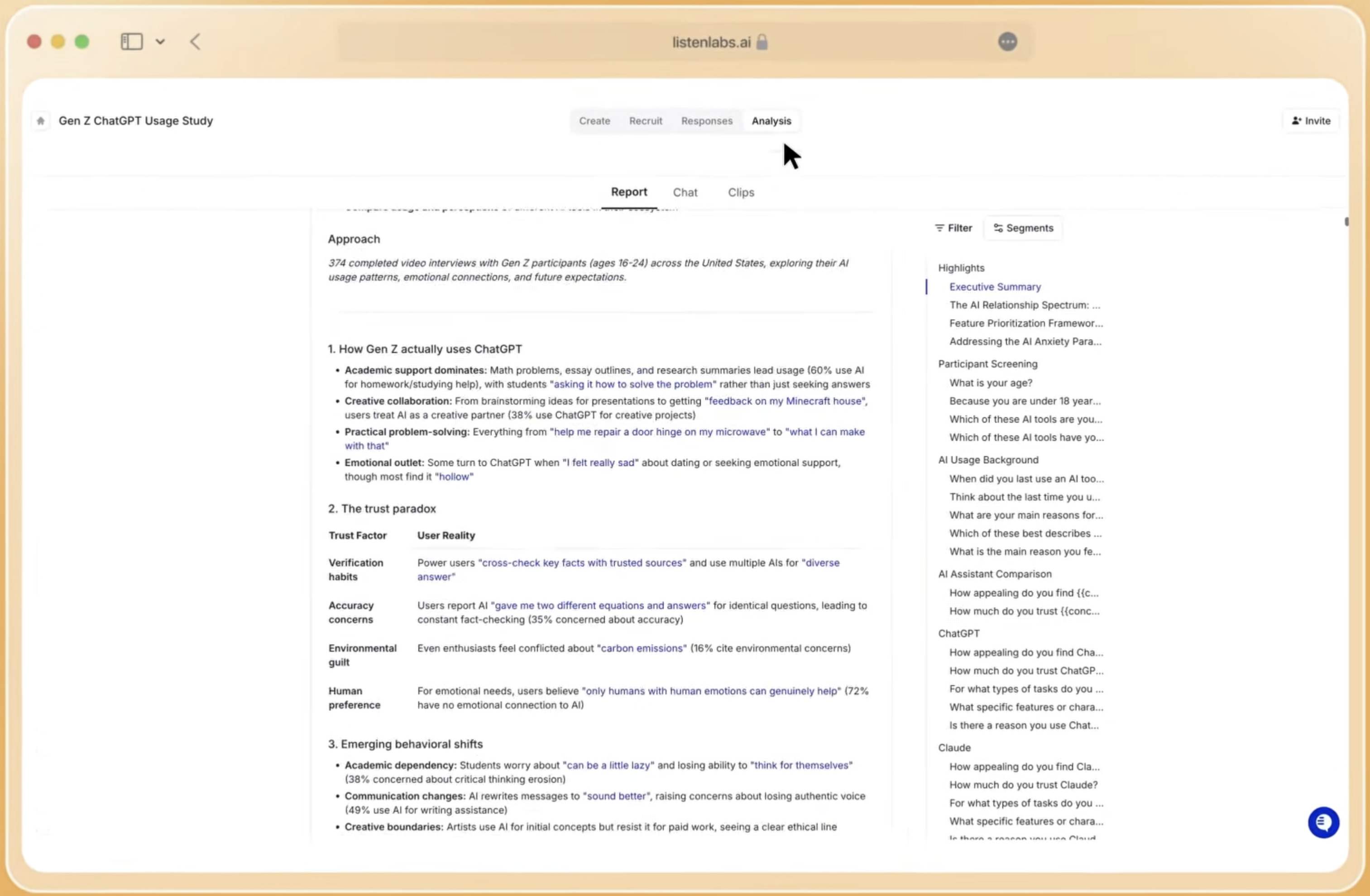
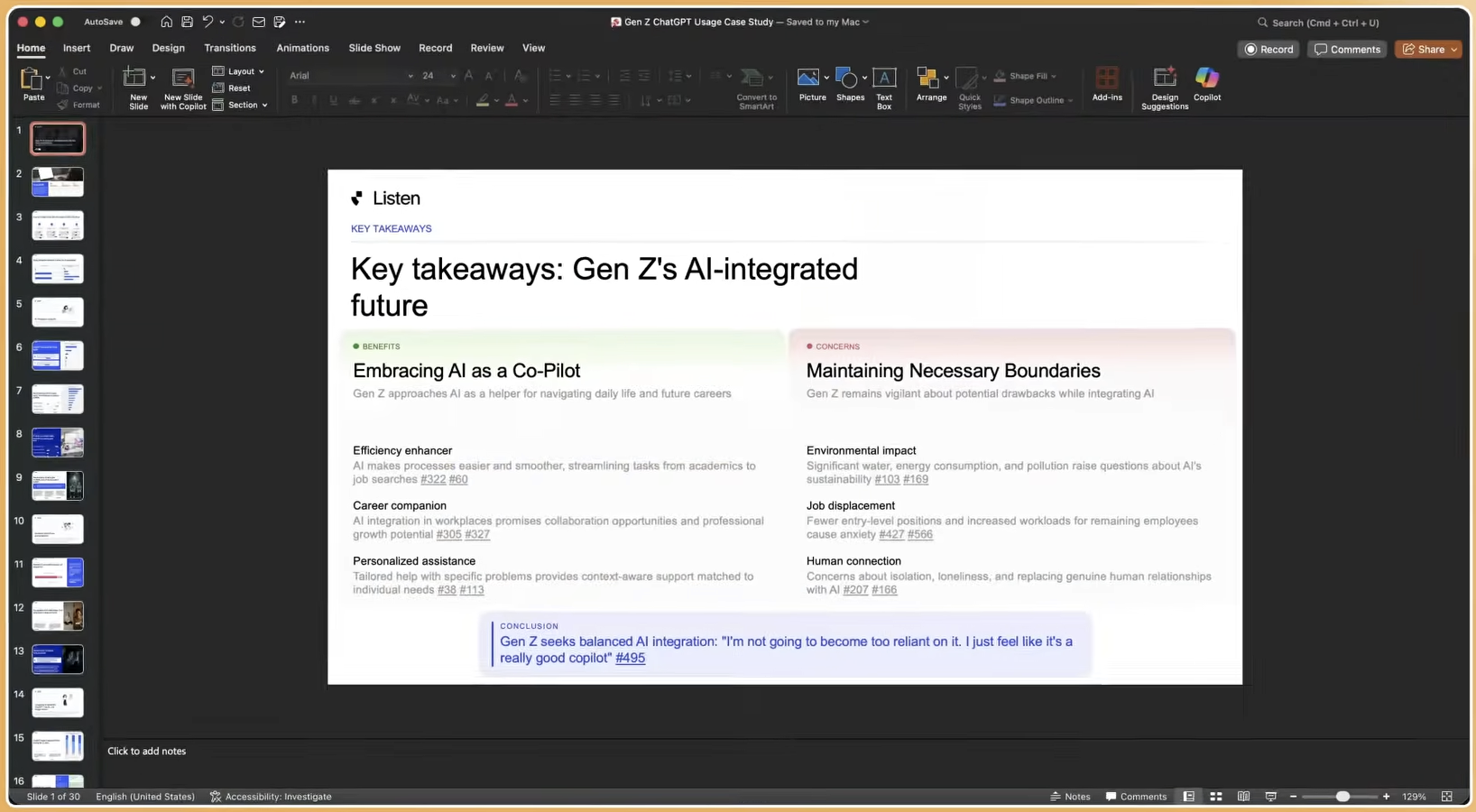
Analysis and Reporting: Research Agent automatically generates key findings, themes, statistical comparisons, video highlight reels, and consultant-quality slide decks in under a minute. Researchers then review and refine these outputs before sharing them with stakeholders.
Benefits of Scaling Qualitative Research with AI
Scale AI moderated research delivers measurable improvements across speed, cost, and insight quality.
-
Compressed Timelines: Studies that traditionally required 4–6 weeks now complete in a single day, which allows research teams to keep pace with business velocity.
-
Cost Efficiency: Substantial cost reductions compared to traditional research, with significantly greater scalability per dollar spent.
-
Unbiased Global Scale: Simultaneous studies across multiple markets and languages without human moderator availability constraints.
-
Qualitative Depth at Large Sample Sizes: Hundreds of adaptive interviews that deliver both statistical confidence and rich contextual insights.
-
Fraud Prevention: Real-time quality monitoring that removes professional survey-takers and low-effort responses.
These benefits depend on platform capabilities. Not all AI moderation tools deliver the same results, and the difference comes from how comprehensively a platform handles the full research lifecycle.
Evaluating Scale AI Moderated Research Platforms
When evaluating scale AI moderated research platforms, enterprises need end-to-end solutions rather than piecemeal tools that create integration challenges. Listen Labs provides a comprehensive platform with the following capabilities that work together as a unified system:
-
Integrated Recruitment: Access to the global panel network mentioned earlier, which removes the need for separate panel vendor relationships.
-
Quality Assurance: Quality Guard fraud detection and participant frequency limits, with a maximum of three studies per month per participant.
-
Advanced Analytics: Emotional Intelligence analysis and Research Agent for automated insight generation that feeds directly into reporting.
-
Enterprise Security: ISO 42001, SOC 2, and GDPR compliance with 256-bit encryption for data protection.
-
Research Expertise: Built by the research team described earlier, not just software engineers, so methods reflect real-world qualitative best practices.
Other platforms often focus on single components such as recruitment panels or basic AI moderation. That approach forces enterprises to manage multiple vendor relationships and data handoffs, which introduces delays and quality risks.
Enterprise Case Studies Using AI-Moderated Research
Leading enterprises show how scaled AI-moderated research changes what research teams can deliver.
Microsoft: Microsoft collected global customer stories for its 50th anniversary celebration within a single day, compressing work that previously required weeks of coordination across multiple markets. The Director of Data Science reported reaching hundreds of users at roughly one-third of the cost while maintaining quality standards that impressed leadership teams.
Anthropic: Anthropic conducted more than 300 user interviews in 48 hours to understand Claude subscription churn drivers and identify where former users migrate and what triggers switching behavior. This effort delivered 5x faster insights and produced a prioritized list of must-fix items and high-value features.
Procter & Gamble: Procter & Gamble evaluated men’s responses to new product claims through more than 250 interviews, surfacing where claims felt exaggerated before market launch. The research showed that comfort, safety, and reliability matter more than novelty, which directly shaped product and brand strategy in hours rather than weeks.
These case studies demonstrate the method’s potential, and understanding when AI moderation fits your needs requires examining both its strengths and its limitations.
Pros and Cons of Scale AI Moderated Research
Advantages:
-
Speed and scalability, with hundreds of simultaneous interviews instead of sequential human moderation
-
Cost efficiency, with substantial reductions compared to traditional moderation
-
Consistency, with standardized probing and no moderator fatigue or variation in style
-
Global reach, with 24/7 availability across time zones and languages
-
Quality participants, with professional survey-takers removed through behavioral screening
Limitations:
-
Methodological boundaries, since complex projective techniques may require human interpretation
-
Cultural nuance, because some cultural contexts benefit from human cultural intelligence
-
Highly sensitive topics, where trauma or deeply personal subjects may need human empathy
Listen Labs mitigates these limitations through proprietary data from tens of thousands of studies, Quality Guard fraud prevention, and human operations teams that add oversight where needed. Industry best practices emphasize keeping people at the center while using AI for scale.
When to Use AI-Moderated Research
Scale AI moderated research excels in scenarios where traditional methods create bottlenecks and teams need both depth and reach.
-
Research Backlogs: When internal teams cannot keep pace with stakeholder demand.
-
Global Studies: Multi-market research that requires consistent methodology across regions.
-
Niche Audiences: Hard-to-reach segments that benefit from large panel access.
-
Continuous Intelligence: Ongoing customer monitoring instead of one-off projects.
-
Concept Testing: Rapid validation of multiple concepts or creative executions.
The method works best when research objectives require both depth and scale, such as understanding customer journeys across diverse segments or testing concepts with statistical confidence. Adoption has grown among large research buyers as teams recognize the competitive advantage of faster insight cycles.
Getting Started with Scale AI Moderated Research
Teams that want to adopt scale AI moderated research should focus on platform selection and a structured pilot.
Platform Evaluation: Assess end-to-end capabilities, including recruitment quality, AI moderation sophistication, analysis automation, and enterprise security compliance.
Pilot Study Design: Start with a familiar research question where you can compare AI moderated results against existing benchmarks or traditional methods.
Team Training: Ensure researchers understand how to design effective prompts and interpret AI-generated insights while maintaining methodological rigor.
Design your pilot study and see results within 24 hours, then use those findings to prove the force-multiplier effect for your research team.
FAQ: Common Questions on AI-Moderated Research
Is AI moderation really as good as human researchers?
Listen Labs maintains the same methodological rigor as excellent in-house research teams while delivering significantly better experiences than under-resourced operations. The platform draws on more than 50 years of combined research expertise and tens of thousands of completed studies, which informs questioning techniques and analysis patterns. For the vast majority of research needs, AI delivers comparable quality at dramatically greater speed and scale.
How do you prevent fraud and ensure participant quality?
Listen Labs uses three layers of protection. The team works exclusively with high-quality, non-commodity panels to remove professional survey-takers. Quality Guard provides real-time monitoring across video, voice, content, and device signals to detect fraud and low-effort responses. Dedicated recruitment operations teams add human review layers, and participants are limited to three studies per month to prevent panel fatigue.
How is this different from surveys?
Surveys deliver structured data through pre-set questions with no ability to follow up or probe deeper. AI-moderated research conducts conversational interviews where the AI adapts in real time and asks follow-up questions based on participant responses. This approach uncovers unexpected findings, emotional nuance, and rich context that surveys inherently miss, which reflects the difference between a checkbox and a conversation.
What about data security for enterprise research?
Listen Labs maintains enterprise-grade security with 256-bit encryption and does not use customer data for AI model training. The platform holds SOC 2 Type II, GDPR, ISO 27001, ISO 27701, and ISO 42001 certifications, which supports compliance with global data protection requirements.
Will this replace our research team?
Listen Labs acts as a force multiplier for existing research teams, not a replacement. The platform enables teams to run more studies with the same headcount, which frees researchers to focus on strategic analysis and decision-making rather than logistics. Research teams become more valuable by delivering insights faster and at greater scale.