
Written by: Anish Rao, Head of Growth, Listen Labs | Last updated: July 3, 2026
Key Takeaways
- Concept testing evaluates early-stage ideas using lightweight stimuli like descriptions or mock-ups to measure relevance and purchase intent before development investment.
- Product testing validates functional prototypes or near-finished products by measuring usability, task completion, and real user experience quality.
- Enterprise teams should evaluate both methods against seven criteria including research speed, sample quality, emotional-signal capture, and time-to-decision.
- Listen Labs accelerates both study types with AI-moderated interviews, Emotional Intelligence analysis, Quality Guard fraud prevention, and consultant-quality deliverables, all delivered in under 24 hours from kickoff.
- Listen Labs helps enterprise teams choose and execute the right research method at the right stage — see how it fits your workflow.
How Concept Testing and Product Testing Play Different Roles
Concept testing happens before significant development investment. It measures whether an idea is relevant, differentiated, and compelling enough to pursue. Stimuli typically include written descriptions, mood boards, rough mock-ups, or early positioning statements. Core metrics include perceived value, purchase intent, uniqueness, and message clarity. The goal is to filter and prioritize ideas before resources are committed.
Product testing happens once a functional prototype or near-finished product exists. It measures how real users interact with the offering, including ease of use, error rates, task completion, and direct experience quality. The stimuli are working products or high-fidelity prototypes. Core metrics include usability scores, satisfaction ratings, friction points, and feature performance. The goal is to validate and refine the experience before launch.
The most common and costly mistake is running product testing on an idea that has not cleared concept validation. A second mistake is running concept testing on a product that is already built and needs usability data. Both errors produce findings that arrive too late or too early to change anything meaningful.
Seven Evaluation Criteria for Enterprise Research Decisions
Seven criteria determine which method fits a given initiative: research speed, depth of insight, sample quality, emotional-signal capture, scalability, cost at volume, and time-to-decision. Enterprise teams operating under quarterly planning cycles and growing research backlogs need to weigh both methods against all seven criteria, not just the ones that are easiest to measure.
Traditional qualitative research often takes four to six weeks from study design to final report. In large enterprises with internal prioritization queues, that timeline can stretch to six months. By that point, the business context has often shifted. Any framework for choosing between concept and product testing must reflect this operational reality, not only methodological ideals. Listen Labs addresses this constraint by compressing both concept and product testing into under 24 hours, from study design through final deliverables.
See how Listen Labs delivers results in under 24 hours for both concept and product testing.
Study Setup and Participant Sourcing for Each Method
Concept testing studies are typically faster to set up because stimuli are lightweight. A description, an image, or a short video is often sufficient. The participant profile, however, must be precise. Testing a new CPG product concept with the wrong demographic produces directionally misleading purchase intent scores. Listen Labs’ Listen Atlas recruitment layer matches participants across behavioral and intent signals, not just self-reported demographics, drawing from a verified global network of 30 million respondents across 45-plus countries.
Product testing studies require more setup time because stimuli are functional. Screen-sharing, task assignment, and prototype access all need configuration before fieldwork begins. Listen Labs supports live URL testing, prototype sharing, mobile screen recording on iOS, and task-based interview flows. These capabilities remove the logistical overhead that typically adds days to study launch timelines.
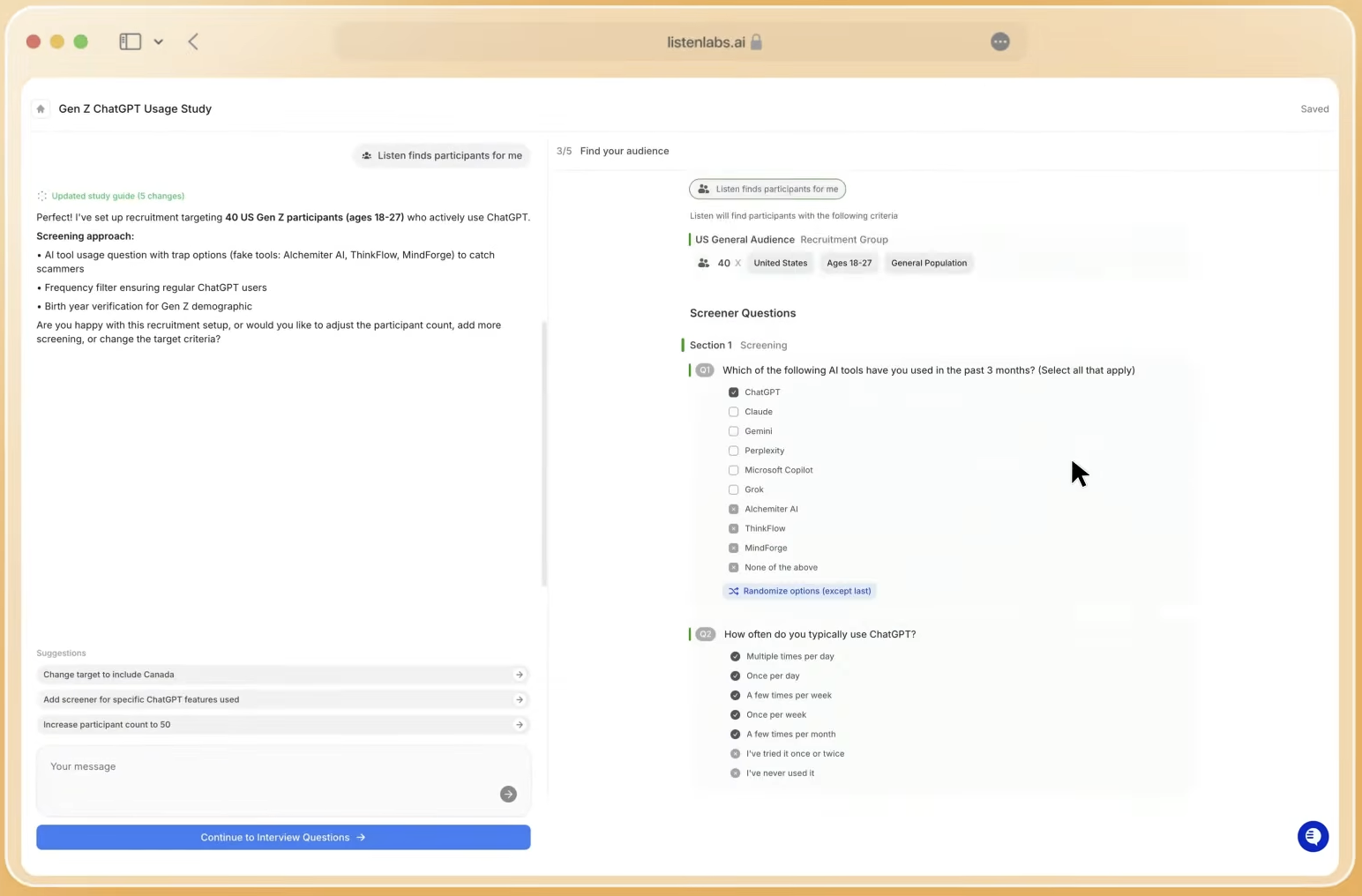
Quality Guard applies to both study types by combining multiple fraud-prevention mechanisms. Real-time monitoring across video, voice, content, and device signals detects fraudulent responses, low-effort participation, and mismatched profiles before they contaminate the dataset. To further prevent professional survey-takers, a problem that undermines commodity panel data, participants are capped at three studies per month, which keeps responses fresh and authentic.
Moderation Style and Emotional Intelligence Signals
Traditional moderation, whether human or static survey, captures what participants say. It rarely captures what they feel. A concept that receives positive verbal ratings may simultaneously trigger confusion or hesitation that predicts poor market performance. A product that users describe as “fine” may generate visible frustration at specific interaction points that only appear in behavioral signals.
Listen Labs’ Emotional Intelligence layer analyzes three simultaneous signal streams: tone of voice, word choice, and subconscious micro-expressions. It is built on Ekman’s universal emotions framework, the same standard used in clinical psychology and UX research. The system quantifies emotions including joy, trust, surprise, fear, disgust, anticipation, sadness, and anger at the question and concept level. Every emotional label is traceable to the exact timestamp, verbatim quote, and reasoning behind it.
For concept testing, Emotional Intelligence highlights which concepts trigger genuine excitement versus polite approval. For product testing, it pinpoints the exact moment a user hesitates, not just the task where they reported difficulty. Both use cases benefit from capturing the gap between stated and felt response. Transcripts and survey scales alone cannot close that gap. Emotional Intelligence is available across 50-plus languages.
Data Quality, Analysis Workflow, and Enterprise-Ready Deliverables
The analysis bottleneck is where most enterprise research programs lose time. Human analysis of qualitative data is slow, subjective, and prone to confirmation bias. Analysts may unconsciously weight findings that confirm pre-existing hypotheses while missing unexpected signals buried in interview transcripts.
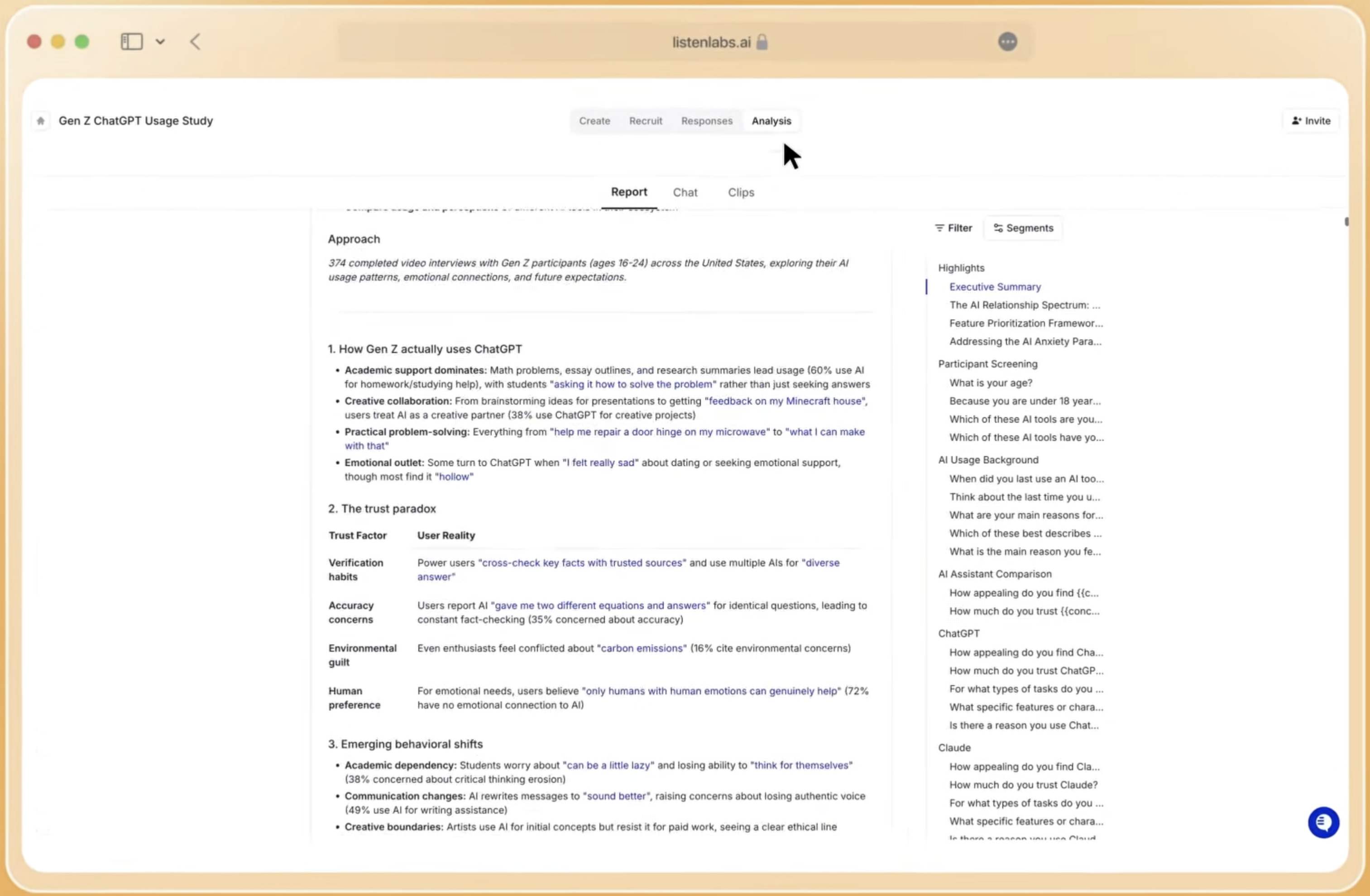
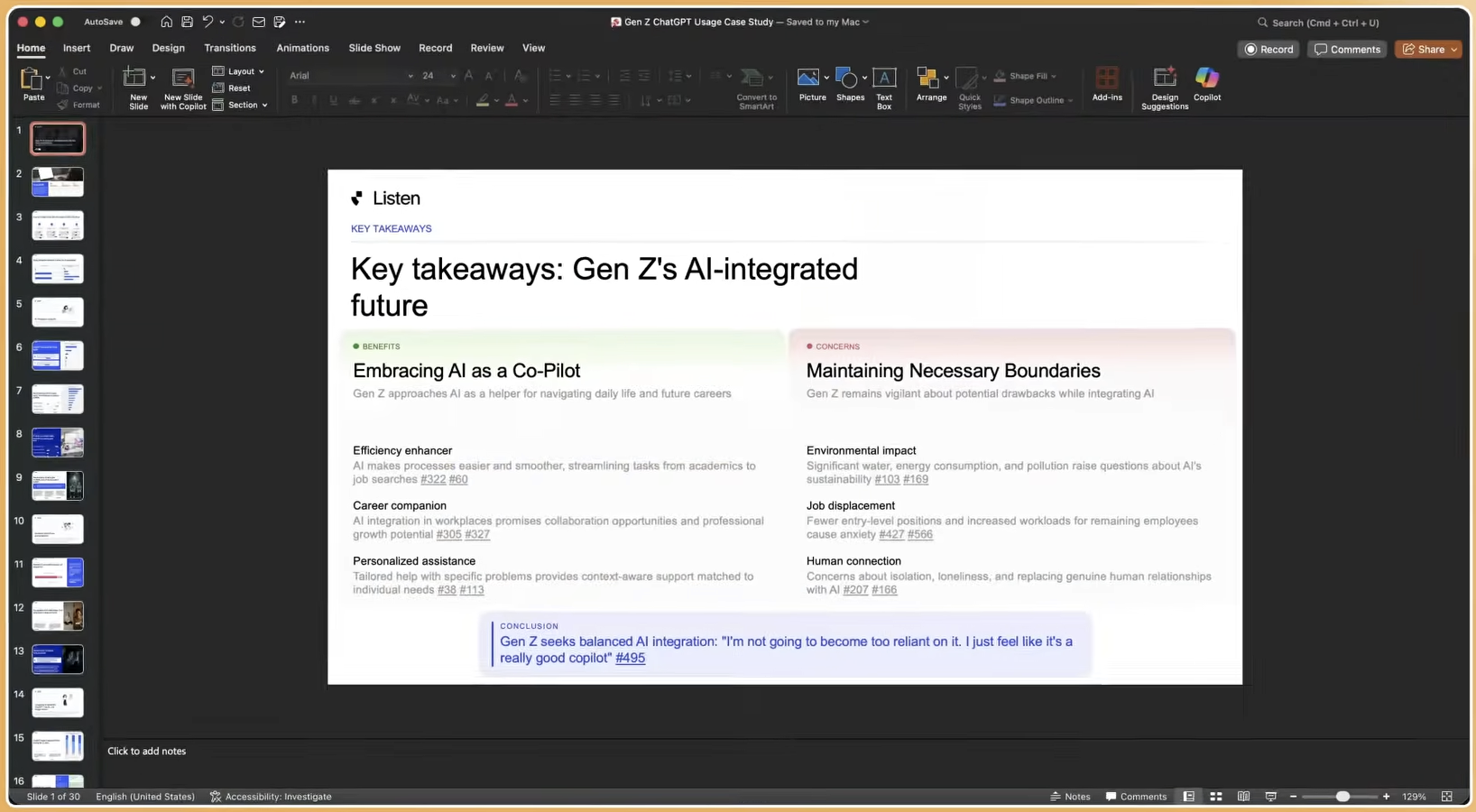
Listen Labs’ Research Agent processes all interview data objectively across hundreds of simultaneous responses. It identifies themes, patterns, and outliers without human bias, drawing on proprietary signal data from tens of thousands of studies conducted on the platform. Deliverables, including consultant-quality slide decks, memo-style reports, video highlight reels, statistical charts, and segmentation breakdowns, are generated in under a minute.
For enterprise teams running both concept and product testing across multiple markets, this workflow supports repeatability. Mission Control stores every study as a growing institutional knowledge base. Teams can run cross-study queries, track trends, and surface answers from past research in seconds, without digging through archived reports.
Best-Fit Scenarios by Role and Use Case
Consumer insights leaders at Fortune 500 enterprises typically use concept testing to screen innovation pipelines before committing to development budgets. They use product testing to validate near-launch offerings before regional rollout. Both study types benefit from the ability to run across multiple markets simultaneously with automatic translation and transcription across 100-plus languages.
UX research leads at product companies use concept testing to evaluate feature directions during discovery. They rely on product testing to run usability studies during sprint cycles. Larger sample sizes than traditional moderated sessions provide statistical confidence that small-sample studies cannot deliver.
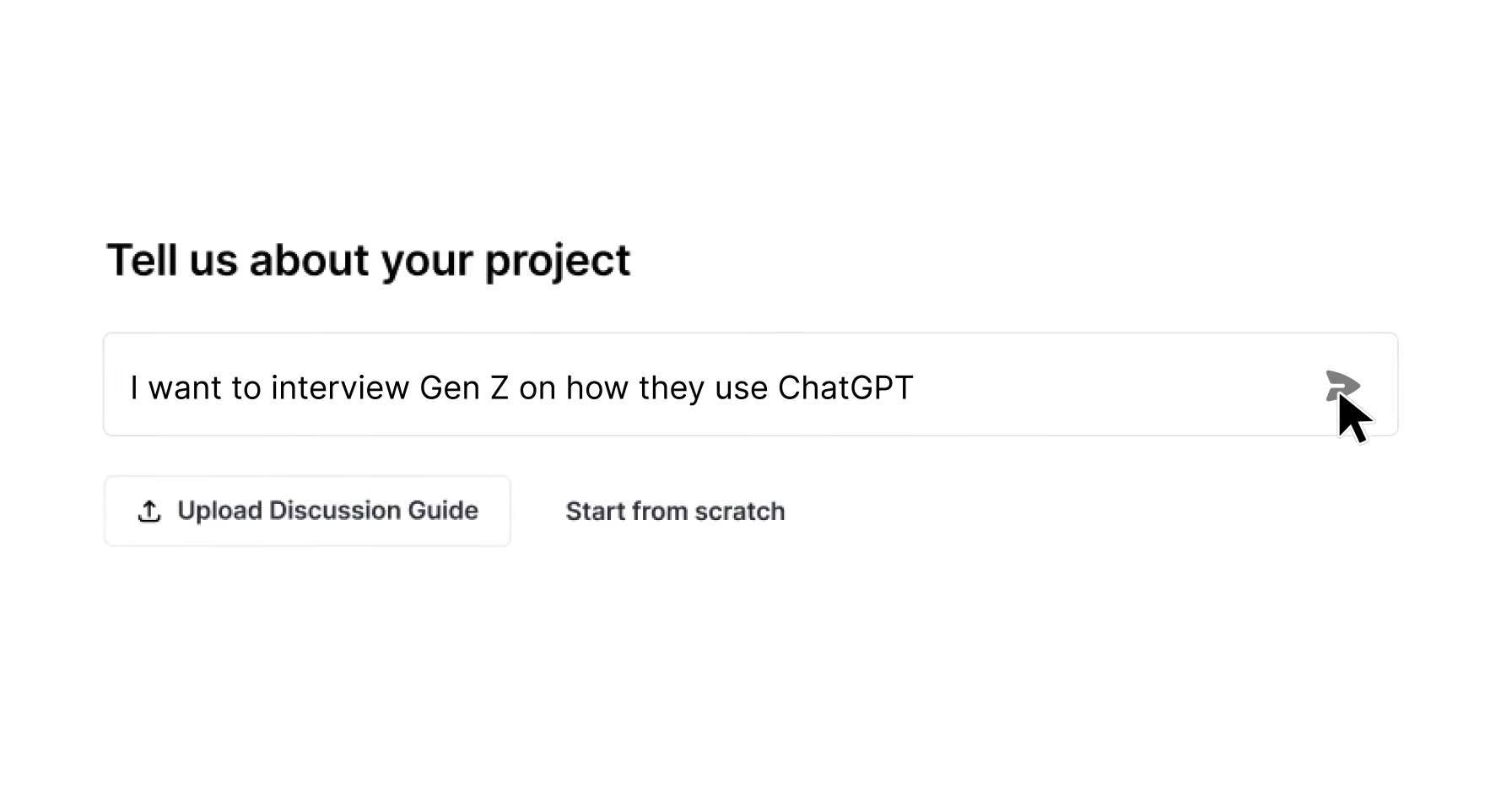
Product managers and brand managers without dedicated research teams use concept testing to validate messaging and positioning before campaign investment. They use product testing to collect structured user feedback without needing deep research methodology expertise. AI-assisted study design translates natural-language research goals into structured interview guides automatically.
Consultancies and agencies use both methods for client engagements where turnaround is measured in days. Access to niche audiences, including enterprise decision-makers, healthcare workers, and consumers below one percent incidence rate, comes from a dedicated recruitment operations team that makes both study types viable for specialized client briefs.
Explore how Listen Labs fits your team’s research workflow.
Operational Requirements and Long-Term Program Health
Stakeholder alignment is a recurring challenge for enterprise research teams. Concept testing findings that arrive after a product has entered development, or product testing findings that arrive after a campaign has launched, generate friction rather than confidence. Speed-to-decision therefore functions as a structural requirement for research to remain relevant inside fast-moving organizations.
Compliance requirements for enterprise research programs include data security, privacy regulation adherence, and vendor certification. Listen Labs holds SOC 2 Type II, GDPR, ISO 27001, ISO 27701, and ISO 42001 certifications. Customer data is never used for AI model training. Enterprise SSO is supported. These certifications apply to both concept and product testing studies conducted on the platform.
Risks, Limitations, and Misconceptions About Each Method
The most common misconception is that faster tools automatically produce better research. Speed matters only when data quality is maintained. Commodity panels filled with professional survey-takers produce fast, cheap, and directionally wrong data. Listen Labs’ recruitment infrastructure is purpose-built to prevent this. Quality Guard’s reputation scoring compounds across every interview, creating a quality flywheel that improves with scale.
A second misconception is that concept testing can substitute for product testing once development is underway. Concept testing measures perceived value based on descriptions. It cannot measure usability, error rates, or interaction quality on functional products. Running concept testing on a near-finished product produces purchase intent data when the team actually needs friction-point data. This mismatch delays launch decisions rather than accelerating them.
Hidden recruitment complexity is a third risk. Reaching the right participants for niche B2B or specialized consumer segments requires more than panel access. It demands behavioral matching, dedicated sourcing operations, and fraud prevention infrastructure working together. When platforms solve only the sourcing problem, they leave moderation, analysis, and delivery to separate vendors, reintroducing the fragmentation that slows enterprise research programs.
Decision Framework: Match the Test to Your Stage
Use concept testing when the idea is not yet built, the goal is to filter or prioritize, and the stimuli are descriptions or mock-ups. The primary questions focus on resonance, differentiation, and willingness to pay. Run concept testing before development investment is committed, before positioning is finalized, and before go-to-market resources are allocated.
Use product testing when a functional prototype or near-finished product exists, the goal is to validate and refine, and the stimuli are working experiences. The primary questions focus on task completion, friction points, and whether the experience matches the promise made in concept testing. Run product testing after development milestones, before launch, and when usability data is needed to prioritize the final development backlog.
When the timeline is compressed and both types of data are needed, cost and capacity have traditionally limited what teams can run. Listen Labs removes that constraint by running both study types in under 24 hours at a third of the cost of traditional research approaches.
Frequently Asked Questions
What is the difference between concept testing and product testing?
Concept testing evaluates early-stage ideas using descriptions, mock-ups, or positioning statements to measure perceived value, relevance, and purchase intent before development begins. Product testing evaluates functional prototypes or near-finished products to measure usability, task completion, and direct experience quality. The two methods answer different questions and apply at different stages of the development cycle.
When should I use concept testing instead of product testing?
Use concept testing when you need to screen or prioritize ideas before committing development resources, validate messaging or positioning before campaign investment, or assess willingness to buy on a new product direction. Use product testing when a working prototype exists and you need usability data, friction-point identification, or validation that the product experience matches the promise made during concept development.
How long does concept testing or product testing take with Listen Labs?
Listen Labs compresses the entire research cycle, including study design, participant recruitment, AI-moderated interviews, analysis, and deliverables, to under 24 hours. Traditional qualitative research for either method typically takes four to six weeks, and in large enterprises with internal prioritization queues, timelines can extend to six months.
How does Listen Labs ensure participant quality for concept and product testing studies?
Three layers of protection apply to every study. Listen Labs works exclusively with high-quality, non-commodity panel sources. Quality Guard monitors every interview in real time across video, voice, content, and device signals to detect fraud, low-effort responses, and mismatched profiles. Participants are limited to three studies per month to eliminate professional survey-takers. A dedicated recruitment operations team adds a human review layer for hard-to-reach segments.
Can Listen Labs capture emotional responses during concept or product testing?
Yes. The Emotional Intelligence layer analyzes tone of voice, word choice, and subconscious micro-expressions simultaneously, built on Ekman’s universal emotions framework. Every emotional signal is quantified per question and concept, traceable to the exact timestamp and verbatim quote. For concept testing, this identifies which concepts trigger genuine excitement versus polite approval. For product testing, it pinpoints the exact moments of hesitation or frustration that participants do not verbalize. Emotional Intelligence is available across 50-plus languages.
Conclusion: Align Method to Stage and Move Quickly
The choice between concept testing and product testing is primarily a timing decision, not a quality decision. Both methods produce valuable data when applied at the right stage. Both produce misleading data when applied at the wrong one. The criteria are straightforward. If the idea is not built yet, test the concept. If the product is functional, test the product. When the timeline is compressed and both are needed, infrastructure becomes the real constraint.
Listen Labs gives enterprise research teams the infrastructure to run both study types at depth and scale, with a rapid turnaround, emotional intelligence, fraud prevention, and consultant-quality deliverables built in. The research backlog problem does not always require more headcount. It often requires a platform built for the speed and quality that modern consumer insights programs demand.