
Written by: Anish Rao, Head of Growth, Listen Labs | Last updated: June 21, 2026
Why Qualitative Research Still Matters for Modern Teams
- Qualitative research explains the “why” behind consumer behavior, adding context that raw numbers alone never capture.
- Its strengths include flexible conversations, real-world validity, emotional and nonverbal signal capture, and idea generation for future testing.
- High cost, long timelines, and small sample sizes have historically kept many teams from using these strengths.
- AI platforms now remove those limits by running hundreds of adaptive, high-quality interviews at once with automated analysis.
- Listen Labs brings all seven advantages together at scale. See how enterprises like Microsoft and P&G achieve same-day, consultant-quality insights.
How Qualitative Research Complements Quantitative Data
Quantitative research delivers speed and statistical breadth. Qualitative research delivers depth, context, and the reasoning behind behavior. Traditional surveys may tell us what people do, but it takes a conversation to understand why, and that “why” separates average customer research from outstanding customer research.
The trade-off has always been structural. A single agency-led qualitative study costs an estimated $15,000–$40,000 and takes six weeks from kick-off to findings. Scaling to hundreds of voices through traditional focus groups requires substantial investment and extended timelines. Those constraints forced organizations to choose between depth and scale. The seven advantages below explain what teams gain once that trade-off disappears, starting with the contextual richness that makes qualitative insights actionable.
1. Rich, Contextual Insights That Guide Clear Decisions
Qualitative research places responses inside the circumstances that produced them. A product manager studying checkout abandonment does not just learn that users drop off. They learn that users feel confused by a specific label, distracted by a competing call-to-action, or uncertain about return policies. That context shapes the fix.
Qualitative methods uncover nuance and complexity in human decision-making that quantitative approaches lack. They compensate for smaller sample sizes through the richness of each response. Traditionally, generating this richness at volume required proportional increases in moderator hours and analyst time. Listen Labs changes this model by running AI-moderated interviews in parallel across hundreds of participants, then processing every response through an automated analysis engine that surfaces patterns while preserving verbatim detail.
2. Clear Reasons Behind Customer Behavior
Qualitative research is essential for capturing the motivations behind behavior that quantitative methods cannot provide. It reveals the reasoning a customer applies when choosing one brand over another, or the hesitation that blocks a trial purchase from becoming a repeat one.
Anthropic used Listen Labs to understand why Claude users cancel their subscriptions. More than 300 user interviews in 48 hours surfaced churn drivers five times faster than traditional methods, identified where former users migrate, and produced a prioritized list of must-fix items. A survey could have measured churn rates. Only qualitative interviews could explain the decision logic behind them. Listen Labs’ AI interviewer probes short or ambiguous answers the same way a trained human moderator would, which preserves the depth that makes “why” answers reliable.
3. Flexible Conversations That Surface the Unexpected
Structured surveys lock researchers into the hypotheses they formed before fieldwork. Qualitative interviews follow the participant’s logic instead. This approach surfaces findings that no pre-set question would have reached. Expert interviewers use question guides and thoughtful follow-ups to reveal stakeholder sentiment, decision-making processes, and unmet needs, including needs researchers did not know to ask about.
Historically, this flexibility depended entirely on moderator skill and availability, which made it expensive and inconsistent across large studies. Listen Labs’ AI interviewer applies dynamic follow-up logic in every session. It adapts in real time to participant responses across hundreds of simultaneous interviews. Unexpected themes surface consistently instead of only when a particularly attentive human moderator happens to notice them.
4. Real-World Validity with Strong Data Quality Controls
Digital ethnography observes and interacts with subjects in their own environment to understand decision-making and build a deep view of how they think and behave. This method produces findings with higher ecological validity than lab-based or survey-only approaches.
Participant fraud has historically weakened this validity at scale. Wave 1 of the Global Data Quality Initiative’s benchmarking study found that research agencies remove 9.4% and suppliers remove 13.7% of respondents pre- and in-survey due to fraud, poor behavior, and quality issues. Listen Labs’ Quality Guard monitors every interview in real time across video, voice, content, and device signals, and limits participants to three studies per month. These controls preserve the authenticity that makes naturalistic findings valid.
5. Stronger Theories and Testable Hypotheses
Teams need a solid hypothesis before they can test it quantitatively. Qualitative research generates the conceptual frameworks, segmentation models, and causal explanations that give quantitative studies their direction. Qualitative methods shine in the initial discovery phase, such as entering an unfamiliar market, because human conversations reveal subtleties and make on-the-spot connections that structured instruments miss.
A study by researchers at the University of Wisconsin-Madison found that LLMs matched human experts in identifying key ideas, grouping themes, and summarizing information during qualitative data analysis. Listen Labs’ Research Agent applies this capability across every study. It generates automated themes, personas, and hypotheses from interview data that research teams can carry directly into quantitative validation.
6. Emotional and Nonverbal Signals at Scale
What participants say and what they feel often diverge. A respondent may rate an advertisement positively while their facial expression shows confusion. Human moderators notice shifts in tone, body language, hesitation, and contradiction that structured instruments cannot capture. These signals frequently reframe the meaning of verbal responses.
Traditional qualitative research captured these signals only when a skilled moderator was present and only for the small sample that moderator could handle. Listen Labs’ Emotional Intelligence feature analyzes tone of voice, word choice, and subconscious micro-expressions across every interview, using Ekman’s universal emotions framework. Every emotion is quantified per question and traceable to the exact timestamp and verbatim quote. For creative testing, concept comparison, and usability research, teams gain emotional data at quantitative scale with the precision of a one-on-one session.
7. Depth with the Reach of Large-Scale Studies
Traditional qualitative studies typically involve a small number of participants, which limits statistical generalizability. That ceiling existed because one human moderator can only run one session at a time. In addition, in a traditional 90-minute focus group, the average attendee speaks for only 9–11 minutes due to competition for airtime.
With qual-at-scale, the old trade-off between depth and scale no longer blocks teams. Listen Labs conducts hundreds of AI-moderated interviews simultaneously, each personalized and adaptive. Procter & Gamble used this capability to complete more than 250 interviews with quantified themes and verbatim proof in hours, directly shaping product and brand strategy before market launch. The Microsoft team collected global customer video stories within a single day, and a Director of Data Science noted, “I can reach out to hundreds of users at one third of the cost.”
Pros and Cons of Qualitative Research in Practice
The seven advantages above show qualitative research at its strongest: contextual richness, behavioral explanation, adaptive probing, ecological validity, hypothesis generation, emotional depth, and scalable sample sizes. The historical drawbacks, including high cost, long timelines, small samples, and fraud risk, came from structure rather than from the method itself.
Market research professionals are increasingly adopting AI tools in their work, which signals that the field now sees AI as the way to preserve qualitative strengths while removing traditional constraints. Oversight remains the key methodological consideration. Human researchers must supervise AI outputs, validate results, and handle ethically sensitive or novel contexts where AI may falter. Listen Labs is designed for this hybrid model. AI handles logistics and analysis while research teams focus on strategic interpretation.
How Listen Labs Scales Qualitative Research
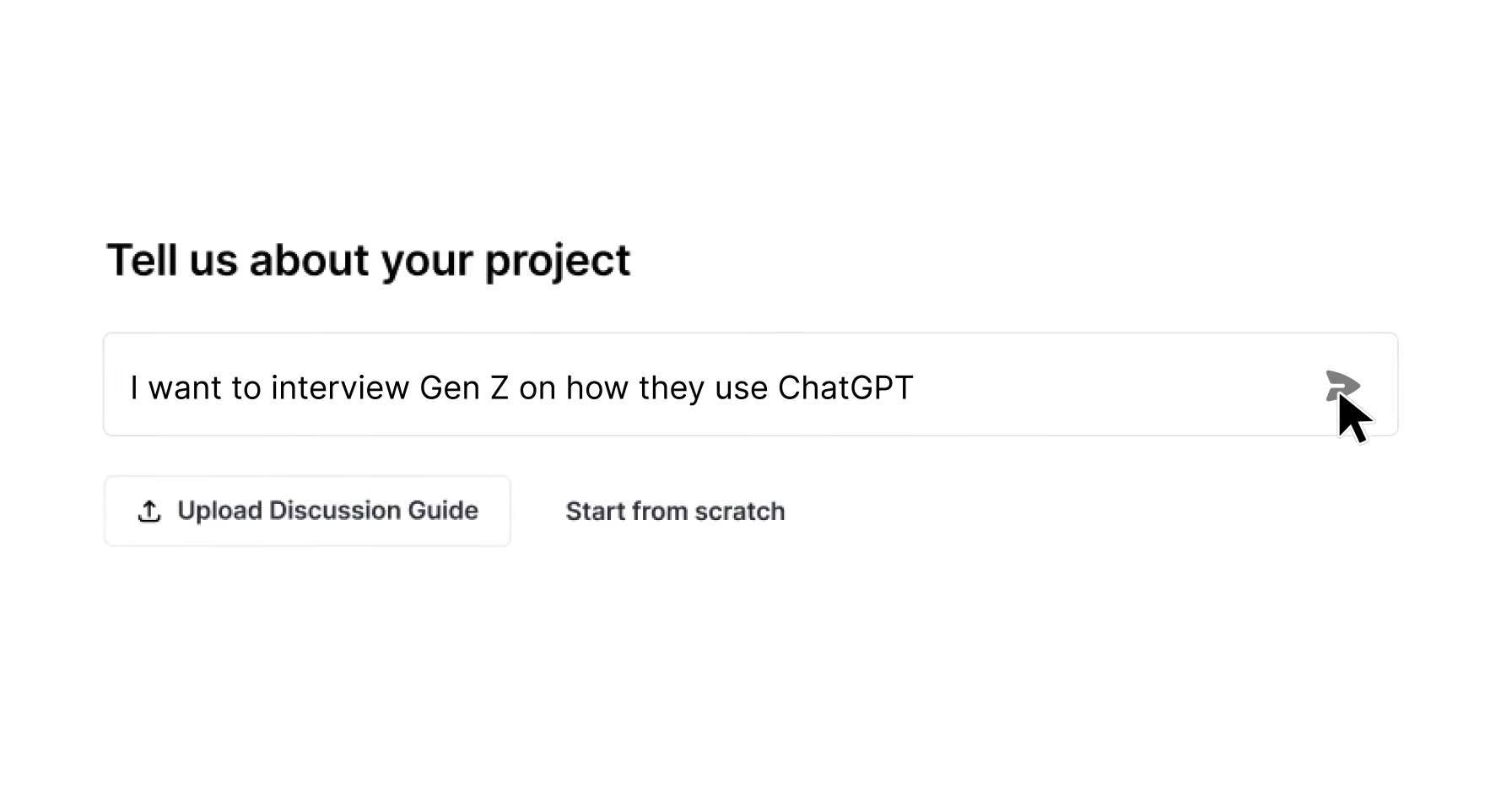
Listen Labs compresses the full research cycle from 4–6 weeks to under 24 hours. AI-assisted study design drafts structured objectives and question guides from a natural-language brief. Participant recruitment draws from a global network of 30 million verified respondents across more than 45 countries and 100 languages. An AI orchestration layer, Listen Atlas, matches participants on behavioral and intent data rather than self-reported demographics alone. A dedicated recruitment operations team reaches hard-to-find segments such as enterprise decision-makers, healthcare workers, and audiences below 1% incidence rate. Organizations can also self-recruit from their own user base at reduced cost.
Quality Guard monitors every interview in real time for fraud, low-effort responses, AI-generated scripts, and mismatched profiles. Participant frequency is capped at three studies per month, which removes professional survey-takers. This approach produces a fraud rate that commodity panels struggle to match.
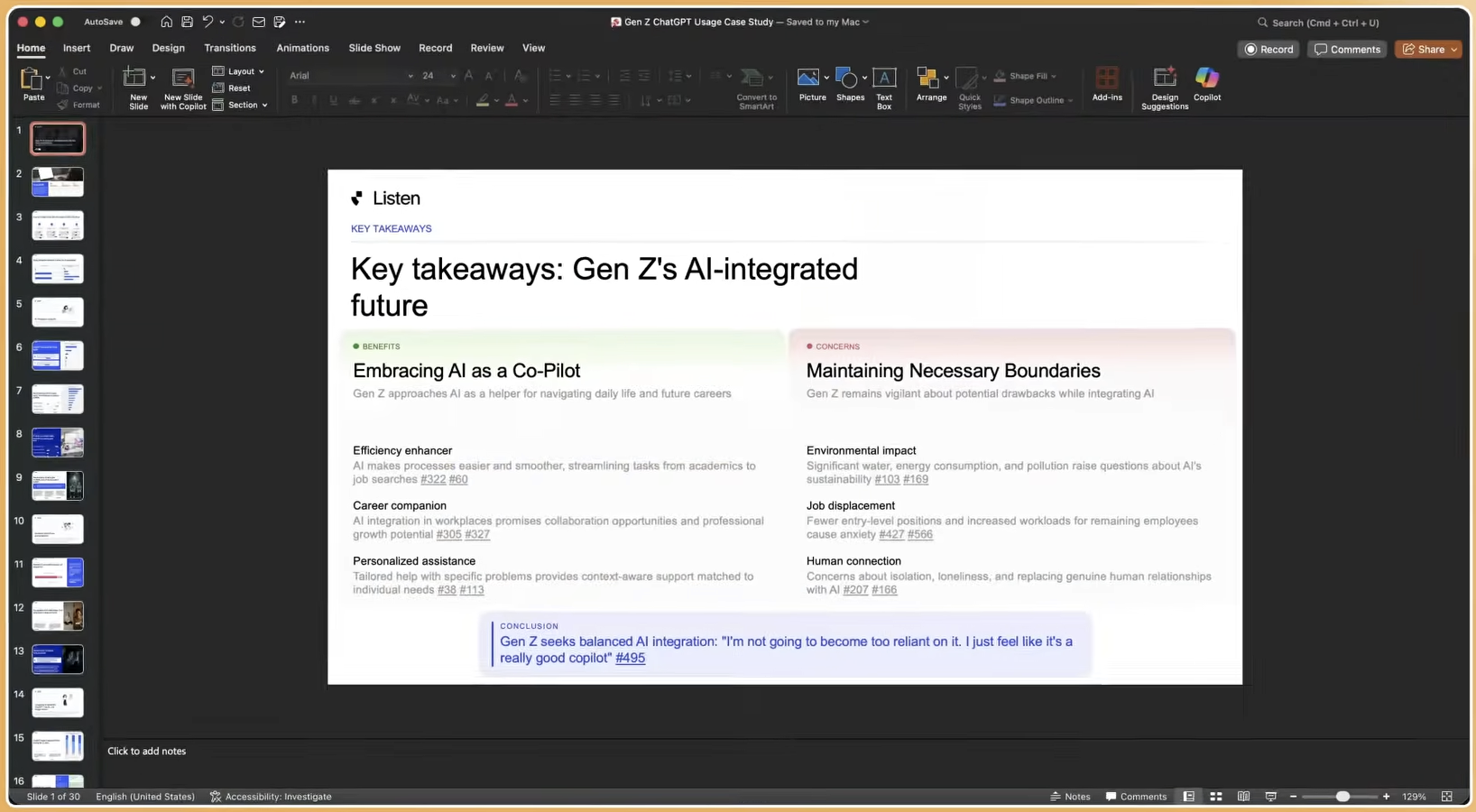
On cost, enterprises running studies through Listen Labs achieve the savings described earlier by replacing the fragmented stack of recruitment vendors, moderators, transcription services, and analysts with a single platform. Traditional focus groups cost $4,000–$12,000 per 90-minute session before analysis and reporting. Listen Labs then auto-generates slide decks, memos, highlight reels, and statistical charts through its Research Agent.
On privacy and security, Listen Labs holds SOC 2 Type II, GDPR, ISO 27001, ISO 27701, and ISO 42001 certifications. Customer data is never used for AI model training. Enterprise SSO is supported. Maintaining ethics, quality, and integrity remains non-negotiable if research is to retain its impact, and Listen Labs is built to meet that standard.
Frequently Asked Questions
Is an AI interviewer as effective as a trained human moderator?
For the vast majority of market research objectives, Listen Labs’ AI interviewer delivers quality comparable to a skilled human moderator at far greater speed and scale. The platform applies dynamic follow-up logic to every response and probes short or ambiguous answers the way a trained researcher would. Listen Labs’ in-house research team, with more than 50 years of combined expertise, continuously reviews and refines the methodology. For strategically sensitive or ethically complex studies, the platform complements human researchers rather than replacing their judgment. Research teams retain full control over study design and interpretation while the AI handles logistics, moderation, and initial analysis.
How does Listen Labs prevent participant fraud?
Three layers of protection operate at the same time. First, Listen Labs works only with high-quality, non-commodity panel sources, avoiding professional survey-takers from incentive-driven pools. Second, Quality Guard applies real-time AI monitoring across video, voice, content, and device signals to detect fraud, low-effort responses, AI-generated scripts, and mismatched profiles. Third, a dedicated recruitment operations team adds a human review layer, and every participant is limited to three studies per month to prevent panel fatigue and repeat-respondent bias. This compounding quality flywheel strengthens with every study conducted on the platform.
Will Listen Labs replace our research team?
Listen Labs acts as a force multiplier for existing research teams. The platform removes the logistics burden of recruitment, scheduling, moderation, transcription, and initial analysis. Researchers can then focus on strategic interpretation and stakeholder communication. Teams that previously ran a limited number of studies per quarter due to capacity constraints can increase their research output with the same headcount. The platform is built by researchers and designed to work in partnership with them, not to substitute for their expertise.
Can we use our own participants instead of the Listen Labs panel?
Yes. Listen Labs supports self-recruitment, which allows organizations to study their own customer base or user community at a reduced credit cost. Organizations can also bring their own panel provider. This flexibility helps UX research teams that need to test with existing product users and enterprises running longitudinal studies with a consistent participant cohort.
How does Listen Labs handle data security and privacy?
Listen Labs maintains enterprise-grade security with 256-bit encryption across all data. The platform holds SOC 2 Type II, GDPR, ISO 27001, ISO 27701, and ISO 42001 certifications. Customer data is never used to train AI models. Enterprise SSO is supported for organizations that require centralized identity management. These standards apply across all 45+ countries where Listen Labs operates, supporting compliance with regional data protection requirements including those in the EU, APAC, and MEA.
Conclusion: Bringing All Seven Advantages Together
The seven advantages of qualitative research, including contextual richness, behavioral explanation, adaptive probing, ecological validity, hypothesis generation, emotional depth, and scalable sample sizes, create the most complete form of customer understanding available to research, product, and marketing teams. Each advantage has historically carried a structural cost such as weeks of elapsed time, five-figure budgets, small samples, and fraud risk that eroded data quality.
Listen Labs removes those constraints. The platform sources verified participants from a 30-million-person global network, runs adaptive AI-moderated interviews across hundreds of sessions at once, captures emotional signals that transcripts miss, and delivers consultant-quality reports on the accelerated timeline described above, with the cost savings already noted. Enterprises including Microsoft, Procter & Gamble, Anthropic, and Skims have replaced weeks-long research cycles with same-day insight delivery without sacrificing the depth that makes qualitative findings actionable.