
Written by: Anish Rao, Head of Growth, Listen Labs | Last updated: June 19, 2026
Key Takeaways
- Most startups fail because they execute product-market fit poorly, not because they lack theory. A structured interview playbook closes this gap.
- The 7-day plan walks through six steps: customer hypothesis, problem interviews, solution interviews, the Sean Ellis survey, retention tracking, and emotional plus transcript analysis.
- Clear decision thresholds at each step (70% problem confirmation, 60% solution preference, 40% Sean Ellis score) stop teams from scaling unvalidated ideas.
- High-quality participants and real-time fraud prevention are essential. Behavioral screeners and AI-moderated interviews deliver reliable signals faster than traditional methods.
- Listen Labs accelerates the entire PMF validation cycle, from recruitment through deliverables, in under 24 hours. See how the full workflow runs in a live demo.
How to run a 7-day product market fit test
The 7-day plan structures PMF validation into six sequential steps, each with a clear heading and decision point. Step 1 defines your customer hypothesis on Day 1. Step 2 runs problem interviews on Days 2–3. Step 3 validates a lightweight concept with solution interviews on Days 4–5. Step 4 administers the Sean Ellis survey on Day 6. Step 5 measures retention and behavioral signals from Day 7 onward. Step 6 analyzes emotional and transcript data on Day 7. Each step has defined inputs, a responsible stakeholder, and a binary decision point, so teams either proceed or iterate before moving forward. The plan serves product managers, founders, and growth leads who need fast insight without a dedicated research team.
Step 1: Define target customer hypothesis and problem statements
Timeline: Day 1. Stakeholders: Founder or PM, optional growth lead. Inputs: Initial customer hypothesis, screener criteria (role, behavior, context), and a problem interview guide template.
Write one customer hypothesis in this format: “[Segment] struggles with [problem] when [context], which causes [consequence].” This hypothesis becomes the foundation for your screener criteria, which filter for people who actually live the problem rather than only matching a profile. Define three to five screener criteria that confirm a respondent experiences the problem. Screener criteria work best when they are behavioral. “Has attempted to solve this problem in the last 90 days” outperforms “works in marketing” because it selects for recent, firsthand experience.
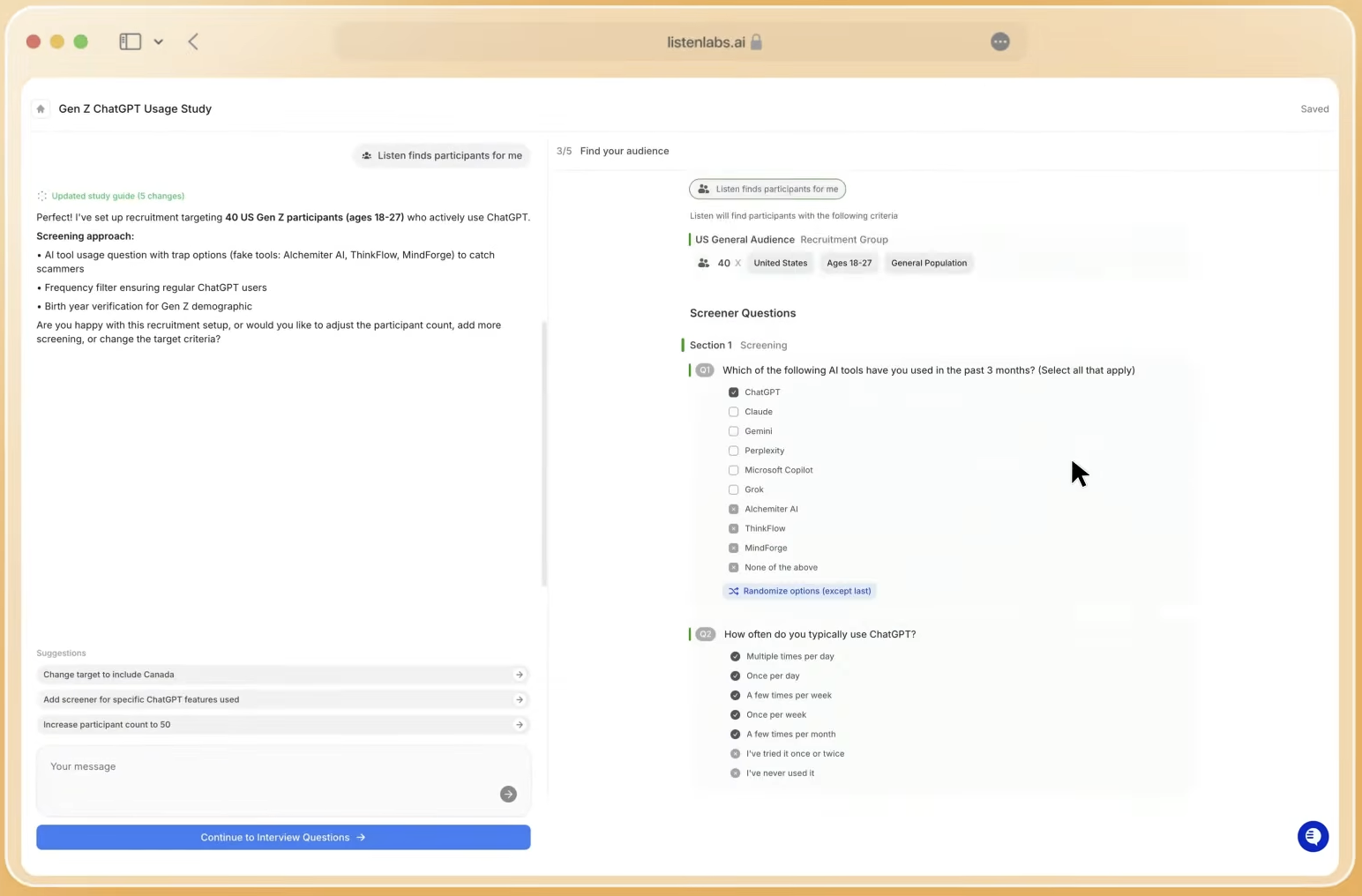
Decision point: If the team cannot agree on a single hypothesis, the problem space is too broad. Narrow to one segment before recruiting.
Step 2: Run problem interviews before building
Timeline: Days 2–3. Stakeholders: PM or founder as primary analyst. Inputs: Screened participant list, semi-structured interview guide (8–12 open questions), note-taking or transcription setup.
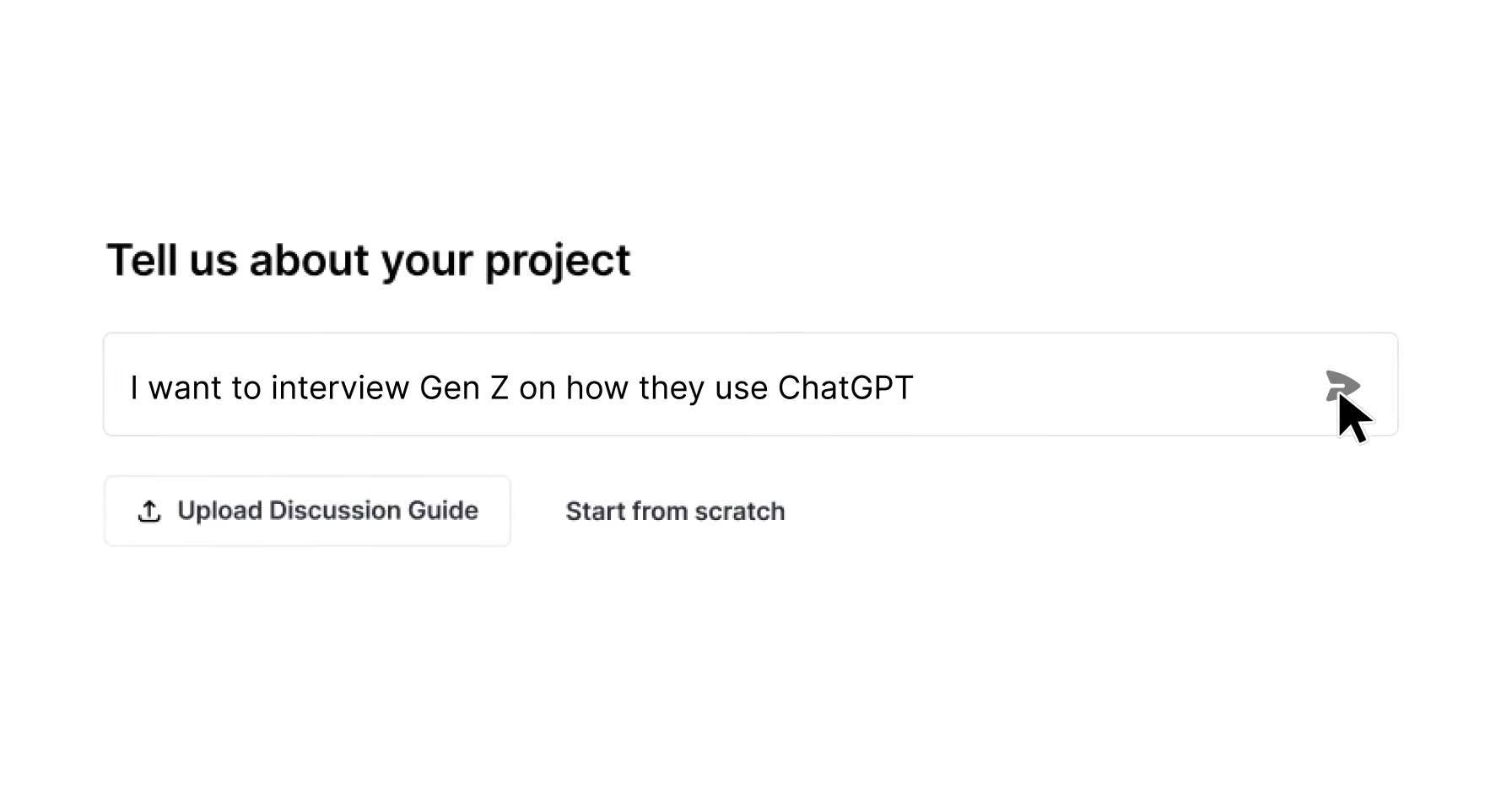
Problem interviews confirm whether the target segment experiences the problem acutely enough to change behavior. Target 15–20 interviews. Ask participants to walk through the last time they encountered the problem, including sequence, workarounds, and cost of the status quo. Do not describe your solution. At this stage, depth matters more than sample size. Qualitative methods uncover nuance and complexity in human decision-making that surveys miss, so 15–20 in-depth problem interviews generate more actionable insight than a large, shallow survey.
If early interviews surface vague or hypothetical answers, the issue usually sits in recruitment rather than the interview guide. Troubleshooting low-quality respondents: If participants cannot recall a specific instance of the problem or default to hypotheticals, tighten behavioral filters and re-recruit. Listen Labs’ Quality Guard monitors every interview in real time for low-effort responses and mismatched profiles, and participants are capped at three studies per month to eliminate professional survey-takers.
Decision point: If fewer than 70% of interviewees describe the problem as a recurring, high-priority issue, revise the hypothesis before proceeding to solution interviews.
Step 3: Validate a lightweight MVP or concept with solution interviews
Timeline: Days 4–5. Stakeholders: PM, designer, or founder. Inputs: Mockup, prototype, or concept description; solution interview guide; screened participants who passed problem interview criteria.
Solution interviews test whether your proposed approach resolves the problem participants confirmed in Step 2. Show the concept, such as a wireframe, a one-page description, or a clickable prototype, and ask participants to narrate their reaction. Probe on perceived value, missing elements, and willingness to change current behavior. Target 15–20 interviews from the same screened segment. Running this volume of solution interviews in two days becomes realistic only when recruitment, scheduling, and moderation run automatically. AI can schedule and conduct interviews, analyze transcripts for themes, and generate quantitative insights from qualitative responses, which compresses a two-day fieldwork window into a single afternoon.
Listen Labs’ AI-moderated interviews apply dynamic follow-up questions in real time, probing short answers and surfacing unexpected objections in a way that mirrors a trained human interviewer across 100+ languages and 45+ countries.
Schedule a demo to see AI-moderated solution interviews deliver verified feedback in under 24 hours.
Decision point: If fewer than 60% of participants describe the solution as meaningfully better than their current workaround, return to Step 1 and revise the problem or solution framing before proceeding.
Step 4: Use the 40% Sean Ellis rule to quantify product market fit
The Sean Ellis survey asks active users one question: “How would you feel if you could no longer use this product?” Response options are Very disappointed, Somewhat disappointed, Not disappointed, or I no longer use this product. A PMF score of 40% or above, defined as the percentage of active users answering “Very disappointed,” indicates strong product-market fit and a green light to scale growth. Scores below 40% signal that the product needs further iteration before scaling.
The formula is straightforward. PMF Score (%) = (Number of “Very Disappointed” Responses ÷ Total Responses) × 100. Superhuman found that 58% of early users would be “very disappointed” without the product, which exceeded the 40% threshold and guided the team to focus on email power users who valued speed.
The 40% threshold functions as a lagging indicator because it measures existing fit rather than predicting it, and results can mislead when the survey targets the wrong segment instead of the full active user base. Administer the survey only to users who have completed a core action in the product within the last 30 days.
Step 4 execution – Timeline: Day 6. Stakeholders: PM or growth lead. Inputs: Active user list with at least 40 respondents for statistical reliability, survey delivery method, and follow-up interview slots for “very disappointed” respondents. Decision point: A score below 40% triggers a return to Step 1. A score above 40% moves the team to Step 5.
Step 5: Measure retention and behavioral signals
Timeline: Ongoing from Day 7. Stakeholders: PM and data or analytics lead. Inputs: Product analytics platform, cohort data, activation and engagement event definitions.
A healthy retention curve that flattens over time, rather than trending toward zero, provides the most honest quantitative signal of product-market fit. Mixpanel reports that eight-week retention rates vary by industry, and higher sustained retention aligns with stronger product-market fit. These benchmarks help interpret whether your flattening curve reflects typical performance or an outlier.
Decision point: A flattening retention curve plus a Sean Ellis score above 40% plus an LTV:CAC ratio above 3:1 together constitute a strong PMF signal. Any single metric in isolation remains insufficient.
Step 6: Analyze emotional and transcript data to surface deeper fit indicators
Timeline: Day 7. Stakeholders: PM, researcher, or founder. Inputs: Interview transcripts and recordings from Steps 2, 3, and any follow-up sessions, plus emotional signal data where available.
Steps 4 and 5 show whether you have product-market fit. Step 6 explains why you see those scores and what to adjust next. At this stage, the goal is to move from raw transcript data to a prioritized insight set that explains which specific value drivers create retention and high disappointment scores, so the team knows what to double down on or fix in the next iteration.
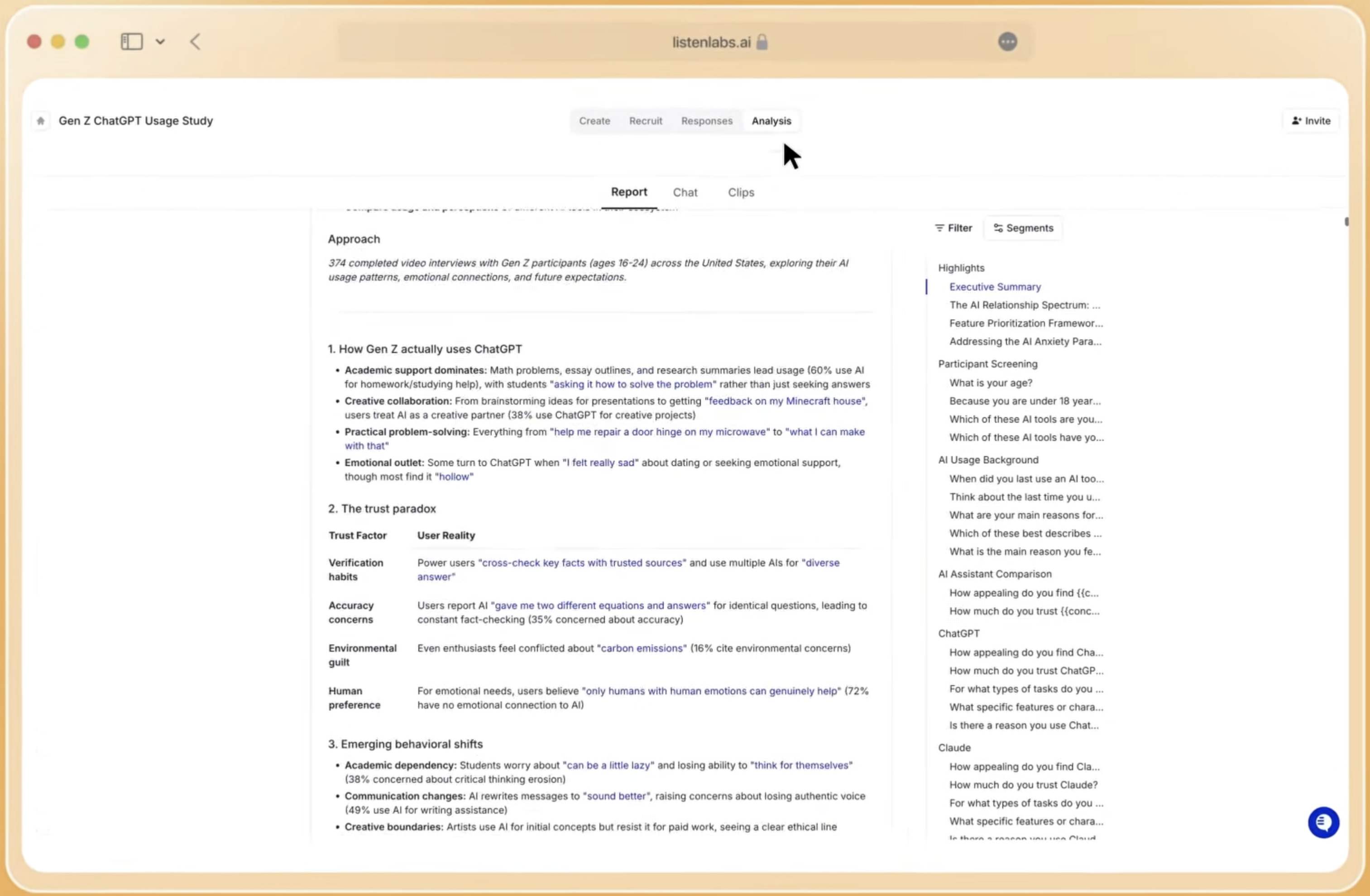
Listen Labs’ Research Agent handles the full analysis workflow from raw data to final output, generating automated key findings, theme clusters, segment breakdowns, and one-click slide decks. One researcher ran a full buying intent analysis across three user segments in under a minute. Listen Labs’ Emotional Intelligence layer adds a second data stream by analyzing tone of voice, word choice, and micro-expressions to surface emotions that transcripts alone miss. This layer builds on Ekman’s universal emotions framework and links each signal to exact timestamps and verbatim quotes.
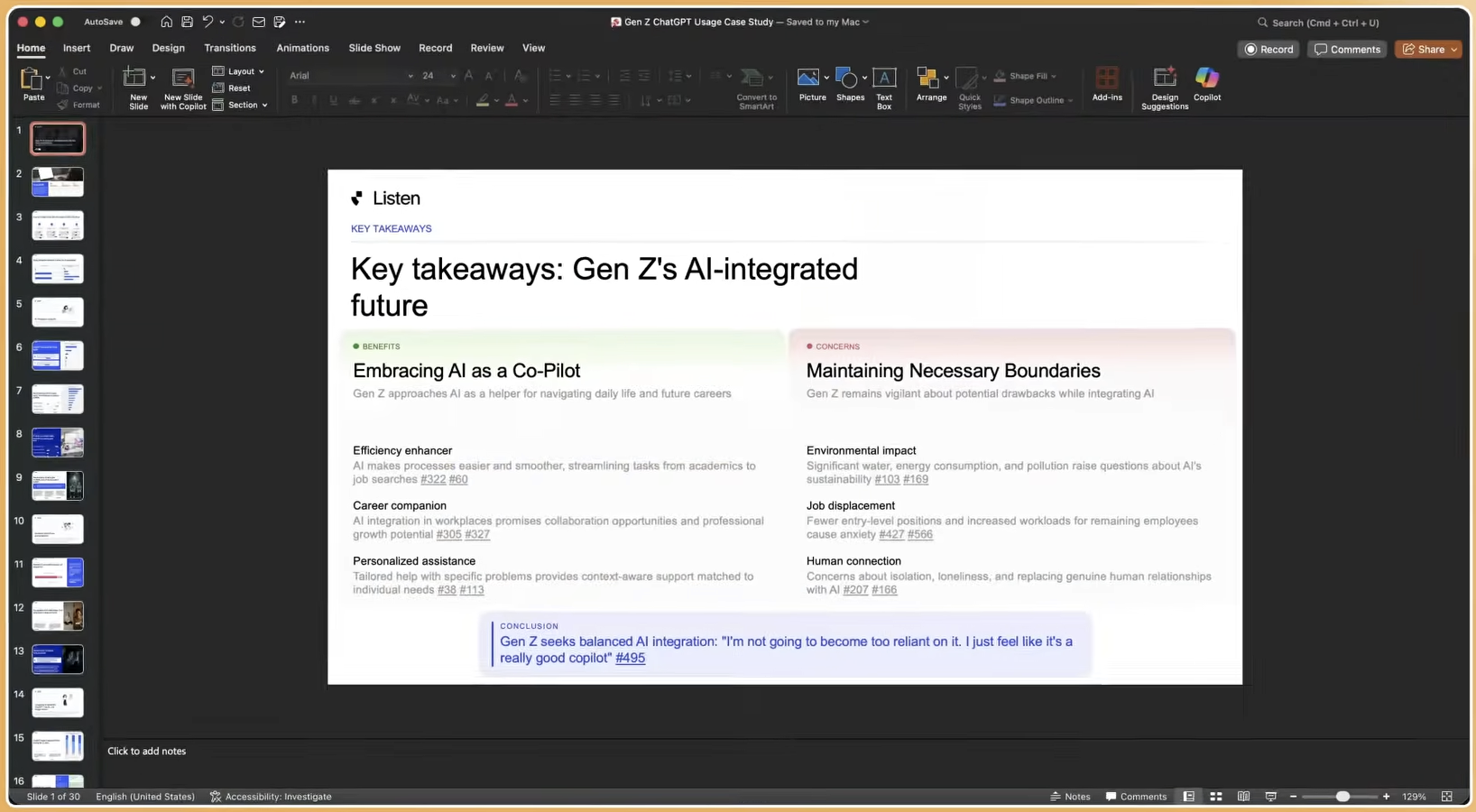
Decision point: If transcript analysis surfaces consistent unmet needs or friction points that the current solution does not address, feed those findings back into Step 1 for the next iteration cycle.
Participant quality and fraud prevention across the playbook
Interview quality only reaches as high as participant quality, so the entire 7-day playbook assumes strong recruitment. If recruitment fails, every decision point becomes unreliable. Three controls apply throughout this playbook, and each one addresses a different failure mode in participant quality.
First, recruit from verified panels with behavioral matching, using screeners based on past actions rather than self-reported demographics, so participants genuinely live the problem instead of guessing what you want to hear. Second, apply real-time behavioral screening during interviews to catch fraud that passes initial screening by monitoring for low-effort responses, AI-generated scripts, and device or voice signal anomalies. Third, enforce frequency limits to prevent professional survey-takers from gaming the system. Participants who complete too many studies per month produce incentive-driven, low-signal answers instead of authentic reactions. The three-study-per-month cap mentioned in Step 2 fits into a broader reputation scoring system that tracks participant quality across every interview on the platform. A dedicated recruitment operations team adds a human review layer for hard-to-reach segments, including enterprise decision-makers, healthcare workers, and audiences below 1% incidence rate.
How the 7-day playbook maps to the 4 stages of product market fit
First Round Capital’s PMF framework defines four stages: Nascent PMF, Developing PMF, Strong PMF, and Extreme PMF.
The 7-day playbook aligns each step with these stages so teams know how today’s work advances long-term fit. Steps 1–2, which focus on problem interviews, act as the diagnostic tool for Nascent PMF. Steps 3–4, which cover solution interviews and the Sean Ellis survey, mark the transition from Nascent to Developing PMF. Step 5, which measures retention, provides the primary signal for Strong PMF. Step 6, which analyzes emotional and transcript data, surfaces the insight layer needed to move from Strong to Extreme PMF by identifying the specific value drivers that generate organic referrals and expansion. Each stage keeps a binary decision point. If the current stage’s signals are not met, teams return to Step 1 instead of advancing prematurely.
Common challenges and troubleshooting during PMF testing
Unclear objectives: When the team cannot define a single customer hypothesis in Step 1, the problem space is too broad. Run a 60-minute internal alignment session before recruiting any participants. Use the hypothesis template from Step 1 as a forcing function.
Low-quality respondents: Screeners based on demographics rather than behavior consistently produce participants who do not live the problem. Replace demographic criteria with behavioral criteria such as specific actions taken, tools used, or decisions made in the last 90 days. Platforms like Listen Labs layer on auto-recruiting, transcription, sentiment tagging, and insight summarization so teams move from question to findings in hours, not weeks, with quality controls built into the recruitment layer. The auto-recruiting and analysis capabilities described in Step 3 remove much of the manual effort that usually blocks progress.
Analysis bottlenecks: Manual thematic analysis of 20–40 interview transcripts typically takes three to five business days and introduces confirmation bias. AI-moderated interviews typically cut time-to-insight by about 84% (six weeks to roughly nine days) or compress fieldwork-to-deliverable from weeks to 48–72 hours. Automated analysis tools remove the bottleneck and process all responses without anchoring on pre-existing hypotheses.
Frequently Asked Questions
How long does product market fit testing actually take?
The 7-day playbook suits teams that can dedicate focused time to each step. Day 1 covers internal alignment and screener design. Days 2–5 cover fieldwork across problem and solution interviews. Day 6 runs the Sean Ellis survey. Day 7 focuses on analysis and synthesis. Retention measurement continues from Day 7 forward. With an AI-moderated interview platform handling recruitment, moderation, and transcription in parallel, the fieldwork phases compress significantly. Listen Labs delivers results from study launch to final report in under 24 hours, so teams with fast internal decision cycles can complete the full plan in three to four calendar days.
How many interviews are needed to validate product market fit?
Problem and solution interviews each target 15–20 participants from a tightly screened segment. This sample size is sufficient to identify recurring themes and reach thematic saturation in qualitative research. The Sean Ellis survey requires at least 40 active user responses for the score to be statistically reliable. Retention measurement requires a cohort large enough to produce a meaningful curve, typically 100 or more users tracked over four to eight weeks. These thresholds represent minimums, and larger samples increase confidence, particularly for the Sean Ellis score and retention analysis.
When should a team iterate versus expand testing?
Teams should iterate when a decision point threshold is not met. Examples include fewer than 70% of problem interview participants confirming the problem as high-priority, fewer than 60% of solution interview participants preferring the solution over their current workaround, or a Sean Ellis score below 25%. Teams should expand testing, such as moving to a larger segment or adjacent market, only after all three signals align: a Sean Ellis score above 40%, a flattening retention curve, and an LTV:CAC ratio above 3:1. Expanding before those signals are confirmed scales a leaky funnel rather than a validated product.
How do you prevent bias in interview-based PMF testing?
Three practices reduce bias. First, use behavioral screeners rather than self-reported demographics so participants genuinely live the problem. Second, conduct problem interviews without describing the solution, because leading with the solution contaminates problem discovery. Third, use AI-moderated interviews for consistency. Human moderators vary in probing depth, tone, and follow-up quality across sessions, while AI applies identical probing logic to every conversation. Listen Labs’ Emotional Intelligence layer adds a non-verbal signal stream, including micro-expressions, tone of voice, and word choice, that captures what participants feel rather than only what they say, which reduces social desirability bias in self-reported responses.
Can this playbook be used for B2B products as well as consumer products?
The playbook works for both B2B and consumer products with two adjustments. B2B screeners must account for organizational role and decision-making authority because the user and the buyer are often different people, and each group requires its own interview track. B2B retention curves also operate on longer time horizons than consumer products, so the ongoing measurement phase in Step 5 should extend to 90-day cohorts rather than 30-day cohorts. The Sean Ellis survey and problem or solution interview structure apply without modification. Listen Labs’ recruitment operations team specializes in sourcing hard-to-reach B2B segments, including enterprise decision-makers and technical buyers, from its network of 30M verified respondents across 45+ countries.
Conclusion
The 7-day interview playbook converts PMF theory into a repeatable execution system with defined inputs, decision points, and quality controls at every stage. Problem interviews confirm the problem before any build investment. Solution interviews validate the concept before full development. The Sean Ellis survey quantifies fit among active users. Retention and behavioral signals confirm durability. Emotional and transcript analysis surfaces deeper fit indicators that drive organic growth. Each step keeps a binary go or no-go decision that prevents teams from scaling a hypothesis that has not been validated. With qual-at-scale, the old trade-off between depth and scale no longer blocks teams, so they can run 15–20 high-quality interviews per step without weeks of manual recruiting, scheduling, and analysis overhead.
Listen Labs handles the entire research lifecycle for this playbook, including AI-assisted study design, global participant recruitment from 30M verified respondents, AI-moderated interviews with dynamic follow-up questions, automated analysis, and stakeholder-ready deliverables, all in under 24 hours.
Book a demo to run your first PMF interview sprint with Listen Labs.