
Written by: Anish Rao, Head of Growth, Listen Labs
Key Takeaways
-
AI-powered qualitative research scales insights 10x faster, compressing weeks-long timelines to under 24 hours with end-to-end workflows.
-
Listen Labs offers a 30M verified participant panel, 100+ language support, and enterprise-grade SOC2/GDPR compliance across 45+ countries.
-
Core practices include AI-moderated interviews, emotional intelligence capture, real-time fraud detection, and automated Research Agent analysis for consultant-quality deliverables.
-
Human-in-the-loop oversight and proprietary AI safeguards address fragmentation, hallucinations, automation bias, and participant fraud.
-
Trusted by Microsoft and P&G, Listen Labs helps enterprises achieve 10x research output today. See how with a personalized demo.
Executive Summary & Four-Pillar Framework
The 12-step AI customer research workflow for 2026 covers human-in-the-loop oversight, enterprise privacy compliance, qualitative-quantitative fusion, real-time fraud detection, emotional intelligence capture, automated analysis, global localization, one-click deliverables, cross-study intelligence, and continuous iteration.
The framework centers on four pillars: speed (sub-24 hour delivery), quality (emotion AI and fraud prevention), scale (hundreds of simultaneous interviews), and security (SOC2/GDPR compliance). These pillars address the core constraints that have historically limited qualitative research: long timelines, small sample sizes, and compliance risks. Listen Labs applies this framework through AI-moderated interviews, automated analysis via Research Agent, and comprehensive participant quality controls.
Industry Landscape: From Fragmented Tools to Unified AI Platform
Traditional research infrastructure fragments across multiple vendors such as Prolific for recruitment-only, Dovetail for analysis-only, UserTesting for human-dependent moderation, and Qualtrics for quantitative surveys. This fragmentation creates delays, quality loss, and cost inefficiencies.
Listen Labs consolidates the entire research lifecycle into a single platform, eliminating handoffs between tools while maintaining enterprise-grade security across 45+ countries through a unified compliance framework. The following comparison shows how this end-to-end approach delivers faster results, broader capabilities, and lower cost than fragmented traditional tools.
|
Feature |
Listen Labs |
UserTesting/Dovetail/Prolific/Qualtrics |
|---|---|---|
|
Time to Results |
<24h |
Weeks |
|
Panel Size |
30M verified |
Limited |
|
Key Moats |
Emotional IQ, Research Agent, Zero Fraud |
Varied (for example, data assets, CX programs) |
|
Cost |
One-third of traditional |
Higher |
12-Step AI Customer Research Workflow
To solve the fragmentation and inefficiency challenges described above, Listen Labs uses a 12-step end-to-end workflow that unifies recruitment, moderation, analysis, and delivery in a single platform.
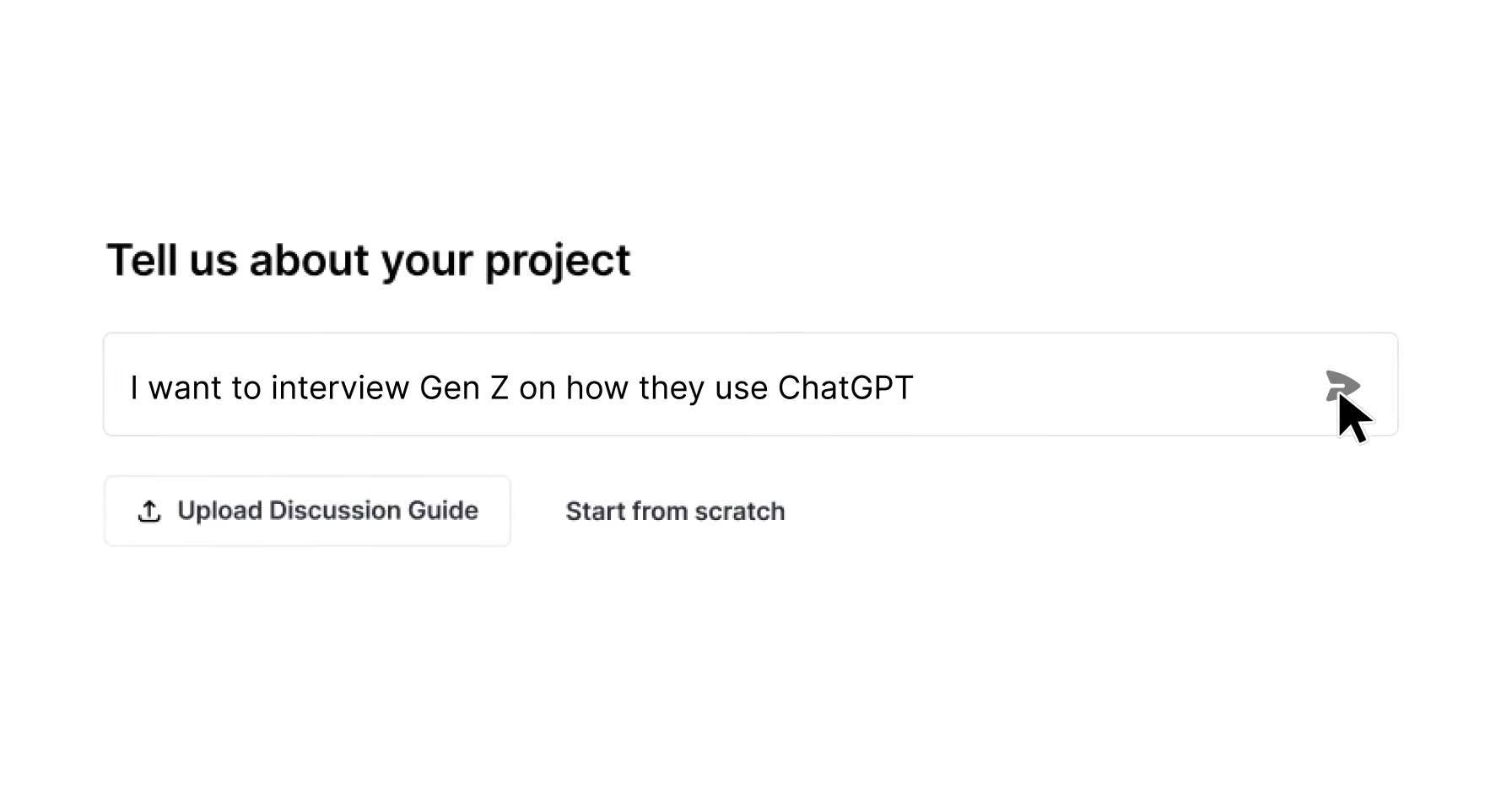
1. AI-Assisted Study Design: AI co-designs research objectives and question frameworks in natural language, which removes weeks of manual study planning.
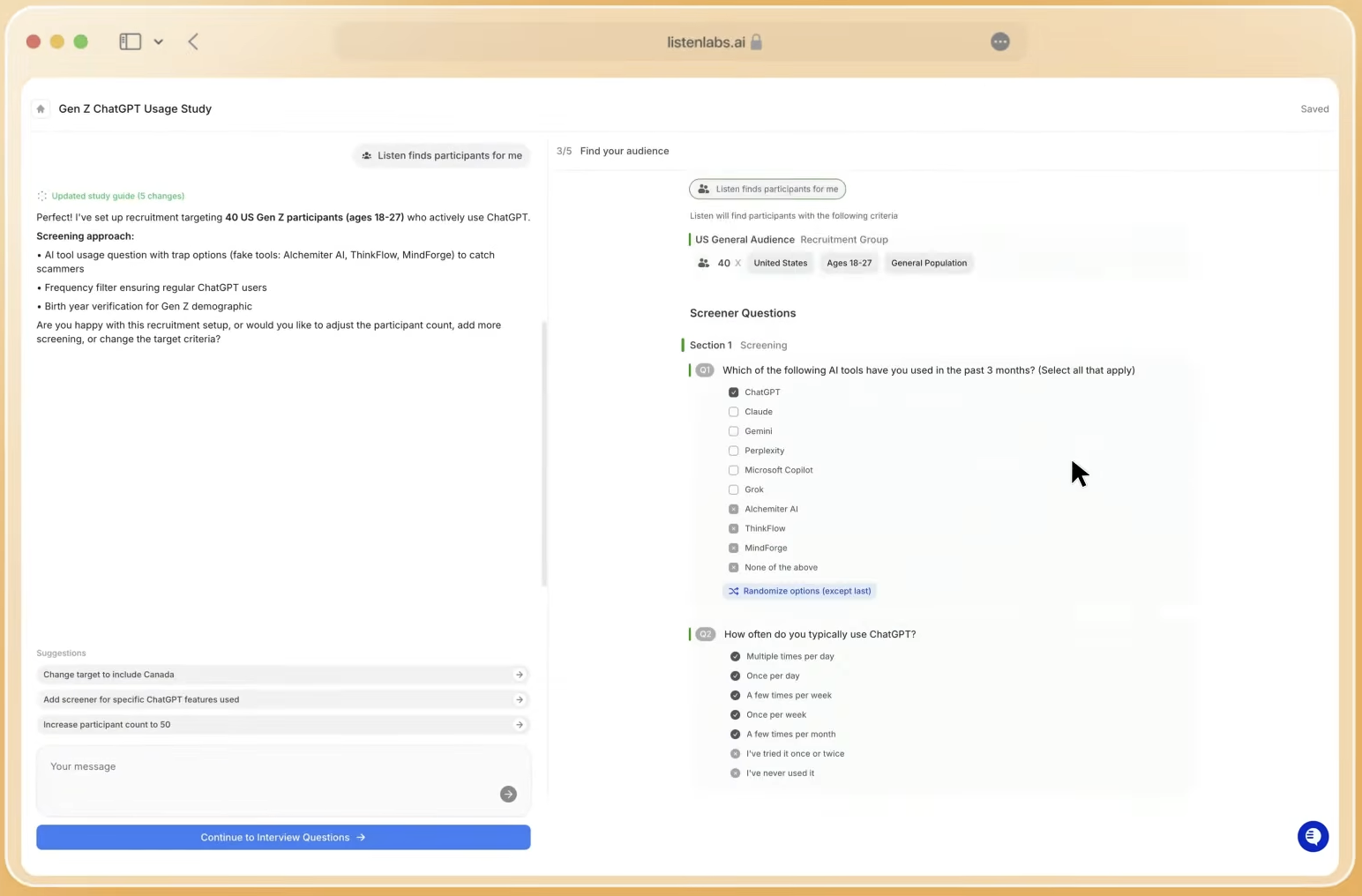
2. Quality Recruitment: Teams access 30M verified participants across niche segments below 1% incidence rates, supported by dedicated recruitment operations teams and Listen Atlas.
3. AI-Moderated In-Depth Interviews: The platform conducts personalized video conversations with dynamic follow-up questions that adapt to participant responses, maintaining 92% comfort levels equivalent to human moderation.
4. Emotional Intelligence Capture: The system analyzes tone of voice, word choice, and subconscious micro expressions using Ekman’s universal emotions framework across 50+ languages, then quantifies emotions per question with traceable AI reasoning.
5. Qualitative-Quantitative Fusion: Teams compress analysis from weeks to hours by combining conversational depth with statistical confidence through large sample sizes.
6. Real-Time Quality Guard: Three-layer fraud prevention includes behavioral matching, real-time monitoring across video, voice, and content signals, and participant limits of three studies per month.
7. Automated Analysis: Research Agent handles the full analysis workflow from raw data to stakeholder-ready deliverables. It generates charts, statistical tests, and segmentations through natural language queries.
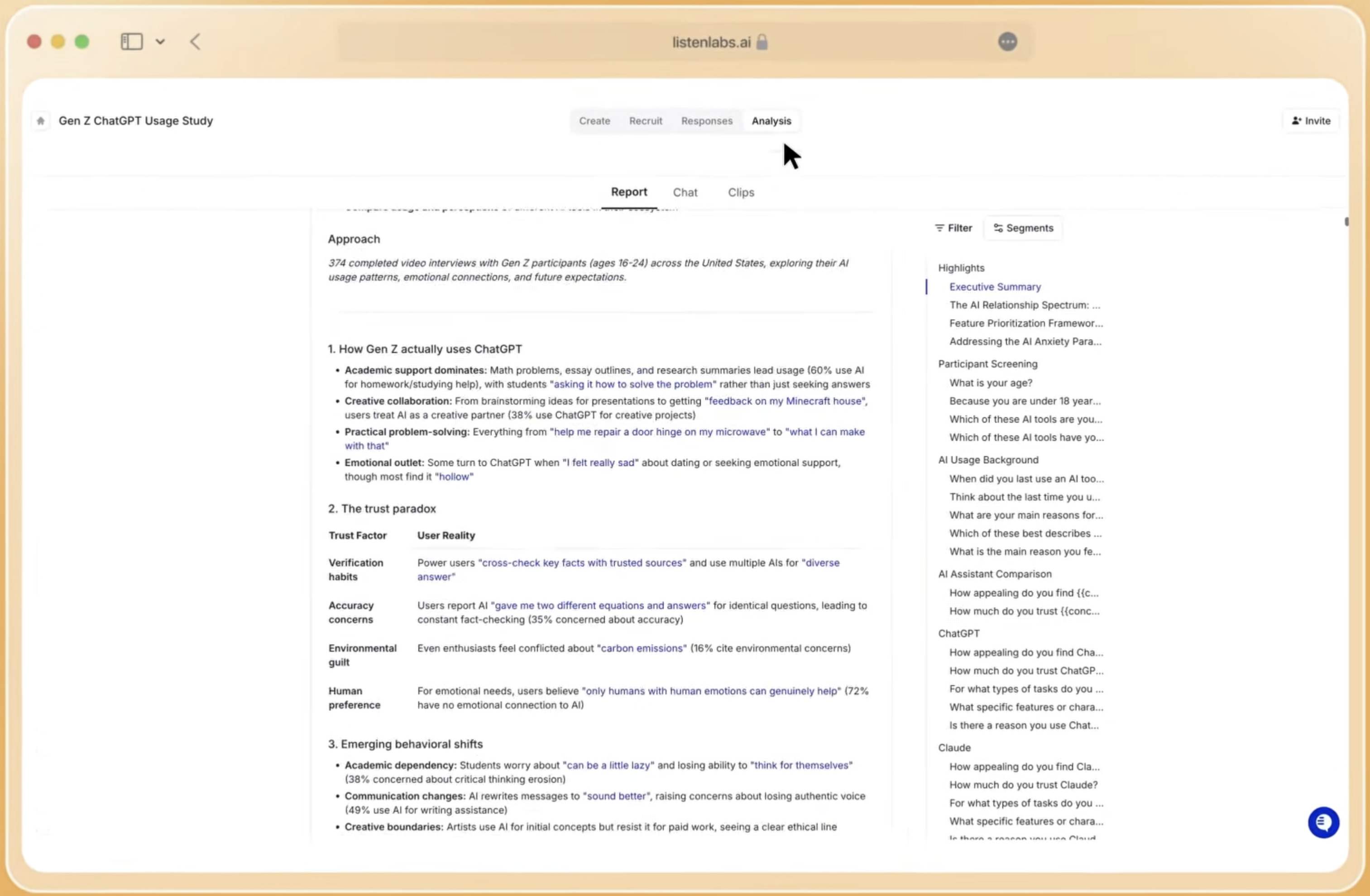
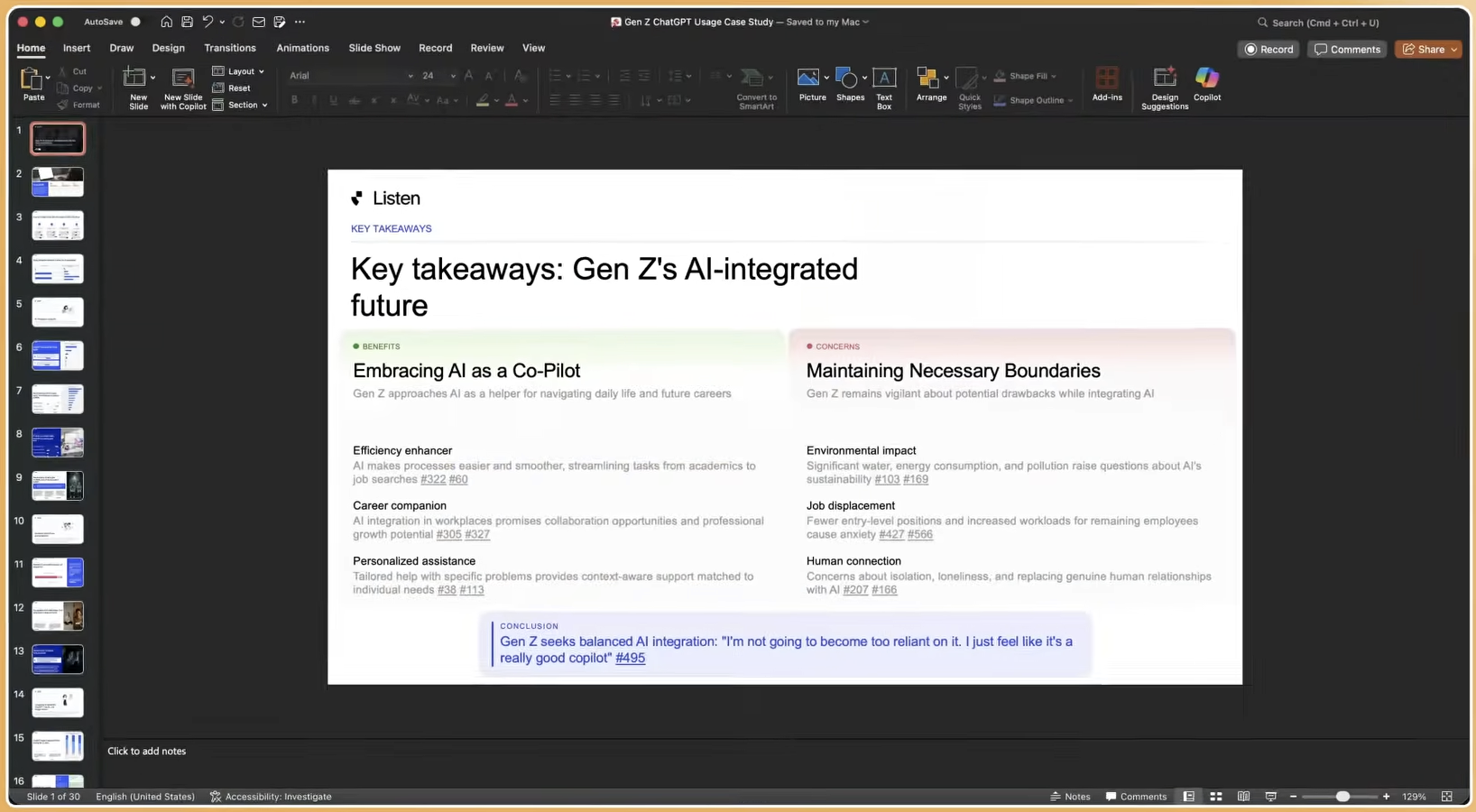
8. One-Click Deliverables: The platform generates consultant-quality slide decks, video highlight reels, and executive summaries in under one minute, with every insight linking to underlying response data.
9. Mission Control Cross-Study Intelligence: Teams build institutional knowledge across all research, enabling cross-study queries and trend tracking that prevent re-researching known insights.
10. Human-in-the-Loop Review: Senior researchers provide oversight with more than 50 years of combined expertise for methodology validation and quality assurance.
11. Global Localization: The platform supports 100+ languages with automatic translation and cultural adaptation for multinational research programs.
12. Continuous Iteration: Teams track participation rates, reliability metrics, and business impact to improve research velocity and quality over time.
Enterprise case studies illustrate this workflow in practice. Microsoft collected global customer stories for their 50th anniversary celebration within 24 hours.
P&G validated product claims across hundreds of interviews and focused innovation on real consumer pain points before market launch. See how these workflows can transform your research process by scheduling a personalized demo.
AI UX Research Best Practices for Product Teams
UX research teams apply this workflow to prototype testing and usability studies using screen-sharing capabilities and emotion-based friction detection. Enterprise scaling focuses on three key personas. Insights VPs clear research backlogs and respond faster to stakeholder requests.
UX researchers run 50 to 100 user studies instead of 5 to 10, while maintaining depth. Product Managers access self-serve research without specialized expertise, which brings customer feedback directly into product decisions.
These personas all face the same depth-versus-scale trade-off in traditional research. AI moderation removes this trade-off by preserving conversational quality while enabling large sample sizes that support statistical confidence.
Pitfalls in AI Research and How to Mitigate Them
AI customer research faces three primary risks that require evidence-based mitigation strategies. Hallucinations represent safety risks, not quirks, so teams need proprietary data moats and validation checks instead of generic AI tools.
Automation bias leads to excessive trust in AI outputs without scrutiny, which means human-in-the-loop oversight and traceable reasoning for every insight are essential. Quality degradation through fraud or low-effort responses calls for real-time monitoring systems and participant reputation scoring across multiple studies.
FAQ
How does AI moderation compare to human researchers?
AI-moderated interviews match the quality of human moderation while delivering far greater scalability. As noted in the workflow above, participants report comfort levels equivalent to human moderators, and many prefer AI for sensitive topics because it reduces perceived judgment and increases anonymity.
The AI conducts personalized conversations with dynamic follow-up questions, capturing the same conversational depth as trained human researchers while enabling hundreds of simultaneous interviews.
What fraud prevention measures ensure participant quality?
Three-layer protection includes behavioral matching on intent rather than demographics, real-time Quality Guard monitoring across video, voice, content, and device signals, and participant frequency limits of three studies per month. Dedicated recruitment operations teams add human review for niche segments. Reputation scoring then builds across every interview to strengthen audience quality over time.
How does pricing work for enterprise teams?
Listen Labs uses a subscription model with platform access that includes set study credits, then variable credit costs per participant based on audience difficulty. General population studies require fewer credits than niche segments below 1% incidence rates. Organizations can also bring their own participants at reduced credit costs, with enterprise demos and pilots available for teams over 100 employees.
Schedule a demo to review pricing for your specific use cases.
Can Listen Labs reach highly specialized audiences?
Yes. The dedicated recruitment operations team sources audiences below 1% incidence rates, including enterprise decision-makers, healthcare workers, engineers, and specialized consumer segments. A verified participant network spans 45+ countries with 100+ language support, while partnerships with niche communities and specialized panel providers extend reach to hard-to-find segments.
What deliverables does the Research Agent generate?
Research Agent produces consultant-quality slide decks, video highlight reels, statistical charts and comparisons, segmentation breakdowns, memo-style reports, and custom analyses based on natural language queries. Every insight links directly to underlying response data with traceable reasoning, which enables teams to verify findings and explore deeper patterns through conversational analysis.
Conclusion: Turn AI Research into a Scalable Advantage
The framework of speed, quality, scale, and security turns traditional research constraints into competitive advantages. Enterprise teams that implement this 12-step workflow achieve 10x research output while maintaining methodological rigor through human-in-the-loop oversight and proprietary data safeguards.