Written by: Anish Rao, Head of Growth, Listen Labs | Last updated: July 8, 2026
Key Takeaways
- Concept testing validates early-stage ideas through structured consumer feedback on comprehension, appeal, relevance, and purchase intent before major investment.
- Monadic testing delivers the most accurate absolute scores by isolating each concept, while sequential and comparative methods introduce bias or limit depth.
- Effective concept testing combines quantitative metrics like purchase intent and clarity with qualitative emotional signals that better predict real-world behavior.
- AI-moderated interviews enable hundreds of simultaneous, adaptive conversations with built-in quality controls, emotional intelligence analysis, and rapid turnaround from days to hours.
- Listen Labs delivers this scale and rigor in a single platform, and Book a demo shows how it turns weeks-long projects into continuous competitive advantage.
Where Concept Testing Creates the Most Value
Concept testing belongs at the front end of any decision that is expensive, hard to reverse, or dependent on consumer understanding. New product launches, major rebrands, pricing architecture changes, and campaign direction decisions all qualify. The method also fits when internal teams disagree on which of several directions to pursue and need consumer evidence to arbitrate.
The timing question matters as much as the decision type. Traditional concept testing often takes weeks, while product decisions now move in days, and insights that arrive after the decision lose practical value. A 4–6 week agency cycle is structurally incompatible with sprint-based product development or campaign planning windows measured in days. When the research cadence cannot match the decision cadence, teams default to intuition, precisely when concept testing becomes most valuable and least available under traditional models.
This timing constraint makes it critical to understand not just when to use concept testing, but also when not to use it. Concept testing is not the right tool for every question. It is directional and diagnostic, not predictive. Concept testing research reliably shows whether a concept is understood, resonates with a specific audience, and reveals friction points, but cannot predict exact adoption rates or long-term retention. Teams seeking volumetric forecasts or in-market sales projections require additional methods layered on top of concept validation. The key is finding a platform that can deliver this validation quickly enough to match your decision timeline.
See how Listen Labs compresses concept testing from weeks to hours without sacrificing methodological rigor, and book a demo.
Choosing Between Monadic and Comparative Concept Tests
Concept testing methodology selection determines both the quality of the signal and the cost of the study. The choice between monadic testing and comparative approaches directly affects which decisions the data can support.
Monadic designs produce the cleanest absolute scores. Monadic design almost always produces more accurate, actionable data for concept tests compared to sequential designs because comparison effects do not distort individual concept scores. The practical standard is 200 respondents per concept, so a two-concept monadic study requires 400 non-overlapping respondents across two separate studies. 150-200 respondents per concept is the standard minimum sample size for quantitative concept testing requiring statistically significant scores at 95% confidence.
Sequential monadic designs reduce recruitment costs by exposing each respondent to multiple concepts, but the methodology introduces measurable bias. The first concept shown is often rated higher, and comparison bias distorts later ratings. Aggressive order randomization and attention checks partially reduce these effects. This structure makes sequential monadic better suited to variant tests and iteration rounds than to high-stakes go or no-go decisions.
Comparative testing fits only when directional preference among two or three concepts is sufficient and absolute performance thresholds are not required. Comparative testing only indicates which option is best among those tested rather than whether any are good enough on their own.
Proto-monadic testing fits AI-moderated interviews especially well. The interviewer can transition to comparative questions after initial monadic evaluation, so teams collect both unbiased individual reactions and comparative preference data within a single conversation.
Metrics and Emotional Signals That Matter in Concept Tests
Rigorous concept testing captures both quantitative metrics and qualitative emotional signals. The standard quantitative battery covers:
- Purchase intent: percentage of participants likely to buy or use the concept
- Concept appeal: average rating or percentage finding the concept attractive
- Clarity: percentage who can accurately restate the concept’s core benefit in their own words
- Relevance: percentage who find the concept meaningful to their actual needs
- Uniqueness: perceived differentiation from existing alternatives
- Believability: confidence that the concept will deliver as described
Effective concept tests assess appeal, clarity, uniqueness, believability, and purchase intent, though as noted earlier, these metrics are directional rather than predictive. Comprehension must be measured before appeal. If respondents misunderstand the concept, subsequent appeal and intent scores lose meaning.
Quantitative scores alone rarely tell the full story. Two concepts can score identically on a survey, yet one sparks genuine excitement in conversation while the other gets polite, lukewarm approval, producing radically different emotional signals. People make decisions emotionally first and rationalize them second, so emotional response often predicts real-world behavior more accurately than stated rational evaluation.
Listen Labs addresses this gap through Emotional Intelligence, which analyzes three layers of signal, tone of voice, word choice, and subconscious micro expressions, to surface nuanced emotions that transcripts alone miss. The feature is built on Ekman’s universal six emotions framework, the same standard used in clinical psychology and UX research: anger, disgust, fear, happiness, sadness, surprise, and neutral. Every emotion is quantified per question and concept, and every label is traceable to the exact timestamp, verbatim quote, and AI reasoning behind it, which enables full auditability rather than black-box sentiment scores. The feature works across 50+ languages and integrates directly with the Research Agent for natural-language queries, charts, and highlight reels of emotionally significant moments.
How Concept Testing Differs from Test Marketing
Concept testing and test marketing occupy different stages of the product development timeline and answer different questions. Concept testing is a pre-development validation method. It evaluates whether an idea is understood, relevant, and appealing before significant investment in production, distribution, or go-to-market execution. The stimulus is typically a concept board, positioning statement, prototype, or early creative, not a finished product in market.
Test marketing, by contrast, launches a finished product into a limited geographic market or controlled retail environment to measure actual purchase behavior, repeat rates, and competitive response before national rollout. It requires a production-ready product, distribution infrastructure, and marketing spend. The cost and commitment are orders of magnitude higher than concept testing.
The practical implication is sequencing. Concept testing should eliminate weak ideas and sharpen strong ones before any test marketing investment. Concept testing is directional, diagnostic, and comparative; it reliably shows whether a concept is understood and resonates with a specific audience, but cannot predict exact adoption rates or long-term retention, which is precisely what test marketing measures. Teams that skip concept testing and proceed directly to test marketing absorb the full cost of discovering fundamental consumer misalignment at a later and more expensive stage.
Example Question Flow for Concept Testing Interviews
Effective concept testing questions follow a structured sequence that moves from open reaction to diagnostic probing. A research-grade AI study template for concept testing covers six core areas.
The session opens with an unprimed first reaction: “What are your initial thoughts after seeing this concept?” The first spontaneous reaction to a concept stimulus is the cleanest signal of performance because it captures unframed consumer thoughts before any moderator probing or framing occurs. Any confusion or misinterpretation observed at this stage becomes diagnostic data about message clarity.
Comprehension questions follow, such as “In your own words, what does this product do?” and “What problem is it solving for you?” These questions establish whether the concept communicates its core benefit before any appeal or intent questions appear.
Relevance and tension probes come next. Examples include “Is this something you would actually need in your life right now?” and “What would have to be true for you to consider switching from what you currently use?” A practical concept testing design captures relevance, uniqueness, credibility, and intended action via short structured scores, then probes the reasons behind each score through questions on interpretation, objections, tradeoffs, and competitive substitutes.
Benefit laddering then moves from functional to emotional to social. The interviewer might ask “What would this make possible for you?” followed by “How would that make you feel?” and “What would using this say about you?” Benefit laddering in concept testing moves from functional understanding to emotional meaning to social signaling.
Credibility and pricing close the guide. Typical questions include “How confident are you that this would actually work as described?” and “What price would make this feel like a fair deal, and at what price would you start to question the quality?”
Book a demo to explore Listen Labs’ ready-to-launch concept testing study templates, built by researchers with 50+ years of combined expertise.
Running Concept Testing at Scale with AI Interviews
AI-moderated interviews now set the standard for concept testing at scale. With qual-at-scale, the old trade-off between depth and scale no longer blocks progress. Listen Labs conducts hundreds of simultaneous AI-moderated video interviews, each personalized and adaptive, with dynamic follow-up questions that probe short or interesting answers the same way a trained human interviewer would.
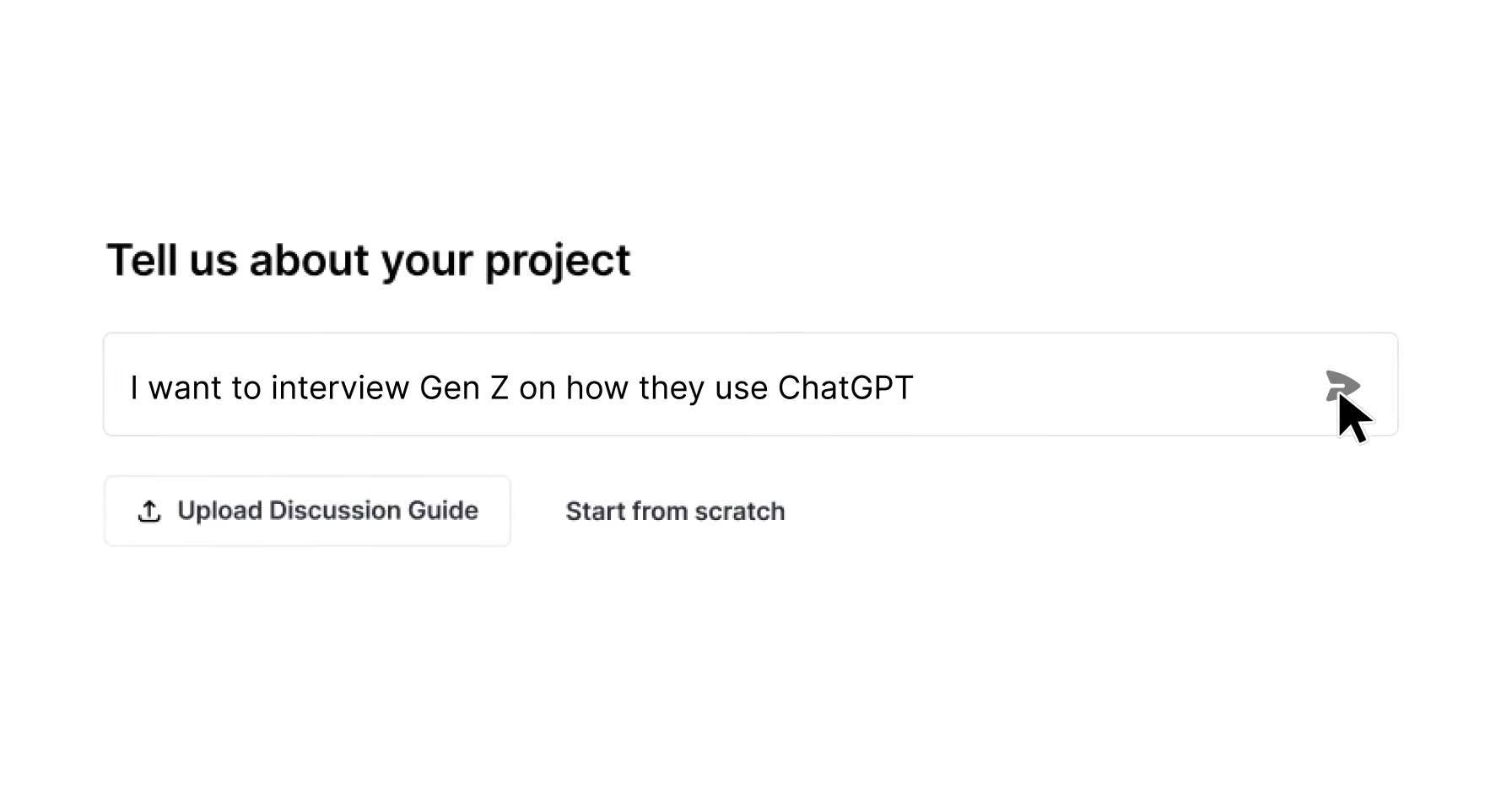
Platforms like Listen Labs layer on auto-recruiting, transcription, sentiment tagging, and insight summarization so teams jump from question to findings in hours, not weeks. The AI moderator delivers an identical protocol across every session, which removes the interviewer drift and tone inconsistency that affect human-moderated studies at scale. Every session captures video, audio, and text responses, with emotional signals analyzed in real time through Emotional Intelligence.
AI can schedule and conduct the interview, analyze the transcripts for themes, and generate quantitative insights from those interviews, all within a single platform. The Research Agent then processes all interview data to produce automated key findings, thematic analysis, and segmentation breakdowns. One researcher ran a full buying intent analysis across three user segments in under a minute.
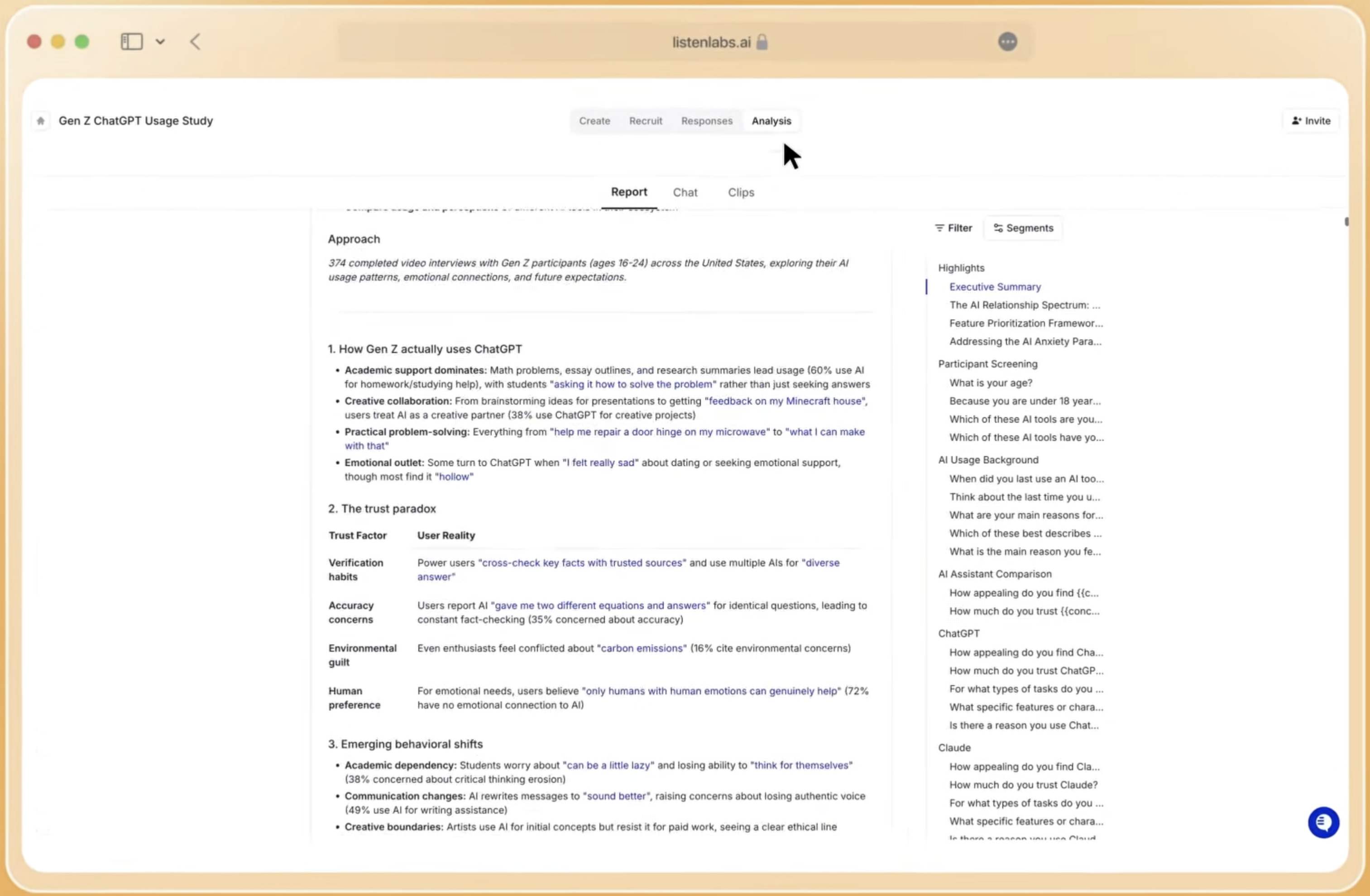
Mixed-method designs are fully supported. Concept testing studies on Listen Labs combine qualitative conversational probing with quantitative formats, including Likert scales, NPS, sliders, and MaxDiff, within a single interview session. Monadic randomization, quotas, branching logic, and version control are all configurable at the study design stage, enabling rigorous monadic or sequential monadic designs at this same scale.
Quality Controls That Keep Scaled Concept Testing Reliable
Scale without quality controls produces fast, unreliable data. Listen Labs operates three distinct layers of quality assurance that address the primary failure modes of AI-moderated research at enterprise scale.
The first layer is participant sourcing. Listen Labs draws from a global network of 30M verified respondents across 45+ countries and works only with high-quality, non-commodity panel sources. Listen Atlas, the AI orchestration layer, matches participants on behavioral and intent data rather than self-reported demographics alone, which removes the professional survey-takers that inflate commodity panels.
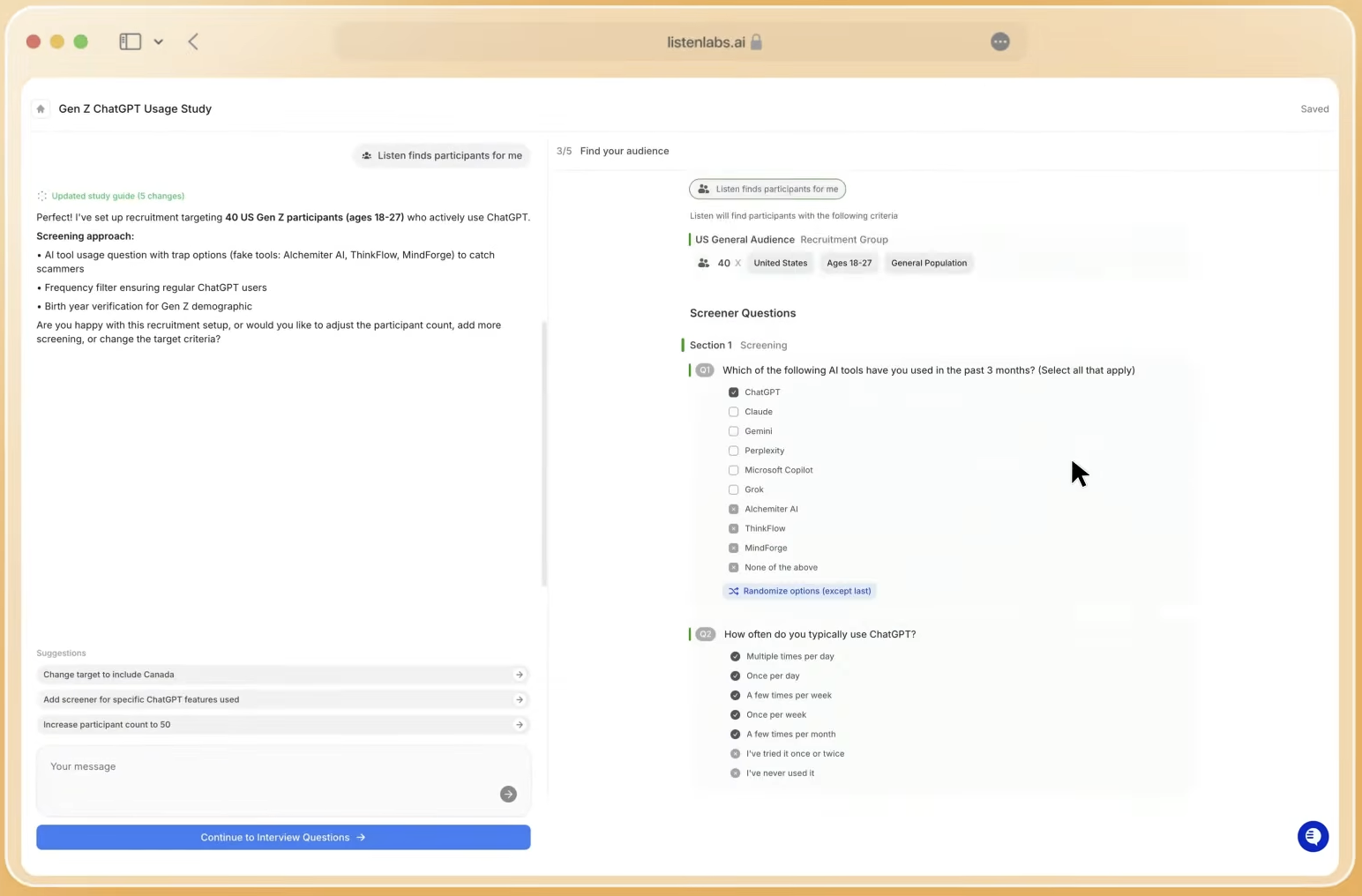
The second layer is Quality Guard, which monitors every interview in real time across video, voice, content, and device signals. It detects and eliminates fraudulent responses, low-effort answers, AI-generated scripts, and mismatched participant profiles before they enter the analysis dataset. Participants are limited to three studies per month, which prevents panel fatigue and repeat-respondent bias that distort concept scores.
The third layer is human review. A dedicated recruitment operations team adds oversight for hard-to-reach segments such as enterprise decision-makers, healthcare workers, and consumers below 1% incidence rate, and conducts quality audits that no automated system can fully match. Enterprise procurement teams now require SOC 2 certification, GDPR compliance, and source traceability as baseline standards for any AI research platform. Listen Labs holds SOC 2 Type II, GDPR, ISO 27001, ISO 27701, and ISO 42001 certifications, and customer data is never used for AI model training.
Enterprise Proof Points: Concept Testing in Practice
Microsoft needed to collect global customer stories for its 50th anniversary celebration and validate how Copilot users were experiencing the product. Using Listen Labs, the team collected hundreds of user video stories within a single day. The Director of Data Science at Microsoft noted: “Our leadership team was very thrilled at both the speed and the scale that Listen Labs enabled. I can reach out to hundreds of users at one third of the cost.”
Anthropic used Listen Labs to understand why Claude users were canceling their subscriptions. The study delivered 300+ user interviews in 48 hours, surfaced churn drivers five times faster than traditional methods, identified where former Claude users migrated, and produced a prioritized list of ten must-fix items. The Director of Product Strategy at Anthropic stated: “Listen Labs lets us understand user churn with a level of clarity and speed we have never had before.”
Procter & Gamble used Listen Labs to evaluate how men respond to new product claims before market launch. The study delivered 250+ interviews with quantified themes and verbatim proof, surfaced where claims felt exaggerated or unclear, and showed that comfort, safety, and reliability matter far more to consumers than novelty. The Analytics and Insight Leader at P&G confirmed: “Listen Labs has been a huge help.” The insights directly shaped product and brand strategy in hours rather than weeks and prevented investment in features consumers would dismiss.
Frequently Asked Questions
Can I use a general-purpose LLM to design a study guide and analyze concept testing results?
General-purpose LLMs can assist with drafting questions, but they lack the proprietary data that makes concept testing effective at enterprise scale. Listen Labs is built on tens of thousands of completed studies, which gives the platform deep understanding of which question types produce better analysis, which methodologies suit which objectives, and how to separate signal from noise. General-purpose models also cannot recruit participants, conduct interviews, or deliver statistically valid outputs. They address one step in a process that requires end-to-end infrastructure.
Is the AI interviewer really as good as a trained human researcher for concept testing?
For the vast majority of concept testing needs, AI-moderated interviews deliver comparable methodological quality at dramatically greater speed and scale. The AI probes short or interesting answers dynamically, maintains consistent protocol across every session, and removes the interviewer drift and tone inconsistency that affect human-moderated studies. Listen Labs’ in-house research team, with 50+ years of combined expertise, continuously reviews and refines the methodology. That structure frees your existing research team to focus on strategic interpretation rather than logistics.
How does Listen Labs prevent participant fraud in concept testing studies?
Three layers of protection work in combination. First, Listen Labs works only with high-quality, non-commodity panel sources, not professional survey-takers. Second, Quality Guard uses real-time AI monitoring across video, voice, content, and device signals to detect fraud, low-effort responses, AI-generated scripts, and mismatched profiles. Third, a dedicated recruitment operations team adds human review, and participants are capped at three studies per month to remove panel fatigue and repeat-respondent bias.
Will Listen Labs replace our consumer insights or UX research team?
No. Listen Labs is designed as a force multiplier for existing research teams, not a replacement. The platform enables teams to run significantly more concept testing studies with the same headcount by automating recruitment, moderation, analysis, and deliverable generation. Researchers focus on strategic decisions, stakeholder communication, and study design, the work that requires human judgment, while the platform handles the operational and analytical workload that currently creates backlogs.
What deliverables does Listen Labs produce from a concept testing study?
The Research Agent generates automated key findings and thematic analysis, consultant-quality PowerPoint slide decks in your company’s branded template, memo-style reports, video highlight reels of the most relevant interview moments, statistical charts and segment comparisons, and custom outputs based on any natural-language query. Every insight links back to the underlying verbatim response, timestamp, and participant data, which provides the full auditability that enterprise stakeholders and procurement teams require.
Conclusion: Turning Concept Testing into Continuous Intelligence
The most significant shift in concept testing is not the move from surveys to AI-moderated interviews. The real shift is the move from one-off validation projects to always-on consumer intelligence programs. When a single concept test takes four to six weeks and costs $50,000–$150,000, organizations run a handful of studies per year and accept the gaps. Qual-at-scale is ideal when research requires large sample sizes or broad geographic reach, with AI tools engaging hundreds or thousands of participants remotely and asynchronously, which makes continuous testing economically and operationally viable for the first time.
Listen Labs compresses the entire concept testing lifecycle, including study design, participant recruitment from a 30M+ verified global network, AI-moderated video interviews with emotional signal capture, automated analysis, and consultant-grade deliverables, into less than 24 hours at a third of the cost of traditional approaches. Research Agent handles the full analysis workflow from raw data to final output, including branded slide decks, highlight reels, and stat-tested segment comparisons. Mission Control then builds those findings into a persistent institutional knowledge base, so every concept test compounds the organization’s understanding of its customers rather than disappearing into a shared drive.
Enterprise teams at Microsoft, Anthropic, P&G, and Skims have already made this shift. The depth versus scale trade-off that defined concept testing for decades no longer acts as a structural constraint, it has become an infrastructure choice.
Book a demo to see how Listen Labs can turn your concept testing program from a quarterly bottleneck into a continuous competitive advantage.