
Written by: Anish Rao, Head of Growth, Listen Labs | Last updated: July 11, 2026
Key Takeaways for Modern Qualitative Analysis
- Qualitative data analysis turns interviews, open-ended surveys, and conversations into structured insights that guide product and business decisions.
- Traditional qualitative projects often run four to six weeks, while AI-powered platforms like Listen Labs complete the full cycle in about a day.
- The six-step process of study design, recruitment, data collection, coding, theme extraction, and reporting gains speed and consistency from AI automation that also captures emotional signals beyond transcripts.
- Five core analysis methods (thematic, content, narrative, discourse, and grounded theory) now scale to hundreds of interviews with AI support while preserving methodological rigor.
- Listen Labs delivers end-to-end AI-moderated research with verified participants, traceable analysis, and instant deliverables. See the platform in action.
Six-Step Qualitative Data Analysis Process with AI Support
This six-step process reflects current best practice for technology-enabled qualitative analysis. Each step contrasts the manual approach with the AI-powered equivalent.
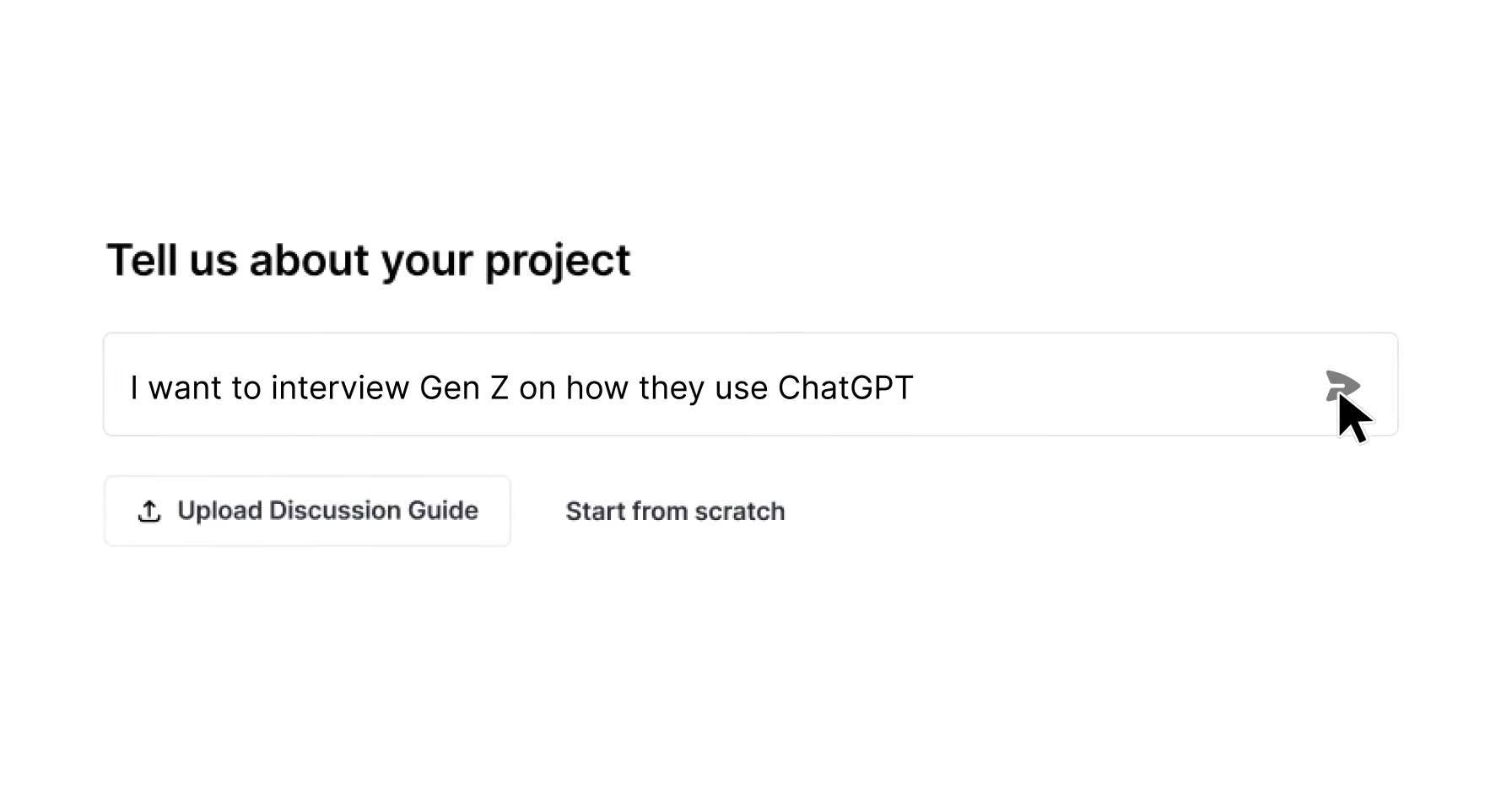
- Study Design and Data Collection Planning. Manually, a researcher drafts a discussion guide over several days and iterates with stakeholders before recruiting begins. With Listen Labs, AI-assisted co-design converts a plain-language research brief into structured objectives, screener criteria, and a probing question guide in seconds, and auto-QA flags issues before launch.
- Participant Recruitment and Screening. Traditional recruitment through panel vendors takes one to two weeks and introduces fraud risk from professional survey-takers. Listen Labs’ Listen Atlas orchestrates recruitment across a 30M-verified-respondent network spanning 45+ countries, and Quality Guard monitors video, voice, content, and device signals in real time to remove fraudulent responses before they enter the dataset.
- Data Collection and Transcription. A skilled analyst needs two to four hours per interview transcript for thorough coding and thematic analysis, scaling to 100–200 analyst hours for 50 interviews. Listen Labs conducts AI-moderated video interviews simultaneously across hundreds of participants, capturing video, audio, text, and screen recordings with automatic transcription across 100+ languages.
- Familiarization and Initial Coding. Manual familiarization requires reading and re-reading every transcript and taking notes on preliminary thoughts, observations, and analytic hunches while paying attention to nuances such as tone and emotional expressions. Listen Labs’ Research Agent handles the full analysis workflow from raw data to final output. It processes all responses consistently and highlights candidate patterns without confirmation bias.
- Theme Development and Emotional Signal Extraction. Human analysts often emphasize findings that confirm pre-existing hypotheses. Listen Labs’ Emotional Intelligence layer analyzes tone of voice, word choice, and subconscious micro-expressions, built on Ekman’s universal emotions framework, to surface emotions that transcripts alone miss. Every emotion label is traceable to the exact timestamp, verbatim quote, and reasoning behind it.
- Deliverable Generation and Stakeholder Reporting. Manual report writing can add days or weeks after analysis concludes. With AI-moderated interviews, talking to users at scale is no longer the hard part, and the challenge becomes understanding what they mean. The Research Agent generates consultant-quality slide decks, memos, charts, statistical tests, and video highlight reels in under a minute, and every insight links directly to the underlying response data.
The full cycle, from study brief to stakeholder-ready deliverables, completes in under 24 hours on Listen Labs, compared to the traditional multi-week timeline mentioned earlier.
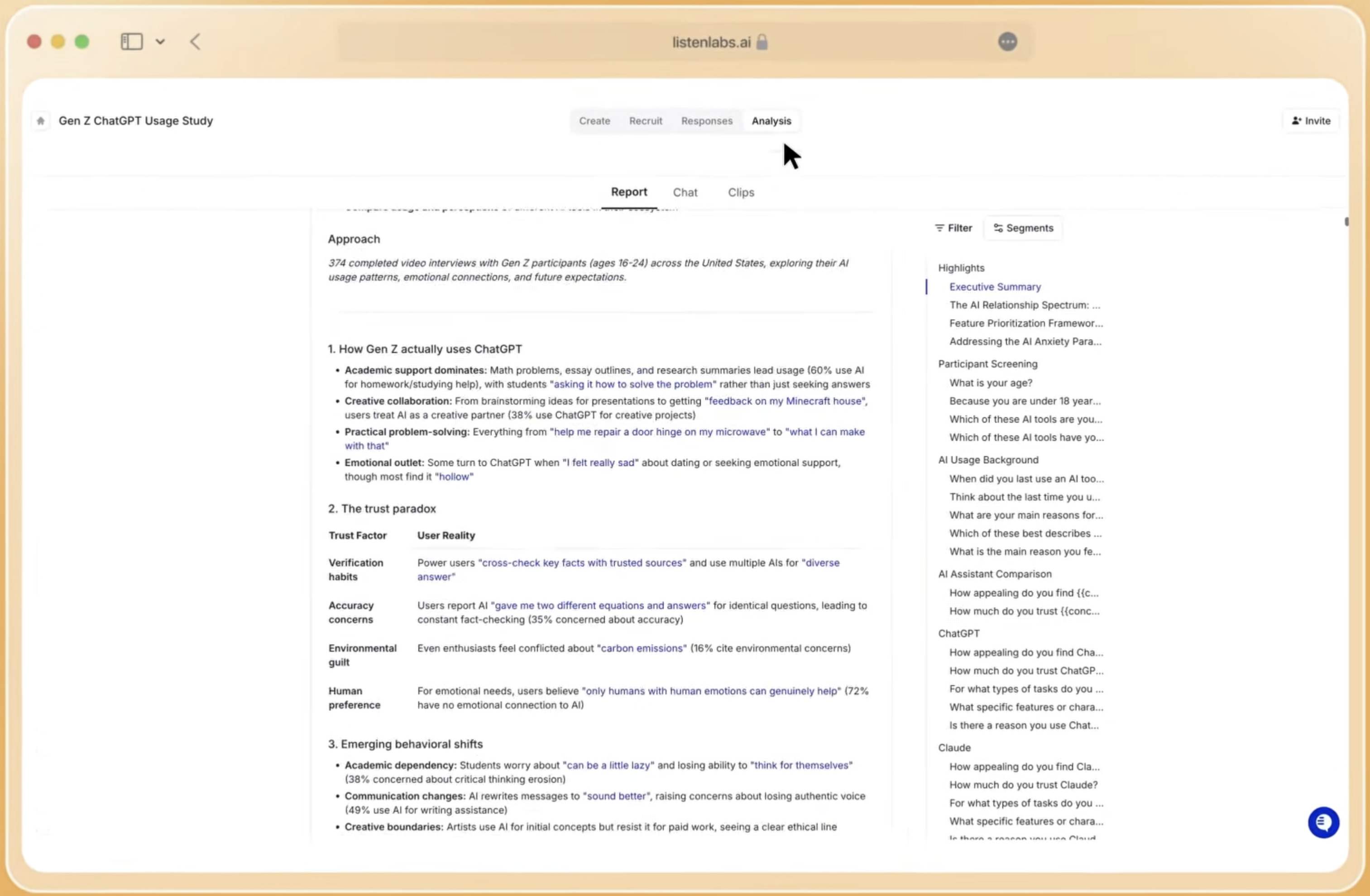
Watch the six-step process run end-to-end on a live research question.
Five Core Methods for Analyzing Qualitative Data
Five core methods structure how researchers extract meaning from qualitative datasets. Each serves a distinct analytical purpose, starting with the most widely adopted approach.
Thematic Analysis for Patterns of Meaning
Reflexive Thematic Analysis, developed by Virginia Braun and Victoria Clarke, is one of the most widely adopted approaches in qualitative research for identifying, analyzing, and reporting patterns of meaning in data such as interview transcripts and survey responses. The six phases, familiarization, coding, generating initial themes, reviewing themes, refining and naming themes, and writing up, are iterative rather than linear, and the write-up itself forms part of the analysis. AI tools can surface candidate patterns and reduce procedural workload, and transparency about AI use and critical engagement with outputs are required.
Content Analysis for Counts and Categories
Content analysis systematically categorizes and counts words, concepts, or emotional signals across a dataset to produce quantifiable findings from qualitative material. Generative AI workflows such as GATOS use text embeddings, clustering, and retrieval-augmented generation to inductively generate codebooks that approximate content analysis steps at scale. At the enterprise level, this enables frequency counts and sentiment distributions across hundreds of interviews that would be impractical to produce manually.
Narrative Analysis for Customer Stories
Narrative analysis focuses on the structure, sequence, and storytelling elements within participant accounts and examines how people construct meaning through the arc of their experience. It is particularly valuable for brand perception studies and customer journey research, where the order and framing of events shape the insight as much as the events themselves.
Discourse Analysis for Language and Context
Discourse analysis examines how language shapes meaning within specific social, cultural, or institutional contexts. Rather than treating participant statements as transparent reports of experience, it interrogates the linguistic choices, power dynamics, and contextual frames that produce those statements. This method is applied in brand research and communications testing to understand how messaging lands differently across segments and markets.
Grounded Theory for Data-Driven Models
Grounded theory builds explanatory theory inductively from the data itself, without imposing a predetermined framework. Researchers collect and analyze data simultaneously so that concepts and relationships emerge from the material. AI can analyze transcripts for themes and generate quantitative insights from qualitative interviews. This support accelerates the constant comparative process that grounded theory requires across large samples.
AI Tools for Qualitative Data Analysis in 2026
Manual qualitative coding requires four to six hours per transcript. At 100 interviews, that represents 400–600 analyst hours before a single theme is confirmed. AI analysis engines remove this bottleneck by processing patterns across large samples simultaneously.
Integrating agentic AI systems into research workflows reduces individual labor and manual rework, shortens end-to-end cycle times, and increases throughput for recurring tasks such as drafting summaries, extracting insights, and assembling reports. Agentic AI also tightens quality and risk control through more traceable workflows with logging, reviewer agents, and human oversight checkpoints, providing a mechanism for bias reduction by making processes more transparent and less dependent on individual manual judgment.
Listen Labs extends AI analysis beyond text through its Emotional Intelligence layer. Three signal streams, tone of voice, word choice, and subconscious micro-expressions, are analyzed simultaneously against Ekman’s universal emotions framework, which tracks anger, anticipation, disgust, fear, joy, sadness, trust, and surprise. Theme identification by AI may miss nuance and context, requiring human verification of outputs, so every Listen Labs emotional label links to the exact timestamp, verbatim quote, and reasoning that produced it, making the analysis fully auditable.
Enterprise teams using Listen Labs convert 100+ interviews into themes, emotional signal charts, segmentation breakdowns, and video highlight reels within the 24-hour window established earlier. Anthropic’s team ran 300+ user interviews in 48 hours and surfaced churn drivers about five times faster than their previous process. Microsoft collected global customer stories for its 50th anniversary within a single day.
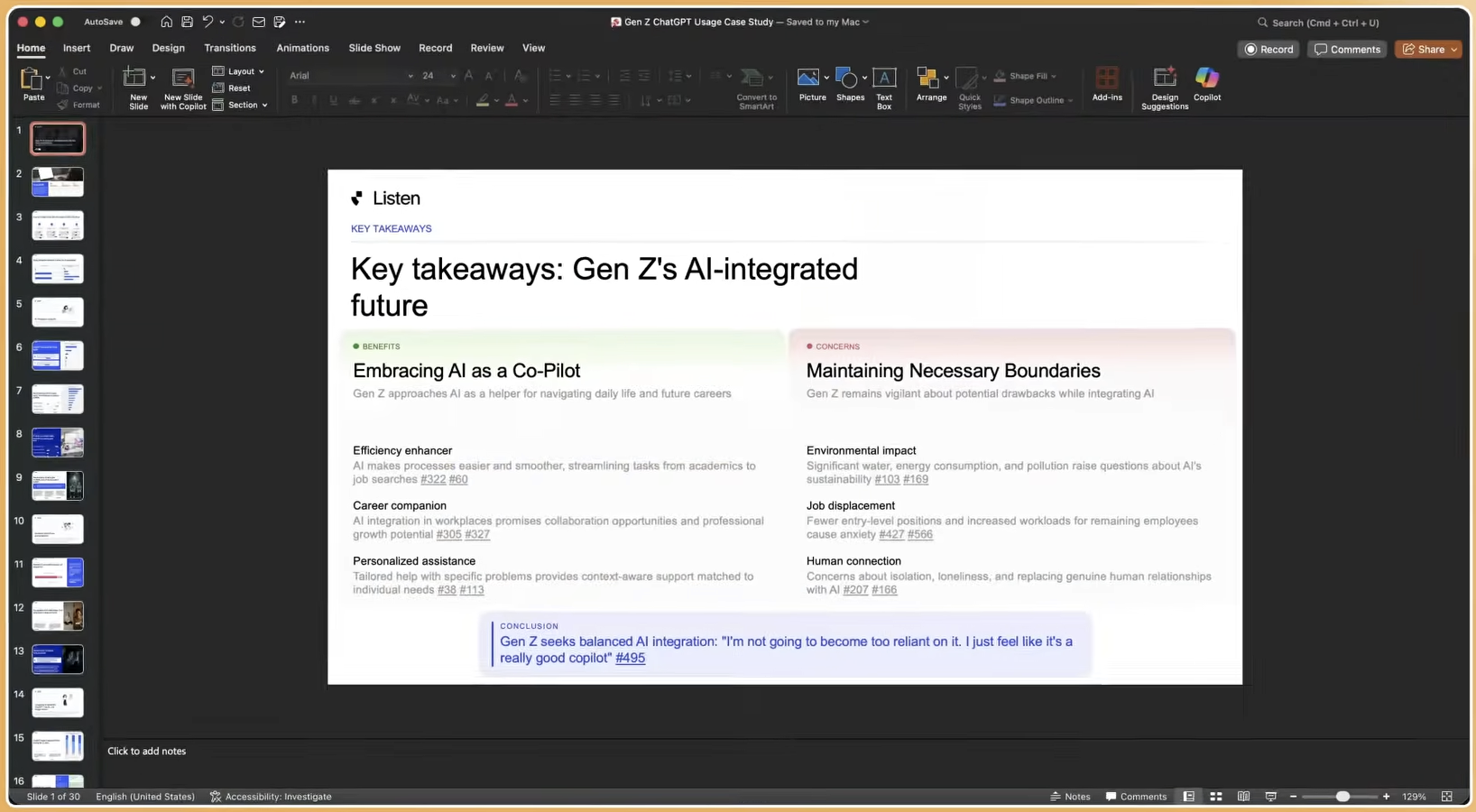
See how we process 100+ interviews in under a day.
Legacy Tools vs. Modern End-to-End AI Platforms
Legacy qualitative analysis tools such as NVivo, ATLAS.ti, and Dovetail require researchers to import transcripts collected elsewhere, apply manual coding schemes, and export findings into separate reporting tools. Each handoff introduces delay, inconsistency, and the risk of insight loss. A manual qualitative study of 25 interviews costs between $20,000 and $50,000 when including recruiting, scheduling, conducting, transcribing, and coding.
Fragmented workflows also compound participant quality problems. Because legacy tools rely on externally collected data, they inherit whatever quality issues exist in the source. Commodity panels carry significant fraud risk, with professional survey-takers optimizing for incentive payouts rather than honest responses. Bias amplification occurs when AI learns from flawed historical data, potentially systematically misinterpreting responses from certain demographics. Starting with low-quality data makes downstream analysis unreliable regardless of the tool applied to it.
Listen Labs addresses these problems across five evaluation dimensions. On research quality, purpose-built Quality Guard monitors every interview in real time and limits participants to three studies per month, which removes professional survey-takers. On speed, the full research cycle completes within the same-day window described earlier instead of four to six weeks. On cost, enterprises run studies at roughly a third of the cost of traditional approaches. On scalability, hundreds of AI-moderated interviews run simultaneously without proportional cost increases. On governance, Mission Control serves as a cross-study repository that prevents institutional knowledge from being siloed in individual reports and enables teams to query everything ever learned from customers in seconds.
Enterprise Results with Listen Labs
Listen Labs is trusted by Microsoft, Anthropic, Procter & Gamble, Skims, Robinhood, Google, Sony, Levi’s, and Nestlé. Across these engagements, research cycles that previously took weeks now compress to hours, and insight quality improves because larger, fraud-screened samples replace small convenience samples.
P&G used Listen Labs to evaluate how men respond to new product claims and delivered 250+ interviews with quantified themes and verbatim proof in hours, directly shaping product and brand strategy before market launch. Skims validated campaign direction with thousands of high-income buyers overnight and secured board-level buy-in with qualitative clarity that translated customer reactions into leadership-ready insight. Robinhood’s qualitative interviews revealed that users who view prediction markets as entertainment drive 2.4x higher weekly re-engagement, and that insight informed integration flows that boosted uptake by 30–40%.
Listen Labs maintains enterprise-grade security with 256-bit encryption and holds SOC 2 Type II, GDPR, ISO 27001, ISO 27701, and ISO 42001 certifications. Ethical AI implementation for qualitative data processing requires addressing privacy, informed consent, algorithmic bias, and data security concerns, and customer data on Listen Labs is never used for AI model training.
Frequently Asked Questions
How do modern AI platforms differ from agencies or survey tools?
Traditional research agencies deliver high-quality work but cannot scale because each study requires dedicated human moderators, analysts, and report writers, which makes cost and time prohibitive for frequent research. Survey tools scale but sacrifice depth, capturing only pre-set responses with no ability to probe or follow up. Listen Labs combines the depth of one-on-one interviews with the scale of quantitative surveys, conducting hundreds of adaptive AI-moderated conversations simultaneously and delivering consultant-quality analysis at a third of the cost of traditional agency engagements.
What are typical timelines for qualitative data analysis?
Manual qualitative analysis of 16–24 interviews typically becomes a multi-week project under traditional processes, including recruiting, scheduling, conducting, transcribing, and coding. At 50 interviews, the analyst workload described earlier becomes prohibitive for most teams. Listen Labs compresses the entire cycle, from study design through recruitment, AI-moderated interviews, analysis, and deliverable generation, to the same-day turnaround referenced above, even as sample sizes grow.
How do you ensure data quality and prevent fraud?
Listen Labs applies three layers of quality control. First, it works exclusively with high-quality, non-commodity panel sources, so professional survey-takers are excluded. Second, Quality Guard uses real-time AI monitoring across video, voice, content, and device signals to detect fraud, low-effort responses, AI-generated scripts, and mismatched profiles during every interview. Third, a dedicated recruitment operations team adds a human review layer, and participants are limited to three studies per month to prevent panel fatigue and incentive-driven responses.
What privacy and compliance standards apply?
Listen Labs holds SOC 2 Type II, GDPR, ISO 27001, ISO 27701, and ISO 42001 certifications. All data is processed with 256-bit encryption, and customer data is never used to train AI models. Enterprise SSO is supported. For organizations operating under regional data sovereignty requirements, Listen Labs’ compliance posture covers the Americas, Europe, APAC, and MEA across 45+ countries.
How can non-researchers use these tools responsibly?
Listen Labs is designed so that product managers, brand managers, and marketing leaders without formal research training can describe their goals in plain language and have the platform handle study design, recruitment, moderation, and analysis automatically. The in-house research team, with 50+ years of combined expertise, has embedded methodological guardrails into the platform so that non-researchers produce rigorous outputs without needing to understand the underlying methodology. Every insight links to the source response data, which makes outputs auditable and defensible to stakeholders.
Conclusion: Turn Qualitative Data into Decisions in Hours, Not Weeks
The six-step qualitative data analysis process of study design, recruitment, data collection, coding, theme and emotional signal extraction, and deliverable generation has historically taken weeks and hundreds of analyst hours. AI-powered platforms shorten that timeline to about a day while expanding sample sizes from dozens to hundreds of participants, reducing confirmation bias through objective pattern detection, and capturing emotional signals that transcripts alone miss.
Listen Labs executes the full cycle end-to-end by recruiting verified participants from a 30M-person global network, conducting AI-moderated interviews in 100+ languages, analyzing responses with traceable AI, and generating slide decks, memos, charts, and video highlight reels in under a minute. Enterprise teams at Microsoft, Anthropic, P&G, Skims, and Robinhood have replaced weeks of fragmented manual work with same-day insight at a fraction of the cost.
Schedule a demo and see how Listen Labs turns 100+ customer interviews into actionable insights at the speed described above.