Written by: Anish Rao, Head of Growth, Listen Labs | Last updated: June 23, 2026
Key Takeaways
Traditional qualitative research is slow and resource-heavy. A single study can take weeks of recruiting, scheduling, interviewing, and manual analysis. AI-moderated interviews compress that cycle to hours while keeping the depth and rigor teams expect.
- Traditional qualitative research cycles take 4–6 weeks (or up to six months in large enterprises), while AI-moderated interviews can deliver rigorous insights in under 24 hours.
- This 13-step process covers the full lifecycle, from defining objectives and sampling strategy to thematic analysis and final deliverables, with AI removing manual bottlenecks at each stage.
- Core steps include purposive sampling, building and piloting a semi-structured guide, obtaining consent, running adaptive interviews with real-time probing, and applying structured coding and theme identification.
- AI tools improve quality through dynamic follow-ups, real-time fraud detection, automated transcription across 100+ languages, and scalable analysis across hundreds of participants.
- Listen Labs accelerates this entire workflow with AI-moderated interviews and Research Agent automation, so you can see a complete study run from first question to final deliverable in a single day. See how the platform works.
The 13-Step Qualitative Research Interview Process
- Define the research objective. State one primary question the study must answer. Vague objectives produce vague findings. Write the objective as a single sentence, such as “Understand why first-year subscribers cancel within 90 days.” Everything downstream, including sampling, guide design, and analysis, flows from this anchor.
- Choose the interview format. Semi-structured interviews are the most common format. They use a guide of key questions with flexibility to explore emergent topics. Alternatives include fully structured interviews for consistent comparability, unstructured interviews for exploratory discovery, diary studies, or task-based usability sessions. Match the format to the objective before building anything else.
- Design the sampling strategy. Qualitative studies use purposive sampling, such as maximum variation, homogeneous, theoretical, or snowball, rather than random selection, with sample sizes chosen to reach data saturation. For AI-moderated studies at scale, sample sizes of 100–500+ are achievable without proportional cost increases, adding statistical confidence to qualitative depth.
- Recruit the right participants. Recruitment is the most common source of delay and quality failure in traditional research. Screener criteria must map directly to the research objective. Listen Labs’ 30M-respondent global panel spans 45+ countries and 100+ languages. Rather than relying on self-reported demographics, the platform sources participants through behavioral and intent matching, so the people you interview actually exhibit the behaviors you are studying. Real-time fraud detection monitors every session to catch professional survey-takers, AI-generated responses, and mismatched profiles before they contaminate your data.
- Build the interview guide. Structure the guide in three sections: opening rapport questions, core topic questions, and closing probes. Use open-ended questions throughout. Keep the guide to a manageable number of questions for the session. Semi-structured interviews rely on preparation, active listening, open-ended questions, and rapport-building to generate rich data.
- Pilot the guide. Run 2–3 test interviews before full fieldwork. Pilots surface ambiguous questions, timing issues, and missing probes. Listen Labs’ Auto-QA flags structural issues in the study guide before launch, shrinking the iteration cycle from days to minutes.
- Obtain informed consent and handle ethics. Ethical compliance requires informed consent, privacy protections, careful handling of sensitive data, alignment with the study’s stated purpose, and protocols for de-identification and secure storage. Collect consent digitally before each session. Document data handling procedures before fieldwork begins.
- Conduct the interviews. Start with neutral, low-stakes questions to build rapport, then move to core topics. Avoid leading questions and maintain consistent pacing. AI can schedule and conduct the interview, analyze transcripts for themes, and generate quantitative insights from qualitative responses, running hundreds of sessions simultaneously without moderator fatigue or scheduling conflicts.
- Apply probing techniques in real time. Probes deepen responses beyond surface-level answers. Use elaboration probes such as “Tell me more about that,” clarification probes such as “What do you mean by X?,” and contrast probes such as “How does that compare to before?” Listen Labs’ AI moderator applies smart follow-ups dynamically, probing short or ambiguous answers the way a trained human interviewer would.
- Record, transcribe, and quality-check. Every session requires a verbatim transcript for analysis. Manual transcription introduces delay and error. Listen Labs captures video, audio, and text simultaneously, with automated transcription across 100+ languages and real-time quality monitoring that flags low-effort responses, AI-generated scripts, and mismatched participant profiles.
- Code the data. Assign descriptive codes to transcript segments. Use inductive coding, where codes emerge from data, or deductive coding, where codes map to a pre-existing framework. Reproducibility improves when researchers preserve transcripts, use codebooks or structured thematic procedures such as Braun and Clarke’s six-phase thematic analysis, and support independent review of the analysis.
- Identify themes and patterns. Group codes into higher-order themes. Look for frequency, intensity, and contradiction. Research Agent handles the full analysis workflow from raw data to final output, identifying patterns across hundreds of responses without human confirmation bias, then enabling natural-language queries for custom segmentation and comparison. Every insight links back to the verbatim quote and timestamp that generated it, creating an automatic audit trail.
- Deliver findings and recommendations. Translate themes into actionable recommendations tied to the original research objective. Deliverables should include an executive summary, supporting verbatim quotes, and a clear “so what” for each finding. Listen Labs’ Research Agent generates slide decks, memos, video highlight reels, and statistical charts in under a minute.
Want to see these 13 steps in action? Schedule a walkthrough to watch a live study run from design to deliverable in a single day.
Interview Guide Template You Can Use Today
A structured interview guide keeps moderators consistent and makes data comparable across sessions. Use the following layout as a starting point for any semi-structured qualitative research interview.
Section 1 — Opening (5 minutes): Introduce the session purpose without revealing hypotheses. Confirm consent and recording permission. Ask a warm-up question such as “Walk me through a typical [relevant behavior] in your week.”
Section 2 — Core Questions (30–35 minutes): Prepare 6–8 open-ended questions organized by topic area. For example, “Describe the last time you experienced [problem area]. What happened? What did you do next?” Include one contrast question per topic, such as “How does that compare to how you handled it a year ago?”
Section 3 — Probing Bank (reference during session): Elaboration: “Can you say more about that?” Clarification: “When you say [X], what do you mean specifically?” Example: “Can you give me a concrete example?” Emotion: “How did that make you feel?”
Section 4 — Closing (5 minutes): Ask “Is there anything important about this topic we have not covered?” Thank the participant and explain next steps for data use.
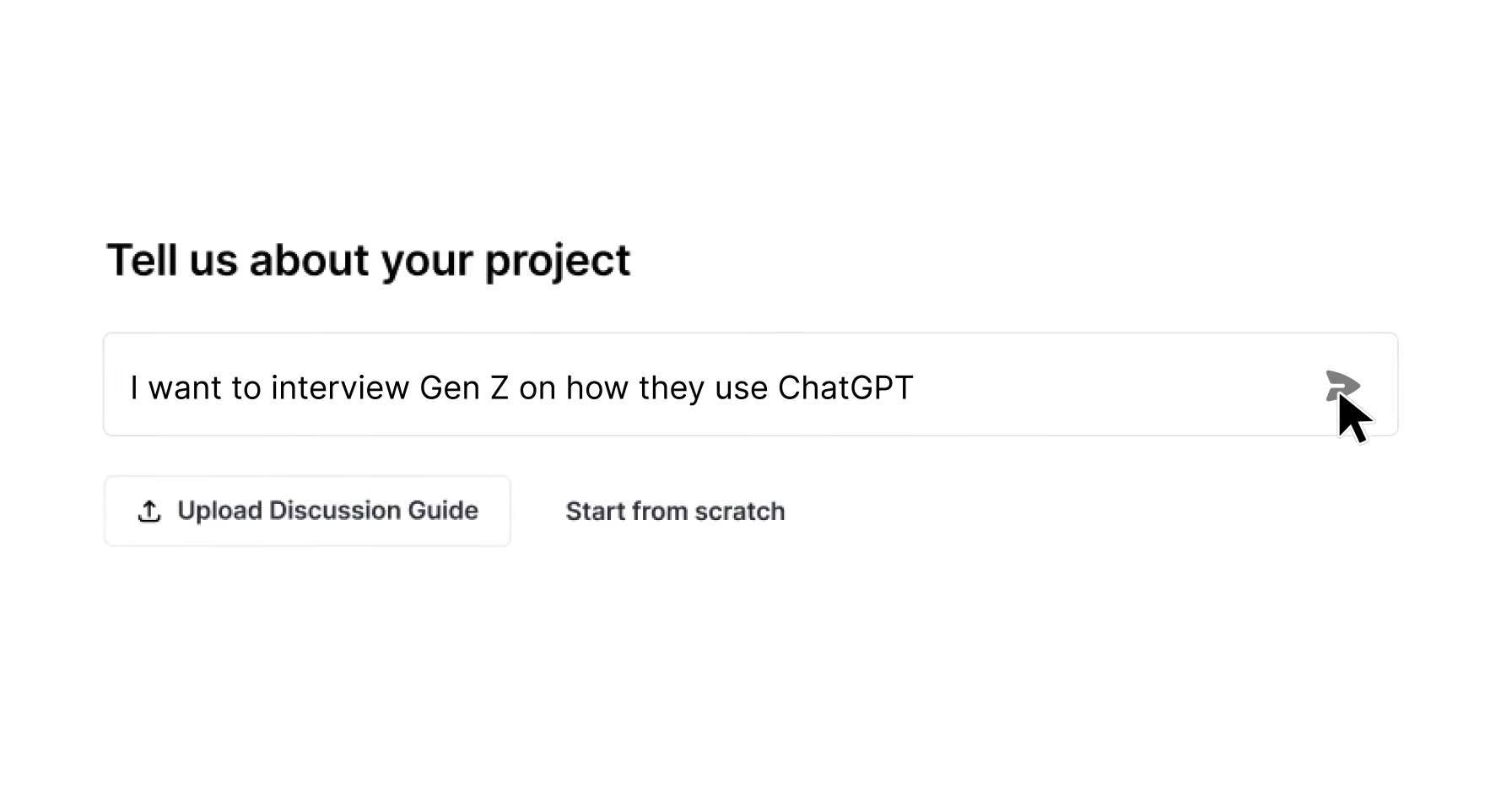
In Listen Labs, this template structure lives directly in the study design interface. AI-assisted co-design drafts objectives, questions, and probing context from a plain-language description of the research goal, then Auto-QA reviews the guide before launch.
Probing Techniques That Surface Deeper Insights
Strong probing separates qualitative interviews from surveys. A survey captures what a participant selects, while a probe uncovers what they actually mean.
Elaboration probes invite participants to expand on an initial response, such as “Tell me more about that experience.” Use these when an answer is accurate but thin.
Clarification probes resolve ambiguity, such as “You mentioned it felt ‘off’—what specifically felt that way?” These probes matter most when participants use vague or evaluative language.
Contrast probes reveal change and comparison, such as “How does that compare to how you used to handle it?” Contrast surfaces the before-and-after logic that explains behavior shifts. Beyond verbal techniques, one of the most powerful probes requires no words at all: silence.
Silence as a probe is underused. A two-second pause after an answer often produces the most candid follow-up a participant offers. Human moderators often fill silence prematurely. Listen Labs’ AI moderator holds the pause deliberately.
Emotional signal probes go beyond verbal content. Listen Labs’ Emotional Intelligence layer analyzes tone of voice, word choice, and micro-expressions simultaneously, built on Ekman’s universal emotions framework. When a participant rates a concept positively but displays hesitation or confusion at the timestamp level, the system flags the discrepancy, capturing what people feel as well as what they say.
Thematic Analysis Best Practices for Large Studies
Thematic analysis is the most widely used method for interpreting qualitative interview data. When executed rigorously, it produces findings that are credible, transferable, and reproducible.
Use a structured six-phase approach: familiarization with data, generating initial codes, searching for themes, reviewing themes, defining and naming themes, and producing the final report. Qualitative research ensures trustworthiness at larger scales through credibility via triangulation and member checking, transferability via rich contextual descriptions, dependability via comprehensive audit trails, and confirmability via reflexive documentation linking data to interpretations.
Maintain an audit trail. Document every analytical decision, including why a code was created, how codes were grouped into themes, and what data was excluded and why. Maintaining data quality at scale requires consistency in the interview guide, clear sampling logic, systematic recording and transcription, and an audit trail documenting how themes were derived from raw interviews.
Separate signal from noise at scale. When analyzing 100+ interviews manually, coding often introduces inconsistency and confirmation bias. Listen Labs’ Research Agent processes all interview data objectively, drawing on proprietary patterns from tens of thousands of completed studies to distinguish genuine themes from noise. The Research Agent approach described in Step 12 keeps analysis consistent across large samples.
AI-Powered Interviews: From Weeks to Hours
With AI-moderated interviews, talking to users at scale is no longer the hard part; the challenge is understanding what they mean. Listen Labs addresses both the conversation and the interpretation.
Research quality: Listen Labs’ AI moderator conducts personalized, adaptive conversations with dynamic follow-up questions, mirroring the probing techniques a trained human interviewer would use. Adaptive questioning only works when the participant is genuine and engaged. Quality Guard therefore monitors every session in real time across video, voice, content, and device signals, catching fraud and low-effort responses as they happen. To prevent panel fatigue, participant frequency is capped at three studies per month, which removes professional survey-takers who treat research as a side hustle. The result is data quality that matches, and in consistency often exceeds, what under-resourced human moderation teams deliver.
Speed: Platforms like Listen Labs layer on auto-recruiting, transcription, sentiment tagging, and insight summarization so teams move from question to findings in hours, not weeks. The Microsoft team collected global customer video stories for the company’s 50th anniversary within a single day. Anthropic surfaced churn drivers from 300+ user interviews in 48 hours.
Cost: Listen Labs replaces multiple vendors, including recruitment, scheduling, moderation, transcription, analysis, and report writing, with a single platform. This consolidation delivers results at roughly a third of the cost of traditional research approaches.
Scalability: With qual-at-scale, the old trade-off between depth and scale no longer applies. Hundreds of AI-moderated interviews run simultaneously, each personalized and adaptive, producing both the statistical confidence of large samples and the nuanced insight of one-on-one conversations. That scale and automation naturally raise a question about security and control.
Governance: Listen Labs holds SOC 2 Type II, GDPR, ISO 27001, ISO 27701, and ISO 42001 certifications. Customer data is never used for AI model training. Enterprise SSO is supported. Every emotional signal, theme, and finding is traceable to the underlying response data, so teams maintain clear oversight even at global scale.
Ready to compress your research timeline from weeks to hours? Book a demo to see the platform in action.
Frequently Asked Questions
How do you ensure participant quality in AI-moderated qualitative interviews?
Listen Labs uses three layers of quality control. First, the platform works exclusively with high-quality, non-commodity panel sources, avoiding professional survey-takers. Second, the Quality Guard system described earlier monitors every session in real time across video, voice, content, and device signals, detecting fraud, low-effort responses, AI-generated scripts, and mismatched profiles. Third, a dedicated recruitment operations team adds a human review layer, and participants are limited to three studies per month to prevent panel fatigue. This combination produces verified, high-quality data across general population and niche audiences alike.
Is an AI moderator as effective as a trained human researcher?
For the vast majority of qualitative research objectives, Listen Labs’ AI moderator delivers comparable depth to a skilled human interviewer and greater consistency across large samples. The AI applies smart follow-up probes dynamically, holds silence to elicit candid responses, and avoids moderator fatigue or interviewer bias across session 1 versus session 300. Listen Labs’ in-house research team, with 50+ years of combined expertise, continuously reviews and refines the methodology. The platform is designed to multiply the output of existing research teams, not replace their strategic judgment.
How does Listen Labs handle data security and privacy compliance?
Listen Labs maintains enterprise-grade security with 256-bit encryption and holds SOC 2 Type II, GDPR, ISO 27001, ISO 27701, and ISO 42001 certifications. Customer data is never used to train AI models. Enterprise SSO is supported. Informed consent is collected digitally before every session, and participant data is handled in accordance with the study’s stated purpose and applicable privacy regulations across all 45+ countries the platform serves.
What types of qualitative research studies can Listen Labs support?
Listen Labs supports the full range of qualitative study types used in market research, including concept and prototype testing, usability testing with screen sharing, creative and ad testing, brand perception studies, consumer journey mapping, multi-market segmentation studies, pricing research, and survey open-end analysis. The platform handles both one-off studies and ongoing continuous research programs. Study styles include free-flowing in-depth interviews, semi-structured interviews, diary studies, ethnography, and task-based UX testing.
Can I bring my own participants instead of using the Listen Labs panel?
Yes. Listen Labs supports self-recruitment, allowing organizations to study their own customer or user base at a reduced credit cost. Organizations can also bring their own panel provider. For hard-to-reach segments such as enterprise decision-makers, healthcare workers, engineers, or audiences below 1% incidence rate, the dedicated recruitment operations team partners with niche communities and specialized networks to source the right participants, even when targeting criteria are extremely narrow.
What deliverables does Listen Labs produce at the end of a study?
The Research Agent generates a full suite of stakeholder-ready deliverables automatically, including automated key findings and thematic analysis, consultant-quality PowerPoint slide decks, memo-style reports, video highlight reels, statistical charts and comparisons, segmentation breakdowns by demographics or custom cohorts, and custom reports based on any natural-language query. Every deliverable links back to the underlying verbatim data and timestamps, maintaining a complete audit trail. Deliverables are available in under a minute after fieldwork closes.
Schedule a live walkthrough to see how Listen Labs handles every step of this process, from participant recruitment through final deliverable, without a single manual handoff.