Written by: Anish Rao, Head of Growth, Listen Labs | Last updated: June 21, 2026
Key Takeaways for Running Reliable Focus Groups
- Most focus groups fail because execution drifts from the textbook, which creates slow, biased, or disconnected findings.
- Clear objectives, tight screening, structured discussion guides, and confident moderation reduce bias and groupthink.
- Strong analysis treats interactions as core data and combines themes with how participants influence one another.
- Teams should track decision impact and consistency across groups, not just participation or saturation metrics.
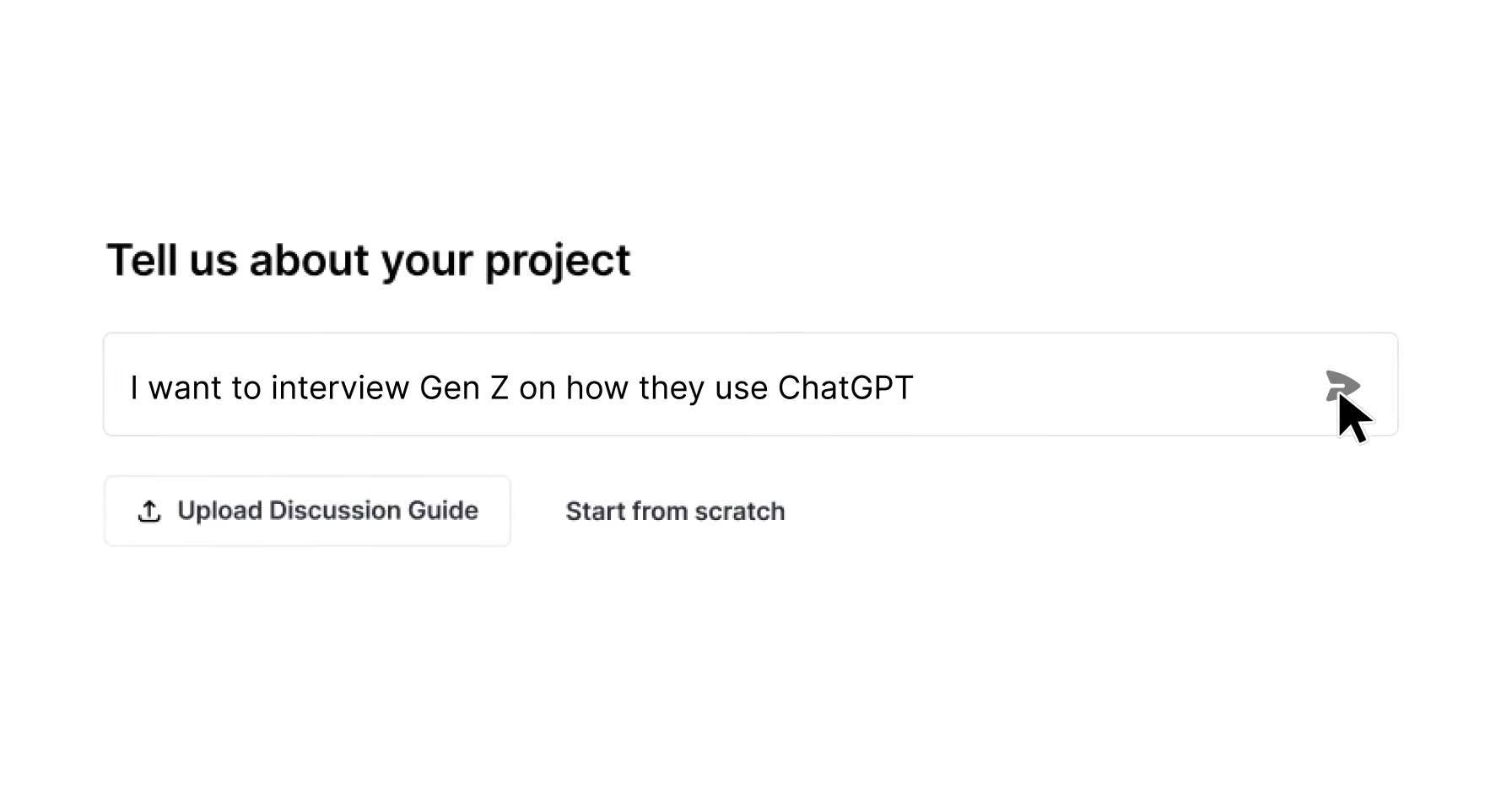
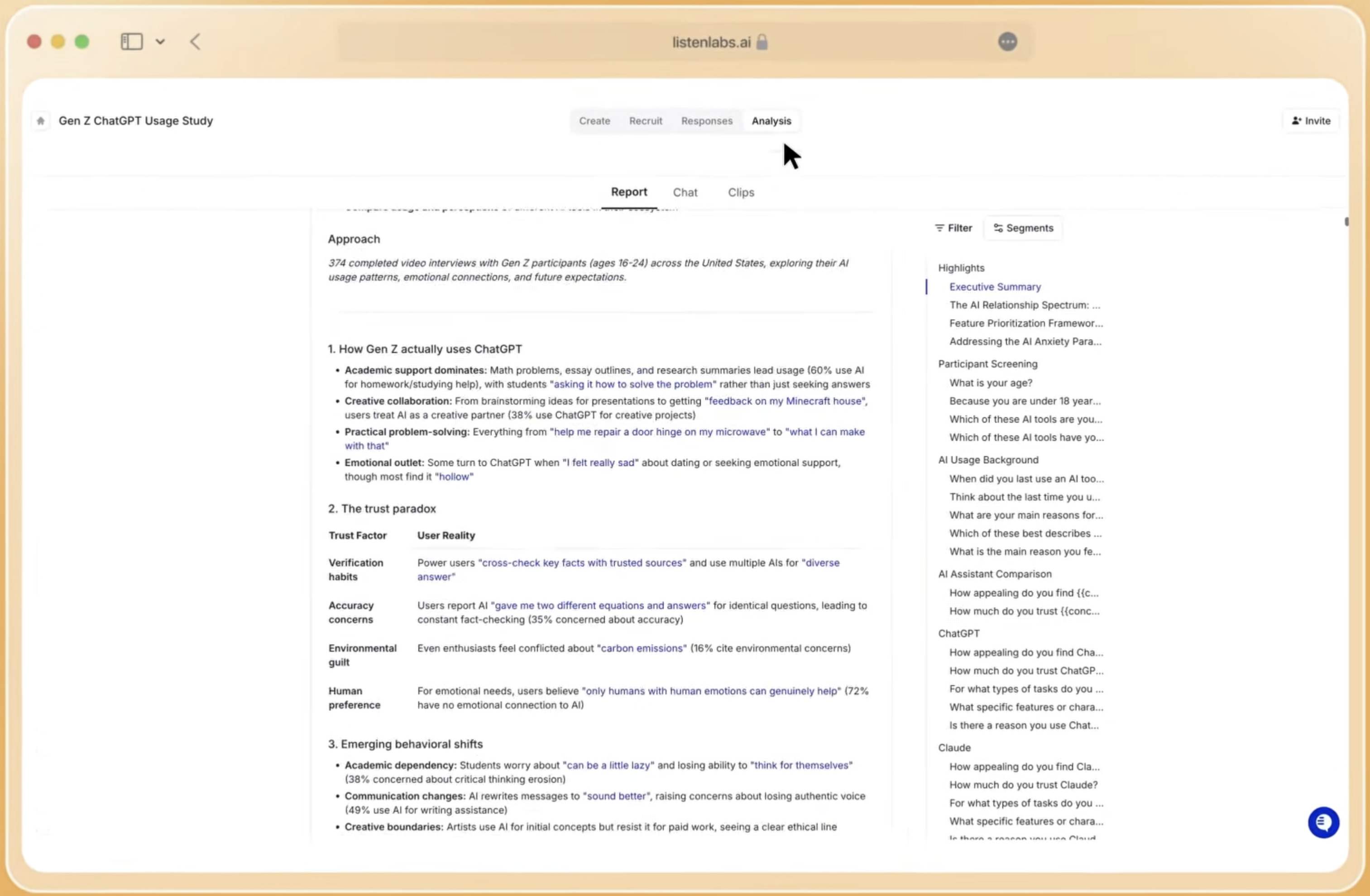
- Listen Labs compresses the entire focus-group cycle to under 24 hours with AI-moderated interviews; Book a demo to see how.
Step 1: Set Clear Research Objectives
Inputs: Business question, stakeholder briefs, prior research. Stakeholders: Insights lead, product or brand owner, research operations. Timeline: Two to three days.
Krueger and Casey recommend stating the research purpose in one sentence and deriving three to five specific, open-ended research questions from it to guide participant selection, question design, and analysis. Vague objectives such as “understand customer sentiment” produce vague findings. Precise objectives such as “identify the top three barriers preventing trial among lapsed users aged 35–54” produce specific, actionable findings.
The main trade-off at this stage is depth versus scale. Focus groups deliver rich interaction data from small samples, typically eight to twelve participants per group. They do not support statistical validation. If the business question requires a confidence interval, use a survey. If it requires understanding why a behavior occurs, use a focus group or individual interview.
Budget and speed also intersect here. A traditional 90-minute focus group session costs $4,000–$12,000, and a complete study from objective-setting through final report typically takes six to seven weeks.
Step 2: Define the Sample Frame and Screen Participants
Inputs: Research objectives, target persona definitions, incidence rate estimate. Stakeholders: Insights lead, recruitment operations. Timeline: Three to seven days for standard audiences, longer for low-incidence segments.
The sample frame defines who qualifies, and the screener enforces that definition. Participation bias occurs when the people who choose to take part are systematically different from those who do not, which skews data in predictable directions. A screener that is too permissive admits unqualified participants. A screener that is too restrictive produces a sample that does not represent the target population.
Follow three core screener design principles. Use behavioral and situational questions rather than self-reported identity labels. Avoid telegraphing the “right” answer. Include disqualifying responses for each criterion. Recruit participants who are both qualified and comfortable sharing in a group setting by screening for clear answers, willingness to elaborate, and active engagement during the screening call, not only demographic fit.
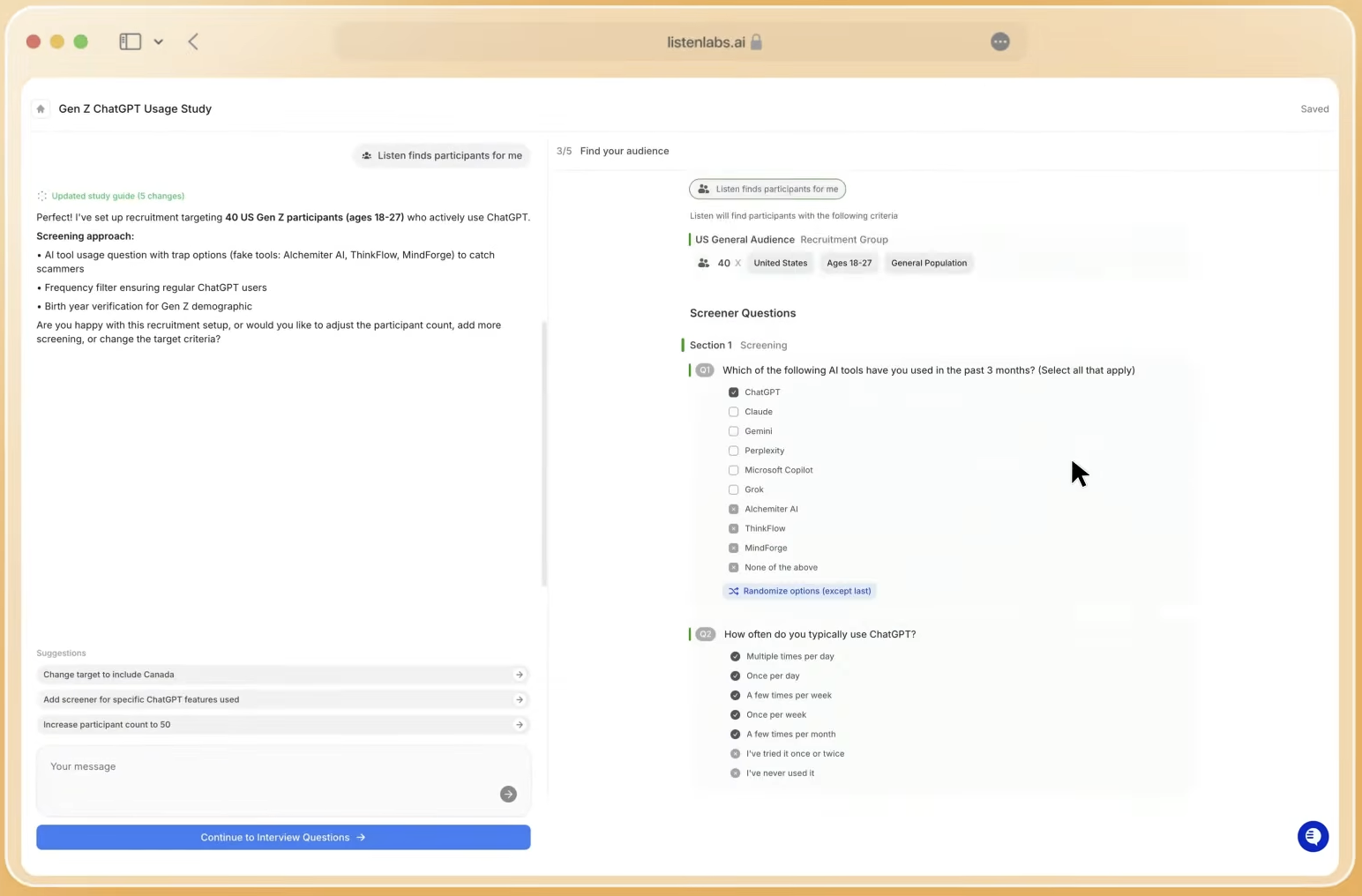
Incidence rate directly affects cost and timeline. Studies targeting audiences below 1% incidence, such as enterprise decision-makers or specialized healthcare workers, require dedicated recruitment operations and longer lead times. To address both scarcity and quality risk, recruit from identity-verified panels with deep profiling across industry, role, seniority, company size, and geography, and combine this with multi-mode outreach and real-time quota monitoring. This approach reduces participation bias more reliably than simply increasing sample size.
Step 3: Create a Structured Discussion Guide
Inputs: Research objectives, screener, stakeholder priorities. Stakeholders: Moderator, insights lead, client or product owner. Timeline: Two to four days including pilot test.
Krueger’s standard applied focus-group question sequence moves through five stages: opening questions (easy and factual), introductory questions (introduce the general topic), transition questions (bridge to specific issues), key questions (three to five questions directly addressing research objectives), and ending questions (summary or direct question tied to purpose).
A ready-to-use template follows this structure.
Opening (5 min): “Please introduce yourself and tell us one thing you bought recently that surprised you.” Purpose: normalize speaking, with no analysis value.
Introductory (5–10 min): “When you think about [category], what comes to mind first?” Purpose: surface unprompted associations.
Transition (10 min): “Walk me through the last time you [relevant behavior]. What triggered it?” Purpose: anchor discussion in real experience rather than hypotheticals.
Key questions (45–60 min): Use three to five questions directly tied to objectives. Example: “What made you choose [X] over alternatives?” Probing language includes “Tell me more about that,” “What does that look like for you,” and “Does anyone see this differently.” Avoid “why” questions, which prompt rationalization rather than description.
Ending (5 min): Ask “Of everything we’ve discussed today, what is most important?” Then ask “Is there anything significant we have not covered?”
Pilot test the discussion guide before the first group, ideally with people similar to target participants, and revise after pilot testing and between early groups as fieldwork reveals improvements. Strong questions start broad then narrow, use open-ended prompts, avoid leading or yes/no formats, and use “think back” prompts instead of predictions.
Step 4: Moderate the Session with Intentional Group Management
Inputs: Finalized discussion guide, participant roster, recording setup. Stakeholders: Lead moderator, co-moderator or note-taker, observers. Timeline: 60–90 minutes per session.
The moderator’s primary function is managing group dynamics without contaminating the data. Social desirability bias occurs when participants tailor answers to align with what they think the moderator or group wants to hear, and trained moderators reduce this by adopting neutral positions and using techniques that encourage candid responses.
Tuckman’s model of group development describes five stages: forming, storming, norming, performing, and adjourning. This framework helps moderators recognize where the group sits and guide it toward the performing stage, where participants share more freely and build on one another’s ideas. Practical techniques include directing questions to quieter participants by name, using brief written exercises before open discussion to prevent dominant voices from anchoring the group, explicitly inviting dissent with prompts such as “Does anyone have a different experience,” and using strategic silence instead of filling pauses immediately.
For virtual sessions, keep group size to four to six participants rather than the eight to ten typical for in-person groups, limit sessions to 60–90 minutes, and call participants by name to manage airtime and prevent overlap. These moderation challenges, including managing dominant voices, preventing overlap, and maintaining engagement across time zones, push some research teams toward AI-moderated individual interviews that remove group dynamics while preserving qualitative depth. Book a demo with Listen Labs to see how this approach handles these dynamics at scale.
Step 5: Capture Data During and After the Session
Inputs: Session recording consent, note-taking protocol, discussion guide. Stakeholders: Moderator, co-moderator, analysis team. Timeline: Capture begins during session, with initial synthesis within 30 minutes of close.
The “hot debrief” is a structured post-session conversation between moderator and co-moderator conducted within 30 minutes of each focus group ending, organized around the discussion guide to capture first impressions, notable quotes, emerging themes, and surprises. Teams often skip this step and later regret it because memory degrades quickly.
Record video and audio with participant consent. Assign a dedicated note-taker whose sole job is timestamped observation, not participation management. Capture verbatim quotes, non-verbal reactions, and moments of disagreement or strong consensus separately from general notes. These distinctions matter during analysis.
Step 6: Analyze Themes and Interactions
Inputs: Recordings, transcripts, hot debrief notes, discussion guide. Stakeholders: Analysis lead, insights team. Timeline: Three to seven days for manual analysis.
Focus group analysis combines deductive coding, which applies pre-defined codes from research questions, and inductive coding, which allows codes to emerge from data patterns, with interaction among participants treated as essential rather than analyzing individual opinions in isolation. The interaction is the data. A participant who changes position after hearing a peer represents a different data point than one who holds firm.
Thematic saturation, which is the point at which additional groups produce no new themes, typically occurs after three to five groups for a homogeneous population. Heterogeneous populations or multiple market segments require more groups. Treat early-group findings as provisional until subsequent sessions confirm them.
Step 7: Deliver Actionable Insights to Decision-Makers
Inputs: Coded themes, verbatim quotes, interaction patterns, research objectives. Stakeholders: Insights lead, business stakeholders, decision-makers. Timeline: Two to five days for reporting.
Findings that do not connect to a decision remain observations, not insights. Every deliverable should map each finding to a specific business question and recommend a concrete next step. Structure reports around implications, not just themes, and lead with the most decision-relevant finding, not the most interesting one.
Downstream impact measurement starts here. Document which decisions the research informed, what action followed, and what outcome resulted. This record creates the evidence base for future research investment.
When Focus Groups Produce Misleading Data
Focus groups produce unreliable data under predictable conditions, and recognizing early-warning signals allows teams to intervene or choose a different method.
Groupthink: In Asch’s Conformity Line Study, participants went along with an obviously wrong majority approximately 32% of the time, and 75% conformed at least once. In focus groups, this appears as rapid consensus, absence of dissent, and participants echoing the first strong opinion expressed. Mitigation: use written pre-discussion exercises, explicitly invite disagreement, and run individual interviews in parallel for comparison.
Social desirability bias: Focus groups primarily engage System 2 analytical thinking, while most real-world purchasing decisions are driven by System 1 automatic processes, which leads participants to provide post-hoc rationalizations that do not reflect actual motives. Participants describe their ideal selves, not their actual behavior. Mitigation: anchor questions in past behavior with prompts such as “Tell me about the last time you…” rather than hypotheticals such as “What would you do if…”.
Dominant-voice effects: A single outspoken participant can dominate discussion and mute quieter perspectives. An early-warning signal appears when one participant speaks more than 40% of total group time. Mitigation: direct questions by name to quieter participants and use round-robin formats for key questions.
Screening failures: Focus group research should not be used when participants have authority relationships over one another, because group dynamics are likely to produce conformity rather than open communication. Screening failures also include participants who gamed the screener to qualify. Mitigation: include behavioral verification questions in the screener and use identity-verified panels.
When to avoid focus groups entirely: Focus groups are less suitable when the goal is individual task performance, statistical validation, or simple yes/no answers, and interviews, usability tests, or surveys fit better in those cases. For sensitive topics where participants are unlikely to speak freely in a group, individual interviews consistently produce more honest data.
Choosing Between In-Person and Virtual Focus Groups
Format choice affects logistics, engagement quality, and the type of data collected, and neither format works best in every situation.
In-person groups give moderators direct access to body language, physical product interaction, and environmental control. They work well when the study involves tactile stimuli such as packaging or physical prototypes, or when the population feels less comfortable with video technology. The logistical overhead is higher because teams must handle facility booking, travel, and scheduling across participants in a single geography.
Virtual focus groups are often preferable for convenience, speed, and geographic reach, while in-person groups may be better when physical product interaction or in-room observation is central to the study. Virtual formats expand the recruitable population significantly and reduce per-session cost. Synchronous online focus groups can reduce the risk of groupthink because physical distance between participants makes it less likely that dominant voices will shape the responses of others.
Virtual formats introduce their own failure modes. Time-zone scheduling difficulties, conversational lag, and shorter text-based responses can strip away tone and nuance compared with in-person formats. Mitigate these issues by limiting group size, using familiar platforms, and sending multi-channel reminders to reduce no-shows.
Measuring Success of a Focus Group Program
Three metrics determine whether a focus group program is working, and each one covers a different stage of the research process. Participation rate measures recruitment efficiency at the front end, and consistent no-show rates above 20% signal screener or incentive problems that keep qualified participants from attending. Finding consistency across groups measures analytical reliability during fieldwork, and if each group produces entirely different themes, the sample frame or discussion guide needs revision before teams can trust the patterns. Downstream decision impact is the most important metric and the least tracked, because it measures what happens after the research concludes, so document which business decisions used focus group findings and whether those decisions produced the intended outcome.
Thematic saturation functions as a process metric, not a success metric. Reaching saturation after three groups means the methodology is working, but it does not prove the findings are correct. Cross-validate qualitative themes with behavioral data or quantitative surveys before treating them as definitive.
Advanced Ways to Expand a Mature Focus Group Program
Teams that have mastered the seven-step process above can extend their programs in three related directions that deepen value and coverage. Always-on research programs replace periodic studies with continuous participant panels that provide rolling feedback on product changes, messaging tests, and market shifts, which removes the lag between business question and insight. Global multi-market studies require localized discussion guides, market-specific moderators, and analysis frameworks that distinguish genuine cross-market differences from translation artifacts, which keeps global comparisons honest. Behavioral and emotional signal integration addresses the fundamental limitation of self-report data, because what participants say and what they feel represent different data points, and layering tone-of-voice analysis, facial expression coding, and behavioral observation onto traditional focus group transcripts surfaces signals that verbal responses consistently miss.
Frequently Asked Questions
How long does a focus group study take from start to finish?
A traditional focus group study, from objective-setting through final report, takes around six to seven weeks. Recruitment for standard audiences takes several business days, and low-incidence or hard-to-reach segments take longer. Analysis and reporting require additional time after fieldwork closes. Enterprise procurement and scheduling overhead can extend this further. AI-moderated interview platforms like Listen Labs compress the same research cycle to under 24 hours by running recruitment, moderation, and analysis in parallel.
How many focus groups do I need to run?
The standard guidance is to run groups until thematic saturation, which is the point at which additional sessions produce no new themes. For a homogeneous target population with a focused research question, three to five groups are typically sufficient. Studies covering multiple distinct segments, geographic markets, or product categories require more groups. Running fewer than three groups for any single segment produces findings that are too fragile to support confident decisions.
How do I handle privacy and compliance requirements?
Participants must provide informed consent before recording begins, and consent should cover how recordings will be stored, who will access them, and how long the team will retain them. For studies involving EU residents, GDPR applies regardless of where the research organization is headquartered. Studies involving health information may trigger additional regulatory requirements. Ensure your recruitment and data storage infrastructure holds relevant certifications, and treat SOC 2, ISO 27001, and GDPR compliance as the baseline for enterprise research operations. Listen Labs maintains SOC 2 Type II, GDPR, ISO 27001, ISO 27701, and ISO 42001 certifications, and customer data is never used for AI model training.
How do I reach hard-to-find or low-incidence audiences?
Standard consumer panels do not reliably reach enterprise decision-makers, specialized healthcare workers, engineers, or consumers with very specific behavioral profiles. As noted in the screening section, low-incidence audiences require specialized recruitment approaches beyond standard consumer panels. Listen Labs’ dedicated recruitment ops team sources audiences below 1% incidence rate and handles the logistics of niche segment recruitment directly.
When should I repeat a focus group study, and when should I retire it?
Repeat a study when a significant market, product, or competitive change has occurred since the last round of fieldwork, when prior findings produced a decision that needs validation, or when an always-on research program requires periodic refresh. Retire a study design when the research question has been answered with sufficient confidence, when the business context has shifted enough to make prior findings irrelevant, or when the same themes have recurred across multiple rounds without producing new actionable findings. Tracking downstream decision impact, which links findings to actions and outcomes, provides the most reliable basis for deciding whether continued investment in a particular research question is justified.
Focus groups remain a legitimate and powerful tool when teams execute them with discipline. The failure modes are well-documented and largely preventable. The steps above provide a repeatable process for producing findings that hold up under scrutiny and drive real decisions. For teams facing research backlogs, tight timelines, or the need to run studies at a scale that traditional focus groups cannot support, AI-moderated individual interviews offer a faster, more scalable alternative without sacrificing qualitative depth, and they deliver the same consultant-quality insights in a fraction of the time traditional methods require.
Book a demo to see how Listen Labs delivers consultant-quality qualitative research in under 24 hours.