
Written by: Anish Rao, Head of Growth, Listen Labs | Last updated: June 18, 2026
Key Takeaways for 2026 Research Teams
- Point solutions speed up individual literature review tasks but force researchers to juggle multiple platforms, data handoffs, and manual quality checks.
- Integrated platforms like Listen Labs compress the full research lifecycle from study design to synthesized output into under 24 hours.
- Key evaluation criteria include research speed, source quality, methodological flexibility, analysis transparency, and total operational burden.
- Listen Labs combines AI-moderated interviews, global multilingual recruitment, emotional intelligence analysis, and automated consultant-grade deliverables.
- Researchers ready to replace fragmented workflows with a single, compliant, end-to-end solution should book a demo with Listen Labs.
How This Comparison Evaluates AI Research Assistants
Choosing the right AI research assistant requires evaluating tools across dimensions that matter to research teams, such as speed, rigor, and operational effort. Nine criteria structure the comparison throughout this article, each tied to a common pain point in research workflows. Research speed measures the time from initial query to a synthesized, usable output. Depth versus scale assesses whether a tool sacrifices nuance for volume or the reverse. Source quality controls examine how each option verifies, filters, or weights its underlying data.
Methodological flexibility covers support for systematic review protocols, adaptive questioning, and mixed-methods designs. Global and multilingual reach determines whether a tool can operate across languages and geographies without manual translation work. Analysis transparency and bias mitigation evaluate whether outputs are traceable to primary sources and whether the tool surfaces its own limitations. Reporting and deliverable generation effort measures how much manual work remains after the tool completes its analysis. Data security and compliance covers enterprise-grade certifications and data handling policies. Total operational burden accounts for the cumulative time, expertise, and toolchain management required to produce a final deliverable across the workflow stages that follow.
Study or Query Setup: From Question to Structured Plan
Elicit allows researchers to enter a research question in natural language and immediately searches its index of more than 138 million papers. This minimal setup comes with constraints that affect systematic review workflows. The free Basic plan limits users to two automated reports per month and two table columns at a time. These limits push researchers who run multi-variable comparisons toward the paid subscription at $49 per user per month billed annually.
SciSpace indexes metadata of 200 million+ papers and supports folder-based multi-PDF synthesis queries. Its free plan restricts literature review columns and export options, including Zotero CSV and BibTeX formats, which affects downstream citation management.
ResearchRabbit requires no formal query setup. Researchers seed it with one or more papers and the platform surfaces related work. This approach works well for exploratory discovery but fits poorly with structured systematic reviews that depend on defined inclusion criteria and reproducible search strategies.
Jenni AI functions primarily as an AI writing assistant with citation support rather than a discovery or extraction engine. It sits downstream of literature identification and helps with drafting and revising text once sources are already selected.
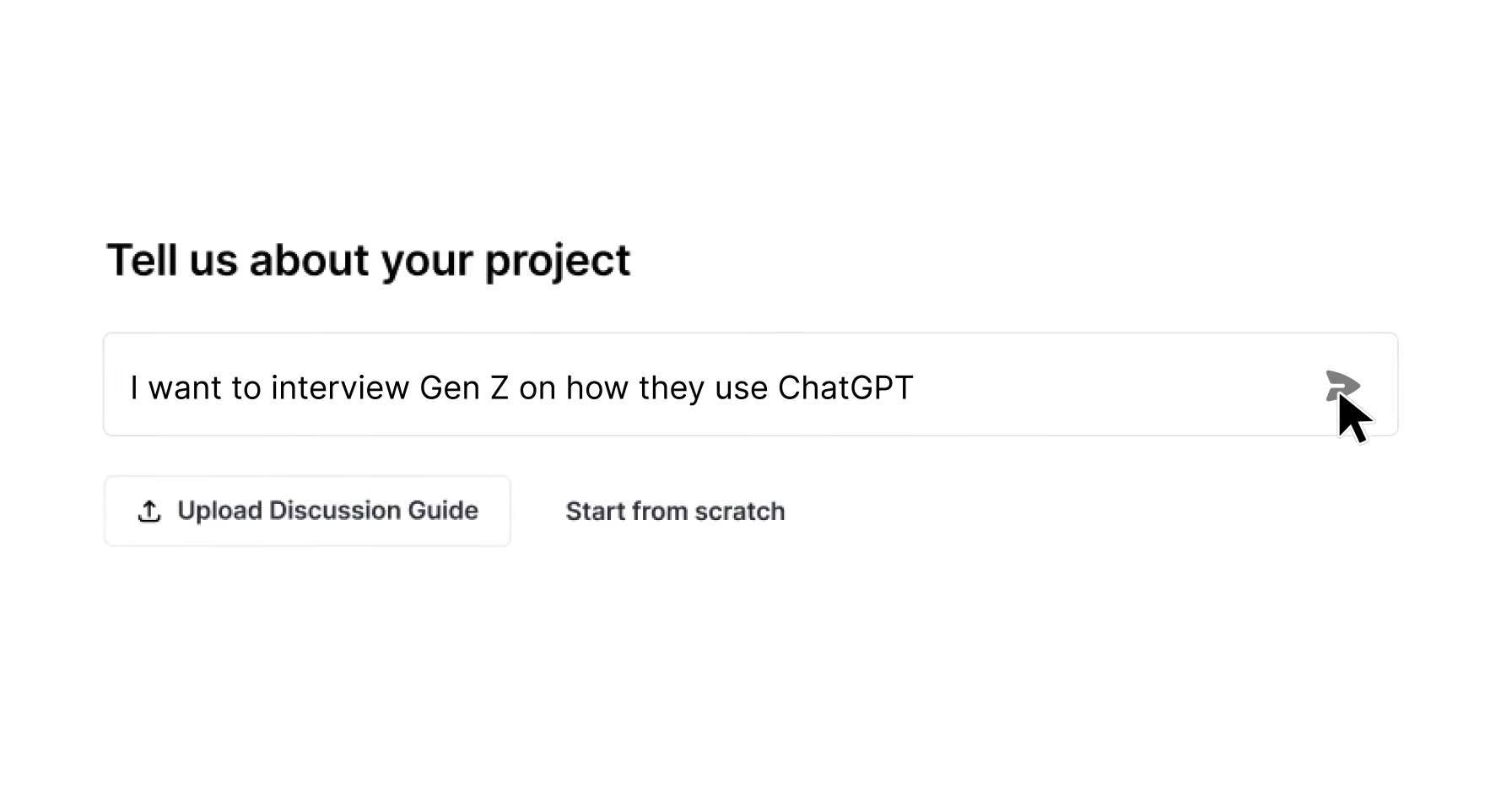
Listen Labs approaches setup as a co-design step. Researchers describe their objectives in natural language and the platform’s AI creates a structured study guide in seconds. That guide includes objectives, questions, and probing context. The platform supports free-flowing in-depth interviews, semi-structured formats, survey-style questionnaires, and task-based designs. Advanced logic such as branching, skip logic, quotas, and version control is available from the start.
Source Recruitment or Paper Discovery Across Tools
Once a study is designed, the next bottleneck is finding the right sources, whether published papers or human participants. This stage highlights the sharpest contrast between point solutions and integrated platforms.
Consensus operates as an AI academic search engine over a database of 220 million or more peer-reviewed papers and features a Consensus Meter that visualizes whether the literature leans yes, no, mixed, or possibly on a given research question. Semantic Scholar indexes over 200 million academic papers and remains entirely free, providing TLDR summaries, highly influential citation signals, recommendations, folders, and alerts. Both tools support broad paper discovery but do not recruit human sources or primary data contributors.
R Discovery offers a database of more than 250 million papers alongside a literature review generator. Its Chat PDF feature is limited to single documents and caps individual files at 100 pages and 20 MB, which constrains large-document workflows.
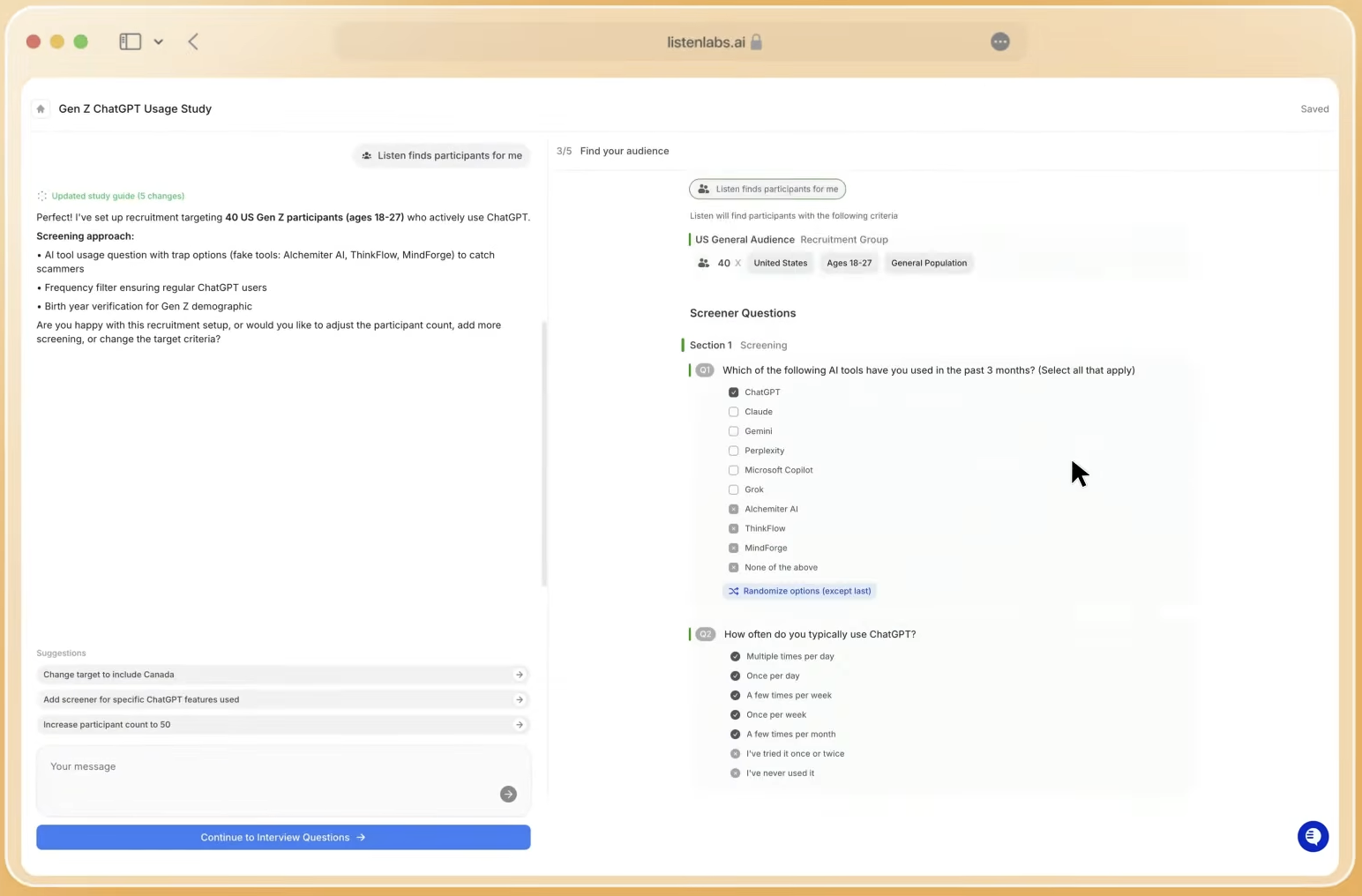
Listen Labs addresses source recruitment through Listen Atlas, a global panel of 30 million verified respondents across more than 45 countries and over 100 languages. An AI orchestration layer automatically matches and bids on participants across multiple panel partners and the proprietary database. A dedicated recruitment operations team handles hard-to-reach segments such as enterprise decision-makers, healthcare workers, and audiences below one percent incidence rate. Researchers can also bring their own participants at reduced cost.
Moderation or Extraction: How Each Tool Collects Data
Elicit’s structured extraction tables allow researchers to compare methods, variables, outcomes, and study details across papers in a consistent format. This workflow ranks among the more rigorous extraction options available in point solutions. The free tier’s two-column limit, however, constrains complex multi-variable comparisons and pushes heavier users toward paid plans.
Paperpal provides source links to exact passages in uploaded PDFs and supports simultaneous chat with up to 10 PDFs alongside a literature matrix generator. SciSpace supplies section-level citations within its PDF chat interface. Both platforms focus on extraction from existing documents. Neither conducts adaptive follow-up questioning, so insights remain limited to what the uploaded documents contain.
Listen Labs conducts AI-moderated video interviews with dynamic follow-up questions. The AI probes deeper on short or ambiguous answers and adapts in real time to participant responses. It captures video, audio, text, and screen recordings within a single session. Mixed-methods formats such as Likert scales, NPS, sliders, grids, and MaxDiff can run alongside open-ended questions in the same interview.
Data Quality and Fraud Controls in Practice
Point solutions for literature review depend on the quality and coverage of their academic databases. King’s College London guidance on AI in systematic reviews states that reviewers must understand any bias or weakness introduced by AI tools and remain responsible for the review’s integrity. A 2025 evaluation found that Elicit AI did not search with high enough sensitivity to replace traditional literature searching in evidence syntheses. Its high precision still makes it useful for preliminary searches and as an adjunct to comprehensive database searching.
Listen Labs addresses data quality through Quality Guard, a three-layer system. The platform works exclusively with high-quality, non-commodity panel sources. Quality Guard applies real-time AI monitoring across video, voice, content, and device signals to detect fraud, low-effort responses, AI-generated scripts, and mismatched profiles. Participants are limited to three studies per month to reduce professional survey-taker behavior. A dedicated recruitment operations team adds a human review layer on top of automated controls.
Qualitative Depth and Quantitative Support Together
Academic point solutions are predominantly designed for quantitative literature aggregation. Consensus visualizes directional consensus across studies. Elicit extracts structured data fields. Semantic Scholar surfaces citation influence metrics. These tools do not capture the adaptive, open-ended qualitative depth that emerges from conversational research with human participants.
Listen Labs combines qualitative interview depth with quantitative scale. Hundreds of AI-moderated interviews can run simultaneously, each personalized and adaptive. The platform’s Emotional Intelligence feature analyzes tone of voice, word choice, and subconscious micro-expressions to surface nuanced emotions that transcripts alone miss. Built on Ekman’s universal emotions framework, every emotion is quantified per question and concept. Each label is traceable to the exact timestamp, verbatim quote, and reasoning behind it. This capability extends across more than 50 languages.
Analysis Workflow and Hallucination Risks
Hallucination risk appears across all AI-assisted research workflows. A 2025 systematic review in Research Synthesis Methods concluded that current evidence does not support generative AI use in evidence synthesis without human involvement or oversight, although generative AI can assist humans for many tasks other than searching. Thesify’s 2026 academic AI tool assessment recommends verifying every AI-generated summary against the primary source and never citing the AI summary itself.
NotebookLM performs source-grounded synthesis of uploaded documents with responses limited to the user-provided source base rather than external web content. This design reduces hallucination risk within the uploaded corpus but does not remove it. Paperpal and SciSpace provide citation-level traceability that supports verification workflows and helps researchers audit AI outputs.
Listen Labs’ Research Agent processes interview data objectively, identifying patterns, themes, and insights across hundreds of responses. The platform separates signal from noise using proprietary data from tens of thousands of studies. Every finding is traceable to the underlying interview data, participant segment, and verbatim response. This audit trail supports evidence standards similar to those used in systematic review protocols.
Deliverable Creation Speed and Effort
Deliverable creation often becomes the slowest part of AI-assisted research workflows. Point solutions require researchers to export data, manually compile findings across tools, and write synthesis sections independently. A recommended 2026 AI research workflow stages tools by task, using Consensus or Semantic Scholar for discovery, Litmaps for citation mapping, Elicit for structured extraction, and a separate writing tool for section-level feedback. Each handoff adds time and introduces quality risk.
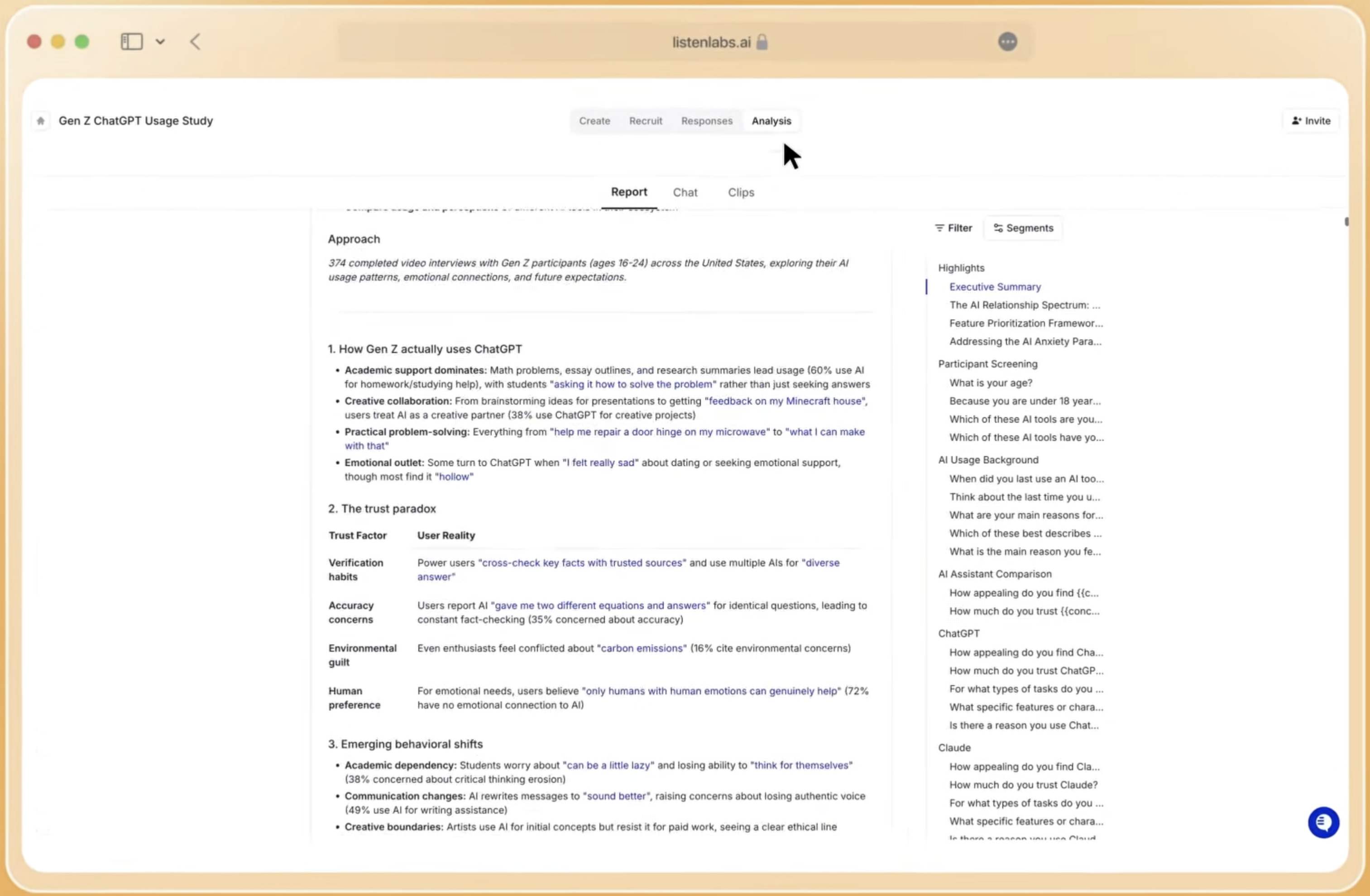
Listen Labs generates deliverables automatically. The Research Agent produces consultant-quality slide decks, memo-style reports, video highlight reels, statistical charts, segmentation breakdowns, and custom reports based on natural-language queries, often in under a minute. The full research cycle from study design to final deliverable completes in under 24 hours, which reduces both calendar time and hands-on effort.
Cross-Study Knowledge Management With Mission Control
Most point solutions do not maintain institutional memory across projects. Researchers using Elicit, SciSpace, or ResearchRabbit start each new review from scratch. These tools offer limited support for querying findings from previous work or tracking how a field has evolved across multiple studies conducted by the same team.
Listen Labs’ Mission Control serves as the organization’s source of truth for everything learned across all studies. Each completed study grows the knowledge base and becomes searchable. Teams can run cross-study queries, track trends over time, and build institutional knowledge. Researchers retrieve answers from past work in seconds without digging through archived reports.
Best-Fit Use Cases for Point Solutions and Listen Labs
PhD candidates conducting exploratory literature reviews on a limited budget gain the most from the free tiers of Semantic Scholar, ResearchRabbit, and Inciteful for discovery and citation mapping, combined with Elicit’s Basic plan for structured extraction. Georgetown University warns against relying on a single AI tool for literature searching, since important material can be missed when mapping academic conversations.
Systematic review teams with compliance requirements need tools that support transparent, reproducible workflows. The 2025 Cochrane, Campbell Collaboration, JBI, and Collaboration for Environmental Evidence position statement provides practical guidance for evidence authors on when and how to use AI in evidence synthesis without compromising quality or trust. These teams require human oversight at every stage and should treat AI tools as adjuncts rather than replacements for systematic search protocols.
Research labs needing multilingual primary data collection, enterprise R&D groups running continuous insight programs, and organizations requiring consultant-grade synthesis from thousands of sources are best served by Listen Labs. Its global reach, verified panel, and end-to-end automation remove much of the fragmentation that point solutions impose.
Operational and Long-Term Considerations for Research Leaders
Point solution workflows require researchers to develop proficiency across multiple platforms, manage data exports between tools, and invest significant time in manual synthesis. Thesify’s 2026 assessment framework evaluates tools on source traceability, reliability in reducing citation errors, support for defined research functions, clear workflow value at specific project stages, and genuinely usable free tiers without paywalled essentials. Free tiers across leading tools impose meaningful constraints: Elicit’s Basic plan allows only two automated reports per month, Consensus caps free users at three Deep Searches per month, and Litmaps restricts free users to two maps and 100 articles per map.
Listen Labs is designed for teams scaling from single studies to continuous research programs. Enterprise SSO, GDPR, SOC 2, ISO 27001, ISO 27701, and ISO 42001 compliance address the security and regulatory requirements that institutional research environments impose. The subscription model replaces multiple vendor relationships with a single contract, which reduces procurement overhead and lowers inter-tool data handling risks.
Risks, Limitations, and Common Misconceptions
Shallow outputs remain a risk with any AI tool that prioritizes speed over depth. Preliminary evidence shows GPT-4 can rival human performance for certain review tasks under specific conditions, but substantial caution is warranted when LLMs conduct systematic reviews without human oversight. Current evidence does not support the assumption that faster tools automatically produce better research.
Hidden data-cleaning complexity often appears in point solution workflows when researchers discover that extracted fields contain inconsistencies, missing values, or misattributed citations. These issues require manual correction before synthesis can proceed. Overestimating automation accuracy leads to under-verification of AI-generated summaries, which introduces errors into final outputs. The three principles of Verify, Disclose, and Refine in Thesify’s 2026 workflow guide recommend verifying every AI-generated summary against primary sources, disclosing AI use per institutional and journal policies, and using AI to improve structure and clarity rather than to outsource core reasoning.
For primary research involving human participants, the belief that AI moderation always produces lower-quality data than human moderation is not consistently supported. Listen Labs’ AI interviewer applies consistent probing logic across every participant. This consistency reduces interviewer variability, which often affects human-moderated studies at scale.
Decision Framework: Criteria-Based Checklist
The nine evaluation criteria discussed earlier, from research speed and source quality to compliance and operational burden, converge into two clear profiles. The following checklist translates those criteria into practical decision points for research teams.
Choose point solutions if your budget is limited and free tiers cover your volume requirements. This profile also fits when your workflow focuses on paper discovery, citation mapping, or PDF extraction, and when you are conducting an exploratory review rather than a systematic one. Point solutions work best when you have time to manage multi-tool workflows and manual synthesis and when your institution does not require enterprise-grade security certifications.
Choose Listen Labs if you need primary data from human participants rather than published literature. This need usually comes with related requirements such as multilingual reach, compressed timelines, and automated reporting. Organizations that fit this profile often require enterprise-grade compliance, run continuous research programs instead of one-off studies, and value cross-study knowledge management and institutional memory built directly into the platform.
Frequently Asked Questions
What is the difference between free and paid AI research tools in 2026, and are free tiers sufficient for serious research?
Free tiers across leading point solutions impose meaningful constraints that affect systematic and large-scale reviews, as outlined in the operational considerations section. For exploratory or small-scale reviews, free tiers are workable. For systematic reviews, multi-variable extraction, or continuous research programs, paid tiers or integrated platforms become necessary. Listen Labs operates on an enterprise subscription model designed for organizations running multiple studies at scale, with credits varying based on audience difficulty.
How significant is hallucination risk when using AI tools for literature reviews, and how do researchers mitigate it?
Hallucination risk is real and documented across AI-assisted research workflows. Current evidence does not support generative AI use in evidence synthesis without human involvement or oversight. Mitigation requires verifying every AI-generated summary against the primary source, never citing an AI summary directly, and disclosing AI use according to institutional and journal policies. Tools that provide citation-level traceability, linking every claim to a specific passage in a specific paper, reduce but do not eliminate this risk. Listen Labs mitigates hallucination risk in primary research by grounding every finding in traceable interview data, with each theme, emotion label, and insight linked to the exact timestamp, verbatim quote, and participant segment from which it was derived.
How long does it take to set up and run a study using an integrated platform versus assembling point solutions?
Assembling a point solution workflow for a literature review, including selecting tools, learning interfaces, running searches, exporting data, cleaning extraction tables, and writing synthesis, typically requires days to weeks depending on the scope of the review. Listen Labs compresses the entire research lifecycle to under 24 hours. AI-assisted study design generates a structured guide in seconds. Participant recruitment from a large verified panel begins immediately. AI-moderated interviews run in parallel across all participants. Analysis and deliverable generation complete automatically, which lowers the total operational burden compared with managing a multi-tool workflow.
Does Listen Labs support multilingual research, and how does it handle translation and transcription?
Listen Labs supports more than 100 languages for conducting interviews, with automatic translation and transcription across supported languages. The platform spans over 45 countries across the Americas, Europe, APAC, and MEA. Emotional Intelligence analysis is available across more than 50 languages. These capabilities make Listen Labs suitable for multi-market research programs that require consistent methodology and comparable outputs across geographies without manual translation work.
How does Listen Labs handle data privacy and enterprise security requirements?
Listen Labs maintains enterprise-grade security with 256-bit encryption, and customer data is never used for AI model training. The platform holds SOC 2 Type II, GDPR, ISO 27001, ISO 27701, and ISO 42001 certifications and supports enterprise SSO. These certifications address the compliance requirements of Fortune 500 enterprises, academic institutions, and regulated industries such as healthcare and financial services. Organizations with strict data governance requirements can conduct research on the platform without exposing participant data to third-party AI training pipelines.
Conclusion: Matching Tools to Research Ambitions
Point solutions for literature review and AI research assistance serve specific tasks well. Elicit extracts structured evidence across a large corpus of papers. Semantic Scholar provides free discovery at scale. ResearchRabbit surfaces related work through recommendation algorithms. Each tool adds value within its defined scope. None of them, however, handles the full research lifecycle, and assembling them into a coherent workflow introduces time cost, data handling risk, and manual synthesis burden that compound across projects.
Listen Labs collapses the traditional four-to-six-week research cycle into under 24 hours by handling study design, global participant recruitment, AI-moderated interviews, automated analysis, and deliverable generation within a single platform. The multilingual reach, verified global panel, enterprise security posture, and cross-study knowledge management described earlier make it a comprehensive option for teams that need speed, depth, and rigor at scale.
Ready to compress your research cycle from weeks to hours? Start with a Listen Labs demo.