Written by: Anish Rao, Head of Growth, Listen Labs | Last updated: July 6, 2026
Key Takeaways for Enterprise Research Leaders
- Most enterprises commission research too late or without a clear decision, so findings rarely shape strategy.
- Recruiting the wrong audiences and relying on low-quality panels produces corrupted data that cannot support confident decisions.
- Traditional research forces a trade-off between depth and scale, while Listen Labs runs hundreds of AI-moderated interviews at once to deliver both.
- Confirmation bias, missing emotional signals, and departmental silos block insights from reaching the right stakeholders at the right time.
- Listen Labs addresses these structural problems with AI-assisted design, Quality Guard, Emotional Intelligence, the Research Agent, and Mission Control. See how the platform turns research into a strategic asset.
1. Starting Research Without a Clear Decision
Why it happens: Research requests in large organizations often arrive reactively. A product launch is imminent, a campaign is already in production, or a leadership review is two weeks away. Teams commission studies to validate existing momentum rather than to inform a real fork in the road.
Business cost: Enterprises that skip validation before major launches expose themselves to substantial financial losses when unvalidated ideas fail. Research conducted without a clear decision anchor produces findings nobody acts on, so budgets are spent without changing outcomes.
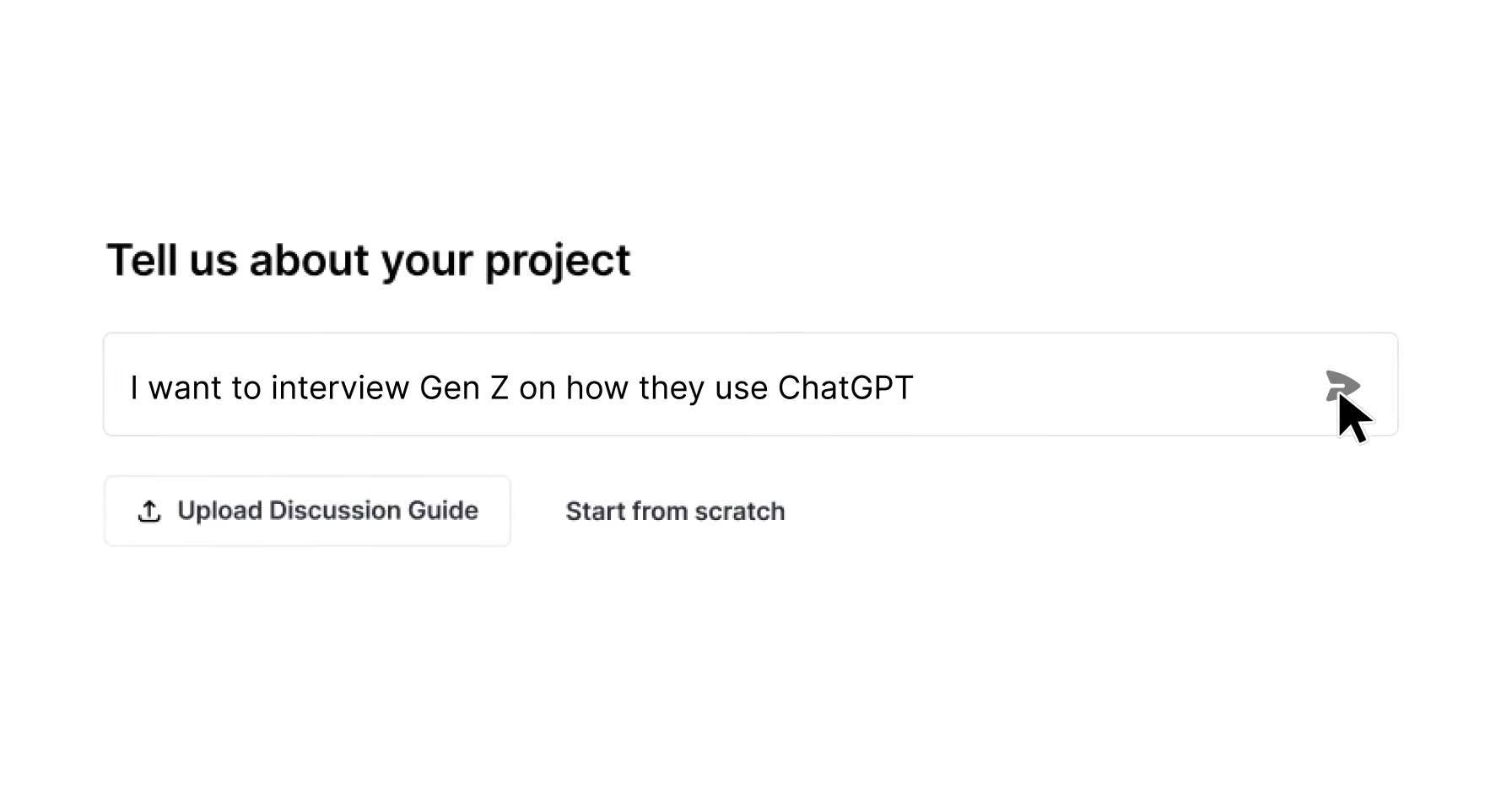
How to fix it: Teams need to define the decision first and the questions second. Listen Labs’ AI-assisted study co-design prompts teams to state the specific decision the research must inform before any questions are written. That structure keeps every prompt tied to a concrete choice, timeline, and stakeholder. Microsoft used this approach to collect global customer stories for its 50th anniversary in a single day and gave leadership stories they could act on immediately.
2. Targeting the Wrong Audience
Why it happens: Recruitment often defaults to whoever is easiest to reach. Teams rely on broad demographic filters instead of behavioral and intent signals. The result is a sample that looks correct on paper but does not reflect the actual decision-makers or consumers the business needs to understand.
Business cost: Research professionals frequently report difficulty accessing niche B2B audiences such as Fortune 500 executives or medical professionals. Insights built on the wrong sample cannot be rescued, no matter how advanced the analysis appears, because the underlying voices are misaligned with the business question.
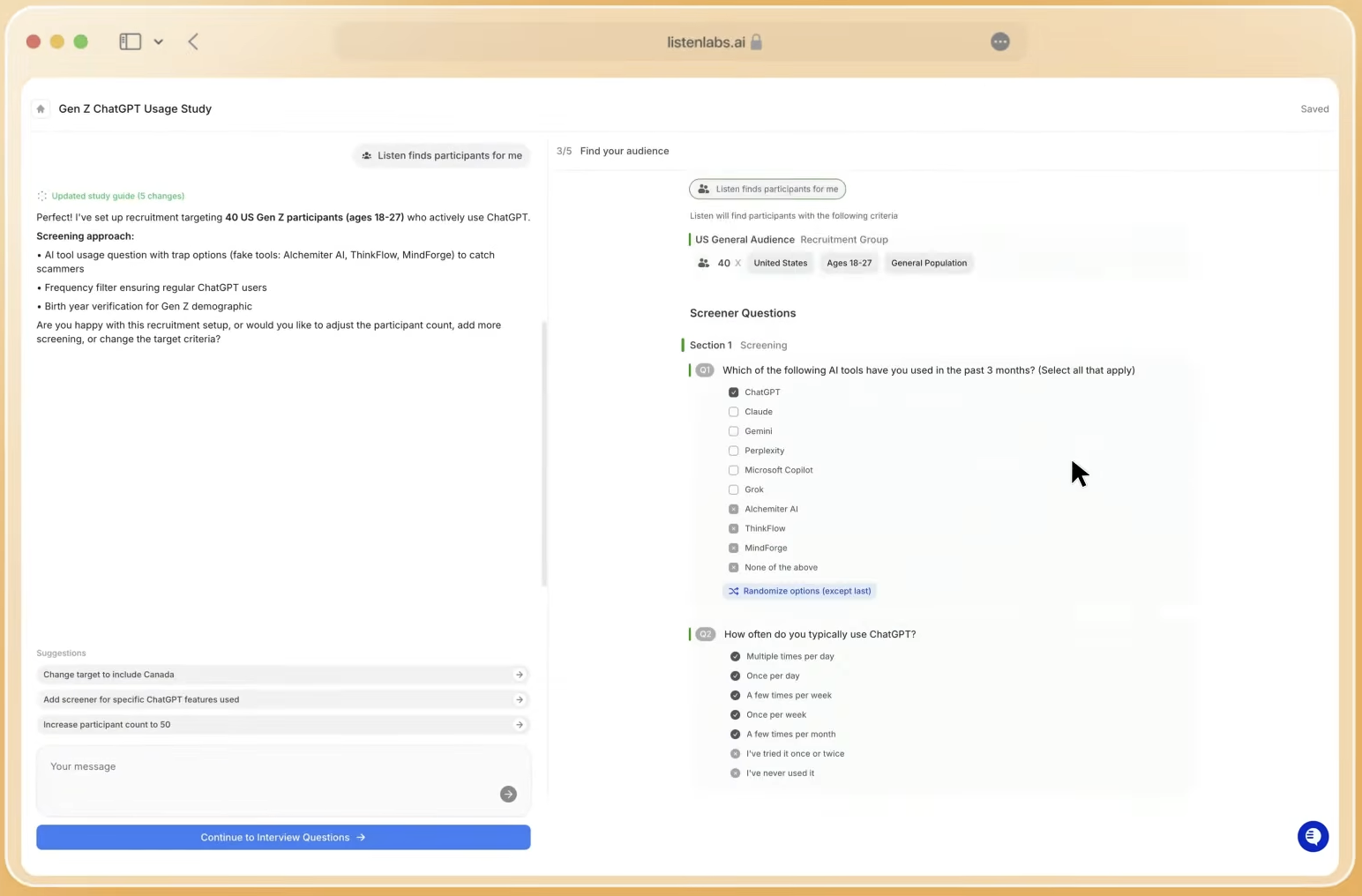
How to fix it: Recruitment must mirror real behavior, not just stated traits. Listen Atlas, the Listen Labs AI orchestration layer, matches participants on behavioral and intent data across a network of 30M verified respondents in 45+ countries, not just self-reported demographics. A dedicated recruitment operations team manages segments below 1% incidence rate and hard-to-reach professionals. P&G used this infrastructure to complete 250+ interviews with precise male consumer segments shaping a new product line and delivered quantified themes and verbatim proof directly to brand strategy teams.
3. Relying on Commodity Panels That Invite Fraud
Why it happens: Speed pressure pushes teams toward the largest, cheapest panels available. Those panels prioritize volume over quality, and the Global Data Quality Initiative 2025 found that 40% of research records are potentially problematic.
Business cost: Fraudulent or incentive-driven responses corrupt the entire dataset, rendering even sophisticated analysis meaningless. Decisions made on compromised data carry the same confidence as decisions made on no data at all, yet they often come with a false sense of rigor.
How to fix it: Quality controls must sit inside every session, not just at the panel level. Quality Guard monitors every Listen Labs interview in real time across video, voice, content, and device signals. Participants are capped at three studies per month, which removes professional survey-takers and reduces fatigue. Listen Labs avoids commodity quantitative panels and relies on curated, verified sources. Anthropic used this infrastructure to complete 300+ user interviews in 48 hours and surfaced churn drivers with a level of data integrity that compressed a process that previously took weeks into under two days.
See how Quality Guard protects your research from fraud and watch it work in real time.
4. Treating Depth and Scale as a Trade-Off
Why it happens: Traditional operations assume qualitative interviews must use small samples. Scheduling, moderating, and analyzing 200 one-on-one conversations with a human team is impractical. Teams default to surveys when they need scale and accept thin qualitative samples when they need depth.
Business cost: Qualitative methods compensate for limitations in speed and sample size through their ability to uncover nuance and complexity in human decision-making. That advantage only appears when sample sizes are large enough to reveal patterns across segments. Surveys at scale miss that nuance entirely, while small qual samples cannot support confident decisions for high-stakes bets.
How to fix it: Depth and scale need to operate together. With qual-at-scale, the old trade-off between depth and scale no longer blocks teams. Listen Labs conducts hundreds of AI-moderated video interviews simultaneously, with dynamic follow-up questions that adapt to each participant’s responses. Skims used this capability to qualify thousands of premium consumers overnight, test campaign direction before a global launch, and secure board-level buy-in without weeks of recruiting overhead.
5. Letting Confirmation Bias Shape Analysis
Why it happens: Human analysts bring hypotheses and organizational politics to the data. Executives often favor information that confirms pre-existing beliefs and resist independent research that would introduce objective consumer perspectives. Even well-intentioned analysts unconsciously weight findings that align with the team’s existing direction.
Business cost: Researchers spend most of their time in analysis: finding patterns, quantifying insights, testing significance, adding macro context, and formatting results for stakeholders who each need something different. When this work is manual, that time investment amplifies bias instead of correcting it, because analysts keep revisiting the same favored narratives.
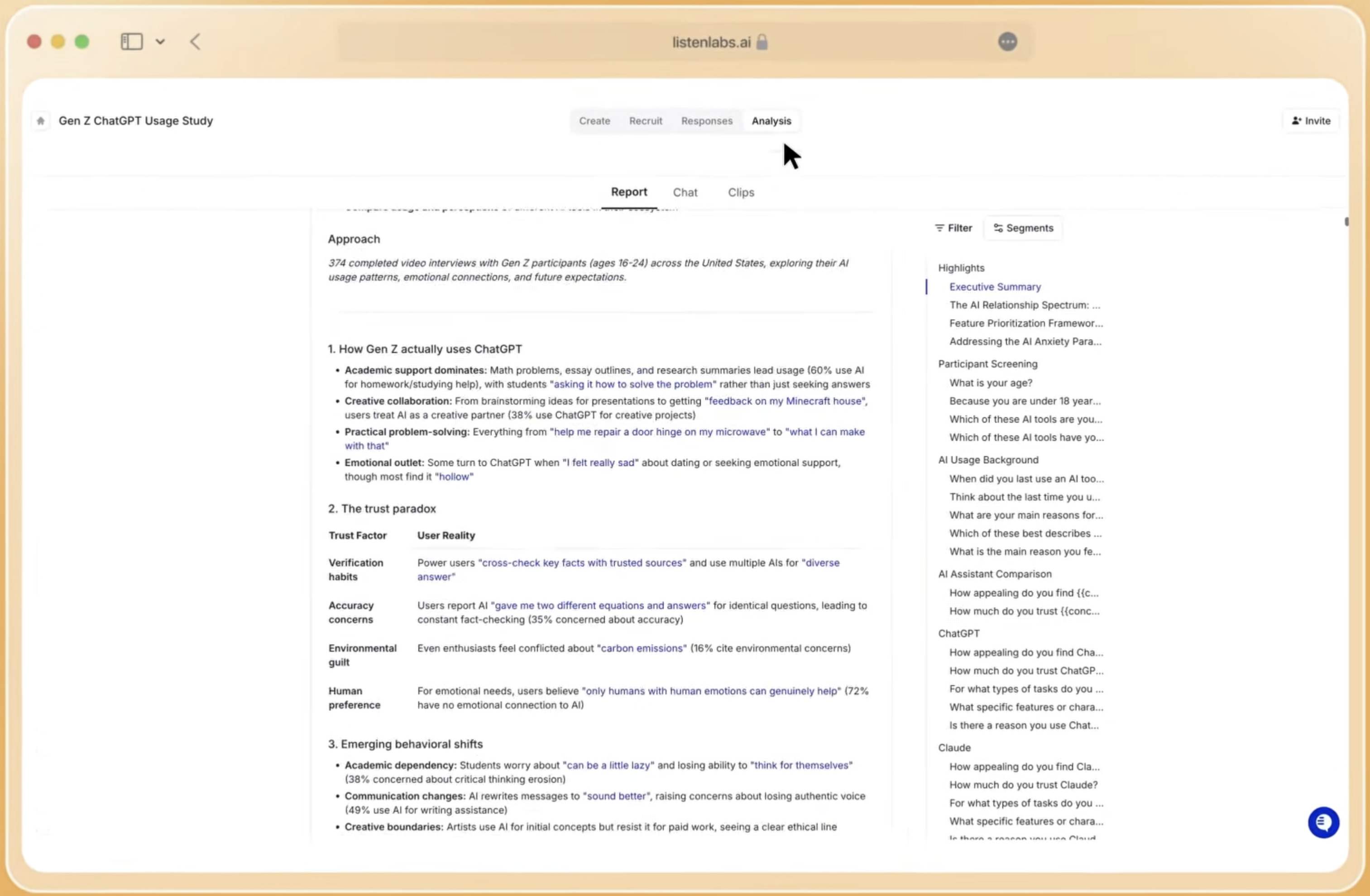
How to fix it: Teams need a neutral first pass through the data. Listen Labs’ Research Agent processes all interview data objectively and identifies themes and patterns across hundreds of responses without human preconception. One researcher ran a full buying intent analysis across three user segments in under a minute. Robinhood used the Research Agent to uncover that users who view prediction markets as entertainment, not income, drive 2.4× higher weekly re-engagement, a counterintuitive insight that human-led analysis had not surfaced.
6. Missing Emotional Signals in Interviews
Why it happens: Most research workflows capture transcripts and self-reported ratings only. Emotional signals such as hesitation, microexpressions of confusion, or a flattening vocal tone never enter the dataset because tools are not designed to detect them.
Business cost: Two concepts can receive identical positive ratings while triggering completely different emotional responses. Without emotional data, teams make creative, brand, and product decisions on incomplete evidence. The gap between what participants say and what they feel becomes a systematic blind spot in consumer insights work.
How to fix it: Emotional context needs to sit alongside rational responses. Listen Labs’ Emotional Intelligence layer analyzes tone of voice, word choice, and subconscious microexpressions across every interview. Built on Ekman’s universal emotions framework, the same standard used in clinical psychology, it quantifies emotions including joy, trust, surprise, fear, disgust, and anticipation per question and concept. Every label links to the exact timestamp, verbatim quote, and reasoning behind it. The layer works across 50+ languages and integrates directly with the Research Agent for natural-language queries and highlight reels of emotionally significant moments.
7. Running Research in Departmental Silos
Why it happens: Larger organizations commonly run isolated research projects, such as brand tracking by one team, ad testing by another, campaign tracking by the agency, and qualitative concept testing by the product team. Teams operate in sprints without cross-department communication, so insights rarely reach all relevant stakeholders.
Business cost: Data silos and fragmentation trap insights in departmental pockets and make it difficult to connect dots across disconnected tools and systems to identify patterns, even in organized businesses. Without access to prior findings, teams end up researching the same consumer questions repeatedly, each time starting from zero.
How to fix it: Organizations need a shared home for everything they learn from customers. Mission Control serves as that single source of truth for all studies. Cross-study queries return answers in seconds, and trend tracking shows how customer sentiment shifts over time. Each new study compounds the value of every previous one instead of existing in isolation.
8. Accepting Weeks-Long Research Cycles as Normal
Why it happens: The traditional consumer insights workflow is fragmented across multiple vendors. One manages recruitment, another handles scheduling, another moderates, another transcribes, and another analyzes. Each handoff introduces delay. Traditional focus groups alone take 3–5 weeks and $4,000–$12,000 per 90-minute session.
Business cost: A 4–6 week research cycle means insights arrive after the decision has already been made. In enterprise settings, internal prioritization and budget approval can stretch that timeline to six months. By that point, the business context has shifted and findings feel stale.
How to fix it: The entire workflow needs to sit on a single platform. Platforms like Listen Labs layer auto-recruiting, transcription, sentiment tagging, and insight summarization so teams move from question to findings in hours, not weeks. The full lifecycle, including study design, recruitment, AI-moderated interviews, analysis, and deliverables, completes in under 24 hours. The compressed timeline that enabled Anthropic’s churn analysis, 48 hours instead of weeks, shows how speed changes what research can accomplish.
9. Failing to Build Institutional Knowledge
Why it happens: Commissioning research reactively rather than strategically pushes teams toward ad-hoc studies that never connect into a cumulative foundation. Findings live in slide decks that nobody revisits and in the memories of researchers who eventually leave.
Business cost: Organizations repeatedly re-research the same questions because prior findings are inaccessible. Research investment does not compound. It resets with every new study, which keeps insight functions in a constant catch-up mode.
How to fix it: Research needs to behave like a living knowledge system. Mission Control functions as that system-wide knowledge base. Every completed study enriches the repository. Teams query past research in natural language and receive answers in seconds without digging through archived reports. Consumer sentiment, recurring pain points, and emerging needs become trackable over time instead of remaining isolated snapshots.
Frequently Asked Questions
How does Listen Labs maintain AI oversight while preserving research quality?
Listen Labs was built by researchers with 50+ years of combined in-house expertise. The methodology framework, including question design, probing logic, and analysis standards, was developed by that team and is continuously refined. AI-assisted study co-design flags issues in the study guide before launch. The Research Agent’s outputs link every insight back to the underlying response data, so teams can verify findings instead of accepting them at face value. The platform functions as a force multiplier for existing research teams, not a replacement for methodological judgment.
How does Listen Labs ensure participant quality at enterprise scale?
Three layers work together. Listen Labs avoids commodity quantitative panels and uses Listen Atlas, the AI orchestration layer, to match participants on behavioral and intent data across a curated network of 30M verified respondents. Quality Guard then monitors every interview in real time across video, voice, content, and device signals, detecting fraud, low-effort responses, AI-generated scripts, and mismatched profiles. A dedicated recruitment operations team adds a human review layer and manages hard-to-reach segments such as enterprise decision-makers, healthcare workers, and audiences below 1% incidence rate. Participants are limited to three studies per month to prevent panel fatigue.
What data-security standards does Listen Labs meet?
Listen Labs holds SOC 2 Type II, GDPR, ISO 27001, ISO 27701, and ISO 42001 certifications. All customer data is protected with 256-bit encryption and is never used to train AI models. Enterprise SSO is supported. These standards apply across all markets where Listen Labs operates, covering 45+ countries in the Americas, Europe, APAC, and MEA.
Can enterprises use their own participants with Listen Labs?
Yes. Listen Labs supports self-recruitment, which allows organizations to study their own customer base or user panel at a reduced credit cost. Enterprises can also bring their own panel provider. Teams commonly use this option for longitudinal studies, customer advisory programs, and research that requires participants with a prior relationship to the brand or product.
What study types does Listen Labs support?
Listen Labs supports concept and prototype testing, usability testing with screen sharing including mobile iOS recording, creative and ad testing, brand perception studies, consumer journey mapping, multi-market segmentation and localization studies, pricing research, and survey open-end analysis. Studies can run as free-flowing in-depth interviews, semi-structured conversations, diary studies, ethnographic sessions, or task-based UX tests. Mixed-methods formats that combine qualitative questions with Likert scales, NPS, sliders, MaxDiff, and branching logic are fully supported. The platform handles both one-off studies and ongoing continuous research programs.
Conclusion: Turning Research into a Compounding Asset
Each of the nine mistakes above reflects a structural issue, not a simple resource gap. Adding headcount or budget to a fragmented, slow, and biased research process only produces more of the same output. Listen Labs removes the structural causes: AI-assisted design prevents undirected studies, Quality Guard removes fraudulent samples, Emotional Intelligence recovers lost emotional signals, the Research Agent reduces biased analysis, and Mission Control turns isolated projects into shared knowledge. Together, these capabilities transform research from a bottleneck into a compounding strategic asset.
See how Listen Labs delivers consultant-quality consumer insights in under 24 hours.